




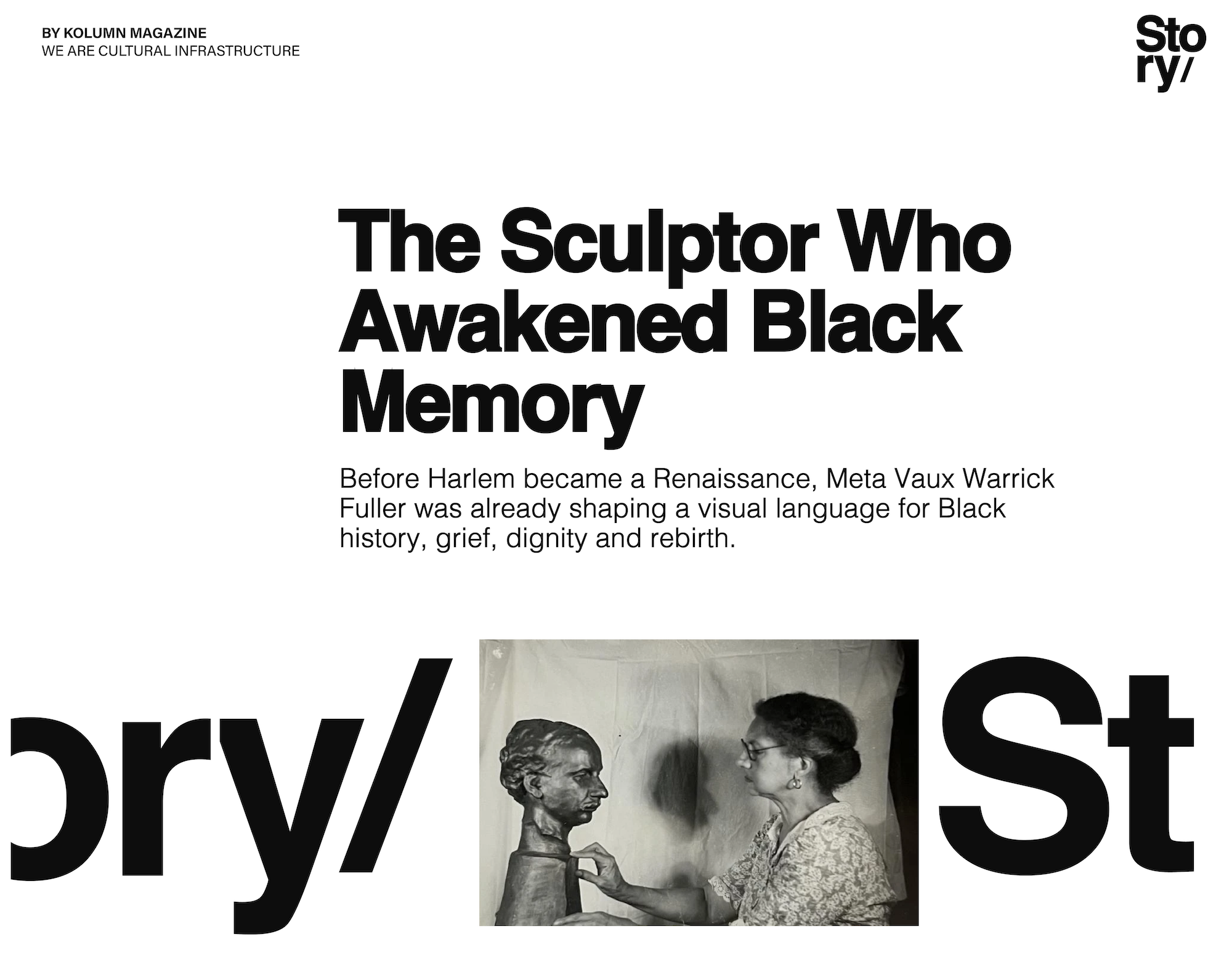
Fuller did not wait for America to make room for Black history. She carved, modeled and staged that history into public view.
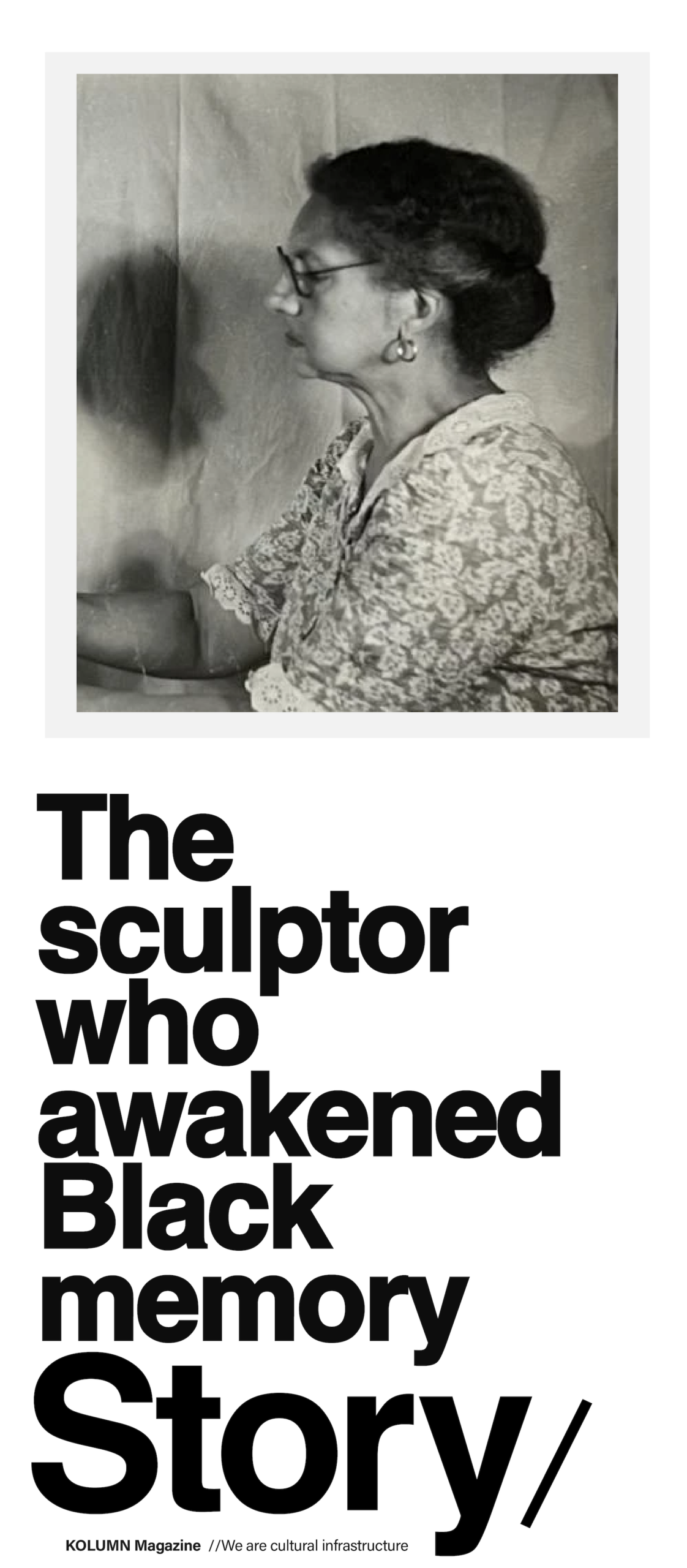
Fuller did not wait for America to make room for Black history. She carved, modeled and staged that history into public view.
By KOLUMN Magazine
There are artists whose reputations rise with the institutions that champion them, and there are artists whose reputations survive because the work refuses to disappear even when institutions look away. Meta Vaux Warrick Fuller belongs to the second category, one of the most consequential American sculptors of the early twentieth century and one of the least adequately understood by the broader public. She was internationally trained, admired in Paris, commissioned by W.E.B. Du Bois, and responsible for some of the earliest major sculptural representations of African American history and racial violence. Yet for much of the century after her most important work was made, Fuller’s name moved through American art history with the unstable status so often assigned to Black women artists: acknowledged by specialists, cherished by communities, preserved by family and local institutions, but rarely granted the centrality her career demands.
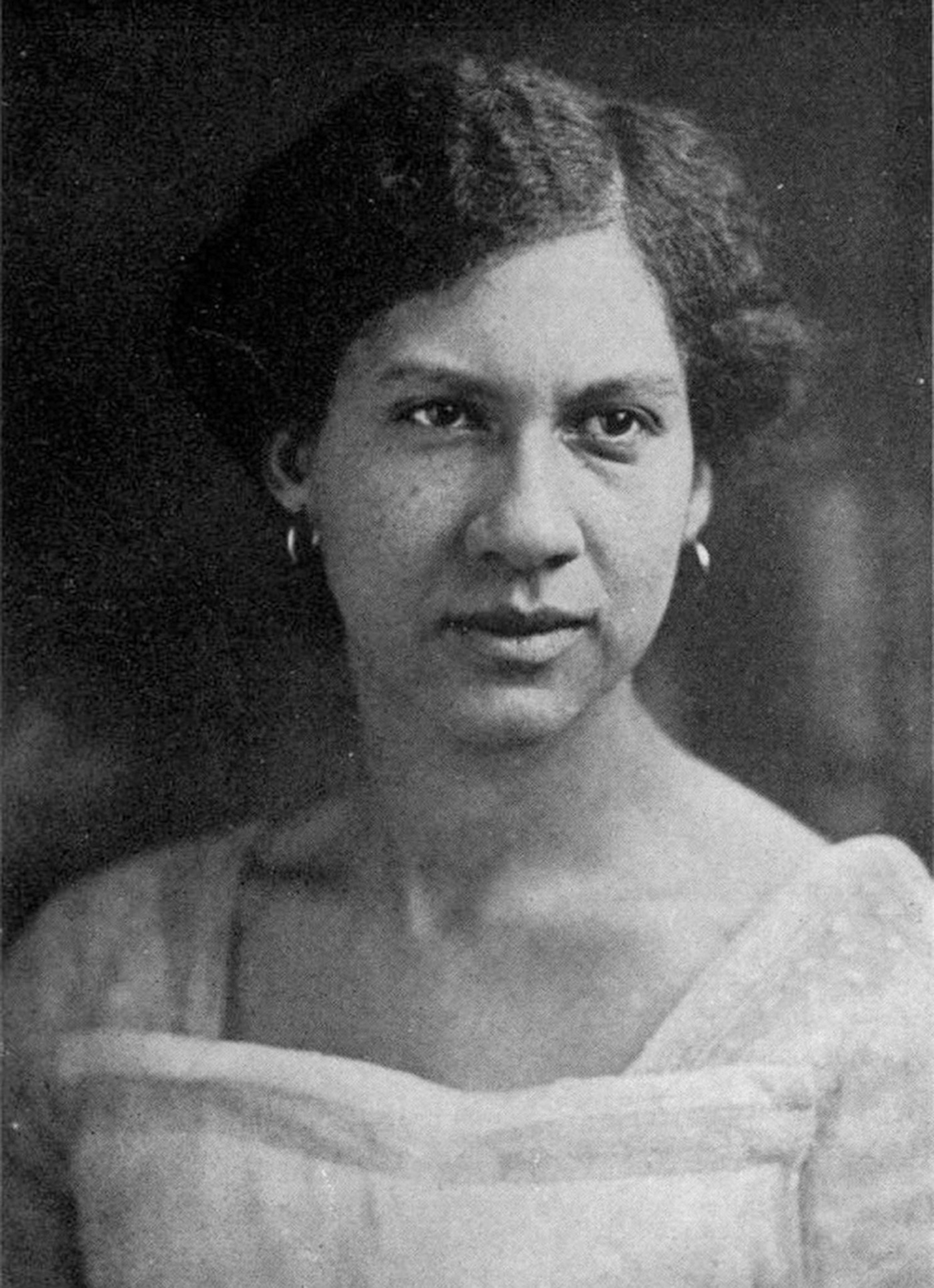
Fuller’s significance begins with the fact that she treated Black history as monumental before American museums, universities and public culture were prepared to do so. The Smithsonian National Museum of African American History and Culture describes her 1921 sculpture Ethiopia as a work commissioned for the America’s Making exposition, where Du Bois organized the “Americans of Negro Lineage” section to show African Americans as contributors to the nation rather than as marginal subjects within it. That context matters because Fuller was not simply making an elegant allegory. She was entering a public argument over who belonged inside the American story, and she did so by giving Black awakening a body, a posture, a face and an ancient lineage.
KOLUMN Magazine’s continuing coverage of Black visual culture has returned often to this central question of historical visibility. In its feature on Edmonia Lewis, KOLUMN examined how a nineteenth-century sculptor of African and Native descent challenged the boundaries of classical art from abroad, while its reporting on Augusta Savage considered how Black women built artistic infrastructure when institutions would not build it for them. Fuller belongs in that same lineage, but her position is singular: she stands between Lewis and Savage, between expatriate struggle and Harlem Renaissance institution-building, between the age of Reconstruction’s collapse and the rise of the New Negro movement. To understand Fuller is to understand that Black modernism did not appear suddenly in Harlem; it was modeled, argued, imagined and sculpted into being by artists who worked before the movement had a name.
A Philadelphia Beginning
Meta Vaux Warrick was born in Philadelphia in 1877, twelve years after the Civil War and at the edge of a historical betrayal. Reconstruction had promised political transformation, but by the time Fuller came of age, federal commitment to Black citizenship was weakening, white supremacist terror was expanding and Jim Crow was hardening into law and custom. Philadelphia offered a different landscape from the plantation South, yet it was not free of racism or gendered limits. The city’s Black middle class had built churches, schools, businesses and cultural networks that made ambition possible, and Fuller’s family gave her access to education and encouragement, but the world she entered still expected Black women to keep their aspirations within narrow boundaries.
Biographical accounts preserved by institutions including Columbia University’s Reid Hall emphasize that Fuller showed artistic promise early and later pursued sculpture with unusual seriousness, a choice that carried both aesthetic and social implications. Sculpture was expensive, physically demanding and professionally male-dominated. It required materials, studio access, anatomical study, exhibition networks and patrons willing to take an artist seriously. For a Black woman in the 1890s, every one of those requirements became an obstacle course. Fuller nevertheless trained at the Pennsylvania Museum and School of Industrial Art, now the University of the Arts, where her talent emerged in a setting that could teach technique but could not remove the structural barriers waiting beyond the classroom.
What distinguished Fuller from the beginning was not merely skill, but temperament. She was drawn to emotional intensity, spiritual struggle and psychological states that exceeded polite decorative expectation. Her early sculpture moved toward suffering, mortality and transformation, subjects that would later allow her to make Black historical experience visible without reducing it to illustration. Fuller was learning form, but she was also learning how bodies could carry ideas. That lesson would become the foundation of her mature work, where allegory, history and embodied grief converged.
Paris and the Discipline of Freedom
Fuller left for Paris in 1899, following a route taken by many American artists who understood that Europe could provide training and exposure unavailable at home. For Fuller, Paris was not simply an artistic capital; it was a reprieve from the racial restrictions of the United States, though not a fantasy of total equality. The city allowed her to study, exhibit and move through artistic circles with a degree of seriousness that American institutions often denied Black artists. Her years there placed her within a transatlantic artistic world shaped by Symbolism, Art Nouveau and the lingering force of academic sculpture, but also by the personal networks of Black expatriates seeking room to create beyond the American color line.
The Reid Hall account of Fuller’s Paris years frames her French period as both a story of artistic ambition and a story of resilience against racial and gender discrimination. In Paris, Fuller studied at the Académie Colarossi, an institution known for admitting women, and encountered an artistic environment in which expressive distortion, emotional intensity and symbolic meaning were not artistic liabilities. That mattered because Fuller’s imagination was never confined to surface likeness. Her sculptures sought the pressure beneath the face, the moral drama beneath the pose, the interior state made visible through the body.
During this period, Fuller also came into contact with Auguste Rodin, whose reputation as the great modern sculptor of emotional form has sometimes overshadowed the more complex story of her own development. The New York Public Library’s presentation of Ethiopia Awakening notes Rodin’s influence alongside that of Du Bois, but Fuller should not be understood as merely derivative of Rodin’s modernism. His example may have confirmed the expressive possibilities of sculpture, yet Fuller’s subject matter pushed her toward terrain that European modernism rarely confronted directly: the historical condition of Black people in the modern world, the politics of racial memory and the symbolic recovery of Africa as a source of dignity.
Equally important was Henry Ossawa Tanner, the great Black painter who had built a career in France after enduring discrimination in the United States. KOLUMN’s feature on Tanner’s life and artistic exile described him as an artist whose career exposed both American possibility and American refusal, and Fuller’s encounter with Tanner belongs to that same story. The presence of Tanner in Paris showed Fuller that international recognition could be possible for a Black American artist, but it also revealed the cost of pursuing artistic freedom beyond the nation that claimed citizenship while withholding equality.
Du Bois, Representation and the Demand for History
Fuller’s relationship with W.E.B. Du Bois gave her work an intellectual and political orientation that would prove decisive. Du Bois understood art as part of the struggle over representation, and he recognized that images could either reinforce racist fictions or dismantle them. In an age when popular culture trafficked in caricature and public memory erased Black achievement, the creation of dignified, historically grounded Black imagery was not ornamental work. It was political labor.
The National Museum of African American History and Culture notes that Du Bois commissioned Fuller’s Ethiopia for the America’s Making exposition, but that collaboration had deeper roots in a shared understanding of art’s civic function. Fuller’s sculpture did not simply accompany Du Bois’s ideas; it made them visible. Where Du Bois argued for Black historical consciousness in essays, exhibitions and editorial work, Fuller translated the argument into form. She gave racial awakening a body wrapped in the signs of antiquity, suggesting that Black modernity was not a break from the past but a reemergence from enforced historical sleep.
This is why Fuller’s work matters beyond biography. She helped invent a visual vocabulary for what would later be called the New Negro movement. Her sculptures insisted that Black people were not merely modern subjects seeking inclusion but heirs to civilizations, makers of history and witnesses to violence. In that sense, Fuller’s work anticipated the central drama of the Harlem Renaissance: the struggle to represent Black life as modern, ancestral, wounded, beautiful, intellectual and free.
Jamestown and the Counter-Memory of a Nation
In 1907, Fuller received one of the defining commissions of her career when she created a series of tableaux for the Jamestown Tercentennial Exposition. The project placed her inside the machinery of public commemoration at a moment when national memory was being shaped by white supremacist nostalgia, Lost Cause mythology and the narrowing of Black citizenship. Instead of accepting the marginal role assigned to African Americans in mainstream historical narratives, Fuller produced visual scenes that placed Black life within the nation’s development.
Historian W. Fitzhugh Brundage, writing for the Organization of American Historians, has treated Fuller’s Jamestown work as an intervention in public memory, noting the significance of a Black woman artist producing historical tableaux for a national exposition. The tableaux depicted African American progress across slavery, emancipation and post-emancipation life, offering viewers a counter-narrative to the degrading stereotypes that dominated much of American popular culture. Fuller’s scenes emphasized family, work, education, religious life and achievement, thereby refusing the idea that Black history could be reduced to bondage or dependency.
The commission’s significance becomes clearer when set against the political climate of the period. The early twentieth century was an era of disfranchisement, racial terror and legalized segregation, but it was also an era in which Black institutions, newspapers, educators and artists were building alternative archives of memory. Fuller’s tableaux belonged to that tradition. They functioned as public pedagogy, asking viewers to see Black Americans as historical agents rather than as objects of white narration. In that sense, Fuller’s Jamestown work was not only art; it was historiography staged in three dimensions.
Marriage, Loss and the Long Work of Making
The year 1907 also brought Fuller’s marriage to Dr. Solomon Carter Fuller, a pioneering Black psychiatrist whose medical work would become associated with early research on Alzheimer’s disease. Their household represented a remarkable convergence of Black intellectual achievement: science, medicine, art, literature, social thought and community responsibility all met within the rhythms of family life. Marriage did not remove the obstacles facing Fuller’s career, however. If anything, it placed her within the broader pattern experienced by many women artists, whose creative labor had to be negotiated against domestic expectation, motherhood and the limited institutional support available to women working outside the most privileged circles.
Then came the fire. In 1910, many of Fuller’s sculptures, molds and records were destroyed, a devastating loss for any artist and a particularly severe blow for one whose historical reputation would later depend on surviving evidence. The destruction helps explain why Fuller’s career has required such careful reconstruction by scholars and curators. When artworks disappear, so do stages of development, networks of influence and proof of ambition. For Black women artists, whose papers and works were already less likely to be preserved by major institutions, such losses can distort the historical record for generations.
Yet Fuller continued to work. That persistence should not be romanticized into a simple triumph-over-adversity narrative, because doing so risks minimizing the material realities she faced. Fuller’s career was shaped by exclusion, limited patronage, the fragility of archives and the racial politics of museum recognition. What matters is not that she overcame these conditions in some sentimental sense, but that she created despite them and that her surviving work demonstrates a sustained, intellectually rigorous artistic project. She returned again and again to the relationship between form and memory, making sculpture bear the weight of grief, racial violence, biblical symbolism, African heritage and historical awakening.
Ethiopia and the Image of Rebirth
Fuller’s Ethiopia, also known as Ethiopia Awakening, remains her most famous work because it condenses so many of her artistic and political concerns into a single figure. Made for the 1921 America’s Making exposition in New York, the sculpture depicts a woman emerging from mummy-like wrappings, her body both constrained and released, ancient and modern, still and expectant. The piece is often described as a visual embodiment of the New Negro movement, and the Smithsonian object record identifies it as widely considered the first Pan-Africanist artwork created in the United States.
That claim is enormous, and it should be understood carefully. Ethiopia was not merely a sculpture about Africa, nor was it simply an allegory of racial pride. It entered a political and cultural moment in which Black intellectuals were challenging colonial narratives that depicted Africa as primitive or historically empty. By invoking Egypt, mummification and awakening, Fuller gave African-descended people a symbolic relationship to antiquity, endurance and future possibility. The sculpture’s power lies in its refusal of rupture: the figure is not born from nothing, but emerges from a past that has been wrapped, hidden and misread.
The National Museum of African American History and Culture preserves Fuller’s own explanation that African Americans had “once made history” and were awakening after a long sleep, unwinding the “bandage” of a mummied past. That language reveals the sophistication of the work. Fuller was not depicting awakening as simple optimism. She was representing a people emerging from historical suppression, carrying both injury and inheritance. The figure’s “expectant but unafraid” posture makes the sculpture less a celebration than a threshold, an image of Black modernity at the moment it recognizes itself.
The influence of Ethiopia extended across Black visual culture. Loïs Mailou Jones’s later The Ascent of Ethiopia belongs to a related field of imagery in which Africa becomes a source of artistic ascent, diasporic connection and cultural authority. KOLUMN’s recent coverage of Black modernist lineages, including its feature on Stephanie Pogue and the artists orbiting Black abstraction and Howard University, shows how these visual inheritances continued to travel through generations. Fuller’s sculpture helped establish a grammar that later artists could revise, expand and contest.
Mary Turner and Sculpture as Protest
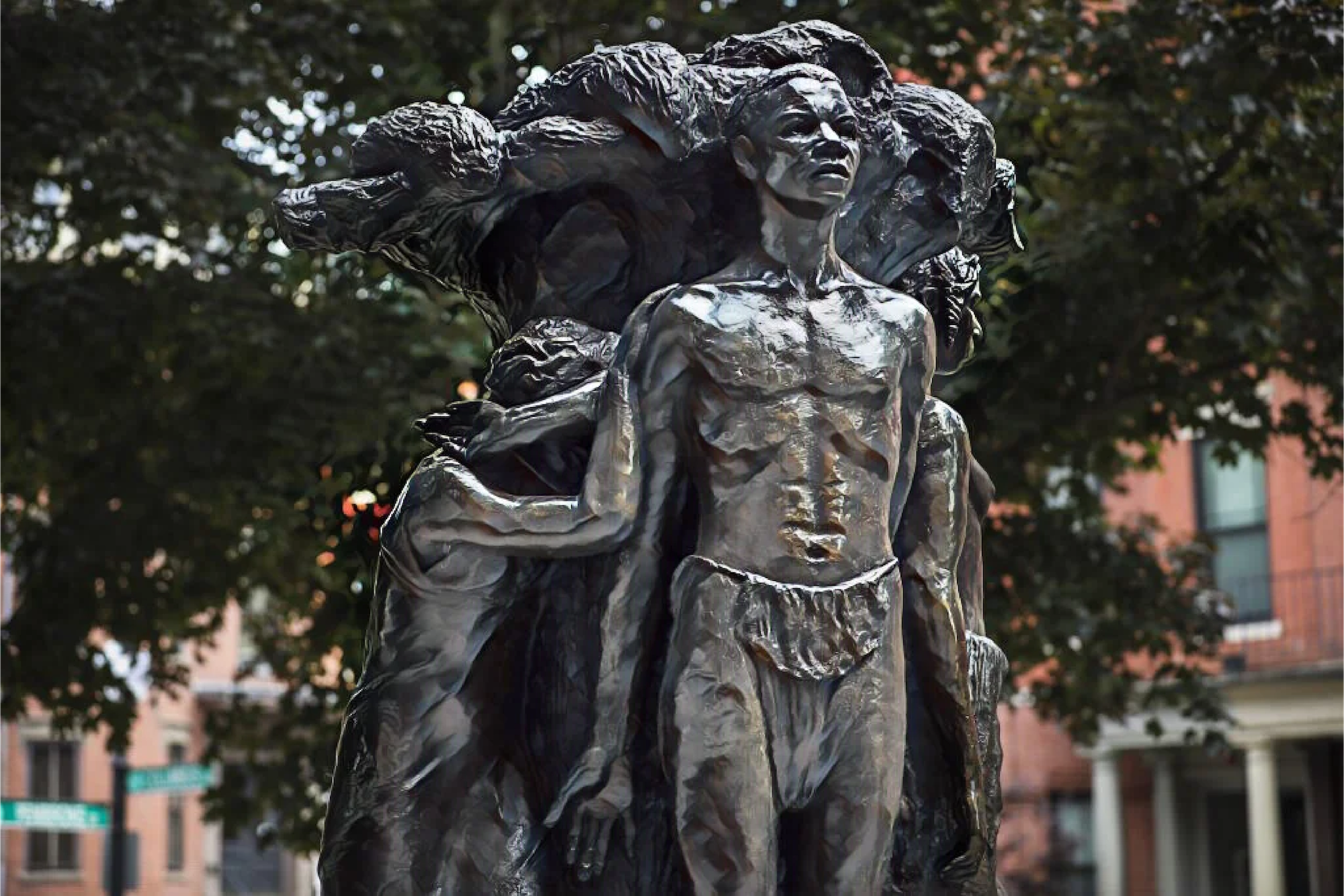
If Ethiopia represents awakening, Fuller’s In Memory of Mary Turner: As a Silent Protest Against Mob Violence represents witness. Created in 1919, the painted plaster sculpture responded to the 1918 lynching of Mary Turner in Georgia, one of the most horrific episodes of racial terror in American history. The work is among the earliest known sculptures by an African American artist to confront lynching directly, and Google Arts & Culture’s record of the sculpture identifies it as a work specifically depicting the brutality of lynch mobs.
Fuller’s decision to address Mary Turner through sculpture was extraordinary. Lynching was not only physical violence; it was a public ritual of racial domination, often staged before crowds, circulated through photographs and protected by legal impunity. To create a memorial object in response was to resist the machinery of erasure that allowed such crimes to become both spectacle and silence. Fuller’s title matters because it names memory and protest together. The work does not shout through monumentality. It insists through presence.
Contemporary scholarship has increasingly recognized the importance of this sculpture within the history of anti-lynching visual culture. In a study published by Nka: Journal of Contemporary African Art, scholar Caitlin Beach examines Fuller’s Mary Turner as a work tied to the memory of mob violence and the challenge of representing racial terror. This critical attention is essential because it moves Fuller beyond the category of inspirational pioneer and places her where she belongs: among artists who understood visual culture as a site of political testimony.
The sculpture also complicates familiar narratives about the Harlem Renaissance as an era of uplift, beauty and cultural celebration. Fuller’s work reminds us that Black artistic awakening occurred in the shadow of violence. Pride and grief were not opposites; they were historically entangled. The same artist who imagined Ethiopia unwinding the bandages of the past also memorialized a Black woman murdered by a mob. That range is precisely what makes Fuller indispensable. She saw Black life in its fullness, including its spiritual grandeur and its exposure to terror.
The Fuller Archive and the Work of Rediscovery
The recovery of Fuller’s reputation has depended heavily on archival labor. Because many of her works were lost, because some surviving pieces remained outside major museum circulation and because Black women artists were long underrepresented in art-historical institutions, Fuller’s legacy required reconstruction. This is where historiography becomes central to the story. Fuller was not simply forgotten by accident. She was marginalized through the combined effects of racism, sexism, archival fragility, institutional neglect and the narrow definitions of modernism that shaped twentieth-century art history.
Scholarship around Fuller has changed significantly over the past several decades. Renée Ater’s Remaking Race and History: The Sculpture of Meta Warrick Fuller has become a major reference point, and a Cambridge University Press roundtable on Ater’s book demonstrates the seriousness with which art historians have come to treat Fuller’s role in remaking race, public sculpture and historical representation. That scholarship matters because it does not merely add Fuller to an existing canon. It changes the questions the canon must answer.
More recent research has examined how Fuller managed her own image and archive. In Panorama, the journal of the Association of Historians of American Art, the essay “Asserting Agency: Meta Vaux Warrick Fuller’s Scrapbook” builds on Ater’s work by studying Fuller’s scrapbook and early career materials, including photographs of her studio and evidence of how she presented herself as a professional artist. The very title of that scholarship is instructive. Fuller was not only producing artworks; she was asserting agency over how her career might be seen, remembered and interpreted.
The Danforth Art Museum at Framingham State University has played a crucial role in preserving that legacy. Its Meta Vaux Warrick Fuller Collection includes maquettes, molds, painted plaster works and sculptures that make visible the breadth of Fuller’s practice, including Mother and Child (Sorrow), Negro Poet, Spirit of Emancipation, Menelik II in Profile and studies connected to Ethiopia Awakening. The collection is important not simply because it preserves objects, but because it allows viewers to see Fuller as an artist of process, experiment and sustained production rather than as the maker of one famous sculpture.
Fuller, Plaster and the Question of Permanence
One of the most important recent developments in Fuller scholarship involves renewed attention to her use of painted plaster. For generations, Western art hierarchies often privileged bronze, marble and other materials associated with permanence, monumentality and institutional prestige. Plaster could be treated as preparatory, temporary or lesser, even though many artists used it in complex and intentional ways. In Fuller’s case, this material history intersects with the racial and gender politics of preservation. What gets cast, collected and conserved is never neutral.
A 2025 essay in Nka: Journal of Contemporary African Art examines the permanence of Fuller’s painted plaster works and situates her material practice within a longer academic tradition. This matters because it challenges the assumption that Fuller’s plaster sculptures should be understood primarily as substitutes for unrealized bronze monuments. Instead, her painted surfaces, scale choices and process pieces can be read as part of an intentional artistic language shaped by training, circumstance and expressive purpose.
The question of material permanence also opens onto a larger question about Black art history. Many Black artists worked with limited resources, outside the patronage systems that allowed white artists to translate models into monumental public commissions. If art history values only the final bronze monument, it risks misunderstanding artists whose most radical work survived in plaster, paper, print, textile, photograph or community memory. Fuller’s legacy forces a more honest standard. Permanence is not only a property of material. It is also a function of cultural will.
Fuller and the Harlem Renaissance Before Harlem
Fuller is often called a forerunner of the Harlem Renaissance, but that phrase can understate her importance. A forerunner merely arrives early. Fuller helped create the conditions that made the movement visually imaginable. By the time Harlem became a shorthand for Black artistic modernity, Fuller had already developed a language of African reclamation, racial protest, historical tableau and symbolic rebirth. She was not waiting for the Renaissance; she was building its visual foundations.
The New York Public Library places Ethiopia Awakening within the cultural world of Du Bois, Rodin and the America’s Making exposition, a constellation that shows how Fuller moved across artistic, political and institutional networks before the Harlem Renaissance became a fixed chapter in textbooks. Her work complicates any clean division between pre-Renaissance and Renaissance art. It reveals continuity rather than sudden eruption, preparation rather than miracle.
This point aligns with KOLUMN’s broader coverage of Black art history, especially its reporting on David Driskell and the long argument for Black memory. Driskell’s landmark work demonstrated that Black American art had a deep, continuous history that could not be reduced to isolated moments of recognition. Fuller’s career proves the same point from an earlier vantage. She shows that the Harlem Renaissance was not the beginning of Black artistic modernity, but one of its public arrivals.
Why Fuller Matters Now
Fuller’s work speaks urgently to the present because Americans are still fighting over monuments, memory and historical truth. Debates over public statues, museum collections, school curricula and reparative interpretation all return to questions Fuller confronted more than a century ago. Who is allowed to represent history? Whose suffering is memorialized? Whose achievements are made visible? Whose past is treated as civilization, and whose past is treated as absence?
The renewed attention to Fuller is therefore not simply an act of recovery. It is a correction of the frameworks that made her recovery necessary. When the Smithsonian’s Searchable Museum presents Ethiopia as a work using Pan-Africanist imagery to represent the New Negro movement, it is also acknowledging that Fuller’s art belongs at the center of national conversations about Black consciousness and cultural heritage. Her sculpture is not a supporting illustration for a historical period. It is one of the period’s defining statements.
Fuller died in 1968, a year now remembered for national rupture, assassination, uprising and grief. By then she had lived through Reconstruction’s aftermath, Jim Crow’s consolidation, the Great Migration, the Harlem Renaissance, two world wars, the rise of modern civil rights activism and the beginning of the Black Arts era. Across that long life, she made work that insisted Black people were not historical afterthoughts. They were makers of civilization, witnesses to terror, bearers of beauty and authors of modernity.
Her legacy requires more than admiration. It requires reclassification. Meta Vaux Warrick Fuller should not be treated merely as an overlooked Black woman sculptor who deserves inclusion in a more diverse canon. She should be understood as one of the artists who forces the canon to change shape. Her work makes clear that American sculpture cannot be fully understood without racial history, that modernism cannot be fully understood without Black internationalism, and that public memory cannot be fully understood without the artists who challenged official forgetting.
The nation has often been late to the artists who told it the truth too early. Fuller was one of them. She sculpted awakening before America could bear to see itself asleep, and she modeled Black history at a time when the country preferred caricature, silence or erasure. More than a century after Ethiopia emerged from its bandages, Fuller’s work continues to ask whether America is finally prepared to look directly at the history she gave form.
More great stories
Afro Sheen, Wall Street, and the Architecture of Black Possibility
July 6, 2026
No Comments
The Fire Inside the Fourth
July 5, 2026
No Comments