


Pogue’s beauty was never ornamental in the shallow sense. It was structure, argument, inheritance, and refusal.
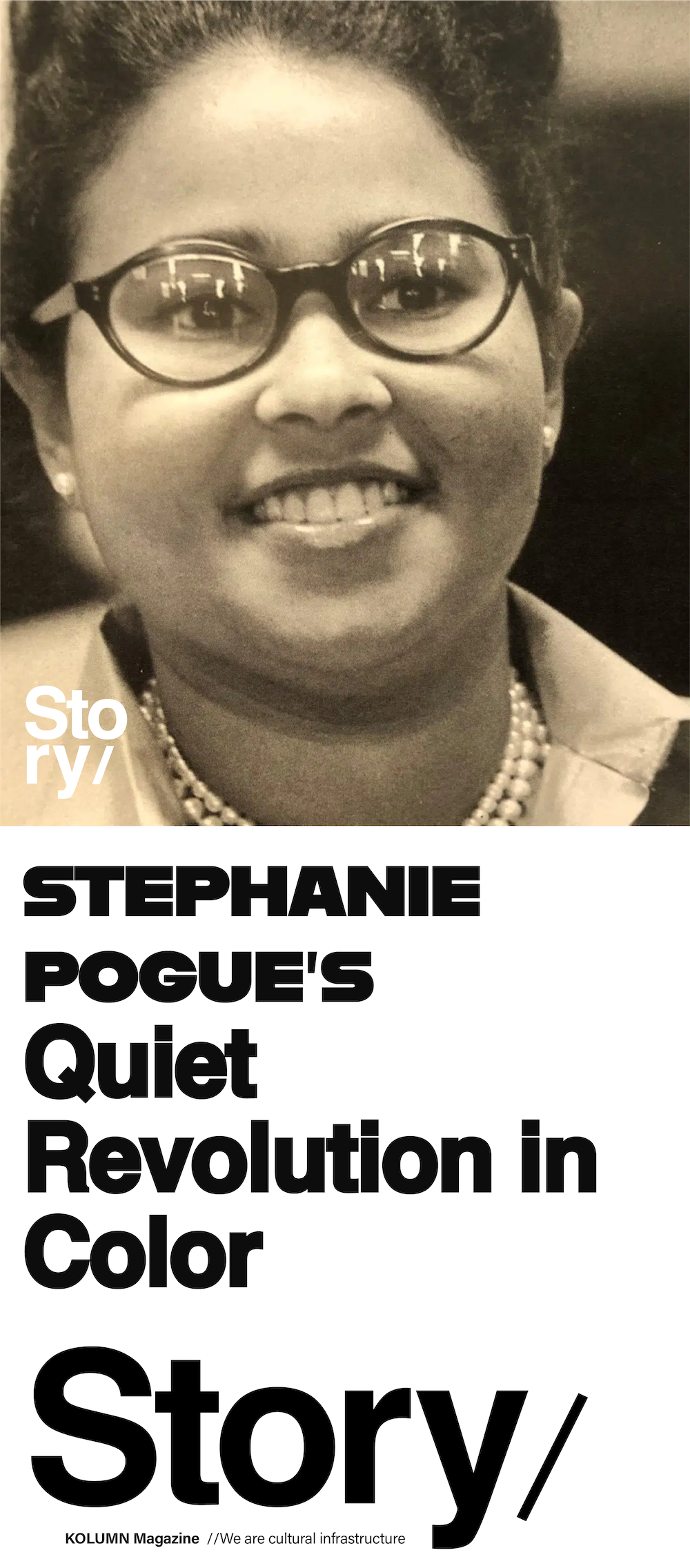
Pogue’s beauty was never ornamental in the shallow sense. It was structure, argument, inheritance, and refusal.
By KOLUMN Magazine
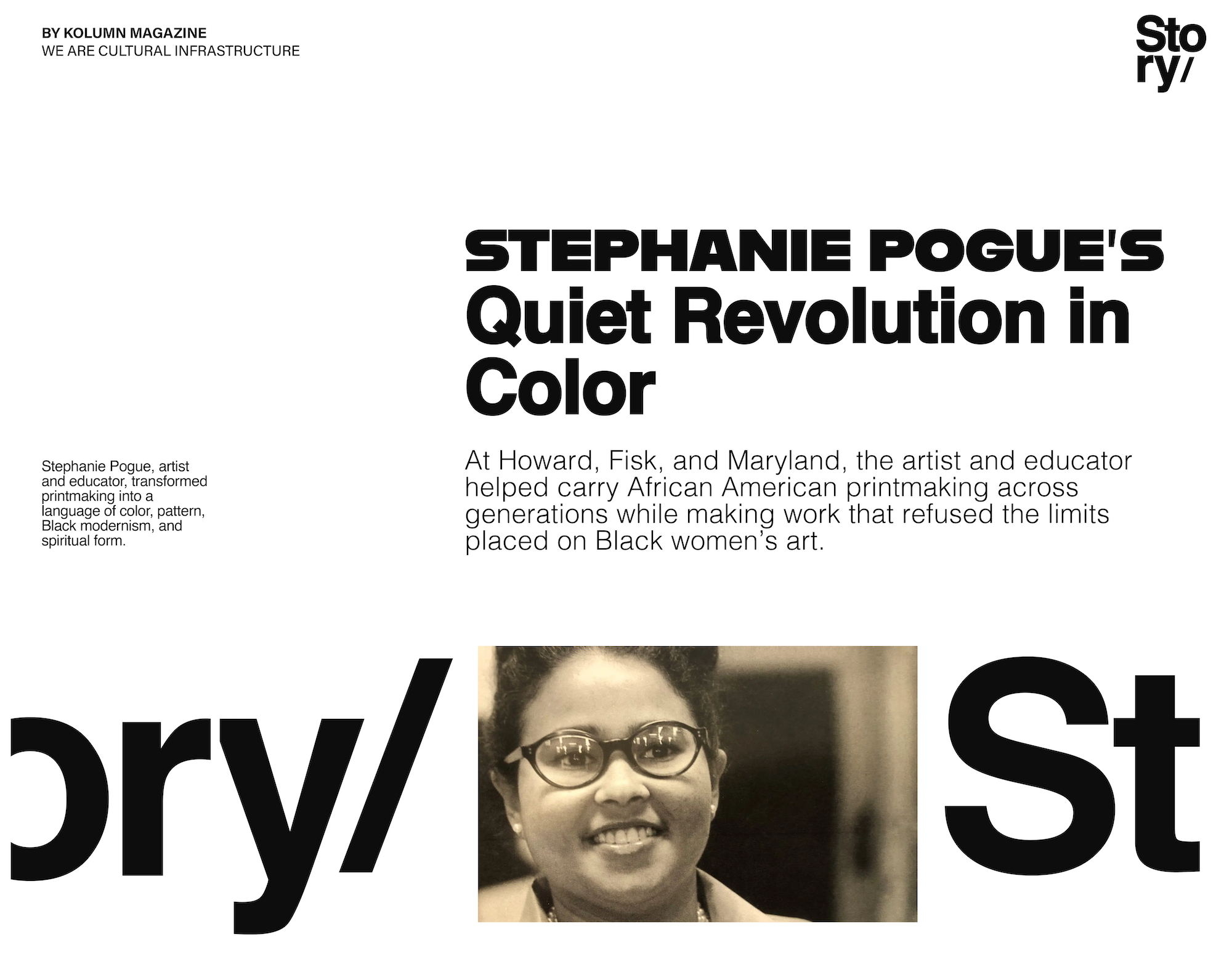
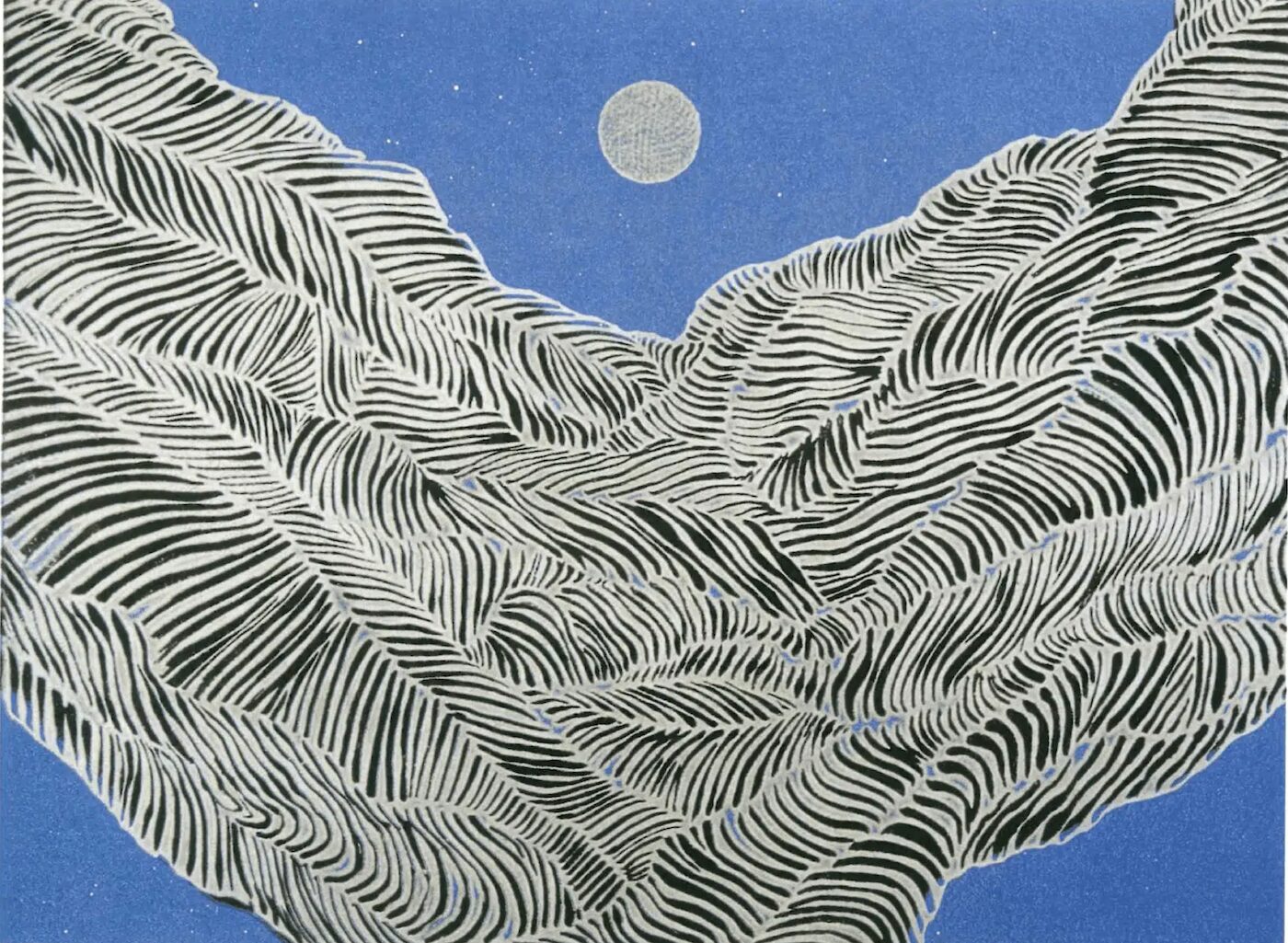
Stephanie Elaine Pogue’s art does not announce itself with spectacle. It gathers. It curls into arabesque. It opens in color. It repeats, not as decoration alone, but as a form of thought. A line bends. A body appears and disappears. A floral shape becomes a spiritual proposition. A woman’s form becomes both universal and particular. In the best of her prints, beauty is not an escape from history; it is the method by which history is survived, revised, and made visible.
Pogue, born in Shelby, North Carolina, in 1944 and raised in Elizabeth, New Jersey, became one of the most accomplished African American printmakers and educators of the late twentieth century. She studied at Howard University, trained at Cranbrook Academy of Art, taught for more than a decade at Fisk University, and later became a professor and department chair at the University of Maryland. Yet her name remains less widely known than many of the artists around her — David C. Driskell, Lois Mailou Jones, Aaron Douglas, Elizabeth Catlett, Lou Stovall, Sylvia Snowden — even though her career moved through the same vital corridors of Black modernism, feminist art, postwar abstraction, and institutional Black art history.
That gap is part of the story. Pogue’s significance rests not only in the prints she made, but in the artistic ecosystems she helped sustain. At Howard, she was shaped by a faculty that had already begun writing African American art into the canon. At Fisk, she worked in the shadow and presence of Aaron Douglas, the great visual architect of the Harlem Renaissance. At Maryland, she trained younger artists while expanding the language of color etching, drawing, and papermaking. The David C. Driskell Center later described her as an “internationally acclaimed printmaker, educator and beloved member” of the University of Maryland community when it mounted Arabesque: The Art of Stephanie E. Pogue, the first retrospective exhibition of her prints, in 2008, six years after her death, featuring forty works and surveying four decades of artmaking at the Driskell Center.
The retrospective’s title, Arabesque, was apt. Pogue’s mature work frequently embraced curving lines, botanical motifs, radiant color, and patterned surfaces. But the word also suggests a deeper truth about her career: she moved through institutions and traditions by bending them. She did not fit neatly into one movement. The Driskell Center noted that her work intersected with Pattern and Decoration, feminist art of the 1970s, and postmodernist sensibilities of the 1990s in its exhibition description. Yet she remained deeply connected to Black art history, especially the Howard-to-Fisk lineage that carried African American visual culture from the New Negro era into the late twentieth century.
In that sense, Pogue belongs beside the artists KOLUMN has recently revisited in its ongoing attention to Black cultural memory — figures such as Jefferson Pinder, whose performance-based art tests the body against history, and Ronald L. Fair, whose literature insisted that Black interior life was central to American truth. Pogue’s medium was different, quieter, more exacting. But her project was similarly expansive: to insist that Black form, Black womanhood, and Black intellectual labor could occupy the full field of American art.
A Black girl in motion
Pogue’s early life contained the seeds of her later practice: movement, discipline, beauty, and displacement. She was born in the South but grew up in New Jersey, where she developed an interest in art, ballet, and music. That triad matters. Her prints often feel choreographic. Forms lean, recur, overlap. The female figure is not simply drawn; it is staged in motion, in relationship to pattern and atmosphere. Even when still, the body appears to remember dance.
Her first stop in higher education was Syracuse University, where she felt isolated as a Black student. Accounts of her life note that she was the only Black student in a dormitory of roughly 250 students, an experience that sharpened her awareness of racial solitude inside elite academic spaces. While there, she took a life-drawing class for non-majors — a seemingly incidental choice that became decisive. After a year, she transferred to Howard University, where her education changed from mere training into inheritance.
Howard in the 1960s was not simply a university with an art department. It was one of the principal laboratories of African American art history. The Howard tradition had already been shaped by James V. Herring, James A. Porter, Alain Locke, Lois Mailou Jones, and James Lesesne Wells. Porter, whose 1943 book Modern Negro Art became a foundational text in the field, helped establish that African American art was not marginal craft or sociological evidence, but a rigorous historical field. Jones brought a cosmopolitan Black modernism that moved between Washington, Paris, Haiti, and Africa. Wells carried the graphic force of printmaking and design. Driskell, who would become one of the leading curators and scholars of African American art, was part of this intellectual environment.
At Howard, Pogue received her B.F.A. in 1966 and was mentored by Driskell, according to Howard University’s James A. Porter Gallery, which also notes that she later earned her M.F.A. in printmaking at Cranbrook Academy of Art in 1968 through its gallery materials. The same Howard account places Pogue in direct continuity with Fisk and Aaron Douglas, observing that Douglas’s use of color and overlapping shapes can be seen reflected in her work in the gallery’s profile.
That lineage is critical. It means Pogue entered the art world not as an isolated talent but as part of a Black pedagogical chain. One generation made the argument that African American art existed as art. The next generation proved how many languages it could speak.
Howard, Cranbrook, and the seriousness of the press
Printmaking is a demanding art. It asks the artist to think backward, in layers, through pressure, surface, chemistry, reversal, and sequence. It is intimate but indirect. The final image is not made by the hand alone but by a disciplined collaboration among plate, ink, paper, and press. For Black artists, printmaking has also carried a democratic charge. Prints can circulate. They can enter homes, schools, libraries, and community institutions. They resist the singularity and exclusivity of the one-of-one object.
Pogue’s commitment to printmaking placed her in a broad African American graphic tradition that includes Elizabeth Catlett, Hale Woodruff, Charles White, James Lesesne Wells, Robert Blackburn, Margaret Burroughs, Mavis Pusey, and Lou Stovall. But Pogue’s own approach grew increasingly lyrical. Her work used the technical possibilities of etching and color viscosity to build surfaces that seemed to pulse.
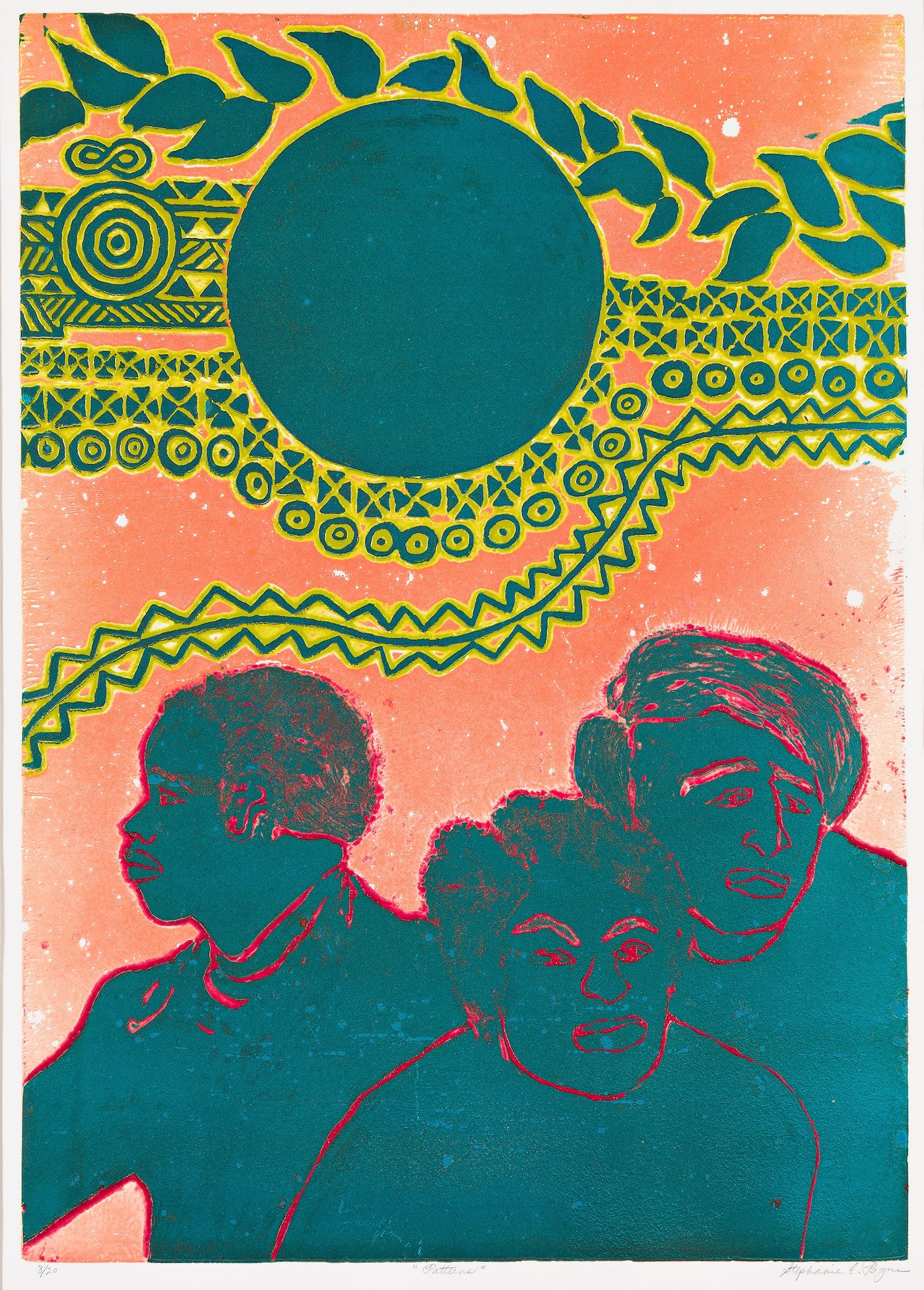
Color viscosity etching, the technique for which she became especially known, allows multiple colors to be applied to a single plate by exploiting the viscosity — or thickness and resistance — of inks. It is a sophisticated method, requiring knowledge of how inks repel or accept one another depending on density and application. In Pogue’s hands, the process produced images that felt layered, dimensional, almost atmospheric. The Driskell Center wrote that she “mastered the technique of color viscosity etching,” creating “multidimensional surfaces in vivid colors” in its event description.
That mastery did not come from instinct alone. After Howard, Pogue went to Cranbrook Academy of Art in Bloomfield Hills, Michigan, one of the country’s most important graduate art institutions. Cranbrook’s modernist legacy emphasized experimentation across craft, design, architecture, and fine art. Pogue’s training there helped refine the formal rigor that would remain visible in her prints: strong composition, disciplined surface, a sensitivity to geometric structure, and a willingness to let craft carry conceptual force.
By 1969, her work already showed technical ambition. Untitled Composition, an original deep etching in colors printed on handmade paper, was published in a limited edition of 200, and art-market documentation describes it as an “accomplished, early example” of her art through Art of the Print. The work’s medium and edition details underscore how early Pogue was pursuing the print not as reproduction but as original art — a field of experimentation in its own right.
Fisk and the long shadow of Aaron Douglas
In 1968, after completing her M.F.A., Pogue joined the faculty at Fisk University in Nashville. Fisk was more than an academic appointment. It was another node in the Black institutional network that made African American art history possible. The university had been central to Black education since Reconstruction, and its art collection and faculty connections linked it to the Harlem Renaissance, modernist muralism, and the preservation of Black cultural production.
At Fisk, Pogue taught printmaking, drawing, and art appreciation. She also served as a gallery director. The position placed her in proximity to Aaron Douglas, who had joined Fisk decades earlier after becoming one of the defining artists of the Harlem Renaissance. Douglas’s murals, with their concentric circles, silhouetted figures, Africanist motifs, and sweeping historical arcs, gave visual form to Black modern destiny. Pogue’s work is not derivative of Douglas, but the influence is legible: overlapping shapes, decorative power, flattened space, and color as architecture.
Howard’s James A. Porter Gallery explicitly connects Pogue’s Fisk years to Douglas’s influence, noting that after graduation she worked at Fisk with Aaron Douglas and that his “use of color and overlapping shapes is reflected in Pogue’s work” in its account of her career. Auction records and art-market descriptions also preserve an important detail: Pogue worked with Douglas as a printmaker, helping reprint several of his images later in his life, including works associated with Emperor Jones, The Junkman, and The Window Shopper as noted in auction documentation.
That relationship makes Pogue a custodian as well as a creator. She did not merely inherit a tradition; she helped physically carry it forward. To reprint Douglas was to touch the matrix of Black modernism, to renew images from a prior era through the pressure and care of a later one. In a field where Black artists have often had to preserve one another against institutional neglect, such labor is never secondary. It is part of the art history.
The Fisk years were also years of exhibition. Pogue’s work traveled through museum, university, and gallery spaces at a time when Black artists were pressing against the exclusions of mainstream American art. Her first exhibition took place at Fisk in 1966, and by the 1970s and 1980s her work had appeared in venues including the Metropolitan Museum of Art, El Museo de Arte Moderno in Cali, Colombia, Cinque Gallery in New York, the Taipei City Museum of Fine Arts, and later international venues in Belgium and Brazil, according to Art of the Print’s biographical summary of her exhibition history.
The 1970s: Black art, feminist art, and the politics of pattern
To understand Pogue’s art, one must understand the historiographical tension around the 1970s. For decades, scholarship on African American art often privileged figuration, protest imagery, social realism, mural traditions, and explicit racial iconography. Those modes were essential, especially in the long struggle against racist caricature and erasure. But they also narrowed the public expectation of what Black art was supposed to look like. If a Black artist made work that was abstract, decorative, spiritual, erotic, formal, or interior, critics sometimes treated that art as less politically legible.
Pogue’s career complicates that framework. Her work was deeply informed by Black art history, but it did not always announce race through narrative imagery. It often moved through pattern, color, female form, nature, and spirituality. The Driskell Center described her images as “a meditation on beauty, color and spirituality,” with the female body, nature, and ornament forming “the core of her imagery” in the 2008 retrospective release. That language matters because it refuses the old binary between beauty and politics.
The Pattern and Decoration movement, which emerged in the 1970s, challenged modernist hierarchies that dismissed ornament as feminine, domestic, non-Western, or craft-based. Artists associated with the movement turned to textiles, Islamic design, mosaics, wallpaper, quilts, and other decorative traditions to contest the austerity of high modernism. For women artists and artists of color, pattern could become a critique of the canon itself. It asked: Who decided that the grid was serious but the floral motif was minor? Who decided that ornament was excess? Who decided that beauty was intellectually weak?
Pogue’s work intersects this debate, but from a distinct Black feminist position. She was not simply importing decoration into fine art. She was working from within African diasporic, Asian, Islamic, and women-centered visual languages. Her Fulbright-Hays fellowships took her to India and Pakistan, where she studied architecture and traditional arts and crafts — experiences that affected her imagery and strengthened her interest in Eastern themes and motifs. The Driskell Center’s exhibition text notes her interest in “nature, spirituality and Eastern themes and motifs” in discussing her work.
This is where historiography becomes essential. Earlier narratives of American modernism often treated abstraction as a largely white, male, Euro-American achievement. Later scholarship — including the work of curators and historians such as David Driskell, Lowery Stokes Sims, Kellie Jones, Adrienne Childs, Elsa Barkley Brown, and others — has insisted on a fuller account, one that recognizes how Black artists negotiated modernism without surrendering history, identity, or community. Pogue’s work belongs to that corrective tradition. It asks viewers to see Black abstraction not as withdrawal, but as another mode of presence.
The female body as universal and particular
Throughout her career, Pogue returned to the female body. She did so not as spectacle, not as academic exercise, and not as simple self-portraiture, but as a recurring field of inquiry. The Driskell Center observed that she revisited “the theme of the female body as universal and particular” in its exhibition description. That phrase is useful because it captures the double movement in her art. The body in Pogue’s prints can seem archetypal — goddess, dancer, vessel, curve, rhythm — while still insisting on the specificity of Black womanhood and the artist’s own interior life.
In American art history, Black women’s bodies have been overexposed and underseen. They have been exploited as laboring bodies, sexualized bodies, ethnographic bodies, caricatured bodies, and political symbols. Pogue’s art does something quieter and more radical: it restores the Black female form to contemplation. Her figures are not there to explain oppression to the viewer. They are there to inhabit beauty, complexity, spirit, and design.
This is why Pogue’s work should be read alongside, but not collapsed into, feminist art of the 1970s. White feminist art often centered the female body as a site of reclamation from patriarchal visual culture. Black feminist art had to contend with that and more: race, stereotype, class, respectability, invisibility, and the burden of representation. Pogue’s female figures are not slogans. They are meditations. They move between selfhood and symbol. They suggest that the Black woman artist’s interior life is not ancillary to liberation; it is one of its conditions.
Her engagement with ornament reinforces this point. The arabesque line, the floral motif, the patterned field — these elements can be read as spaces of protection and expansion around the body. They refuse the isolation of the figure. They place the body inside a cosmos of relation. In Pogue’s prints, the woman is not extracted from the world; she is continuous with it.
Maryland and the labor of institution-building
In 1981, Pogue left Fisk for the University of Maryland, College Park, where she taught printmaking and drawing in the Department of Art. She later served as department chair from 1993 to 1998, according to the Driskell Center in its retrospective announcement. Howard’s James A. Porter Gallery also notes that she became chair of Maryland’s Department of Art in 1993 and later returned as professor and gallery director until her death in 2002 in its biographical text.
University labor is often invisible in artist biographies. Exhibitions and collections receive attention; teaching is treated as background. But for Black women artists, teaching has frequently been a primary site of cultural transmission. Pogue’s classrooms were part of her legacy. She trained students in technique, but also in the seriousness of looking, making, and sustaining a practice. She entered Maryland before the Driskell Center was founded, but her career helped prepare the institutional ground from which such a center could emerge.
The Driskell Center itself, established in 2001, describes its mission as preserving, documenting, and presenting African American art and culture while providing “an intellectual home for artists, museum professionals, art administrators, and scholars of color” in its institutional description. Pogue’s life intersected directly with that mission. Her mentor, David Driskell, became the center’s namesake. Her retrospective became one of its acts of recovery. Her work embodied precisely the kind of African diasporic visual culture the center was built to protect.
The 2008 retrospective also had a community dimension. In conjunction with Arabesque, the Driskell Center collaborated with Art Enables, a Washington, D.C., arts program for adults with developmental and mental disabilities, inviting participating artists to respond to Pogue’s images and create new works as described by the center. That detail feels consonant with Pogue’s career. Her art did not remain sealed in the museum. It became a prompt, an opening, a shared visual language.
The expert voices that restored her frame
The scholarship around Pogue remains thinner than it should be, but the experts who have addressed her work have pointed toward its breadth. The 2008 Arabesque catalogue included essays by David C. Driskell, curator Adrienne L. Childs, and historian Elsa Barkley Brown, according to the Driskell Center in its announcement. Childs, an art historian whose work has examined race, ornament, identity, and the politics of representation, authored “Form, Color and Beauty in the Art of Stephanie E. Pogue” for the catalogue, as listed among her exhibition catalogue essays on her publications page.
Childs’s curatorial framing is especially important. The Driskell Center’s exhibition language, under her curatorial direction, placed Pogue at the intersection of Pattern and Decoration, feminist art, and postmodernism in the exhibition description. That framework releases Pogue from the narrow category of “African American woman printmaker” while still honoring that identity. It allows her work to participate in multiple art-historical conversations at once.
David Driskell’s presence in the catalogue also carries weight. Driskell was not only Pogue’s mentor but one of the central figures in the institutional recognition of African American art. His 1976 exhibition Two Centuries of Black American Art helped reshape the field by arguing for a long, complex, and nationally significant Black visual tradition. To have Driskell write on Pogue was to place her inside that tradition not as footnote, but as participant.
Elsa Barkley Brown’s involvement adds another layer. A historian of African American women, politics, and culture, Barkley Brown’s presence in the catalogue suggests that Pogue’s art invites social and gendered readings as much as formal ones. Her prints are not only about line and color. They are also about the worlds Black women make when they are allowed to think visually, spiritually, and expansively.
A career across exhibitions, collections, and afterlives
Pogue’s exhibition record shows an artist whose work circulated widely, though not always with the public recognition it deserved. Her prints appeared in Flowers of Form at the Studio Museum in Harlem in 1971 and in Contemporary Black Artists in America at the Whitney Museum that same year, according to compiled exhibition histories. She was included in Forever Free: Art by African-American Women, 1862–1980, a landmark exhibition that helped historicize Black women’s artistic production across more than a century. That exhibition’s importance lies in its refusal to treat Black women artists as isolated exceptions; it placed them in a continuum.
Later exhibitions continued to situate Pogue among major Black artists. The Smithsonian’s Gathered Visions: Selected Works by African American Women included Pogue alongside artists such as Malkia Roberts, Gail Shaw-Clemons, Sylvia Snowden, Renée Stout, Denise Ward-Brown, Joyce Wellman, and Adell Westbrook in the Smithsonian exhibition listing. In 2019, Galerie Myrtis included her in Art of the Collectors VII with artists including Romare Bearden, John Biggers, Lois Mailou Jones, Jacob Lawrence, Valerie Maynard, Faith Ringgold, Purvis Young, and others in the gallery’s exhibition listing.
Such company matters. It shows how Pogue’s work has continued to circulate within networks of Black collectors, galleries, museums, and scholars committed to preserving twentieth-century African American art. Yet it also raises a question: Why has Pogue not become a more familiar name?
Part of the answer lies in medium. Printmakers have often been undervalued relative to painters and sculptors, despite the technical sophistication of the field. Part lies in gender. Black women artists of Pogue’s generation often faced compounded marginalization: excluded from white male modernist narratives, underrecognized in mainstream feminist histories, and sometimes overshadowed within Black art histories that favored more explicitly political or figurative work. Part lies in temperament and form. Pogue’s work was not easily reducible to slogan or scandal. It required looking.
The discipline of beauty
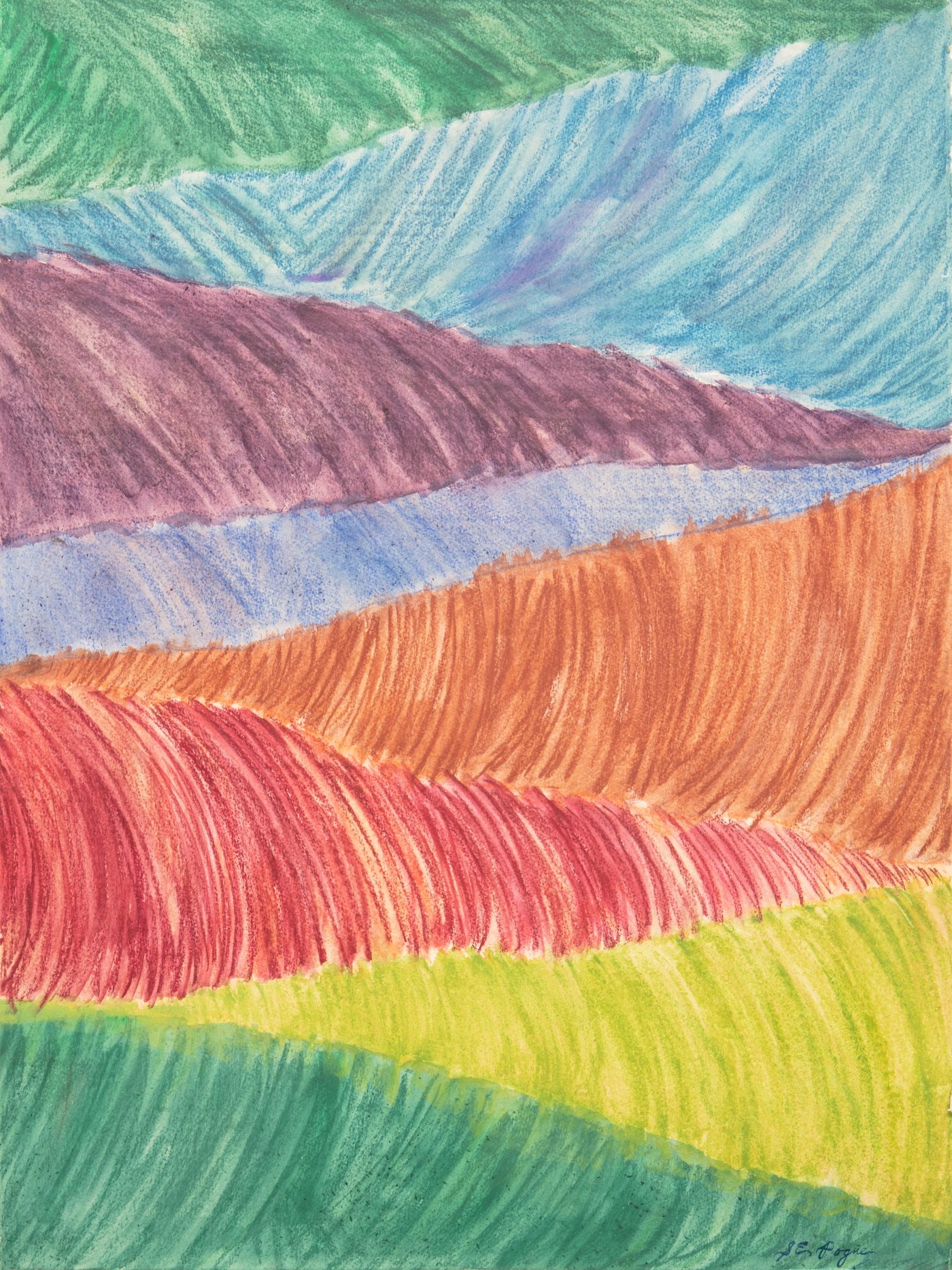
Beauty is a contested word in modern art. For much of the twentieth century, serious art was often expected to reject prettiness, decoration, pleasure, and sensuality. Beauty could be dismissed as conservative, feminine, commercial, or evasive. Pogue’s work challenges that suspicion. Her beauty is disciplined. It is not sentimental. It is constructed through technique, repetition, and restraint.
The Driskell Center described her prints as featuring “floral motifs, undulating lines, exotic arabesque patterns and a bold use of color” in the retrospective announcement. But those formal qualities should not be mistaken for softness. Pogue’s art asks viewers to reconsider what force looks like. Force can be a clenched fist, yes. But it can also be a saturated field of color. It can be a female figure refusing distortion. It can be an artist mastering a difficult process and bending it toward her own spiritual being.
The same announcement noted that although Pogue was aware of the shifting landscape of American art, she remained individualistic and focused on images consistent with what she called her own “spiritual being” at the Driskell Center. That phrase is perhaps the closest thing to an artist’s manifesto. It suggests a refusal to chase fashion, even as her work conversed with major movements. Pogue was not outside history. She was inside it, but not owned by it.
A Black modernist inheritance
Pogue’s life helps us see African American art history not as a series of isolated geniuses, but as an intergenerational structure. Howard trained her. Cranbrook refined her. Fisk placed her in direct relationship with Aaron Douglas. Maryland gave her a platform to teach, lead, and continue producing. The Driskell Center later recovered and reframed her legacy. Each institution mattered. Each also depended on people like Pogue — artists who did the daily work of making, teaching, hanging exhibitions, mentoring students, and preserving images.
This is the story KOLUMN has returned to across its cultural profiles: Black art survives because people build infrastructure around it. Not only museums, but classrooms. Not only archives, but relationships. Not only public fame, but the quieter acts of care that keep work from disappearing.
Pogue’s significance also lies in how she expands the map of Black modernism. Too often, the public story of Black art moves from Harlem Renaissance figuration to civil rights protest to contemporary market visibility. Pogue asks us to slow down in the middle decades — the 1960s through the 1990s — and see the experiments happening in print studios, university galleries, women’s exhibitions, and diasporic design languages. She asks us to see color etching as a serious site of Black thought.
What remains to be recovered
Pogue died in 2002, at 58. Her death came before the recent surge of institutional interest in African American art and Black women artists. Had she lived into the 2010s and 2020s, one imagines a different public career: more retrospectives, more acquisitions, more scholarly essays, more inclusion in surveys of feminist abstraction and Black printmaking. But art history is not fixed. It is revised by attention.
The work of recovery has begun, but it remains incomplete. Her prints belong in broader conversations about Pattern and Decoration, Black feminist abstraction, African American printmaking, Howard University’s art legacy, Fisk’s cultural role, and the afterlives of Harlem Renaissance modernism. She should be taught alongside Elizabeth Catlett and Margo Humphrey, Alma Thomas and Howardena Pindell, Lois Mailou Jones and Sylvia Snowden, Lou Stovall and David Driskell. Not because her work resembles all of theirs, but because it helps complete the field they collectively made.
Pogue’s art is a reminder that Black cultural history is not only made in moments of confrontation. It is also made in the studio, where an artist decides that a line must curve rather than break; that color can carry spirit; that the female body can be neither symbol nor object but presence; that ornament can be intellectual; that beauty can be a serious form of freedom.
Her prints still gather. They still curl. They still open.
And in that opening, Stephanie Pogue remains what she always was: a maker of pressure and grace, a teacher of color, and one of the quiet architects of Black modern art.
More great stories

Afro Sheen, Wall Street, and the Architecture of Black Possibility
July 6, 2026
No Comments
The Fire Inside the Fourth
July 5, 2026
No Comments