

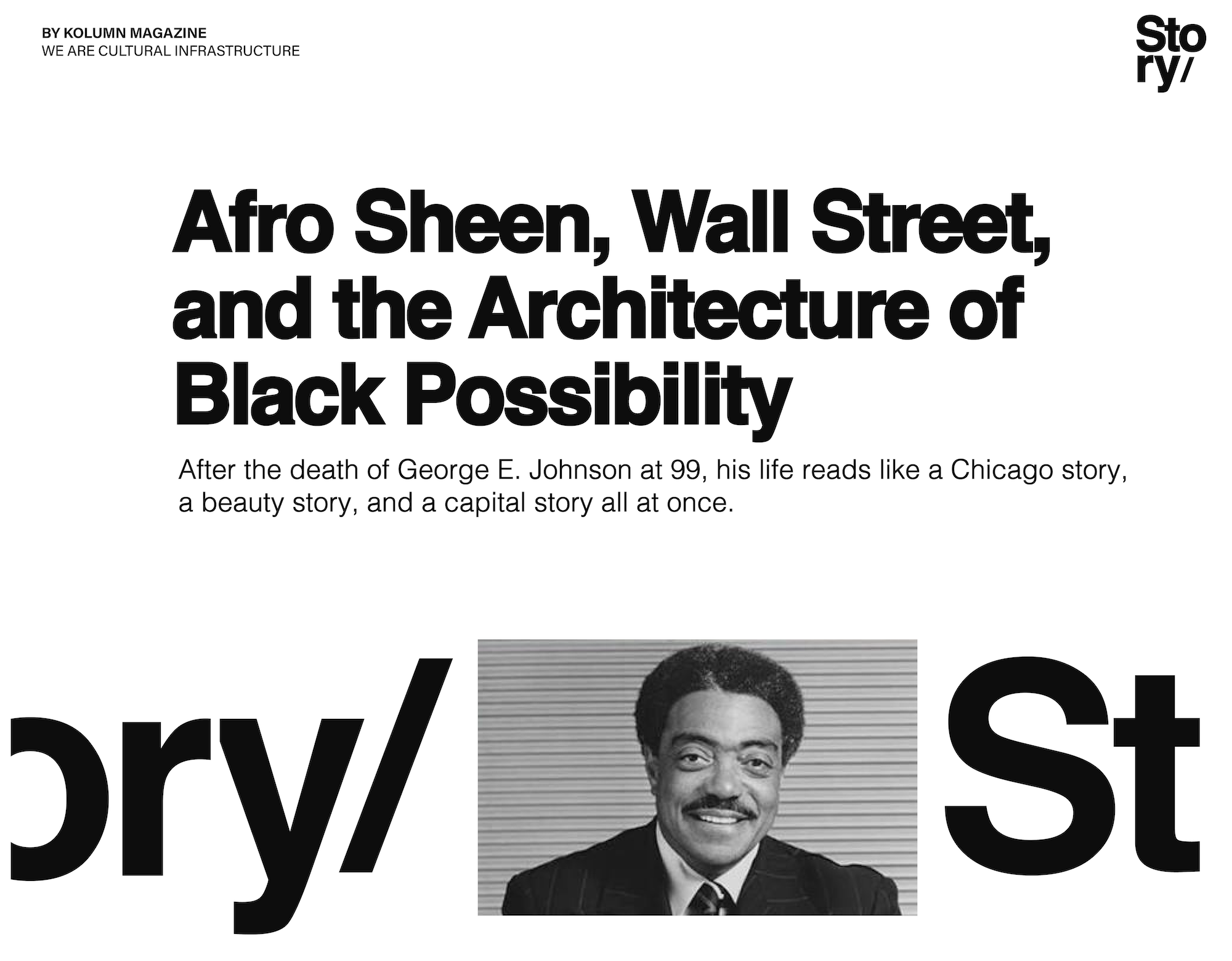
George E. Johnson did not simply sell hair care. He sold proof that Black consumers, Black workers, Black media, and Black capital could form an economy of their own.
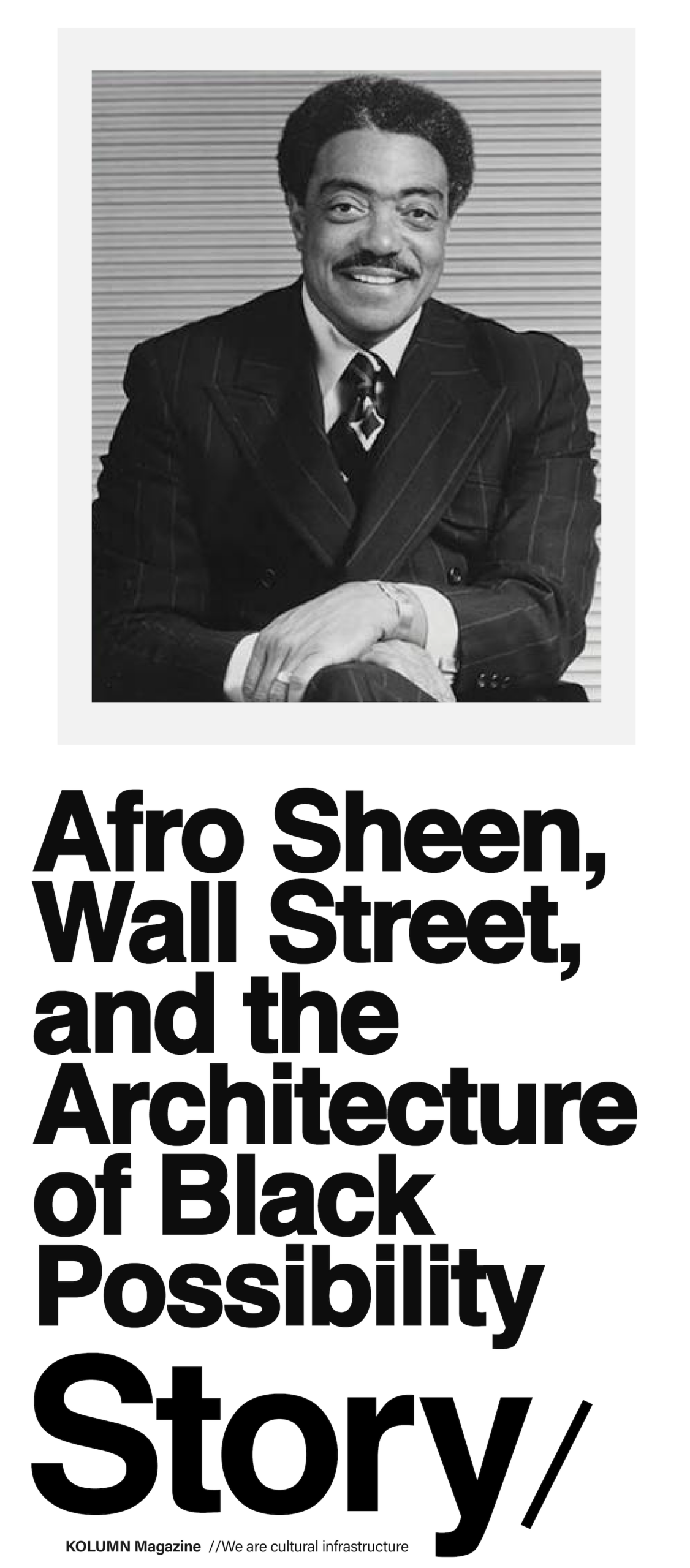
George E. Johnson did not simply sell hair care. He sold proof that Black consumers, Black workers, Black media, and Black capital could form an economy of their own.
By KOLUMN Magazine
George E. Johnson died Monday morning at 99, leaving behind a life that stretched from a Mississippi sharecropper’s shack to the American Stock Exchange, from shoe-shine stands and bowling alleys to one of the most recognizable Black consumer brands of the twentieth century. The Chicago Sun-Times reported Johnson’s death, describing him as the founder of Johnson Products Company and a pioneer whose South Side headquarters became a beacon of Black accomplishment.
Johnson’s story begins in Richton, Mississippi, where he was born in 1927, and moves quickly to Chicago, where his mother, Priscilla, brought him after his parents separated. The HistoryMakers biography of Johnson records the contours of that early ascent: work at eight, school interrupted, day jobs and night jobs, then a critical apprenticeship at Fuller Products, the Black-owned cosmetics firm founded by S.B. Fuller.
In 1954, Johnson and his wife, Joan Henderson Johnson, founded Johnson Products Company with a few hundred dollars and a sharp understanding of a market that white corporations had ignored, misread, or exploited. Their early products included Ultra Wave for men and, later, Ultra Sheen for women. By the late 1960s and 1970s, Afro Sheen became one of the signature beauty products of the Black Power era, entering bathrooms, barber shops, beauty salons, television screens, and family memory. The company’s importance was not merely commercial. As BlackPast notes in its history of Johnson Products, the company became the first Black-owned business listed on the American Stock Exchange.
That sentence is easy to read too quickly. Johnson did not merely build a successful company. He pushed a Black manufacturing company into a financial world that had long treated Black enterprise as marginal, risky, or invisible. He made a product for Black hair and turned it into a statement about ownership.
A Business Born Where America Was Not Looking
Johnson’s genius was not only that he understood hair. He understood neglect. Black consumers had needs, preferences, rituals, aspirations, and spending power, but mainstream American corporations often saw them only as afterthoughts. Johnson saw a market where others saw a niche. He saw expertise where others saw informality. He saw beauty culture as infrastructure.
That insight placed him inside a long tradition of Black entrepreneurship: Madam C.J. Walker, Annie Turnbo Malone, S.B. Fuller, John H. Johnson, Reginald F. Lewis. KOLUMN has explored this lineage before in “What A Deal Can Mean”, its feature on Reginald F. Lewis and the politics of Black capital, and in “Where the Black Dollar Goes Now”, which examined the modern struggle to convert Black consumer power into Black business ownership. Johnson belongs squarely in that archive. His life asked a question still alive in American business: What happens when Black people control not only the purchase, but the production, distribution, advertising, and image?
The answer, in Johnson’s case, was Johnson Products.
He built the company during an age when segregation was not just law in parts of the country but logic across the economy. Access to credit was restricted. Retail distribution was gatekept. Advertising ignored Black households or caricatured them. Corporate leadership was overwhelmingly white. In that environment, Johnson Products did something radical: it treated Black consumers as central.
Joan Johnson and the Company Behind the Company
No serious account of George Johnson’s life can treat Johnson Products as a one-man achievement. Joan Johnson was co-founder, strategist, and corporate force. The New York Times obituary for Joan Johnson recognized her role in helping build a company that broke a racial barrier on Wall Street. The Chicago Sun-Times obituary for Joan Johnson likewise emphasized that Johnson Products was launched by husband and wife together in 1954.
That partnership matters because the company’s success depended on understanding both product chemistry and cultural meaning. Ultra Sheen was not simply a formula. It entered a world where Black women’s hair had been policed by white beauty standards, workplace expectations, school rules, social respectability, and intimate community debates. Afro Sheen later moved through a different moment, when the Afro became a public symbol of pride, militancy, self-definition, and aesthetic refusal.
The Johnsons did not invent Black beauty culture. Black women and men had been shaping it for generations. But Johnson Products industrialized and nationalized a portion of that culture while keeping its voice recognizably Black. The company understood barbers, beauticians, salons, churches, local radio, Black newspapers, and the persuasive power of seeing oneself reflected in advertising.
The Afro as Advertisement and Argument
Afro Sheen arrived at a time when hair itself had become political speech. The Afro was not merely a style. It was a visible rejection of the demand that Blackness be hidden, softened, disciplined, or remade for white comfort. Johnson Products did not create that movement, but it met it with uncanny timing.
The scholarship around Black hair has long emphasized that hair is never just hair. It is history, labor, gender, class, discipline, creativity, and resistance. In Johnson’s business career, that complexity became a commercial field. He had to sell products without flattening the people who used them. At the height of Afro Sheen’s cultural power, the brand did not whisper assimilation. It spoke in the register of pride.
This is where Johnson’s legacy becomes complicated and fascinating. Some critics of the Black hair-care industry have argued that relaxers and straighteners reinforced Eurocentric beauty norms. Others have pointed out that Black consumers have always used hair products with agency, adapting tools to style, occasion, identity, and self-presentation. Johnson Products lived inside that tension. Ultra Sheen and Afro Sheen could sit in the same company because Black beauty itself was never one thing.
Johnson’s significance is that he built a company large enough to move with the culture. When the politics of style changed, Johnson Products changed with it. That flexibility was not accidental. It came from listening to Black consumers as full cultural actors.
Soul Train and the Saturday-Morning Mirror
Johnson’s name is inseparable from Soul Train. The company became a crucial sponsor of Don Cornelius’s program, helping bring a Black-produced, Black-centered music and dance show to national audiences. The Associated Press account of Johnson’s memoir notes that Johnson Products was known not only for its Wall Street breakthrough but also for sponsoring the popular 1970s program. The AFRO’s interview on Johnson’s memoir records Johnson’s recollection of seeing the show’s promise and recognizing that its energy could carry Black culture into homes across the country.
The match was nearly perfect. Soul Train gave Johnson Products a living, moving, dancing audience. Afro Sheen gave Soul Train a sponsor that understood the world the show was broadcasting. Together, they created a feedback loop of commerce and culture: Black hair, Black music, Black dance, Black advertising, Black ambition.
This is part of Johnson’s historiographical importance. He is not only a business figure. He is a media figure. His advertising dollars helped make Black visibility commercially viable on national television. He understood that a company could buy airtime and, in doing so, buy cultural space.
Wall Street and the Question of Proof
In 1971, Johnson Products became the first Black-owned company listed on the American Stock Exchange. The Chicago Community Trust describes the milestone as part of Johnson’s barrier-breaking career, linking the success of Afro Sheen and other products to the company’s arrival on Wall Street.
The achievement was symbolic, but it was not only symbolic. Public listing meant scrutiny, scale, and access to capital. It meant that Black enterprise could not be dismissed as merely local or sentimental. Johnson Products forced financial institutions to confront a Black company as an investable, measurable, corporate fact.
For historians of Black business, that fact carries weight. Black entrepreneurs had long built institutions in the face of exclusion: insurance companies, banks, newspapers, beauty firms, funeral homes, real estate offices, grocery stores, and professional practices. But public markets were another arena. Johnson’s breakthrough did not end discrimination in capital markets. It did not solve the racial wealth gap. But it created evidence.
Evidence matters. Every generation of Black entrepreneurs has had to battle the presumption that Black success is exceptional rather than instructive. Johnson’s company said otherwise. It said a Black firm could manufacture, advertise, distribute, employ, sponsor, grow, and trade.
Chicago as Factory, Laboratory, and Stage
Johnson’s story is also a Chicago story. The city gave him markets, networks, Black newspapers, salons, churches, talent, customers, and a working-class discipline shaped by migration. Chicago was not simply a backdrop. It was the machine around the machine.
The Great Migration carried millions of Black Southerners north and west, reshaping cities such as Chicago, Detroit, Cleveland, New York, Los Angeles, and Philadelphia. Johnson was part of that movement’s second generation: born in Mississippi, made in Chicago. His rise reflects what migration made possible and what it could not guarantee. Black Chicago created consumers, workers, professionals, artists, voters, and entrepreneurs, but it also confronted redlining, segregation, police abuse, school inequality, and industrial exclusion.
Johnson Products grew from within that contradiction. The company was proof that Black Chicago could produce corporate power. It was also proof that such power had to be built against the grain.
Johnson’s philanthropy and civic work extended that vision. The Horatio Alger Association profile quotes Johnson saying he was most proud of the impact his success had on Black youth in the community. That statement reads differently now, after his death. It suggests that Johnson understood legacy less as wealth than as permission. His success gave young people permission to imagine scale.
The Memoir at 97
In 2025, Johnson published Afro Sheen: How I Revolutionized an Industry with the Golden Rule, from Soul Train to Wall Street, written with Hilary Beard. The publisher Little, Brown and Company lists the memoir as a 320-page account of Johnson’s life and business career. The timing was remarkable: a man in his late nineties deciding that his story still needed to be told.
That late-life act of narration is itself part of the legacy. Black business history is often under-archived. Companies disappear. Records scatter. Advertising survives without context. Founders become names on products rather than thinkers in history. Johnson’s memoir resisted that disappearance.
In a WTTW interview about the memoir, Johnson said he had not intended to write a memoir until a 2021 epiphany convinced him that he had to tell his story. Beard described the book as an opportunity to recover a history too often left untold. That phrase—too often left untold—could apply to much of Black enterprise in America.
Historiographically, Johnson’s memoir belongs beside autobiographies and business histories that treat Black entrepreneurship not as side narrative but as central evidence in the story of American capitalism. His life complicates easy categories. He was a self-made man, but self-making required community. He was a capitalist, but his capitalism was shaped by racial exclusion. He sold beauty products, but beauty products became vehicles of media, politics, and pride.
The Limits and Lessons of Black Capitalism
A serious reflection on Johnson must also avoid hagiography. Black capitalism has always carried tension. Business success can create jobs, pride, and institutional power, but it cannot by itself dismantle structural racism. A Black-owned company can break barriers without breaking the system that made those barriers meaningful.
Johnson Products eventually faced competition, family conflict, changing consumer preferences, corporate pressure, and shifts in the Black hair-care market. The rise of natural hair movements, multinational beauty conglomerates, and new Black-owned brands changed the landscape. Johnson’s triumph did not freeze history.
But that is precisely why his life matters. He did not solve the problem of Black economic exclusion. He demonstrated one way to fight it. He built at scale in an economy designed to doubt him. He linked product to pride, advertising to ownership, and cultural fluency to corporate strategy.
KOLUMN’s “Cookies, Credit and the Racial Wealth Gap” argued that Black entrepreneurship often begins with talent but stalls at capital. Johnson’s life shows both sides of that equation. He began with almost nothing by Wall Street standards, but he built a company that made capital take notice. The lesson is not that grit is enough. The lesson is that when Black founders gain even narrow access to capital and markets, they can build institutions that alter culture.
Expert Voices and the Meaning of the Archive
The expert consensus around Johnson’s significance has sharpened in recent years because scholars and journalists have increasingly treated beauty culture as a serious archive. Hair products are not trivial objects. They reveal migration, gender, labor, advertising, chemistry, respectability politics, resistance, consumer power, and media strategy.
The South Side Weekly review of Johnson’s memoir situated the book within Johnson’s role as a famed entrepreneur and founder of a premium Black hair-care company. The Chicago Sun-Times feature on the memoir framed Johnson as a pivotal figure whose products revolutionized the market and whose career allowed him to give back to Black Chicagoans. The PBS program “George E. Johnson Sr.” likewise treated him as an iconic business leader whose story linked Afro Sheen, Soul Train, and Wall Street.
Taken together, these accounts make clear that Johnson’s life cannot be reduced to nostalgia. Afro Sheen commercials may live warmly in memory, but the business behind them was hard, strategic, and historically consequential. Johnson was operating in a marketplace where Black people were constantly studied as consumers but rarely respected as owners. He changed that frame.
A Life Measured in Infrastructure
The deepest measure of Johnson’s significance may be infrastructure. He built products, yes. But he also helped build systems: manufacturing capacity, salon education, Black advertising, television sponsorship, financial credibility, civic philanthropy, and generational confidence.
That is why his death lands beyond the beauty industry. It marks the passing of a man who helped define a Black institutional era in Chicago, alongside figures who built newspapers, banks, churches, schools, labels, galleries, community organizations, and political machines. Johnson Products was part of that institutional ecosystem. It proved that Black culture could be manufactured without being extracted, advertised without being mocked, and sold without surrendering its center.
To remember George E. Johnson only as the man behind Afro Sheen would be accurate but incomplete. He was also the man who understood that Black people deserved products made with them in mind, media that reflected their movement, and companies large enough to force recognition.
The Shine That Remains
There is a particular intimacy to Johnson’s legacy. His products lived close to the body. They sat on bathroom counters, under sinks, in beauty shops, on dresser tops, in mothers’ hands, fathers’ routines, teenagers’ Saturday-night preparations. They were part of getting ready, being seen, stepping out.
That intimacy gave Johnson Products a power that balance sheets cannot fully describe. Hair care is practical, but it is also ceremonial. It is preparation for public life. It is how people meet the world. Johnson built a company inside that ritual.
Now, after his death, the question is not whether Johnson mattered. The question is whether America will remember him at the proper scale. He was not a footnote in beauty history. He was a central figure in Black business history, Chicago history, media history, and the history of American consumer capitalism. His company made products, but his life made an argument: that Black enterprise could be modern, national, profitable, stylish, generous, and unapologetically directed toward Black people.
George E. Johnson sold shine. But the shine was never only cosmetic. It was the gleam of self-recognition, the polish of ambition, the visible surface of a deeper insistence. In an economy that tried to keep Black enterprise small, he built high. In a culture that often treated Black beauty as a problem, he treated it as a market, an art, and a source of power.
He leaves behind more than a brand. He leaves a standard.
More great stories
The Fire Inside the Fourth
July 5, 2026
No Comments
The Man Who Put Black America on the Record
June 28, 2026
No Comments