





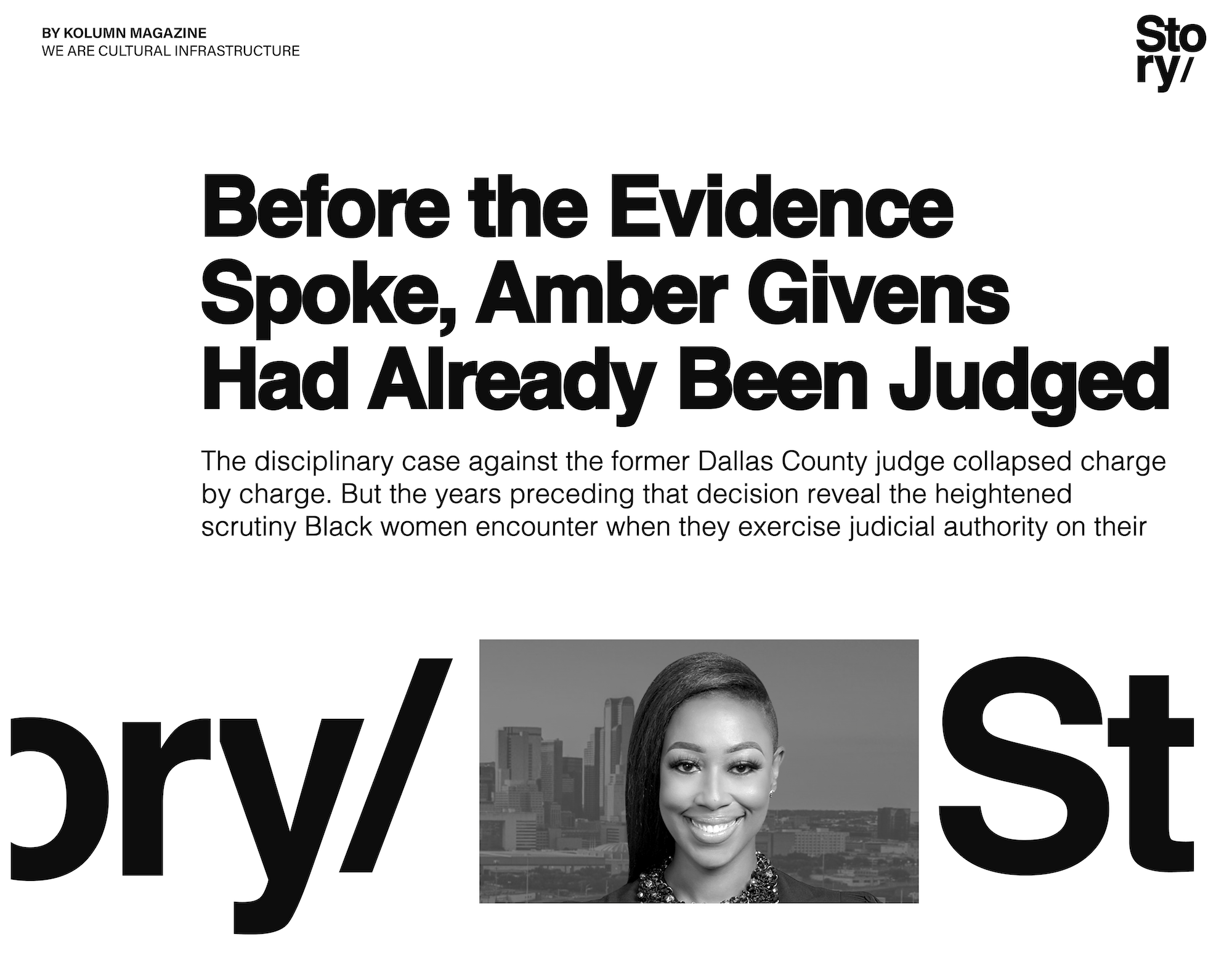
Before the evidence was tested, Amber Givens had already been judged—not only for what she allegedly did, but for the kind of Black woman in authority she was believed to be.

Before the evidence was tested, Amber Givens had already been judged—not only for what she allegedly did, but for the kind of Black woman in authority she was believed to be.
By KOLUMN Magazine
There is a second burden carried by Black women who enter the American judiciary. The first is written into law: master the record, understand precedent, protect constitutional rights, control the courtroom and exercise the authority of the state without fear or favor. The second is unwritten but no less consequential: continually prove that the authority belongs to them.
A Black female judge may issue the same firm instruction as a colleague and be remembered as hostile. She may challenge a lawyer and be called combative. She may preside over institutional disorder and become the individual face of its failures. Her confidence can be recast as arrogance, her independence as insubordination and her unwillingness to accommodate professional expectations as evidence that she lacks judicial temperament.
Former Dallas County District Judge Amber Givens spent years inside that second trial.
The formal allegations against her were serious. The Texas State Commission on Judicial Conduct accused Givens of allowing a court coordinator to preside over a virtual hearing, acting in cases after she had been recused, mistreating attorneys and litigants, demonstrating bias against members of a defense lawyers’ association, mishandling recusal motions and violating constitutional protections.
The informal accusation was broader. Givens was represented as something approaching a judicial personality disorder: too polarizing, too confrontational, too dismissive of lawyers and too resistant to the courthouse establishment to be trusted with power.
That version of Givens traveled rapidly. It moved through complaints, disciplinary proceedings, local news reports, lawyers’ conversations and a campaign for Dallas County district attorney. Long before the witnesses were cross-examined and the technology records scrutinized, the public had been offered a familiar character—the difficult Black woman whose exercise of authority had become indistinguishable from misconduct.
Then the allegations were tried.
On July 16, 2026, a three-justice Special Court of Review issued an opinion dismissing every public reprimand and admonition against Givens. After hearing fourteen witnesses, reviewing hundreds of documents and video evidence, questioning Givens directly and conducting a two-day trial from the beginning, the court concluded that the commission had failed to prove a single charge by a preponderance of the evidence. (State Commission on Judicial Conduct)
Not some charges.
Not merely the weakest allegations.
Every charge.
The decision did more than remove disciplinary sanctions from Givens’ record. It exposed the distance between the force with which an institution can accuse a Black woman in authority and the quality of evidence required to sustain that accusation. It also illuminated a recurring feature of Black female public life: institutions may question their legitimacy with extraordinary confidence while proving their alleged failures with remarkably little certainty.
The Charges Were Administrative, but the Punishment Was Public
Precision matters in describing what happened to Givens.
She was not criminally indicted in this proceeding. The State Commission on Judicial Conduct brought administrative charges alleging violations of the Texas Code of Judicial Conduct and the Texas Constitution. The possible outcomes involved judicial sanctions rather than criminal punishment.
But the distinction between an administrative charge and a criminal count does not lessen the reputational force of an official reprimand.
A public judicial sanction is a government declaration about character, competence and fitness for office. It is searchable, quotable and politically reusable. It can follow a judge into every election, professional dispute and subsequent public appointment. Even when later dismissed, the accusation frequently remains more memorable than its legal failure.
The commission’s June 2025 actions involved four disciplinary matters. Its public reprimand alleged that Givens had failed to decide a matter assigned to her, permitted her court coordinator to conduct a Zoom bond hearing, treated several attorneys without patience, dignity and courtesy, displayed bias against members of the Dallas Criminal Defense Lawyers Association, failed to process recusal motions properly and secretly recorded a telephone conversation with a regional presiding judge. (State Commission on Judicial Conduct)
Separate public admonitions alleged that she had acted in two criminal cases after being recused, ordering one person jailed as a condition of probation and another arrested after declaring his bond insufficient.
Taken together, the commission characterized the alleged conduct as willful and persistent behavior inconsistent with judicial duties and damaging to the public reputation of the judiciary.
Those words carried institutional authority. They also gave legal form to grievances that had circulated around the Dallas courthouse for years.
News accounts reported that more than 100 recusal motions had been filed against Givens during a concentrated period. Defense lawyers described recurring conflict. The commission portrayed multiple incidents as a pattern rather than a series of separately disputed events. In public, the volume of allegations began to function as corroboration.
But volume is not proof.
Ten complaints can reflect ten independently verified violations. They can also arise from a single professional conflict that has expanded, organized and replicated itself. The purpose of a disciplinary trial is to distinguish between those possibilities.
That distinction is especially important when the accused official belongs to a class of people whose competence and temperament have historically been subjected to heightened interpretation.
Black female judges do not enter an ideologically neutral profession. They enter a legal culture developed over generations when judges were presumed to be white and male, and when the traits associated with judicial authority—firmness, detachment, intellectual command and control—were interpreted through that presumption.
When a Black woman embodies those traits, the institution may not receive them in the same way.
That does not mean criticism of a Black female judge is inherently racist or sexist. It means that responsible accountability must separate demonstrable misconduct from the social discomfort that can accompany unfamiliar authority.
In Givens’ case, that separation did not occur fully until the accusations reached a court required to examine them anew.
A Trial From the Beginning
Texas law gave Givens the right to appeal the informal sanctions through a trial de novo before a Special Court of Review.
“De novo” is crucial. The review court did not merely inspect the commission’s paperwork for procedural error or defer to its findings. It considered the case from the beginning, applying the rules of law, evidence and civil procedure that govern an ordinary trial.
The commission carried the burden of proving each element of each charge by a preponderance of the evidence. That standard is lower than the criminal requirement of proof beyond a reasonable doubt. It generally asks whether the alleged conduct was more likely than not to have occurred.
The commission did not have to eliminate every possible uncertainty. It simply had to place the evidentiary balance on its side.
The Special Court of Review consisted of Chief Justice Scott Golemon of the Ninth Court of Appeals, Justice Gisela Triana of the Third Court of Appeals and Justice Lee Harris of the Tenth Court of Appeals. The panel convened on February 24 and 25, 2026.
The commission called eleven witnesses, including attorneys who had appeared before Givens, regional judicial officials, probation personnel, a commission representative and Dallas County District Attorney John Creuzot. Givens testified, submitted to cross-examination and answered questions from the judges. Her defense called two additional witnesses by video deposition.
The court received hundreds of documents and video evidence.
This was not a technical dismissal produced by an incomplete filing. It was not a ruling that the commission had missed a deadline or used an incorrect form. The court heard the people who had accused Givens, the officials who had worked around her, the witnesses who challenged the accusations and Givens herself.
After that examination, the panel found that the evidence did not prove the violations alleged.
The court described Givens as “certainly a polarizing individual.” Yet it also identified serious weaknesses in the institutional and testimonial foundations of the case. Dallas County’s court software made it difficult to determine whether recusal motions had been filed or granted. The COVID-19 pandemic created exceptional challenges for trial courts. Witnesses gave inconsistent accounts of specific events, some of which had occurred years earlier.
Those deficiencies mattered because the case had been constructed around intent, authority and character. To discipline Givens for willful or persistent misconduct, the commission needed more than evidence that confusing, contentious or harmful events had occurred. It needed to establish that Givens committed the particular violations alleged.
It could not.
“Polarizing” Is Not a Canon of Judicial Conduct
The court’s description of Givens as polarizing deserves scrutiny of its own.
The word appears balanced. It acknowledges that conflict surrounded her while distinguishing personality from legally actionable misconduct. Yet “polarizing” is not a neutral descriptor when applied to a Black woman exercising institutional power.
It often tells the reader that people reacted strongly to her without requiring an inquiry into who those people were, what they expected, whether their expectations were reasonable or why her authority produced such intense resistance.
A white male judge who runs a demanding courtroom may be described as exacting. A Black female judge who does so may be remembered as abrasive. A male jurist who challenges lawyers may be praised for intellectual rigor. A Black woman who rejects their arguments may be accused of disrespect.
This is not simply a rhetorical concern. Research has repeatedly shown that women, and particularly women of color, encounter a narrower range of professionally acceptable behavior. They are expected to be decisive without appearing domineering, authoritative without seeming angry, confident without being read as arrogant and collegial without compromising independence.
An American Bar Association resource on racial and gender bias summarizes research showing how implicit gender assumptions affect women in the legal profession. Separate ABA-associated research has documented how women of color experience bias, second-guessing and pressure to conform to institutional expectations developed around white male professionals. (American Bar Association)
Sociologist Tsedale Melaku has described the additional labor imposed upon Black women in elite legal spaces as an “inclusion tax”—the emotional, professional and material cost of being required to demonstrate belonging within institutions that still perceive them as exceptions. Black female lawyers interviewed about their professional experiences have described being presumed less competent, subjected to microaggressions and compelled to overperform merely to receive ordinary recognition. (Teen Vogue)
A judge occupies a different role from a law-firm associate or prosecutor, but the institutional assumptions do not disappear at the bench. They may become more volatile because the Black woman is no longer requesting entry, advancement or approval. She is issuing orders.
Givens’ case cannot be reduced to bias. Attorneys possessed the right to object to her conduct and petition the commission. Judicial authority must remain subject to vigorous accountability.
But the court’s ruling establishes that the perception of Givens as polarizing did not prove the charges. Professional friction could not be converted into a violation merely because enough people experienced or described it negatively.
A personality may explain why complaints accumulated. It does not establish whether the complaints were true.
The Hearing That Became an Alleged Impersonation
The most sensational allegation concerned an April 2021 virtual bond hearing.
The commission accused Givens of allowing her court coordinator, Arceola Warfield, to preside over the Zoom proceeding in her place. Two probation officers reportedly believed that they heard Warfield conducting the hearing when Givens should have been performing the judicial role.
The allegation was easily understood and exceptionally damaging. A judge cannot delegate judicial authority to a coordinator. If Givens had simply allowed a staff member to impersonate her and exercise the power of the court, the conduct would have raised grave due-process questions.
Local coverage frequently repeated the allegation in its most incriminating formulation. KERA reported the commission’s claim that Givens had allowed her coordinator to impersonate her during the online proceeding. WFAA similarly described the reprimand as arising from her allowing a coordinator to conduct a hearing. (KERA News)
Givens denied that version of events.
She testified that she was working remotely during the pandemic and experienced computer difficulties. She said that she telephoned Warfield and instructed the coordinator to hold the phone near the computer, allowing Givens to conduct the proceeding through the telephone connection. Her defense cited cellphone records and supporting testimony from a former bailiff.
The distinction between the two accounts could hardly be greater.
In the commission’s version, Givens abandoned her judicial duty and allowed an employee to exercise authority fraudulently.
In Givens’ version, she remained the judge conducting the proceeding but used an improvised connection because the ordinary technology failed during a public emergency.
This was precisely the kind of disputed factual question the commission was required to prove. The court found that it had not.
The allegation also illustrates how institutional disruption can become personalized when the person presiding is a Black woman already regarded as difficult.
Across the country, the pandemic forced courts into hastily assembled virtual proceedings. Judges, lawyers, clerks, witnesses and defendants navigated unstable connections, unfamiliar platforms, interrupted audio and inconsistent access to equipment. Procedures developed over centuries were transferred into commercial videoconferencing software within weeks.
Improvisation was nearly universal.
Yet in Givens’ case, a disputed technological workaround became evidence of a characterological failure: she had supposedly surrendered the courtroom because she did not respect the limits of her authority.
The trial record made that certainty unsustainable.
The Special Court of Review expressly acknowledged the many challenges faced by trial courts during COVID-19. It did not conclude that pandemic conditions excused proven misconduct. It concluded that the evidence, considered within those conditions, did not prove misconduct at all.
When the System Failed, the Judge Became the Explanation
The recusal allegations followed a similar pattern.
The commission accused Givens of acting in two criminal matters after she had been recused. In one case, she ordered an individual jailed as a condition of probation. In another, she declared a defendant’s bond insufficient and ordered an arrest.
The consequences were serious. A judge who has been recused generally lacks authority to continue acting in the case. Orders affecting a person’s liberty require especially rigorous adherence to jurisdiction and due process.
But the central question was not simply whether orders had been entered after recusal. It was whether the evidence established the misconduct charged to Givens, including what she knew about the status of the cases when she acted.
The court found that Dallas County’s case-management software contained “many shortcomings” that made it difficult for a judge to know whether a motion to recuse had been filed or granted.
That finding materially altered the story.
Before trial, the incidents could be represented as proof that Givens ignored judicial boundaries. After trial, the record showed that the county’s own information system could fail to communicate who possessed legal authority over a case.
Givens’ defense argued that the software continued to identify her as the presiding judge. A retired judge assigned to cases from which she had been recused reportedly supported the proposition that she did not know the recusal had become effective when she acted. Her lawyers contended that the misconduct theory improperly converted a defective administrative system into evidence of knowing defiance.
The review court did not absolve Dallas County’s justice system of responsibility for what occurred. Nor should anyone minimize the consequences when a person is detained under an order entered by a judge who no longer has authority over the case.
But responsibility for a harmful outcome and proof of individual misconduct are not identical.
Institutions often resist that distinction. Systems are diffuse and difficult to punish. Their failures involve software, clerk procedures, notification protocols, training, staffing and communication. An individual official offers a simpler explanation.
For Black women in authority, that simplification can become especially severe. They are often treated not merely as people working within troubled institutions, but as the embodiments of institutional trouble itself.
The system’s confusion becomes her incompetence. The bureaucracy’s delay becomes her disregard. A technological flaw becomes her abuse of authority. A workplace conflict becomes evidence of an inherently defective temperament.
The review court returned the institutional context to the record. Once the software failures were acknowledged, the commission could no longer rely upon the mere fact of post-recusal action to prove willful misconduct.
That did not make the underlying errors harmless.
It made the accusations against Givens unproved.
The Organized Opposition Around Her Courtroom
Givens’ relationship with members of the Dallas criminal-defense bar formed another major component of the disciplinary narrative.
Defense attorneys have an essential role in monitoring judicial conduct. Their clients confront the coercive power of the state, often while poor, detained or politically invisible. A defense bar unwilling to challenge judges would fail one of its most important professional obligations.
The Dallas Criminal Defense Lawyers Association and its members therefore had every right to raise concerns, document incidents and file complaints.
But accountability also requires an examination of how a professional community’s shared opposition may shape the production of evidence.
Givens’ defense argued that communications among association leaders reflected an organized effort to remove her from office or prompt a criminal investigation. An April 2026 Texas Metro News report on her post-trial filing described messages in which lawyers allegedly discussed getting Givens “off the bench.” The defense characterized the disciplinary complaints as part of a yearslong campaign rather than a collection of independent discoveries. (Texas Metro News)
Such communications do not automatically invalidate complaints. People who believe an official is dangerous or unethical often coordinate because coordination is necessary to overcome institutional resistance.
But coordination can also produce confirmation bias.
Once a professional group concludes that a judge is unfit, every disagreement can be interpreted through that conclusion. A sharp exchange becomes further evidence of hostility. A disputed ruling becomes personal retaliation. Administrative confusion becomes intentional obstruction. The sheer number of incidents appears to confirm the original premise, even when many incidents are being selected and interpreted by people who already share it.
This dynamic is intensified when race and gender stereotypes make the premise culturally familiar.
The “angry Black woman” stereotype does not require an explicit racial slur to operate. It functions as a framework for interpretation. Assertiveness is perceived as aggression. Refusal to defer becomes irrational hostility. Emotional neutrality can be called coldness, while visible frustration is treated as loss of control.
The disciplinary trial provided a setting in which those interpretations had to be separated from provable facts.
Witness testimony contained inconsistencies. Memories had degraded. The court found that the evidence, taken as a whole, did not establish bias, discourtesy, improper delegation, incompetence or willful misconduct by the applicable standard.
The complaints deserved review.
They did not deserve automatic belief.
From Jane Bolin to Constance Baker Motley
Amber Givens’ case belongs to a history extending far beyond Dallas County.
Jane Bolin became the first Black woman judge in the United States in 1939, when New York Mayor Fiorello La Guardia appointed her to the city’s Domestic Relations Court. Bolin entered the judiciary at a time when Black attorneys were excluded from major law firms, many bar associations and the professional networks through which judgeships were commonly obtained.
Her appointment was historic, but history did not make her authority culturally ordinary. She remained a Black woman occupying a position that American legal institutions had long reserved for white men.
Constance Baker Motley brought that tension into federal court.
As an attorney for the NAACP Legal Defense and Educational Fund, Motley helped litigate the dismantling of Jim Crow, participated in Brown v. Board of Education and argued ten cases before the United States Supreme Court, winning nine. President Lyndon Johnson appointed her to the United States District Court for the Southern District of New York in 1966, making her the first Black woman to serve as a federal judge.
Motley’s confirmation was opposed not only by segregationists but by political figures who questioned her experience and portrayed her civil-rights work as evidence that she could not be impartial. Her extraordinary litigation record did not insulate her from the presumption that a Black woman’s proximity to racial justice made her less judicial, while generations of white male judges had carried their own ideological commitments without their legitimacy being similarly questioned.
The pattern persisted.
Black female jurists have often been required to demonstrate neutrality according to standards formed without them. Their lived knowledge may be treated as bias, while the assumptions of the dominant culture pass as objectivity. Their authority is received as political before they issue a ruling.
The confirmation hearings of Justice Ketanji Brown Jackson provided a modern example. Despite credentials that included Harvard College, Harvard Law School, a Supreme Court clerkship, service on the United States Sentencing Commission and nearly a decade on the federal bench, Jackson faced repeated insinuations that her record was insufficiently rigorous or ideologically suspect. An American Bar Association reflection on the hearings described the resilience required as she confronted bullying and bias while maintaining the controlled demeanor expected of a nominee whose every reaction was being watched. (American Bar Association)
This history does not establish that the complaints against Givens were false because similar suspicion has confronted other Black female jurists. Historiography is not a shortcut around evidence.
It does establish why evidence must remain central.
When a society possesses durable stereotypes about Black women’s anger, temperament and competence, accusations that activate those stereotypes can feel true before they are proved. A disciplinary institution must therefore be more rigorous, not less, in distinguishing demonstrable conduct from culturally available interpretation.
The Bench Is Diverse. Its Scrutiny Is Not Equal.
The assumption that judicial institutions evaluate all judges neutrally is difficult to sustain empirically.
Political scientist Maya Sen examined federal district court decisions and found that rulings by Black judges were more likely to be reversed on appeal than comparable decisions by white judges. The disparity persisted across subject areas rather than appearing only in civil-rights cases. In The Guardian’s report on the research, Sen described differences sufficiently pronounced to suggest that implicit bias may influence how judicial work is assessed within the appellate system. (The Guardian)
The study did not focus specifically on Black women, and appellate reversal is distinct from judicial discipline. Yet its implications are relevant: the race of a judge can affect how legal authority is received, evaluated and validated by other actors within the judiciary.
Gender adds another layer.
Women in traditionally male professions confront what social psychologists have described as a double bind. Leadership requires assertiveness, but women who display assertiveness can be penalized for violating expectations of warmth and deference. Women of color encounter compounded stereotypes that cannot be understood by examining race and gender separately.
A Legal Momentum training report titled “When Bias Compounds” illustrates how stereotypes about African American women shape interactions even among judges, including assumptions that professional judgments arise from racial affinity rather than expertise. (Legal Momentum)
These findings do not permit the conclusion that every adverse assessment of a Black woman is discriminatory. They require something more disciplined: an awareness that assessment itself occurs within culture.
Givens was entitled to no lower standard of conduct because of her race or gender.
She was entitled to no higher burden of belonging.
The Politics Surrounding the Case
The disciplinary case unfolded alongside Givens’ transition from the bench into electoral politics.
She resigned from the 282nd Judicial District Court in December 2025 to challenge Dallas County District Attorney John Creuzot in the Democratic primary. Givens had first been elected to the district court in 2014 after working as a prosecutor in New York and Texas. Her judicial career included support for diversion programs and community-based approaches to reducing recidivism, though conflict with the defense bar had become a defining feature of public coverage.
Creuzot was not merely Givens’ political opponent. He also testified as a witness during her disciplinary trial.
On March 3, 2026, Givens defeated him in the Democratic primary, an upset that placed her on course to become Dallas County’s next district attorney. Axios reported that the result displaced a two-term incumbent, while KERA’s coverage of Givens’ first post-election remarks emphasized her stated focus on community-centered justice. (Axios)
Because no Republican candidate filed, her primary victory effectively positioned her to assume the office in January 2027, barring an extraordinary development.
The unresolved sanctions therefore carried implications far beyond her former judgeship. They could have shadowed her administration of one of Texas’ largest prosecutor’s offices, provided a permanent weapon to political opponents and framed every future disagreement as evidence of an established ethical defect.
The commission’s lawyers sought a severe sanction. Givens’ attorneys argued that the case was unsupported and retaliatory. The electorate made its own political judgment before the court completed its legal one.
Election results do not determine whether misconduct occurred. Voters may choose a candidate despite credible allegations, reject an official for reasons unrelated to ethics or misunderstand the legal record.
But the political environment helps explain the stakes.
The disciplinary charges did not exist in a sealed chamber. They circulated during a contest over who would control prosecutorial power in Dallas County. They shaped narratives about Givens’ character, relationships and fitness for office.
When the court later dismissed every charge, the decision removed the official foundation beneath much of that narrative.
Critics remain free to oppose Givens politically. Lawyers remain free to criticize her judicial record. Journalists remain free to report that conflict surrounded her tenure.
They cannot responsibly present the dismissed sanctions as proved misconduct.
When Accusation Becomes the Punishment
KOLUMN Magazine has previously examined the power of failed legal accusations to inflict lasting punishment upon Black women in public authority.
In “I Will Not Be Bullied: Inside the Political Prosecution—and Collapse of the Case Against Letitia James”, KOLUMN explored how allegations against New York Attorney General Letitia James acquired political force before the government’s case failed. The later analysis “When the Grand Jury Says No” examined the institutional asymmetry that emerges when the machinery of government is deployed loudly against a Black woman but retreats more quietly when the evidence proves inadequate. (KOLUMN Magazine)
The legal circumstances are distinct. Givens faced judicial-discipline charges, not a criminal prosecution. Her case was governed by Texas judicial-conduct law and reviewed under a civil evidentiary standard.
The structural resemblance lies in the chronology.
The accusation arrives first, with an official seal.
The accused woman must then live inside it.
Headlines repeat the allegations. Professional opponents cite them. Political commentary translates them into character. Search engines preserve the initial government language. The public remembers that there was “something” involving ethics, wrongdoing or abuse even when it does not remember the final disposition.
Years later, the evidence may fail.
By then, the process has performed much of the work of punishment.
Givens was publicly reprimanded, excluded from ordinary presumptions of professional legitimacy and compelled to defend herself through an investigation, sanctions, litigation, a two-day trial and post-trial briefing. Dallas County commissioners later excluded her from a $25,000 judicial salary supplement provided to other district judges, prompting a lawsuit in which she alleged that she had been unlawfully singled out. The county subsequently considered restoring the payment. (KERA News)
The formal sanctions were therefore not abstractions. They existed within a wider environment in which Givens was treated as an official exception—someone whose entitlement to ordinary professional treatment could be reconsidered because allegations had attached themselves to her name.
The appellate process eventually worked. The Special Court of Review considered the evidence independently and dismissed the case.
But due process operating at the end of a long ordeal does not erase what occurred before it.
What the Court Did Not Decide
The ruling does not establish that every moment in Givens’ courtroom was ideal.
It does not declare that no lawyer ever felt disrespected. It does not deny that conflict existed between Givens and members of the defense bar. It does not erase the fact that orders affecting liberty were entered after recusal. It does not prove that every administrative decision she made was wise.
Nor did the court find that the commission, the complainants or the witnesses acted with racial or gender animus.
Responsible reporting should not manufacture a discrimination finding the court did not make.
What the ruling establishes is both narrower and more decisive: the commission failed to prove the violations it charged.
That conclusion matters because the public narrative frequently moved beyond the evidence. Disputed conduct was treated as settled fact. Personality was treated as corroboration. Institutional failures were attributed to individual intention. Professional opposition was interpreted as confirmation that Givens’ behavior must have been intolerable.
The Special Court of Review tested those assumptions.
It had the authority to affirm the commission’s decision, impose a greater sanction, impose a lesser sanction, dismiss the charges or direct the commission to initiate formal proceedings.
It dismissed everything.
The virtual-hearing charge failed.
The allegations concerning recusal failed.
The claims that Givens lacked patience, dignity and courtesy failed.
The accusations of bias against defense lawyers failed.
The claims that she lacked legal competence failed.
The constitutional charge alleging willful or persistent misconduct failed.
This was not a compromised vindication. The court did not split the difference between Givens and her accusers. It concluded that the evidence failed to prove “each and every charge alleged in the charging document.”
That sentence should govern the historical record.
Accountability for Those Who Judge the Judges
The State Commission on Judicial Conduct performs an indispensable role.
Judges possess enormous authority over liberty, family, property, employment and constitutional rights. Judicial independence cannot become immunity. People subjected to abusive, discriminatory or incompetent judges need a credible institution willing to investigate complaints and impose sanctions.
The failure of the case against Givens does not discredit the principle of judicial accountability.
It tests whether the commission applies that principle accurately.
A disciplinary body charged with preserving confidence in the judiciary must also consider how unsupported public sanctions damage that confidence. Its responsibility is not fulfilled merely because a judge can appeal years later. The commission must assess evidence, institutional context, witness reliability and competing explanations before converting allegations into official findings.
The Givens ruling raises questions that deserve institutional examination.
How thoroughly did investigators test Dallas County’s software before construing the recusal incidents as misconduct? How did the commission evaluate the cellphone records and contrary testimony concerning the virtual hearing? What weight did it give to the coordinated professional opposition against Givens? How did it distinguish discourtesy from forceful judicial disagreement? Why did findings sufficient to support multiple public sanctions collapse under the ordinary civil standard of proof?
The review court did not answer those questions because it did not need to determine why the commission failed. It needed only to determine whether the charges had been proved.
They had not.
But the commission’s mission is not punitive, as the court itself emphasized. Its purpose is to maintain the honor and dignity of the judiciary and protect the public.
That mission requires accountability for accusation as well as misconduct.
When the subject is a Black female judge, such discipline becomes especially important. American institutions have repeatedly treated Black women’s authority as presumptively political, emotional or excessive. A judicial commission cannot eliminate that history, but it can refuse to reproduce it by demanding that allegations be separated from stereotype and conflict from proof.
What Givens Carries Into the Prosecutor’s Office
Givens is now preparing to become Dallas County’s chief prosecutor.
The transition has already been contentious. In June, she said that Creuzot’s administration was not providing the cooperation necessary for an orderly transfer of power, according to CBS Texas. (CBS News)
Her responsibilities will be immense. The district attorney determines which allegations become criminal charges, which cases proceed, which defendants receive diversion, what plea offers are made and when the government should concede that evidence is insufficient.
Givens will assume that authority having experienced the accusatory machinery of government from the other side—not as a criminal defendant, but as an official whose name, reputation and career were burdened by state findings that could not withstand a trial.
The lesson should be formative.
A prosecutor’s ethical responsibility is not to advance every accusation that sounds serious or satisfies political expectations. It is to test evidence, examine witness credibility, disclose weaknesses, understand institutional causes and withdraw when proof is inadequate.
Givens’ disciplinary case demonstrates how easily the gravity of an allegation can be mistaken for the strength of its evidentiary foundation.
It also demonstrates how much damage can occur before that mistake is corrected.
Whether she carries those lessons into the district attorney’s office will become part of the next chapter of her public record. Vindication in one proceeding does not exempt her future decisions from examination. Indeed, the authority to prosecute others will subject her to legitimate and necessary scrutiny.
The question is whether that scrutiny will be rigorous rather than reflexive, evidentiary rather than cultural and proportionate rather than personalized.
The Burden Beyond the Bench
Amber Givens’ case belongs to a history larger than one Dallas courtroom.
Black women who enter the judiciary do not arrive as abstractions. They enter institutions shaped by long-standing ideas about who naturally possesses authority, whose anger is rational, whose confidence signifies competence and whose errors are treated as ordinary.
They are required to perform the work of judging while also negotiating how others perceive them performing it.
That history does not place Black female judges beyond criticism. It makes evidentiary rigor more important.
Accountability cannot be credible when personality substitutes for proof, when institutional defects are assigned to an individual or when familiar stereotypes make disputed allegations feel true before they are tested. A disciplinary system cannot preserve confidence in the judiciary by lowering its own standards whenever professional conflict has made a judge unpopular.
Givens was publicly sanctioned in such an atmosphere.
She was described as polarizing. Her courtroom conflicts were gathered into a theory of character. Her character was then used to make the allegations appear mutually reinforcing. Each complaint seemed to validate the others because they involved the same woman whom many people had already decided was difficult.
But repetition was not corroboration.
Conflict was not misconduct.
Institutional authority was not evidence.
When the commission was required to prove its case, the architecture collapsed. Its witnesses did not produce a consistent account. The court technology did not support the simple narrative of knowing defiance. The pandemic complicated the most sensational allegation. The evidence did not establish bias, discourtesy, incompetence or willful misconduct.
The final opinion required only six pages to dismiss charges that had occupied years of Givens’ life.
That imbalance is the story.
An accusation can occupy the public record indefinitely. A dismissal cannot retrieve every headline, repair every professional relationship or recover every year spent beneath suspicion. It cannot fully remove the expectation that a Black woman in authority must remain controlled, agreeable and institutionally accommodating in order to be regarded as legitimate.
But a dismissal can correct the legal record.
The State of Texas placed Amber Givens’ judicial conduct on trial. In doing so, it also exposed the familiar scrutiny imposed upon Black women who occupy the bench: scrutiny expansive in accusation, personal in its conclusions and less certain when evidence is finally required to speak.
This time, the evidence spoke.
The charges did not survive it.
More great stories
The Fire Inside the Fourth
July 5, 2026
No Comments

The Man Who Put Black America on the Record
June 28, 2026
No Comments