






Milton Davis is not just a novelist in the field. He is one of the people who helped make the field harder to ignore.
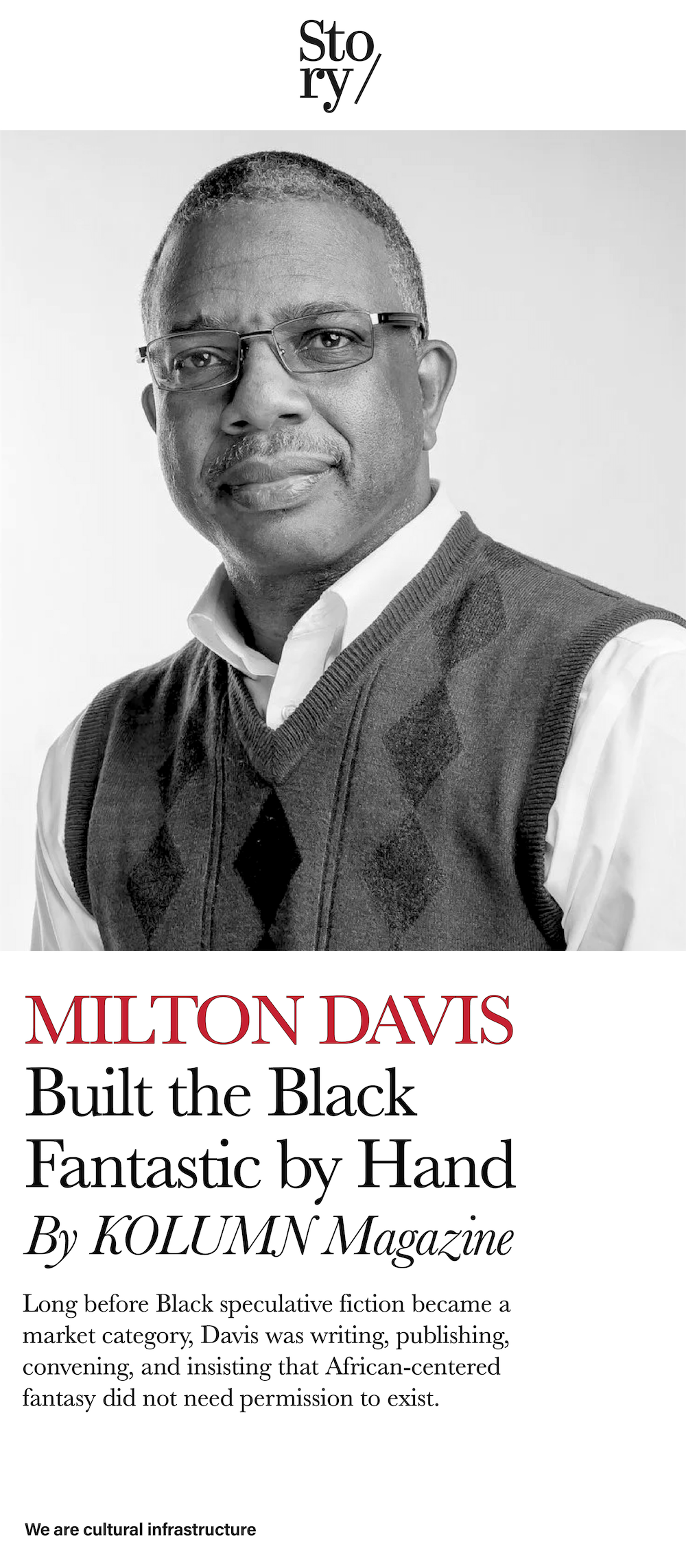
Milton Davis is not just a novelist in the field. He is one of the people who helped make the field harder to ignore.
By KOLUMN Magazine
When literary institutions finally discover a field that Black writers have been cultivating for years, they often tell the story backward. Suddenly there are trend pieces, curated reading lists, conference panels, and the flattering illusion that a world has just arrived because the gatekeepers have only now learned how to name it. Milton Davis’s career is a useful correction to that habit. He is not simply a prolific author of speculative fiction. He is one of the people who helped build the independent architecture that allowed Black speculative fiction to flourish outside the timetable of mainstream recognition. As Davis describes himself, he is a Black speculative-fiction author and publisher; across interviews and biographies, that description expands into a body of work that includes novels, anthologies, comics, publishing, community organizing, convention-building, and sustained advocacy for African- and Diaspora-rooted fantasy.
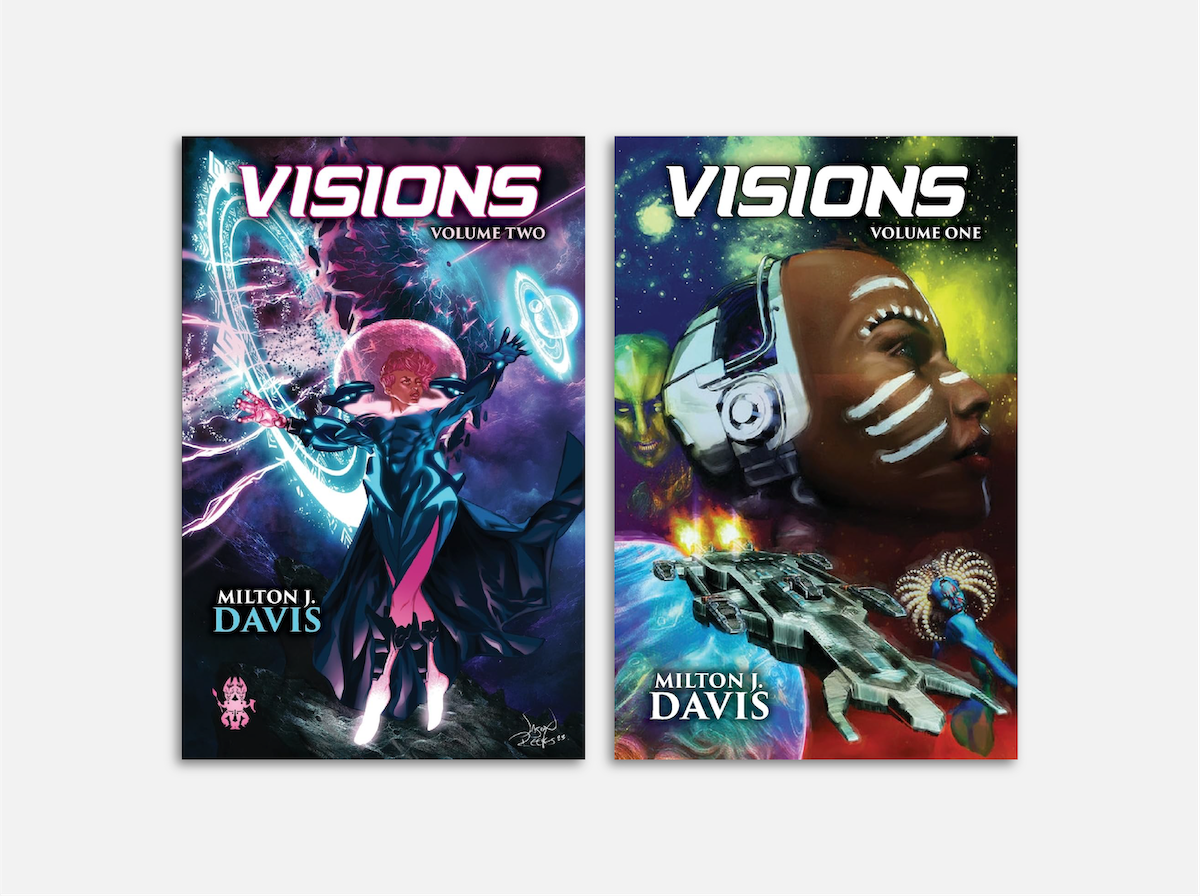
That distinction matters. Plenty of writers publish books. Fewer create pathways. Davis did both. Through MVmedia, the Atlanta-area micro press he has run for years, he has published his own work and helped circulate writing by others in a field that larger publishers long treated as peripheral or commercially uncertain. In different snapshots across the past decade, interviews have described MVmedia as a company devoted to science fiction, fantasy, and Sword and Soul, with an explicit mission of representing people of color positively. Those descriptions vary in the count of Davis’s books because his output kept growing: ten novels in one 2017 profile, seventeen by 2020, twenty-one authored books by 2022, and more recent bios describing him as the author of dozens of novels and story collections. What remains consistent is not merely the volume. It is the aim. Davis has spent years building imaginative worlds rooted in African and African Diaspora history, culture, and traditions, while also helping to make that creative lane more visible to readers and writers who were never supposed to inherit it whole.
KOLUMN has recently written, in its piece on J. California Cooper, about a Black literary tradition that prized oral texture, emotional clarity, and worlds built from intimate cultural knowledge rather than from institutional approval. Davis belongs to that larger tradition, even if his chosen terrain is different. If Cooper made the small poem and the domestic scene feel vast, Davis has done something analogous with the fantastic: he has insisted that African-centered speculative storytelling is not a supplement to the genre but one of its necessary vocabularies. That makes him not just a fantasy writer with a niche audience, but an important figure in the broader history of Black literary self-determination.
The writer who came to the page by finishing what he had started
There is something refreshingly unsentimental about Davis’s origin story as a published author. According to the African American Literature Book Club biography, in 2005 he gathered hundreds of pages of unfinished manuscripts and decided to pursue the long-postponed dream of completing a novel. That effort resulted in Meji Book One, released through MVmedia in 2008. The detail feels important because it strips away the mythology that often attaches to writers after the fact. There is no thunderclap of instant discovery here. There is accumulation, discipline, unfinished work turned into finished work, and the decision to stop waiting for someone else to ratify the effort.
Davis’s biographies also repeatedly note another fact that deserves more than passing mention: for years he worked as a chemist while writing and publishing speculative fiction. One profile jokes that he worked as an R&D chemist by day to hide his identity as an obsessive speculative writer by night; another BlackSci-Fi appreciation notes that he “continues to work as a chemist” while pursuing writing. That duality says something about the economic reality of Black independent literary production. The fantasy of the full-time novelist is often just that, a fantasy. Many Black writers, especially those building outside major New York infrastructure, have had to treat literature as calling, second shift, and entrepreneurial experiment all at once. Davis’s path reflects that harder truth.
It also clarifies why his career has never been reducible to one clean category. He writes novels, yes, but also short fiction, edits anthologies, works in comics and graphic storytelling, and thinks in terms of ecosystems rather than isolated titles. DMR Books’ 2022 spotlight described him as one of the busiest writers in the self-publishing scene, noting that he had contributed to anthologies from publishers including Baen and Titan while also publishing graphic novels and role-playing games through MVmedia. Davis himself said in that interview that he had been writing and publishing for over fourteen years, had published over forty books in total, and authored twenty-one of them. He also pointed to his story “Monsters of Mena Ngai” appearing in Black Panther: Tales of Wakanda, a credit that matters not simply because Marvel is a major platform, but because it reflects the degree to which Davis’s work had become legible beyond the smallest indie circles.
Sword and Soul was never a side road
To understand Davis’s significance, you have to understand Sword and Soul. And to understand Sword and Soul, you have to understand that genre labels are often arguments about who gets to be centered in imagination. Davis has repeatedly described the form as action-adventure, heroic fiction, or epic fantasy based on African history, culture, and traditions; in another formulation, he has emphasized pre-colonial African and African Diaspora culture, history, and tradition. The subgenre itself was coined by Charles R. Saunders, creator of Imaro, but Davis became one of its most visible modern champions and expanders.
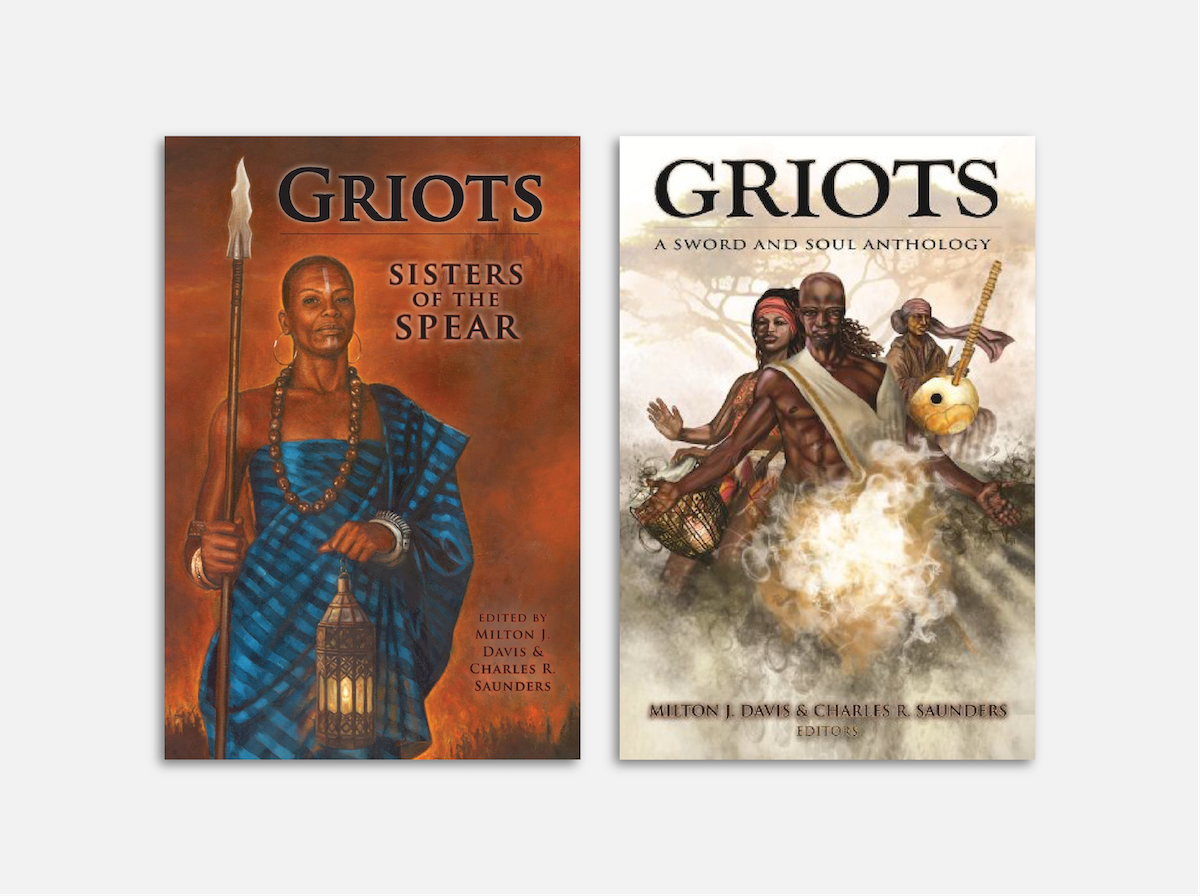
This is not trivial taxonomy. Fantasy, especially in its popular commercial forms, has spent decades pretending that pseudo-medieval Europe was the neutral setting and everything else was variation. Sword and Soul challenged that false universality by relocating the epic center. In Davis’s hands, the genre became not only homage to Saunders but continuation, revision, and infrastructure. The AALBC biography credits Davis with helping lead the revival of Sword and Soul and points specifically to Griots: A Sword and Soul Anthology, which he co-edited with Saunders in 2011. FIYAH’s 2017 spotlight likewise noted Davis’s editorial work on Griots and Griot: Sisters of the Spear, as well as his broader curation of anthologies and publications through MVmedia. Black Gate’s memorial writing on Saunders later observed that Davis had pushed Sword and Soul in multiple directions, from short stories and novels to role-playing games.
The significance of that work is both literary and political. Literary, because genres only survive when people make enough work inside them for readers to perceive an actual conversation rather than an isolated exception. Political, because Black writers have long had to fight the assumption that the speculative is somehow less serious than realism, even as realism itself has often been denied to Black life by a culture that refuses to see Black experience in full. Davis’s intervention says: Black people belong in the future, in the mythic past, in invented kingdoms, on strange planets, inside pulp adventure, and at the center of heroic narrative. Not as allegory. Not as corrective footnote. As premise.
That insistence helps explain why Davis’s work has often resonated most strongly in spaces that took Black speculative production seriously before the mainstream did. BlackSci-Fi celebrated him during Black History Month in 2018 as one of the Black speculative writers “killing the game” across science fiction, fantasy, Steamfunk, Sword and Soul, and horror. FIYAH profiled him as an independent force. Academic and para-academic conversations about Black indie speculative production have since treated writers like Davis as indispensable to understanding the field’s actual development, arguing that accounts focused only on major publishers present an incomplete picture of the genre’s evolution.
He did not wait for the industry to imagine a market
One of the most revealing facts about Milton Davis is that his career makes better sense if you think less like a publicist and more like a historian of institutions. The usual literary profile wants a breakout title, a singular masterpiece, a tidy ascent. Davis’s real contribution is messier and arguably more durable. He did not simply produce content for a preexisting market. He helped cultivate audience, language, venues, and collective identity around Black speculative fiction at a moment when the field needed organizers as much as it needed authors.
The State of Black Science Fiction Convention is part of that story. A 2016 This Is Horror feature on a panel from the first convention in Atlanta identifies Davis as a co-founder, alongside Balogun Ojetade, and quotes his introductory remarks about expanding Black readership in speculative literature and reinvesting success into Black communities. The panel description is striking because it does not read like a vanity event built around celebrity. It reads like strategy: distribution challenges, market education, social media, libraries, school reading lists, investor cultivation, grassroots models, and the question of how Black speculative work might move to the next level without surrendering control of its images.
That is infrastructure thinking. It suggests that Davis understood something the mainstream publishing industry still periodically rediscovers with great fanfare: communities excluded from cultural power do not merely need visibility; they need institutions, recurring spaces, circuits of trust, and practical mechanisms of circulation. This is why Davis’s significance exceeds bibliography. He helped define a Black speculative-fiction public.
Black Speculative Fiction Month extends the point. Inklette Magazine reported in 2019 that Milton Davis and another author had come up with the idea and aligned it with an already existing October celebration of Black speculative and imaginative arts. A more recent essay on celebrating Black Speculative Fiction Month describes Davis as a co-founder and frames the observance as an effort to uplift unapologetically Black narratives in speculative fiction that mainstream publishers often avoid. Even allowing for the modest scale of those sources, the pattern is clear: Davis was not merely responding to an established holiday or institutional campaign. He was among the people helping imagine occasions through which the field could see itself.
The Black fantastic as community practice
Davis’s own explanations of his work are often disarmingly plain. In interviews he has said that science fiction may have the greatest impact on Black readers because it places Black people in the future under their own terms. That sentence is simple enough to miss its force. Black people in the future under their own terms. It is a statement about genre, yes, but also about historical theft. So much of modernity has been narrated as though Black people existed only as labor beneath it, victims beneath it, or symbols within it. Davis’s work, across Sword and Soul, Steamfunk, Cyberfunk, and space opera, rejects that arrangement.
It also helps explain his cited influences. In one interview he named Charles R. Saunders, James Baldwin, Frank Herbert, and Philip José Farmer as major inspirations. That list is more revealing than it may initially appear. Saunders provides lineage in Black fantasy; Baldwin provides moral and stylistic seriousness, the insistence that language matters because truth matters; Herbert and Farmer point to the large-canvas speculative ambitions of worldbuilding and adventure. Davis’s fiction occupies the crossroads where those impulses meet: cultural grounding, ideological argument, genre pleasure, and the old pulp appetite for movement.
There is also the matter of tone. Davis has never seemed interested in approaching Black speculative fiction as a purely academic corrective. He likes adventure. He likes scale. His catalog includes Steamfunk quests, Sword and Soul epics, vampires, comics, scripts, and cross-media experiments. That breadth is not evidence of dilution. It is evidence that he understands the fantastic the way Black readers often have: not as one prestige shelf in the bookstore, but as a broad imaginative commons where horror, fantasy, sci-fi, folklore, history, and futurity constantly overlap.
That orientation places him in a lineage larger than any one imprint. Black speculative literature has always involved a struggle over permission: permission to mythologize, to futurize, to invent without explanation, to write the Black past without flattening it and the Black future without whitening it. Scholars writing about Black indie speculative fiction have argued that any account of the field that focuses only on output from large traditional publishers misses the scope of innovation happening in independent spaces. Davis’s career is a case study in exactly that claim.
Why the mainstream record on Davis feels thinner than it should
There is an uncomfortable truth hovering over any longform piece about Milton Davis: for a figure this productive and this consequential within his sphere, the record of major mainstream coverage is relatively thin. That does not mean he lacks significance. It means significance and institutional attention have never been the same thing. Much of what is publicly legible about Davis comes from Black speculative-fiction outlets, author interviews, convention bios, independent publishers, community magazines, and his own platforms. The imbalance tells its own story.
That story should sound familiar to KOLUMN readers. KOLUMN’s recent coverage of figures like Alice Childress, J. California Cooper, and Ta-Nehisi Coates has repeatedly returned to a central problem in Black cultural history: institutions are often late to Black innovation, and then later narrate their lateness as discovery. Childress was not “early”; America was late, KOLUMN argued. Something similar can be said here. Black speculative readers and writers did not need a mainstream trend cycle to know that Milton Davis mattered. They were already reading him, publishing with him, interviewing him, appearing on panels with him, and helping build the spaces where his work could travel.
There is another consequence to this late attention: writers like Davis are often misrecognized as merely “indie,” as though independent publication is a lesser state rather than a deliberate and historically necessary strategy. But independence, especially in Black cultural production, has often been less an aesthetic pose than a material solution to exclusion. When Davis built MVmedia into a publishing vehicle for African- and Diaspora-centered speculative fiction, he was doing what Black cultural producers have done for generations: constructing parallel channels when the official ones proved too narrow, too paternalistic, or too incurious.
The publisher as world-builder
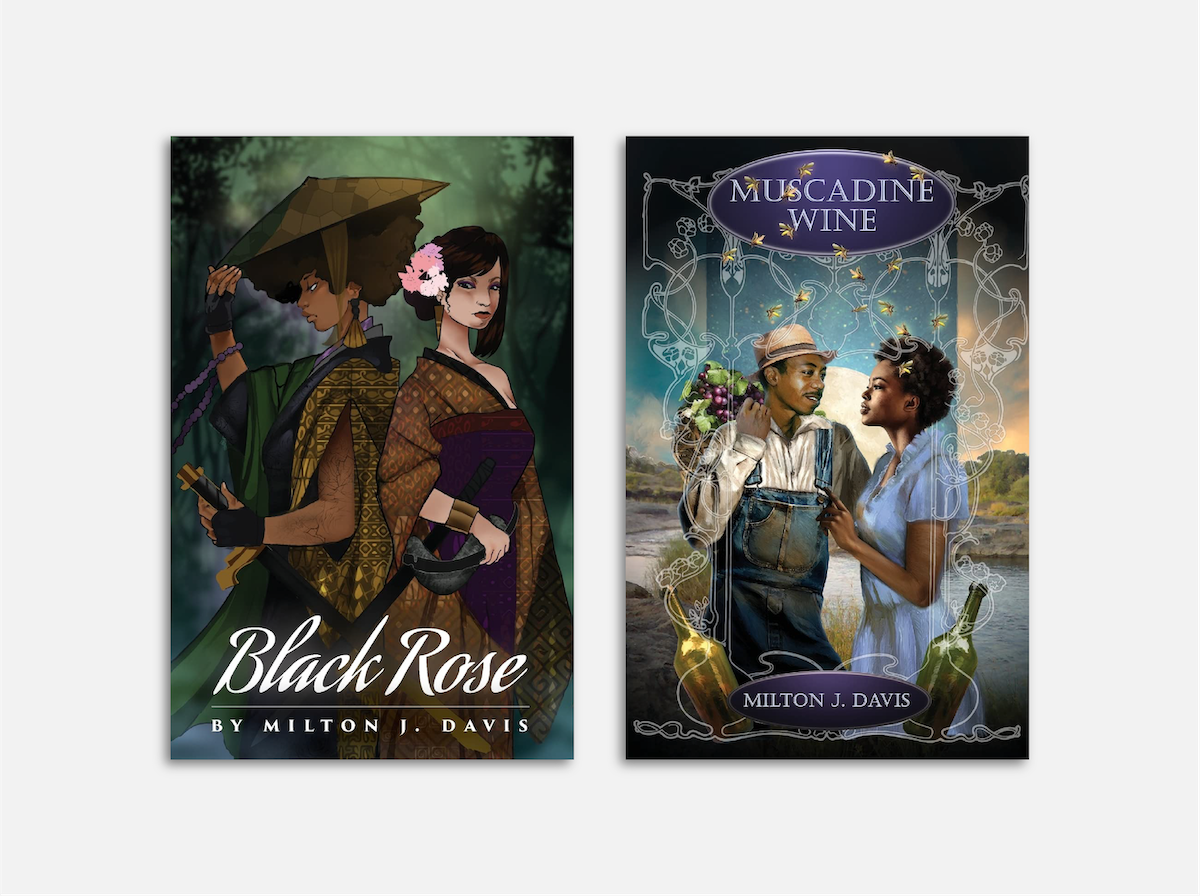
To call Davis a publisher is not to add a line to the résumé. It is to name a second kind of authorship. Publishers shape what becomes thinkable as a field. Through MVmedia, Davis has published work by others, elevated Sword and Soul and related subgenres, and helped keep Charles R. Saunders’s legacy present for newer readers. FIYAH noted that MVmedia had published Saunders’s Abengoni: First Calling and Nyumbani Tales alongside works by Balogun Ojetade and others. DMR Books highlighted Davis’s total publishing footprint beyond his own books. Those details matter because literary movements do not survive on admiration alone. They survive because someone edits, prints, promotes, warehouses, ships, convenes, and keeps going.
This is where Davis’s career becomes especially legible as Black institution-building. He has not merely written fantasies set against African and Diasporic traditions. He has helped produce the conditions under which those traditions could circulate in modern genre form with less mediation from institutions that historically treated Blackness as topical but not foundational. Even the recurring descriptions of his company’s mission, modest as they may seem, amount to a direct rebuke of an industry that too often equated universality with whiteness. Representing people of color positively is not a marketing slogan in this context. It is a structural intervention.
That word, “positively,” should not be mistaken for softness. Davis’s work is not important because it flatters Blackness or turns culture into branding. It is important because it widens who gets to be complex, mythic, flawed, dangerous, adventurous, and central. Positive representation at its best is not propaganda. It is the refusal of diminishment.
What Milton Davis means now
So what, exactly, is Milton Davis’s significance? He is not merely a prolific genre writer. He is one of the Black speculative-fiction builders who understood that representation without infrastructure is fragile. He helped revive and extend Sword and Soul after Charles R. Saunders named it. He helped co-create communal spaces such as the State of Black Science Fiction Convention and Black Speculative Fiction Month. He has sustained an independent publishing operation aimed at African- and Diaspora-rooted imaginative work. He has written across forms and subgenres with a steadiness that suggests vocation rather than momentary relevance. And he has done much of this while the broader culture remained only intermittently attentive.
There is also a subtler significance. Davis represents a different theory of literary importance, one KOLUMN is particularly well positioned to appreciate. Not every important Black writer becomes a household name. Some become load-bearing figures inside the culture: people whose labor, generosity, stubbornness, and output make other careers more possible and widen the imaginative field for everyone else. Their names may not arrive with the commercial thunder of a crossover phenomenon. But remove them, and the ecosystem looks thinner, weaker, less coherent. Davis belongs to that category.
His career also poses a challenge to literary journalism. If we only write extensively about Black writers once they have passed through institutional checkpoints familiar to white publishing, we will always be late to the actual story. The actual story is often being built elsewhere: in independent presses, specialty conventions, online communities, small magazines, and long-running collaborations. By the time the center notices, the work of creation has already been underway for years. Davis’s life in letters is a reminder that Black cultural history cannot be written honestly from the center outward. It has to be written from the labor outward.
And that, finally, is why Milton Davis is a KOLUMN subject. KOLUMN has spent recent months making the case that Black culture is not simply a collection of famous names, but a set of systems, vocabularies, and infrastructures built by people who refused erasure. In that sense Davis sits naturally beside KOLUMN’s literary and intellectual profiles. Like J. California Cooper, he belongs to a Black writing tradition too rich to be measured solely by mainstream acclaim. Like Ta-Nehisi Coates, though with a radically different method and field, he is concerned with who gets to author reality. Like so many Black institution builders before him, he has answered exclusion not only with critique but with construction.
Milton Davis built worlds. That part is easy to say. The more exact sentence is that he helped build the conditions under which Black worlds could proliferate without apology. In an industry that still too often mistakes belated acknowledgment for generosity, that may be the more enduring achievement.
More great stories

Afro Sheen, Wall Street, and the Architecture of Black Possibility
July 6, 2026
No Comments
The Fire Inside the Fourth
July 5, 2026
No Comments