




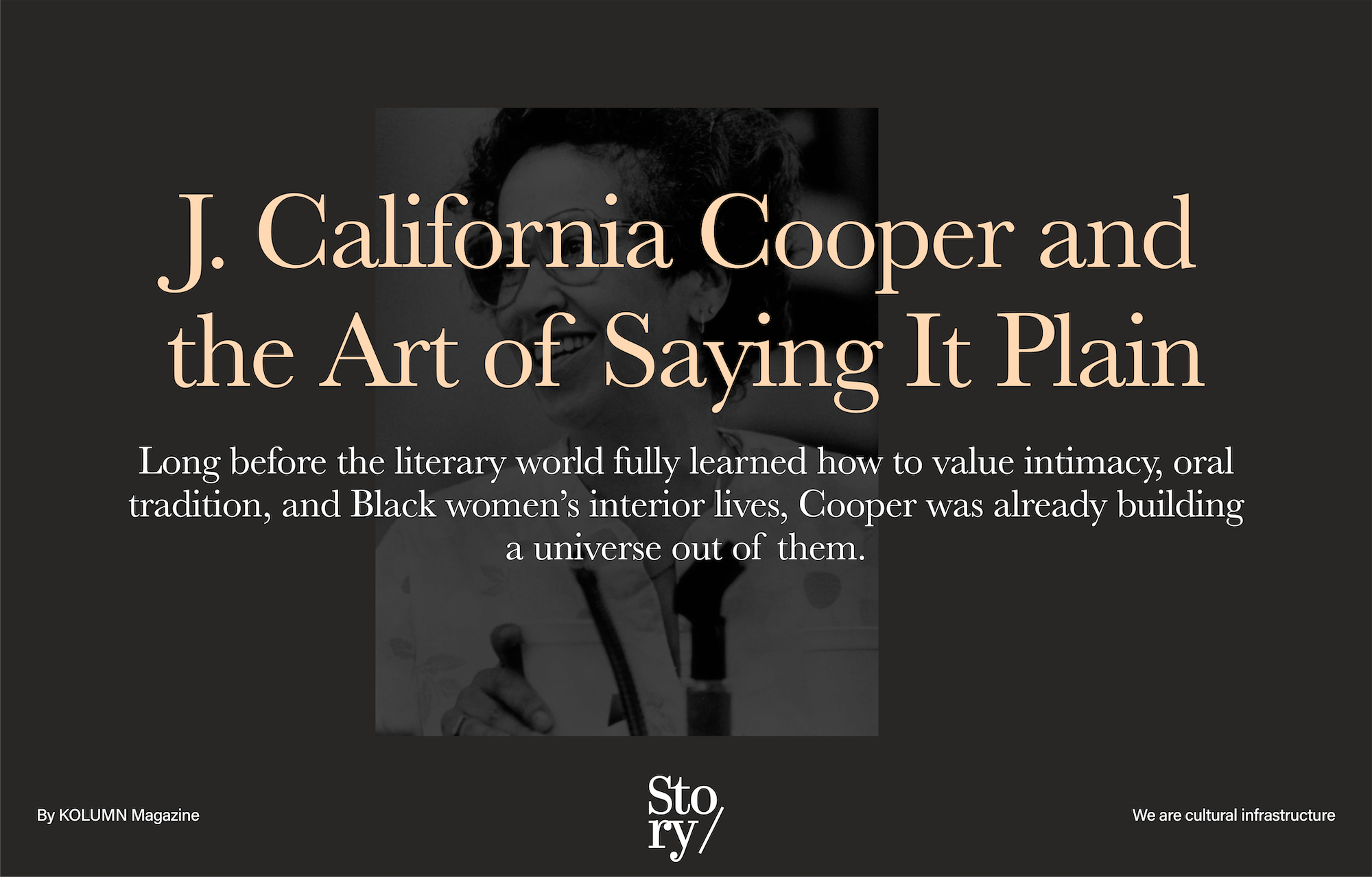
She did not write as though she were trying to impress the gatekeepers. She wrote as though truth had to be carried, by hand, from one life to another.
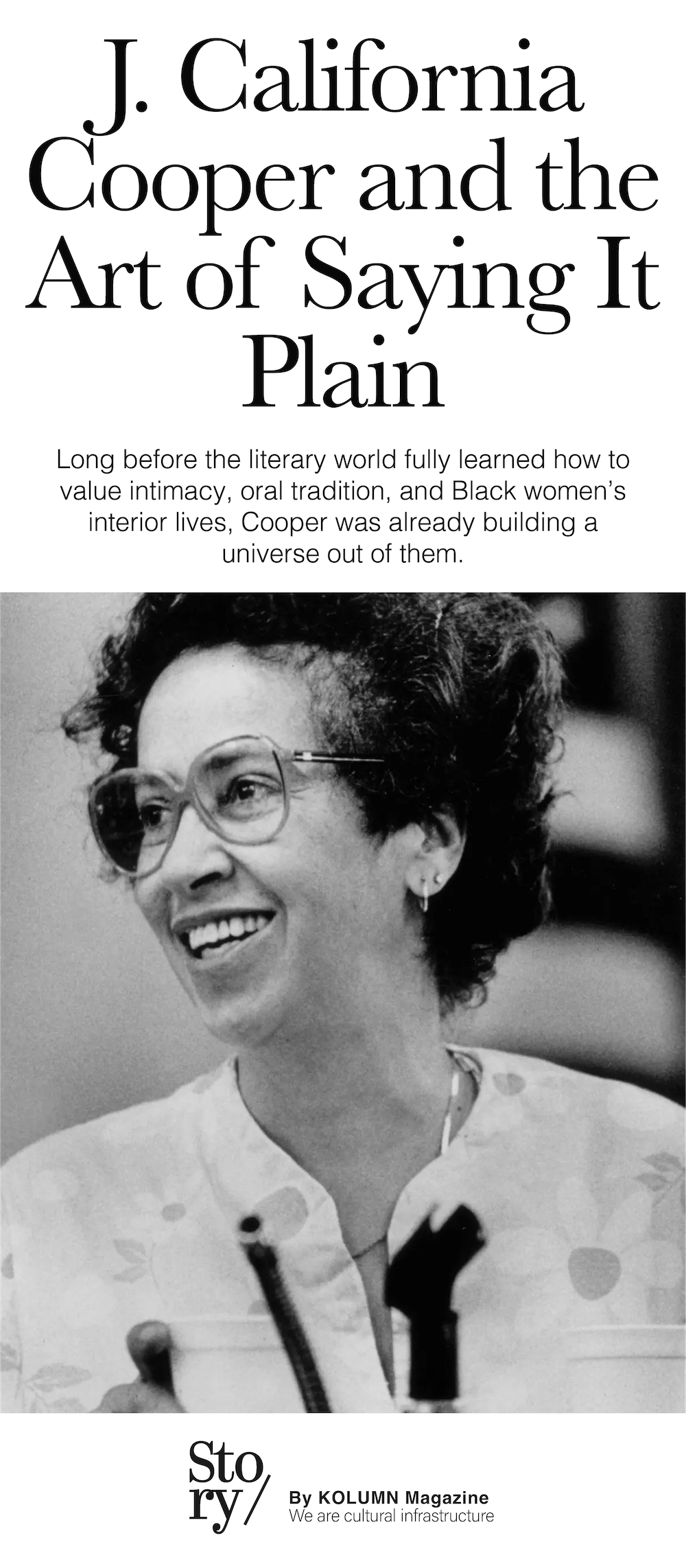
She did not write as though she were trying to impress the gatekeepers. She wrote as though truth had to be carried, by hand, from one life to another.
By KOLUMN Magazine
There are writers whose work announces itself with pyrotechnics, and then there are writers whose sentences walk into the room like somebody’s auntie, sit down at the kitchen table, fix you with a look, and tell you exactly what time it is. J. California Cooper belonged firmly to the second camp. She did not write as though she were trying to impress the gatekeepers. She wrote as though truth had to be carried, by hand, from one life to another before it got lost.
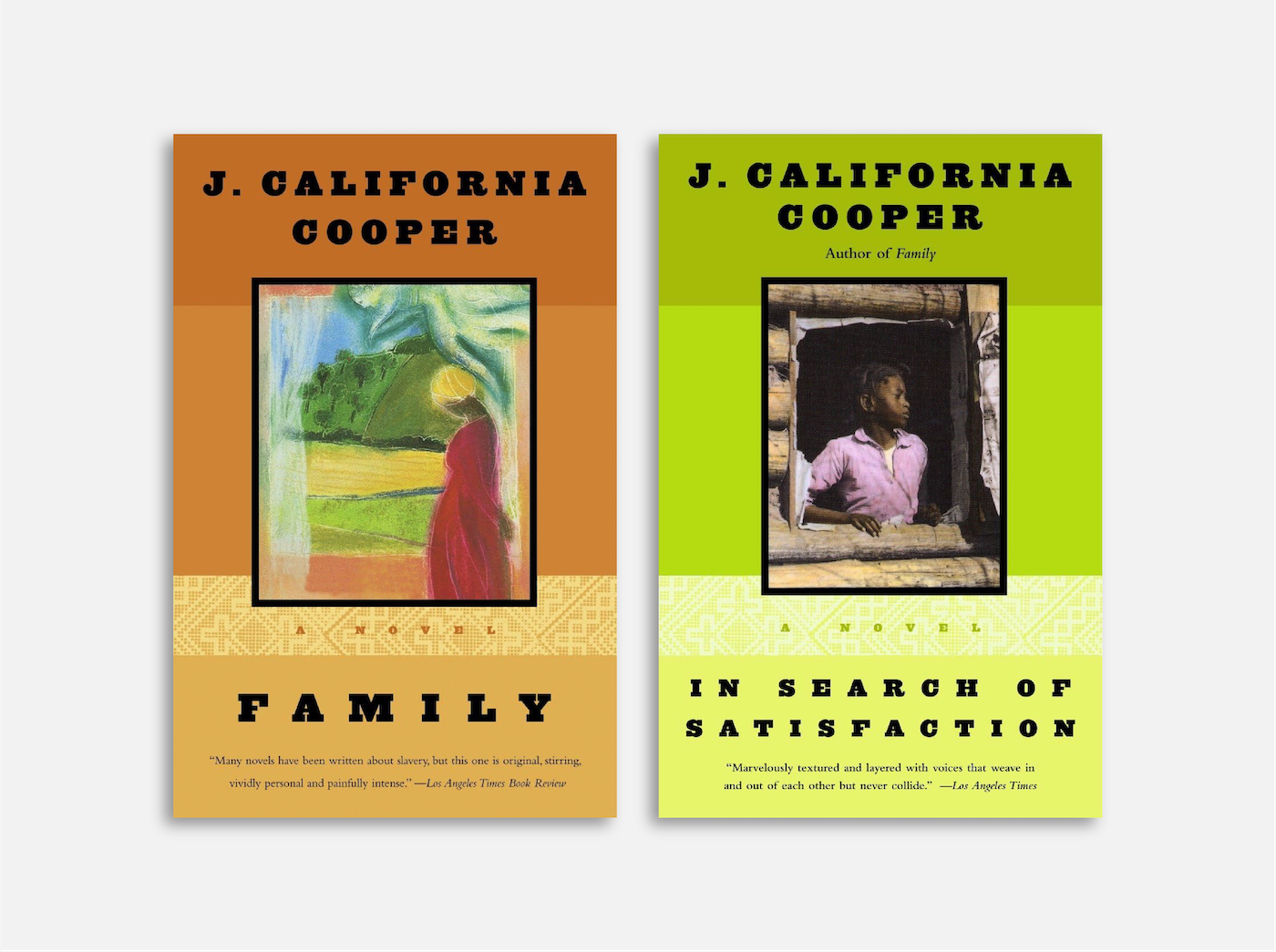
That truth could be funny. It could be tender. It could be brutal. It could arrive in a sentence so plain you might miss, at first, how much work it was doing. But Cooper, born Joan Cooper in Berkeley, California, in 1931 and known to most readers by the name she fashioned for herself, built an extraordinary literary career on that kind of plainness. She moved from theater into fiction after Alice Walker encouraged her to turn her gifts for dialogue and storytelling toward the page. Over time, she became the author of numerous plays, short-story collections, and novels, including A Piece of Mine, Homemade Love, Family, In Search of Satisfaction, The Wake of the Wind, and Life Is Short But Wide. Along the way she was named Black Playwright of the Year for Strangers, won an American Book Award for Homemade Love, and earned a reputation as one of the most distinctive chroniclers of Black life in late-20th-century American literature. (The Washington Post)
What made her distinctive was not just subject matter, though her commitment to Black women’s lives was unmistakable. It was form, rhythm, scale, and moral temperature. Cooper wrote fiction that often felt oral even on the printed page. Her narrators seemed to know the difference between what happened and what it meant. Her characters could be wounded, ridiculous, loving, petty, holy, lonely, and wise, all at once. She worked in a register that critics sometimes called “folksy,” a word that can be descriptive when used carefully and patronizing when used lazily. In Cooper’s case it points toward something real: her deep investment in the cadences of spoken language, in the old technologies of witness, parable, and community memory. Alice Walker famously described Cooper’s style as “deceptively simple and direct,” linking her to Langston Hughes and Zora Neale Hurston, while later critics and interviewers kept returning to the moral force tucked inside that apparent simplicity.
To understand Joan California Cooper’s significance, you have to begin with the fact that she was not manufactured by literary institutions. She came to fiction after other work, other lives, other forms of labor. Accounts of her life describe a woman who held a range of jobs before and during her writing career, from secretary to truck driver to manicurist, and who kept a famously private relationship to biography, even resisting the casual public consumption of her given first name and age. In one Washington Post profile, she joked that if she gave away her first name, people would start using it; in other retellings she made clear that she intended to keep something for herself. That privacy was part of her authorship, not incidental to it. Cooper was willing to offer stories, but she did not confuse that offering with self-exposure.
There is something particularly resonant about that choice for a Black woman writer working in a culture that is often ravenous for revelation but less interested in respecting mystery. Cooper’s fiction is full of emotional and social disclosure, but Joan California Cooper herself remained elusive. The work did the explaining. The work did the testifying. The work, in a sense, was the autobiography she chose.
From the stage to the page
Before she became widely known as a fiction writer, Cooper was a playwright. That matters because the theater never really left her work. She wrote roughly 17 plays, and Strangers earned her Black Playwright of the Year honors in 1978. Even her prose carries dramatic architecture: scenes arrive already in motion; voices are differentiated with startling economy; dialogue is not filler but destiny. You can hear her ear for speech in nearly everything she wrote.
The pivot from stage writing to fiction is now part of literary lore. Alice Walker, having seen or heard enough to recognize Cooper’s talent, urged her to write stories and helped bring her first collection, A Piece of Mine, into the world through Wild Trees Press, the small press Walker founded with Robert Allen. That origin story is important not just because Walker’s intervention mattered, though it plainly did, but because it shows how Black literary traditions often move through recognition, mentorship, and community patronage rather than through the institutions that later act as if they discovered genius on their own. A Piece of Mine, published in 1984, introduced readers to a writer who had no interest in sanding down the grain of Black speech for elite approval. The book was also the first title published by Wild Trees Press, making it significant in the histories of both Cooper’s career and Black independent publishing.
If you read early notices on Cooper, one phrase appears again and again: “deceptively simple.” That phrase is useful, but only up to a point. Simplicity in literature is often treated as the absence of difficulty, when in fact it can be the result of a very high order of craft. Cooper’s sentences are clean because she knows exactly where emphasis belongs. Her structures feel conversational because she understood pacing. Her narrators can sound intimate because she knew how to build trust and then complicate it. What some reviewers called “simple prose” was in fact extremely controlled prose. It was carrying oral tradition into print without flattening it into pastiche.
In that sense, Cooper belongs in a lineage with writers who understood that literary value does not depend on ornamental opacity. Like Hurston, like Hughes, and in a different way like Toni Cade Bambara, she knew that vernacular is not a deviation from art. It is art. And Black speech, when rendered with attentiveness rather than caricature, can hold entire epistemologies.
The worlds she made
Cooper’s fiction kept returning to a cluster of subjects that were never merely themes in the academic sense. They were pressures: love and its failures, men and women misreading one another, the endurance of Black women, domestic violence, betrayal, spiritual reckoning, the afterlife of slavery, and the possibility that ordinary people might still reach toward grace even after life had tried to beat it out of them. A Piece of Mine and Homemade Love established her as a major short-story writer, one especially concerned with women living under desperate or constrained circumstances, but never reducible to victimhood. Her stories often contain lessons, but the word “didactic,” sometimes applied to her work critically, does not quite fit. Parables teach; that is what they do. Cooper knew the difference between moralizing and moral structure.
Her 1986 collection Homemade Love went on to win the American Book Award, cementing the sense that Cooper was not simply a cult writer or a regional voice but a major figure in American letters. The collection’s premise, broadly speaking, was as ambitious as it was intimate: to trace the many forms love takes, including the damaged, improvised, familial, erotic, and sustaining. That her work could be described in the same breath as folk tradition and literary achievement speaks to one of the great tensions in American criticism: books rooted in Black communal speech are often admired for warmth before they are recognized for form. Cooper deserved both kinds of recognition.
Then there is Family, her 1991 novel, which remains one of her most discussed works for good reason. The book is narrated by Clora, an enslaved woman who, after death, tells the story of her descendants. The premise could have become gimmick in lesser hands. In Cooper’s hands it became a way to stretch historical narration beyond bodily limits, allowing memory, grief, and witness to outrun mortality. Reviewers highlighted the novel’s rhythms, its vernacular intensity, and its unsparing rendering of slavery’s violence even as it insisted on the stubbornness of survival. One account, echoing a New York Times review, described it as the sort of book that ought to be read aloud. Publishers Weekly praised the novel’s power and grace in weaving dialect, myth, and the realities of slavery into a portrait of historical terror.
That last point matters. Cooper did not sanitize Black suffering to make it legible. But she also did not surrender Black life to suffering alone. In Family, as in other work, pain is neither the only note nor the final argument. The dead can speak. The scattered can remain connected. History is catastrophic, but it is also lived, transmitted, transformed. Her imagination made room for the supernatural not as escape but as method, one way of telling the truth about what official records cannot hold.
“Black speech, when rendered with attentiveness rather than caricature, can hold entire epistemologies.”
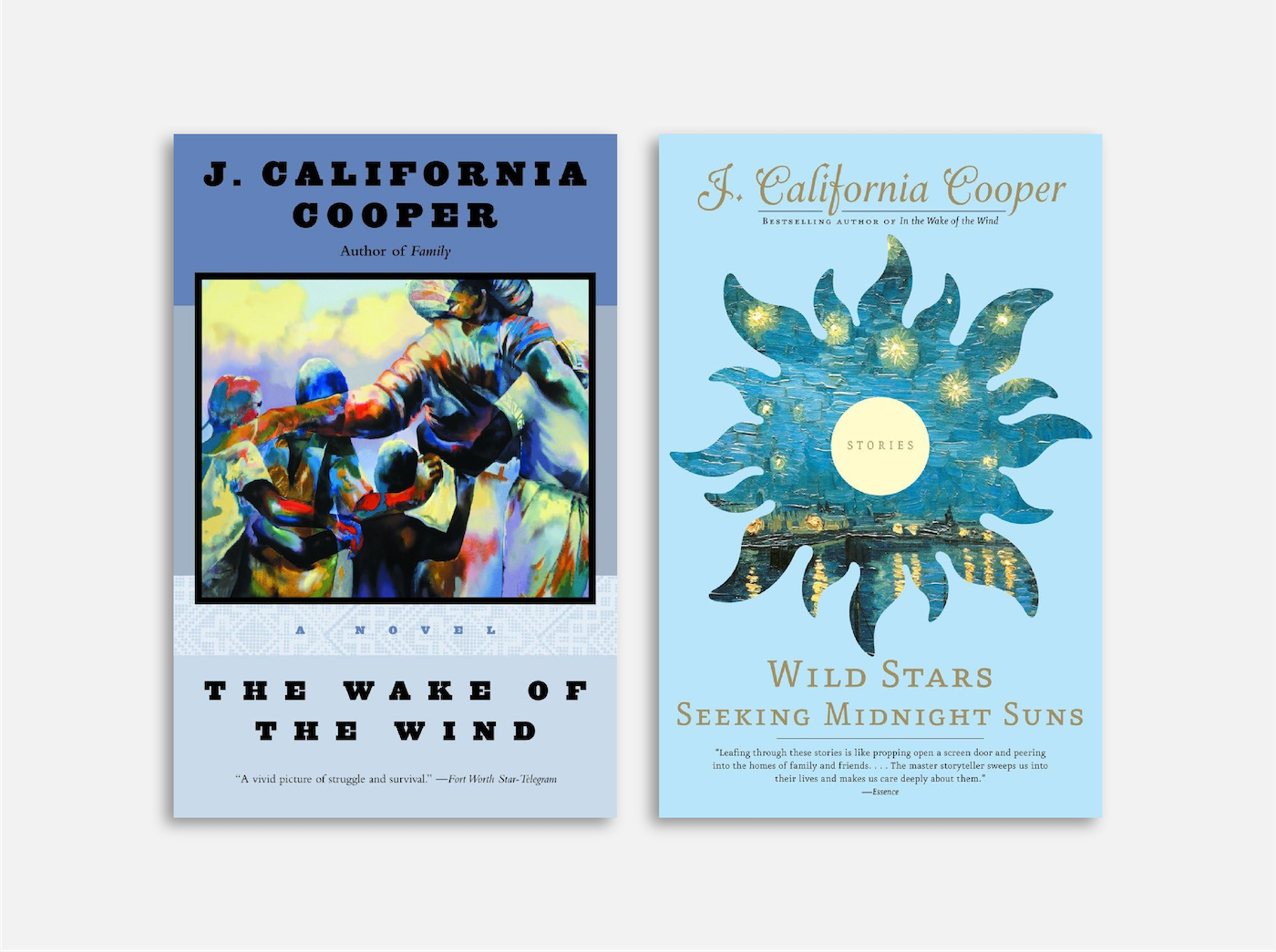
Her later fiction continued to widen the field. Publisher materials and literary profiles credit her with a substantial bibliography: story collections including Some Soul to Keep, The Matter Is Life, Some Love, Some Pain, Sometime, The Future Has a Past, Wild Stars Seeking Midnight Suns, and Catch a Falling Heart; novels including In Search of Satisfaction, The Wake of the Wind, Some People, Some Other Place, and Life Is Short But Wide. Taken together, they form a body of work more expansive than many casual readers realize, and one that kept returning to a central proposition: that so-called ordinary Black lives contain the whole drama of human existence.
Writing Black women without asking permission
It has become almost obligatory in literary criticism to say that a writer “centered Black women.” The phrase can be true and still too weak for the work. Cooper did not merely center Black women; she trusted them as narrators of reality. That is a more radical thing.
Many of her stories place Black women in conditions of emotional duress, economic precarity, romantic disappointment, or social diminishment. But she writes them with an authority that refuses both sentimental rescue and sociological flattening. They can be contradictory. They can make bad choices. They can laugh at the wrong moment, forgive too much, misjudge a man, save a household, carry generations, and still not be reduced to symbols of resilience. Cooper understood something that literary culture still struggles with: Black women’s interior lives are not niche material. They are world-making material.
That sensibility helped her build a readership that was loyal, almost protective. Readers recognized themselves in her work, or recognized their mothers, cousins, church friends, neighbors, ex-husbands, grandmothers, and the folks who always had one more story to tell before they let you leave the porch. But recognition alone is not why her books lasted. Plenty of writers get described as relatable. Cooper lasted because she could convert recognition into literature. She could make a familiar type strange again, not by exoticizing it, but by revealing its hidden moral weather.
There is also a formal politics in her use of voice. American literary culture has long rewarded Black writers who can translate themselves upward into the idiom of prestige while underrewarding those who preserve local speech without apology. Cooper’s work resists that bargain. The oral energy of her stories is not decorative local color; it is the engine of thought. Her narrators think in the music available to them, and that music is intelligent, layered, and emotionally exact. When critics compared her work to folktales or parables, they were not wrong, but they sometimes underplayed how modern and formally shrewd she was. Cooper knew what she was doing with repetition, timing, and tonal turns. She knew how to make a sentence pivot from comic observation to devastating judgment in a few beats.
The argument inside the style
Cooper’s fiction is sometimes described as warm. It is warm. It is also sharp, unsparing, and occasionally merciless. Warmth, in her hands, is not softness. It is proximity. She writes close enough to her characters that they can condemn themselves through what they say, or redeem themselves through what they finally learn to see.
This is one reason her work can provoke such strong reader responses. Some readers find the moral architecture consoling; others find it too explicit. But that debate can obscure the deeper point: Cooper was never pretending to occupy a position of ironic neutrality. She believed fiction could say something about how to live. That belief has often been unfashionable in periods when the literary marketplace favored cool detachment, ambiguity as an end in itself, or the performance of sophistication through emotional withholding. Cooper had no interest in that game. She was interested in justice, foolishness, cruelty, accountability, tenderness, and the old, difficult question of whether people can change.
Her 2013 interview in Mosaic is revealing on this point. The exchange captures a writer who sounded weary of being asked to over-explain her process, yet still unmistakably grounded in a practical, unsentimental understanding of craft and character. The portrait that emerges is of a woman with a “clear, no nonsense voice laced with a special wisdom,” which is also a fair description of many of her narrators.
That no-nonsense quality may help explain why her books still feel contemporary. We are living in a period saturated with performance, branding, and grand declarations about authenticity. Cooper’s work, by contrast, feels uninterested in self-mythology. It is attentive to people rather than posture. In an era when many readers are once again drawn to fiction that can name structural violence without abandoning emotional immediacy, Cooper’s writing feels not dated but newly available.
A writer’s writer, a reader’s writer
One of the odd things about literary history is how often it separates “writer’s writers” from “popular writers,” as though technique and accessibility were opposites. Cooper troubles that division. She was, in the best sense, both. Fellow writers admired the command in her voice. Ntozake Shange praised the truthfulness and musicality of her stories. Alice Walker championed her early and publicly. Other authors and critics have continued to invoke her as an exemplar of how vernacular storytelling can achieve literary force without surrendering readability.
At the same time, Cooper was deeply legible to ordinary readers. Her books circulated not only in classrooms and literary conversations but also among people who simply wanted a good story told by somebody who sounded like she knew life from the inside. That accessibility has sometimes worked against full canonization; American institutions still have a habit of mistaking difficulty for depth and plainness for ease. But Cooper’s continued reprinting by major publishers and her persistence in reading communities suggest that the shelf life of readerly love may be longer than the shelf life of academic fashion.
Her work also traveled across media. “Funny Valentines,” from Homemade Love, was adapted for television by Julie Dash for BET, a reminder that Cooper’s stories carried dramatic possibilities beyond the page and that filmmakers, too, recognized the vividness of her characters and situations.
What she offered readers was not simply plot, though she could certainly tell a story. She offered company. Not comfort exactly, because many of her books contain severe pain, but company of a rare sort: the sense that someone on the page understood the mess of wanting love in an unjust world. She understood that people embarrass themselves. She understood that they lie. She understood that they endure things they should never have had to endure. And she understood that, still, they joke, flirt, remember, gossip, grieve, and keep moving.
“Cooper’s work resists the old bargain that asks Black writers to translate themselves upward for elite approval.”
Why she matters now
J. California Cooper died in Seattle on September 20, 2014, at 82, according to her daughter, Paris Williams, after a period of illness and heart failure. Obituaries marked her as a prolific writer whose fiction illuminated African American life and especially the struggles and strengths of Black women. That is true, and yet the phrasing can make her sound narrower than she was. Cooper is not important only because she represented Black women’s lives; she is important because she expanded what American literature could sound like while doing so.
She matters now because the contemporary literary conversation has finally caught up, at least in part, to values she embodied decades ago. There is broader critical recognition that oral tradition is not secondary to literary tradition but one of its engines. There is more willingness to see Black women’s domestic, emotional, and communal realities as central rather than peripheral. There is more curiosity about writers who worked across genre and audience. Cooper anticipated these shifts without waiting for them.
She also matters because she offers a corrective to a narrow understanding of seriousness. Too often, serious literature is imagined as austere, detached, linguistically intimidating, or emotionally withholding. Cooper reminds us that seriousness can arrive in a story that sounds like it was told on a front porch. That humor can coexist with terror. That wisdom can be colloquial. That readability is not capitulation. That moral urgency need not come wrapped in abstraction.
And she matters because her work remains useful, in the richest sense of that word. Useful to readers trying to think about love beyond cliché. Useful to writers trying to understand voice. Useful to teachers introducing students to Black vernacular traditions in prose. Useful to anyone interested in how literature holds communities together across time. Useful, too, as a record of what Black women writers have had to do to be heard in a culture that often prefers their labor to their authority.
If there is any injustice in the way Cooper is remembered, it is not that she is forgotten; dedicated readers, writers, and Black literary communities have kept her very much alive. It is that she is sometimes remembered too small, as merely beloved, merely wise, merely accessible, merely “folksy.” She was all of those things, and more. She was an architect of voice. A dramatist who never stopped listening. A moral storyteller who understood that judgment without compassion is cheap, and compassion without judgment is sentimental. A writer who could make the room laugh and then, in the next breath, make it go still.
The legacy of saying it plain
The temptation, when writing about an author like Cooper, is to end with uplift. She would probably have understood the temptation and distrusted it a little. Her fiction is too alert to contradiction for that. So it is better to say this plainly: J. California Cooper left behind a body of work that deserves not just affection, but sustained study; not just occasional tribute, but continual rereading.
She belongs in the conversation about major American short-story writers. She belongs in the conversation about Black women novelists who reimagined historical narration. She belongs in the conversation about playwrights whose dramatic instincts sharpened their prose. And she belongs in the conversation about writers who resisted the pressure to overcomplicate what they knew in their bones.
She once seemed to many readers like a singularity, and in some ways she remains one. But perhaps the better way to see her is as part of a broad Black tradition of telling that values music, witness, morality, gossip, memory, humor, and the right to opacity. She did not arrive from nowhere. She extended a line. She altered it. She made room inside it.
That may be the deepest measure of Joan California Cooper’s significance. She trusted the voices she came from. She trusted the people on whom polite literary culture often looks past. She trusted that the lives of Black women, poor folks, working folks, hurt folks, hopeful folks, and complicated folks were not minor subjects but major human material. Then she built a literature to prove it.
And she did it in a voice that, once heard, is very hard to mistake. pull-quote placement for publication layout.
More great stories

Afro Sheen, Wall Street, and the Architecture of Black Possibility
July 6, 2026
No Comments
The Fire Inside the Fourth
July 5, 2026
No Comments