




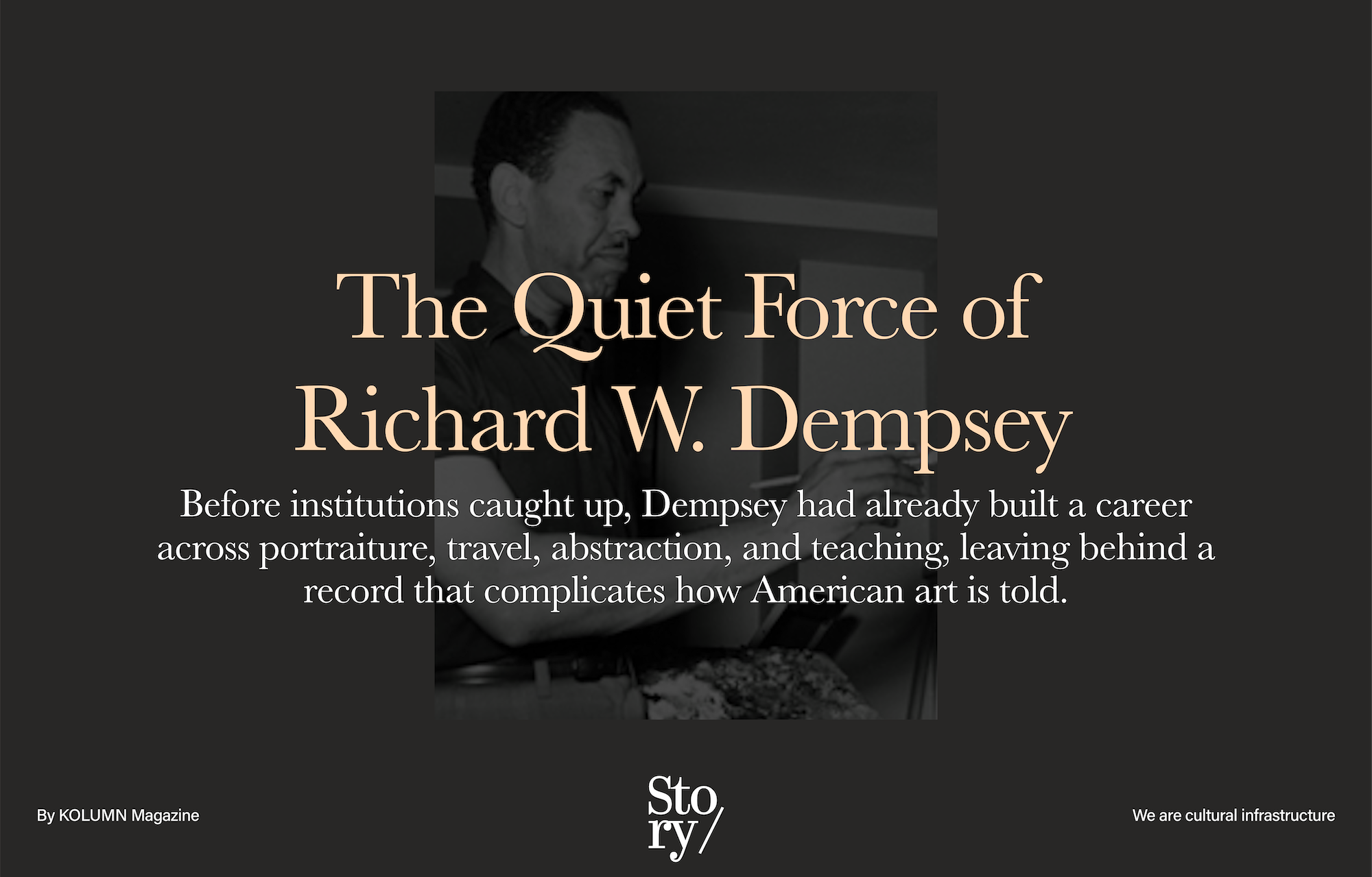
Richard W. Dempsey did not choose between Black portraiture and abstraction. He insisted they belonged to the same artistic intelligence.
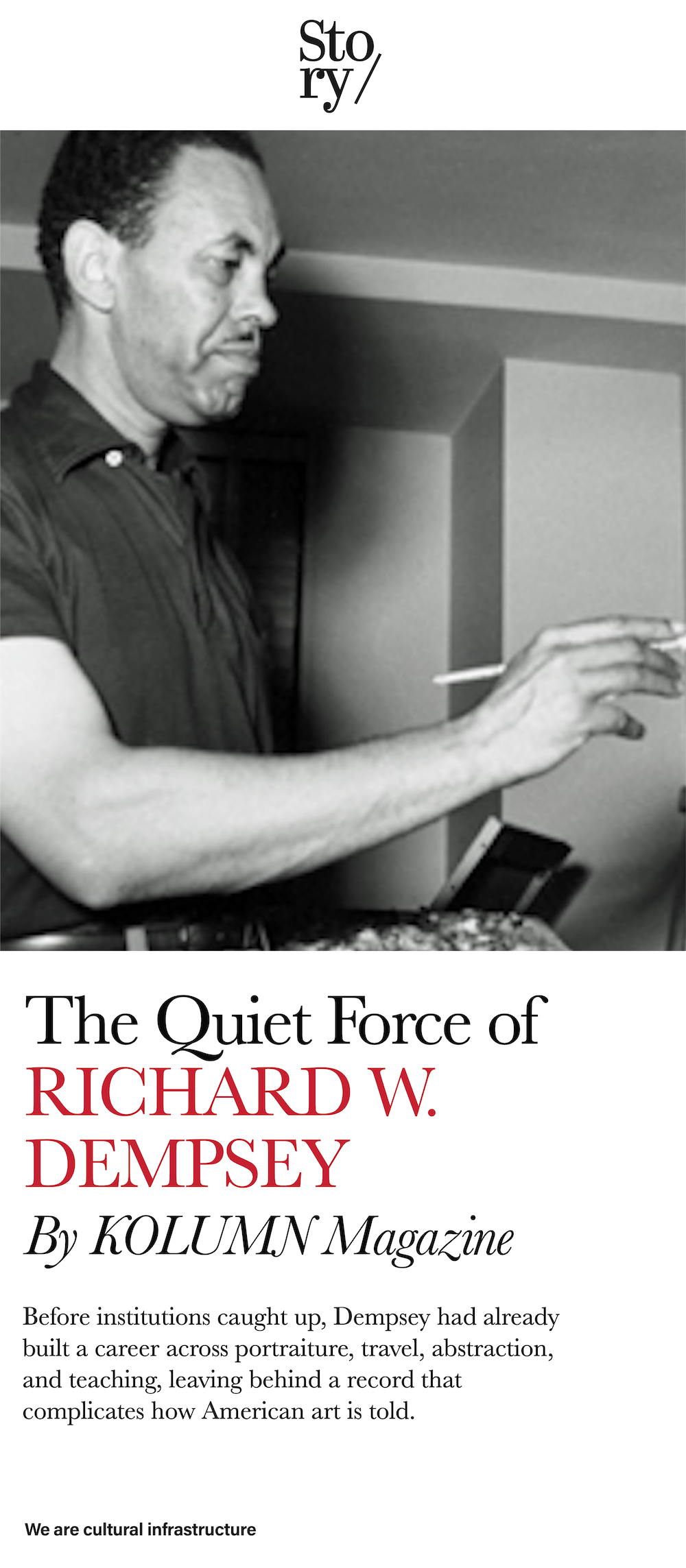
Richard W. Dempsey did not choose between Black portraiture and abstraction. He insisted they belonged to the same artistic intelligence.
By KOLUMN Magazine
In the tradition of KOLUMN’s recent artist appreciations, Richard W. Dempsey belongs to the category of figure who should have been impossible to overlook and yet, for decades, was too often handled as a specialist’s name rather than a central American one. That gap between achievement and recognition is not incidental to his story. It is the story. Dempsey was born in Ogden, Utah, in 1909, came of age in Oakland, trained in California, moved to Washington in 1941, studied further at Howard University, taught art, worked for the federal government, exhibited widely, earned a Julius Rosenwald Fellowship, won purchase awards, and built a body of work that ranged from portraits of prominent Black Americans to increasingly searching abstractions shaped by travel in Haiti, Jamaica, Mexico, and the U.S. South. His work now sits in major institutional collections, including the Smithsonian American Art Museum and the National Gallery of Art, and his papers are preserved by the Archives of American Art.
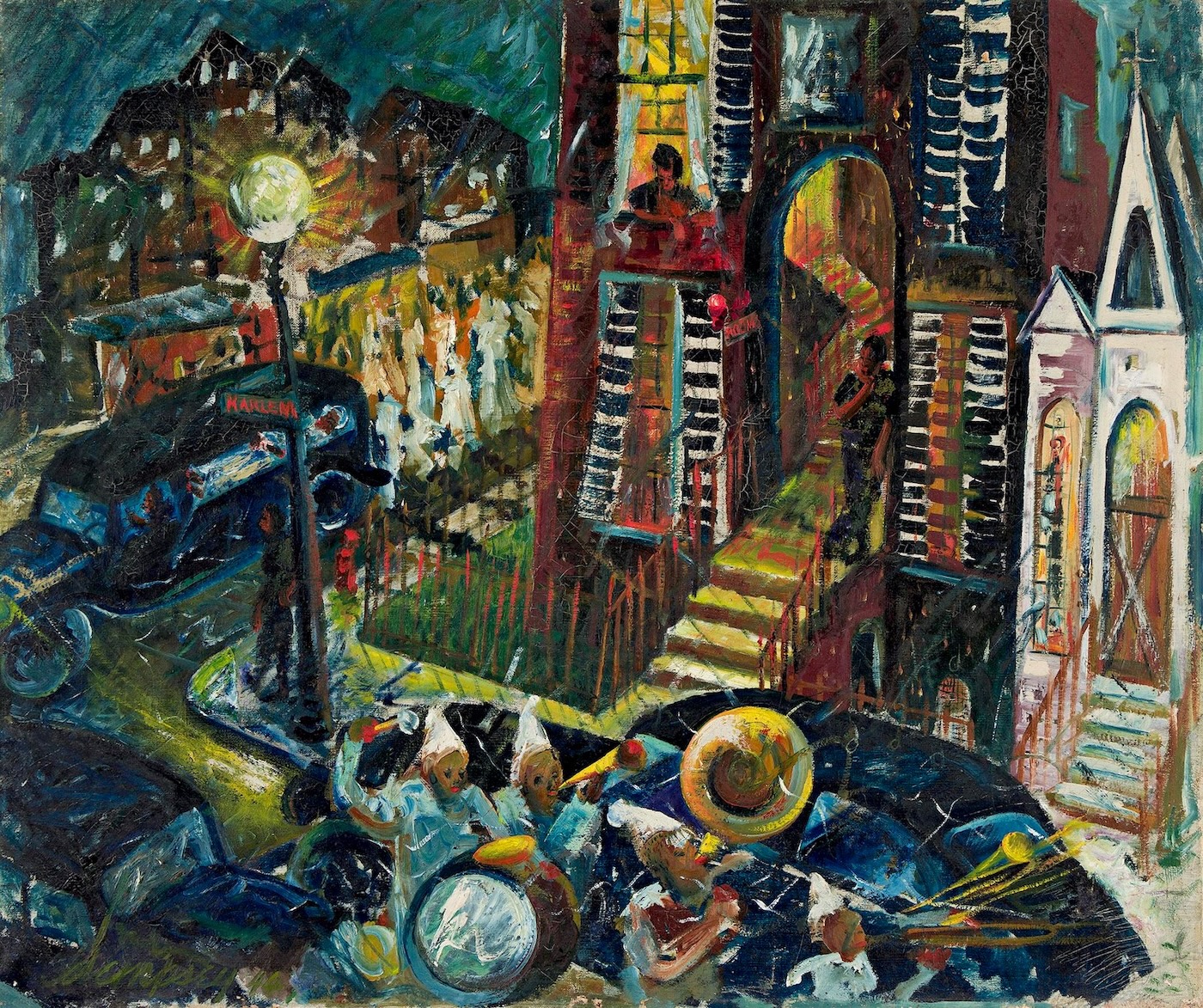
Even that summary, though, can make Dempsey sound more neatly categorized than he was. He was not simply a “Black portrait painter,” though he painted Black excellence with force and seriousness. He was not simply an “abstract expressionist,” though abstraction became a crucial idiom for him. He was not simply a Washington artist, though Washington gave him professional footing and institutional proximity. He was, more usefully, one of those artists whose career exposes the falseness of tidy separations between documentary and imaginative art, between race-conscious representation and formal experiment, between public service labor and private artistic ambition. Dempsey’s life moved across those lines again and again. That mobility is what makes him significant now.
A life built across geographies
Richard William Dempsey was born on September 14, 1909, in Ogden, Utah, but his formation as an artist was inseparable from Oakland, where he spent his youth. The official and semi-official record is strikingly consistent on this point: Sacramento Junior College, then the California School of Arts and Crafts, then the Students Art Center, with early solo exhibitions in Oakland and San Francisco before his eventual relocation east. This matters because it places him within a West Coast training ecology that art history has often undervalued when telling the story of Black modernism. Too many accounts still jump from Harlem to Chicago to New York, with Washington entering only through Howard or postwar bureaucracy. Dempsey complicates that map. His early visual education was California-made, modern, and eclectic.
By the mid-1930s, Dempsey had already begun exhibiting his work. Sources tied to gallery and institutional histories note a first one-man show in Oakland in 1935 and three more exhibitions in San Francisco before he moved to Washington, D.C., in 1941 to work as a draftsman with the Federal Power Commission. That move is easy to describe as pragmatic, but it also placed him in one of the most important Black intellectual and artistic centers in the country. Washington was not merely where Dempsey found stable employment. It was where his practice entered fuller conversation with Black institutional life, Black patrons, Black educators, and Black exhibition networks.
That Washington chapter is central. At Howard University, Dempsey continued his studies and is associated in the record with James Lesesne Wells; other sources also connect him with instruction from artists including Sargent Johnson, Maurice Logan, Raymond Strong, Katherine Gans, Edward Leslie, and Sidney Lemos. The full roster suggests something essential about him: he did not belong to a single narrow lineage. He was shaped by academic study, Black artistic mentorship, public-sector design labor, and direct contact with modernist currents on both coasts. In Washington, he would also become part of a Black art infrastructure that included the Barnett-Aden Gallery, a historic venue that helped sustain Black artists when mainstream institutions were still segregated in practice, even when not in policy.
The federal artist, the working artist
There is a temptation, when writing about painters, to romanticize only the studio and the canvases. Dempsey’s life resists that. He worked for the federal government, first as a draftsman and later, according to National Gallery and collection-based accounts, in graphics and visual information roles associated with the General Services Administration. One source notes that he effectively carried on a double career: independent creative artist and commercial or governmental visual professional. The phrasing is useful because it names a reality common to many mid-century Black artists. Stability did not diminish seriousness. The paycheck was not a footnote to the art. It was often the condition that made the art possible.
The Washington Post obituary from 1987 captures the public-facing version of this life in compressed form. It describes Dempsey as a Washington artist whose paintings included portraits of Duke Ellington, Joe Louis, and Thurgood Marshall, and abstract impressions drawn from what he had seen in Washington’s inner-city slums as well as Africa and Central America. That framing, however brief, is revealing. It shows a career perceived not as a static specialty but as a broad visual enterprise: portraitist, observer, traveler, interpreter of social conditions, and abstract painter. It also points to the elasticity of his subject matter. Dempsey could move from the iconic individual to the charged atmosphere of place.
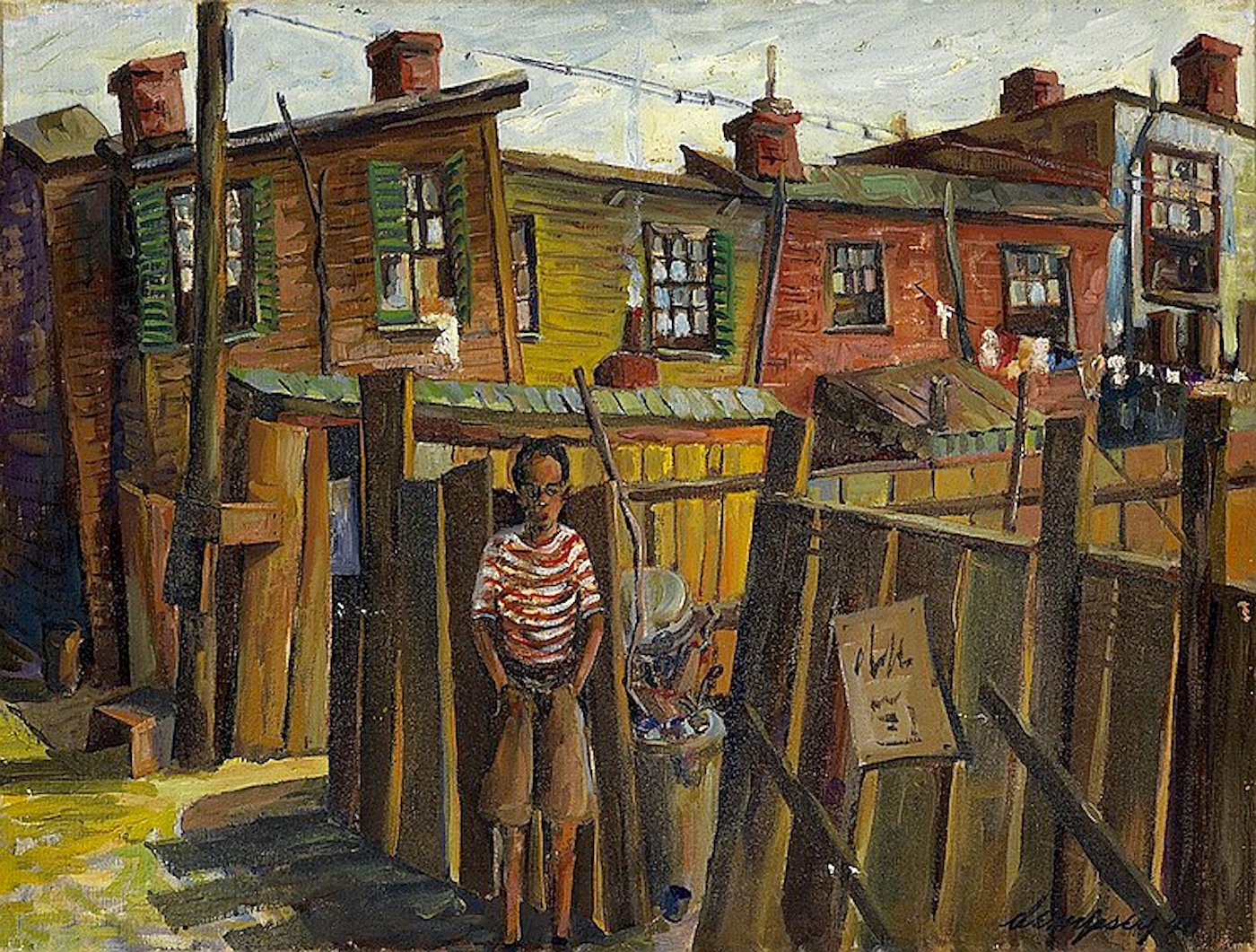
This matters because so much of Black art history has been narrated through false binaries. Figurative work has often been treated as socially legible and therefore politically useful, while abstraction has been treated as private, elite, or detached. Dempsey’s record contradicts that split. His abstract language did not mark an exit from Black life. It marked another means of processing it. If a portrait could honor the stature of Ellington or Marshall, abstraction could register weather, motion, memory, pressure, or the psychic residue of travel and urban encounter. His work suggests that Black representation includes not only the face but the field around the face, not only the body but the mood, tempo, and fracture of the world the body inhabits. That is a modernist proposition, but it is also a political one.
The Rosenwald Fellowship and the politics of portraiture
One of the defining facts of Dempsey’s career is his 1946 Julius Rosenwald Fellowship. Multiple sources confirm that the award supported a series of paintings of notable Black Americans. The Johnson Collection’s summary is especially pointed, identifying the project as the creation of one hundred portraits of prominent Black historical figures and listing some of the names associated with that undertaking: Ethel Waters, Duke Ellington, Thurgood Marshall, Joe Louis, Adam Clayton Powell, and Jacob Lawrence. Another source places Dempsey among a remarkable fellowship company that included Augusta Savage, Charles Alston, Richmond Barthé, Selma Burke, Aaron Douglas, Elizabeth Catlett, and others. The fellowship does not just confer prestige. It locates Dempsey inside one of the most meaningful patronage structures in twentieth-century Black art.
Portraiture in this context was not merely commemorative. It was corrective. To paint Black leaders, artists, and public figures in the 1940s was to participate in an argument about national visibility. Who belonged in the visual record of the United States? Who deserved formal dignity, painterly attention, and circulation through exhibitions, institutions, and reproduced images? Dempsey’s fellowship project answered those questions not with manifesto but with production. He painted into being a counter-archive of American importance. That matters all the more because portraiture was a medium the broader public could read instantly, which meant it could travel across educational, class, and institutional boundaries more easily than many forms of abstraction.
At the same time, the Rosenwald-funded portrait project should not reduce Dempsey to historical utility. Too often Black artists become legible to institutions first through service: who they documented, whom they uplifted, how they contributed to the race. Dempsey did all of that. But the work also had formal stakes. Portraiture is never only about likeness. It is about authority, mood, surface, spatial decisions, and the relation between sitter and painter. A portrait of Ellington or Marshall is not neutral because the subject is famous. It is an encounter between the artist’s eye and public iconography. Dempsey’s significance lies partly in how he moved through that encounter without getting trapped there. He knew how to paint eminence, and then he kept pushing beyond it.
Washington, Black institutions, and artistic fellowship
It is difficult to understand Dempsey apart from Washington’s Black cultural ecosystem in the mid-twentieth century. The city offered him proximity to Howard, to Black-owned galleries, to federal employment, and to a network in which artists, educators, civil-rights thinkers, and cultural workers moved in overlapping circles. Sources connect him to the Barnett-Aden Gallery and to teaching roles at the Corcoran School of Art and Glen Echo Park. His 1968 retrospective at Howard University, documented in his exhibition record, is especially telling. Retrospectives are statements. They announce not promise but achievement, not emergence but an already substantial body of work. By then, Dempsey had been building for decades.
The Howard retrospective also hints at a structural pattern in Black art history: many Black artists received their most serious institutional acknowledgment first from Black institutions or regional ones rather than from the national museums that later claim them. Howard did not “discover” Dempsey; it recognized one of its own artistic interlocutors. Barnett-Aden did not add legitimacy to an untested artist; it provided a venue where legitimacy could circulate on Black terms. This distinction matters because it resists the familiar storyline in which artists become real only once white-majority institutions certify them. Dempsey’s career had its own internal architecture of validation long before the mainstream caught up.
That history is also why Dempsey’s relative obscurity today feels less like an accident than an index of how canon formation works. He exhibited, taught, won awards, held a retrospective, traveled internationally, and produced work now housed by major institutions. Yet he is still more often encountered in archive listings, specialist galleries, and auction databases than in broad public conversations about American modernism. The issue is not lack of accomplishment. It is selective remembrance. Black modernists who move between representation and abstraction, and who do much of their work outside New York-centered mythologies, are especially vulnerable to being flattened or sidelined. Dempsey belongs squarely in that category.
Travel as transformation
Among the most vivid recurring details in the source record is Dempsey’s extensive travel. Accounts cite trips to Haiti, Jamaica, Mexico, North Carolina, South America, and, in one obituary summary, Africa and Central America. The National Gallery’s Corcoran catalogue entry notes that the government of Haiti invited him to visit and paint there in 1951. Exhibition records show solo shows tied to Haiti and Jamaica. Gallery biographies emphasize the importance of Caribbean color to his later work. This pattern is too consistent to ignore. Travel was not ornamental to Dempsey’s practice. It was catalytic.
For Black American artists of Dempsey’s generation, travel could perform several functions at once. It could offer formal release from the visual habits of U.S. realism. It could create contact with other Black worlds beyond the American racial order. It could complicate the idea that modernism was imported chiefly from Europe. In Dempsey’s case, the Caribbean appears less as picturesque subject matter than as chromatic and structural provocation. One gallery description, though promotional in tone, puts it well enough to be useful: his sensitivity to color was heightened by frequent trips to Jamaica and Haiti. That language aligns with the broader arc visible in the works and records that survive.
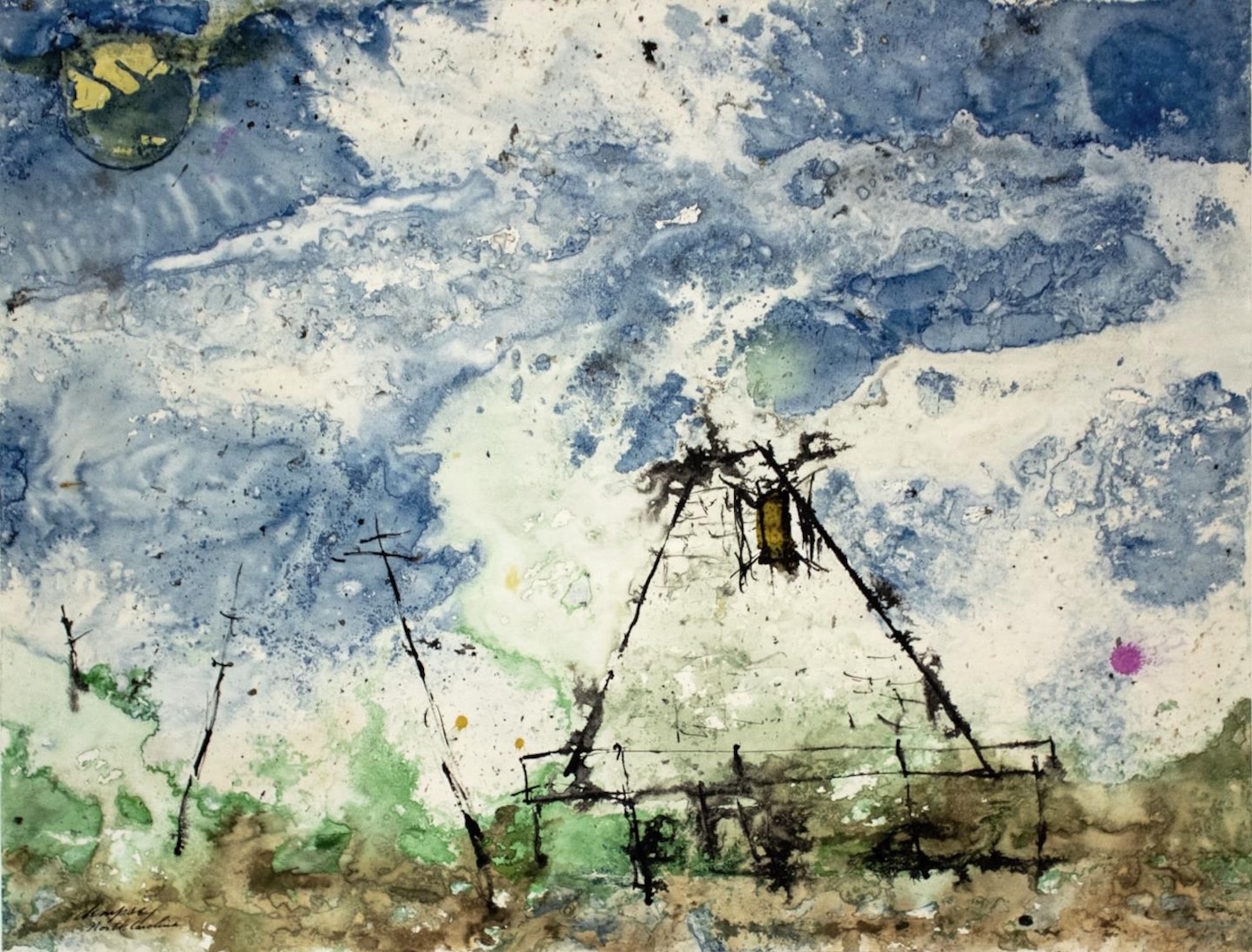
This is where Dempsey becomes particularly contemporary. He belongs to a lineage of Black artists for whom diasporic encounter changed not just content but method. The point was not merely to paint another location. It was to allow another location to reorganize the picture plane. That reorganization can be felt in works associated with landscape, cityscape, weather, and abstraction. Even when his paintings retain vestiges of architecture or terrain, they often seem pulled toward sensation first and description second. The eye is asked to move through rhythm, saturation, and force rather than through stable narrative. That is not escapism. It is a way of picturing what it feels like for place to act upon consciousness.
One can see the spectrum of this impulse in the fragmentary public record of works: a 1940 pastel now in the Smithsonian American Art Museum titled simply Untitled and categorized as abstract; the National Gallery’s Meditation from 1945; later works and auction-catalog references that point to Jamaican scenes, Mexican mountains, Cape Hatteras storms, North Carolina houses, cityscapes, and fully nonobjective abstractions. Even allowing for the limitations of auction language and uneven documentation, the through line is clear. Dempsey painted the world as something unstable, weathered, kinetic, and emotionally charged.
From likeness to atmosphere
To say Dempsey evolved from portraiture to abstraction oversimplifies the matter. It suggests a clean progression from one phase to another, as if he abandoned the human figure for pure form. The available evidence points to something more layered. The Washington Post obituary places portraiture and abstraction side by side, not in sequence. Gallery and collection texts describe a painter whose work “skewed abstract” even while acknowledging his portraits of notable Black Americans. His practice seems less like a ladder and more like a braid: figuration, landscape, social observation, travel painting, and abstraction continually informing one another.
This is one reason Dempsey merits fuller critical attention. American art history often likes artists who can be described in a single phrase. Dempsey makes that difficult. He is not easy to package as solely regional, solely racial-documentary, solely abstract, or solely institutional. But that difficulty is exactly what makes him useful to a present-day rethinking of the canon. He demonstrates that Black artists were never merely entering modernism from the outside. They were already remaking its terms from within, often while carrying burdens of representation that white peers did not have to carry in the same way. Dempsey could paint public Black greatness and still insist on the rights of formal experiment.
Even the surviving institutional works suggest a mind unwilling to settle. SAAM’s Untitled from 1940, a pastel on paper, is designated abstract and predates many of the later travel-inflected descriptions that dominate secondary accounts. The National Gallery’s Meditation from 1945, rendered through scraping on a black ground, implies a very different tactile and tonal inquiry. These are not the records of an artist who stumbled late into abstraction. They indicate someone already probing nonliteral visual form while still participating in portrait and representational traditions.
Awards, exhibitions, and the measure of a career
There is also the matter of professional recognition. Sources credit Dempsey with a medal at the Golden Gate Exposition in 1940, the Rosenwald Fellowship in 1946, a purchase award at Atlanta University in 1951, and a Corcoran purchase award connected to area exhibitions in the 1950s. Exhibition histories list solo shows in Washington, Haiti, Jamaica, Colombia, and at the International Monetary Fund, among other venues. The Corcoran catalogue notes that a retrospective of fifty-six oils and watercolors was held at Howard in 1968. Read together, these facts describe not a minor sideline painter but an artist with sustained visibility, institutional circulation, and a durable work ethic.
Recognition, however, is not the same thing as permanence in the public imagination. Mid-century Black artists often received awards and local acclaim only to be omitted from the next generation’s textbooks, museum walls, and survey courses. Their reputations survived in community memory, family archives, regional collectors, and specialist dealers, while the larger market and the larger academy moved on. Dempsey’s posthumous condition bears this out. Today he appears in serious institutional holdings, archival finding aids, collection guides, and auction records, but he is not yet a household reference point in the way many lesser white modernists are. That imbalance is one of the clearest arguments for returning to him.
Why Dempsey matters now
So why Richard W. Dempsey now? Because contemporary readers are better positioned than earlier generations to see the full scale of what his career represented. We are living in a period of canon repair, archive retrieval, and renewed argument over who counts as foundational in American art. Dempsey fits this moment not because he is newly invented, but because the frameworks that once minimized him are finally under pressure. A Black artist who worked across portraiture, abstraction, travel painting, public employment, and teaching is no longer an awkward fit for the story. He is the story.
He also matters because he unsettles the appetite for easily consumable rediscovery. Dempsey is not a single “lost masterpiece” waiting to be turned into a museum slogan. He is a career artist. The value lies in duration, range, and persistence. He made work in Oakland and Washington. He painted eminent Black figures and unnamed abstractions. He participated in Black institutional life while maintaining federal employment. He absorbed Haiti, Jamaica, Mexico, and the Carolina coast into an expanding visual vocabulary. He taught. He exhibited. He kept going. That kind of life is less cinematic than a tragic prodigy’s arc, but it may tell us more about how American art was actually built..
And then there is the work itself, or at least the work as glimpsed through institutions and records. It insists on a painter interested in structure but not rigidity, color but not prettiness, atmosphere but not vagueness. Even when the titles are sparse or the documentation incomplete, the surfaces suggest emotional weather. Dempsey seems drawn to thresholds: between figure and field, street and memory, architecture and rhythm, description and pulse. That sensibility gives the work a continued charge. It does not feel frozen in historical obligation. It feels alive to instability, which is one reason it still speaks.
The archive, the afterlife, and the unfinished reckoning
The existence of the Richard Dempsey papers at the Archives of American Art is not a minor detail. Archives are one of the places where art history decides whether an artist will remain anecdotal or become legible for sustained scholarship. His papers, dating from 1929 to 1989 with bulk material from the 1960s through the 1980s, mean that Dempsey’s life is not inaccessible. It is researchable. That is a crucial distinction. The challenge now is not the total absence of evidence. It is the labor of synthesis, interpretation, exhibition, and publication. Institutions have pieces of the puzzle. The fuller narrative still has to be assembled and argued.
There is honesty required here. The source base presently available in public view leans more heavily on institutional biographies, collection catalogues, archival records, and a contemporaneous Washington Post obituary than on long-form national newspaper criticism. That absence tells its own story. Dempsey was working, showing, winning, and teaching in an era when many Black artists were still denied the depth of critical attention routinely granted elsewhere. It would be wrong to pretend the record is fuller than it is. But it would be equally wrong to mistake that uneven record for a measure of his worth.
In fact, part of Dempsey’s significance lies precisely in how he illuminates the limits of mainstream cultural memory. His career asks us to think about the artists who were visible enough to matter in their own moment, yet not absorbed securely into national art mythology. He was collected, awarded, taught, archived, and exhibited internationally. Still, he remains underdiscussed. That is not a contradiction. It is the ordinary result of an art world that has long separated importance from publicity and Black accomplishment from durable canonization.
KOLUMN ‘s perspective
Richard W. Dempsey should be understood as more than a rediscovered Black painter deserving a respectful footnote. He should be read as an American modernist whose career helps redraw the map of twentieth-century art. His biography links Utah, Oakland, Washington, Howard, Barnett-Aden, the federal government, the Caribbean, and the Black institutional world that sustained serious art-making outside the glare of dominant taste. His practice links portraiture to abstraction without treating one as noble duty and the other as personal luxury. His record shows how Black artists built ambitious careers through discipline, travel, teaching, and relentless production, often without the historical reward their labor warranted.
If American art history is serious about broadening itself, Dempsey is not a peripheral inclusion. He is a test case. Can the field make room for artists whose careers were institutionally real, aesthetically adventurous, racially grounded, and geographically multiple? Can it tell a story of modernism that does not require Black artists to choose between representation and formal innovation in order to be legible? Can it recognize that a painter who spent thirty years in government service might still be one of the more revealing artistic figures of his generation? Dempsey forces those questions, and that is reason enough to return to him.
What remains, then, is not just tribute but work. Curators could mount a serious retrospective that places the portrait project, the travel paintings, and the abstractions in conversation rather than in sequence. Scholars could use the archival papers to reconstruct networks, patrons, correspondences, and exhibition histories that would clarify his place in Black and American art. Editors could stop treating artists like Dempsey as episodic recoveries and begin writing them into the main text. Until then, Richard W. Dempsey will remain what he has been for too long: an artist whose career is documented enough to prove his importance, but not yet narrated enough to secure it.
And perhaps that is the sharpest way to end: Richard W. Dempsey was never marginal to the making of Black modern art. He was made marginal by the habits of remembrance that shaped the field around him. The paintings, the awards, the teaching, the archive, the museum holdings, the obituary record, and the exhibition history all say the same thing. He was here. He worked. He mattered. The question now is whether the rest of American culture is ready to say it with the same confidence his life already earned.
More great stories
Afro Sheen, Wall Street, and the Architecture of Black Possibility
July 6, 2026
No Comments
The Fire Inside the Fourth
July 5, 2026
No Comments