




He devoted your life to how all of these riches could advance the cause and legacy of your father, your mother and your family.
He devoted your life to how all of these riches could advance the cause and legacy of your father, your mother and your family.
By KOLUMN Magazine
There are some American inheritances so large they almost cease to look like inheritances at all. They become weather systems. They become monuments, arguments, school lessons, postage stamps, federal holidays, museum wings, sermon illustrations and political shorthand. Martin Luther King Jr. is one of those inheritances. To be born into that name was to enter a country that felt it knew your father already, and therefore felt it knew something about you. Dexter Scott King spent his life resisting that simplification even as he accepted the work it imposed. He was not his father’s replica, not his father’s rhetorical double, not the second coming of a movement. He became, instead, something more modern and in its own way more revealing: a steward, a strategist, a guardian of meaning in the age of commodified memory.
When Dexter King died on January 22, 2024, at his home in Malibu after battling prostate cancer, he was 62 years old, still serving as chairman of the King Center and as president of the King estate. The official statements and subsequent memorial coverage returned to one phrase again and again: protector. That word matters. It suggests both devotion and burden. A protector has to love the thing being protected, but also police its borders. In Dexter King’s case, that meant defending not merely a father’s reputation but a body of speeches, papers, images, symbols and moral authority that had become part of the American civic canon and, at the same time, an object of relentless public consumption.
That is why Dexter King deserves more precise consideration than the generic obituary language that often trails the children of famous men. He was an activist, yes, but not in the narrow sense that usually supplies dramatic copy. His activism was institutional. His field of contest was often archival, legal, financial and interpretive. He helped shape the way the King family understood ownership, the way Atlanta held onto Martin Luther King Jr.’s papers, the way the public accessed the civil rights leader’s words, and the way the family’s moral capital was translated — sometimes elegantly, sometimes controversially — into organizational control. He was a public son in a private war over history itself.
Born into a symbol
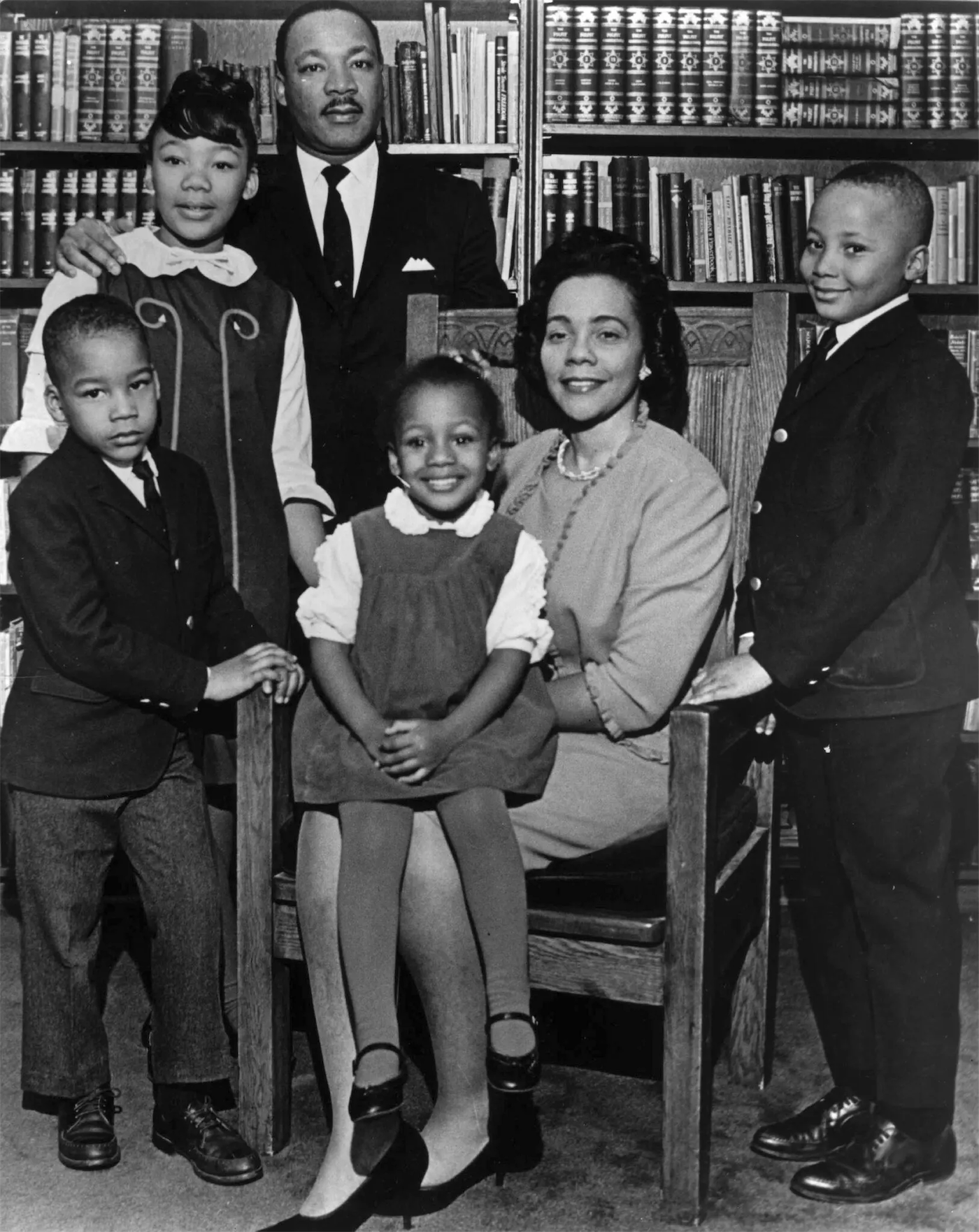
Dexter Scott King was born on January 30, 1961, the third of four children of Martin Luther King Jr. and Coretta Scott King. He was named for Dexter Avenue Baptist Church in Montgomery, the church where his father had served before the bus boycott vaulted him onto the national stage. That biographical detail can sound ornamental, but it is more than that. It tied the child to a geography of movement history before he could possibly understand it: Montgomery, Atlanta, Ebenezer, the South, the pulpit, the march, the unfinished job. He was seven when his father was assassinated in Memphis in 1968. The event that made Martin Luther King Jr. immortal also ended Dexter King’s ordinary childhood.
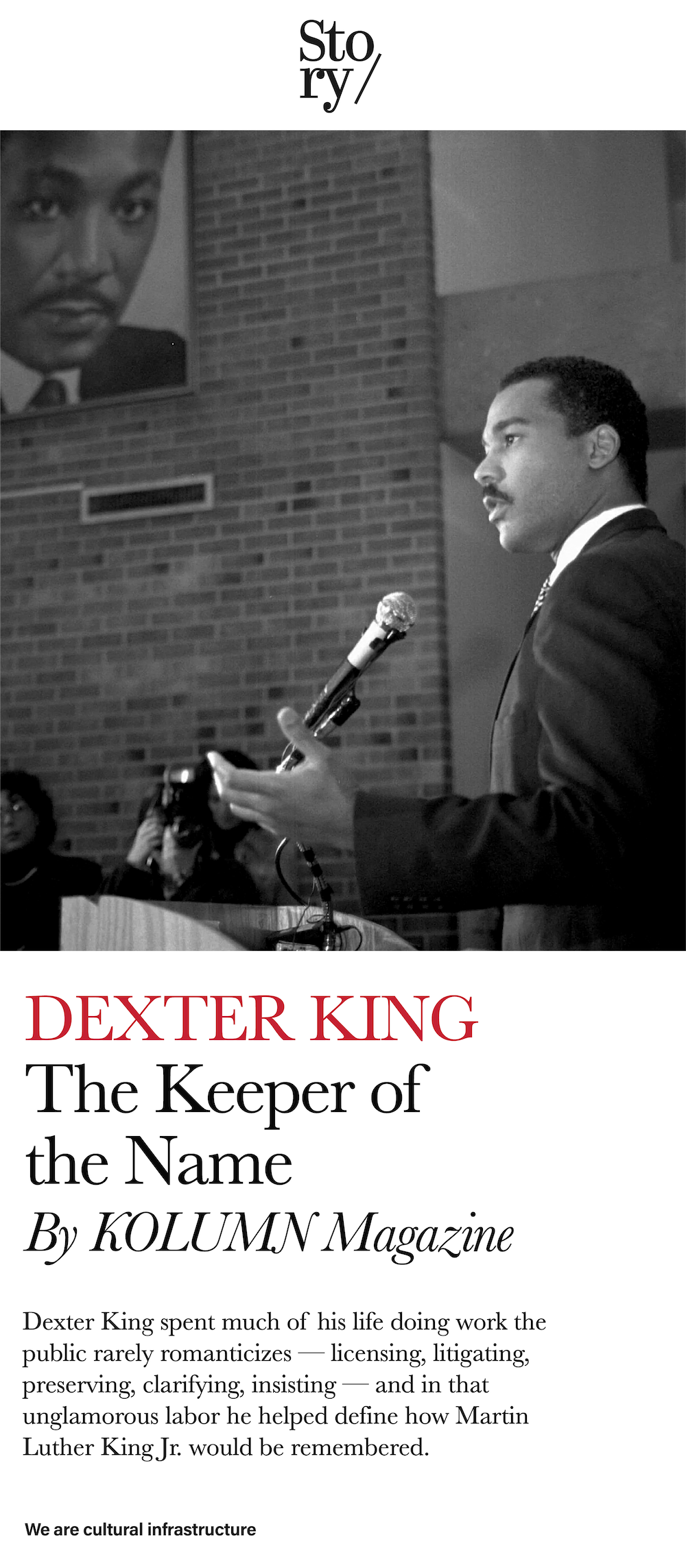
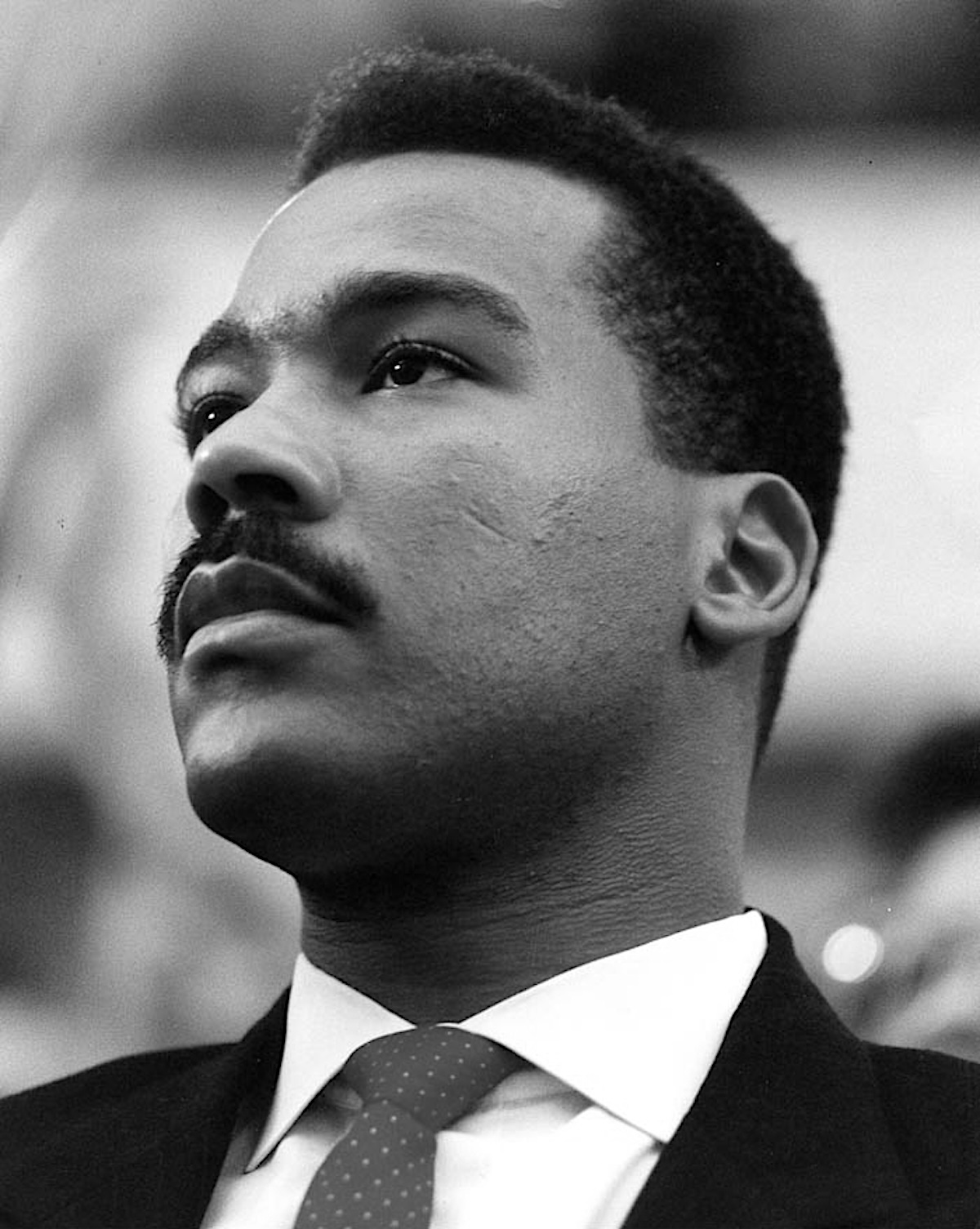
Like many children of historic figures, Dexter grew up under the coercive force of comparison. By the time he reached adulthood, the resemblance to his father had become a recurring media fixation. Journalists wrote about the visual echo first — the stillness, the mustache, the profile, the cadence that occasionally seemed to summon an old reel of film back to life. But resemblance is not destiny, and it can become a trap. A son of Martin Luther King Jr. was always in danger of being read not as a person but as a test: did he speak like him, march like him, lead like him, soothe like him, carry himself like him? Dexter’s life makes clearer how unfair that standard was. Martin Luther King Jr. had inherited a tradition; Dexter inherited a saint.
He attended Morehouse College, his father’s alma mater, and studied business administration. That choice — business, not theology, not political science, not ministry — now looks like an early clue to the shape his stewardship would take. He was being formed not for the pulpit but for management, structure and negotiation. Stanford’s King Institute notes that when he later became chairman, president and chief executive officer of the King Center, he articulated a mission centered on educating the public and promoting his father’s philosophy of nonviolence around the world. The formulation is important because it fused two imperatives that often pull against each other: moral instruction and institutional administration.
The difficult business of inheritance
The sentimental version of legacy work imagines candlelight, commemoration and noble repetition. The real thing is messier. It involves budgets, boards, copyrights, donors, family disagreements and the constant pressure of outside appropriation. Dexter King entered that world early. In 1989, Coretta Scott King named her son as president of the King Center, but the arrangement quickly ran into conflict. Contemporary accounts described tension over management style, direction and generational differences; he resigned after only a few months. Years later, when he returned to leadership, he framed that earlier episode as a harsh education, a moment that forced him into a deeper reckoning with who he was and what kind of institutional change was actually possible.
That failed first ascent is central to understanding Dexter King because it revealed both his ambition and the peculiar difficulty of governing a legacy organization founded by one parent to preserve the memory of another. The King Center was never just another nonprofit. It was an operating site of American civil religion. Every administrative decision could be read as theological. Every structural disagreement could be inflated into a public referendum on whether the King family was honoring or commercializing the dream. Dexter King seems to have understood, perhaps earlier than some of his critics, that the age of passive reverence was over. If the King legacy was going to survive in a media economy that could endlessly recycle the image of Martin Luther King Jr., it would need active management.
By the mid-1990s and later in 2005, Dexter King moved back into senior roles at the King Center. Stanford records that by 2005 he was chairman, president and chief executive officer, and he described the mission in expressly global terms: educate the public, perpetuate and promote nonviolence. That phrasing may sound familiar now, but at the time it signaled an effort to treat the King legacy not as a museum piece but as a portable doctrine. He wanted something more than annual pageantry. He wanted training, transmission and organizational coherence.
There was, however, a cost to that approach. Protecting a legacy at scale almost inevitably means drawing lines around access. It means saying no. It means charging licensing fees. It means deciding whether a speech is public scripture or family property, whether memory belongs to the nation or to heirs, whether a historical icon can be both democratic symbol and managed estate. Dexter King spent years standing in that contradiction instead of pretending it did not exist. Much of his public work involved protecting the King family’s intellectual property. That labor made him indispensable to some and overly restrictive to others. It also made him one of the clearest examples of what happens when the afterlife of a civil rights movement enters the machinery of American copyright, branding and cultural capital.
Memory, ownership and the King estate
It is tempting to sneer at legacy management as mere monetization, but that reading is too lazy for the stakes involved. The King estate did not emerge in a vacuum. It evolved in a national culture eager to flatten Martin Luther King Jr. into a safe consensus figure while stripping his critique of militarism, poverty and structural racism of its original sharpness. Under those conditions, control over text and image was not simply financial. It was interpretive. Dexter King served as chief executive of the King estate and, according to the Atlanta History Center, oversaw licensing of his father’s image and likeness while pursuing action against unauthorized use. The Washington Post obituary was even more direct: much of his work involved protecting the family’s intellectual property.
The legal history around the “I Have a Dream” speech helps explain why. In litigation involving CBS, the estate argued that public delivery of the speech did not place the text into the public domain. Reporting from the Reporters Committee for Freedom of the Press notes that the Eleventh Circuit allowed the estate’s copyright claim to proceed, reversing a lower-court ruling that had favored CBS. For Dexter King, this was not abstract doctrine. It was part of a broader struggle over whether one of the most famous speeches in American history could be treated as common stock or protected expression. Many people found the estate’s posture unromantic. But unromantic, in this case, was precisely the point. Someone had to do the unglamorous work of insisting that historical reverence was not the same thing as unrestricted use.
Critics argued that this approach narrowed public access and made the family appear proprietary about a national moral resource. That criticism was not invented out of thin air; it reflected genuine discomfort with the privatization of collective memory. But the opposite danger was real too: that Martin Luther King Jr. would be endlessly excerpted, diluted and commercially repurposed without discipline or context. Dexter King’s legacy sits exactly inside that argument. He did not solve it. No one could. What he did was force the country to confront the fact that the making of a secular saint had produced not just inspiration but governance problems.
Saving the papers, shaping the archive
If Dexter King’s reputation has often been filtered through licensing disputes, that should not obscure one of his most significant interventions: helping keep Martin Luther King Jr.’s papers in Atlanta. In 2006, a proposed Sotheby’s sale raised the prospect that the papers might leave the city or be dispersed by private-market logic. Reporting from The Guardian described the emergency arrangement that brought the documents under a $32 million deal, preserving roughly 7,000 items and consigning them to Morehouse College. The Atlanta History Center later credited Dexter King with playing a crucial role in that 2005 sale process to the City of Atlanta, underscoring that the move helped ensure preservation and accessibility for future generations.
This may be the most revealing episode in his public life because it shows the better version of institutional control. Whatever one thinks about the estate’s licensing posture, the preservation of the King papers was not trivial custodianship. It was a fight over intellectual geography. Would Martin Luther King Jr.’s working life remain materially connected to Atlanta, to Morehouse, to Black institutional memory in the city that formed him? Or would the papers become elite collectibles, accessible largely through the prestige circuits of wealth? The answer mattered. Archives are not neutral warehouses. They shape who gets to study, narrate and inherit history. Dexter King understood that.
KOLUMN has already touched adjacent terrain in its reported feature “Three Kings of Morehouse,” which traced the institutional arc from A.D. Williams to Martin Luther King Sr. to Martin Luther King Jr., arguing that Morehouse, Ebenezer and Sweet Auburn finance formed an interlocking architecture of Black leadership. That framing is useful here because Dexter King’s work was, in part, about preserving the paper trail of that architecture. “Three Kings of Morehouse” notes that the King papers help document not just a life but the intellectual and material infrastructure of the movement — letters, drafts, financial records, itineraries, revisions, the literal paperwork of freedom struggle. Dexter’s role in keeping those records tied to Atlanta places him within the family’s longer institutional story, even if his labor looked more boardroom than pulpit.
The son who asked the hardest question
There is another Dexter King, less discussed and more spiritually exposed: the son who in 1997 sat across from James Earl Ray, the man convicted in his father’s assassination, and asked him directly, “Did you kill my father?” Contemporary reporting from that prison meeting records Ray’s answer: “No, no, I didn’t.” It also records Dexter King telling Ray, “My family believes you,” while repeating that the family wanted a trial so the truth could be tested publicly. The scene was extraordinary for its symbolism alone. A son confronting the convicted assassin of his father is already the stuff of national myth. But the deeper significance lay in what the encounter revealed about the King family’s long distrust of the official narrative.
This part of Dexter King’s life has to be handled carefully. It would be irresponsible to present the family’s view as established fact. The Justice Department’s later overview of the assassination allegations states that Ray maintained his innocence for decades and that conspiracy allegations persisted, but federal investigators did not substantiate claims that the assassination had been orchestrated by a broader proven plot in the way some had alleged. Still, Dexter King’s decision to meet Ray was historically important because it showed that for him, legacy work did not mean passive sanctification. It meant inquiry, even when inquiry risked public bewilderment. He was not content to inherit a story simply because the state had certified it.
That choice also illuminates something essential about the King children more broadly: they did not inherit only praise. They inherited surveillance files, unresolved suspicions, political misuse, sentimental distortion and endless expectations of grace. Dexter King’s prison visit suggested a son still trying to find the truth inside the monument. It was perhaps one of the most intimate forms of public courage available to him — not leading a march, but refusing to stop asking whether the country had told the whole story about the man whose death became part of its civic mythology.
Beyond the surname
One of the problems of writing about Dexter King is that the surname can swallow the man. He had his own interests, temperament and cultural instincts. He was drawn to entertainment and production, and the Los Angeles Times profiled him in 1995 as someone with an entrepreneurial bent and a serious interest in the arts. The Atlanta History Center notes that he pursued acting and film production and voiced his father in the Emmy-nominated animated film Our Friend, Martin. That detail is worth pausing on. There was something almost uncanny in the gesture: a son lending voice to the father the nation believed it already knew. It was not imitation so much as mediated inheritance, another example of Dexter operating in the charged territory between family memory and public pedagogy.
He also embraced veganism and animal-rights advocacy, framing that commitment as an extension of nonviolence rather than a lifestyle eccentricity. Vegetarian Times, republishing a 1995 interview from its archive, described him as crediting a vegan diet with giving him strength to pursue equality and justice, and explicitly linked that ethic to spiritual growth and nonviolence. In a culture that often wants civil rights heirs to perform one legible kind of activism, Dexter’s insistence that compassion should extend across species reads as both idiosyncratic and entirely consistent with the broader moral vocabulary of non-harm. It was a reminder that inheritance does not always repeat; sometimes it extrapolates.
If that made him seem unusual within the public imagination of the King family, so be it. Dexter King often seemed less interested in pleasing the public than in defining a coherent personal ethic under impossible symbolic pressure. That may be one reason he can appear elusive in retrospective portraits. He was neither the overtly public-facing political figure some expected nor a purely ceremonial heir. He occupied the middle terrain: administrative, ethical, strategic, intermittently artistic, occasionally controversial, frequently misunderstood.
Family, fracture and repair
No serious account of Dexter King can ignore the public family disputes that periodically spilled into view. The King legacy has long been entangled with disagreements among the siblings over control, transparency, institutional direction and property. That reality has often been used to cheapen the family’s work, as though conflict disqualifies stewardship. In truth, the opposite may be closer to accurate. Conflict is what happens when a family must manage not only grief but a national shrine with assets, obligations and enormous symbolic value. Dexter King stood at the center of many of those disputes because his role placed him at the operational heart of the estate.
Yet the final chapter did not end in estrangement alone. After Dexter King’s death, Bernice King spoke publicly about meaningful time spent with her brother and about the fact that their love had endured despite disagreements. Georgia Public Broadcasting quoted her recalling his encouragement: “Keep this legacy going. You got this.” That is a small line, but a revealing one. It suggests that beneath the litigation, press scrutiny and sibling tensions was a private understanding of succession not unlike the one that had shaped the family for decades. The public often wants dynasties either frozen in harmony or exposed in scandal. Real families are neither. They argue, align, fracture, repair and continue.
What his life meant
So what, exactly, was Dexter King’s significance?
Not that he replicated Martin Luther King Jr. He did not. Not that he surpassed the contradictions of institutional guardianship. He did not do that either. His significance lies in how clearly his life exposed the second-generation problem of the Black freedom struggle: what happens after martyrdom, after canonization, after the cameras move from the streets to the archive. The first generation fought to change the nation. The second had to fight over how the nation would remember, quote, package, teach and sometimes sanitize that struggle. Dexter King lived inside that second battle.
That battle matters. The country loves Martin Luther King Jr. most when he can be reduced to a single speech and a single dream, abstracted from his radicalism and detached from the infrastructure that sustained him. Dexter King’s most consequential work pushed against that flattening, even when the methods were unpopular. Protecting papers, litigating rights, controlling image use, maintaining institutional continuity, trying to keep Atlanta central to King memory, insisting on stewardship instead of drift — these are not cinematic acts. But history is not kept alive by cinema alone. Sometimes it is kept alive by administrators who understand that sentiment without structure dissolves fast.
There is also something distinctly Black and modern in Dexter King’s story. For generations, Black families built institutions under siege — churches, colleges, newspapers, banks, civic leagues — and then had to defend them not only from white hostility but from the market’s appetite for extraction. The King legacy, because it became globally recognizable, only intensified that dynamic. Dexter King’s work sits in that lineage of Black institutional defense. He was not guarding a museum artifact. He was trying to keep a moral inheritance from being stripped for parts.
In that sense, he belongs in a KOLUMN frame not simply as “Martin Luther King Jr.’s son,” but as a figure in the broader story of how Black memory is organized, financed, contested and transmitted. KOLUMN’s “Three Kings of Morehouse” traced the pipeline from college to church to Black financial infrastructure. Dexter King represents a later phase of that same story: the conversion of inheritance into governance, archive into institution, family name into legal and cultural stewardship. He was not the movement’s prophet. He was, in a more procedural age, one of its keepers.
His death closed a chapter, but it also clarifies the work ahead. The King legacy will continue to be fought over because all living legacies are fought over. Who gets to invoke nonviolence? Who gets to monetize memory? Who gets to curate the archive? Who gets to decide what version of Martin Luther King Jr. is handed to another generation? Dexter King spent his life answering those questions in practice, if not always to universal approval. That may be the clearest measure of his importance: he understood that remembrance is never passive. It is built, defended, revised and, when necessary, protected from the very culture that claims to revere it.
And perhaps that is the final irony of Dexter King’s life. The son of the man most associated with America’s moral imagination ended up doing work rooted in contracts, copyright, governance and controlled access — the bureaucratic vocabulary of a nation that rarely knows how else to preserve what it claims to love. But there was an ethic inside that bureaucracy. There was a devotion inside the paperwork. There was, in the least glamorous corners of legacy work, an argument about dignity. Dexter King made that argument with the tools available to his era. The result was not sainthood. It was something more useful: custodianship.
If Martin Luther King Jr. helped give the nation one of its great democratic vocabularies, Dexter King spent much of his life making sure that vocabulary was not casually emptied out, detached from its source or sold back to the public without context. That is a quieter form of labor, but not a lesser one. It belongs to the history of Black preservation, Black institutions and Black afterlives. And it belongs, too, to the harder truth about famous families: sometimes the child’s real task is not to extend the father’s charisma, but to defend the conditions under which the father can still be read honestly.
More great stories
Afro Sheen, Wall Street, and the Architecture of Black Possibility
July 6, 2026
No Comments
The Fire Inside the Fourth
July 5, 2026
No Comments