



I am a visual storyteller.
I am a visual storyteller.
By KOLUMN Magazine
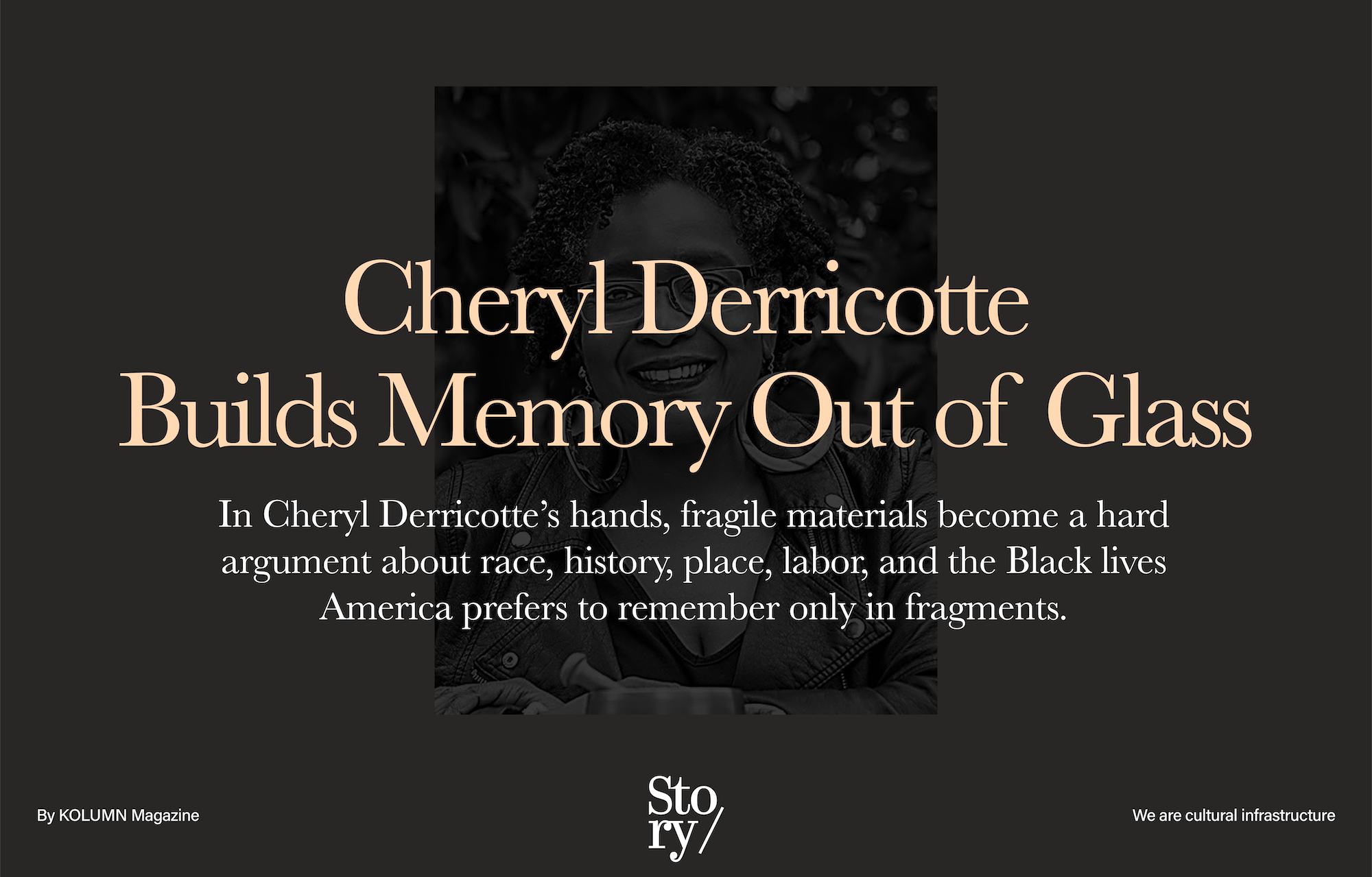
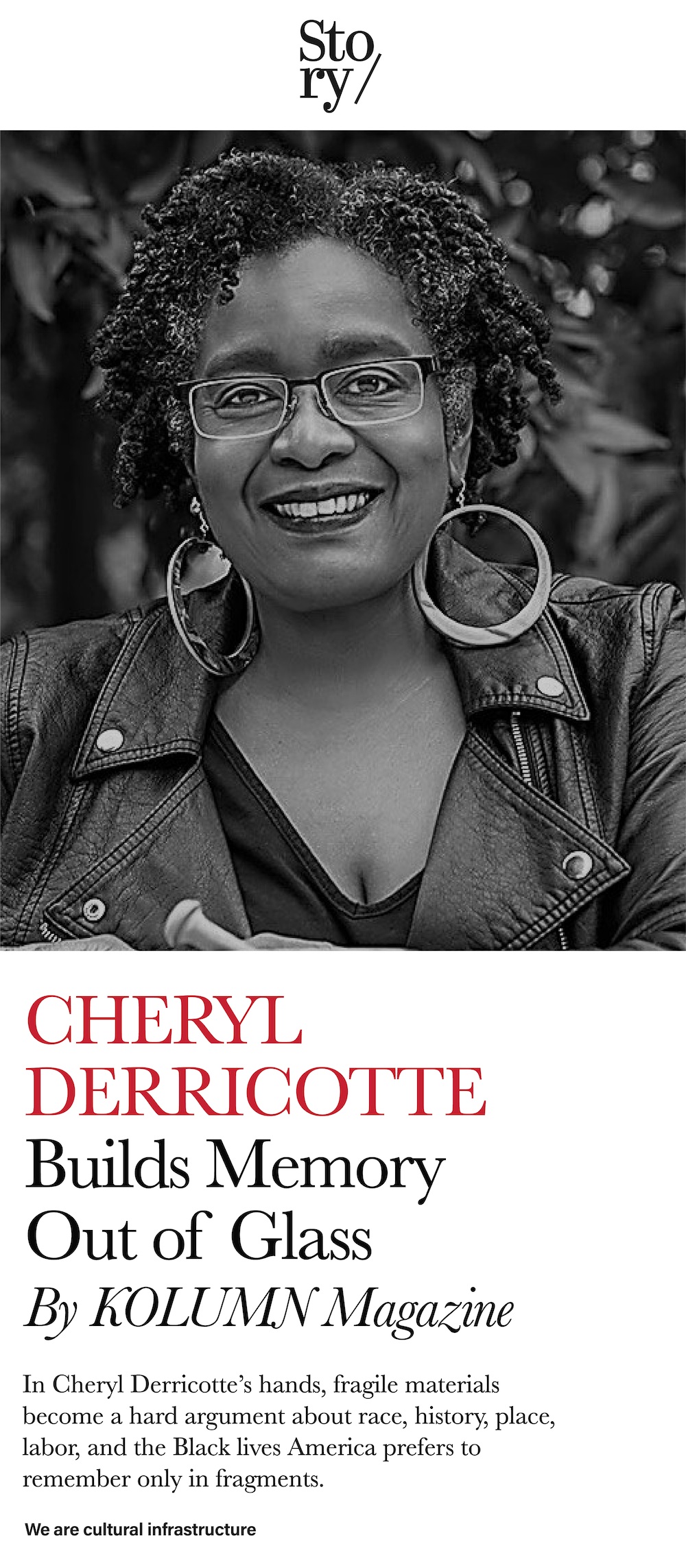
In the lineage of KOLUMN’s artist-centered features on Black makers who turn material into testimony, Cheryl Derricotte belongs to a particularly rigorous tradition: the artist as archivist, the artist as translator, the artist as public historian, the artist as someone unwilling to let beauty arrive unaccompanied by evidence. Her medium may be glass, with its seductions of light and translucence, but her subject is almost always heavier than the surface first suggests. She works in paper and textiles too, yet across forms the through-line remains remarkably consistent. Derricotte makes objects and images that ask what race looks like when it is tracked through land, labor, memory, domesticity, public space, and the long afterlife of American myth. She is based in San Francisco, originally from Washington, D.C., and formally trained not only in art but in urban affairs and regional planning, a combination that helps explain why her work so often feels spatially intelligent and politically alert at once. Her own biography frames that hybridity clearly: a B.A. in Urban Affairs from Barnard, a Master of Regional Planning from Cornell, a later MFA from the California Institute of Integral Studies, and a longstanding parallel life in planning and project management.
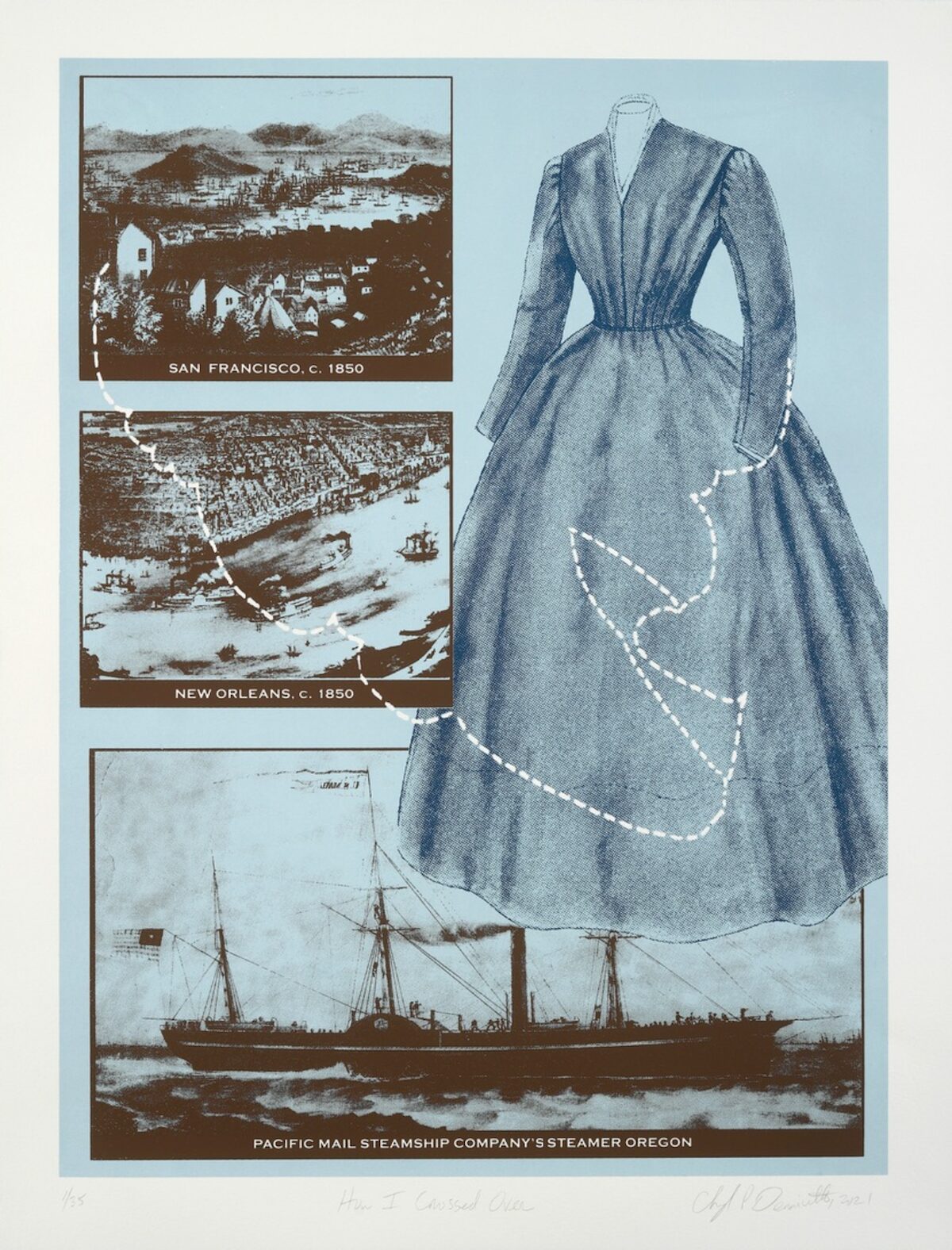
That double formation matters. Plenty of artists use history as subject matter; fewer think about history the way a planner thinks about a city. Derricotte does. Her work is deeply concerned with where stories are housed, who gets zoned into visibility, and what it means to move through a landscape structured by both memory and erasure. In a 2024 conversation with Museum of Glass curator Jabari Owens-Bailey, she described herself not just as an artist but as “an artist and a project manager,” adding that the through-line in her work is “text and image” and that her practice is research-based. Those details are not incidental. They explain the crispness of her conceptual architecture. Derricotte’s pieces do not simply emote about injustice; they are built. They are researched into being. Even when they appear lyrical, they are often doing the disciplined work of historical correction.
Washington, D.C., and the Education of an Artist
To understand Cheryl Derricotte’s significance, it helps to begin with the fact that she came to glass neither through inherited craft lineage nor through an early institutional pipeline that makes young artists legible to the art world before they have much life in them. She arrived by way of adult commitment, side doors, and persistence. She studied ceramics and sculpture at the Corcoran after work in the late 1990s and early 2000s. In one of the more disarmingly funny descriptions an artist has ever offered of her origin story, Derricotte said she came to glass through “complete arrogance,” meaning the kind of bold curiosity that sends someone from one medium into another before permission has been granted. She later studied at the Washington Glass School and, according to earlier interviews, found encouragement from artist Tim Tate, then continued learning from figures such as Therman Statom and others whose narrative uses of glass helped shape her own developing language. That matters because Derricotte’s work has never treated glass as decorative luxury. From early on, she was interested in its storytelling capacity: its ability to hold image, text, trace, and contradiction all at once.
Washington, D.C., is central to that formation as well. In the Museum of Glass interview, Derricotte called it “the original Chocolate City,” and spoke warmly about its museums, its art scene, and the fact that growing up there shaped her. D.C. gave her access to institutions, yes, but it also gave her a political education in public memory. It is a city built on national symbolism and Black presence, official monuments and unofficial truths, federal narratives and neighborhood realities. That tension echoes through her work. The artist who grew up in a city saturated with representation would become an artist interested in who representation leaves out. The planner who learned to think about urban systems would become the artist who sees place not as backdrop but as argument.
Beauty, Fragility, and the Discipline of Looking
This is part of why Derricotte’s art resists the easy binary between formal beauty and political seriousness. She uses beautiful materials, but she does not confuse beauty with innocence. On a gallery page presenting her statement, she writes that she does not often “lead with beauty,” even though the work is well-crafted and made of beautiful materials. She describes glass, textiles, and paper as collaborators for confronting “race, money, power and place,” and notes her attraction to materials that appear fragile but can survive across time. That formulation is as close as one gets to a key for reading her work. Derricotte understands fragility as something culturally assigned. Glass can break, yes, but it can also outlast empires. Paper can tear, but archives depend on it. Textiles can fray, but they can also carry labor, lineage, and touch. Her practice lives in that tension between seeming delicacy and actual endurance.
If there was an early institutional turning point, it came with Ghosts/Ships, her 2016 exhibition at the Museum of the African Diaspora in San Francisco. MoAD notes that Derricotte was one of two Bay Area artists selected among 45 applicants for its Emerging Artists Program, and KQED’s coverage at the time made clear why the show mattered. Inspired in part by Fred Wilson’s Mining the Museum, Derricotte used public-domain images related to the global African slave trade, drawn from the British Museum, and merged them with glass, paper, and video. KQED described the exhibition as linking past and present, culture and place, through haunting imagery. What made the show important was not simply its subject, but its method. Derricotte was not illustrating a known history. She was mining the archive, then translating it into a visual grammar capable of bearing grief without flattening it into piety. This was one of the moments when her mature concerns snapped into public focus: diaspora, historical image-making, the ethics of display, and the problem of how to look at violence without reproducing it as spectacle.
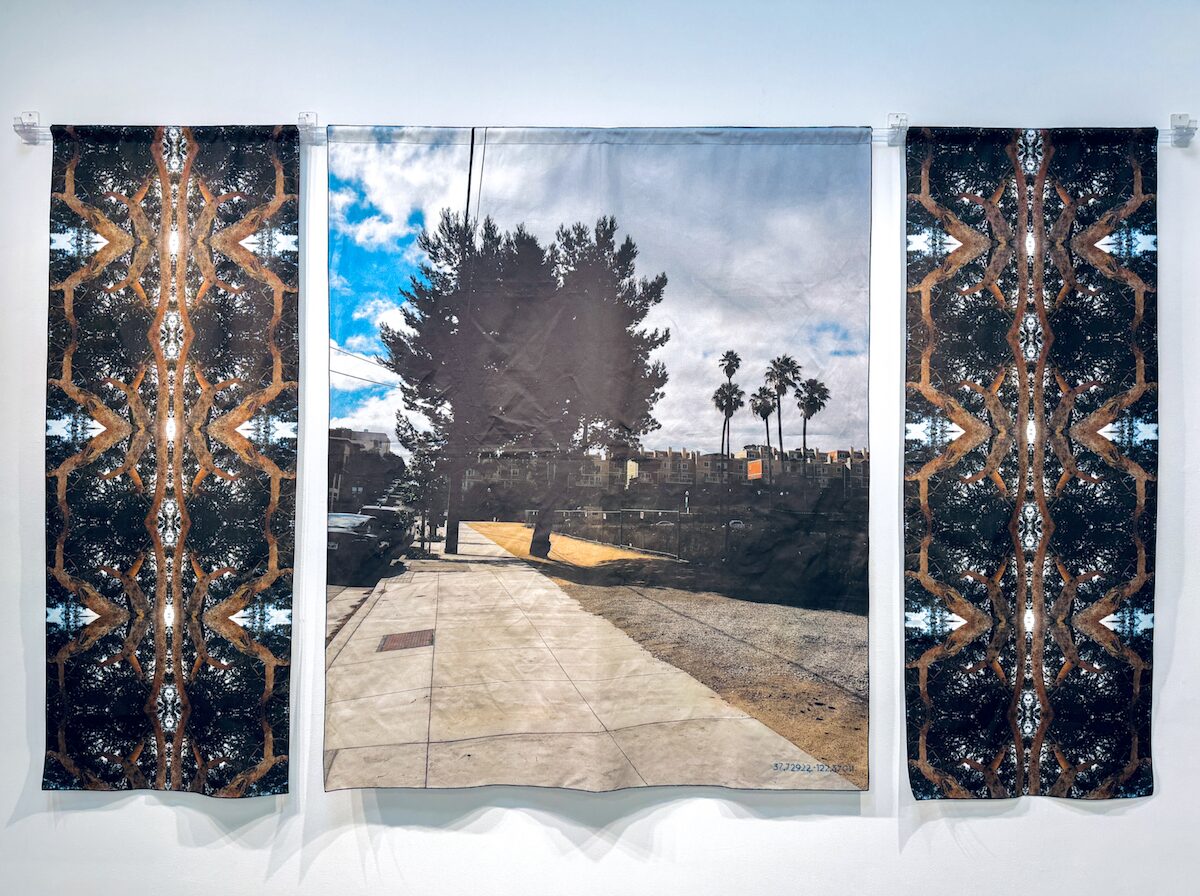
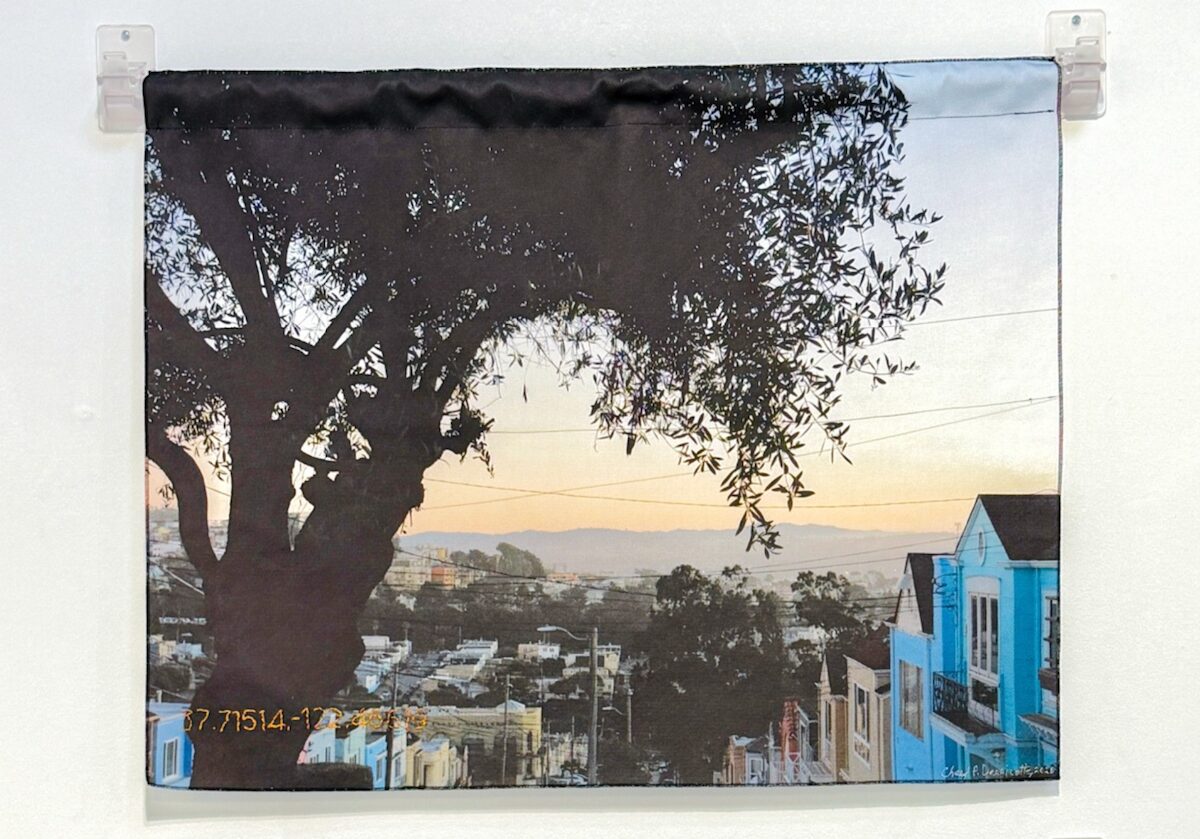
Making the Invisible Legible
That show also clarified another key feature of her practice: she is exceptionally good at converting absence into structure. Again and again, Derricotte returns to people, stories, and forms of Black labor that have been under-described, under-imaged, or filed away in the lower shelves of collective memory. But rather than merely lamenting invisibility, she builds around it. She uses what is missing as compositional fact. That strategy becomes even more evident in later work concerning Sally Hemings and James Hemings. In the Museum of Glass transcript, Derricotte explains that part of what fascinated her was the fact that there are no conventional pictures of James or Sally Hemings. That led her to ask a crucial question: how do you make a portrait of someone for whom no traditional image survives? It is a question at once aesthetic and moral. Portraiture, in Derricotte’s hands, stops being just about likeness and becomes a matter of restored presence.
The Hemings work is especially revealing because it shows Derricotte working against one of the most overfamiliar gravitational centers in American history: Thomas Jefferson. In that same conversation, she describes being drawn, during the early pandemic period, toward Jefferson-related material for a French Consulate project about beauty and its transmutation. Her answer was not reverence. It was complication. She made work that juxtaposed Jefferson with agricultural and political context, then pushed further into research on Sally and James Hemings. What interested her was not simply the scandalous proximity to a founding father, but the question of agency, labor, and historical distortion. She wanted to “bring their portraits into view,” as she put it, with the same ease America has long granted Jefferson’s image. That is a devastatingly simple statement of purpose. The republic made one face endlessly available and withheld others; Derricotte’s work intervenes in that hierarchy of access.
Labor as Portrait, Presence as Method
What is striking about her treatment of Sally Hemings in particular is how firmly she declines the sensational shortcut. She does not reduce Hemings to a scandal, a euphemized romance, or a footnote to Jeffersonian contradiction. Instead, she turns toward work, toward the domestic labor that structured Hemings’s days and underwrote the household economy around her. In the residency work she described at the Museum of Glass, Derricotte enlarged objects associated with sewing and tailoring: spools, irons, needles, scissors. The goal, she said, was not narrative so much as presence, to make the viewer feel in the presence of a seamstress. That move is larger than it first appears. It is an argument that Black women’s labor is itself portrait-worthy; that domestic skill, repetition, and embodied expertise are not marginal facts but central ones; and that the material culture of a life can restore dignity where the archive withheld an image.
The political intelligence of Derricotte’s work is perhaps most obvious when she steps into public space. Her best-known large-scale commission to date is Freedom’s Threshold, the Harriet Tubman monument unveiled in 2023 at the Gateway at Millbrae Station. The work is a 12-foot sculpture in glass and metal, featuring Tubman’s likeness across more than 30 glass tiles, set in a doorway-like structure and anchored by 14 glass bricks that represent Tubman’s 14 rescue trips on the Underground Railroad. Reporting from the San Francisco Chronicle and Local News Matters emphasized both the scale of the commission and its distinctiveness: the work was described as a major public monument, and in the Chronicle, Derricotte said it was believed to be the first monument to Tubman constructed with glass. That detail is more than novelty. Glass transforms public monumentality. Instead of the heavy opacity associated with bronze heroics, Derricotte offers translucence, light, permeability, and a reminder that public memory need not look like military permanence in order to endure.
The Tubman monument also reveals how deeply Derricotte understands the politics of audience. Public art is not gallery art enlarged; it is social choreography. It has to meet commuters, residents, passersby, skeptics, children, elders, and people who did not consent to having an aesthetic experience that day. Derricotte’s statement about the work is telling: she said she wanted a design that would reflect Tubman’s “rich legacy and service to America.” That phrasing manages to be generous without sanding down the radicalism of Tubman’s life. Service, in this context, does not mean respectability. It means the labor of liberation. By placing Tubman in the threshold, Derricotte creates an image that is both literal and symbolic: a woman of passage, transit, movement, escape, and arrival, installed at a transit-oriented development where movement structures everyday life. The planner in Derricotte clearly understands the force of that siting.
There is another reason Freedom’s Threshold matters. It demonstrates how Derricotte’s practice scales without losing specificity. Many artists can make intimate work or public work; fewer can do both while keeping their conceptual spine intact. In a smaller piece, Derricotte layers text and image to destabilize easy readings. In a monument, she does much the same, only with public symbolism, architectural cues, and collective ritual. The 14 bricks are a good example. They are legible to a general audience as commemorative units, but they also preserve Tubman’s historical action as countable persistence. Public memory here is not an abstract halo; it is tied to repeated acts of risk. That is typical of Derricotte. She rarely lets memory become vaporous.
Institutional Recognition and Expanding Reach
The Bay Area has been especially important to her rise, not just as a place of residence but as a testing ground for the kinds of cross-disciplinary practice she embodies. Her résumé maps a steady accumulation of residencies, grants, museum exhibitions, and collections: de Young Open in 2020; MoAD’s Emerging Artist distinction; a 2022 inaugural BIPOC residency at the Corning Museum of Glass; a 2023–24 municipal artist residency with Kala Art Institute and the City of Berkeley’s Climate Equity Pilot Program; a Spring 2024 residency and visiting professorship at the University of Utah; and 2024 visiting artist stints at the Museum of Glass. Her work is now in permanent collections including the Museum of Glass, the de Young, the Oakland Museum of California, the Historic New Orleans Collection, and the San Francisco Public Library. That record signals institutional recognition, but it also suggests something more important: she has become one of the artists through whom institutions are trying to think more seriously about Black history, craft, memory, and the civic function of art.
Her inclusion in A Two-Way Mirror: Double Consciousness in Contemporary Glass by Black Artists at the Museum of Glass sharpened that position. The exhibition was structured around W.E.B. Du Bois’s idea of double consciousness and featured Black artists using glass to address identity, race, gender, and culture. Museum of Glass identified Derricotte’s Glass Boys works as part of that conversation. In the interview, Owens-Bailey connected her newer Hemings project to those earlier panels, noting that both engaged erasure. That is an astute read. Derricotte is not just making politically themed objects; she is elaborating a theory of image justice. She asks who gets pictured, who gets monumentalized, whose labor is treated as background, and how a medium associated with refinement can be conscripted into a harder social argument. Du Bois is a fitting frame because Derricotte’s work is often about what happens when Black presence is simultaneously visible and misread, available and denied, looked at and refused.
Time, Violence, and the Refusal of Abstraction
That same seriousness appears in work that deals less with canonical history and more with contemporary brutality. The de Young Open brought wider attention to her piece 2017 Year-at-a-Glance: 214 Dead Black Men, a calendar-like work marking days on which Black men were killed. The Cornell planning blog, discussing the work, noted how the piece uses a yearly planner and bullet marks to reckon with police violence; The San Francisco Chronicle similarly described the work’s stark method and noted that the de Young was among the most prestigious opportunities in her career. Here again Derricotte chooses a familiar form and makes it unbearable in the most necessary way. The planner is usually a device for order, productivity, appointments, future management. She turns it into a ledger of racial death. The gesture is artistically exact because it reveals how terror is administered not outside ordinary time but inside it, day by day, calendar square by calendar square.
Method as Meaning
If some artists are best understood through style, Derricotte is better understood through method. She researches, gathers, layers, prints, scales, binds, installs, and situates. She has said that text is an important component of her work and that she often begins with a phrase or title before there is even a schematic drawing. That literary impulse matters. Even when no paragraph appears in the final object, language hovers inside the work as scaffolding. It gives her art a rhetorical quality without reducing it to slogan. Titles become pressure points. Historical names become formal prompts. A piece can begin with a phrase, pass through archive and process, and emerge as an object that still remembers its verbal source.
The Civic Imagination of an Artist-Planner
The writing impulse may also explain why Derricotte’s work often feels unusually hospitable to viewers while remaining uncompromising in content. She knows how to build entry points. A viewer can start with the craft, the beauty of kiln-formed glass, the elegance of powder printing, the tactility of book structures, the drama of scale. Then the work opens further. This is not softness; it is strategy. The art invites before it indicts. Her artist statement makes that clear when she describes slowly made work by hand as a signifier of value in a digitized, mechanized world. The slowness matters. It restores duration to histories that have been skimmed, aestheticized, or turned into curricular shorthand. Derricotte’s work asks for another tempo, one more suited to mourning, study, and ethical looking.
That slower tempo has also allowed her to move into books, prints, and community-facing projects without losing coherence. Her statement notes that in 2022 she created a limited-edition artist book centered on Mary Ellen Pleasant, the famed abolitionist and entrepreneur who became one of the wealthiest Black women in Gold Rush-era San Francisco, and that she later made a smaller pocket-sized book called 21 Lessons to circulate Pleasant’s wisdom more broadly. In 2025, Derricotte’s engagement with Pleasant appeared again in Black Gold: Stories Untold at Fort Point, where FOR-SITE listed her commissioned work The Best Table in San Francisco. Coverage of the exhibition noted that Derricotte focused on Mary Ellen Pleasant, continuing a line of inquiry that makes perfect sense in her practice: Black women’s labor, property, entrepreneurship, and civic presence in California history. Derricotte is drawn to figures whose stories reveal how power actually moved, often outside the official frames of state history.
The Pleasant work also underscores something easy to miss in discussions of Derricotte: she is a Bay Area artist in a particularly local, grounded sense. She is not merely living in San Francisco while participating in a national discourse. She is studying the region’s Black histories, its environmental anxieties, its neighborhoods, its planning apparatus, and its public culture. Her 2023–24 role as a municipal artist-in-residence with Berkeley’s Climate Equity Pilot Program made that explicit. In interviews and program materials, the residency is described as a collaboration involving climate equity, the San Pablo corridor, and community engagement around matters like e-bikes, electrification, and coalition-building. Kala’s Roadwork exhibition states that Derricotte organized gatherings and workshops to foster conversations about environmental issues, climate resilience, and urban planning. This is not a side hustle adjacent to the real art. It is the real art in expanded form: art as civic literacy, art as engagement practice, art as a way of making planning legible and participatory rather than technocratic.
That point may be one of the most important for understanding her significance. Cheryl Derricotte stands at an unusually productive intersection of Black visual culture, craft discourse, public art, and urban thought. American art institutions have often treated those categories as adjacent but separate. Craft belongs over here. Public art over there. Community engagement somewhere else. Planning in another building entirely. Derricotte’s career quietly refuses those separations. She is a licensed city planner and an exhibiting artist. She can talk about historical portraiture and corridor planning, domestic labor and public transit siting, Mary Ellen Pleasant and climate equity. The result is a practice that feels not scattered but whole. She is one of the artists showing what it means to make socially serious work without abandoning form, and to make formally refined work without abandoning society.
There is also, finally, the matter of tone. Derricotte’s work is not interested in cheap triumphalism. Even when it honors Black achievement, it tends to preserve complexity. Harriet Tubman is not turned into generic inspiration. Sally Hemings is not reduced to legend. Mary Ellen Pleasant is not simplified into an uncomplicated icon. This ethical restraint is part of what makes her work trustworthy. She appears to believe that Black history deserves neither sanitizing uplift nor voyeuristic darkness, but sustained attention. That is a discipline as much as an aesthetic.
And perhaps that is the clearest way to describe Cheryl Derricotte’s significance. She is an artist of attention. She attends to the sentence beneath the slogan, the labor beneath the portrait, the city beneath the monument, the archive beneath the image, the wound beneath the polished surface. In an era that rewards speed, frictionless symbolism, and a shallow appetite for “important” art that can be consumed in one glance, Derricotte keeps making work that insists on something more demanding. She insists that looking is a civic act. She insists that material has memory. She insists that translucence can carry weight.
For KOLUMN, that matters because her work sits inside one of the central questions of Black cultural production now: how do we make forms equal to the histories we carry? Derricotte’s answer is not to choose between beauty and truth, nor between research and feeling, nor between public address and private craft. Her answer is to braid them. She makes glass do archival work. She makes public art carry historical argument. She makes the handmade feel intellectually exacting. She makes old names breathe again without pretending the nation ever treated them fairly. And in doing so, she has become one of the more compelling artists working in the Bay Area and beyond, not because her materials are fragile, but because her sense of responsibility is not.
More great stories
Afro Sheen, Wall Street, and the Architecture of Black Possibility
July 6, 2026
No Comments
The Fire Inside the Fourth
July 5, 2026
No Comments