
The Wright did not emerge from elite permission. It began as a Black community’s answer to erasure.
The Wright did not emerge from elite permission. It began as a Black community’s answer to erasure.
By KOLUMN Magazine
There are museums that collect history, and then there are museums that seem to have been built because history itself was in danger. The Charles H. Wright Museum of African American History belongs to the second category. It stands in Detroit’s Midtown Cultural Center, near the Detroit Institute of Arts and the Michigan Science Center, but its deepest neighborhood is not only geographic. It occupies a moral address: the place where Black memory is gathered, defended, interpreted and returned to the people who made it.
The Wright, as Detroiters call it, describes itself as a place “where our past, our present, and our people converge,” and that phrasing matters because it refuses the old museum habit of treating Black life as either antiquity or trauma alone. On its official site, the institution frames its work through exhibitions, education, public programming and the African World Festival, the annual celebration of diasporic culture scheduled to return to Hart Plaza in July 2026. The museum’s contribution to the Black community is therefore not confined to what sits behind glass. It is in the gathering, the teaching, the mourning, the celebration and the insistence that African American history is not a seasonal observance but a civic infrastructure.
Founded in 1965 by Dr. Charles Howard Wright, a Detroit physician and civil rights activist, the museum began as the International Afro-American Museum, according to the Encyclopedia of Detroit. The timing was not incidental. That year, the Voting Rights Act became law, Malcolm X was assassinated, uprisings and organizing campaigns remade urban politics, and Black communities across the country were pressing the nation to confront what it had hidden in plain sight. Wright’s idea was radical because it treated Black history not as supplementary material but as a central archive of American civilization.
The origin story has become part of the institution’s own mythology. Wright was inspired after visiting a memorial in Denmark honoring World War II heroes, an encounter that led him to ask why African Americans did not have comparable public institutions to document their own struggle, achievement and sacrifice. As the National Park Service notes in its profile of The Wright, the museum now centers both national African American history and Detroit’s specific role in civil rights, labor, migration and cultural production.
A Doctor’s Diagnosis
Dr. Wright understood historical absence as a public-health problem. He had delivered babies, practiced medicine and served Black Detroit at the intimate scale of family life, yet he also recognized a broader wound: generations were being asked to live inside a nation whose official memory had been curated against them. The museum was his treatment plan. It would preserve, educate and dignify.
The first museum opened in a house on West Grand Boulevard, not in a grand civic palace. That beginning matters because it reveals the Wright’s institutional DNA. It was not born as a top-down monument. It was born as a community repository, assembled through conviction, donated materials, local support and a belief that Black people had a right to see themselves as historical actors. Teen Vogue’s history of the institution describes how Wright and other early Black museum founders helped shape a national movement of African American museums, work that would later contribute to the founding of the Association of African American Museums.
That context is essential to understanding the Wright’s contribution. Before the Smithsonian’s National Museum of African American History and Culture opened in Washington, before diversity departments became common museum language, and before “representation” entered institutional branding, Black communities were building their own memory houses. They did so because mainstream museums had long treated Black life as peripheral, ethnographic, decorative or absent. The Wright emerged from that corrective tradition, alongside institutions such as the DuSable Black History Museum in Chicago and later African American museums across the country.
The museum’s historiography is therefore inseparable from Black self-determination. Carter G. Woodson had founded the Association for the Study of Negro Life and History in 1915, establishing the intellectual foundation for what became Black History Month. Wright’s museum translated that scholarly mission into public space. It made history walkable. It gave families a room in which to encounter the Middle Passage, abolition, Reconstruction, Jim Crow, labor organizing, migration, music, art and freedom struggles as one continuous human story.
The Architecture of Belonging
The Wright’s current 125,000-square-foot building opened in 1997, after the museum outgrew earlier spaces and Detroit committed to a larger cultural home. Travel Michigan identifies it as a major institution dedicated to the African American experience, noting its more than 35,000 artifacts, exhibitions, programs and research-based public education. The number matters, but so does the scale of meaning behind it. Artifacts in a Black museum are never merely objects. They are evidence.
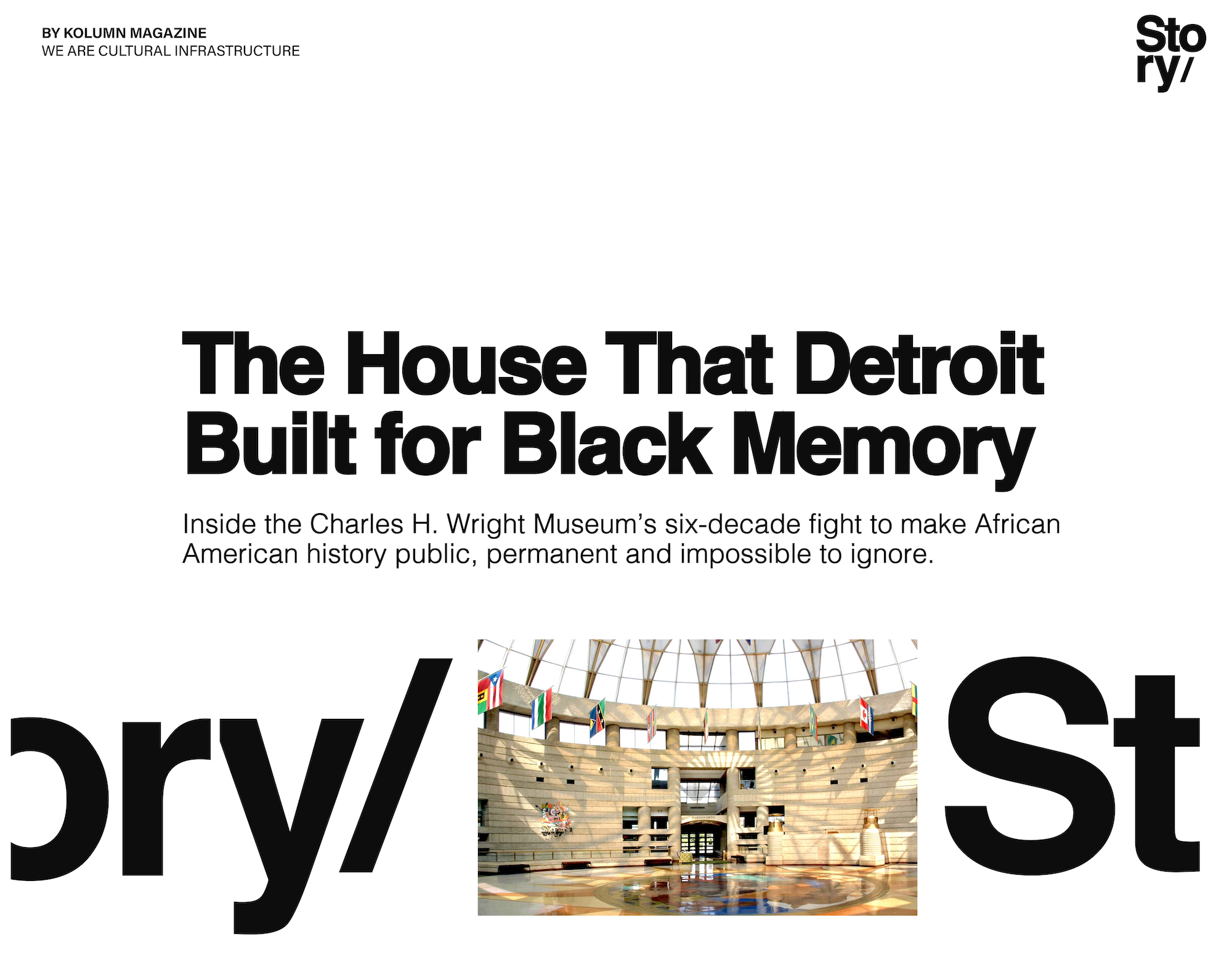
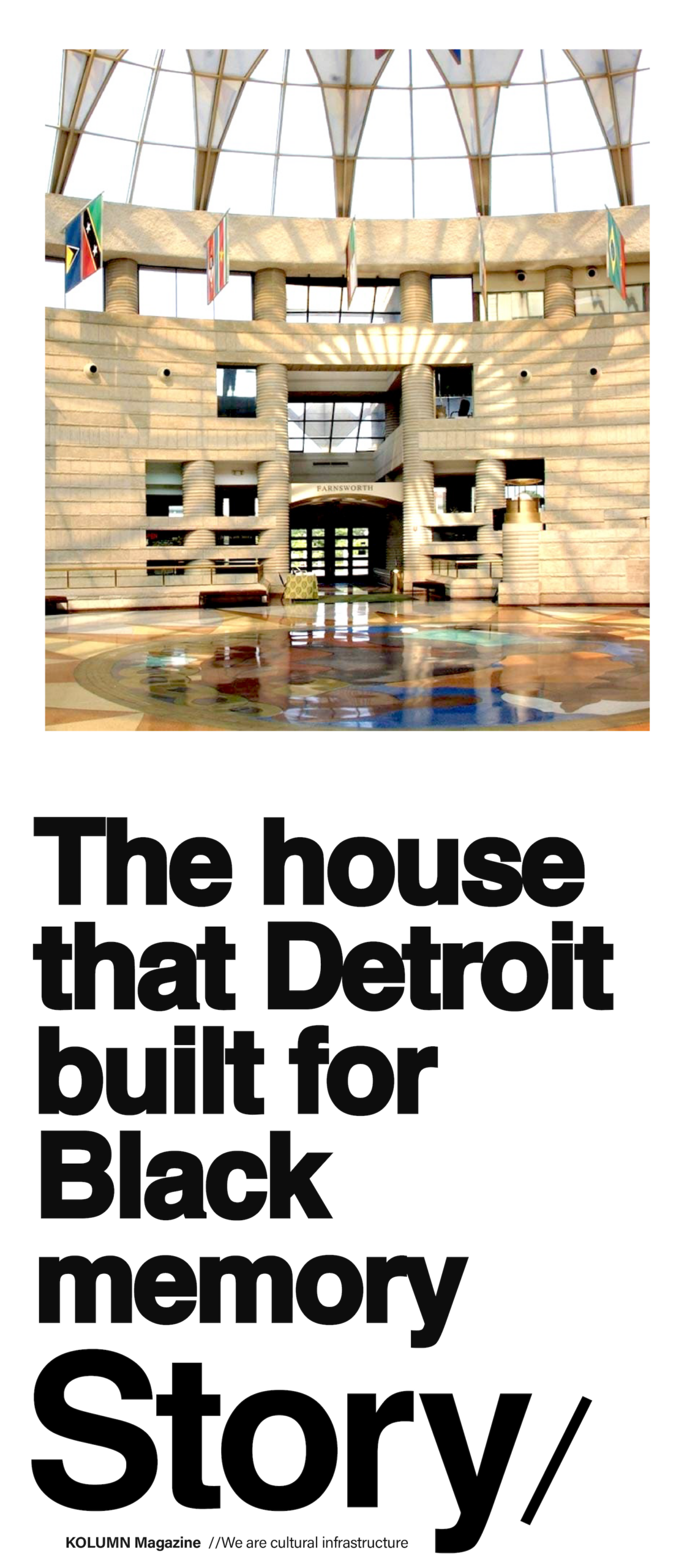
The building itself performs a civic argument. Its rotunda, dome and circular forms resist the narrow corridor of textbook history. Visitors do not simply move from “slavery” to “civil rights” as if Black life can be flattened into suffering and rescue. They enter a spatial narrative shaped around origins, rupture, endurance and creativity. Under the museum’s dome, the famous “Ring of Genealogy” mural by Hubert Massey functions almost like a public altar, placing ancestral continuity beneath visitors’ feet and above their heads.
The museum’s long-term exhibition, “And Still We Rise: Our Journey Through African American History and Culture”, is the institution’s central interpretive experience. The Wright describes it as a 22,000-square-foot exhibition with more than 20 galleries, allowing visitors to travel across time and geography. The National Park Service calls it one of the longest-running exhibitions in the United States dedicated to African American history and notes that it begins in Africa, moves through the Middle Passage and continues into the Americas.
That curatorial arc is important because it contests a persistent distortion in American public memory: the suggestion that Black history begins with enslavement. “And Still We Rise” begins before captivity, with African civilizations, social systems, knowledge traditions and cultural worlds. This is not decorative prelude. It is historiographical correction. The exhibition insists that the Black past is not reducible to what was done to Black people. It includes what Black people built, believed, remembered, resisted and remade.
Detroit as Archive
To understand The Wright, one must understand Detroit as more than backdrop. Detroit is one of the great Black cities of the twentieth century, a capital of migration, labor, music, organizing and municipal power. The Great Migration transformed the city’s neighborhoods and factories. The auto industry drew Black workers from the South, even as discrimination shaped where they could live, what jobs they could hold and how power moved through the city. Black Detroit produced union leaders, ministers, artists, teachers, entrepreneurs and political organizers whose influence reached far beyond Michigan.
The Wright’s collections and public programs give that history a local body. The Midtown Cultural Connections project notes that the museum is home to major materials including the Blanche Coggin Underground Railroad Collection, the Harriet Tubman Museum Collection and the Sheffield Collection, which documents the labor movement in Detroit. The Sheffield materials are especially significant because they connect civil rights history to labor history, a relationship too often separated in mainstream accounts.
Horace Sheffield Jr., a major Detroit labor and civil-rights figure, represented the overlap between workplace struggle and racial justice. The Walter P. Reuther Library at Wayne State University, which announced that an addition to the Horace Sheffield Jr. Papers had opened for research after prior stewardship by The Wright, described Sheffield as a prominent voice in Detroit’s labor and civil-rights movements. That language helps clarify the museum’s role: it has not only displayed Black history; it has held materials that scholars, families and communities need in order to reconstruct the political life of the city.
Detroit’s Black history is not ornamental. It is structural. It includes the rise of Motown, the organizing power of Black churches, the election of Coleman Young as the city’s first Black mayor, the civic meaning of Rosa Parks’s later years in Detroit and the complicated inheritance of deindustrialization, white flight, urban policy and resilience. The Wright gives this story a public address. In a city too often narrated through ruin photography and comeback clichés, the museum insists that Detroit’s Black community is not scenery. It is authorship.
A Museum That Teaches in Public
The Wright’s contribution to the Black community is most visible in how it educates. Museum education is sometimes described in soft terms—outreach, engagement, programming—but at The Wright it has sharper stakes. A Black child walking through “And Still We Rise” encounters a counter-curriculum. A parent or grandparent sees family memory placed inside a longer national and diasporic frame. Teachers gain a resource that can complicate classroom narratives often constrained by politics, textbooks and time.
The museum’s educational function has become even more urgent as public battles over history intensify. Across the country, school districts, legislatures and federal agencies have fought over how slavery, racism, civil rights, gender, migration and inequality may be taught. In that climate, Black museums function not merely as cultural venues but as democratic safeguards. The Wright’s 2025 statement highlighting Detroit art institutions’ resistance to political challenges to diversity noted that leaders at the museum and peer institutions said their mission of elevating Black voices would not change.
That is not a neutral statement. It places the museum within a national struggle over historical authority. Who gets to say what happened? Who gets funded to preserve evidence? Who is accused of being “divisive” for telling the truth? Black museums have always answered those questions with brick, archive, exhibition and program.
Expert voices in museum studies have long argued that museums are not passive containers; they are knowledge-making institutions. The Wright exemplifies that claim. Its exhibitions do not simply arrange artifacts chronologically. They interpret power. They ask visitors to understand the African diaspora through forced migration and voluntary movement, through violence and invention, through law and art, through local Detroit history and global Black culture.
The Festival as Civic Ritual
If the galleries are the museum’s interior memory, the African World Festival is its public pulse. The Wright describes the African World Festival as a three-day celebration of the African diaspora, honoring culture, history and community. Detroit PBS reported that the festival, organized by The Wright, has been expected to draw tens of thousands of attendees, making it one of the city’s major cultural gatherings.
Festivals can be misunderstood as entertainment appended to “serious” museum work. At The Wright, the festival is part of the serious work. It turns diasporic identity into sound, food, dance, commerce, craft, language and public congregation. It creates space for vendors, artists, elders, children, performers and families to inhabit Black culture as living practice rather than historical exhibit. In that sense, African World Festival is not separate from the museum’s mission. It is the mission outdoors.
The festival also expands who the museum serves. Not everyone enters cultural institutions easily. Museums can feel expensive, formal, academic or intimidating. A festival lowers the threshold. It allows a person to encounter the museum through music before scholarship, through food before archive, through community before text. That is not a dilution of history. It is a Black cultural method. Knowledge has always traveled through gathering.
Mourning, Celebration and Civic Memory
The Wright has also served Detroit as a place of public mourning. That role is part of its contribution to the Black community, though it is harder to quantify than attendance or collection size. Black institutions often become civic sanctuaries because official public space has not always been hospitable to Black grief. Churches have long performed that function. So have historically Black colleges, fraternal halls, newspapers and community centers. In Detroit, The Wright belongs to that lineage.
When a community gathers in a museum to honor leaders, artists or ancestors, it is making a claim about whose lives deserve ceremony. The museum’s rotunda and public spaces carry a symbolic gravity because they place Black mourning inside Black historical continuity. A funeral, memorial or tribute at The Wright is not only an event. It is an act of placement. It says: this life belongs to the record.
That function echoes KOLUMN Magazine’s own archive-centered work. In KOLUMN’s recent story “When Black Memory Went to Auction”, the question was what happens when a massive Black photographic archive, once belonging to Ebony and Jet, moves through bankruptcy, philanthropy and institutional custody. The Wright presents a related but locally rooted answer: Black memory needs institutions with enough durability to survive market failure, political pressure and generational loss. The museum is one such vessel.
Historiography: From Recovery to Authority
The Wright’s importance can be measured through the evolution of African American public history itself. Early Black historical work often had to prove that Black people had a history at all. Woodson, Anna Julia Cooper, W.E.B. Du Bois, Arturo Schomburg and generations of Black teachers, librarians and church historians built archives against a dominant culture that treated Black life as marginal. Their work was often described as recovery, but recovery understates the ambition. They were not merely finding lost materials. They were challenging the architecture of knowledge.
By the time Dr. Wright founded his museum in 1965, the Black freedom struggle had made history a battleground. Civil rights activists did not only demand access to buses, schools, ballots and jobs. They demanded a different national memory. The movement exposed the lie of American innocence and forced the country to confront the violence that had sustained racial hierarchy. Museums like The Wright emerged from that pressure. They translated movement history into permanent public interpretation.
In later decades, Black museums moved from recovery toward authority. They no longer existed only to fill gaps left by mainstream institutions. They became interpretive leaders. Hyperallergic’s 2025 assessment argued that The Wright “set the template” for narrating the African American experience, noting that the museum has presented a core exhibition in various forms since its opening and that its earlier exhibition, “O the People,” covered more than 400 years of African and African American history before the current “And Still We Rise” iteration.
That point matters because it positions The Wright not as a regional curiosity but as a national model. Long before the Smithsonian’s Black history museum became a major destination in Washington, Detroit had built a museum that treated African American history as sweeping, complex and institution-worthy. The Wright helped establish the expectation that Black museums could be intellectually ambitious, architecturally significant and community-accountable at once.
The Community Return
The phrase “contribution to the Black community” can sound too polite for what The Wright has done. Contribution suggests addition. The Wright’s role is closer to restoration. It restores historical scale to lives that were minimized. It restores public dignity to stories pushed into family memory. It restores continuity between Africa, the diaspora, the United States and Detroit. It restores civic confidence by making Black achievement visible in the built environment.
For Black Detroiters, the museum offers affirmation without simplification. It does not ask visitors to choose between pain and pride. The African American story requires both, and The Wright’s interpretive strength lies in refusing to separate them. The same institution can teach the Middle Passage, honor civil-rights activists, preserve labor archives, celebrate artists, host festivals and welcome schoolchildren. That breadth mirrors Black life itself.
For the broader community, The Wright offers a necessary correction to American amnesia. It teaches non-Black visitors that African American history is not a niche subject. It is the history of democracy, capitalism, law, migration, music, labor, medicine, education, war, religion and urban life. In Detroit, that lesson becomes especially concrete because the city’s Black history is inseparable from the nation’s industrial and cultural modernity.
The Burden of Keeping the Record
Yet the Wright’s importance also reveals a burden. Black institutions are often asked to do more with less: preserve archives, educate schools, host civic events, respond to political crises, support artists, serve tourists, comfort communities and correct national myths. The work is immense, and the resources rarely match the responsibility. That tension is part of the larger museum landscape, where institutions devoted to communities of color often face chronic funding inequities even as their missions become more urgent.
The Wright’s endurance over six decades is therefore not merely a story of institutional success. It is a story of community insistence. Detroiters built, supported, visited, defended and used the museum. Public history survives when people decide it must. The Wright’s existence says that Black memory cannot depend entirely on universities, government agencies or national museums. It requires local custodians, rooted institutions and communities that understand preservation as a form of power.
That power is visible in the museum’s 60th-anniversary moment. Detroit PBS described The Wright as a cornerstone of Detroit’s cultural and educational landscape, founded by Dr. Wright and 32 community members and now celebrating 60 years of Black history and culture. The detail of those 32 community members is crucial. It reminds us that institutions are not abstractions. They begin with people willing to gather, plan, donate, argue, build and believe.
A Future Against Forgetting
The future of The Wright will likely be shaped by the same questions that shaped its beginning. What does a Black museum owe to a community under pressure? How does it preserve the past while speaking to the present? How does it remain accessible, rigorous, joyful and honest? How does it protect history when political forces seek to flatten or sanitize it?
The answers will not come only through exhibitions. They will come through archives, school partnerships, digital access, oral histories, public programs, artist commissions, festivals and the daily labor of museum workers. They will come through the continued willingness to treat Black history as living civic knowledge.
In Detroit, The Wright stands as a counter-monument to erasure. It began because Dr. Charles H. Wright saw that a people’s history needed a house. Six decades later, that house has become a landmark, classroom, archive, sanctuary and gathering ground. Its contribution to the Black community is not simply that it preserves history. It gives history back in public, with enough force and beauty to make forgetting harder.
The Wright Museum’s great lesson is that memory is not passive. It must be organized. It must be funded. It must be taught. It must be made visible in stone, glass, paper, sound, procession and festival. In a country where Black history is repeatedly threatened, revised, commodified or neglected, The Wright continues to answer with a permanent verb: remember.
More great stories
Afro Sheen, Wall Street, and the Architecture of Black Possibility
July 6, 2026
No Comments
The Fire Inside the Fourth
July 5, 2026
No Comments