




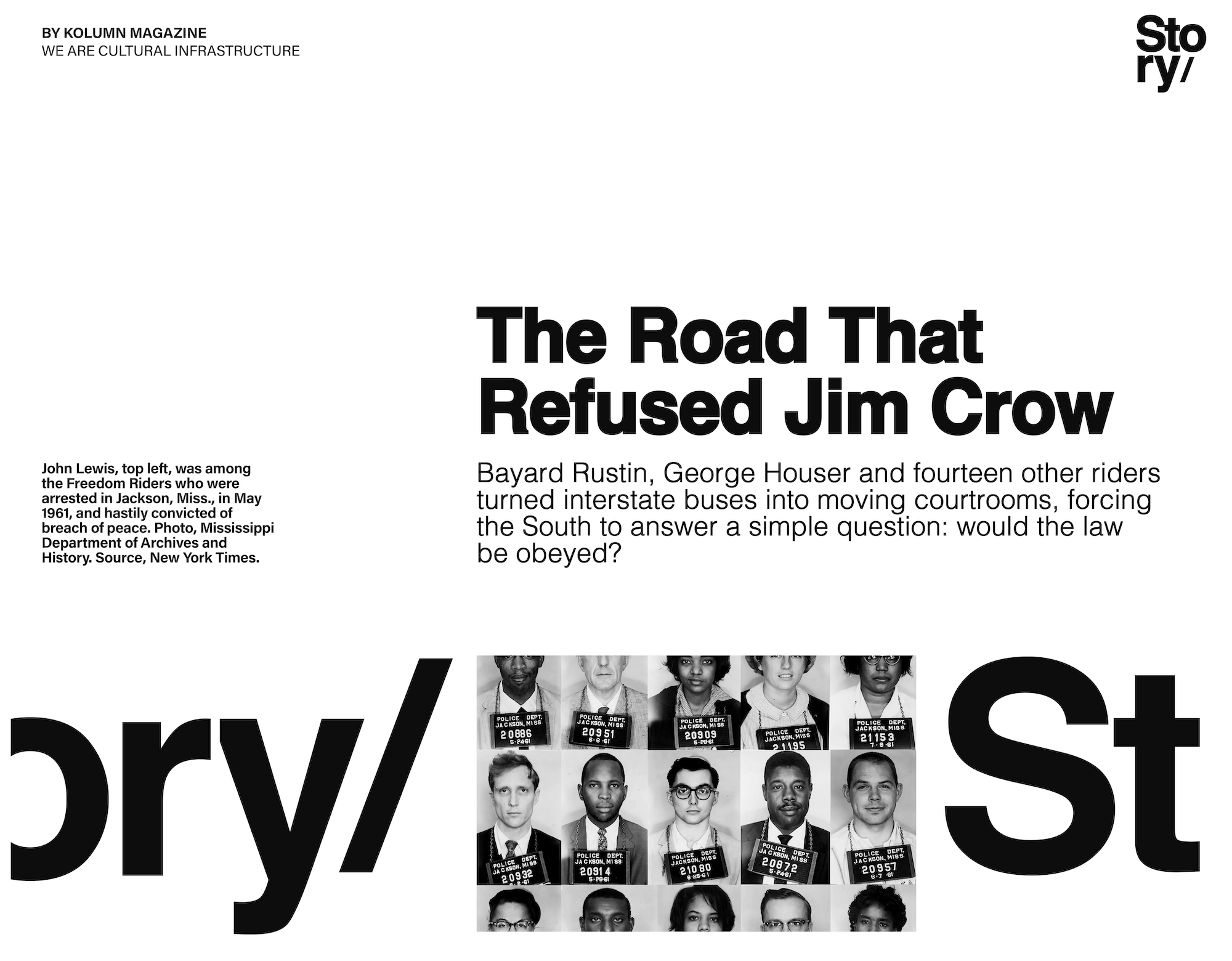
Before Rustin became the master organizer of the March on Washington, he helped turn a bus seat into a constitutional battlefield.
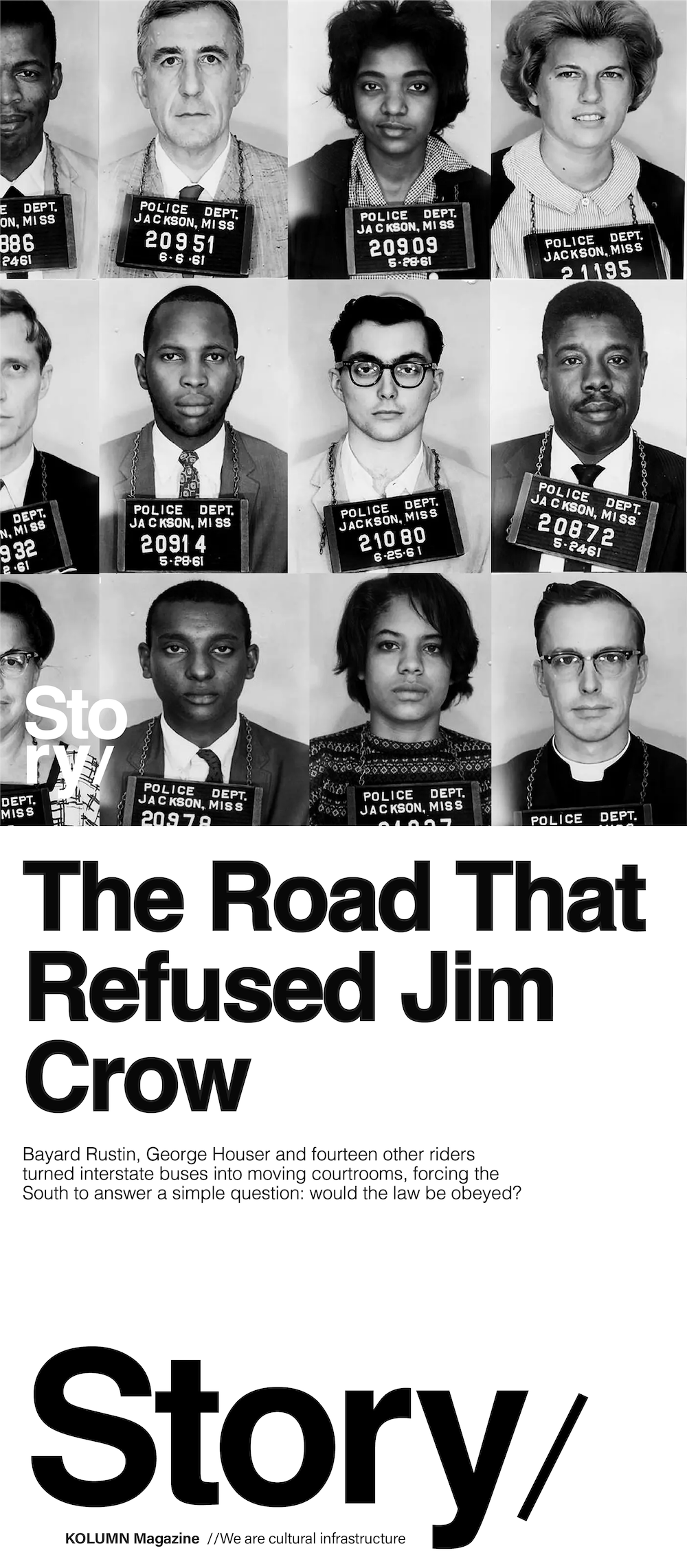
Before Rustin became the master organizer of the March on Washington, he helped turn a bus seat into a constitutional battlefield.
By KOLUMN Magazine
On April 9, 1947, sixteen men — eight Black, eight white — boarded Greyhound and Trailways buses in Washington, D.C., and headed south into a country that had already been told, by its highest court, that state-enforced segregation on interstate buses could not stand. The riders called their campaign the Journey of Reconciliation. History would later call it the first Freedom Ride. The distinction matters. This was not a symbolic pilgrimage. It was a field test of American law, a confrontation with Jim Crow at highway speed, and a warning that courtroom victories without enforcement were only paper freedoms. The organizers — the Congress of Racial Equality and the Fellowship of Reconciliation — planned to test compliance with Morgan v. Virginia, the 1946 Supreme Court ruling that struck down Virginia’s segregation law as applied to interstate bus passengers; the Court framed the issue as one involving state laws that burdened interstate commerce, not simply one of racial etiquette.
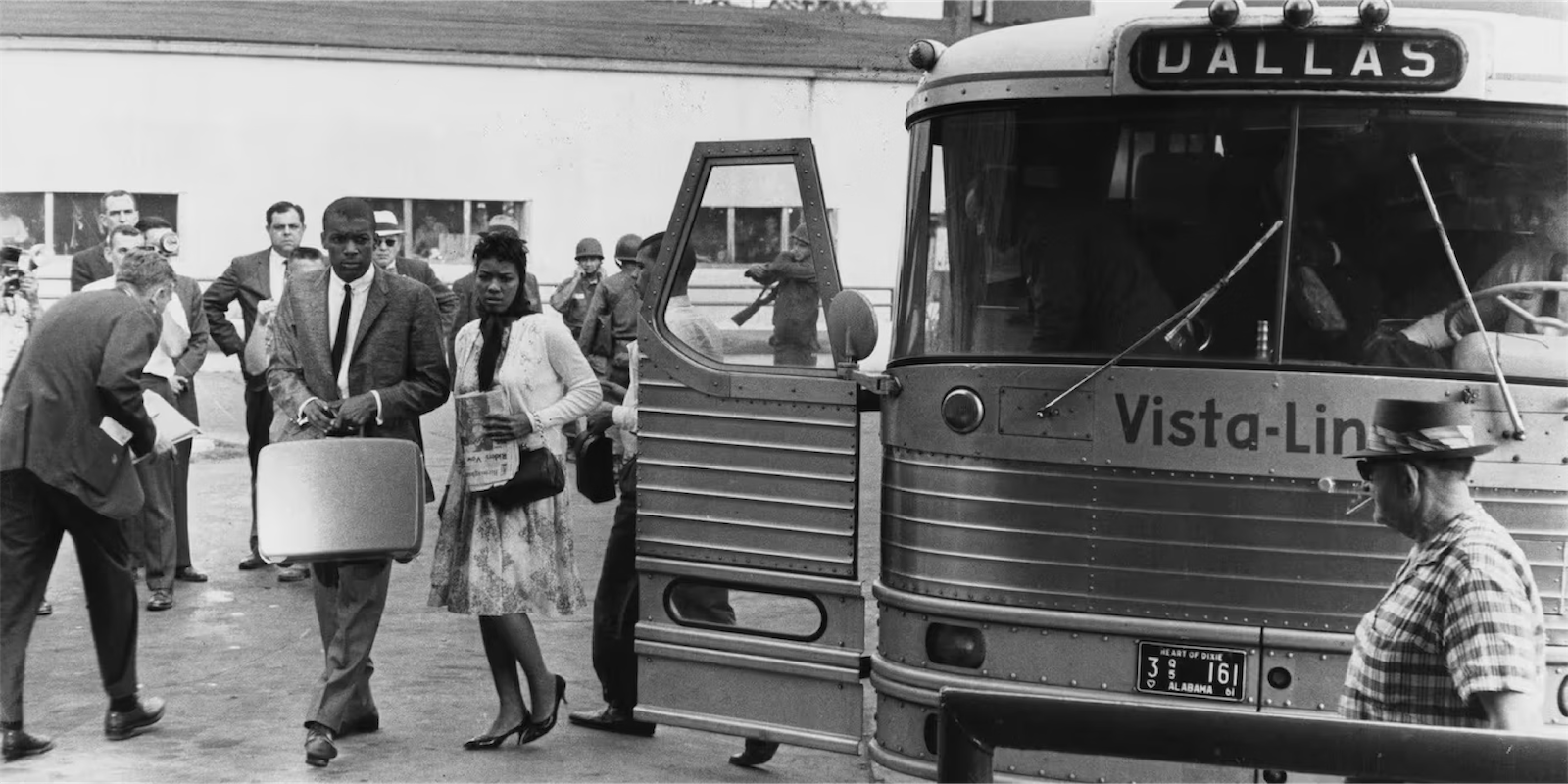
The riders’ itinerary ran through the Upper South — Virginia, North Carolina, Tennessee and Kentucky — and their method was disarmingly simple. Black riders sat in front. White riders sat beside them or in the back. They traveled in interracial pairs. They refused to perform the choreography of segregation. According to the SNCC Digital Gateway, the group planned to visit fifteen cities, speak publicly about the Morgan case, develop nonviolent techniques for handling conflict and document what happened when law met local custom.
The Court Had Spoken. Jim Crow Had Not Listened.
The immediate legal spark was Irene Morgan. In 1944, Morgan, a Black woman traveling by Greyhound from Gloucester County, Virginia, to Baltimore, refused to give up her seat to white passengers. She was arrested and convicted under Virginia’s segregation law. Her case reached the Supreme Court, where lawyers including Thurgood Marshall and William H. Hastie argued that state segregation rules imposed an unconstitutional burden on interstate commerce. On June 3, 1946, the Court struck down the Virginia statute as applied to interstate bus travel.
KOLUMN Magazine recently framed Morgan’s stand as “the law of refusal,” noting that her case established the legal ground later tested by the Journey of Reconciliation and then by the 1961 Freedom Riders. That connection is essential: Morgan’s victory did not end Jim Crow travel, but it gave activists a constitutional weapon. The Journey of Reconciliation was the act of carrying that weapon into the world.
The riders understood the danger. Southern bus drivers, police officers, local judges and white mobs often treated segregation not as a legal rule but as a sacred social order. The Supreme Court could issue an opinion in Washington. But enforcement happened in depots, aisles, sidewalks and jail cells. The Journey forced the question out of legal abstraction. Would a Black passenger actually be allowed to sit where federal law said he could sit? Would a white passenger be punished for sitting beside him? Would bus companies comply? Would police enforce the Constitution or local custom?
The Architects of a Moving Protest
The Journey was led by figures who would later become central to the architecture of the civil-rights movement. Bayard Rustin, then a CORE treasurer and Fellowship of Reconciliation field secretary, brought a disciplined commitment to nonviolence, pacifism and direct action. George Houser, a white Methodist minister and CORE leader, helped organize the campaign with Rustin. The North Carolina Department of Natural and Cultural Resources identifies Rustin and Houser as leaders of the April 9 departure from Washington, D.C.
The participants included Bayard Rustin, Wallace Nelson, Conrad Lynn, Andrew Johnson, Dennis Banks, William Worthy, Eugene Stanley and Nathan Wright among the Black riders; the white riders included George Houser, James Peck, Igal Roodenko, Joe Felmet, Worth Randle, Homer Jack, Ernest Bromley and Louis Adams, according to civil-rights movement archival materials.
This was not simply a protest group. It was a laboratory. Many of the riders came out of pacifist, Quaker, labor, socialist or Christian nonviolence circles. Cambridge’s summary of the Journey notes that twelve of the sixteen were pacifists and that the riders occupied front seats in biracial pairs while churches, colleges and NAACP chapters hosted rallies along the route.
KOLUMN Magazine’s recent profile of Rustin, “The Man Who Built the March,” rightly places the Journey inside Rustin’s longer career as a strategist who translated nonviolent principle into operational design. Before he organized the 1963 March on Washington, before he became the indispensable technician of mass demonstration, Rustin was already testing how disciplined interracial action could expose the machinery of racial power.
Chapel Hill and the Violence Beneath the Surface
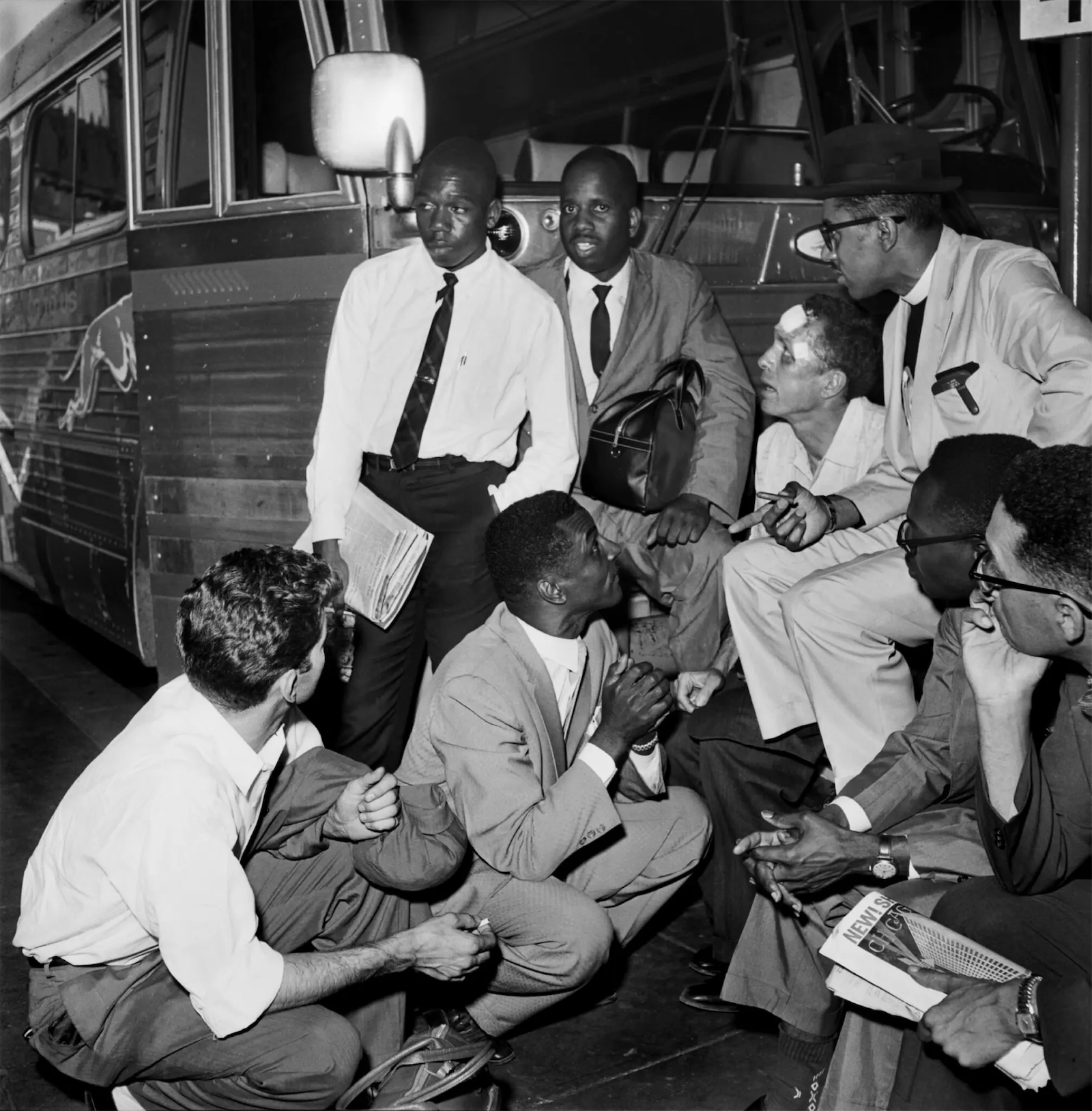
The Journey’s most remembered confrontation came in North Carolina. On April 13, 1947, the riders arrived in Chapel Hill after speaking with students and townspeople. As they prepared to leave for Greensboro, two Black riders refused to move to the rear of the bus. Several protesters were attacked, and four riders were arrested.
The University of North Carolina’s 75th-anniversary account notes that four riders, including Rustin, were arrested after being attacked by an angry mob; they were later tried, convicted and sentenced to thirty days on a chain gang. Their appeals failed, and in March 1949, three of the riders surrendered at the Hillsborough courthouse to serve their sentences on segregated chain gangs in Roxboro, North Carolina.
The chain gang punishment is crucial because it reveals what the Journey exposed: Jim Crow did not operate only through signs and seating charts. It was a carceral system. It had sheriffs, judges, jailers and forced labor behind it. When activists challenged segregated transportation, the state responded not merely with inconvenience but with punishment designed to degrade the body and break the will.
Rustin later wrote about his imprisonment and chain-gang experience, turning punishment into testimony. That pattern — repression converted into movement evidence — would define later civil-rights campaigns. In Birmingham, Selma, Jackson and Montgomery, violence would become visible proof that the state’s defense of segregation depended on coercion.
Why 1947 Was Earlier Than We Remember
Popular memory often begins the Freedom Rides in 1961, when CORE and student activists rode buses from Washington toward New Orleans to test whether Southern terminals were complying with federal desegregation rulings. The 1961 rides were historic, deadly serious and nationally transformative. But even the National Park Service acknowledges that CORE built those rides on earlier efforts, including the 1947 Journey of Reconciliation, an integrated bus ride through the segregated Upper South.
That earlier date changes the shape of civil-rights history. It reminds us that the movement did not suddenly emerge in the mid-1950s with Montgomery, nor in 1960 with lunch-counter sit-ins, nor in 1961 with burning buses in Alabama. The modern movement had roots in wartime labor struggles, pacifist networks, Black legal insurgency, anti-colonial thought, church organizing and direct-action experiments that began well before the television age made Southern brutality impossible for white America to ignore.
The Journey also complicates the idea that legal victories naturally produce social change. Morgan v. Virginia was real. It mattered. But the ruling did not implement itself. The same gap would appear again after Brown v. Board of Education in 1954, after Boynton v. Virginia in 1960, and after federal civil-rights legislation in the 1960s. In America, the distance between a right declared and a right lived has often been measured in risk.
The Strategy: Nonviolence as Enforcement
The genius of the Journey was that it treated nonviolence not as passivity but as enforcement. The riders were not asking politely for moral recognition. They were asserting a legal right in public, under pressure, with witnesses. That was the innovation. Nonviolence became a practical instrument for testing whether democratic institutions meant what they said.
SNCC Digital Gateway describes the Journey’s purpose as both educational and tactical: riders would speak about the Morgan decision, develop techniques for conflict and record incidents. That combination became a movement template. Establish the law. Enter the segregated space. Remain disciplined. Force authorities to choose. Document the response. Build public pressure.
The Journey’s restraint was not weakness. It was strategy under moral discipline. Every seat choice was calculated. Every arrest was evidence. Every beating revealed the lie beneath “separate but equal.” Every jail sentence showed that local officials would rather punish interracial democracy than obey federal law.
The Riders as a Blueprint for 1961
The line from 1947 to 1961 is direct. James Peck, one of the white participants in the Journey, later joined the 1961 Freedom Ride and was brutally beaten in Birmingham. CORE carried forward the method: interracial teams, interstate bus travel, deliberate testing of federal law, willingness to absorb violence without retaliating, and a commitment to turning local repression into national evidence.
The difference was media environment and political scale. In 1947, the Journey remained relatively under-covered and regionally contained. In 1961, television, national newspapers and Cold War optics made the Freedom Rides a crisis the Kennedy administration could not easily ignore. But the moral technology had already been prototyped.
The Journey also helped refine movement infrastructure. It linked national organizations with local churches, colleges and NAACP branches. It trained activists in how to confront police, bus drivers and mobs. It demonstrated that interracial direct action could force hidden violence into public view. It proved that the bus — an ordinary machine of American mobility — could become a stage on which the nation’s democratic contradictions were performed.
The Forgotten Riders and the Politics of Memory
Why is the Journey not more widely remembered? Partly because American civil-rights memory favors clean origin stories. Rosa Parks, Montgomery, sit-ins, Freedom Rides, Birmingham, March on Washington, Selma: these moments form a recognizable sequence. But the actual movement was messier, older and more networked. It was built through lesser-known campaigns, failed appeals, local humiliations, small meetings, jailhouse writings and dangerous experiments whose importance became clear only later.
KOLUMN Magazine’s recent work on Conrad Lynn also points toward this deeper lineage, identifying Lynn as one of the figures whose radical legal and civil-rights commitments placed him inside the Journey’s orbit before the Freedom Rides became canonical memory. The presence of Lynn, Rustin, Worthy and others reminds us that the Journey belonged to a broader Black freedom tradition that included labor rights, anti-colonial politics, pacifism, legal insurgency and direct confrontation with state power.
Memory also tends to simplify leadership. Rustin is now increasingly celebrated, but for much of his life he was marginalized because he was Black, gay, pacifist, formerly associated with radical politics and often more useful to public leaders as an organizer behind the curtain than as a face at the podium. The Journey reveals Rustin before the country knew what to do with him: disciplined, brave, strategic and already thinking in systems.
What the First Freedom Ride Teaches Now
The Journey of Reconciliation matters because it exposes a recurring American pattern: rights are often won in court before they are honored in life. That gap is where movements are born. It is where citizens decide whether law is merely language or a tool for liberation.
The campaign also teaches that direct action is not chaos. It is structured moral pressure. The riders studied the law. They planned an itinerary. They coordinated public meetings. They anticipated arrests. They trained themselves in nonviolence. They documented incidents. They built alliances. Their courage was not spontaneous; it was organized.
That is why the Journey remains significant beyond transportation history. It belongs to the history of democratic enforcement. The riders understood that citizenship was not only something granted by courts or legislatures. It had to be enacted. It had to be seated. It had to be ridden into hostile territory.
In 2022, Orange County, North Carolina, cleared the names of four men arrested in Chapel Hill during the Journey, acknowledging the injustice of their convictions decades after the fact. The gesture was overdue, but historically resonant. The law that once punished them now recognizes them. Yet the deeper lesson is not that America eventually corrects itself. It is that correction usually begins with people willing to be punished before the country is willing to call them right.
The Road Still Speaks
The Journey of Reconciliation began on April 9, 1947, but its meaning did not end when the buses returned to Washington. It lived on in the Freedom Rides of 1961, in the sit-ins, in the jail cells, in the legal campaigns, in the movement discipline that turned ordinary spaces into constitutional tests. It lived on in the idea that democracy must be practiced where it is denied.
To call it the first Freedom Ride is not merely to correct a timeline. It is to restore a method, a genealogy and a set of names to their rightful place. Before the burning bus in Anniston, before the mobs in Birmingham and Montgomery, before federal marshals and national headlines, there were sixteen riders carrying a Supreme Court decision into the South and asking whether America intended to obey itself.
They did not end Jim Crow on the road. But they made evasion visible. They revealed the cowardice of local power. They trained a movement in the uses of disciplined confrontation. They showed that a bus seat could become a battleground, a courtroom, a pulpit and a prophecy.
The first Freedom Ride was not only a ride. It was an argument on wheels. And America is still answering it.
More great stories
Afro Sheen, Wall Street, and the Architecture of Black Possibility
July 6, 2026
No Comments
The Fire Inside the Fourth
July 5, 2026
No Comments