
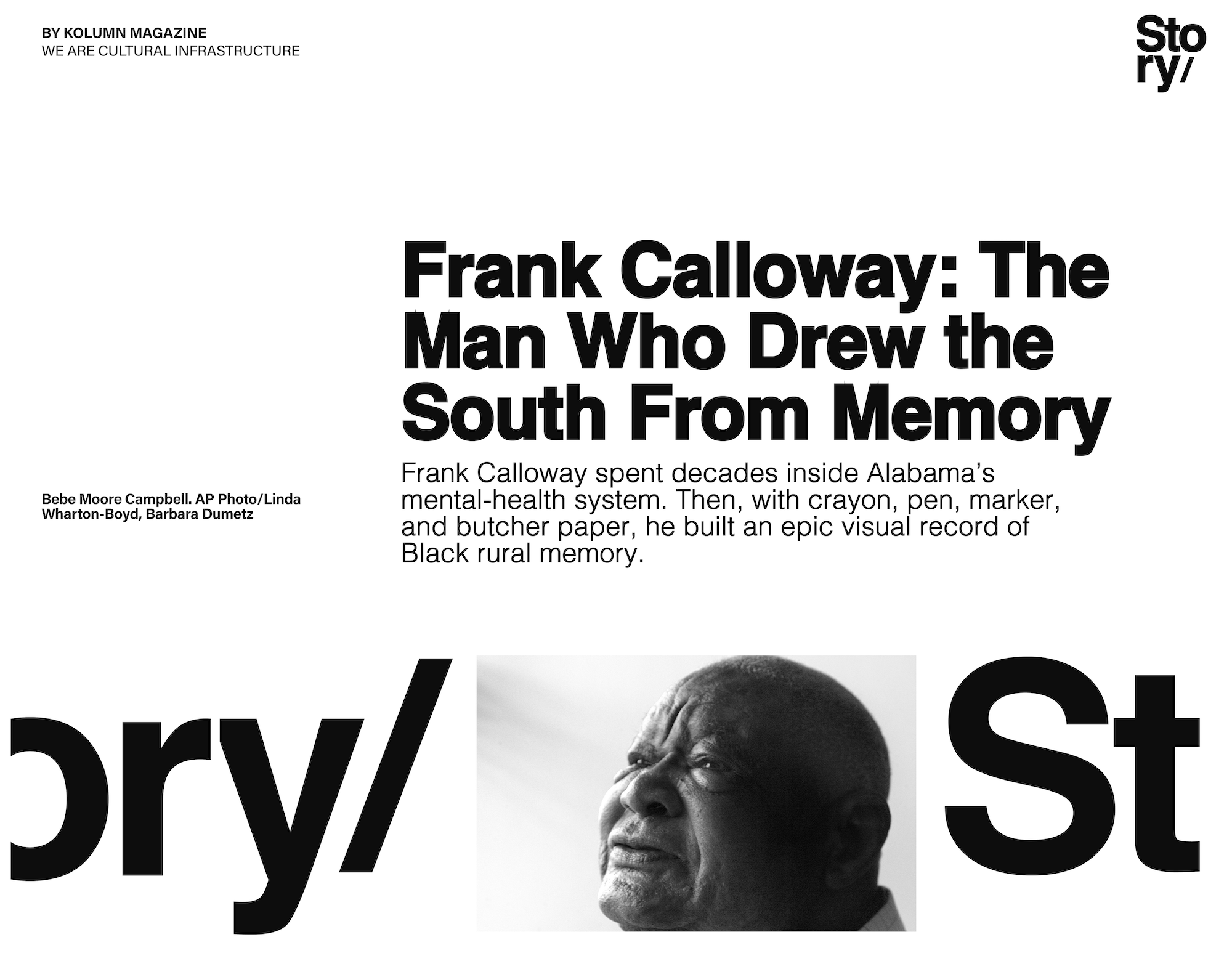
Frank Calloway did not draw nostalgia. He drew the architecture of remembering.
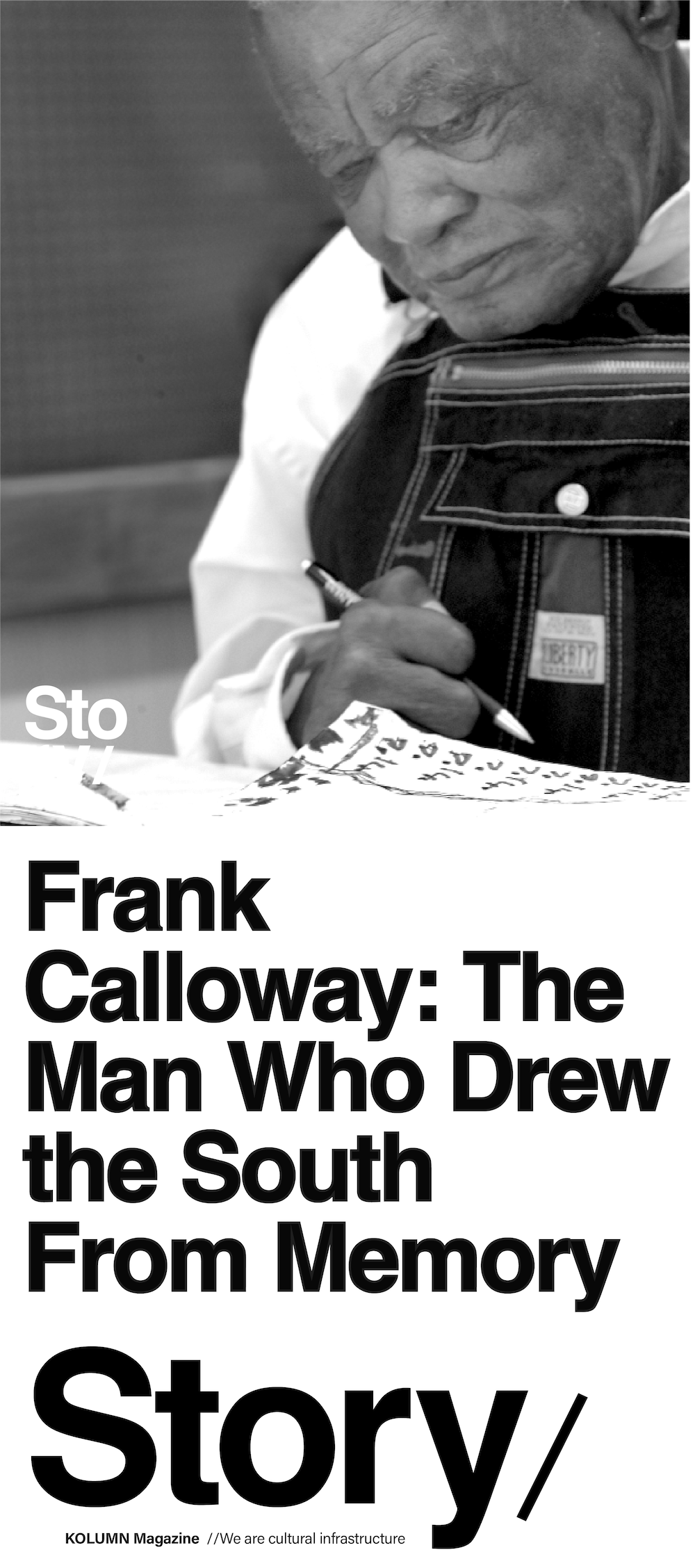
Frank Calloway did not draw nostalgia. He drew the architecture of remembering.
By KOLUMN Magazine
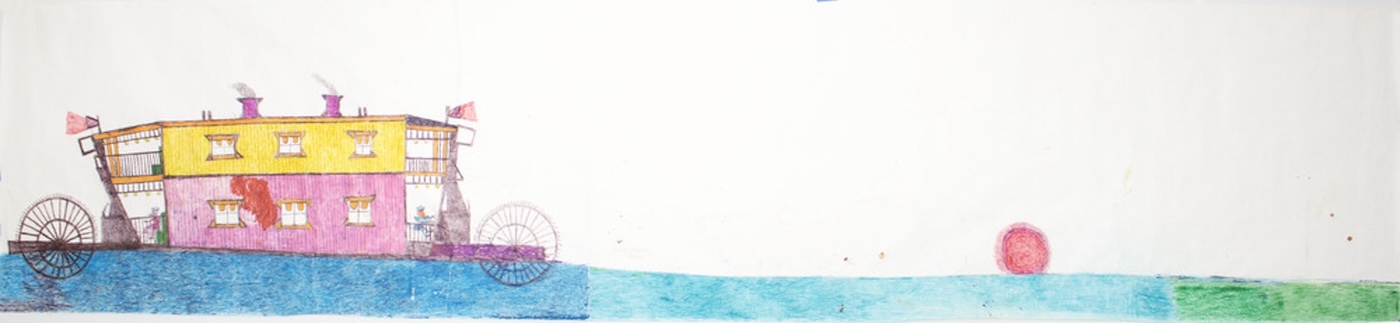
Frank Calloway’s art begins with a paradox: the work looks open, crowded, moving, alive—yet much of it was made inside the long shadow of confinement.
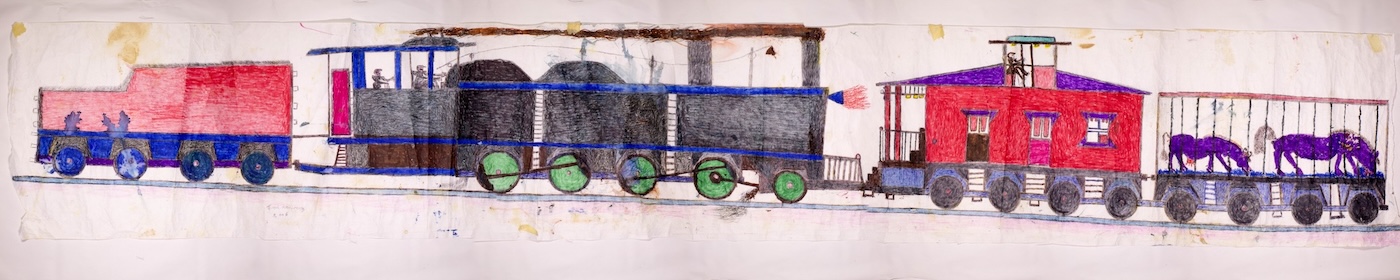
He drew farms and roads, animals and houses, towns and rail lines, wagons and crowds. He drew the rural South not as a still photograph but as a procession, a world always in motion. His materials were humble: crayon, marker, ballpoint pen, and long rolls of butcher paper. His scale was not. The scrolls could run eight feet, thirty feet, even more than sixty feet, according to biographical accounts from the Outsider Art Fair and other art-world records.
Calloway, who died in Tuscaloosa in 2014, is often described as a self-taught or “outsider” artist. That label is useful only up to a point. It places him in a market category, but it does not fully explain the force of the work. His drawings are not merely art from outside the academy. They are memory systems. They are Black Southern landscapes reconstructed by a man whose own life had been routed through poverty, labor, illness, institutionalization, and late recognition.
The basic facts of his life are difficult in the way many Black Southern lives are difficult: the record is incomplete, the dates are contested, and the official paperwork often tells less than the work itself. Some sources once reported that Calloway was born in 1896 and was 112 years old in 2008; later gerontology research disputed that claim and placed his birth in 1915, a correction reflected in later summaries of his life. The Outsider Art Fair describes him as born sometime between 1896 and 1913 in Montgomery, Alabama, while other sources use July 2, 1915, as the accepted birth date.
The uncertainty matters. It is not a decorative biographical wrinkle. It points to the broader problem of how Black lives, especially poor Black lives, enter the archive. The state records the confinement. The art market records the exhibition. The newspapers record the novelty of advanced age. But the person—the child, the worker, the witness—must often be reconstructed through fragments.
Calloway’s fragments tell a story of labor before art. The Outsider Art Fair notes that he worked mostly on farms, in logging, and building roads before his institutionalization. Andrew Edlin Gallery’s 2009 exhibition announcement described him as “poor, black and fatherless” in Montgomery and said he had been committed since 1952 to Bryce Hospital and the Alabama Department of Mental Health in Tuscaloosa. That sentence is stark, but it should not be allowed to flatten him. Poverty was a condition. Fatherlessness was a wound. Institutionalization was a fact. None of those was the sum of the man.
The South He Remembered
Calloway’s drawings return again and again to agrarian scenes: barns, fields, animals, houses, roads, people working, people traveling, people gathered. The images have sometimes been described as childlike, but that word can be misleading. There is sophistication in his sequencing, density, and rhythm. The scenes stretch horizontally like memory unspooling. They move the eye from one event to another, one structure to another, one small drama to the next.
The Chicago Sun-Times, reviewing visionary art in 2008, called attention to his rural scenes on long sheets of butcher paper and noted that some scrolls were as long as thirty feet. The review also observed an “intuitive devotion to rhythm, pattern and number” in his ballpoint pen and crayon works. That phrase gets close to the visual intelligence of Calloway’s art. The scrolls are not simply crowded. They are organized. They contain movement, recurrence, spatial logic. They have the pulse of someone who remembers not only what things looked like, but how they repeated.
This is where Calloway belongs in a larger KOLUMN conversation about Black memory work. In previous KOLUMN stories on cultural preservation—such as the magazine’s writing on the Nina Simone Childhood Home and Black Southern sites of memory—the central question has been how fragile places become durable public history. Calloway’s answer was not architectural restoration. It was hand, color, and line. He preserved a world by drawing it at length.
His scrolls are not windows onto the past. They are arguments that the past had texture, traffic, labor, weather, and sound.
The rural South in Calloway’s work is not the plantation fantasy of white nostalgia. It is not the Old South as moonlight and magnolias. It is closer to an inventory of lived space. Roads matter. Fences matter. Animals matter. Houses matter. Work matters. Motion matters. The drawings suggest that memory is not a museum case but a route: one thing leading to another, a field giving way to a house, a wagon moving toward a town, a train line cutting across the page.
That sense of movement may have come from Calloway’s own working life. A man who had farmed, logged, and helped build roads would have understood the landscape through labor. Roads were not abstractions. Fields were not scenery. They were places where bodies worked, sweated, carried, endured.
Bryce Hospital and the Meaning of Confinement
Any serious account of Calloway must deal carefully with his years inside Alabama’s mental-health system. He was diagnosed with schizophrenia and committed in 1952, according to accounts cited by the Outsider Art Fair and later biographical summaries. He lived for decades on or near the Bryce Hospital campus and later at the Alice M. Kidd Nursing Facility in Tuscaloosa.
Bryce Hospital itself is a major institution in Alabama history. The class-action case Wyatt v. Stickney, filed in 1970 on behalf of patients at Bryce Hospital, became a landmark in the legal history of mental-health treatment. The Encyclopedia of Alabama describes it as a ruling that established baseline care and treatment requirements for institutionalized people with developmental disabilities, while Disability Justice notes that the federal court held that involuntarily committed people had a constitutional right to treatment that offered a realistic opportunity to return to society.
Calloway’s art cannot be reduced to that legal context, but it cannot be separated from it either. The institution shaped the conditions under which he made work. Reports and gallery accounts indicate that he became especially prolific after being encouraged to draw and after taking an art class in the 1980s.
This is the ethical tension at the center of his story. The art world often loves the romance of the “outsider”: the isolated genius, the untrained hand, the visionary making beauty beyond conventional institutions. But Calloway was not simply outside. He was inside—inside a state system, inside a diagnosis, inside a life where autonomy had been sharply limited. To celebrate the art without acknowledging that reality would be sentimental. To focus only on confinement would be another erasure.
The better reading is harder and more honest: Calloway made expansive work under constrained conditions. His drawings do not cancel the institutional facts of his life. They complicate them. They insist that a person can be confined and still imaginatively vast.

Late Recognition
Calloway’s public recognition came late. His work appeared in the 2006 Consumer Art Exhibition at the Montgomery Museum of Fine Arts, in a 2008 exhibition at the American Visionary Art Museum in Baltimore, and in later Andrew Edlin Gallery exhibitions in New York, according to the Outsider Art Fair and Andrew Edlin Gallery records.
The 2008 Baltimore exhibition, “The Marriage of Science, Art and Philosophy,” helped introduce him to a broader audience. The Chicago Sun-Times noted that Calloway, then widely reported as 112, traveled to Baltimore for the opening—his first time outside Alabama. That detail is almost unbearably poignant: a man whose art stretched across imagined roads finally taking a road out of the state where he had spent his life.
Andrew Edlin Gallery presented “Frank Calloway: Pageants from the Old South” in 2009, describing it as his first gallery exhibition. A second Andrew Edlin exhibition followed in 2011, drawing from his output over the previous decade. The Outsider Art Fair bibliography records that his work was reviewed by The New York Times, Artnet, and the Associated Press, a mark of how quickly the art world began to recognize the significance of what he had been making.
Recognition arrived late, but the lateness does not diminish the work. It indicts the systems that took so long to see it.
Late recognition is a familiar pattern in the history of Black artists, especially those outside formal institutions. The market often discovers them after decades of production, then frames their work as revelation. But revelation for whom? Calloway knew what he was making. His caregivers saw him making it. The art existed before the gallery wall gave it prestige.
That distinction matters because it shifts the center of authority. The art world did not create Frank Calloway. It caught up to him.
The Problem With “Outsider”
The term “outsider art” has always carried contradictions. It can honor artists who worked beyond academic training and institutional approval. It can also exoticize them. In Calloway’s case, the label risks making his distance from the mainstream seem natural rather than produced by race, class, disability, and confinement.
He was “outside” the academy, but he was not outside history. He was “self-taught,” but he was not untaught by life. He was not trained in the language of museums, but he had studied roads, fields, animals, machines, weather, and work. His visual vocabulary came from the world that made him.
The strongest way to understand Calloway is not as an outsider to art, but as an insider to memory. His drawings know things that official culture often forgets. They know that rural Black life was not empty. They know that roads carried more than traffic. They know that the South was not a backdrop but a system of movement, labor, surveillance, survival, and improvisation.
In this sense, Calloway’s work belongs beside other Black cultural archives that make ordinary life monumental. KOLUMN has often returned to figures and places that preserved Black experience outside official power, from civic memory to the preservation of Black cultural landmarks. Calloway’s scrolls extend that tradition. They are not documentary in the strict journalistic sense, but they are documentary in the deeper cultural sense: they testify.
Why Frank Calloway Matters Now
Frank Calloway matters because his life forces several American histories into the same frame. There is the history of Black rural labor in the South. There is the history of mental-health institutionalization. There is the history of self-taught art and the market that belatedly validates it. There is the history of archives and who gets to make them.
His drawings also matter because they resist the thinning of Black Southern memory. Too often, the rural South is remembered through trauma alone or romanticized into pastoral myth. Calloway’s work does neither. It is vivid, busy, structured, sometimes joyful, sometimes strange. It suggests that memory is not a single mood. It is accumulation.
The long scroll format is crucial. A framed square can suggest a scene. A scroll suggests duration. It asks the viewer to move with it, to follow, to keep looking. Calloway’s art does not deliver the past as a single image. It makes the past unfold.
That unfolding may be the deepest metaphor for his life. For decades, he was largely unseen by the national art world. Then the drawings emerged into public view, and the scale of what he had been making became harder to ignore. A life that might have been summarized by diagnosis and institutional address instead became legible through color, line, motion, and memory.
The Archive He Made by Hand
Frank Calloway’s legacy is not only aesthetic. It is archival. He made an archive without official permission, without institutional training, without the usual apparatus of preservation. The archive was not filed in boxes. It rolled across butcher paper. It lived in repetition: barns, roads, animals, houses, vehicles, workers, communities.
The website dedicated to his work describes him as an American self-taught artist who used crayon and marker to depict detailed agrarian scenes on continuous scrolls of butcher paper. Its bibliography notes that after Calloway’s death in 2014, permission was granted by a county probate judge to have his artworks photographed and catalogued. That detail is important. It reminds us that preservation is not automatic. Even after an artist dies, the work must be protected, documented, and made available to future viewers.
For KOLUMN, Calloway’s story belongs in the larger project of recovering Black lives that were not always granted full institutional recognition in their own time. His art asks us to widen the definition of historical evidence. A drawing can be evidence. A remembered road can be evidence. A repeated house or cow or wagon can be evidence. A scroll can carry what a courthouse never recorded.
Frank Calloway did not leave behind a manifesto. He left a world. He left it in crayon, marker, pen, and paper. He left it long, crowded, rhythmic, and alive.
And perhaps that is the most fitting final image: an old man at a table by a window, drawing for hours, laying down one remembered thing after another. Not asking permission. Not waiting for the museum. Not explaining the South to those who had misread it. Simply making it visible, again and again, until the paper could barely contain it.
More great stories
Afro Sheen, Wall Street, and the Architecture of Black Possibility
July 6, 2026
No Comments
The Fire Inside the Fourth
July 5, 2026
No Comments