


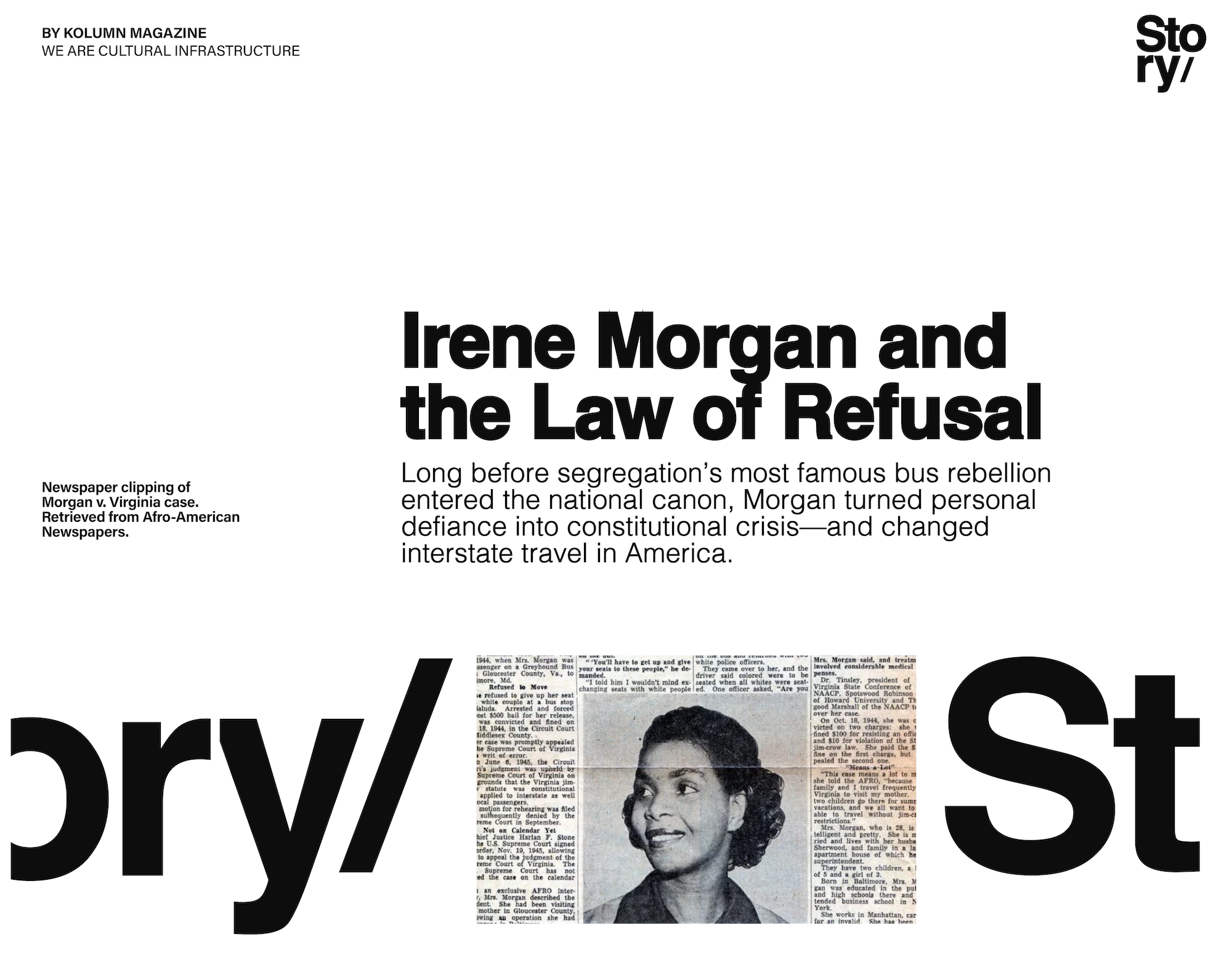
Irene Morgan matters not because she came first in some tidy sequence, but because she exposed a truth the nation kept postponing: segregation in travel was both a local humiliation and a national constitutional crisis.
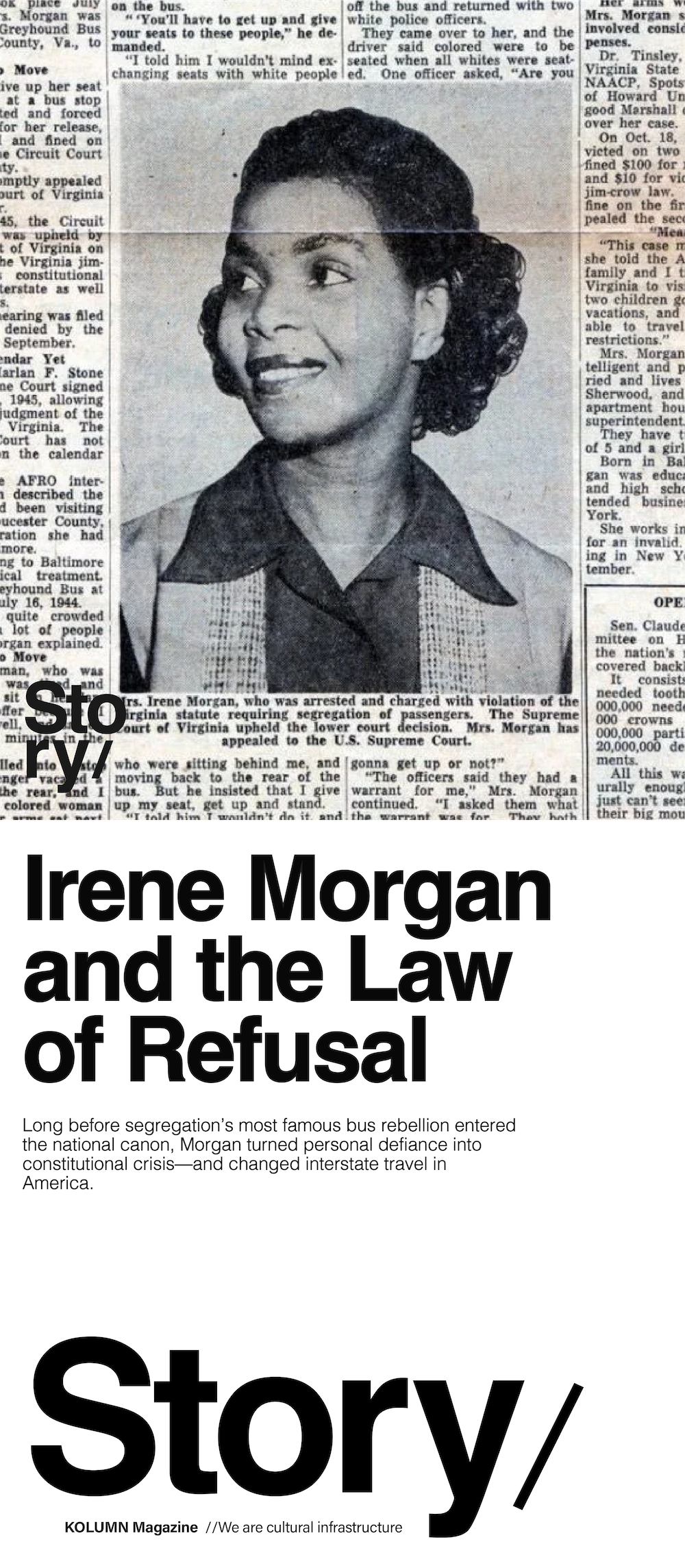
Irene Morgan matters not because she came first in some tidy sequence, but because she exposed a truth the nation kept postponing: segregation in travel was both a local humiliation and a national constitutional crisis.
By KOLUMN Magazine
Irene Morgan is one of those essential people whose importance far exceeds her popular recognition, which is precisely why her life keeps demanding a return. Morgan did not become famous in the way the nation likes its heroes to become famous. She did not fit neatly into the sentimental grammar that often governs civil-rights memory. She was not soft-edged, not designed for myth, not especially interested in behaving like the nation’s preferred version of a heroine. In 1944, on a Greyhound bus traveling from Gloucester County, Virginia, to Baltimore, she refused to surrender her seat to white passengers. When law enforcement tried to remove her, she resisted physically. Her case went all the way to the Supreme Court, and in 1946, in Morgan v. Virginia, the Court struck down state-enforced segregation on interstate buses as an unconstitutional burden on interstate commerce. That ruling came nearly a decade before the Montgomery bus boycott and helped establish the legal groundwork later tested by the Journey of Reconciliation in 1947 and, eventually, the Freedom Riders in 1961.
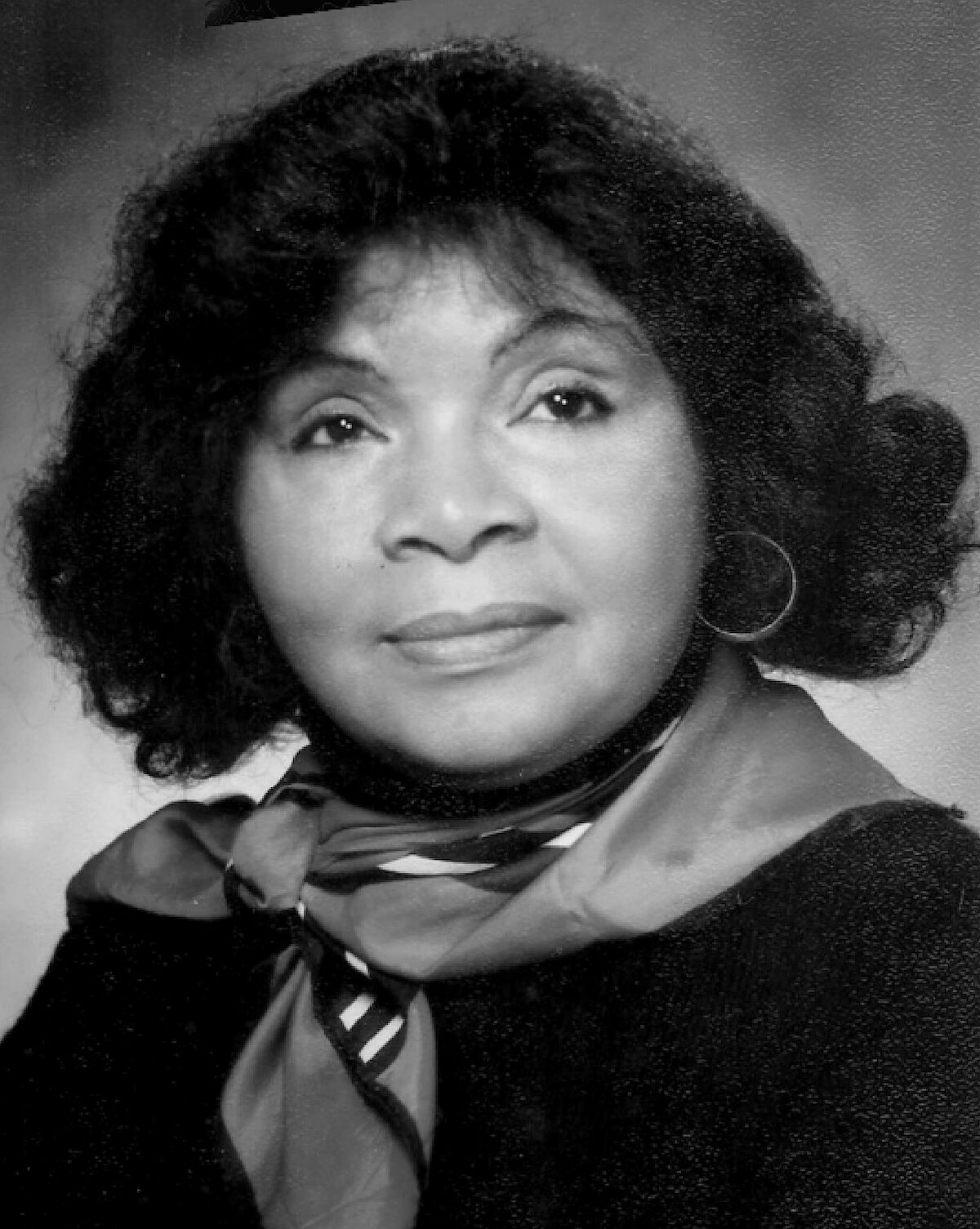
That alone would make Morgan historically significant. But to stop there would be to flatten her into a footnote: the woman “before Rosa Parks,” the name scholars know, the correction added to a textbook, the obligatory prequel to someone else’s story. Morgan deserves better than prequel status. Her importance lies not only in chronology but in texture. She reveals how Black resistance often happens before the country develops the language to celebrate it. She reveals how legal victories can be real and still remain unenforced. She reveals how movement history is shaped as much by memory’s exclusions as by its monuments. The America that now praises Irene Morgan did not protect her when she was arrested, did not rush to enshrine her when she won, and did not promptly give her the canonical status her achievement warranted. Her life, in other words, is not merely a story of courage. It is a story about what the nation does with Black courage once it can no longer deny it.
To understand Morgan properly, one has to begin before the bus ride, before the courtroom, before the retrospective honors. Irene Amos Morgan was born on April 9, 1917, in Baltimore, Maryland, the daughter of Robert Amos and Ethel Dean Smith Amos. She was raised in a Black working-class family with Southern roots and was a lifelong Seventh-day Adventist. Several state and archival sources note that records sometimes vary on her full given name, but Irene is the name by which she was known and remembered. She left school before completing high school and, like many Black women of her generation, worked early to help support family life. During World War II, she worked for the Glenn L. Martin aircraft company in Baltimore, helping produce B-26 Marauder bombers for the war effort. That detail matters, not because patriotic labor automatically ennobles resistance, but because it clarifies the contradiction she inhabited: Black Americans were being asked to produce democracy abroad while enduring a caste order at home.
The trip that changed history came in July 1944, at a moment when Morgan was physically depleted. Accounts from the Washington Post, the Library of Virginia, PBS, and later historical summaries note that she had been visiting her mother in Gloucester County and was traveling back to Baltimore, where she worked, after a difficult period that included illness and recovery from miscarriage. She boarded the Greyhound in Virginia for an interstate trip to Maryland. The bus, like many vehicles of the era, operated within the warped logic of Jim Crow, where Black passengers could be displaced at the command of drivers and backed by local law. When a white couple boarded and needed seats, the driver ordered Morgan and another Black woman to move. The other woman complied. Morgan did not.
The standard civil-rights retelling of such moments often sands down the edges. It prefers dignity rendered in quiet, almost liturgical terms. Morgan’s refusal was dignified, yes, but it was also ferocious. She did not simply decline. She resisted. Historical accounts say she tore up the warrant presented to her. When a sheriff tried to handle her physically, she fought back. In later recollections, she described kicking one officer and clawing at another. There is something bracing in that memory because it refuses sanitization. Morgan did not only defend principle; she defended bodily autonomy. In the moral economy of segregation, Black women were expected to yield space, yield safety, yield decorum, yield even their bodies to white authority. Morgan rejected the whole arrangement. It is one reason her story has sometimes sat awkwardly beside more domesticated civil-rights iconography. She was not pliant enough to become instantly marketable as myth.
She was arrested and charged with both resisting arrest and violating Virginia’s segregation law. Morgan paid the fine related to resisting arrest, but she refused to accept the segregation conviction as legitimate. That distinction is revealing. She was not claiming that the confrontation had never happened. She was insisting that the law itself was wrong. Her case moved through the courts, first losing in Virginia’s state judiciary, before the NAACP Legal Defense apparatus helped take it to the U.S. Supreme Court. The legal team included William H. Hastie and Thurgood Marshall, with Leon A. Ransom on the brief. Their strategy was notable. Rather than centering the case on the Fourteenth Amendment alone, they argued that segregation in interstate bus travel placed an impermissible burden on interstate commerce and therefore could not stand under the Constitution’s Commerce Clause. In June 1946, the Supreme Court agreed and reversed the Virginia judgment.
That legal strategy is part of why Morgan’s story matters so much to anyone interested in how social change actually works. Movements are not built only from speeches, marches, and charismatic public confrontation. They are also built from jurisdiction, doctrinal innovation, procedural patience, and tactical realism. Morgan’s lawyers understood that the Court of the mid-1940s might be more willing to police the uniformity of interstate commerce than to abandon racial hierarchy wholesale. The result was not the moral clarity that later generations often prefer in retrospect. It was something at once narrower and more useful: a holding that states could not impose their own segregation regimes on interstate passengers because such a patchwork burdened national commerce. Justice Stanley Reed’s majority opinion made that logic explicit. In its own dry register, the Court was admitting that Jim Crow’s geography could not be allowed to fracture interstate travel into a “crazy quilt” of local commands.
But legal triumph is not the same thing as lived transformation. This is where the Irene Morgan story becomes especially instructive, and especially American. Morgan v. Virginia was a landmark. It was also widely ignored. Southern states and carriers continued to enforce segregation on interstate routes in practice, and Black travelers remained vulnerable to harassment, expulsion, arrest, and violence. One of the great deceptions of U.S. civics is the idea that a Supreme Court victory automatically settles the matter. In Black history, legal wins routinely arrive before white compliance, before institutional enforcement, before federal seriousness, before safety. Morgan’s case is one of the clearest examples. The law changed in 1946. The country did not immediately follow.
That gap between law and reality gave rise to one of the most important but still under-discussed direct-action campaigns of the mid-century freedom struggle: the Journey of Reconciliation in 1947. Organized by the Congress of Racial Equality and Fellowship of Reconciliation, the Journey sent an interracial group of men through parts of the Upper South to test compliance with the Morgan ruling. They encountered arrests, beatings, jail time, and chain gangs. Historians and contemporary sources routinely describe the Journey as the first Freedom Ride. That description is not a casual flourish. It is an acknowledgment that Morgan’s case did not end a battle; it set the stage for a new one. Without Irene Morgan’s legal win, there is no 1947 test ride in the same form. Without the 1947 test ride, the 1961 Freedom Rides look less legible as a tactic. Morgan stands at the hinge point between courtroom victory and movement experiment.
This is part of why the familiar comparison to Rosa Parks, while unavoidable, can also be reductive. Yes, Morgan acted eleven years earlier. Yes, both women refused the racial discipline of bus segregation. Yes, Morgan’s defiance belonged to a lineage that helps us understand Montgomery more fully. But the differences matter too. Morgan was on an interstate bus, Parks on a city bus. Morgan’s case became a Commerce Clause ruling, while the Montgomery movement developed through a mass boycott and litigation that culminated in Browder v. Gayle. Parks was folded into a vast public campaign that reshaped global perceptions of the Black freedom struggle. Morgan’s action, though legally momentous, entered public mythology more slowly and less completely. Comparing them is useful only if it enlarges both women rather than shrinking Morgan into a dress rehearsal for somebody else’s fame.
There is also the question of gendered respectability. The civil-rights movement has often been remembered through a politics of presentation that rewarded certain kinds of public comportment. The “ideal” heroine is often framed as calm, churchly, modest, and unthreatening. Morgan’s own recollections complicate that template. She fought the officers. She spoke with plainness, not saintly abstraction. She was not auditioning for anyone’s approval. That does not make her less admirable; it makes her more legible as a real Black woman navigating danger in real time. Her refusal was not choreographed for posterity. It was instinctive, moral, embodied, and alive. In that sense she belongs with the Black women whose resistance the archive often under-theorizes because it does not always arrive in polite form.
Morgan’s post-1940s life also resists simplification. After the death of her first husband, Sherwood Morgan, she later married Stanley Kirkaldy and lived in New York. There, according to archival and biographical records, the couple ran a dry-cleaning business and a child-care center in Queens. In one of the most remarkable chapters of her later life, she returned to formal education in her sixties, earning a bachelor’s degree from St. John’s University in 1985 and a master’s degree in urban studies from Queens College in 1990. This portion of her story matters because it interrupts the narrow habit of treating movement figures as though their historical significance ended the moment they performed the act for which they are remembered. Morgan did not simply become a relic of 1944. She kept living, working, learning, raising family, and participating in the long afterlife of her own courage.
By the late 20th century, some of the recognition that had eluded her began to arrive. The documentary You Don’t Have to Ride Jim Crow! helped bring renewed attention to her role and to the Journey of Reconciliation. Gloucester County honored her in 2000 during its 350th anniversary observances. In January 2001, President Bill Clinton awarded her the Presidential Citizens Medal, explicitly connecting her wartime-era refusal to the larger Black freedom struggle. Official records from the Clinton presidency and the Library of Virginia make clear that the federal government, belatedly, understood the significance of what Morgan had done. Yet the lateness of that recognition is not incidental. It is part of the story. America often waits until its dissidents are safely historicized before praising the dissent.
When Clinton presented the medal, he described the contradiction plainly: Black Americans were fighting and dying for freedom abroad while facing Jim Crow at home. That line is not mere ceremonial rhetoric. It points back to the precise wartime hypocrisy Morgan had exposed in 1944. She was part of the so-called Double V generation, even if not always named that way in popular memory: people who understood victory over fascism abroad as inseparable from victory over white supremacy at home. Her act on that bus was not abstract courage floating free of context. It emerged from a period in which Black workers, Black soldiers, Black churchgoers, Black migrants, and Black families were increasingly unwilling to defer democratic claims until some more convenient season.
Morgan died on August 10, 2007, at age 90, in Gloucester County, Virginia. Obituaries and remembrances described her as warm, courageous, and increasingly appreciated in her later years, though still not nearly as widely known as she should have been. Since then, historical markers, educational initiatives, and renewed scholarship have continued to recover her place in the story. Virginia officials dedicated a marker in Gloucester County in 2020 emphasizing that her arrest and lawsuit led to the Supreme Court decision striking down segregation on interstate transportation. These acts of memorialization matter. They help repair public memory. But they also carry a warning. A marker can preserve history, and still not fully interpret it. A medal can honor a person, and still not redress the years of under-recognition. The work of memory is more demanding than commemoration alone.
For KOLUMN, Irene Morgan’s story resonates in a particularly pointed way because this publication has already shown, in recent pieces on figures such as Charles Sherrod and Samuel Wilbert Tucker, an interest in the Black freedom struggle beyond its most over-recycled icons. KOLUMN’s article on Sherrod emphasized the people who kept working after the headline moments passed; its piece on Tucker highlighted the quiet architecture of freedom built through legal and local struggle. Morgan belongs exactly in that lineage. She was both headline and architecture, both confrontation and groundwork. Like Tucker, her importance can be measured in legal consequence. Like Sherrod, her legacy disrupts the lazy tendency to mistake publicity for significance.
And that may be the deepest lesson of Irene Morgan’s life. The civil-rights movement did not move forward only because the nation was eventually persuaded by eloquence or shamed by spectacle. It also moved because ordinary Black people refused in strategically decisive places: on buses, in courtrooms, at lunch counters, in schools, at registrar offices, in union halls, at church meetings, and in the intimate geography of the everyday. Morgan’s refusal happened in transit, which made it especially revealing. Travel in America has always been about more than movement. It is about who can pass safely, who can rest, who can stop, who can eat, who can use the bathroom, who can occupy space without explanation, who gets treated as a citizen and who gets treated as cargo. Morgan challenged not just a seating rule but a national system for organizing Black vulnerability in motion.
Her case also helps clarify the relationship between local cruelty and federal power. Jim Crow loved to disguise itself as custom, as common sense, as the regional way of doing things. The legal genius of Morgan v. Virginia was that it stripped away some of that provincial alibi. If a person was traveling across state lines, then the state could not simply claim unlimited authority to force racial segregation on that journey. That doctrinal move sounds technical, but its democratic implications were profound. It meant Black citizenship could not be infinitely subordinated to local prejudice whenever a state called prejudice “order.” The ruling did not abolish segregation broadly. But it punctured the presumption that white Southern habit was entitled to national deference.
This is one reason Morgan should be taught not as an interesting aside, but as a central figure in the evolution of mid-century civil-rights strategy. She sits at the crossroads of several histories at once: Black women’s resistance, wartime democratic contradiction, NAACP litigation strategy, interstate commerce jurisprudence, direct-action experimentation, and the long prehistory of the Freedom Rides. Too often, public memory isolates these strands. Morgan compels us to see them braided together. Her life demonstrates that the movement’s turning points were not always the events later placed at the center of national ritual. Sometimes they were the less marketable moments, the legally complex moments, the moments that were too early for consensus and too unsentimental for mythmaking.
There is, too, something politically useful in Morgan’s refusal to behave like a memorial statue before her time. Contemporary culture often rewards historical figures who can be reduced to inspiration without friction. Morgan is harder than that. She fought back. She was angry. She understood the insult instantly and treated it as intolerable. That is not a flaw in the record. It is a corrective to the ways Black protest is repeatedly judged according to whether it is sufficiently decorous for white retrospective approval. Morgan reminds us that resistance can be lawful in principle and unruly in appearance; that moral clarity does not always arrive wearing a calm expression; that the body sometimes knows injustice before the nation agrees to name it.
Her relative obscurity also tells us something about how the American canon gets built. The figures who become fixtures are not always the most important. They are often the most narratively convenient. Parks became central for good reason, but also because her story was absorbed into a version of movement history the nation could eventually ritualize. Morgan’s story, by contrast, raised messy questions: Why had a Supreme Court ruling not been enforced? Why did the nation need another decade and another bus icon to remember what had already happened? Why were militant Black women so frequently honored late, if at all? Why was a legal watershed still vulnerable to amnesia? These are not side questions. They go to the heart of how American historical memory protects itself from its own omissions.
To write about Irene Morgan now is therefore to do more than restore a name. It is to insist on a different map of the freedom struggle, one less dependent on a few overfamiliar peaks and more attentive to the terrain that made them possible. It is to remember that Black women have long been constitutional actors, not merely movement symbols. It is to see that legal history and social history are inseparable. It is to understand that the country’s progress narratives are often tidier than the truth. And it is to admit that the freedom movement has always had architects whose blueprints were credited late, tested incompletely, and inherited by others who became more famous.
In the end, Irene Morgan’s significance is not only that she refused to move. It is that she changed what movement itself could mean in America. She transformed a seat assignment into a constitutional contest. She transformed personal indignation into public precedent. She transformed the bus from a site of routine humiliation into a battlefield over national citizenship. And even after the Court ruled, her story kept teaching: that law without enforcement is fragile, that memory without correction is dishonest, and that freedom in this country has often depended on Black women deciding, in the face of command, that they would not cooperate with their own diminishment.
That is the KOLUMN-sized truth of Irene Morgan. She was not merely before Rosa Parks. She was before the country was ready to understand what she had done. She was before its commemorative habits knew where to place a woman who fought back. She was before its public schools learned to teach the legal and tactical prehistory of the Freedom Rides with any seriousness. But being early is not the same as being peripheral. Sometimes the person history keeps at the edge is the very person who made the center possible. Irene Morgan belongs there: not in the margins of the civil-rights narrative, but in its load-bearing frame.
More great stories
Afro Sheen, Wall Street, and the Architecture of Black Possibility
July 6, 2026
No Comments
The Fire Inside the Fourth
July 5, 2026
No Comments