


His willingness to defend the politically radioactive cost revealed the integrity of his commitments.
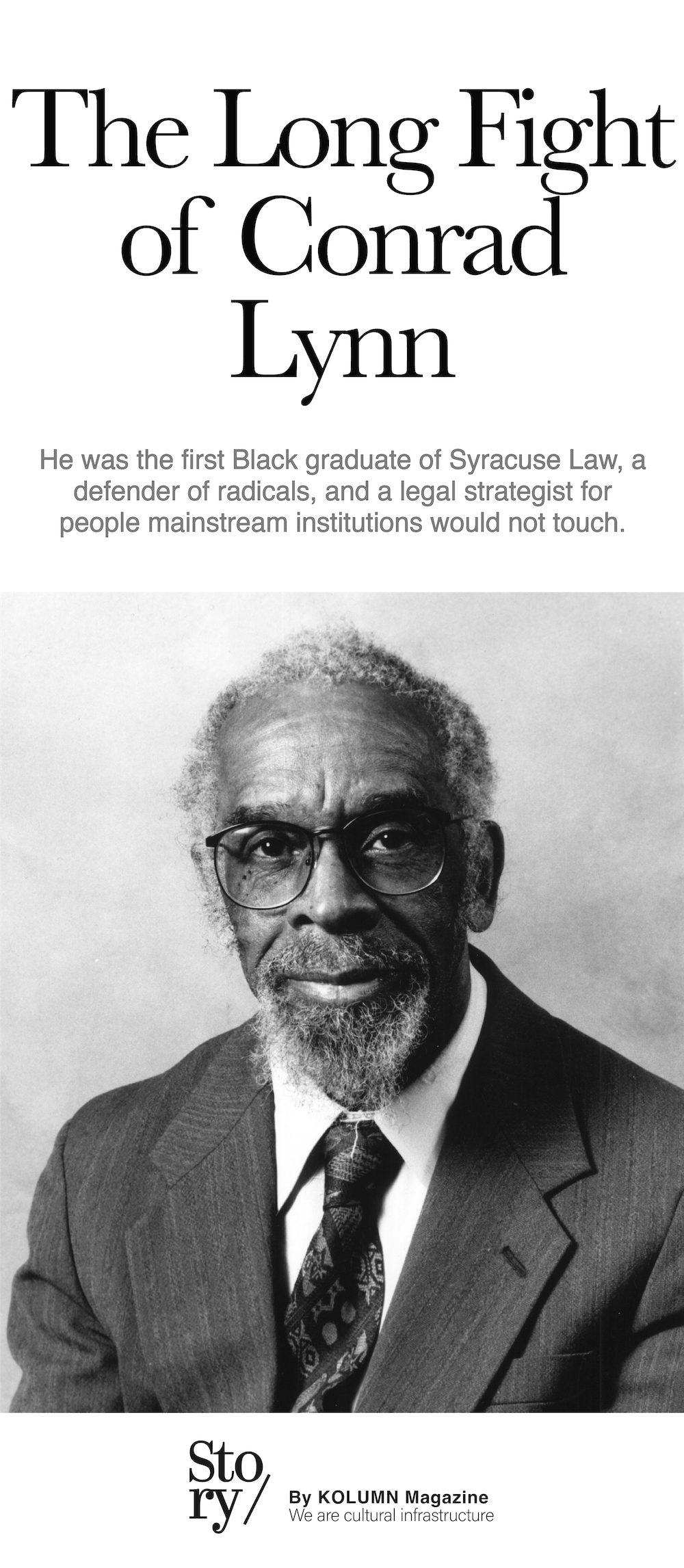
His willingness to defend the politically radioactive cost revealed the integrity of his commitments.
By KOLUMN Magazine
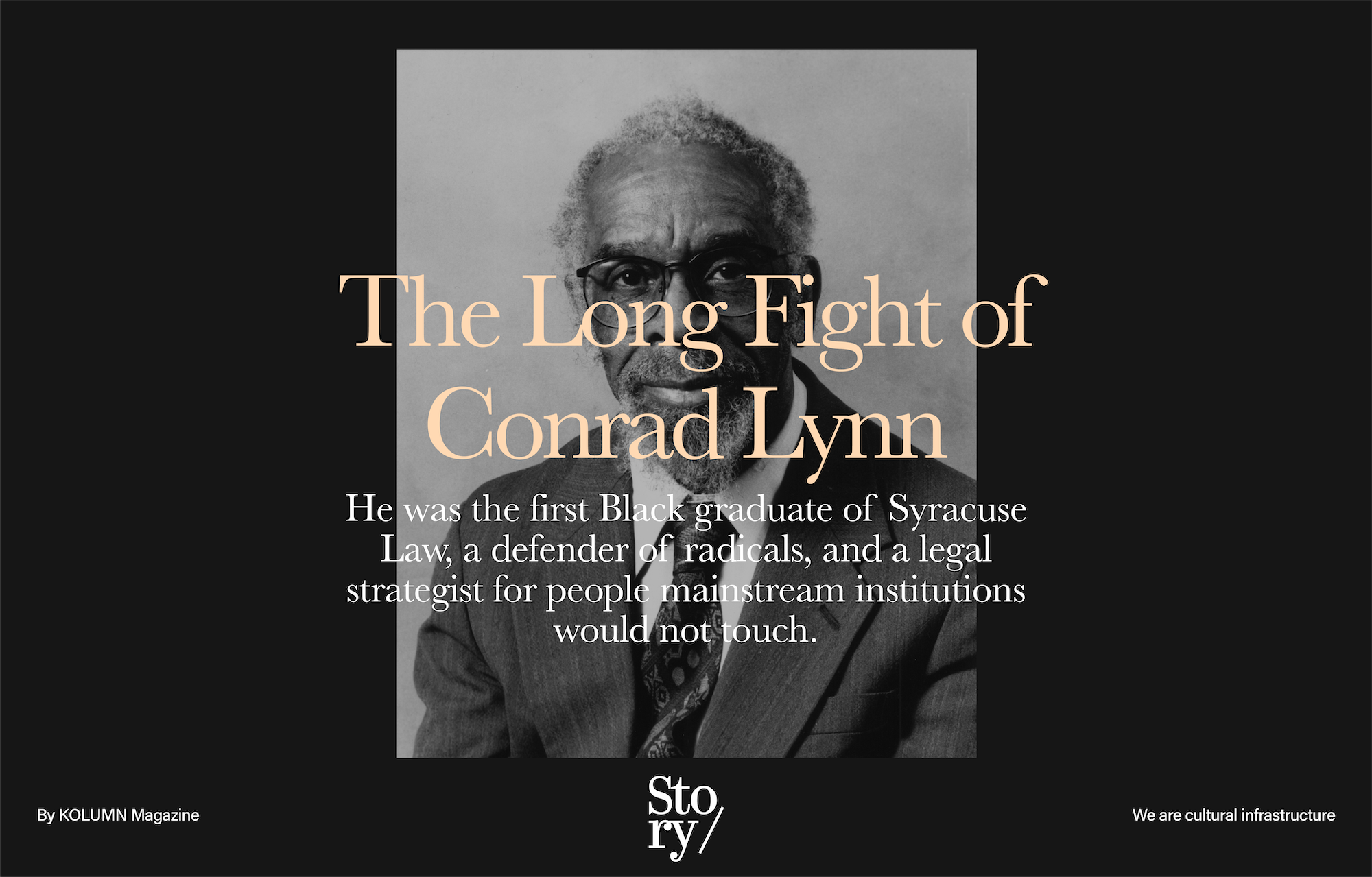
If you want to understand not the airbrushed memory of the civil rights movement, but its harder edges—its collisions with the courts, the state, liberal caution, anti-communist hysteria, empire, war, and the strict boundaries of respectability—Conrad Lynn is one of the clearest figures to study. He spent decades operating in the space where race, law, dissent, and power overlapped. His career was not just about winning cases, though he certainly fought to do that. It was also about exposing how the law behaves when the people seeking justice are the very people America has already taught itself to fear.
Born in Newport, Rhode Island, in 1908, Lynn came of age in a country that offered Black ambition only narrow lanes of advancement. His family later settled in Rockville Centre on Long Island, and he eventually attended Syracuse University, earning his undergraduate degree in 1930. In 1932, he became the first Black graduate of Syracuse University’s law school. On paper, it was the sort of milestone that could have launched a carefully respectable professional life. But Lynn had little interest in becoming merely respectable. He built his career taking on precisely the kinds of cases other lawyers often avoided.
That choice defined everything that followed. Over the course of six decades, Lynn represented Black defendants, antiwar resisters, labor activists, radicals, nationalists, children caught in the machinery of racist prosecution, and public figures whose politics made even their allies nervous. He challenged segregation in the military. He participated in the 1947 Journey of Reconciliation, a direct predecessor to the Freedom Rides. He defended the boys in the infamous Kissing Case. He represented Robert F. Williams, Puerto Rican nationalist Lolita Lebrón, Vietnam-era draft resisters, and the Harlem Six. He remained active deep into old age, still drawn to insurgent politics long after many of his contemporaries had either been absorbed into institutions or written out of public memory.
His significance lies not just in the list of names and causes attached to him, but in the consistency of his moral logic. Conrad Lynn kept returning to the same question: Who gets the full protection of the law when the law itself is entangled with racism, militarism, and state power? Again and again, his answer was to stand beside those who had already been marked as disposable.
A Radical Formation
One of the easiest ways to misunderstand Conrad Lynn is to imagine his radicalism as an accessory to his legal career, as though it were some colorful ideological flourish attached to an otherwise conventional life in the law. It was not. His politics were foundational. They shaped the clients he took, the causes he committed to, and the way he understood the limits of liberal reform.
As a young man, Lynn gravitated toward left politics. He later spoke openly about having joined the Young Communist League while at Syracuse, and that association shadowed him for years. In Cold War America, radical Black politics could trigger suspicion from the federal government, discomfort from mainstream organizations, and professional isolation from institutions that preferred safer messengers. Lynn lived with all of that. But he did not retreat from it.
This mattered because the civil rights struggle was never as ideologically tidy as it is often presented today. The movement was not a single stream with one method, one politics, or one destination. It contained profound tensions—between moderates and radicals, integrationists and nationalists, pacifists and self-defense advocates, legal strategists and street-level organizers. Conrad Lynn moved through that world with unusual clarity. He did not believe racism was simply a moral defect that could be corrected by better laws and more enlightened attitudes. He understood it as bound up with labor exploitation, policing, imperial power, and the state’s use of violence.
That analysis put him out of step with the public version of the movement that later became easiest to celebrate. The nation has always had an easier time honoring Black dissent once it has been stripped of its sharpest critiques. Lynn would not make that stripping easy. He kept insisting, through both his legal work and his public life, that Black freedom could not be separated from larger questions of power.
In that sense, his relative obscurity is not accidental. America tends to remember the civil rights figures it can domesticate. Lynn has remained less famous because he makes the story less comfortable and more complete.
The Segregated Army and an Early Legal Defiance
Long before military service became a common shorthand for patriotic Black citizenship, Conrad Lynn helped bring one of the nation’s ugliest contradictions into legal view: a segregated Army claiming to defend freedom abroad.
During World War II, Lynn represented his brother, Winfred Lynn, who refused induction into the U.S. Army unless he could serve in a nonsegregated unit. Winfred’s position was simple, morally coherent, and deeply disruptive: he was prepared to serve his country, but not on humiliating racial terms. The case did not produce an instant sweeping victory. But it did something arguably more important in that moment—it exposed the absurdity and brutality of a democracy demanding Black sacrifice while maintaining Black subordination.
Conrad Lynn’s involvement in the case shows a pattern that would repeat throughout his life. He was willing to litigate from positions that others considered too controversial, too confrontational, too politically risky, or too far ahead of public sentiment. Many mainstream civil rights organizations were cautious about cases that could be framed as unpatriotic, especially during wartime. Lynn was less interested in patriotic optics than in the underlying injustice.
The case also helps place him within a longer genealogy of Black refusal. Before the better-known military desegregation fights of the postwar years, before executive orders and commemorative language softened the memory of these conflicts, there were Black people like the Lynn brothers insisting that dignity could not be postponed until after service. They were not asking for symbolic inclusion. They were challenging the terms of membership altogether.
That is one of the enduring lessons of Conrad Lynn’s life: he understood that sometimes the most important legal fights are not the ones guaranteed to succeed, but the ones that force the nation to confront its own incoherence.
Before the Freedom Rides, There Was the Journey of Reconciliation
In 1947, Conrad Lynn joined the Journey of Reconciliation, an interracial direct-action campaign organized to test a Supreme Court decision banning segregation in interstate bus travel. Today it is often described as the forerunner to the Freedom Rides of the early 1960s, though it receives only a fraction of the public attention. That imbalance tells us something about how memory works. We tend to preserve the movement’s most cinematic moments and forget the rehearsals that made them possible.
Lynn’s presence on the Journey of Reconciliation is significant for more than one reason. First, it places him not only in courtrooms, but in direct action. He was not the kind of lawyer who waited comfortably on the sidelines for history to arrive at his office door. He entered the conflict himself. He was arrested during the action, becoming one of the participants who quite literally tested whether the law would mean anything once Black bodies tried to inhabit it.
Second, the episode shows how early Lynn understood transportation segregation as a crucial site of confrontation between constitutional theory and lived reality. The legal ruling existed. Southern custom remained. Someone had to force the contradiction into the open. That required a willingness to move from doctrine into danger.
The Journey of Reconciliation never achieved the mythic status later attached to the Freedom Rides, but the work mattered. It revealed a generation of activists already pushing against segregated interstate travel more than a decade before 1961. It also revealed the slow, accumulative nature of movement struggle. Civil rights breakthroughs did not appear out of nowhere. They were built through repeated tests, losses, arrests, experiments, and acts of courage that often faded from public view.
Conrad Lynn belonged to that earlier wave. He was helping lay the groundwork before television made such actions legible to the wider nation. That alone should place him more firmly in any honest history of civil rights protest.
The Kissing Case and the Denial of Black Childhood
If Lynn’s career contains a single episode that lays bare the grotesque moral logic of Jim Crow justice, it may be the Kissing Case of 1958.
In Monroe, North Carolina, two Black boys, just seven and nine years old, were accused of rape after kissing a white girl while playing. The charge itself was monstrous, not merely because it was legally absurd, but because it revealed the deeper racial script running beneath it. These were children. Yet Black childhood offered no protection. Their innocence offered no protection. Once Black boys were positioned near white femininity, the machinery of Southern racial paranoia moved swiftly to transform childish behavior into criminal menace.
Lynn defended the boys, and in doing so he stepped into a case that quickly became an international scandal. The global outrage was not incidental. It mattered that the world could see what Southern justice looked like when stripped of euphemism. The facts were too naked, too ugly, too revealing to remain provincial. Public attention, including from high-profile figures beyond the South, helped push the matter toward resolution and release.
What made the Kissing Case so emblematic of Lynn’s career is not simply that he took it, but that he understood what kind of case it was. This was never just a local criminal matter. It was an X-ray of American racial order. It showed how white supremacy criminalized Black presence, Black touch, Black proximity, even Black play. Lynn recognized that the defense had to function on more than one level. It had to challenge the particulars of the case, yes, but it also had to expose the underlying social system that made such a prosecution conceivable.
That was one of his great instincts as a lawyer: he knew that some cases are not merely about defendants. They are about the culture producing the accusation. He knew how to see a courtroom as a site where broader truths could be forced into view.
The Kissing Case also underscores how often Conrad Lynn’s work centered the most vulnerable people in moments when the state was eager to make them examples. He repeatedly placed himself between public hysteria and the bodies it threatened to consume.
A Lawyer for the Politically Radioactive
As the 1950s gave way to the 1960s, Lynn’s practice increasingly reflected the sharpened political climate of the era. He represented Robert F. Williams, the Monroe activist whose support for armed self-defense unsettled both white power structures and some more cautious civil rights leaders. He defended H. Rap Brown and took on matters involving Black militants, dissidents, and people whose politics made them difficult to market to a broad American audience. He also worked on behalf of Puerto Rican nationalists, including Lolita Lebrón.
This is the part of Lynn’s life that most clearly separates him from more easily memorialized civil rights lawyers. He did not confine himself to the cases that could be made broadly sympathetic. He did not believe legal defense should depend on ideological tidiness. If a person was facing the machinery of the state, and especially if that machinery was colored by repression, racism, colonialism, or political retaliation, Lynn was willing to step in.
That made him indispensable to a period when prosecution and political suppression often overlapped. The United States in the 1960s and early 1970s was not merely adjudicating crime. It was also policing dissent. Black insurgency, anti-colonial advocacy, antiwar resistance, and nationalist politics all attracted extraordinary scrutiny. Lawyers willing to defend people in those zones were doing more than practicing law. They were maintaining democratic infrastructure under pressure.
Lynn’s work with Puerto Rican nationalists also highlights the international scope of his politics. He did not see Black freedom in the United States as separate from anti-colonial struggle elsewhere. That worldview was too expansive for many mainstream institutions, but it was consistent with a broader radical tradition that linked race, empire, and state violence. In Lynn’s hands, the courtroom was a place where those connections could be named, not hidden.
His willingness to defend the politically radioactive cost him broader acclaim. But it also reveals the integrity of his commitments. He was not interested in being the lawyer of approved dissent. He was interested in justice where the danger was greatest.
The Harlem Six and the Battle Over Narrative
Among the most revealing episodes in Conrad Lynn’s career was his involvement in the Harlem Six case, which emerged from the unrest and police violence surrounding Harlem in the mid-1960s. The details of the case were complicated, but the broader pattern was painfully familiar: Black community anger, heavy-handed policing, public panic, and the rapid conversion of social crisis into criminal prosecution.
Lynn understood that such cases were never just about the facts as arranged by the prosecution. They were about narrative authority. Prosecutors tend to narrow. They strip away background, grievance, history, police conduct, community conditions, and the structural pressures that shape an event. They want crime to appear self-contained. Lynn worked in the opposite direction. He insisted on restoring context.
That mattered immensely in a case like the Harlem Six, where the state had every incentive to depoliticize what was happening and recast it as ordinary criminality. Lynn’s defense work pushed back against that move. He treated the courtroom as a contested narrative space, one in which the defendants could not be understood apart from the conditions surrounding them. That was not an attempt to evade accountability. It was an insistence that state power should not control the entire story.
This approach helps explain why Lynn became such a trusted figure for communities and families dealing with highly politicized prosecutions. He was not merely eloquent. He was perceptive. He recognized how quickly Black collective suffering could be translated into individual guilt, and how law could be used to punish not only acts, but atmosphere.
The Harlem Six case also reinforced a recurring truth about Lynn’s career: he was especially valuable when the official explanation of events was too convenient. He specialized in entering those spaces where the state’s version of order looked suspiciously like the criminalization of Black unrest.
Vietnam, the Draft, and Dissent as a Civic Duty
Lynn’s anti-militarist commitments did not end with his brother’s wartime challenge to segregation. During the Vietnam era, he represented numerous draft resisters and conscientious objectors, continuing a line of argument he had been making in one form or another for decades. He understood military obligation not as an abstract civic duty, but as a political demand imposed by a state that had never been neutral toward Black people, radicals, or the poor.
For Lynn, opposition to the draft was not simply a matter of pacifism. It was also about coercion, citizenship, and racial hypocrisy. What did it mean for a country to demand military sacrifice from people it routinely marginalized at home? What did patriotism look like when the freedoms being defended abroad were incomplete, compromised, or outright denied domestically?
These were not marginal questions in Black political life. By the late 1960s, they were being voiced with increasing force by figures such as Muhammad Ali and Martin Luther King Jr. Lynn had been circling those contradictions much earlier. His anti-draft work placed him squarely within a broader Black radical critique of American war-making, one that linked foreign policy to domestic racial order.
The courtroom, in these cases, became one more place to preserve dissent in the record. Lynn did not win every battle, and he did not pretend that the law was always ready to receive the moral argument being made. But part of his greatness was his willingness to make those arguments anyway. He understood that legal struggle is not only about immediate victory. Sometimes it is about establishing the terms by which future generations will judge the present.
That perspective gave his work unusual durability. Even when he lost, he often clarified the stakes.
Anti-Communism and the Cost of Black Radicalism
To understand why Conrad Lynn remains less famous than many people whose lives intersected with his, it is necessary to reckon with anti-communism. The Cold War narrowed the acceptable boundaries of public dissent, and Black radicals often faced especially punitive scrutiny. Their critiques of racism were manageable only so long as they stopped short of condemning empire, capitalism, policing, or war too directly.
Lynn did not stop short.
His left affiliations, his international commitments, and his willingness to defend controversial figures made him vulnerable to surveillance and political isolation. He was called before the House Un-American Activities Committee in 1963, a fact that says as much about the climate of the era as it does about Lynn himself. HUAC was not just interested in identifying communists. It functioned more broadly as an instrument of intimidation, disciplining those who linked domestic injustice to larger critiques of U.S. power.
Lynn understood that. He also understood that Black political possibility was being constrained by anti-communist fear. The result was not just the punishment of individuals, but the narrowing of the entire freedom movement’s public vocabulary. Some arguments became harder to make. Some solidarities became more dangerous to claim. Some people became easier to erase from the official story.
Lynn’s relative obscurity today is partly a residue of that process. It is not that he lacked achievement or importance. It is that he represented a strain of Black political life the country has often preferred not to memorialize. He reminds us that civil rights history was not only about appeals to conscience. It was also about sharp critiques of state violence, militarism, class power, and colonial rule.
In that sense, Lynn’s life is not just a biography. It is evidence of what gets filtered out when American history is cleaned up for national consumption.
Why He Never Became a Household Name
It is common to say that Conrad Lynn was “overlooked,” but that word can be a little too gentle. People like Lynn are not simply forgotten by accident. They are frequently edited out because they complicate the story too much.
He does not fit the easiest narrative arc of the civil rights era. He was not confined to one issue, one style, or one ideological lane. He linked Black freedom to antiwar resistance, anti-colonial struggle, criminal defense, and radical politics. He defended people who frightened the mainstream. He remained skeptical of respectability as a standard for deserving justice. He did not offer the nation an easy redemption story.
There is also the matter of professional prestige. The legal profession often celebrates attorneys who attach themselves to causes that, even when contested, remain broadly legible as noble. Lynn repeatedly moved toward clients and cases that could stain a reputation. He did not organize his career around approval. He organized it around necessity.
That has made him harder to package, but it has also made him more valuable as a historical figure. He reveals that democracy depends not only on the defense of the admired, but on the defense of the reviled. He understood that the rights of the unpopular are often the real measure of whether rights mean anything at all.
His legacy survives not because he became famous, but because he modeled a form of oppositional lawyering that remains essential. Every lawyer who insists that political context matters in a prosecution is working in terrain Lynn helped map. Every activist who refuses to separate civil rights from war, prisons, or empire is brushing up against the broader world he inhabited. His influence lives in traditions that are often more visible in practice than in commemoration.
The Final Years and the Work That Outlived Him
Conrad Lynn remained active deep into his later years. He continued writing, speaking, organizing, and practicing long after many of his peers had stepped away from public struggle. In 1987, he helped found Refuse & Resist!, reinforcing the point that his political imagination did not mellow into passivity with age. He stayed, almost stubbornly, on the side of resistance.
He died in 1995 at age 87. By then, he had spent more than half a century moving through the fault lines of American democracy. He left behind an autobiography, an archival record, and a legal-political legacy far larger than his public name recognition would suggest.
The questions his life raises remain deeply current. What does it mean to defend people the public has already been taught to fear? How should lawyers behave when legality and justice are plainly misaligned? What happens when the most urgent cases are also the least respectable in the eyes of mainstream America? What forms of dissent get erased because they challenge not only prejudice, but power?
Lynn’s life does not offer sentimental answers. What it offers instead is a model of principle stripped of decoration. He did not begin with likability. He did not wait for public consensus. He did not sort people into deserving and undeserving before extending his labor. He stood in the gap between state power and public abandonment.
That remains radical. It was radical when he defended segregated soldiers, accused children, nationalists, resisters, and Black defendants in politicized cases. It is radical now, in a culture that still often decides who deserves rights by first deciding who deserves sympathy.
Conrad Lynn should be remembered not as a side character in other people’s movements, but as a major figure in the deeper American tradition of radical lawyering. He belongs to that lineage of attorneys who understood the courtroom as one arena within a much larger struggle, and who refused to confuse respectability with righteousness.
He was not the lawyer of a tidy national memory. He was something more difficult and more necessary: a lawyer for freedom in its least marketable form.
And maybe that is the clearest way to understand his significance. Conrad Lynn believed justice could not be reserved for the blameless-looking, the politically safe, or the publicly approved. It had to extend to the militant, the dissenter, the child cast as a threat, the nationalist, the draft resister, the radical, the already damned. In a country that still ranks human beings by deservingness before it extends concern, that remains a profoundly unsettling idea.
It was the idea that shaped his life. It is the idea that keeps his life relevant.
More great stories
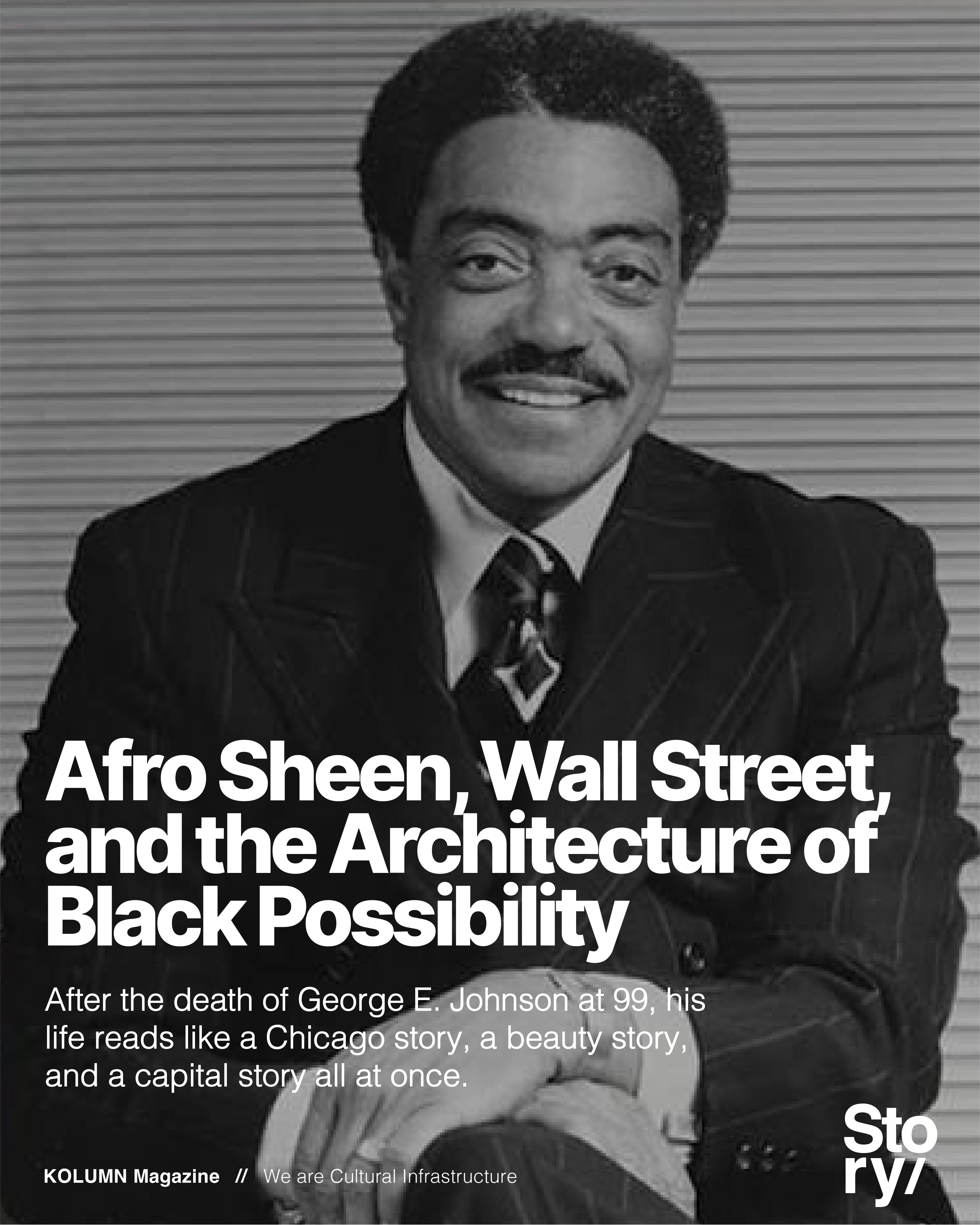
Afro Sheen, Wall Street, and the Architecture of Black Possibility
July 6, 2026
No Comments
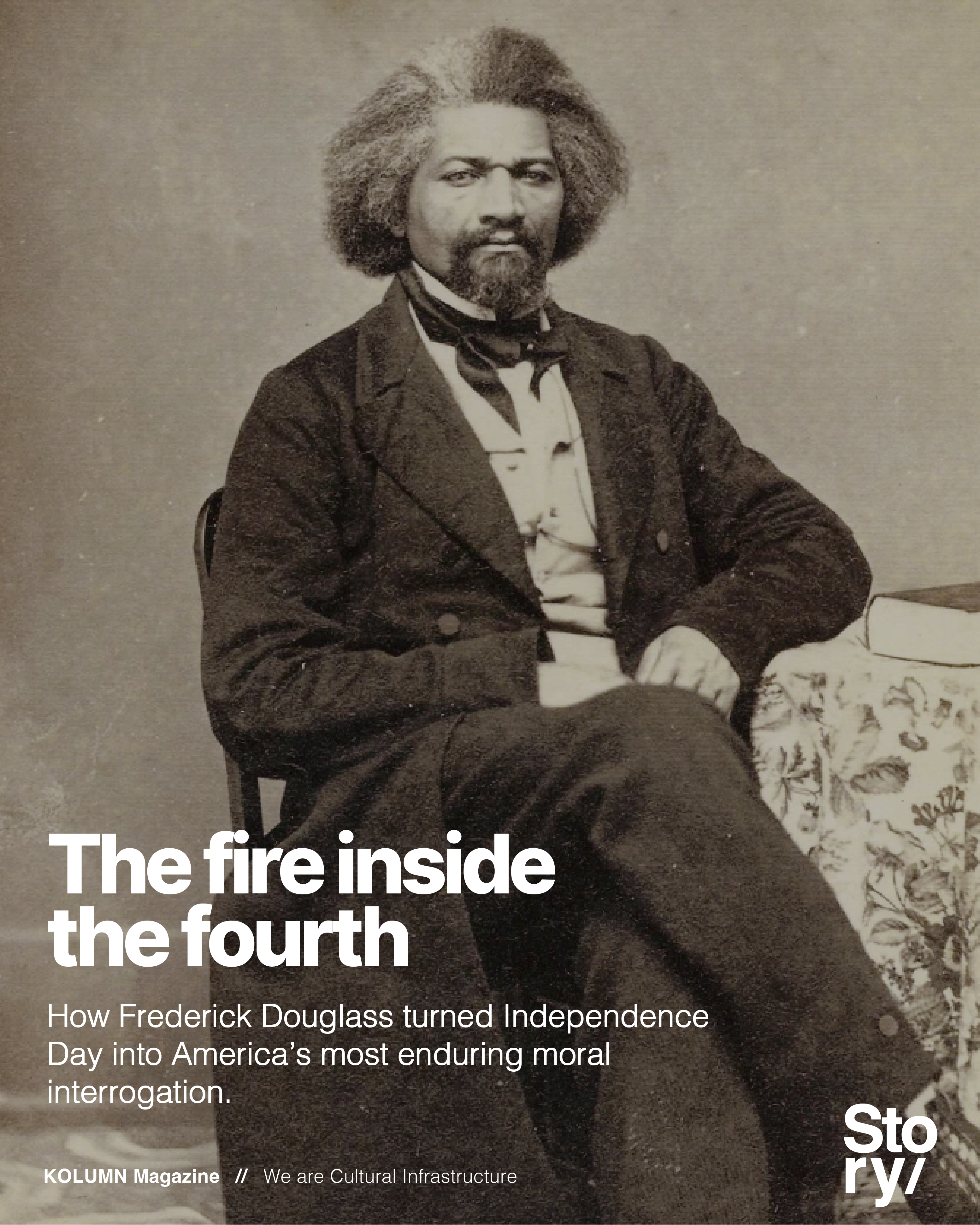
The Fire Inside the Fourth
July 5, 2026
No Comments