

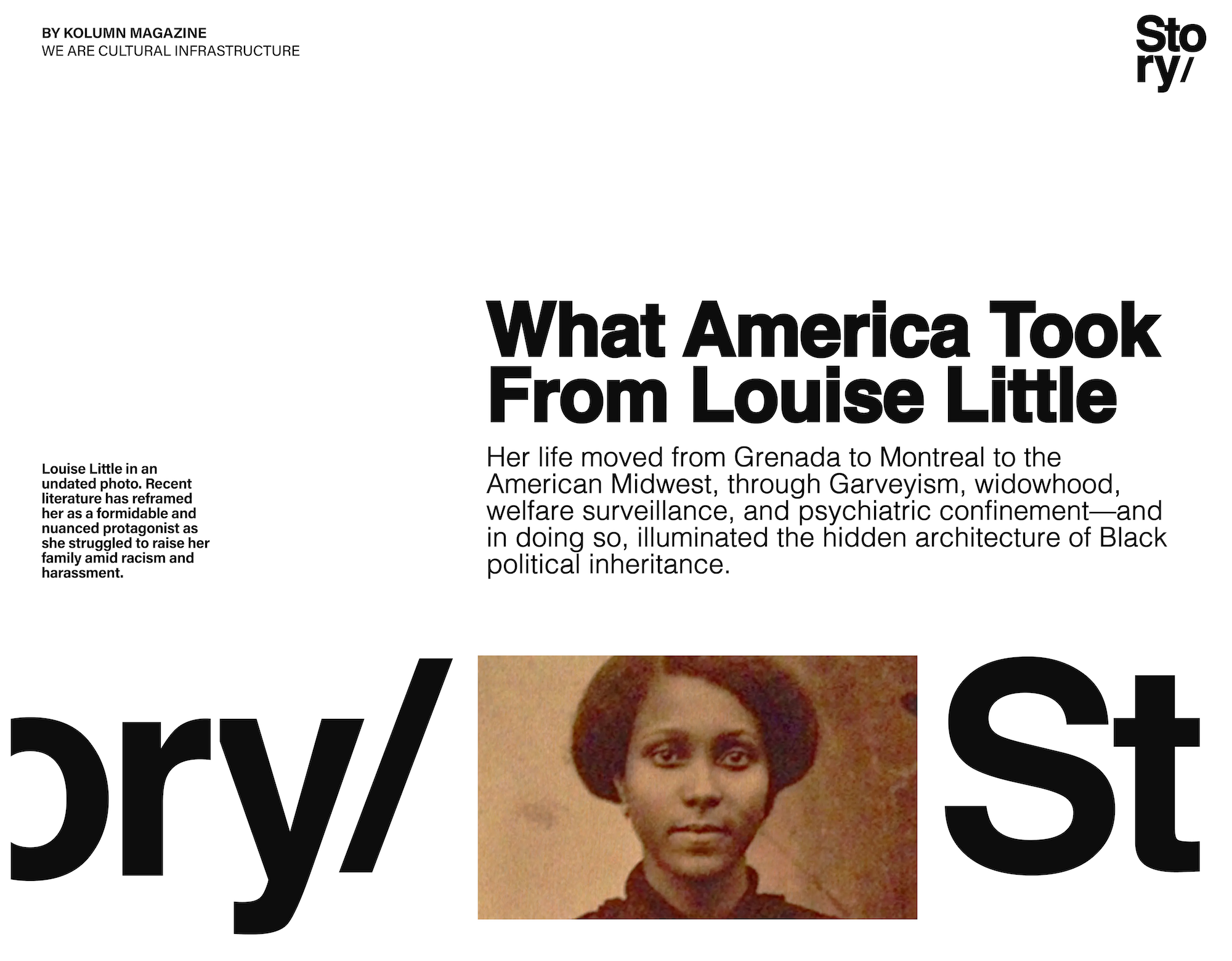
Louise Little was not merely Malcolm X’s mother. She was one of the first political worlds he ever knew.
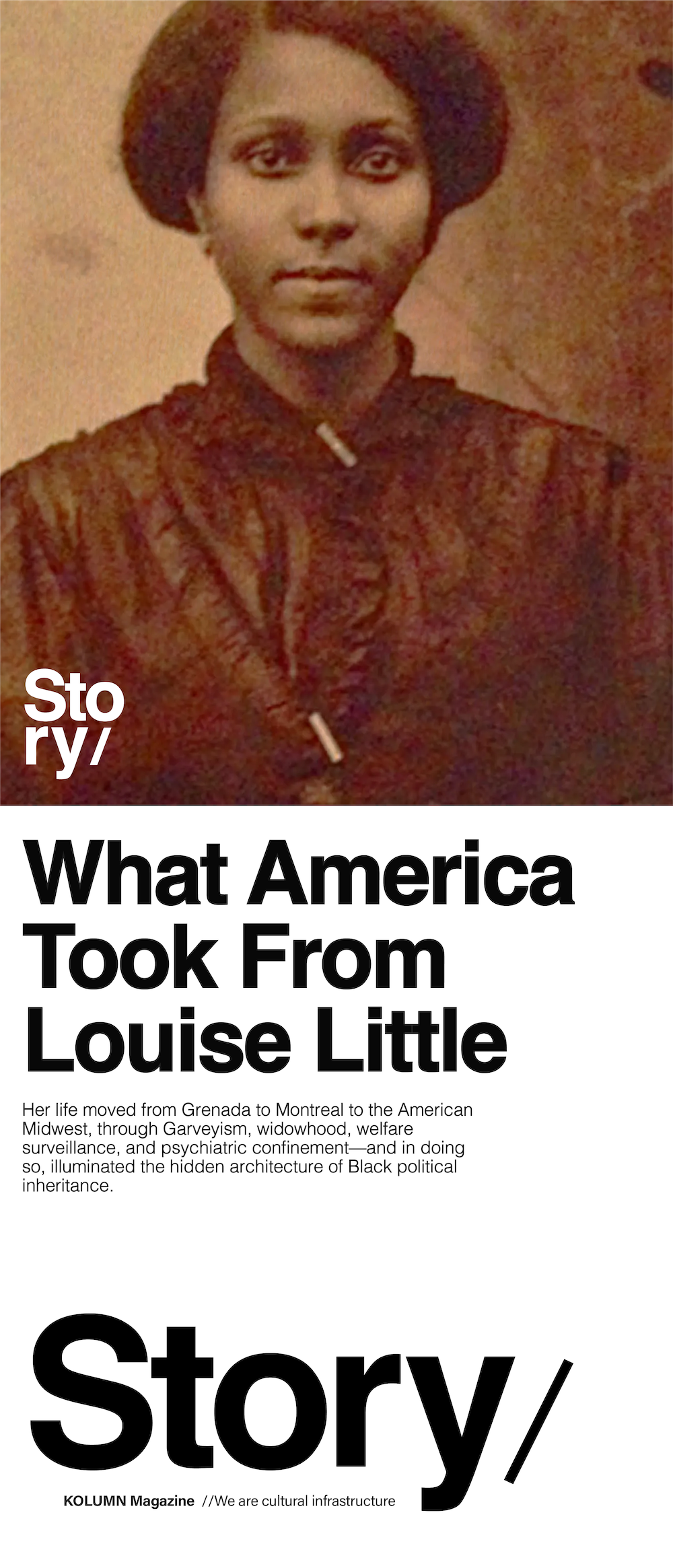
Louise Little was not merely Malcolm X’s mother. She was one of the first political worlds he ever knew.
By KOLUMN Magazine
There is a familiar way American history tells the story of Louise Little. It introduces her through her son. It reduces her to an origin wound. It remembers just enough to make Malcolm X legible: she was born in the Caribbean, married a Garveyite preacher, lost her husband, struggled to raise her children, was institutionalized, and vanished into the background of a national legend. That version of Louise Little is neat, emotionally efficient, and historically inadequate.
The fuller record tells a harder and more important story. As the National Museum of African American History and Culture has argued, Louise Little was not simply a tragic maternal presence in Malcolm X’s life. She was an active member of Marcus Garvey’s Universal Negro Improvement Association, a woman who helped build political culture at the grassroots, encouraged reading Black newspapers, exposed her children to the languages and ideas of the African diaspora, and instilled the pride that would later become one of the signatures of Malcolm’s public thought. In other words, she was not just part of his emotional formation. She was part of his political education.
That distinction matters. It matters because American memory has a habit of shrinking Black women who helped shape modern history, especially when their labor took place in homes, neighborhoods, movement branches, editorial correspondence, and local associations rather than at podiums. It matters because Louise Little’s life opens a wider frame: one that includes the Caribbean, migration, Black internationalism, Black motherhood, the welfare state, psychiatric confinement, and the quiet brutality of institutions that claimed to help while also punishing refusal. And it matters because, as historian Erik S. McDuffie explained in an interview with Black Perspectives, Louise Little has too often been treated as a faithful wife and grieving mother rather than as “a brilliant thinker and Garveyite grassroots activist.”
KOLUMN has already spent time on this broader question of historical minimization. Its recent profile, “Betty Shabazz Knew Survival Was Never Passive”, pushed against the tendency to remember Black women attached to famous men only in the vocabulary of endurance. Louise Little belongs in that same corrective tradition. She was not scenery in Malcolm X’s biography. She was one of the people who made his political world imaginable.
A Caribbean Beginning the Archive Never Properly Held
Louise Little was born Louise Helen Norton Langdon in La Digue, Grenada, though even the exact year of her birth remains inconsistently recorded. The American Black Holocaust Museum’s account of her life notes that she was born either in 1894 or 1897, and that uncertainty is not trivial. It reflects a larger truth about Black women in the archive: even the first facts of their lives were often treated as disposable.
The larger shape of her early life is clearer. According to the same American Black Holocaust Museum essay, adapted from a New York Times “Overlooked No More” obituary, Louise was raised in Grenada in a family marked by the afterlives of slavery and colonial hierarchy. That mattered. She did not arrive in North America as an empty vessel waiting for American race relations to educate her. She came from a Black Atlantic world already shaped by empire, displacement, racial classification, and survival.
Scholarly work has helped sharpen that context. In his article, “The Diasporic Journeys of Louise Little”, McDuffie situates her in a transnational history of Black migration and grassroots organizing, arguing that her life helps illuminate Canada and the U.S. Midwest as important sites of Black diasporic protest. That is a major reframing. It places Louise Little not at the emotional edge of a family story, but near the center of a political geography that linked Caribbean migration, Garveyism, and Black radical thought across borders.
Accounts of Louise also consistently describe her as educated and linguistically capable. The National Museum of African American History and Culture notes that she spoke several languages and encouraged her children to understand themselves as part of a wider African diaspora. That detail does more than enrich a portrait. It disrupts the crude stereotypes that have often framed her life. Louise Little was not a passive victim who happened to stand near history. She was literate, articulate, and ideologically formed.
Montreal and the Education of a Garveyite
After the deaths of the grandparents who had helped raise her, Louise moved to Montreal in 1917. That migration placed her in one of the liveliest circuits of Black international thought in the early twentieth century. Montreal was not merely a waypoint; it was a diasporic crossroads where Caribbean migrants, Black North Americans, religious figures, workers, and organizers gathered and argued over the future of Black freedom.
It was there that Louise encountered the Universal Negro Improvement Association. The PBS American Experience feature on Earl and Louise Little identifies both Louise and her future husband Earl Little as committed Garveyites and shows how deeply the UNIA shaped the household they would build. That detail is often repeated, but not always properly understood. Garveyism was not simply slogan, pageantry, or romance. For many Black people across the diaspora, it was a political education. It offered a language of racial pride, economic independence, transnational belonging, and distrust of white power. Louise Little absorbed that language and helped carry it forward.
The National Museum of African American History and Culture notes that Louise served as a recording secretary in the mid-1920s and contributed reports to Negro World, the UNIA’s newspaper. That fact alone should permanently alter how she is written into history. To serve as a recording secretary was to help structure the memory of a movement. To write reports for Negro World was to participate in Black print culture, movement communication, and the everyday labor by which political communities recognize themselves.
McDuffie’s scholarship on Louise Little is especially useful here because it resists the temptation to treat women’s movement work as secondary. He frames Garveyite women’s activism through the idea of “community feminism,” a practice rooted not in elite visibility but in building, documenting, sustaining, and politically educating communities. Louise Little’s life fits that framework exactly. She was not waiting in the wings of a male-led movement. She was part of the machinery that made the movement work.
Marriage, Migration, and a Family Under Pressure
Louise married Earl Little in 1919. Together they built a life across several cities, including Philadelphia, Omaha, Milwaukee, and Lansing, while raising a family inside the discipline and aspiration of Garveyite politics. Malcolm Little was born in Omaha on May 19, 1925, as the PBS timeline of Malcolm X’s life records. But the family’s movement through the Midwest was never just a matter of ordinary relocation. It unfolded in an atmosphere of racial hostility directed at Black people who refused subordination.
The PBS feature on Malcolm X notes that the Little family’s Lansing home burned in 1929 and that Earl Little died in 1931 in what authorities described as a streetcar accident. Malcolm, both in The Autobiography of Malcolm X and in public memory, long connected those events to white supremacist violence. Whether every official record was willing to name that violence plainly is almost beside the point. The social context was unmistakable: this was a Black nationalist family living in a country that often met Black autonomy with terror.
After Earl’s death, Louise Little faced an almost impossible task. She was a widow with many children, limited resources, and the constant gaze of white officials. But even here the archive tells a richer story than the shorthand suggests. Malcolm’s autobiography remembers his mother as disciplined, proud, and determined to keep order in the household. McDuffie’s research shows that her political commitments did not evaporate under pressure. She still carried a Garveyite worldview, and she still understood Black children as people who needed protection from the psychic violence of white supremacy.
This is one of the most important parts of her legacy. The National Museum of African American History and Culture argues that Louise instilled pride in Malcolm and his siblings in their Caribbean heritage and their place in the African diaspora. That means the early architecture of Malcolm X’s thought did not begin in prison, or even only in the Nation of Islam. It began much earlier, with a mother who taught him that Blackness was not deficiency and that white institutions were not morally neutral.
The Welfare Office, the Caseworker, and the Punishment of Black Pride
If Louise Little’s story tells us anything especially urgent, it is that the line between aid and control has always been thin for Black families. After Earl Little’s death, public assistance brought Louise under increasing scrutiny from welfare officials and social workers. In dominant American memory, these figures are too often cast as caretakers. For poor Black families, they were also inspectors, disciplinarians, and interpreters of “fitness.”
Malcolm’s autobiography is full of resentment toward these officials, and not without reason. They entered the family’s life carrying the authority to judge whether a proud Black widow was coping correctly, speaking correctly, parenting correctly, accepting help correctly. McDuffie, in his Black Perspectives interview, argues that Louise’s later psychiatric confinement should be understood not as a detached medical fact but as a form of incarceration shaped by white supremacy and patriarchy. That language is deliberately unsparing, and it should be.
What happened to Louise Little cannot be separated from the broader American habit of pathologizing Black women who do not bend. Grief can be read as instability. Anger can be read as irrationality. self-possession can be read as defiance. A woman trying to preserve dignity under impossible pressure can be translated by the state into a problem needing management. Louise Little’s life stands at that collision point.
By 1938, as PBS records in its Malcolm X timeline, Louise had been declared mentally ill and committed to a state mental hospital. She would remain institutionalized for roughly twenty-six years. That number is staggering. Twenty-six years is not a brief collapse, not a chapter, not a biographical detour. It is a confiscated lifetime.
What Her Children Lost When the State Took Her
The public shorthand says Louise Little was institutionalized and the children were placed elsewhere. But that language is bloodless compared to what it actually meant. A household was broken open. A mother who had been teaching pride, discipline, and diasporic consciousness was removed. The children were dispersed through a system of foster care, supervision, and separation.
The PBS timeline notes that after Louise’s commitment, Malcolm was sent to a juvenile home and later moved through a set of environments that would shape the rest of his life. The standard interpretation turns that into biographical setup for Malcolm X. The more morally serious interpretation begins elsewhere: what did the family lose when Louise Little was taken away? What did her children lose when the state replaced maternal authority with bureaucratic power?
They lost continuity. They lost protection. They lost the daily texture of a political education that had already begun in the home. And Malcolm lost one of his first teachers. The National Museum of African American History and Culture is explicit that Louise shaped Malcolm’s sense of race and diaspora. Once that is taken seriously, her absence reads differently. It was not simply that a child suffered maternal loss. It was that a developing Black political consciousness was interrupted by the state.
There is a terrible irony in that history. The son who would later become one of the most formidable critics of American racism first learned something fundamental about American power by watching it destroy his family. White terror threatened the family from without. Public institutions disciplined it from within. Louise Little stood at the center of both pressures.
Beyond the Breakdown Narrative
American biography has always loved the language of personal breakdown because it allows structure to disappear. If Louise Little “broke,” then the nation does not have to account for what pressed down on her. If she simply “succumbed,” then the institutions around her can remain innocent.
But the newer scholarship refuses that comfort. McDuffie’s work on Louise Little and his interview with Black Perspectives ask readers to see the convergence of racist harassment, widowhood, poverty, state intrusion, and gendered punishment. The American Black Holocaust Museum’s reposting of the New York Times “Overlooked No More” obituary similarly reframes Louise as a “formidable and nuanced protagonist” rather than a passive sufferer.
That reframing is not sentimental rescue. It is historical rigor. It asks what kind of nation repeatedly encountered proud, politically formed Black women and chose to treat them as unstable rather than as persons reacting rationally to intolerable conditions. It asks us to remember that mental health systems have never been free from the racial assumptions of the societies that created them. And it asks whether the categories used to confine Louise Little were as objective as later retellings pretend.
The answer is not that archives can now erase all uncertainty. They cannot. But the old certainty was false too. It was the certainty of institutions speaking for her. That is exactly the kind of certainty history should distrust.
Release, Survival, and the Years Public Memory Barely Mentions
Louise Little was released from institutional confinement in 1963, after her children worked to secure her freedom. McDuffie notes this in his Black Perspectives interview, and the dates align with the broader historical record summarized by PBS. By then Malcolm had already become Malcolm X, a national figure, a minister, and one of the most visible Black voices in the country.
That timeline is almost too cruel in its symmetry. America took the mother for long enough that the son became world-historical before she was returned to ordinary life.
Yet even after her release, Louise Little’s public memory remained narrow. She lived for decades afterward, dying in 1989, but those years rarely occupy much space in mainstream retellings. The American Black Holocaust Museum’s account and other public-history interventions have tried to correct that imbalance, but the fact of the imbalance remains revealing. Once a Black woman is fixed in national memory as tragedy, the public often loses interest in her survival.
That is one reason the belated recognition matters. The New York Times’ “Overlooked No More,” as republished by the American Black Holocaust Museum, did more than provide a missing obituary. It admitted, indirectly, that a woman this consequential had been left outside the paper’s original canon of public significance. The omission was not accidental. It was structural.
Why Louise Little Matters Now
Louise Little matters now because her life clarifies that Black political history is not made only by the names that become famous. It is also made by women who raise children inside disciplined ideas, who keep movement records, who teach pride at the kitchen table, who write reports for newspapers, who survive the state’s suspicion, and who pay dearly when that suspicion hardens into policy.
She matters because the system that engulfed her has not vanished. Family regulation systems still fall hardest on Black mothers. Welfare and child-protection structures still carry disproportionate power over poor Black families. Institutions still mistake noncompliance for pathology. Public language still sentimentalizes Black maternal sacrifice while refusing the material conditions that would make flourishing possible.
She also matters because she complicates the mythology of self-made male leadership. Malcolm X was not conjured from nowhere. He emerged from a household already organized by Black nationalist thought. The PBS feature “Any Means Necessary” notes that Malcolm’s first influences were his parents, both followers of Marcus Garvey. But even that formulation can remain too general unless Louise is restored to full scale. She was not only “one of his parents.” She was one of the people who taught him to read the world.
KOLUMN’s own recent pieces, including “Before ‘Global Black Politics’ Had a Name, Vicki Garvin Was Living It” and the Betty Shabazz feature, have been part of a broader editorial effort to recover Black women from supporting-role history. Louise Little belongs in that recovery not as an addendum but as a central case. Her life stretches from Grenada to Montreal to Omaha to Lansing to confinement and back again. Few biographies expose so clearly how migration, race, motherhood, nationalism, bureaucracy, and state violence can all converge inside one woman’s life.
The Inheritance She Left
It is tempting to close a story like this with uplift. To say Louise Little endured. To say history has finally caught up. To say her son’s legacy vindicated her. But those endings can become too neat. They can soften what was done to her.
A better ending begins with precision. Louise Little was a Grenadian-born Black woman who entered the modern Black political world through migration and Garveyism. She was a movement worker, writer, organizer, and mother. She helped shape Malcolm X’s understanding of Black pride and diasporic identity. She was widowed under conditions shadowed by racial terror. She was scrutinized by welfare authorities. She was institutionalized for more than two decades. She survived long enough to see her children become adults and one of them become a global political symbol. And still, for years, public history remembered her mostly as a wound in someone else’s life.
That memory is no longer sufficient.
Louise Little deserves to be placed where the evidence places her: among the Black women who built political consciousness from the ground up, who moved across borders carrying ideas with them, who made homes into schools of racial dignity, and who suffered when a white nation decided that Black women’s pride was too much to tolerate. She was not a footnote to Malcolm X. She was part of the foundation beneath him.
And once that is understood, her story stops looking like background material and starts looking like American history in one of its clearest forms: Black brilliance, Black labor, Black motherhood, and Black political imagination meeting the full force of a country determined to diminish them.
More great stories
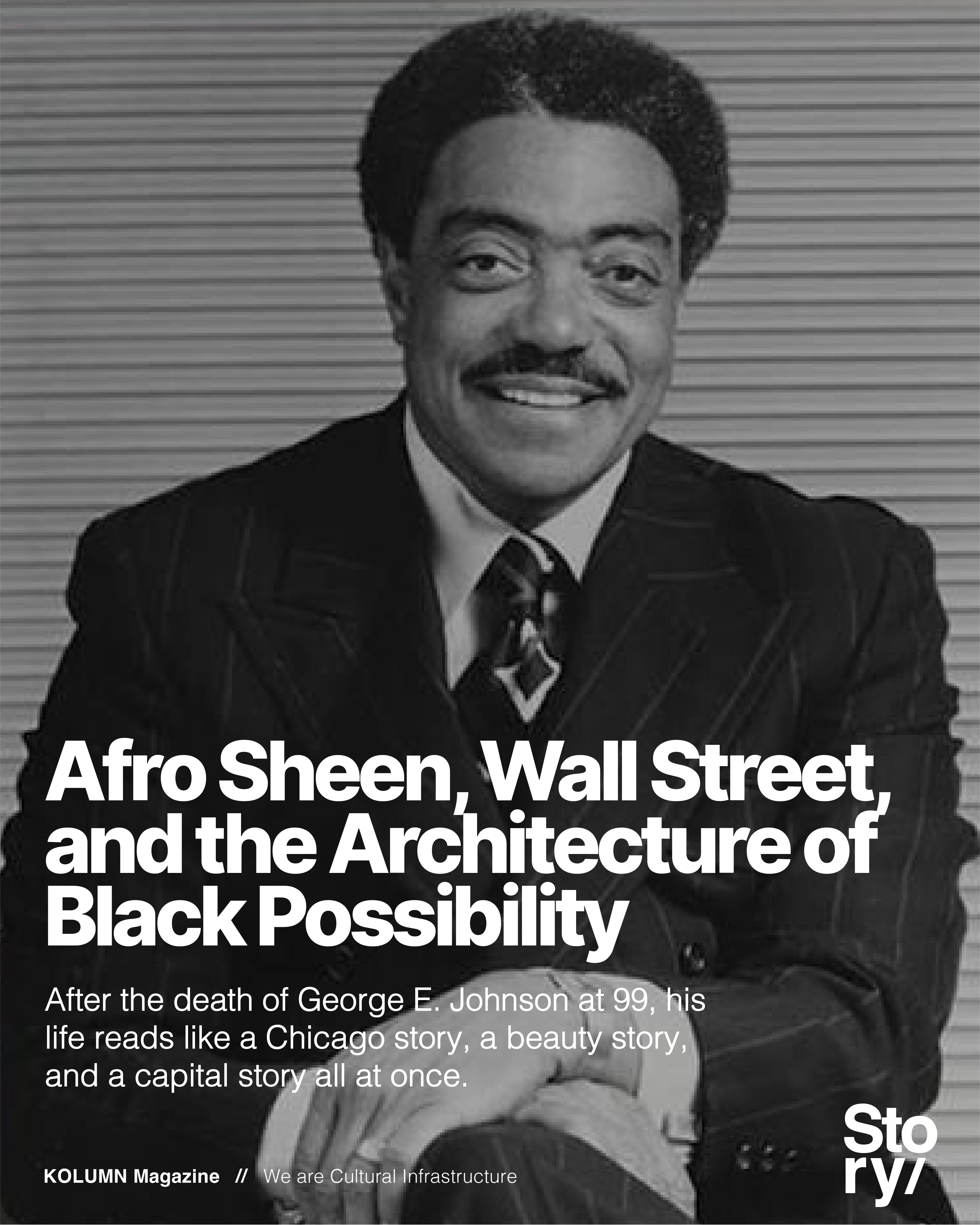
Afro Sheen, Wall Street, and the Architecture of Black Possibility
July 6, 2026
No Comments
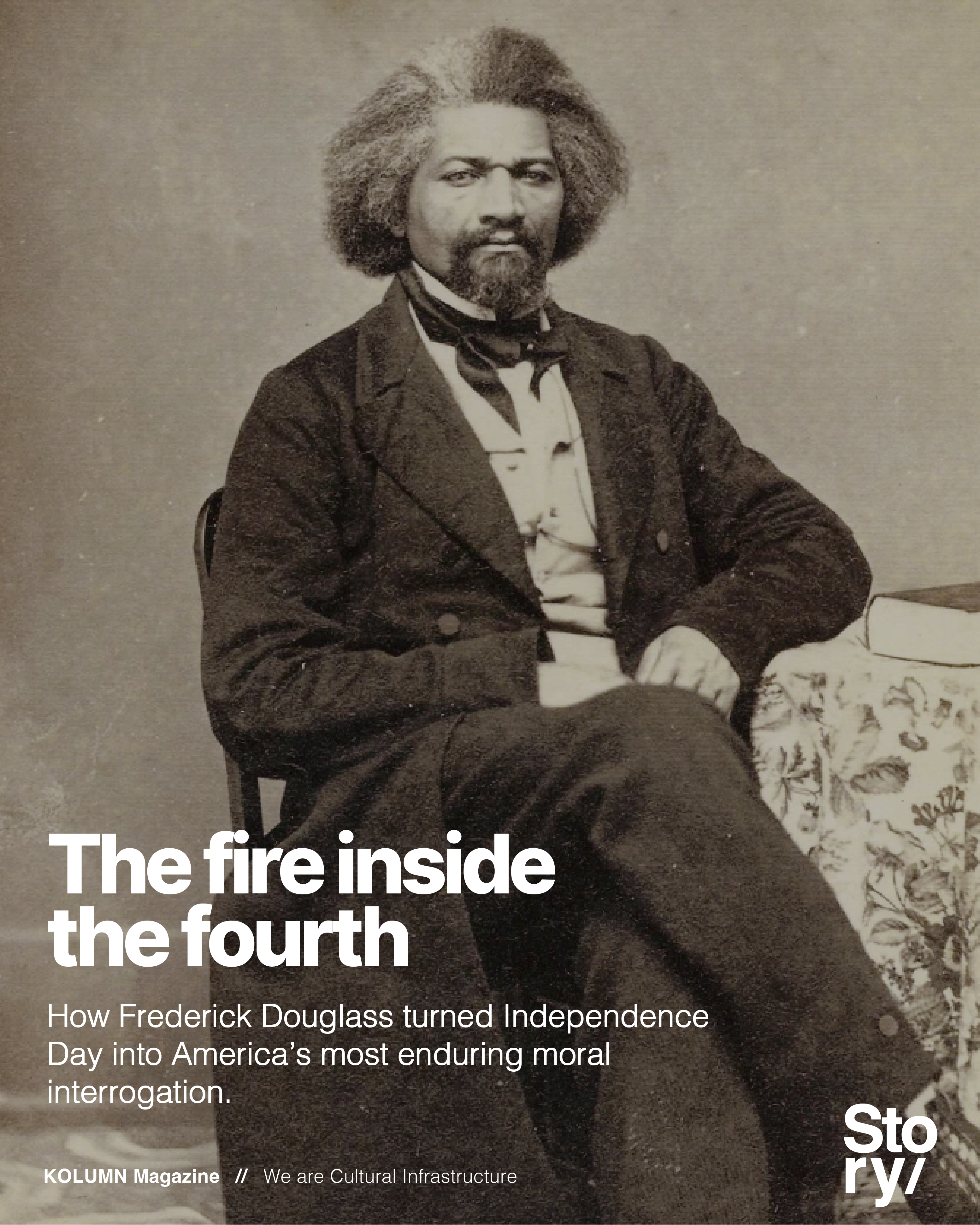
The Fire Inside the Fourth
July 5, 2026
No Comments