


She died as she lived, struggling.” — Rev. Joseph E. Lowery, after Shabazz’s death.
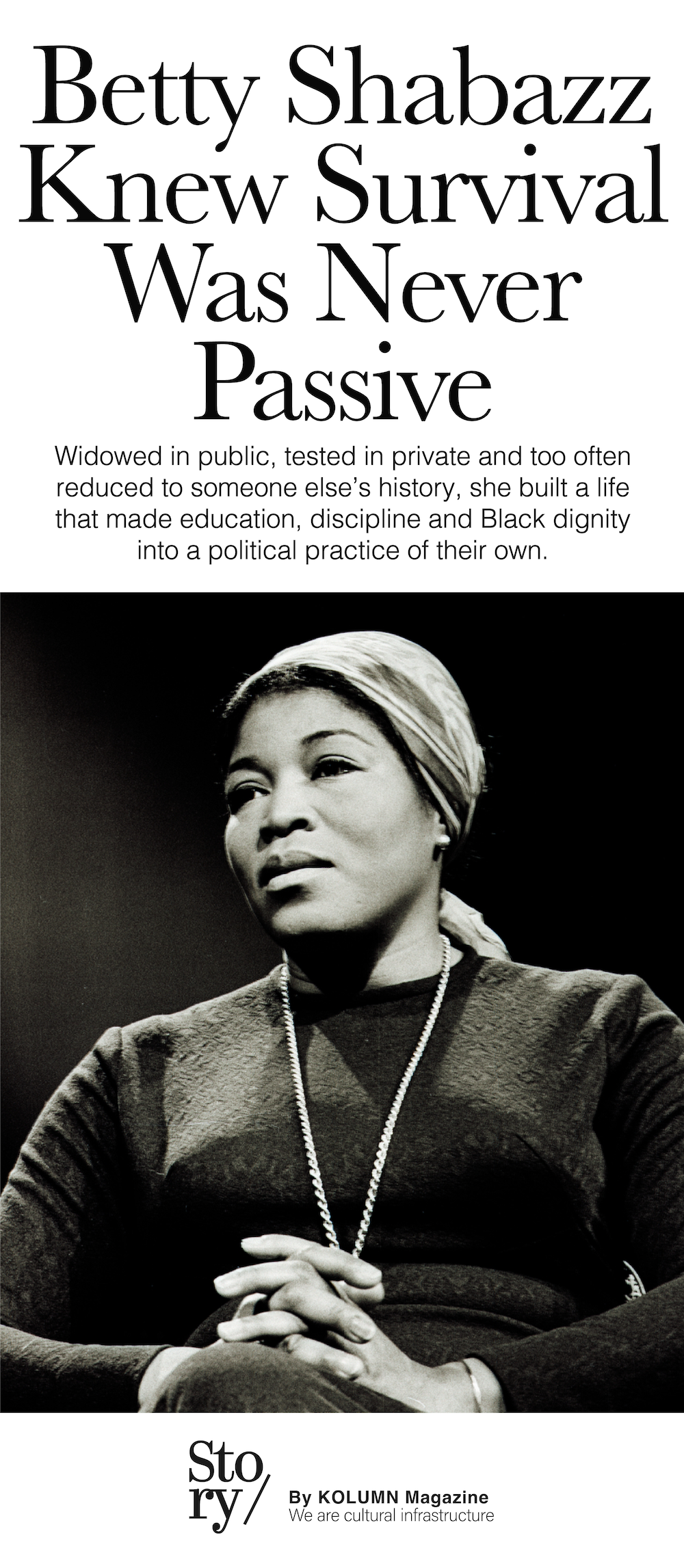
She died as she lived, struggling.” — Rev. Joseph E. Lowery, after Shabazz’s death.
By KOLUMN Magazine
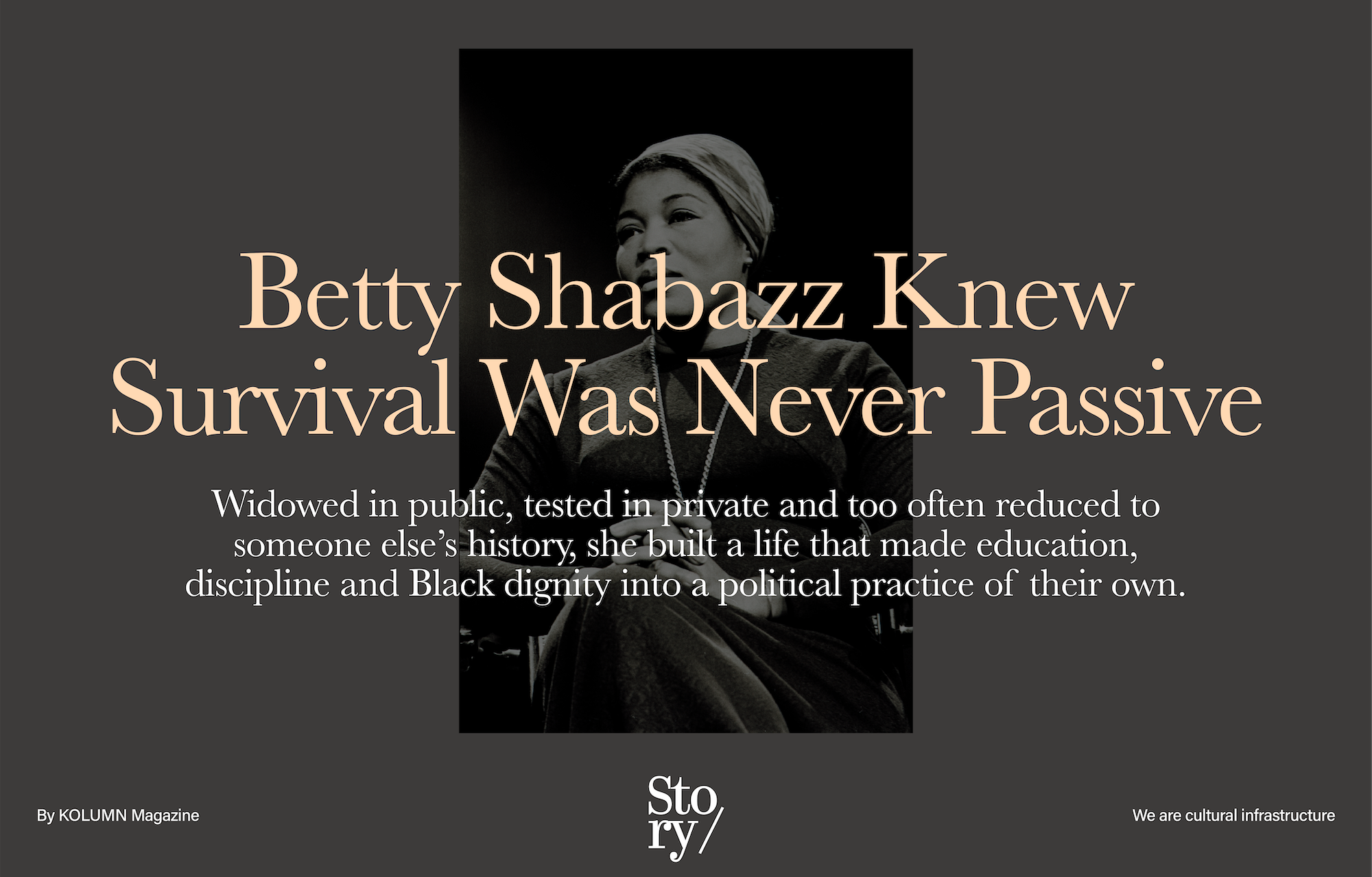
There is a particular kind of historical shrinking that happens to women who stand near iconic men. Their names remain recognizable, but their actual lives are blurred into supporting roles. Betty Shabazz has often suffered that fate. She is commonly introduced first as Malcolm X’s widow, which is true but radically incomplete. She was also a nurse, an educator, a public intellectual, a Sunni Muslim, a mother of six daughters, a college administrator and, in the decades after Malcolm X’s assassination, one of the most quietly authoritative stewards of Black memory in the United States. The shorthand has endured because it is easy. The fuller story endures because it is harder, and because it tells us more about what Black political survival looked like after the cameras moved on.
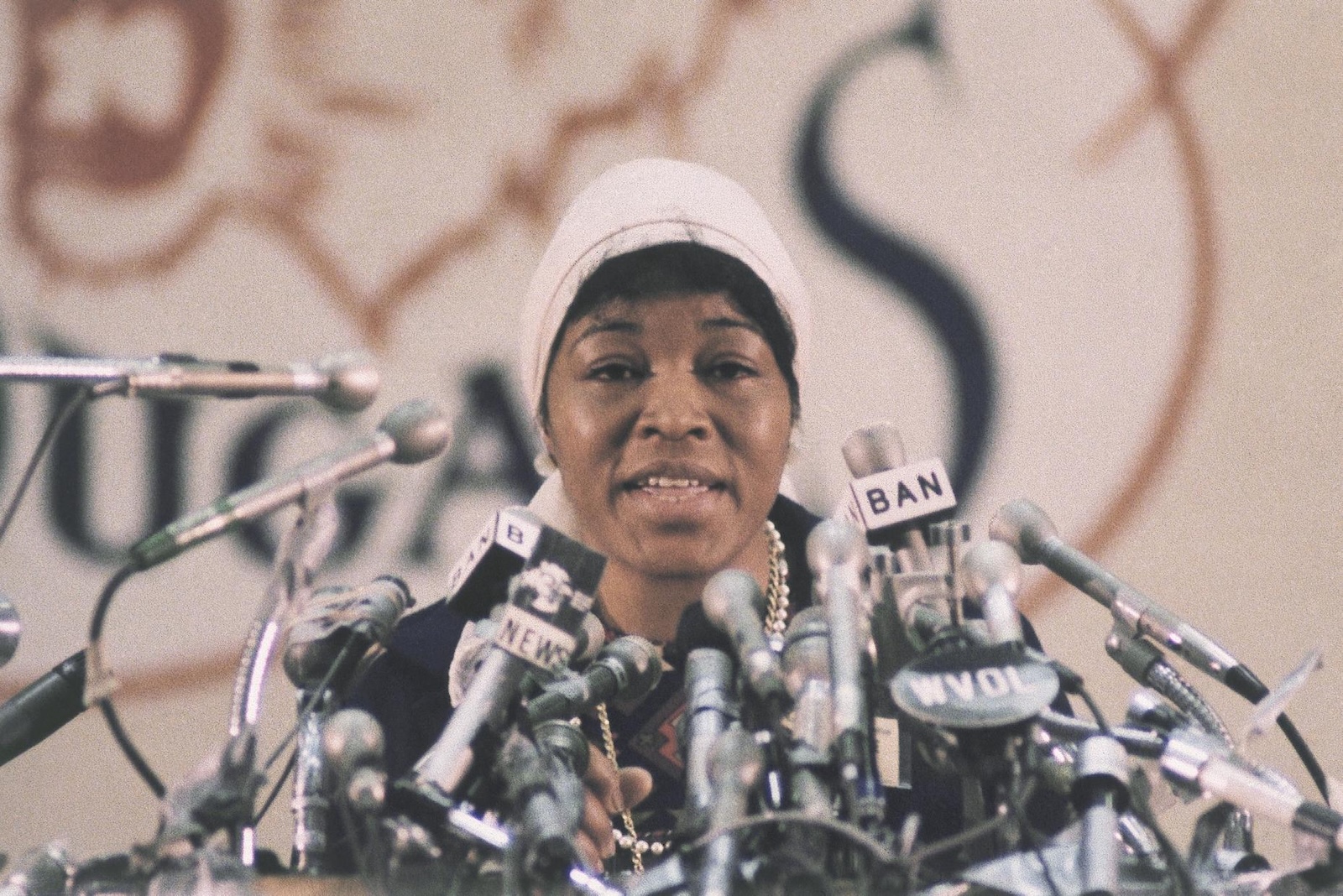
To write about Betty Shabazz responsibly is to resist melodrama without sanding down the tragedy. Her life included more than enough of it: a childhood marked by instability, a move north, difficult encounters with Jim Crow racism, a marriage forged inside the Nation of Islam, the public murder of her husband in front of her and their children, the burden of raising six daughters while preserving a controversial legacy, and finally her own death from burns after a fire set by her young grandson in 1997. Yet to make tragedy the entire plot is to repeat the old error. What made Shabazz historically important was not simply what happened to her. It was what she built afterward, and the political ethic she embodied while doing it.
That ethic was disciplined rather than theatrical. She did not cultivate charisma in the way Malcolm did. She did not turn herself into a headline-chasing movement celebrity. Even when she became nationally known, much of her authority came from a different register: bearing, seriousness, self-command, insistence. The Washington Post, in its 1997 obituary, described how she repeatedly rose above personal tragedy by leaning on self-reliance, discipline and education, the very values she associated with Malcolm’s teachings. The New Yorker, reflecting on her death, emphasized the “dignity and modesty” with which she carried an exemplary life after widowhood at 28. Those details matter because they point to the core of her significance. Betty Shabazz made endurance look like governance.
The public Betty Shabazz was composed, often elegant, and deeply controlled. But that control should not be mistaken for passivity. She was not simply preserving a memory; she was curating an argument. Through speeches, teaching, cultural work and institution-building, she pressed a question that remains contemporary: what does it mean to honor radical Black political history without embalming it? Part of her answer was educational. Part was spiritual. Part was maternal. And part of it was institutional, visible today in the Shabazz Center at the historic Audubon Ballroom, which describes itself as dedicated to preserving and advancing the legacies of Malcolm X and Dr. Betty Shabazz through education, advocacy and cultural programming.
Any serious appraisal of Betty Shabazz also requires a second correction. She was not merely the keeper of Malcolm’s flame, though she surely was that. She was, in her own right, a thinker about Black communities, Black children and Black futures. The Black Women’s Religious Activism project notes that she supported organizations including the National Council of Negro Women and the NAACP, spoke at the 1995 Million Man March and, near the end of her life, argued publicly for jobs and skills development in Black communities. In an editorial quoted by that archive, she wrote that churches, community groups, entrepreneurs, sororities, fraternities and professional organizations needed to connect more people to employment and training. That is not ceremonial language. It is governance language.
So the real challenge in telling her story is not whether there is enough material. There is plenty. The challenge is how to narrate a life that was both intensely public and persistently misread. Betty Shabazz did not become a symbol because she was static. She became one because she kept moving through history’s worst weather and refused to surrender her standards. Her legacy sits at the crossroads of Black nationalism, post-civil-rights institution building, Muslim American history, Black motherhood and the long politics of memory. To understand her is to understand that survival, in Black public life, has often been one of the most underrated forms of leadership.
Before the public knew her name
One of the complications in writing about Betty Shabazz is that some details of her early life remain contested. Public sources differ on her birth year, and some accounts conflict on place-of-birth particulars. Authoritative summaries generally place her birth in the mid-1930s and agree that her early years involved instability before she was raised in Detroit by foster parents, Lorenzo and Helen Malloy. Because the birth record has long been discussed as uncertain across secondary accounts, it is more accurate to emphasize what is clear: Detroit mattered, and so did the contrast between her foster family’s relative protection and the harsher racial order she would later face in the South.
Detroit gave her a kind of scaffolded upbringing. By many accounts, the Malloys tried to shelter her from the full force of racism. That impulse was understandable and limited at once. Protection can offer safety, but it can also leave a young person underprepared for the bluntness of American racial hierarchy. When Shabazz left for Tuskegee Institute, she encountered a Jim Crow reality that cut through any remaining innocence. According to later recollections cited in biographical accounts, even the train ride south became part of her racial education. The Washington Post obituary similarly notes that she studied education at Tuskegee and later shifted toward nursing in New York during the 1950s.
That southern encounter was foundational. It is tempting to narrate it as a simple political awakening, but that would flatten the emotional shock involved. For many Black migrants and northern-raised Black students, the South offered not revelation in the abstract but humiliation in the concrete: where you could sit, when you could be served, how long you had to wait, what tone white clerks used, what your body was expected to know before your mind had language for it. Betty Shabazz’s later commitment to dignity was not incidental to those experiences. It was likely sharpened by them.
The move to New York altered the trajectory again. There she studied nursing, became involved with the Nation of Islam and began teaching health and hygiene classes to Muslim women. That practical detail is revealing. Even before her life intersected with the most visible currents of Black political history, she was already doing work rooted in care, instruction and discipline. She was not entering movement life as ornament. She was entering it through a lane of service and pedagogy.
It was also in New York that she met Malcolm X at Temple Seven. Their relationship has been romanticized, mythologized and debated for decades, but the basic architecture is well established: they met within the Nation of Islam, married in 1958 and built a family while Malcolm’s public profile rose dramatically. The marriage placed Betty inside one of the most consequential and volatile political-religious movements in modern Black American history. But “inside” should not be confused with “equal footing” in public narrative. Malcolm’s voice dominated the era’s press coverage. Betty’s influence, like that of many women in movement spaces, was more often recorded indirectly.
That asymmetry shaped how later generations inherited her. Malcolm was remembered in speech footage and rhetorical flashes. Betty was remembered in stillness: standing beside him, sitting behind him, gathering the children, remaining after the rupture. Yet those images also show a woman studying power at close range. She understood the Nation of Islam from within, understood Malcolm’s transformation from within, and understood the costs of public dissent from within. Her later authority did not come from abstraction; it came from having lived at the fault line.
Marriage, movement and the politics around the kitchen table
Betty Shabazz and Malcolm X have often been narrated as archetypes: the fierce public man and the steadfast private woman. That framing contains some truth and a lot of distortion. The Washington Post, drawing on Michael Eric Dyson’s Making Malcolm, noted that Shabazz was seen as a supportive wife but also as strong-willed, with an affectionate sparring relationship with Malcolm, especially over gender roles. That small but important detail pushes back against the idea that she existed simply to affirm his worldview. Their home was also a site of negotiation.
This matters because the Nation of Islam prescribed highly structured gender expectations, and Malcolm himself publicly preached versions of family order that could be rigid and patriarchal. To imagine Betty as merely receiving those ideas is to misread the dynamic. Women in Black religious and nationalist traditions have often exercised influence through forms the archive underrecords: argument, household governance, political counsel, emotional calibration, strategic disagreement. If Shabazz and Malcolm sparred about gender, as Dyson suggested and the Post relayed, then their marriage was not a one-way transmission belt. It was a political household with two minds in it.
At the same time, her role inside that household should not be minimized. The couple had six daughters. They were building family life while Malcolm’s responsibilities expanded, his enemies multiplied and the Nation of Islam’s internal tensions intensified. To sustain home under those conditions required more than devotion. It required logistics, composure and judgment. The historical record gives Malcolm the microphone. Betty often handled the architecture that made the life around the microphone possible.
When Malcolm began his break with the Nation of Islam, Betty supported him. The Post reported that when he moved away from the organization, the two converted together to orthodox Islam, and that she remained a devout Sunni Muslim for the rest of her life. That shift is crucial. It signals that she was not frozen inside the earlier movement identity. She moved with Malcolm through a doctrinal and political transformation that widened his worldview after his travels to Africa and Mecca. PBS’s Malcolm X: Make It Plain emphasizes that his last year brought a deeper understanding of Islam and greater openness to working with white allies. Betty was not merely adjacent to that turn; she lived it.
“The white man and the black man have to be able to sit down at the same table.” Malcolm X’s late-career shift mattered to Betty Shabazz’s life as well as his own. (PBS)
There is a tendency in popular memory to treat Malcolm’s final year as his alone, as though only his consciousness evolved. But marriages do not metabolize ideological upheaval one person at a time. Betty was there for the uncertainty, the break, the danger and the reorientation. She understood what it meant for him to leave the Nation, to become more vulnerable, and to enter a new stage of political life without the institutional shield he had once possessed. In that sense, she was also among the first interpreters of Malcolm’s late transformation.
And then came the assassination. In February 1965, as Malcolm prepared to speak at the Audubon Ballroom, he was killed before her eyes while she was pregnant with twins and seated with four of their daughters. It is one of the most replayed facts of 20th-century Black history, but the familiarity of the fact can drain it of force. To witness your husband’s murder in public is one thing. To do so while children are beside you, and while the nation is still deciding whether it fully recognizes his humanity, is another. The enormity of that moment shaped everything that followed.
Widowhood as political labor
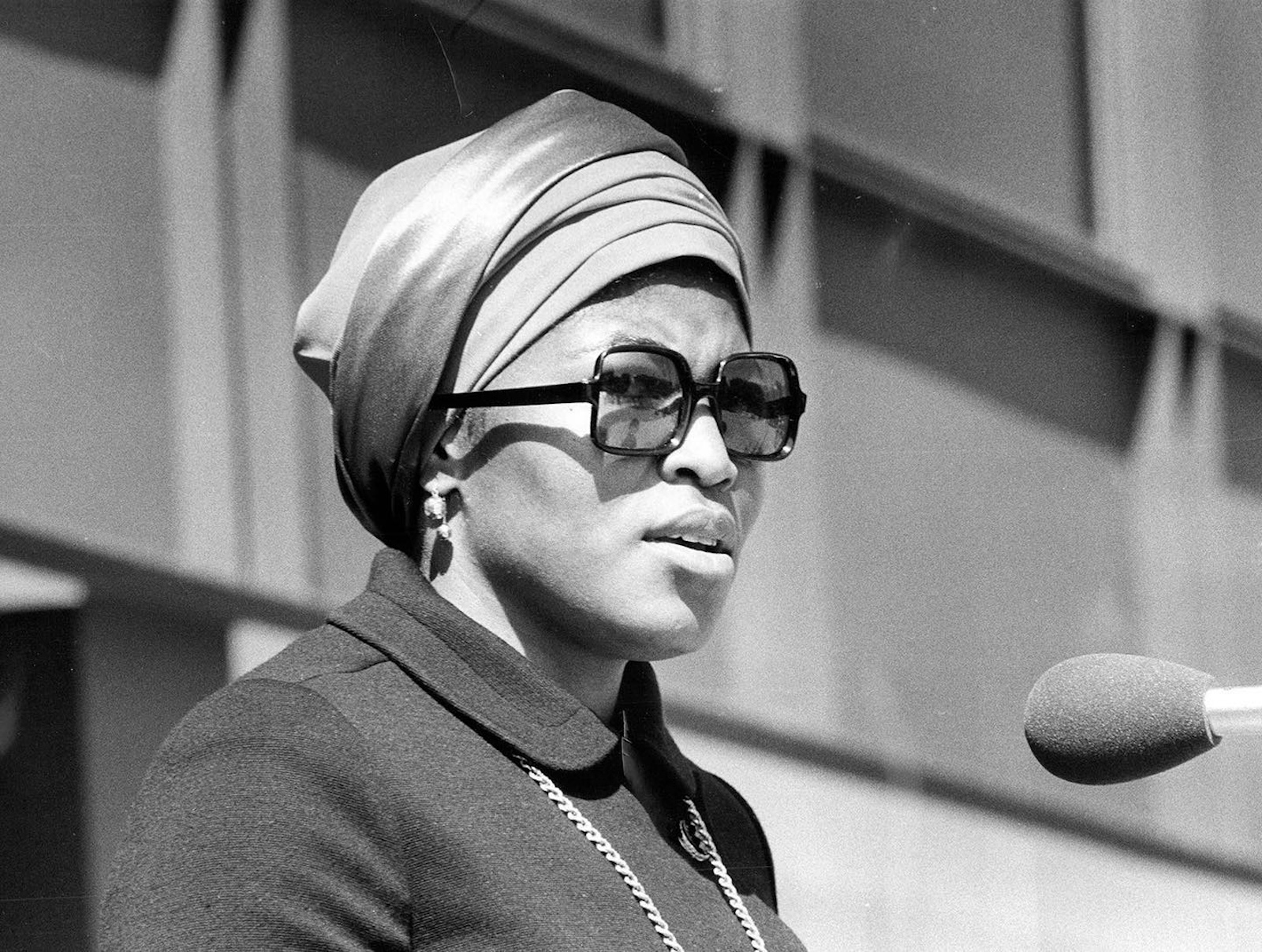
Widowhood is often described as a private condition. In Betty Shabazz’s case, it became a form of public work. She was 28, pregnant, and suddenly responsible not only for six daughters but for a legacy that much of mainstream America still regarded with suspicion. The New Yorker later observed that there was not an outpouring of support comparable to what other widows of slain national figures received. That distinction is telling. Malcolm X, in 1965, did not yet occupy the consensual place in public memory that he would later attain. To be his widow then was to inherit both grief and controversy.
Betty Shabazz’s response was neither theatrical sanctification nor retreat. She went back to school. According to the Post obituary, she earned undergraduate, master’s and doctoral degrees in education from the University of Massachusetts and became an associate professor at Medgar Evers College in Brooklyn, later serving in communications and public relations there as well. UMass Amherst’s own Black Presence initiative notes that she earned a doctorate in education at the university, underscoring her place in that institution’s history of Black scholarship and leadership.
That educational arc deserves more attention than it usually gets. It is often mentioned as an admirable postscript, a testament to perseverance. But it was also an ideological statement. Education, for Shabazz, was not simply self-improvement. It was a method of re-entering public life on her own terms. After years of being known through Malcolm’s meteoric ascent and catastrophic death, the classroom and the doctorate allowed her to claim authority in a register no one could dismiss as inherited. She did not become “respectable” by abandoning Malcolm. She made scholarship part of the continuation.
Her work at Medgar Evers College further illuminates that point. A historically Black institution within CUNY, the college sits within a lineage of Black educational self-determination that maps cleanly onto Shabazz’s priorities. To teach health sciences, direct communications and serve as an administrator in such a setting was to operate where ideas met community need. It is one thing to deliver commemorative speeches about Black empowerment. It is another to build and sustain institutions that serve Black students daily. Shabazz did both, but the latter may tell us more about her actual political temperament.
Her daughters’ accounts and the surrounding public memory suggest that she also turned home into a pedagogical space. She guarded their privacy, protected them from spectacle and emphasized self-worth, self-sufficiency and historical consciousness. This was not accidental parenting. It was strategy. A family carrying one of the most recognizable surnames in Black America had to decide whether it would live as artifact, wound or force. Betty pushed toward force.
There is a larger pattern here. Black women widowed by the movement have often been asked to perform grace for the nation while reconstructing family under impossible conditions. Coretta Scott King is the most obvious comparison, and The New Yorker explicitly placed Betty Shabazz alongside King and Myrlie Evers-Williams as a kind of trio of African American matriarchal icons. But the comparison can obscure as much as it reveals. King inherited a martyr whose public respectability was already legible to liberal America. Shabazz inherited Malcolm, whose mainstream canonization would come later. Her labor therefore included translation as well as preservation.
Betty Shabazz did not just keep Malcolm X’s memory alive. She helped make it newly legible to a country that had once preferred to caricature him.
That translation work can be seen in the speeches attributed to her over the years. The Post quoted her saying that Malcolm’s teachings continued to inspire young people around the world, and that ideas once dismissed were now common sense. That is the voice of someone engaged in historical revision in real time. She knew the image of Malcolm had been distorted while he lived. She understood that the struggle over his memory was also a struggle over Black political possibility. Her job, as she came to define it, was not merely to mourn him but to contest the frame through which the nation remembered him.
Faith after rupture
Religion is indispensable to understanding Betty Shabazz, and yet it is often underplayed in secular retellings. She entered public life through the Nation of Islam, converted with Malcolm to Sunni Islam and, according to the Post, remained a devout Sunni Muslim until her death. The Black Women’s Religious Activism archive places her squarely within a tradition of Black women whose spiritual commitments helped animate social change. That framework is useful because it restores an inner dimension to a life too often narrated only through external events.
For Shabazz, Islam was not just identity. It was discipline, cosmology and community. It offered language for order in a life that repeatedly met chaos. It also complicated any attempt to reduce her to “civil rights widow,” a category that usually presumes Christian movement iconography. Betty Shabazz belonged to a Black Muslim genealogy that has often been sidelined in mainstream civil-rights storytelling, despite its enormous influence on Black consciousness, style, internationalism and ideas of self-determination.
Her trip to Mecca after Malcolm’s death, mentioned in the Post obituary, reads as one of the most important symbolic acts of her life. She went, the paper reported, while distraught about raising six children alone and feeling lost without the friend and mentor she had relied on. Mecca, in this context, was not tourism or tribute. It was reconstitution. It linked her personal grief to a broader spiritual geography and to the Islamic turn Malcolm had made near the end of his life.
It is also worth noting how religion and dignity intersected in her public bearing. Shabazz’s seriousness was not merely personality. It was partly formed by a spiritual ethos that valued restraint, ethical rigor and self-possession. This is one reason she could appear so calm even when discussing subjects of extraordinary pain. The calm was not the absence of feeling. It was the practice of containment.
Her significance in Black Muslim women’s history is therefore larger than many mainstream profiles allow. She modeled a form of public womanhood that was at once devout, educated, maternal and politically alert. In a national culture that tends to flatten Muslim women into stereotypes of silence or exoticism, Betty Shabazz stands as a rebuke. She was neither silent nor ornamental. She was a strategist of memory operating from a religious center.
Betty Shabazz and the making of Malcolm X’s afterlife
Malcolm X’s status today feels secure. His face is ubiquitous, his quotations circulate constantly and his political vocabulary has entered mainstream discourse in ways that would have seemed unlikely in 1965. But that canonization did not happen automatically. It was built through books, films, organizing, scholarship, family stewardship and years of insistence against distortion. Betty Shabazz was central to that process.
The Shabazz Center today explicitly frames itself as a living memorial that embodies Malcolm’s humanitarian legacy and Betty’s vision for education and empowerment. Located at the Audubon Ballroom, where Malcolm delivered his final speech, it is one of the clearest institutional expressions of her long labor of preservation. The center’s mission ties legacy to racial equity, social justice, education and youth development, which is exactly the sort of practical, future-facing frame Shabazz favored in life.
This is one reason it is inaccurate to describe her role as merely custodial. Custodians preserve what exists. Betty Shabazz helped produce the terms on which Malcolm could be remembered. She defended him against caricature, spoke about the continuing relevance of his teachings and linked his legacy to living social problems rather than static martyrdom. When she argued that Malcolm’s teachings still inspired youth and that “yesterday’s philosophy is today’s common sense,” she was making a canonizing claim. She was asserting historical vindication.
Her work also intersected with the broader Black cultural shift that made Malcolm newly legible in the late 20th century. The New Yorker’s 1997 reflection hints at that transformation by contrasting the cool response to Malcolm’s death in 1965 with the broad reverence surrounding Betty’s memorial service. By then, Malcolm’s once-threatening separatist reputation had been reabsorbed into a broader Black political consensus that valued cultural pride, self-definition and skepticism toward easy integrationist triumphalism. Betty Shabazz lived long enough to witness that revision and to shape it.
There is a temptation to make this sound seamless, but it was not. Memory is a battleground. Malcolm’s image was commercialized even as it was recovered. His politics were softened in some tellings and romanticized in others. Betty moved through all of that. She was, at various times, consultant, interviewee, critic, gatekeeper and mourner. She knew that the difference between memory and branding could collapse quickly. Her insistence on seriousness was, in part, a defense against that collapse.
Reconciliation, controversy and the costs of public grace
No account of Betty Shabazz can ignore the wrenching controversy surrounding Louis Farrakhan and her daughter Qubilah Shabazz in the mid-1990s. The broad outline is well documented: Betty and other followers of Malcolm long believed Farrakhan bore responsibility in the climate that led to Malcolm’s assassination. In 1995, after Qubilah was charged in an alleged plot to kill Farrakhan, he publicly asked Betty for forgiveness, and a widely noted reconciliation followed. The Washington Post reported that many Black leaders treated the reconciliation as an act of extraordinary grace, further elevating Shabazz’s public standing.
This episode is often narrated sentimentally, as though forgiveness was simply moral uplift. In reality, it was politically excruciating. Betty Shabazz had carried the memory of Malcolm’s assassination for three decades. To appear publicly in reconciliation with Farrakhan, while her daughter faced prosecution and while long-held suspicions remained unresolved, was not a neat act of closure. It was a maneuver inside a fraught Black public sphere where family pain, federal power, communal pressure and media attention collided.
Whether one reads that reconciliation as magnanimity, necessity, compromise or all three, it revealed something fundamental about Shabazz’s public method. She was willing to step into morally ambiguous terrain if she believed something larger was at stake: her daughter’s future, Black communal fracture, the optics of internal warfare. That does not make the choice uncomplicated. It makes it adult.
The Black Women’s Religious Activism archive notes that she also spoke at the 1995 Million Man March, another signal that she remained engaged with the evolving terms of Black public life rather than frozen in the scripts of the 1960s. By the last years of her life, she was still speaking nationally, still invoking economic development, still trying to connect cultural memory to structural need. She was not living in the past. She was trying to make use of it.
The educator, not the footnote
It is hard to overstate how much Betty Shabazz’s identity as an educator reshapes the meaning of her life. Without it, she remains locked in the shadow biography of Malcolm X. With it, she emerges as something more expansive: a Black woman who transformed lived history into pedagogy.
Education gave her a language for continuity. Malcolm had preached political awakening, religious rebirth and racial self-respect. Betty, operating in a different register, pursued institutional education, public speaking and youth formation. The difference in style should not obscure the continuity in aim. Both were invested in consciousness. Betty’s route simply ran through classrooms, degrees and civic instruction rather than oratory alone.
This may be why her legacy still resonates so strongly in educational spaces. UMass claims her as part of its Black intellectual history. The Shabazz Center centers learning in its mission. School and youth initiatives bearing her name have extended her memory into younger generations. All of this makes sense. She represents a model of Black leadership in which education is not secondary to liberation but one of its chief instruments.
There is also something politically clarifying in the fact that she studied public health administration and taught health-related subjects before later serving as an administrator. Those details remind us that the labor of Black freedom has never been solely rhetorical. It is also administrative, bodily and infrastructural. It lives in clinics, colleges, curricula, communications offices and family routines. Shabazz inhabited that world.
Betty Shabazz’s politics often looked less like a rally than a syllabus: structure, discipline, repetition, formation.
The final tragedy and the danger of letting it define her
In June 1997, Betty Shabazz was severely burned in a fire set in her home by her 12-year-old grandson Malcolm. She died weeks later after extensive treatment, including multiple surgeries. The event was horrifying, intimate and immediately sensational. It also risked swallowing the rest of her life in the public imagination. Even now, many contemporary summaries end with the fire as though history’s last cruelty should also be its lasting interpretation.
That would be a mistake. The tragedy matters, of course. It exposed family strain, generational pain and the deep, often under-discussed pressures inside families marked by public history and private trauma. The New Yorker saw in the manner of her death echoes of the troubled family realities borne by many in the Black underclass, and Washington Post coverage underscored the instability that had marked her grandson’s life. But even here, Shabazz’s meaning cannot be reduced to victimhood. The larger public response to her hospitalization and death showed how widely her moral stature had expanded. Long lines formed for blood drives. Political, cultural and civil-rights leaders rallied to her side.
The breadth of that response was itself historical evidence. By 1997, Betty Shabazz was not simply Malcolm’s widow. She was a revered figure in her own right, recognized across ideological lines for dignity, stamina and service. President Bill Clinton issued condolences. Civil-rights leaders praised her perseverance. The Post quoted Rev. Joseph Lowery calling her one of the “queen mothers of the black experience.” Whatever else one makes of public mourning language, that phrase captures the symbolic position she had come to occupy.
Her death also marked the culmination of a life spent converting wound into work. The cruelty of the ending does not invalidate that conversion. If anything, it makes it more visible. She had lived through assassination, public misrepresentation, family crisis and institutional struggle without surrendering the disciplines that organized her life. That is not sainthood. It is rigor.
Why Betty Shabazz still matters
Betty Shabazz matters now for reasons that exceed commemoration. She speaks directly to contemporary questions about how Black communities remember radical figures, how women’s labor disappears inside male-centered histories and how education functions as political practice rather than mere credentialing.
She also matters because she complicates familiar movement categories. She was not easily contained by “civil rights,” “Black Power,” “religious activist,” “educator” or “widow.” She crossed those frames. Her life reminds us that the boundaries historians draw between movements are often tidier than the people who lived through them. Betty Shabazz stood in the overlap between Muslim organizing, Black nationalism, post-1960s institution building, public memory work and community uplift.
Her example is especially instructive in an era that often confuses visibility with influence. Shabazz was visible, yes, but that was not the source of her power. Her power came from moral credibility accumulated across years of consistency. She studied. She taught. She raised children. She spoke carefully. She protected what she believed was worth protecting. She attached legacy to institutions. There is nothing flashy about that. There is also nothing minor about it.
And perhaps this is the deepest reason her life continues to resonate: she gives us a more demanding model of what survival can mean. Not survival as mere endurance, not survival as branding, not survival as therapeutic cliché. Survival as standard-bearing. Survival as memory with homework attached. Survival as a refusal to let the dead be simplified, the living be deformed or the future be left unprepared.
Betty Shabazz has often been presented as the woman history happened to. A better reading is that she was one of the people who taught history how to remember itself. Malcolm X’s afterlife in American political culture is not understandable without her. Nor is the broader story of Black women who turned personal catastrophe into public architecture.
In the end, what remains most striking is not only that she survived what she survived, but how she chose to define the meaning of that survival. She chose education over spectacle. Institution over anecdote. Discipline over self-mythology. That is a profound political choice, and one that makes Betty Shabazz larger than the shorthand history has so often given her.
More great stories
Afro Sheen, Wall Street, and the Architecture of Black Possibility
July 6, 2026
No Comments
The Fire Inside the Fourth
July 5, 2026
No Comments