
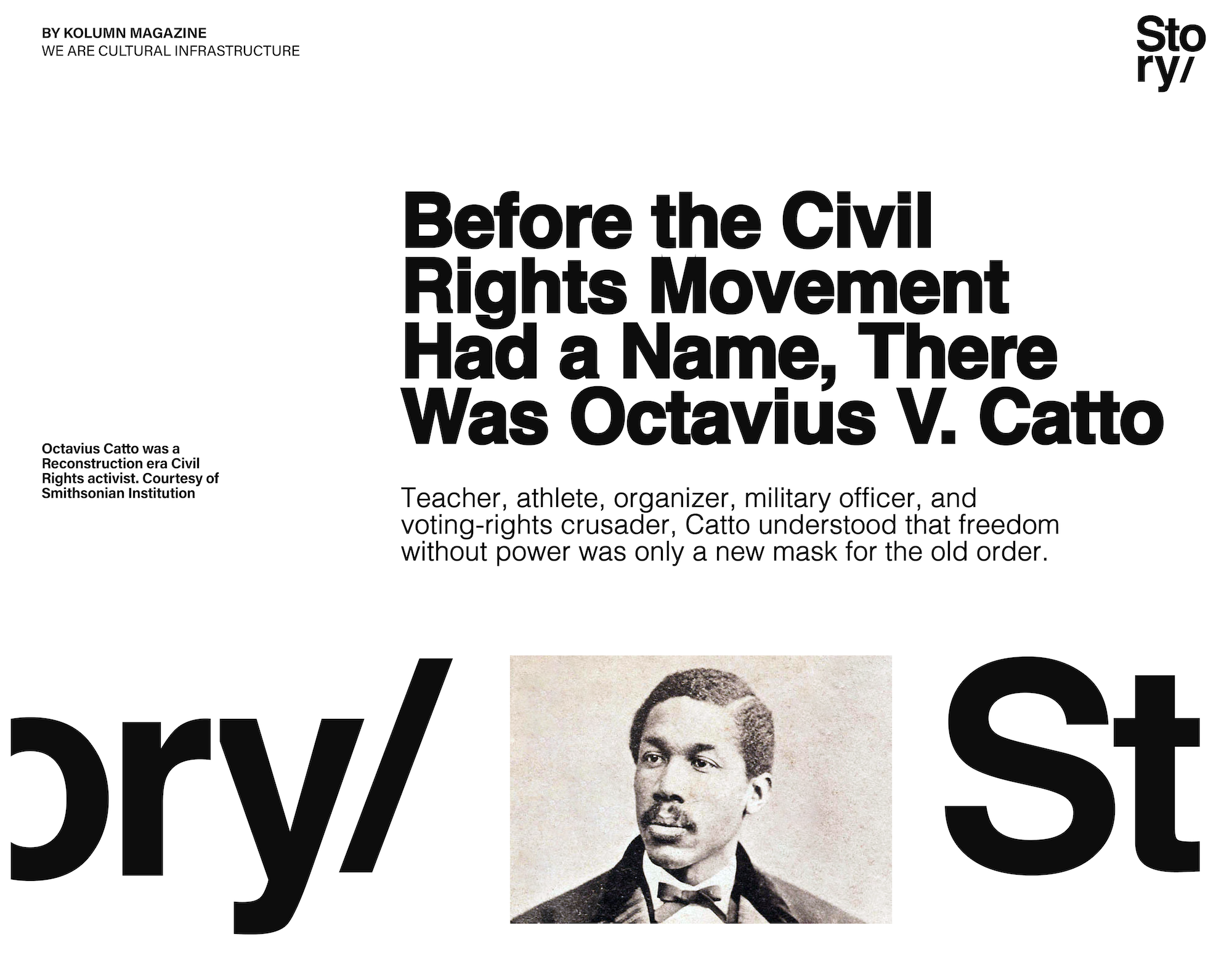
Octavius V. Catto did not ask America to improve its manners. He demanded that it revise its definition of citizenship.
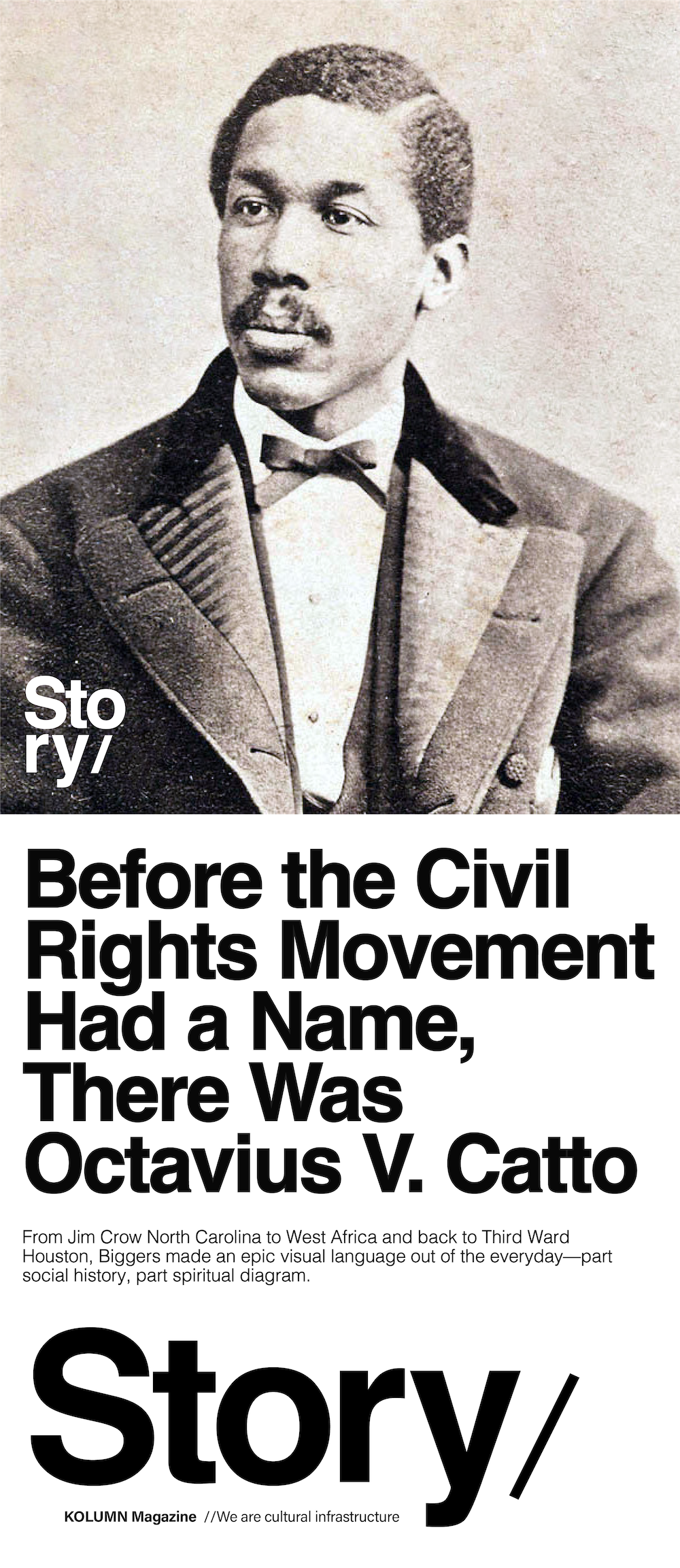
Octavius V. Catto did not ask America to improve its manners. He demanded that it revise its definition of citizenship.
By KOLUMN Magazine
There are some American lives that seem to arrive early, as if the nation has not yet developed the vocabulary to describe what it is seeing. Octavius Valentine Catto was one of those lives. Born free in Charleston, South Carolina, in 1839 and raised in Philadelphia, Catto became, before age thirty-three, an educator, classicist, organizer, voting-rights advocate, military officer, public intellectual, and athlete of unusual renown. The official shorthand often describes him as a “civil rights activist,” but that phrase, useful as it is, undersells the scale of his work. Catto was not simply petitioning for better treatment. He was trying to reorder American democracy after slavery by insisting that Black people were not appendages to the republic but co-authors of it, a point made clear in biographical accounts from the National Park Service, the Encyclopedia of Greater Philadelphia, and the Historical Society of Pennsylvania.
To write about Catto now is to write against amnesia. For generations, he lived in the margins of public memory, more familiar to archivists, neighborhood historians, and Philadelphia’s Black civic institutions than to the broader American canon. That began to change in recent years, especially with the 2017 unveiling of A Quest for Parity, the public memorial at Philadelphia City Hall commissioned by the Octavius V. Catto Memorial Fund and noted by Visit Philadelphia as the city’s first public statue honoring a specific Black historical figure. But memorials, however necessary, are not the same thing as comprehension. Catto’s life is not just a local story about one martyred Philadelphian. It is a national story about Reconstruction, Black education, organized resistance, athletic citizenship, and the violent backlash that met Black political participation almost the moment it became real, as the National Park Service and the Encyclopedia of Greater Philadelphia both make plain.
Like the recent KOLUMN run of archival recoveries and civic portraits—pieces that have traced the lives of figures such as Hallie Quinn Brown, Fred Gray, and Mary White Ovington—Catto’s story asks the magazine to do more than celebrate an individual. It asks us to read a life as infrastructure. The question is not only who Catto was, but what kind of country required him, and what kind of country killed him.
A child of Black aspiration in a city that called itself free
Catto was born on February 22, 1839, in Charleston to Sarah Cain and William T. Catto, a Presbyterian minister who had freed himself from slavery before helping lead his family north. The family’s movement from the slave South toward Philadelphia was not merely geographic. It was ideological. They were joining a Black world already constructing institutions of worship, education, literary debate, and mutual aid in order to survive a nation that made freedom conditional even where slavery had formally receded. According to the Society for American Baseball Research, William Catto’s abolitionist commitments deeply shaped Octavius’s political development; the Philadelphia Encyclopedia likewise places the family within the broader stream of Black migration into Philadelphia, a city whose antislavery reputation coexisted with entrenched anti-Black prejudice.
That contradiction mattered. Philadelphia was the “City of Brotherly Love” in slogan, but in practice it was a city of segregated schools, constrained labor markets, racial violence, and civic humiliation. The Philadelphia Encyclopedia notes that Catto attended segregated institutions before finishing his education at the Institute for Colored Youth, while the National Park Service identifies him as part of a generation of free Black Philadelphians who understood that the North’s racism was not softer than the South’s so much as differently administered. In Catto’s lifetime, the architecture of discrimination in the urban North was enforced not by plantation law but by ordinance, custom, police, employers, and white mobs.
And yet Black Philadelphia was not simply besieged. It was brilliant. Literary societies, churches, benevolent associations, and schools functioned as training grounds for political thought. The Free Library of Philadelphia notes Catto’s role as recording secretary of the Banneker Institute, one of the city’s important Black literary societies, where debate, reading, and oratory were part of community self-fashioning. The National Park Service also places Catto within the network of organizations that would make Philadelphia a center of Black rights advocacy during and after the Civil War. This matters because Catto did not emerge from nowhere. He was produced by a Black civic culture that believed education was not ornamental. It was defense.
The Institute for Colored Youth and the making of a public man
If Catto’s family and city provided the conditions of his early formation, the Institute for Colored Youth provided the discipline. Founded through a bequest from Quaker philanthropist Richard Humphreys and chartered in Pennsylvania in 1842, the Institute was designed to educate Black youth as teachers and leaders. In Catto’s own 1864 commencement address, preserved through the National Park Service and linked to the Library of Congress, he described the school’s history with the seriousness of a statesman taking stock of a national resource. The Institute’s curriculum included Latin, Greek, geometry, and trigonometry; its library contained more than two thousand volumes; and its mission was explicitly tied to the education and uplift of Black communities. Those are not incidental details. They reveal what Black leadership in the mid-nineteenth century thought freedom required: literacy, mathematics, language, rhetoric, memory, and institutional durability.
Catto graduated from the Institute in 1858, reportedly as valedictorian, and soon joined the faculty. Both Cheyney University—the institutional descendant of the Institute for Colored Youth—and the Philadelphia Encyclopedia describe him as a teacher who used education as a platform for wider civic reform. He later became principal of the boys’ department, a role that underscores his influence not only as an activist in the streets but as a daily architect of Black intellectual life. Catto understood that institutions are where a people learn how to imagine themselves before they ever enter the ballot line.
His 1864 address is especially revealing. It is the kind of document that compresses biography, pedagogy, and politics into a single moment. Catto argued that education had to be understood as foundational to justice, and he connected the failure to educate the masses in the South to the broader catastrophe of civil war. The National Park Service reproduces the address and notes Catto’s call to educate “the masses in the South” at war’s end, a sign that he already grasped what Reconstruction would require before the war was even over. He was not speaking about charity. He was speaking about national reconstruction through Black capability.
What emerges from the record is a man for whom scholarship was inseparable from citizenship. Catto was not the soft version of a radical, the kind America likes to flatter in retrospect because his intellect can be severed from his demands. He studied the classics and worked among Philadelphia’s elite educational institutions, but he carried that cultivation directly into conflict. As Philadelphia magazine later put it in a modern reevaluation, Catto was the kind of nineteenth-century civil rights icon who integrated both streetcars and the Franklin Institute. That pairing says something essential: he was contesting exclusion at every level, from transit to science to politics.
The Black freedom struggle was intellectual work before it became legislative text
Modern retellings of civil rights history often flatten its protagonists into a simple morality play of courage versus hatred. Catto’s life resists that flattening. He belonged to a tradition in which Black freedom work was as much about argument as protest, as much about institution-building as demonstration. In Philadelphia’s Black literary and civic societies, he practiced a form of politics that assumed people had to be trained to govern and to contest governance. The Free Library of Philadelphia places him in the orbit of Black literary organizing; the National Park Service situates him among the figures who helped organize the Pennsylvania State Equal Rights League in 1864.
That league deserves more public attention than it usually gets. The National Park Service describes the Pennsylvania State Equal Rights League as a body dedicated to morality, education, temperance, frugality, industry, and the recognition of Black rights through appeals to law and conscience. To contemporary ears, some of that language may sound stiff, even conservative. In its own time, it was a disciplined framework for collective advancement and legal pressure. Catto, serving as corresponding secretary, was part of a generation of Black leaders who knew that rights had to be argued in newspapers, courts, conventions, classrooms, and legislative chambers all at once.
This is also why Catto feels so contemporary. He understood structural inequality in overlapping terms. Transit discrimination was not separate from school discrimination; voting intimidation was not separate from labor inequality; representation in public institutions was not separate from dignity in public space. The National Park Service notes his work with Congressman Thaddeus Stevens to support desegregation of Philadelphia’s streetcars, while the Philadelphia Encyclopedia identifies him as a leading Black Philadelphian using education as a base for wider rights work. The point is not simply that Catto was busy. It is that he saw the architecture.
That architecture was Northern as well as Southern. Catto’s genius was to grasp that emancipation would mean little if white Americans could replace slavery’s legal bars with civic humiliations dressed up as custom. Reconstruction, in his hands, was not just the rebuilding of the South. It was the remaking of the republic.
Streetcars, humiliation, and the daily theater of caste
One of Catto’s most important battles was over Philadelphia’s streetcars, a contest that sounds modest until one remembers what public transportation meant in the nineteenth century. Streetcars were not merely vehicles. They were moving maps of belonging. To be refused a seat, thrown off a car, or forced into humiliating exception was to be told, publicly and repeatedly, that one’s freedom had limits visible to everyone. The National Park Service credits Catto with promoting the passage of a Pennsylvania law desegregating the city’s streetcars; SEPTA and Visit Philadelphia both note that Catto, Caroline LeCount, and other activists pursued petitions, direct action, and court pressure in that fight.
Caroline LeCount belongs in this story not as ornament but as co-strategist. Visit Philadelphia notes that LeCount, a teacher and activist engaged to Catto, was among the women who boarded segregated streetcars, were removed, and then pursued legal action that helped enforce the 1867 integration law. This detail matters because it clarifies the ecology of Black organizing in Philadelphia: Catto was not a lone male tribune but part of a broader civic movement in which Black women were central to both strategy and consequence. The campaign against streetcar segregation was a battle over daily degradation, and Black women knew its stakes intimately.
To win such a fight required more than outrage. It required pressure points. It required the ability to document injury, mobilize allies, appeal to legislators, and translate indignity into public argument. That is what Catto and his circle did. Philadelphia magazine later emphasized Catto’s role in integrating both the streetcars and the Franklin Institute, while the National Park Service ties his transit work to the broader postwar campaign for Black citizenship. This is one of the places where Catto’s historical importance becomes unmistakable: long before the better-known bus and transit struggles of the twentieth century, he and his collaborators recognized public transportation as a civil-rights battleground.
It is tempting, from the distance of a century and a half, to reduce that victory to symbolism. It was not symbolic. It changed where Black Philadelphians could move, how they could work, and what claims they could make in public. It was about access. It was about humiliation. It was about whether the city would have to look at Black people as fellow riders and, by extension, fellow citizens.
War, uniform, and the demand that soldiers become citizens in peace
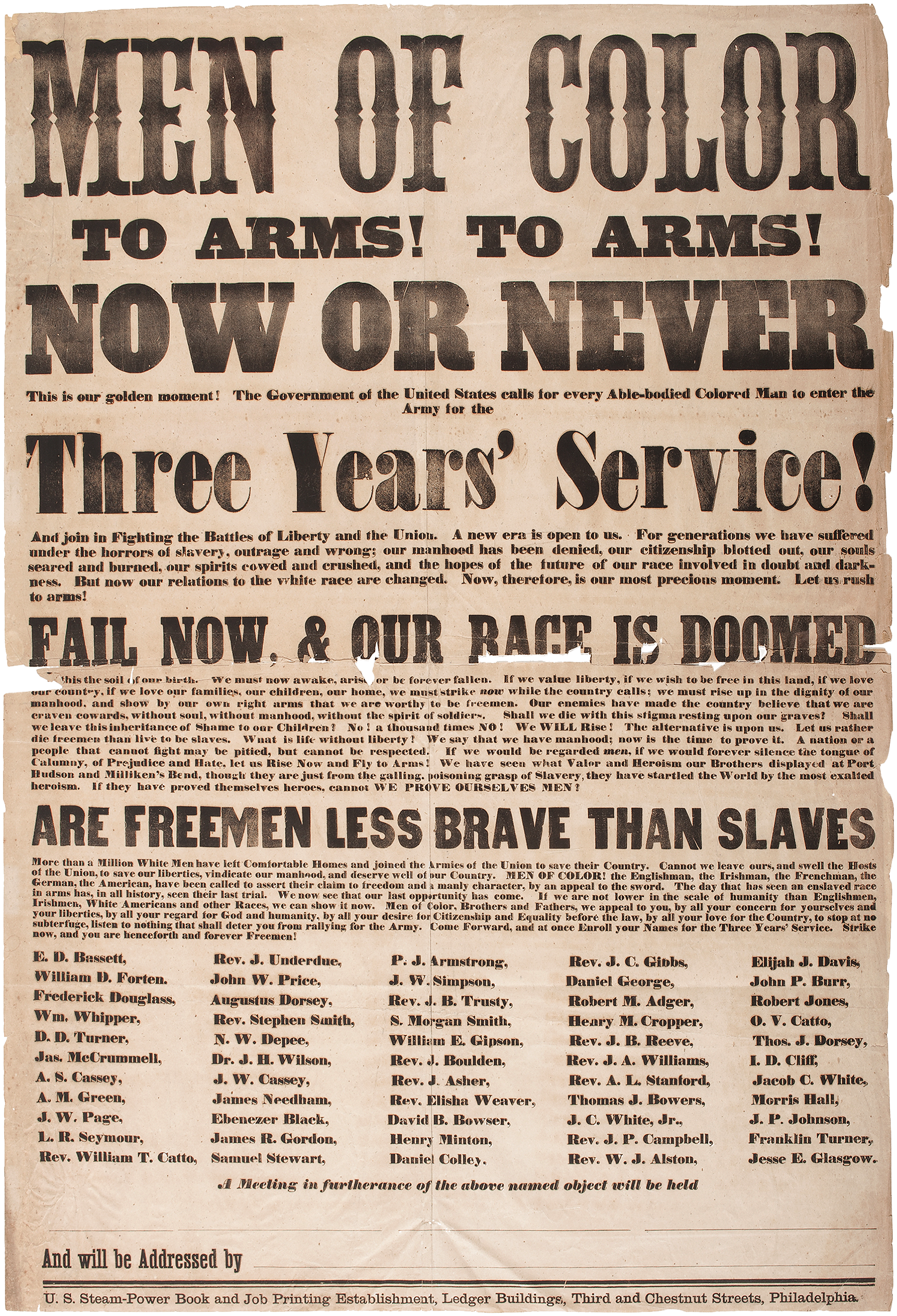
The Civil War intensified Catto’s activism and clarified his political theology. If Black men could be summoned to risk death for the Union, then the Union could not coherently deny them civic standing afterward. That conviction sits at the center of one of the most memorable lines associated with Catto: “Let soldiers in war be citizens in peace,” quoted by Smithsonian Magazine and echoed in later summaries by the National Park Service. The line is so crisp that it almost hides its severity. Catto was exposing the American habit of accepting Black sacrifice while refusing Black sovereignty.
During the war, Catto worked with Frederick Douglass and others to recruit Black men for military service. The National Park Service and the Society for American Baseball Research both note his involvement in raising United States Colored Troops in the Philadelphia area. This was not symbolic patriotism. Recruiting Black soldiers in the Civil War was part military labor, part abolitionist strategy, part claim-making exercise. It asserted that Black men were not passive recipients of emancipation but active agents in the Union cause.
Catto also held military rank. The Pennsylvania Department of Military and Veterans Affairs notes that after the war he joined the Pennsylvania National Guard and rose to brigade inspector general with the rank of major, making him one of the highest-ranking African Americans in military service at the time. The Philadelphia Encyclopedia likewise describes him as a major in the Pennsylvania National Guard. This is a striking detail because it reveals the breadth of his public identity. Catto was not only a teacher and organizer. He was a uniformed representative of state power in a nation that still treated Black citizenship as negotiable.
That contradiction would prove fatal. The same nation willing to put a Black man in uniform remained unwilling to protect him at the polls. Catto saw that clearly. His Civil War service and recruiting work were not evidence of naïve faith in America. They were tactical investments in a future he intended to force into existence.
Baseball, respectability, and the politics of Black excellence
There is a tendency in public memory to treat Catto’s athletic life as the charming side note that rounds out the résumé. That is a mistake. His baseball and cricket achievements were political, not because sports magically transcend society, but because organized athletics in the nineteenth century were entangled with status, discipline, publicity, and access to civic legitimacy. The National Park Service identifies Catto as a professional athlete as well as a civil-rights activist, and the Society for American Baseball Research describes him as founder, captain, and star shortstop of the Pythian Base Ball Club.
The Pythians were more than a team. They were part of a claim. Baseball in the 1860s was becoming a national language, and Catto understood that Black participation in the game mattered culturally and politically. SABR’s account of Catto and the Pythians explains that the club became a vehicle for his civil-rights work and public stature, while another SABR history notes the club’s role in early integrated competition in Philadelphia in 1869 and places the Pythians among the earliest Black baseball clubs in the country (SABR; SABR Games Project).
Sports were a stage on which Black achievement could become undeniable even when white institutions tried to deny its meaning. Catto’s presence there complicates the lazy assumption that Black respectability politics began as a twentieth-century strategy. In reality, Black athletes, educators, and organizers in Catto’s era were already using skill, discipline, and public performance to contest white narratives of incapacity. The Philadelphia Encyclopedia links early Black baseball in the city to Catto and his Institute for Colored Youth circle, underscoring how education, activism, and athletics moved together rather than in separate tracks.
This, too, feels modern. Catto recognized that public life was mediated by spectacle as much as law. A Black man who could teach Greek, organize voters, and captain a ball club was not merely admirable. He was dangerous to a racial order that depended on caricature.
The franchise arrives, and white democracy panics
The ratification of the Fifteenth Amendment in 1870 transformed the stakes of politics in places like Philadelphia. Black male suffrage threatened not only abstract white supremacy but concrete political machines, patronage networks, ward power, and municipal control. The National Park Service notes that after the amendment’s ratification, Black men came to the polls in greater numbers and were met with intimidation and violence. The Encyclopedia of Greater Philadelphia makes the local mechanics even clearer, describing a racially polarized Election Day environment in 1871 in which Black voters overwhelmingly aligned with Republicans, thereby threatening Democratic ward operations.
This is where Catto’s story becomes indispensable to understanding Reconstruction. Voting rights were not attacked in the abstract. They were attacked precisely when they began to work. Catto helped lead the registration of Black voters in Philadelphia, and by doing so he moved from civic leader to direct threat in the eyes of those invested in political monopoly. The Encyclopedia of Greater Philadelphia describes him as a leader who “led efforts to register thousands of African Americans to vote,” while the National Park Service situates his murder in the violent context of Black voter intimidation following the Fifteenth Amendment.
There is an enduring American lie that says violence erupts when democracy breaks down. The Reconstruction record shows something more disturbing: violence often erupts when democracy expands. In that sense, Catto’s murder was not an interruption of politics. It was politics by other means. White supremacist violence was deployed to narrow the electorate, punish Black organizing, and teach everyone watching that the ballot could be met with the bullet.
This is why Catto’s significance cannot be confined to Philadelphia commemoration. His life shows that the fight over Black voting rights did not begin in Selma, Birmingham, or Mississippi alone. It was already central in Northern cities during Reconstruction. The franchise did not simply arrive and settle the matter. It triggered a counterrevolution.
Election Day, October 10, 1871
On October 10, 1871, Catto was on his way to vote. He never made it. At the intersection of Ninth and South Streets, he was confronted by Frank Kelly, a white Democratic operative, and shot multiple times. The National Park Service states that Kelly shot Catto three times; the Encyclopedia of Greater Philadelphia identifies the murder as part of a wider climate of election-day violence in South Philadelphia. Catto was thirty-two years old.
The facts of the assassination are stark, but their meaning is even starker. Catto was not killed in a private quarrel. He was killed in the context of political terror aimed at suppressing Black voting power. The Historical Society of Pennsylvania preserves materials related to the trial of Frank Kelly, and the National Park Service directly connects the murder to a period in which Black voters were meeting organized intimidation at the polls. Catto’s death belongs in the same lineage as the massacres and targeted killings that marked Reconstruction across the South, even if Philadelphia’s Northern location has too often sheltered it from being read that way.
The trial only deepened the indictment. Despite witnesses, Kelly was acquitted by an all-white jury, as summarized by Smithsonian Magazine and documented through holdings at the Historical Society of Pennsylvania. The acquittal was not merely a legal outcome. It was a public announcement of impunity. The system did not fail to deliver justice; it delivered the justice it was built to deliver for white political violence against Black civic assertion.
Catto’s funeral drew thousands. That, too, matters. Martyrdom can sometimes be narrated so narrowly that it becomes solitary, but Catto’s death was publicly understood by Black Philadelphia as a communal wound. His killing revealed the cost of leadership, but it also revealed the existence of a people who knew exactly what had been taken from them.
The long eclipse and the politics of memory
Why did a figure of such magnitude recede so far from the national imagination? Part of the answer lies in the broader suppression of Reconstruction memory. When the nation chose reconciliation between white North and white South over justice for freedpeople, men like Catto became inconvenient. Their lives testified to the possibility of multiracial democracy, and their deaths testified to the violence required to crush it. That was not a story the reunited nation wanted at the center of its self-image. The National Park Service’s Reconstruction theme study situates Catto within the national civil-rights struggle of the era, but the very need for such recovery tells you how much was buried.
Philadelphia, too, participated in the burial. For decades, Catto survived more fully in Black institutions than in official civic storytelling. The Historical Society of Pennsylvania, the Free Library of Philadelphia, and local historians helped keep his record alive, while organizations such as the Black Elks and later the Octavius V. Catto Memorial Fund sustained public remembrance, as noted by Visit Philadelphia. This is a familiar pattern in Black history: the archive is preserved in community long before the state decides it is worthy of bronze.
The 2017 unveiling of A Quest for Parity marked an important corrective. Visit Philadelphia describes the memorial as the result of a long campaign and emphasizes its prominence at City Hall. Cheyney University noted that the monument was the first on public land in Philadelphia dedicated to an African American. Both facts are celebratory. Both are also quietly damning. That it took until 2017 for a city so central to Black history to honor Catto in this way tells us how public memory works: it is not neutral, and it is never merely late. It is political.
Still, late is better than never, especially if commemoration can become education rather than self-congratulation. Catto’s memorial should not function as absolution for Philadelphia or for the nation. It should function as a question. What other foundations of American democracy remain credited to the wrong people, or to no people at all?
Why Catto matters now
Octavius V. Catto matters now because the tensions he confronted remain recognizable. He lived in a country that praised equality while engineering exclusion, celebrated service while denying citizenship, and called elections sacred while tolerating voter intimidation. That is not antiquarian resonance. It is civic diagnosis. The National Park Service explicitly frames Catto as a Reconstruction-era civil-rights activist whose story turns on suffrage, violence, and public rights; the Encyclopedia of Greater Philadelphia shows how tightly local machinery and racial terror could intertwine. The machinery changes. The instinct does not.
He also matters because he offers a fuller model of Black leadership than the nation often allows itself to remember. Catto was not legible in only one register. He was not just an educator, or just an activist, or just an athlete. He was all of those at once, which means he understood that liberation must be fought on multiple fronts simultaneously. Schools matter. Transit matters. Voting rights matter. Military service matters. Public symbolism matters. Cultural performance matters. Catto’s life refuses the fantasy that one kind of excellence can substitute for power, or that one reform can finish the work.
There is another reason he matters. Catto forces a confrontation with Northern innocence. Too much American civic storytelling still imagines racism as a Southern pathology periodically corrected by national conscience. Catto’s Philadelphia destroys that narrative. Here was a free Black leader in a major Northern city, educated, organized, visible, patriotic, and deeply embedded in civic life, who was nevertheless murdered on Election Day amid anti-Black political violence and then denied justice by the courts. That is not a regional exception. It is an American pattern.
If KOLUMN’s broader project is to restore Black life to the center of the national frame—not as supplement, not as niche, but as the architecture of the story—then Catto belongs squarely in that mission. He is not an aside to Reconstruction. He is one of its clearest interpreters.
A martyr, yes—but first, a strategist
There is a risk in writing about Catto that the manner of his death will swallow the method of his life. Martyrdom is powerful, but it can turn a person into an emblem and erase the craft that preceded the sacrifice. Catto deserves better than that. He deserves to be understood as a strategist of democratic expansion. He organized. He taught. He wrote. He recruited. He negotiated with institutions. He pressured lawmakers. He built public legitimacy through excellence in multiple arenas. The record preserved by the National Park Service, Cheyney University, the Historical Society of Pennsylvania, and SABR is not the record of a symbolic figurehead. It is the record of a builder.
That is perhaps why his opponents found him so intolerable. A man who can be dismissed as exceptional can be quarantined from the masses. A man who turns institutions into engines for collective power cannot. Catto was dangerous because he was reproducible. He was training students, mobilizing voters, shaping public habits, and demonstrating Black competence in domains white supremacy claimed for itself. He represented not merely individual Black achievement but a blueprint.
And that may be the deepest tragedy of his murder. America did not only lose a single brilliant man in 1871. It assaulted a political future he was helping midwife. The bullet at Ninth and South was aimed at more than a body. It was aimed at Reconstruction itself.
The country he saw, the country we still owe
Catto’s life leaves us with an old American question that never seems to age out of relevance: who gets to belong to the nation in fact, not just in theory? He answered that question with uncommon clarity. Black people did not need to earn citizenship through service, scholarship, or decorum; they already possessed a claim grounded in humanity and law. But since America routinely behaved as if that claim were conditional, Catto fought across every available arena to remove the condition. That is why he remains so arresting. He understood both the principle and the mechanics.
Today his memorial stands at City Hall with outstretched arms, a physical rebuke to the nation’s selective memory and a reminder that some of the country’s most modern democratic thinkers lived long before the country was willing to call them that. Visit Philadelphia notes that Catto’s story now anchors the city’s public narrative about activism and voting rights; the National Park Service presents him as one of Reconstruction’s central civil-rights figures. Both are right. But the most honest tribute is not recognition alone. It is application.
Catto asked the nation to be coherent. If Black children could be taught, then they could lead. If Black men could fight, then they could vote. If Black riders paid fares, they could not be denied seats. If the Constitution claimed equality, public systems could not be built on insult. That was his logic. It remains devastating because it remains unfinished.
The simplest way to honor Octavius V. Catto is to stop treating him like a rediscovered local hero and start treating him like what he was: one of the great democratic minds of nineteenth-century America, and one of the clearest witnesses to how fiercely this country has resisted becoming what it says it is.
More great stories
Afro Sheen, Wall Street, and the Architecture of Black Possibility
July 6, 2026
No Comments
The Fire Inside the Fourth
July 5, 2026
No Comments