

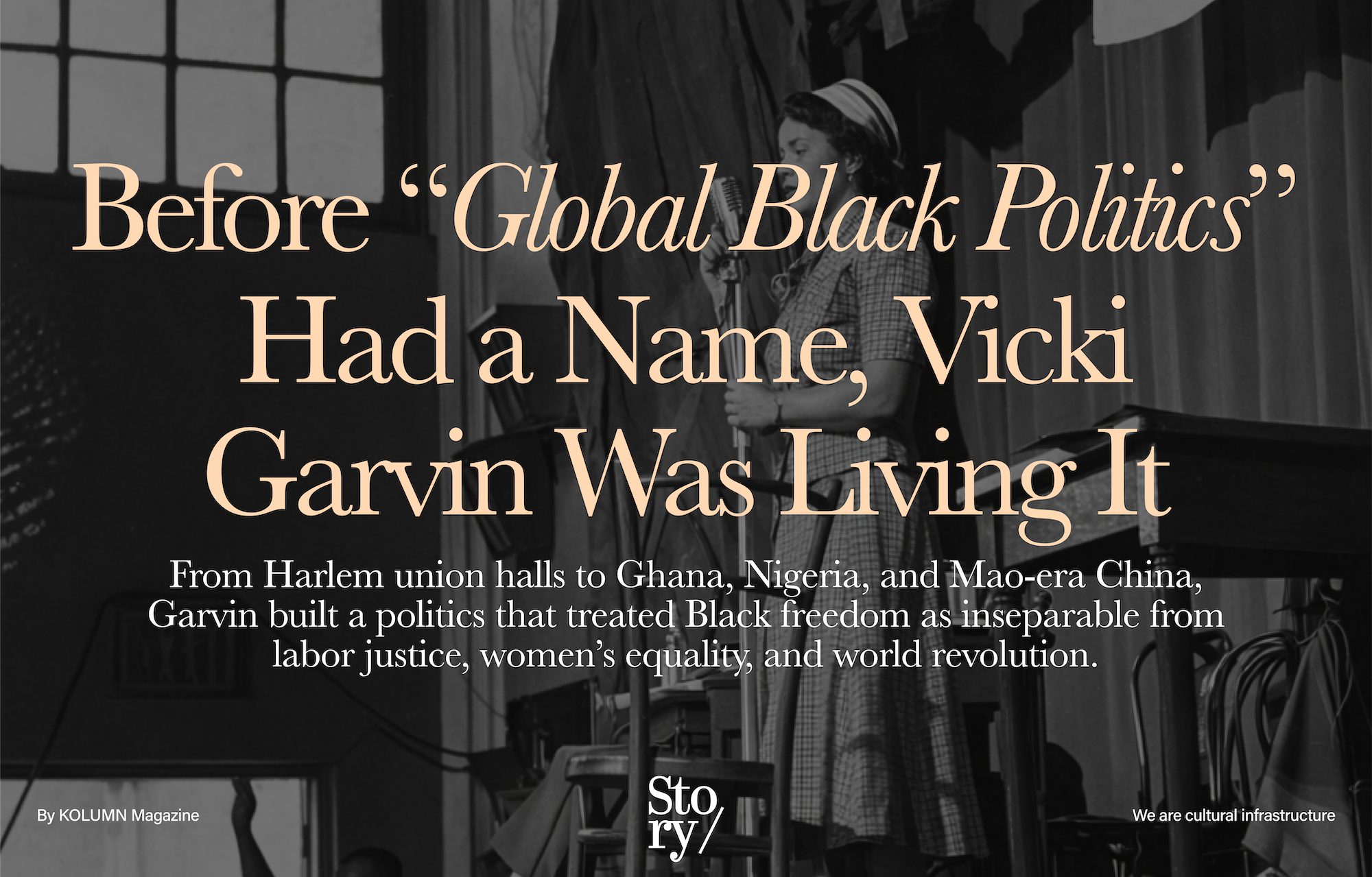
Vicki Garvin did not think the Black freedom struggle stopped at the water’s edge. She treated Harlem, Accra, and Shanghai as connected political classrooms.
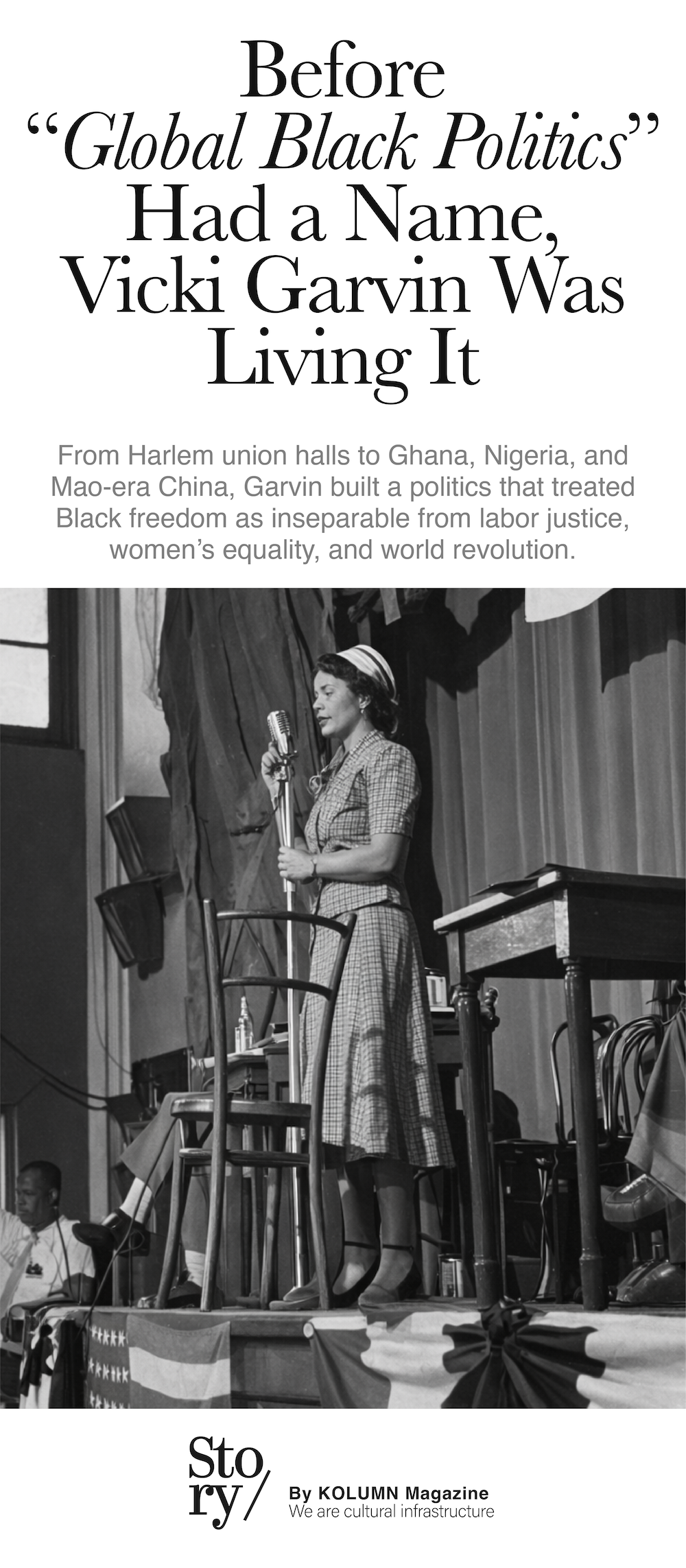
Vicki Garvin did not think the Black freedom struggle stopped at the water’s edge. She treated Harlem, Accra, and Shanghai as connected political classrooms.
By KOLUMN Magazine
Vicki Garvin was a trade union organizer, a Black radical intellectual, a Pan-Africanist, an internationalist, a mentor to younger militants, and an organizer whose political life stretched from Harlem labor struggles to Ghanaian independence-era networks to classrooms in Shanghai. The official record now describes her in sweeping but accurate terms: the New York Public Library archives identify her as a trade union leader, Black radical intellectual, Pan-Africanist, and activist, while other archival descriptions emphasize how her papers document work across labor organizing, international travel, and political education.
Yet Garvin is still not a household name in the way Malcolm X, Ella Baker, Fannie Lou Hamer, Angela Davis, or even some lesser strategists of the Black freedom struggle have become. Part of that is because she lived in places where mainstream historical narratives do not always know what to do with her. She belonged to the Black Left during the Cold War, worked inside and around Communist circles, criticized racism within the labor movement, moved through decolonizing Africa, and then spent years in the People’s Republic of China. That combination has never fit neatly into the civics-class version of American dissent.
Garvin’s significance lies not just in what she did, though what she did was formidable. It lies in the conceptual bridge she represented. She understood race and class as intertwined rather than competing explanations. She treated Black workers as central political actors, not a constituency to be spoken for by others. She believed women’s equality was not a side issue but a measure of whether a political movement was actually serious. And she treated U.S. racism, African decolonization, and global anti-imperial struggle as parts of the same historical crisis. In that sense, Garvin was not simply participating in twentieth-century radical politics. She was helping define its most expansive vocabulary.
To write about Vicki Garvin now is to recover more than a biography. It is to recover a method: the idea that serious political analysis has to move from the job site to the neighborhood, from the nation to the world, and from rhetoric to organization. In an age when internationalism is often reduced to branding and solidarity is too often a mood rather than a structure, Garvin’s life feels not old but unnervingly current.
A childhood shaped by migration, scarcity, and political sight
Vicki Garvin was born Victoria Holmes in Richmond, Virginia, on December 18, 1915, and came of age in a Black family whose move north was shaped by the same forces that shaped so many Black lives in the early twentieth century: racial exclusion, economic vulnerability, and the belief that migration might open up a narrower but still real field of possibility. Her family settled in Harlem during the Depression years. According to the National Museum of African American History and Culture, her political consciousness was deeply influenced by watching her parents face employment discrimination and by the poverty her family endured.
That detail matters because Garvin’s politics never came from abstraction alone. Before she was a theorist of labor, she was a daughter watching labor markets sort Black people into humiliation. Before she was an internationalist, she was a Harlem girl learning that race and class were not separate subjects. Those early encounters with discriminatory work structures seem to have provided the throughline for the rest of her life. Even when she later moved through Marxist analysis, union organizing, Pan-Africanism, and Chinese revolutionary discourse, she kept coming back to the fact that ordinary Black workers were being exploited not in theory, but in wages, hiring, housing, and dignity.
She attended Wadleigh High School for Girls and, according to memorial and biographical accounts, became active early, including the creation of Black history clubs and support for campaigns around better employment for Black residents in Harlem. She later earned a degree in political science from Hunter College and then became the first African American woman to earn a master’s degree in economics from Smith College, where exposure to Marxist economics sharpened the analytical tools she would use for the rest of her political life. Those educational milestones were not just impressive individual achievements; they gave Garvin a language to explain the injustice she had already witnessed up close.
There is a temptation, when writing about figures like Garvin, to narrate education as uplift: the bright young woman leaves poverty behind and ascends through learning. But that is not really her story. Education did not distance her from working-class struggle. It radicalized her understanding of it. She did not become less grounded in Harlem as she entered elite academic spaces. She became more equipped to diagnose what Harlem had taught her.
Labor was not a side issue. It was the issue.
Garvin’s political adulthood took shape through labor organizing. During World War II she worked at the National War Labor Board, and accounts of her life note that she organized an in-house union there and served as its president. She later became national research director for the United Office and Professional Workers of America, a left-led Congress of Industrial Organizations union. These were not glamorous roles, and that is part of the point. Garvin’s politics were built in the mundane but decisive machinery of organizing: research, worker education, grievances, institutional pressure, coalition-making.
In postwar America, Black workers faced a double enclosure. They were shut out by employers and frequently marginalized within labor institutions that claimed to represent the working class as a whole. The AAIHS account of the National Negro Labor Council makes clear how urgent that crisis was. The NNLC emerged from a 1950 Chicago conference and sought to build an independent national structure able to mobilize the “strength of Negro workers” against Jim Crow employment practices, inequality, and exclusion from skilled labor. Black women, including Vicki Garvin, held leadership roles in the organization and were publicly recognized for asserting the centrality of Black women workers to the movement.
That organizational context is essential to understanding Garvin. She was not merely “in labor.” She belonged to a tradition of Black labor radicalism that insisted civil rights without economic power would be partial, brittle, and easily absorbed. The NNLC organized around jobs, fair employment, training, and apprenticeship access. It did not wait for elite institutions to deliver equality from above. It treated Black workers themselves as the base from which a broader freedom politics could emerge.
Garvin rose to become vice president of the NNLC and executive secretary of its New York chapter. That placement tells you something about her abilities. The organization was national in ambition, local in practice, and constantly under siege. To hold leadership there required intellectual range, tactical discipline, and a willingness to confront both external reaction and internal sexism. Even sympathetic histories of mid-century labor often understate how hard Black women had to push to be heard inside movements that celebrated justice while reproducing hierarchy. Garvin not only endured that contradiction; she organized through it.
The NNLC years also reveal Garvin at her clearest analytical edge. She understood that anti-Black racism was not simply a moral failure. It was built into the distribution of jobs, training, union access, and public legitimacy. That is why her political imagination stayed material. Housing mattered. Wages mattered. Hiring mattered. Skill pathways mattered. In that sense, she belongs in the same conversation as A. Philip Randolph, Claudia Jones, and later Black workers’ movements that refused to separate racial justice from economic structure.
McCarthyism came for Garvin because it recognized the threat
If Garvin never became a mainstream American heroine, one major reason is that Cold War repression was designed to make organizers like her politically radioactive. The same qualities that made her formidable—her Marxist analysis, her labor leadership, her Black radical commitments, her refusal to shrink her politics to fit the national mood—also made her a target.
The NNLC drew scrutiny precisely because it was effective, outspoken, and connected to Communists and fellow travelers during a period when Black radicalism was increasingly criminalized through anticommunism. The AAIHS history of the council describes how the House Un-American Activities Committee and conservative labor leaders worked, in effect, to cripple it. By the mid-1950s, the organization was forced to dissolve under pressure. Garvin herself was called before HUAC in 1953, and biographical accounts note that the harassment narrowed her employment options and burdened both her politics and personal life.
That episode should not be treated as biographical background noise. It is central to Garvin’s significance. McCarthyism did not merely punish individual radicals; it narrowed the acceptable script of Black politics in the United States. It made it easier for liberal America to celebrate racial progress when detached from critiques of capitalism, imperialism, and global power. Garvin was among those who refused that narrowing. The cost was steep. The NNLC collapsed. Garvin left the Communist Party in 1957. But there is a difference between political defeat and political erasure, and the latter is what much of mainstream memory imposed on this generation of Black radicals.
In a strange way, the repression confirms the seriousness of what Garvin and her comrades were building. States do not mobilize hearings, blacklists, and stigma against people they consider harmless. Garvin represented the possibility of a Black politics rooted in workers, alive to women’s leadership, hostile to colonialism, and unafraid of systemic critique. That combination threatened not only the Right, but also more respectable Black leadership structures that wanted recognition without radical transformation.
Malcolm X did not emerge in isolation, and Garvin was part of why
One of the most striking parts of Garvin’s historical footprint is her relationship to Malcolm X. In recent years, scholarship and public history have become more attentive to the Black women who helped shape his political development, and Garvin is consistently named among them. The Smithsonian’s National Museum of African American History and Culture notes that Garvin met Malcolm when he was working as a bartender in Harlem and maintained an ongoing conversation with him about revolution, politics, and economics from the 1940s to December 1964. She saw leadership potential in him, invited him to meetings and lectures, and even tried, unsuccessfully, to recruit him into the Communist Party.
That relationship deserves more than anecdotal treatment. Too often Malcolm is remembered as if he developed through dramatic self-transformation alone: prison, Nation of Islam, pilgrimage, break, martyrdom. But radical thinkers are also made in conversation. Garvin mattered because she was one of the people who widened Malcolm’s political frame. She offered him exposure to left analysis, internationalist thinking, and the idea that Black struggle in the United States could be understood in relation to labor, anti-colonialism, and world revolution. Time’s account of Malcolm’s women mentors similarly places Garvin among the Black women radicals who helped refine his views on Black radicalism and internationalism.
None of this means Garvin “made” Malcolm X. History is rarely that tidy, and serious writing should resist it. But it does mean that the familiar story of male charismatic leadership is incomplete without the women intellectuals and organizers around him. Garvin’s importance here is twofold. She helped shape one of the century’s defining Black political voices, and her role exposes how often women’s labor in movement formation goes uncredited unless someone deliberately goes back and looks for it.
There is also an irony in the fact that Garvin tried to recruit Malcolm into the Communist Party and failed. In one sense, that is just a detail. In another, it captures Garvin’s whole posture toward politics: she was always organizing, always reading potential, always trying to move people from emotion to structure. She recognized that anger, by itself, was not enough. It had to be organized into analysis, institution, and strategy.
Africa was not an exile from politics. It was an expansion of it.
After the collapse of the NNLC and the constrictions of McCarthy-era America, Garvin moved into a wider Black world. In 1960 she went to Nigeria, newly independent and full of the contradictions of postcolonial nationhood. Biographical accounts describe her growing disillusionment there with the realities of neocolonialism, a reminder that formal independence did not automatically produce economic justice or social transformation. By 1963 she had moved to Accra, Ghana, then under Kwame Nkrumah and functioning as a magnet for Black internationalists, exiles, artists, and political dreamers.
Accra in those years was more than a city. It was a laboratory. Garvin was part of a network that included Maya Angelou, Julian Mayfield, W.E.B. Du Bois, Shirley Graham Du Bois, Ollie Harrington, and others who understood Africa not as a symbolic ancestral backdrop but as an active site of political reorientation. It was in Ghana that Garvin’s Pan-Africanism and anti-imperialism were further sharpened, not because Africa gave her politics for the first time, but because it enlarged the scale at which she could think and act.
This is also where Garvin again intersects with Malcolm X’s story. When Malcolm visited Ghana in 1964, Garvin was part of the committee that received him and helped shape his itinerary. By then, the conversations that had begun in Harlem had moved onto a continental stage. Here was Garvin, a veteran of Black labor radicalism in New York, now helping guide one of America’s most important Black political figures through a transnational anti-colonial environment. That alone should make clear that she was not a peripheral actor in Black internationalist history. She was one of its connective tissues.
What Africa offered Garvin was not romantic escape. It offered proof that empire, race, labor, and sovereignty were globally entangled. It also exposed the limits of nationalist triumphalism. Nigeria’s independence did not end inequality. Ghana’s revolutionary promise would soon face violent reversal. Garvin’s significance lies partly in the fact that she kept learning politically rather than protecting a fixed ideology from reality. She was radical, but not simplistic.
China made Garvin legible as a transnational educator
In 1964, Garvin moved to the People’s Republic of China and began teaching at the Shanghai Foreign Languages Institute. The American Historical Association abstract on her later career describes her as a union organizer who, seeking more effective ways to fight poverty and discrimination, went to China and worked there until 1970. It notes that she lectured not only on English but also on American history, the civil rights movement, and women’s equality. A dissertation on the Black radical imagination in China further describes how she incorporated Maoist political ideas into her teaching and tried to connect language instruction to ideological struggle.
This part of Garvin’s life can be easy to flatten into Cold War spectacle. Black American radical goes to Maoist China. But the deeper story is richer. Garvin became, in effect, a translator across political worlds. She brought African American history into a Chinese classroom. She created or helped create coursework on Black American history and used her own movement experience as material. She was not just an expatriate observer; she was participating in how Black struggle in the United States would be interpreted abroad.
That role matters because the 1960s were a period when African American freedom struggles had global symbolic force. China, like many postcolonial and revolutionary states, read U.S. racial conflict as evidence of American hypocrisy and as proof that anti-imperial struggle had no clean national boundaries. Garvin stood inside that exchange. She was part teacher, part political witness, part ideological courier. Her life in Shanghai underscores that Black radical history cannot be properly told inside U.S. borders alone.
The dissertation evidence also shows Garvin as something more complicated than a mere traveler enthralled by revolution from afar. She studied Mao’s teachings, aligned herself with aspects of Chinese political discourse, remained in China during the Cultural Revolution when many foreign instructors left, and later taught workers and technicians bound for African countries. She eventually worked with Peking Review. That record suggests deep commitment, but it also opens interpretive questions about what she saw, what she idealized, and what she perhaps bracketed. Any fair assessment of Garvin has to allow that Black radicals of her generation sometimes invested revolutionary hopes in states and projects whose realities were more contradictory than their promises.
That does not diminish her importance. It makes her more historically real. Garvin was not an icon cut from moral certainty. She was an organizer searching for viable structures of liberation in a century full of betrayal, compromise, and state violence. Her turn toward China was part of that search.
Gender was not incidental to Garvin’s politics
One of the most important—and still insufficiently appreciated—dimensions of Garvin’s life is the way she linked women’s equality to broader liberation movements. The available record does not present her as a single-issue feminist in the narrow contemporary sense, nor as someone who treated gender as a detachable lane. Instead, it shows her moving through labor, Black liberation, and anti-imperial politics while insisting that women’s standing inside those movements mattered.
The AHA abstract notes that in China she lectured on women’s fight for equality. Later biographical accounts of her return to the United States place her in the National Black United Front’s Women’s Committee and at the 1985 United Nations World Conference on Women in Kenya. Other accounts emphasize that she remained active in formations such as Sisters Against South African Apartheid and Black Workers for Justice. In other words, even in her later years, Garvin was still working at the junction of race, labor, global politics, and women’s organizing.
This is where Garvin becomes especially useful to contemporary readers, because she scrambles a lot of lazy assumptions. She was not a labor person who ignored gender. She was not an internationalist who skipped local organizing. She was not a Black nationalist who had no use for class analysis. She was not a Marxist who dismissed race as secondary. She moved through all those terrains, imperfectly but deliberately, trying to force each one to account for the others.
Her significance, then, is not just that she “did many things.” It is that she refused segmentation. That refusal now reads as strikingly modern, though it was hard-won and often underrecognized in her own time. Garvin understood what many institutions still struggle to grasp: oppression is coordinated, so liberation has to be coordinated too.
Returning home without retiring from the fight
Garvin returned to the United States in 1970, settling first in Newark with Leibel Bergman, whom she had married in China. She lectured widely on China, worked in community health and civic organizations, and later edited New China, a magazine associated with U.S.-China friendship work. She eventually spent time in Chicago, mentoring younger radicals, before returning to New York, where she became active in the National Black United Front and remained involved in anti-apartheid, labor, and Black radical formations into the 1980s and 1990s.
What is striking about this period is the continuity. Garvin did not come back from Africa and China to become a museum piece of earlier militancy. She kept working. She adapted to different political generations, new organizations, and shifting debates. That matters because some activists are best understood as belonging to a moment. Garvin belonged to a tradition. Traditions survive by being transmitted, revised, argued over, and handed off. Garvin seems to have been good at handoff. Biographical descriptions repeatedly frame her as a mentor to younger activists and as a strategist able to navigate ideological differences.
The New York Public Library’s archival holdings reinforce that sense of breadth. Her papers span decades and include material related to labor, speeches, international correspondence, teaching, political organizations, and recorded media. That paper trail is not just evidence of a busy life. It is evidence of a political mind working across forms: speeches, organizing, travel, pedagogy, debate. Garvin was not only present in movements; she was documenting, interpreting, and helping shape them.
She died in New York City on June 11, 2007, at age 91. Memorial accounts described her as a freedom fighter who remained committed to justice until the end of her life. That longevity matters. Garvin’s career stretched from Depression-era Harlem through World War II labor activism, McCarthyism, African decolonization, Mao-era China, Black Power, anti-apartheid activism, and later Black radical formations. She was not just a witness to the twentieth century’s major Black political transformations. She carried threads between them.
Why Vicki Garvin matters now
There is always a risk, in recovery writing, of making the forgotten figure stand in for every virtue the present supposedly lacks. Garvin deserves better than that kind of sentimental rescue. She was not important because she can be used to flatter contemporary politics. She was important because she forces a more accurate and more demanding map of Black political history.
First, she reminds us that Black freedom struggle has always been international, not merely in symbolism but in organization, travel, exchange, and analysis. Long before “global” became an academic brand, Garvin was living a politics that linked Harlem to Accra and Shanghai.
Second, she restores labor to the center of Black political life. The mainstream public memory of the civil rights era still often privileges access, law, and moral appeal over the grind of worker organizing and economic power. Garvin’s life says that was never enough. Jobs, unions, training, and class structure were not background conditions. They were the terrain of the struggle itself.
Third, she complicates the gendered storytelling of movement history. Garvin was not only a participant. She was a theorist, recruiter, strategist, teacher, and mentor. Her role in Malcolm X’s development is a useful corrective here, but not the whole story. She matters not because she influenced a famous man. She matters because she had a major political life of her own.
Fourth, she helps explain how anticommunism distorted American memory. When certain political vocabularies are declared illegitimate, the people who speak them most fluently often get written out, even if they were indispensable in their time. Garvin’s relative obscurity is not accidental. It is one of the afterlives of the Cold War.
And finally, Garvin matters because she modeled political seriousness. She read. She organized. She taught. She crossed borders, but not superficially. She revised her views in contact with history. She understood institutions. She believed ideas had to become structure. That kind of seriousness is rare in any era. In ours, it can feel almost radical in itself.
The fuller map
Maybe the cleanest way to understand Vicki Garvin is this: she belonged to the part of Black political history that refused to accept the borders others drew. Not the border between race and class. Not the border between national and international struggle. Not the border between labor and feminism. Not the border between thought and action.
That refusal is why she can seem difficult to place in conventional narratives. But difficulty, here, is a sign of value. Garvin’s life asks us to expand the map rather than trim the evidence to fit it. It asks us to remember that Harlem union politics could connect to anti-colonial Africa, that Black women radicals were not assistants to history but authors of it, and that some of the most important figures in a movement are the ones who keep its ideas moving across people, organizations, and continents.
If Vicki Garvin has not been fully canonized, that says something about canon-making. It often favors the dramatic over the organizational, the singular over the connective, the domestically legible over the transnational, the charismatic over the strategic. Garvin was strategic. She was connective. She made politics travel. And because she did, she helped shape a broader Black radical tradition than many Americans have been taught to see.
Her life leaves behind a challenge as much as a legacy. Are we willing to tell the story of Black freedom in a way that is as large, material, female-led, labor-conscious, and internationalist as the struggle itself actually was? Vicki Garvin’s life suggests that until we do, we will keep mistaking partial history for the whole thing.
More great stories
Afro Sheen, Wall Street, and the Architecture of Black Possibility
July 6, 2026
No Comments
The Fire Inside the Fourth
July 5, 2026
No Comments