



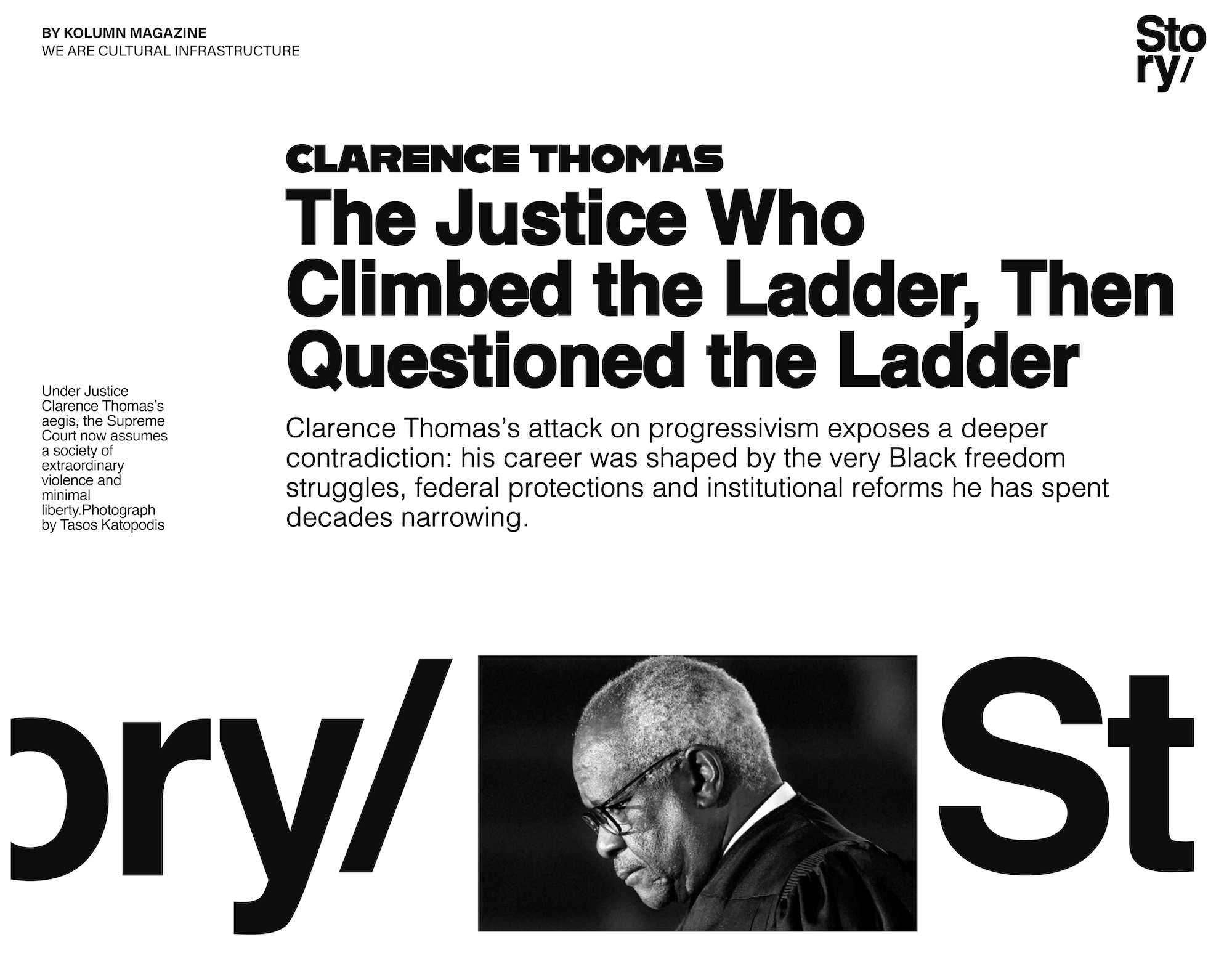
Clarence Thomas did not rise in spite of the civil-rights revolution. He rose through a world remade by it.
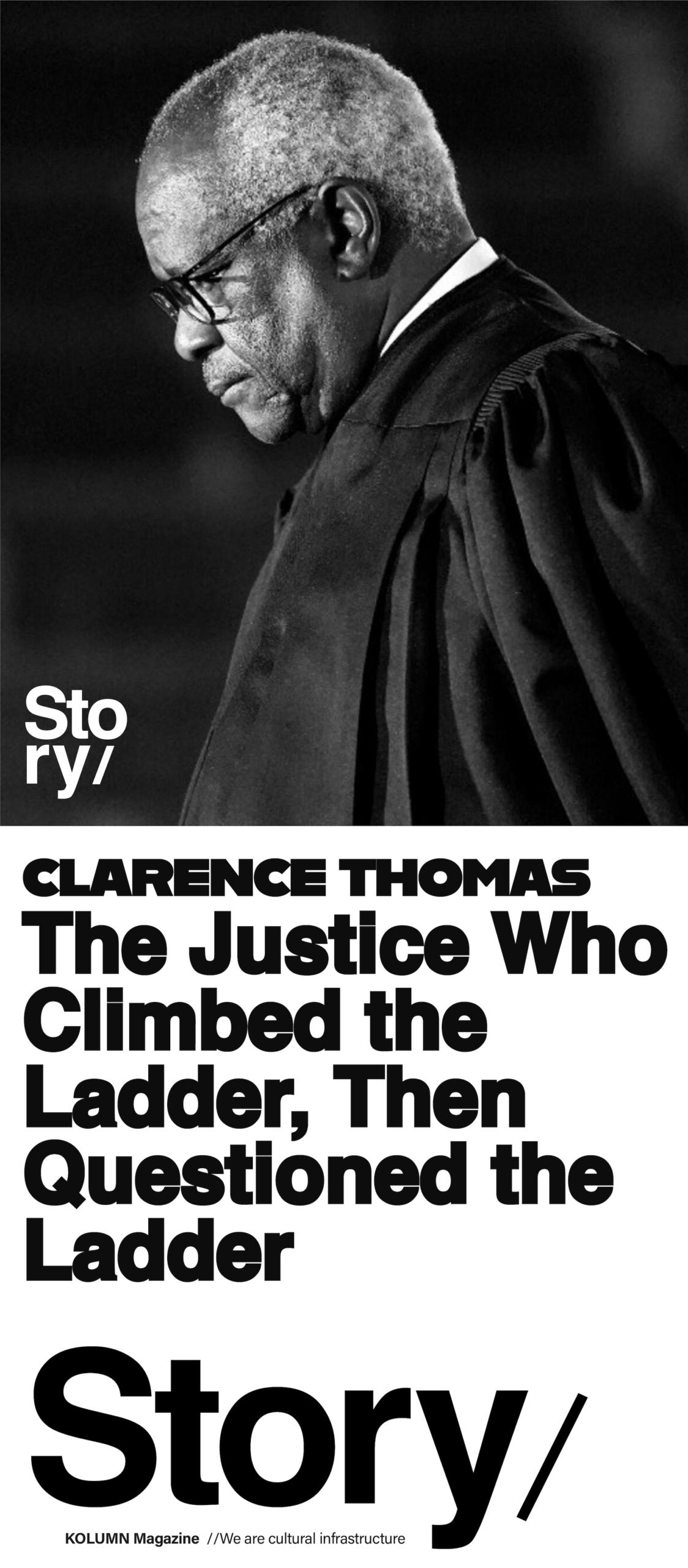
Clarence Thomas did not rise in spite of the civil-rights revolution. He rose through a world remade by it.
By KOLUMN Magazine
On April 15, 2026, Justice Clarence Thomas stood at the University of Texas at Austin and delivered a lecture commemorating the 250th anniversary of the Declaration of Independence. The setting was formal, the occasion patriotic, the language grave. Thomas warned that the principles of the founding had “fallen out of favor,” and he praised UT’s School of Civic Leadership for seeking to revive “Western civilization and the American constitutional tradition,” according to the university’s own account of the lecture in UT Austin News. In the published text of the address, Thomas framed progressivism not as a contested American reform tradition but as a fundamental assault on the Declaration’s premise of natural rights, writing that progressivism “seeks to replace the basic premises of the Declaration of Independence,” in remarks later posted by Civitas Outlook.
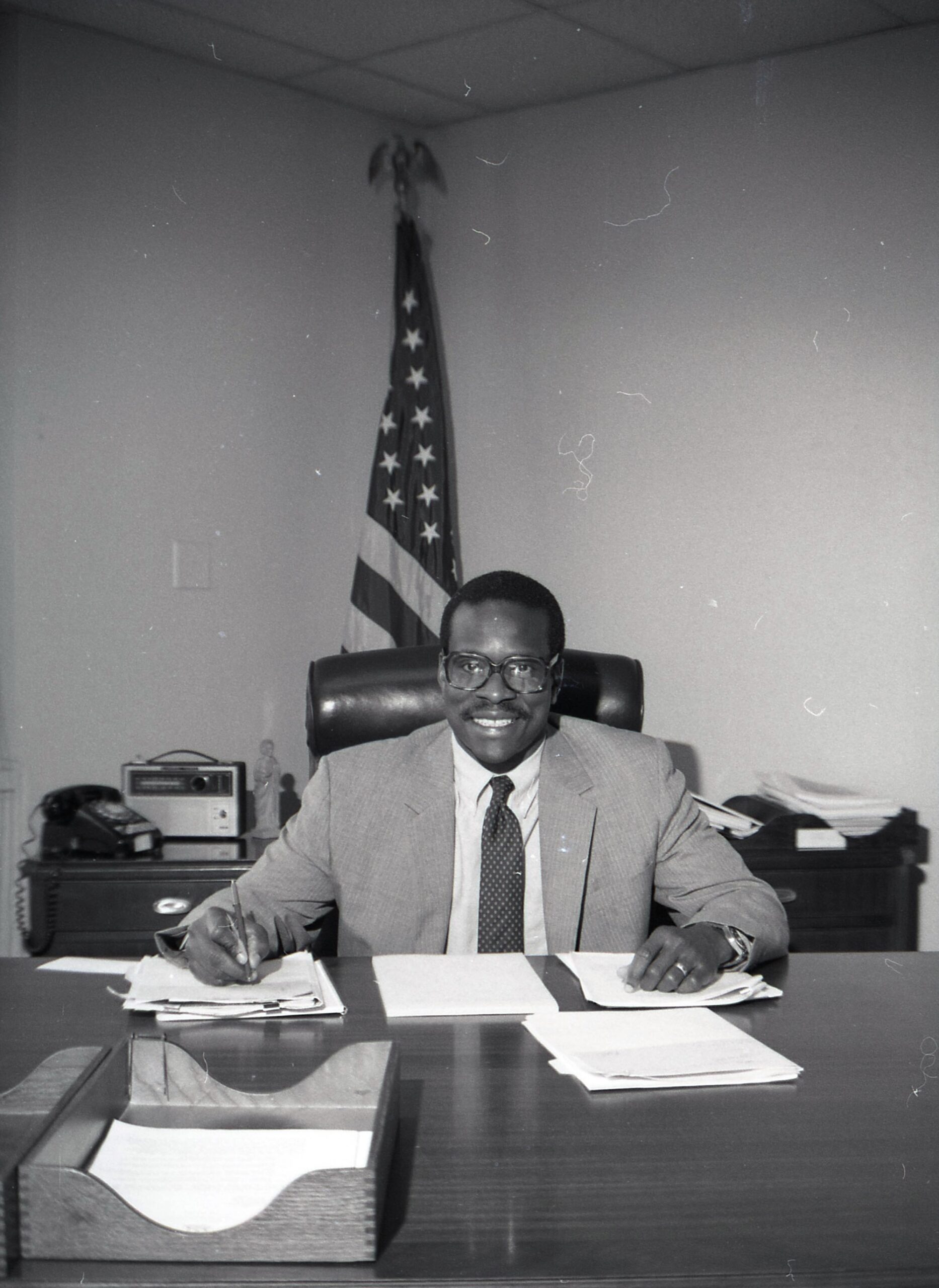
It was vintage Thomas: austere, sweeping, defiantly countermajoritarian. He did not merely criticize modern liberalism. He indicted an entire lineage of American reform. The problem is that Thomas’s own life sits inside that lineage. His rise—from Pin Point, Georgia, to Holy Cross, Yale Law School, the Equal Employment Opportunity Commission and the Supreme Court—was not made possible by a static constitutional order. It was made possible by a country forced, through protest and law, to expand the meaning of citizenship.
Thomas has every right to reject progressivism as a political philosophy. But the sharper question is historical: What does it mean for a justice to denounce the very tradition of reform, federal enforcement and institutional correction that made his own career imaginable?
That contradiction is not incidental. It is the throughline.
The Speech as Indictment
Thomas’s April address treated progressivism as a rupture in the American project. In his telling, the founding rested on fixed truths: rights came from God, not government; government existed to secure those rights, not redefine them. Progressivism, he argued, inverted that premise. It made rights contingent, elastic, administrative, dependent on experts and state power. Conservative outlets quickly celebrated the speech as a warning against the modern left; The Heritage Foundation called it a “clarion call,” while C-SPAN archived the address as part of the national debate over the Declaration’s anniversary.
But Thomas’s argument depends on a strategic narrowing of progressivism. It treats the term as if it belongs only to Woodrow Wilson, bureaucratic rule and elite disdain for ordinary citizens. That is one version of the story, and not a false one in every respect. Progressivism has always contained contradictions. Early twentieth-century reformers fought monopolies, expanded democratic participation and pursued social welfare, even as many tolerated or advanced racism, imperialism and eugenics. The Progressive Era was not uniformly emancipatory.
Yet American progressivism also produced a broader reform vocabulary: the belief that democracy must be made real through law, policy, public pressure and institutional change. Britannica describes progressivism as a reform movement that brought major changes to American politics and government in the early twentieth century, while the Center for American Progress’s historical overview frames it as a tradition aimed at “more equal and just social conditions” consistent with democratic ideals in The Progressive Intellectual Tradition in America.
That distinction matters. Thomas attacks progressivism as though reform itself were the enemy of liberty. But for Black Americans, the status quo was rarely liberty. The status quo was slavery, then Black Codes, then Jim Crow, then redlining, exclusion, disfranchisement, police terror and school segregation. Progress, in the Black freedom tradition, was not an abstraction. It was the difference between being counted and being erased.
The Civil-Rights Revolution Was a Progressive Reconstruction
The civil-rights movement was not merely a moral awakening. It was a structural intervention. It demanded that the federal government do what states had refused to do: protect Black citizenship against local tyranny. The Library of Congress describes the movement as a nationwide struggle against segregation and exclusion, one that relied on sit-ins, boycotts, marches, Freedom Rides and lobbying for legislative action. That combination—grassroots pressure plus federal remedy—is the architecture of American progressivism at its most consequential.
The Civil Rights Act of 1964, the Voting Rights Act of 1965 and the Fair Housing Act of 1968 did not simply recognize rights that already existed in practice. They forced the country to build enforcement machinery around rights that white supremacy had nullified. The National Archives notes that the Voting Rights Act was passed 95 years after the Fifteenth Amendment, after Black voters in the South had faced poll taxes, literacy tests, intimidation, economic retaliation and violence. The NAACP Legal Defense Fund calls the VRA one of the civil-rights movement’s most significant achievements because it ended discriminatory practices and established preclearance requirements that blocked voting discrimination before it could take effect.
That was progressivism in practice: not utopian theory, but federal power deployed against racial caste.
This is where Thomas’s critique becomes historically evasive. If rights are natural but unenforced, they are promises without infrastructure. Black Americans did not lack eloquent founding language. They lacked institutions willing to make that language binding. The civil-rights era did not betray the Declaration. It forced the nation to take the Declaration seriously.
KOLUMN Magazine has returned to this point repeatedly in its coverage of Black political struggle. In “Black Vote Dilution at an Industrial Scale”, the magazine noted that modern Supreme Court doctrine has narrowed the practical force of one of the country’s most important civil-rights statutes. In “The New Jim Crow Lines”, KOLUMN traced how the Voting Rights Act gave Congress and the courts tools to challenge maps that diluted Black political power. And in “Frederick D. Reese and the Grammar of Freedom”, the magazine framed Selma not as a sentimental memory but as an organized campaign that pushed the federal government toward action.
Thomas’s speech asks listeners to fear reform. Black history asks a harder question: What happens when reform never comes?
The Beneficiary Who Became the Prosecutor
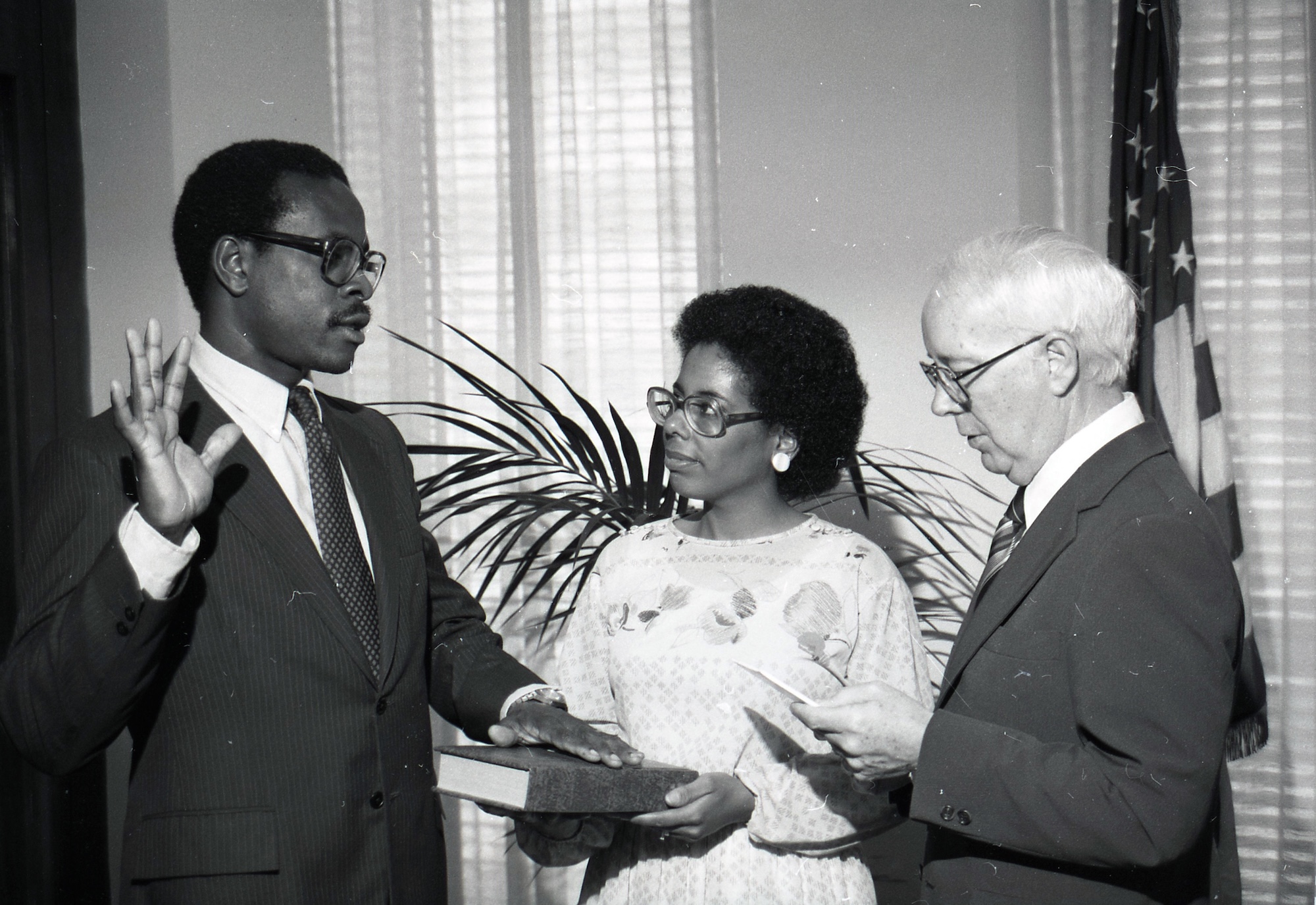
Clarence Thomas was born in 1948 in Pin Point, Georgia, and raised in the segregated South. His biography is inseparable from the world civil-rights activism changed. The Supreme Court’s own biographical page states that Thomas graduated from the College of the Holy Cross in 1971 and Yale Law School in 1974 before entering public service and eventually joining the Court in 1991 through Oyez and Justia. PBS’s Frontline has reported that Thomas arrived at Yale Law School as one of a small number of Black students during an era when elite institutions were actively trying to respond to racial exclusion through admissions reform in Clarence Thomas’ Long Battle Against Affirmative Action.
Thomas later came to resent affirmative action, arguing that it stigmatized Black achievement and allowed white institutions to question whether Black students truly belonged. That wound is real. It is also revealing. Thomas interpreted the insult as proof that the remedy was corrupt, rather than proof that racism had adapted to the remedy. He did not conclude that elite legal employers were wrong to diminish Black credentials. He concluded that race-conscious reform had made the credentials suspect.
There is a human tragedy in that conclusion. But there is also a political project.
Over decades, Thomas has become one of the Court’s most forceful opponents of race-conscious remedies. In Adarand Constructors v. Peña, he wrote that there was “moral and constitutional equivalence” between laws designed to subjugate a race and laws designed to foster equality through racial classifications, an opinion available through Justia. In Students for Fair Admissions v. Harvard, Thomas joined the majority striking down race-conscious admissions and wrote separately to denounce affirmative action, in a decision published by the Supreme Court.
That is the contradiction sharpened to a blade: Thomas benefited from a world in which institutions were pressured to open doors previously closed to Black students, then used his authority to restrict the tools that opened them.
Historiography Against Amnesia
The best civil-rights historiography resists the tidy story Thomas prefers. The movement was not a plea for colorblindness in the abstract. It was a demand for power, protection and material change. Historians such as Jacquelyn Dowd Hall have argued for a “long civil rights movement,” one that stretches beyond the familiar 1954-to-1968 frame and links legal equality to labor, housing, education and economic justice. The Journal of African American History has published debates over that “long movement” framework, underscoring how scholars continue to contest the movement’s chronology, geography and political meaning.
That historiographical debate matters because Thomas’s speech performs a kind of narrowing. It separates founding ideals from the social movements that forced those ideals into public life. It separates rights from remedies. It separates liberty from the people who had to bleed for it.
Black progressivism, in particular, complicates Thomas’s caricature. A Yale Law Journal essay on Black progressivism traces reformist critiques by figures such as T. Thomas Fortune, Ida B. Wells and the Niagara Movement, showing that Black intellectuals developed a democratic critique of Jim Crow and economic exploitation even as the Supreme Court moved in a more restrictive direction. That tradition did not worship the state. It understood that private power, local custom and state violence could be just as oppressive as federal bureaucracy.
Ida B. Wells did not need a lecture on natural rights. She needed a government willing to confront lynching. Black sharecroppers did not need abstract equality. They needed protection from debt peonage, terror and disenfranchisement. Students in Little Rock did not need a civics seminar about liberty. They needed federal troops because Arkansas officials defied Brown v. Board of Education. KOLUMN’s “The Price of a Desk” captured that truth bluntly: Little Rock was a contest between federal authority and state defiance, and a reminder that the Court can declare while the executive must enforce.
Thomas’s account of progressivism leaves little room for that history because that history exposes the weakness of his premise. Rights do not enforce themselves. Power yields nothing because parchment asks politely.
The Court That Narrows the Movement’s Gains
Thomas’s jurisprudence has not been limited to affirmative action. He has also joined or authored opinions narrowing civil-rights enforcement, voting protections and democratic accountability. The most consequential example remains Shelby County v. Holder, the 2013 decision that invalidated the Voting Rights Act’s coverage formula and effectively disabled the preclearance regime that had required certain jurisdictions with histories of discrimination to obtain federal approval before changing voting rules. The Brennan Center for Justice describes the Voting Rights Act as one of the most successful civil-rights measures in American history while noting that the Supreme Court has weakened it.
Thomas went even further than the Shelby County majority. He had previously called for striking down Section 5’s preclearance requirement and maintained that position. His constitutional vision is consistent, but consistency does not absolve consequence. The effect has been to weaken one of the central achievements of the civil-rights movement.
This is the terrain KOLUMN has covered in its recent voting-rights work. “Black Vote Dilution at an Industrial Scale” treated vote dilution not as a technical redistricting dispute but as a modern continuation of the struggle over Black political power. That framing is essential. The civil-rights movement did not end because Congress passed a statute. It entered a new phase: litigation, redistricting, judicial interpretation, state resistance, federal retreat.
Thomas’s April speech presents progressivism as the danger. But for many Black voters, the danger has been the dismantling of progressive enforcement.
The Elite Critic of Elites
There is another contradiction in Thomas’s posture: his long war against elites has unfolded from inside one of the most elite institutions in American life. He is a Supreme Court justice with life tenure, immense power and minimal democratic accountability. His speeches often warn against experts, bureaucrats and cultural arbiters. Yet he exercises authority in a system where nine unelected lawyers can override Congress, states, universities and voters.
That tension has grown sharper amid ethics controversies. ProPublica reported in 2023 that Thomas accepted luxury travel from billionaire Harlan Crow over many years without disclosing many of the trips in Clarence Thomas Secretly Accepted Luxury Trips From GOP Donor. CREW later filed complaints seeking investigation into Thomas’s failure to disclose gifts and property transactions with Crow in CREW files civil and criminal complaint against Clarence Thomas and called for scrutiny of Thomas’s recusals related to the 2020 election and January 6 in Thomas must recuse, Supreme Court needs Code of Conduct.
Thomas has denied wrongdoing and has said he believed certain hospitality did not require disclosure. That defense deserves to be stated. But the broader optics are unavoidable: a justice who warns against elite control has benefited from proximity to billionaire patronage while wielding power over the legal architecture of American democracy.
That does not make every Thomas opinion corrupt. It does make his rhetoric harder to separate from the institutional reality around him. When he condemns progressivism as rule by elites, he speaks from a Court whose conservative supermajority has repeatedly limited the power of elected branches to regulate guns, voting, abortion, administrative agencies and campaign finance. The result is not less elite power. It is elite power relocated—from public institutions to courts, donors, corporations and private networks.
What Thomas Gets Right, and What He Erases
A fair reading should concede one point: Thomas is right that progressivism has a troubled history. Woodrow Wilson’s racism was not incidental. Many early progressives embraced paternalism, segregation, eugenics or imperial hierarchy. Black historians have long understood that reform movements can reproduce domination even while promising uplift. The Progressive Era did not save Black America from Jim Crow; in many places, it coexisted with it.
But Thomas does not stop at critique. He collapses the entire reform tradition into its worst expressions. That is not historical analysis. It is ideological selection.
The Black freedom struggle was itself a progressive force, even when its leaders did not always use that label. It sought to expand democracy, regulate abusive power, secure labor rights, protect voting access, desegregate schools, open housing markets and force public institutions to recognize Black humanity. The House of Representatives history office notes that civil-rights activists pressured Congress to pass legislation addressing racial inequality, aided by Black lawmakers who helped carry movement demands into federal law.
That was not tyranny. That was democracy correcting itself.
Thomas’s version of natural-rights constitutionalism often treats government action as suspect when it tries to remedy racial inequality, but the civil-rights record shows that government inaction was itself a choice—a choice that protected segregationists, employers, registrars, sheriffs, school boards and landlords. Neutrality in an unequal system does not produce freedom. It preserves hierarchy.
The Personal Wound as Public Philosophy
Thomas’s defenders often argue that his views are not hypocritical because he has openly explained his resentment of affirmative action. They say his experience at Yale convinced him that race-conscious admissions harmed Black students by branding them as inferior. That is not a frivolous claim. Stigma is real, and Thomas lived it.
But hypocrisy does not require secret motives. It can arise when a public figure universalizes a personal wound into doctrine while ignoring the broader system that produced the wound. Thomas’s humiliation at Yale was not caused simply by affirmative action. It was caused by racism’s refusal to credit Black excellence unless white institutions could imagine it as charity.
The remedy may have been imperfect. The exclusion it confronted was worse.
This is where Thomas’s story becomes emblematic of a larger conservative move: convert the pain of racism into an argument against racial remedy. The white employer doubts your credentials; blame affirmative action. The elite institution treats you as symbolic; blame diversity. The law school opens its doors late and awkwardly; blame the opening, not the decades of closure.
That move is politically powerful because it carries the authority of lived experience. Thomas is not an outsider to Black struggle. He is a product of it, a witness to it, and in his youth, by many accounts, a man enraged by racial injustice. But lived experience is not self-interpreting. It can become solidarity, or it can become grievance. In Thomas’s hands, it became constitutional suspicion toward the very remedies that helped build the post-Jim Crow order.
The Long Shadow of Thurgood Marshall
The symbolism of Thomas’s seat cannot be avoided. He succeeded Thurgood Marshall, the NAACP Legal Defense Fund lawyer who helped dismantle legal segregation and became the first Black justice on the Supreme Court. Marshall’s career embodied the progressive legal tradition Thomas now rejects: strategic litigation, federal enforcement, institutional reform and the belief that constitutional meaning grows more honest when excluded people force themselves into its interpretation.
The contrast is almost too stark. Marshall used the Court to pry open American democracy. Thomas has used his seat to insist that many of those crowbars were constitutionally suspect.
That does not mean Thomas had an obligation to imitate Marshall. Black justices are not required to share a politics. But succession carries historical meaning. Thomas inherited a seat made possible by the civil-rights revolution, then became one of the leading judicial voices against race-conscious efforts to repair the inequities that revolution exposed.
The irony is not that Thomas is conservative. The irony is that his conservatism depends on a historical forgetting so profound that it turns the machinery of Black advancement into a constitutional threat.
Progressivism as Black Survival
Progressivism, at its best, is not simply a left-wing brand. It is a theory of unfinished democracy. It asks whether the country’s institutions are producing the liberty they proclaim. For Black Americans, that question has never been academic.
When Black teachers in the South organized citizenship schools, they were practicing progressivism. When voting-rights workers challenged literacy tests, they were practicing progressivism. When parents sued school boards, when workers demanded fair employment, when lawyers attacked exclusionary housing, when students sat down at lunch counters, they were insisting that America change because America’s existing arrangements were unjust.
The civil-rights era did not merely benefit Clarence Thomas as an individual. It changed the conditions under which a Black child from coastal Georgia could imagine elite education, federal office and judicial authority. It changed the institutions that later evaluated him, hired him, promoted him and confirmed him. It did not eliminate racism; Thomas’s own life proves that. But it altered the field on which racism operated.
To denounce progressivism without acknowledging that debt is not merely ideological. It is historical malpractice.
The Final Contradiction
Clarence Thomas’s April 2026 speech will likely be remembered by conservatives as a bold defense of the founding and by liberals as another provocation from a justice who has moved the Court sharply rightward. But the deeper story is not partisan theater. It is the unresolved conflict between memory and power.
Thomas is correct that rights cannot depend solely on government generosity. Black history agrees. Rights must be deeper than political fashion. But Black history also teaches that rights without enforcement are fragile, and that appeals to “freedom” have often been used by those resisting Black equality. Jefferson Cowie’s Pulitzer-winning Freedom’s Dominion explores how white resistance to federal power repeatedly invoked liberty while defending racial hierarchy, a theme summarized by Basic Books.
That is the contradiction Thomas refuses to face. The civil-rights movement did not abandon America’s founding promises. It rescued them from the people who had monopolized their meaning.
At UT Austin, Thomas warned that progressivism threatens the Declaration. But the Black freedom struggle—the struggle that made his own ascent possible—was built on the conviction that America’s founding words were not self-executing. They needed marchers. They needed lawyers. They needed federal registrars. They needed legislation. They needed courts willing to confront power rather than sanctify it.
Thomas climbed through the America they made. Then he turned and told the country to fear the making.
That is more than contradiction. It is the central hypocrisy of his public life.
More great stories
Afro Sheen, Wall Street, and the Architecture of Black Possibility
July 6, 2026
No Comments
The Fire Inside the Fourth
July 5, 2026
No Comments