

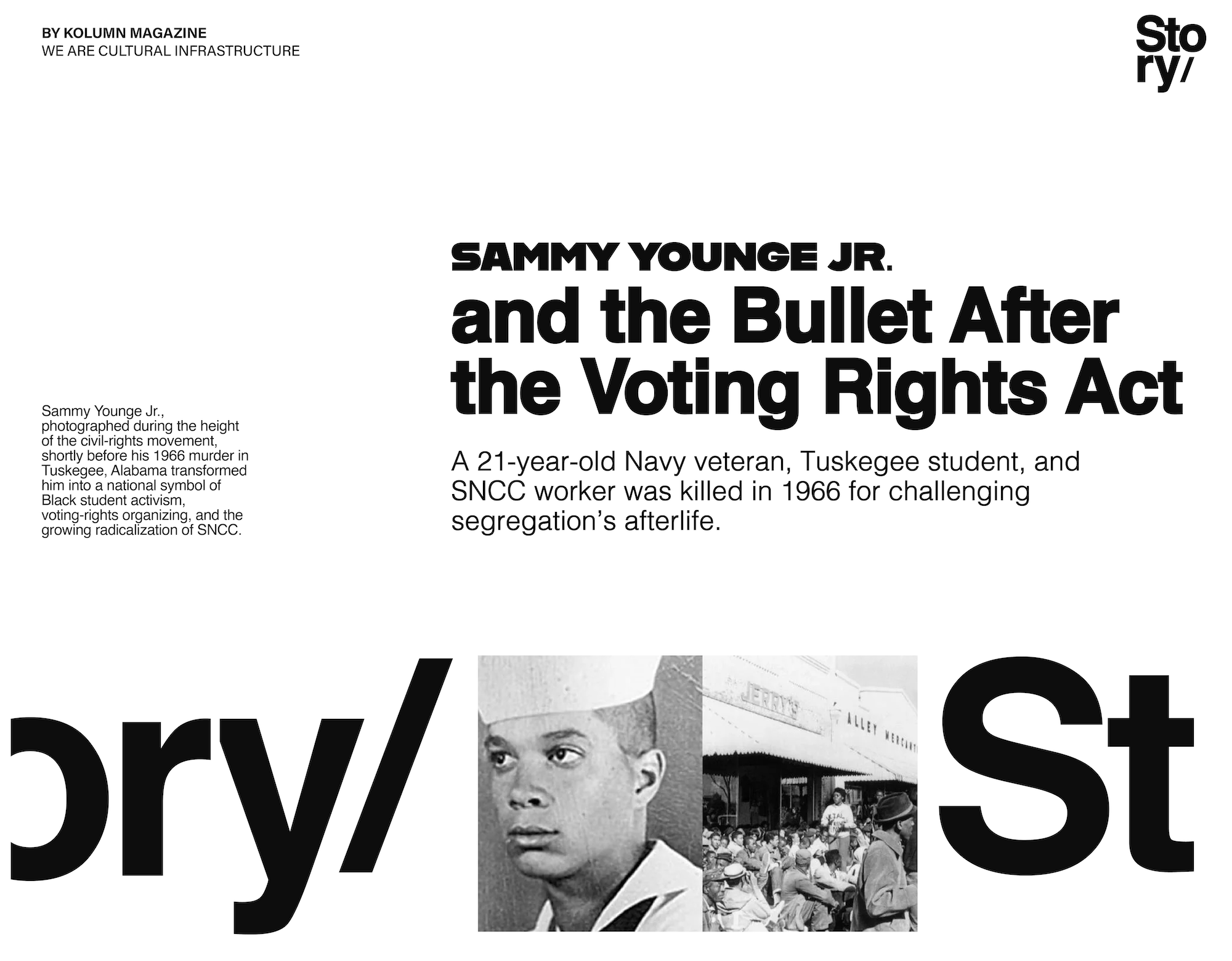
Sammy Younge Jr. was killed after the great civil-rights laws had passed, which is precisely why his death matters.
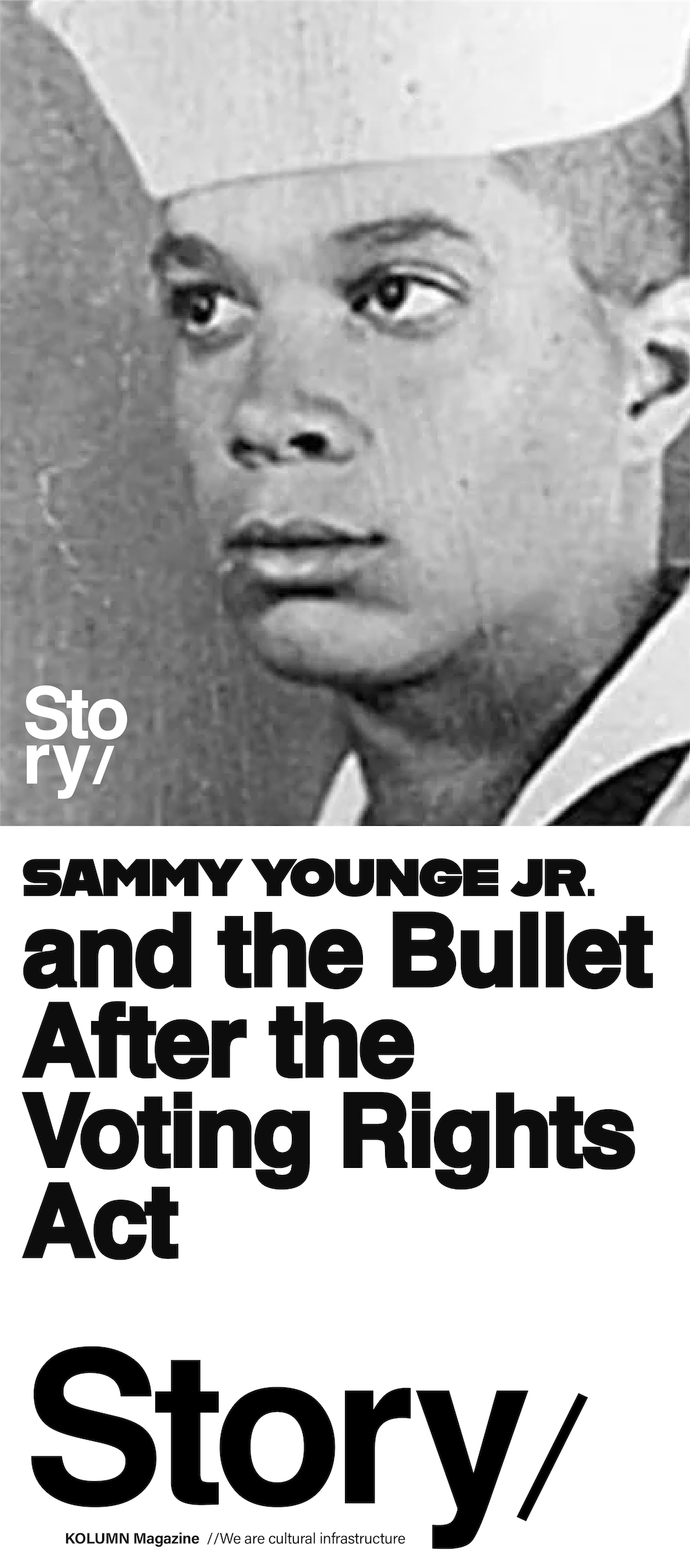
Sammy Younge Jr. was killed after the great civil-rights laws had passed, which is precisely why his death matters.
By KOLUMN Magazine
In the official American memory of the civil-rights movement, 1965 often arrives as a triumphant year. Selma. The Edmund Pettus Bridge. The Voting Rights Act. Lyndon Johnson before Congress declaring, in the borrowed cadence of the movement itself, “We shall overcome.” The story is usually told as if the nation crossed a moral threshold and kept walking forward.
Then came January 3, 1966.
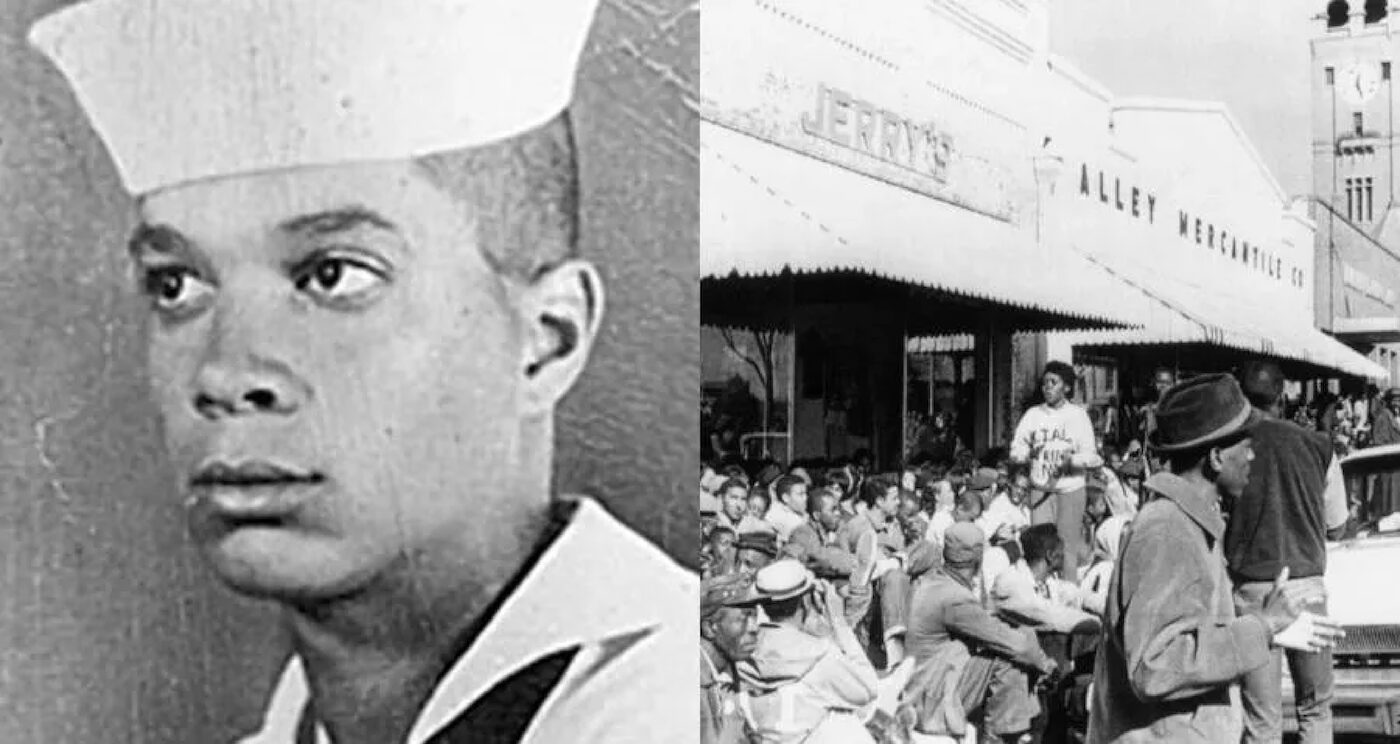
That night, Samuel Leamon “Sammy” Younge Jr., a 21-year-old Navy veteran, Tuskegee Institute student, and civil-rights organizer, entered a Standard Oil gas station in Tuskegee, Alabama, and challenged the racial order where it still lived most intimately: at the door of a public restroom. According to accounts preserved by the SNCC Digital Gateway, Younge tried to use the “white” restroom near the town’s bus station. The white attendant, Marvin Segrest, shot him. The Equal Justice Initiative notes that Younge had spent that day registering Black voters in Macon County before stopping at the station.
Younge’s killing exposed the difference between law and power. The Civil Rights Act of 1964 had outlawed segregation in public accommodations. The Voting Rights Act of 1965 had targeted the machinery of disfranchisement. But in Tuskegee, as in much of the South, white authority still controlled the restroom key, the courthouse corridor, the jury box, the gun, and the story told afterward.
The Encyclopedia of Alabama identifies Younge as the first African American student activist killed during the civil-rights movement. His death became a turning point not only because he was young, not only because he was a veteran, and not only because Tuskegee was supposed to symbolize Black achievement. It became a turning point because it forced SNCC—the Student Nonviolent Coordinating Committee—to say aloud what many organizers already knew: American democracy was demanding Black loyalty while refusing Black protection.
Three days later, SNCC issued its historic statement opposing the Vietnam War, linking Younge’s murder in Alabama to U.S. violence abroad. As the SNCC Digital Gateway records, the organization argued that the murder of Samuel Younge in Tuskegee was not morally separate from the killing of Vietnamese civilians. This was not rhetorical excess. It was political diagnosis.
Tuskegee’s Son
Sammy Younge Jr. was born in Tuskegee on November 17, 1944, into a Black community defined by accomplishment and contradiction. Tuskegee was home to Tuskegee Institute, the intellectual inheritance of Booker T. Washington and generations of Black educators, scientists, veterans, nurses, and organizers. It was also in Macon County, Alabama, where Black majorities lived under systems designed to neutralize their political power.
Younge’s biography reads like a compressed map of mid-century Black aspiration. He attended Tuskegee Institute High School, joined the United States Navy after graduating in 1962, and was medically discharged in 1964 after serious illness. The BlackPast profile notes that he later enrolled at Tuskegee Institute as a political science student. He was not simply drifting into protest. He was moving through the institutions Black America had built to train disciplined citizens for a country that kept denying their citizenship.
At Tuskegee, Younge joined the Tuskegee Institute Advancement League, a student civil-rights organization connected to SNCC. The Encyclopedia of Alabama describes his work across Alabama and Mississippi, including voter-registration activity and direct-action campaigns against segregation. He participated in the Selma-to-Montgomery movement, worked with organizers in Mississippi, and helped press Tuskegee’s own businesses and institutions to comply with the law.
That last detail matters. The civil-rights movement was never only a campaign against sheriffs with bullwhips and governors at schoolhouse doors. It was also a fight over lunch counters, job counters, church pews, hospital wards, courthouse lines, and bathrooms. Younge belonged to the generation that came of age after Brown v. Board of Education but before the country had absorbed what Brown actually required. They had been promised a new nation. They found the old one waiting behind every “white” sign.
The Violence After Victory
The killing of Sammy Younge Jr. came after the movement’s most celebrated legislative victories. That timing is the core of his historical significance. It disrupts the clean civic myth that law automatically transforms life.
The Washington Post has described 1966 as the year that opened with Younge’s death and moved toward the public emergence of Black Power. That sequence is essential. Younge’s death did not create the movement’s shift toward militancy, internationalism, and self-defense; those currents were already present. But his killing gave them fresh evidence.
In the aftermath, thousands marched in Tuskegee. SNCC workers, students, local residents, and national allies understood the meaning of the killing immediately. A Black veteran could serve the United States military, return home, register voters, attend one of the most important Black institutions in the country, and still be killed for refusing to accept the architecture of Jim Crow.
The Department of Justice’s cold-case closing memorandum states that Younge was fatally shot at approximately 11:55 p.m. after an argument over restroom use. The memo also reflects the limits and frustrations of later federal review: by the time the case was reexamined, witnesses had died, the shooter had died, and the state prosecution had long ended in acquittal.
That acquittal was its own verdict on Alabama justice. Segrest was tried and found not guilty by an all-white jury. The trial’s result confirmed what Black communities had known for generations: racial violence did not end at the trigger. It continued through police discretion, prosecutorial choices, jury selection, courtroom narration, and the presumption that white fear could justify Black death.
SNCC’s Moral Break
Younge’s death helped push SNCC into one of the most consequential public positions taken by any major civil-rights organization during the 1960s: opposition to the Vietnam War.
The SNCC statement was radical because it refused to separate domestic racism from foreign policy. It argued that the U.S. government could not credibly claim to defend freedom in Vietnam while failing to enforce freedom in Alabama. This was a profound shift in civil-rights rhetoric. It moved beyond appeals to American conscience and toward an indictment of American power.
That internationalist turn had deep roots. Black activists had long connected Jim Crow to colonialism, segregation to empire, and racial capitalism at home to military violence abroad. But SNCC’s statement after Younge’s murder made that connection in the voice of young organizers who were no longer willing to protect the image of the United States for the sake of political respectability.
KOLUMN readers will recognize this as part of a broader editorial thread: the freedom struggle was not a parade of isolated heroes, but an ecosystem of organizers, strategists, witnesses, and local institutions. KOLUMN’s recent profile of James Forman placed SNCC’s internal radicalism in precisely this context, while its essay on Black Power traced how the language of power emerged from the limits of symbolic integration.
Sammy Younge Jr. belongs in that same frame. His life was brief, but the politics around his death were expansive. They touched voting rights, campus activism, antiwar dissent, Black self-defense, local organizing, and the historiography of the movement itself.
How Historians Remember Him
The historiography of Sammy Younge Jr. is also a study in how civil-rights memory gets organized. Some lives become national shorthand. Others remain embedded in movement archives, local commemorations, scholarly footnotes, and the memories of comrades.
James Forman’s 1968 book, Sammy Younge Jr.: The First Black College Student to Die in the Black Liberation Movement, helped establish Younge’s death as more than a local tragedy. The WorldCat record summarizes the book as a work built from interviews with Younge’s family, friends, and fellow SNCC workers. Forman’s framing mattered: he placed Younge not simply in the “civil-rights movement,” but in the Black liberation movement. That phrase widened the lens from legal equality to power, self-determination, and structural transformation.
Later historians of SNCC and Black Power have treated Younge’s killing as one of the hinge events of 1966. The Civil Rights Movement Veterans archive preserves memorial material and movement recollections that keep his story close to those who lived the work. The PBS FRONTLINE Un(re)solved project places him among the unresolved and contested cases of racial violence that still haunt the legal record.
The most careful reading of Younge’s significance must hold two truths together. First, his death was an individual human loss: a son, student, veteran, friend, and organizer was killed at 21. Second, his death became a political event because it revealed the anatomy of white supremacy after reform. The laws had changed. The danger had not.
The Local Meaning of a National Crime
Tuskegee was not just any Southern town. Its Black institutions made it symbolically powerful. Its racial order made it politically volatile. The murder of a Tuskegee student activist punctured the idea that Black achievement could insulate Black people from racial violence.
That is part of why Younge’s story still carries such force. He was not killed in some remote corner of the South outside the gaze of Black institutional life. He was killed in the shadow of Tuskegee, a place associated with Black education, military service, medical history, and civic ambition. His death said that even the most storied Black spaces existed inside a larger regime of coercion.
The SNCC Legacy Project recently revisited Younge’s killing through the memory of Wendell Paris, whose life of activism was shaped by the murder. Paris’s interpretation is especially important: he has argued that Younge was killed not merely because of a restroom dispute, but because of his effectiveness as a voter-registration worker. That is an expert movement voice, not a detached academic abstraction. It reminds us that white resistance often attached itself to immediate incidents while responding to deeper threats.
The restroom confrontation was the surface. Black political power was the substance.
What Sammy Younge Jr. Still Asks
To write about Sammy Younge Jr. today is to resist the temptation to make him only a martyr. Martyrdom can honor the dead, but it can also flatten them. Younge was not born to symbolize a movement’s unfinished business. He became a symbol because a society made his ordinary demand—the right to use a public restroom—into a capital offense.
His life asks sharper questions than commemoration usually allows. What does citizenship mean when a veteran can be killed for asserting it? What is the value of civil-rights law when local power refuses enforcement? What happens when Black students conclude that appeals to conscience are not enough? What does a nation reveal when it asks young Black men to fight abroad while leaving them unprotected at home?
Those questions did not die in Tuskegee.
They echo in every debate over public space, policing, voting access, historical memory, and state violence. They echo whenever America celebrates civil-rights victories while minimizing the backlash that followed them. They echo whenever the movement is remembered as a morality play rather than a struggle over power.
Sammy Younge Jr. lived only 21 years. But his death forced a generation of organizers to say what polite America did not want to hear: the problem was not simply segregation’s signs. The problem was the system willing to kill to keep those signs meaningful.
That is why his story belongs near the center of the civil-rights canon. Not as an emblem of despair, but as evidence. Not as a minor tragedy after the movement’s “victories,” but as proof that those victories were never self-enforcing.
The bathroom was never just a bathroom. It was a border. Sammy Younge Jr. crossed it. America answered with a bullet.
More great stories
Afro Sheen, Wall Street, and the Architecture of Black Possibility
July 6, 2026
No Comments
The Fire Inside the Fourth
July 5, 2026
No Comments