




The Court did not repeal the Voting Rights Act. It changed the terrain beneath it.
The Court did not repeal the Voting Rights Act. It changed the terrain beneath it.
By KOLUMN Magazine
The Supreme Court’s decision in Louisiana v. Callais did not arrive like a singular constitutional earthquake. It arrived more like permission.
Within days of the ruling, Republican lawmakers and allied legal strategists across the South began discussing congressional maps that, only a few years earlier, would likely have faced immediate Section 2 challenges under the Voting Rights Act. The atmosphere surrounding redistricting changed almost overnight. What had previously been treated as legally dangerous — dismantling or weakening majority-Black districts — suddenly became politically imaginable.
The ruling, issued on April 29, 2026, held that Louisiana’s congressional map containing a second majority-Black district constituted an unconstitutional racial gerrymander because the state lacked a sufficiently compelling reason to prioritize race in drawing the district, according to the Supreme Court opinion published by the Legal Information Institute at Cornell Law School. Though the Court did not formally invalidate Section 2 of the Voting Rights Act, critics argued that the decision substantially narrowed the practical force of one of the country’s most important civil-rights statutes.
For voting-rights advocates, the concern was immediate and existential: if states could now argue that race-conscious remedies themselves violated the Constitution, then what remained of the federal protections designed to stop racial vote dilution in the first place?
The implications extended far beyond Louisiana. In Tennessee, lawmakers quickly advanced proposals that could divide Memphis’s majority-Black congressional district among several Republican-leaning districts. In Florida, Governor Ron DeSantis approved new congressional maps critics argued weakened Black political influence across multiple regions of the state. Similar conversations began surfacing in Alabama, Georgia, Texas, and North Carolina as conservative legal organizations signaled that Callais had created a new constitutional pathway for challenging race-conscious districts.
The broader message was unmistakable: the legal risk surrounding racial vote dilution had changed.
For nearly sixty years, the Voting Rights Act functioned as one of the federal government’s clearest acknowledgments that formal access to the ballot alone was insufficient if electoral systems were designed to dilute Black political power. The law emerged from a brutal history of racial exclusion that included literacy tests, poll taxes, intimidation campaigns, violence, grandfather clauses, and district systems specifically engineered to weaken Black electoral influence.
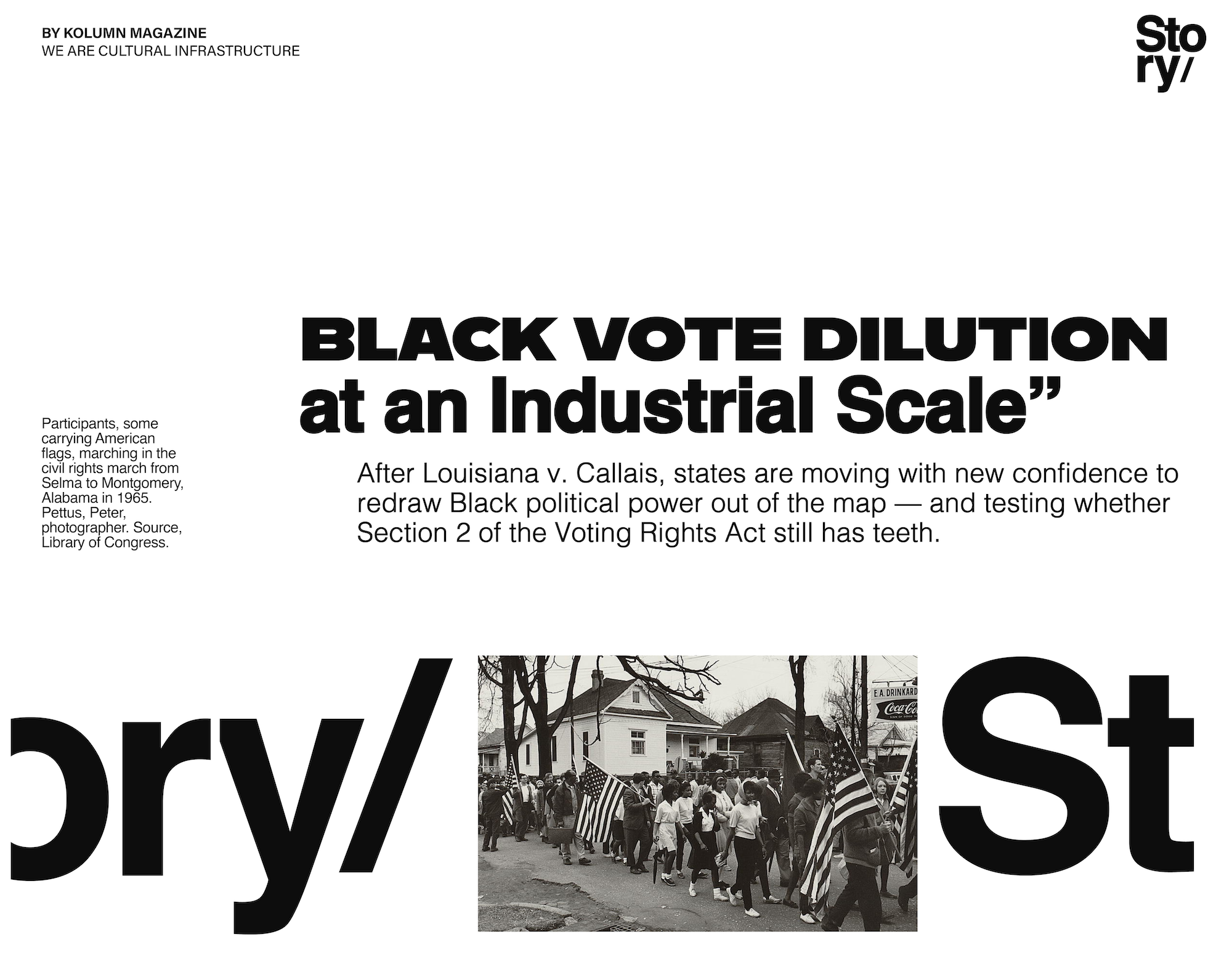
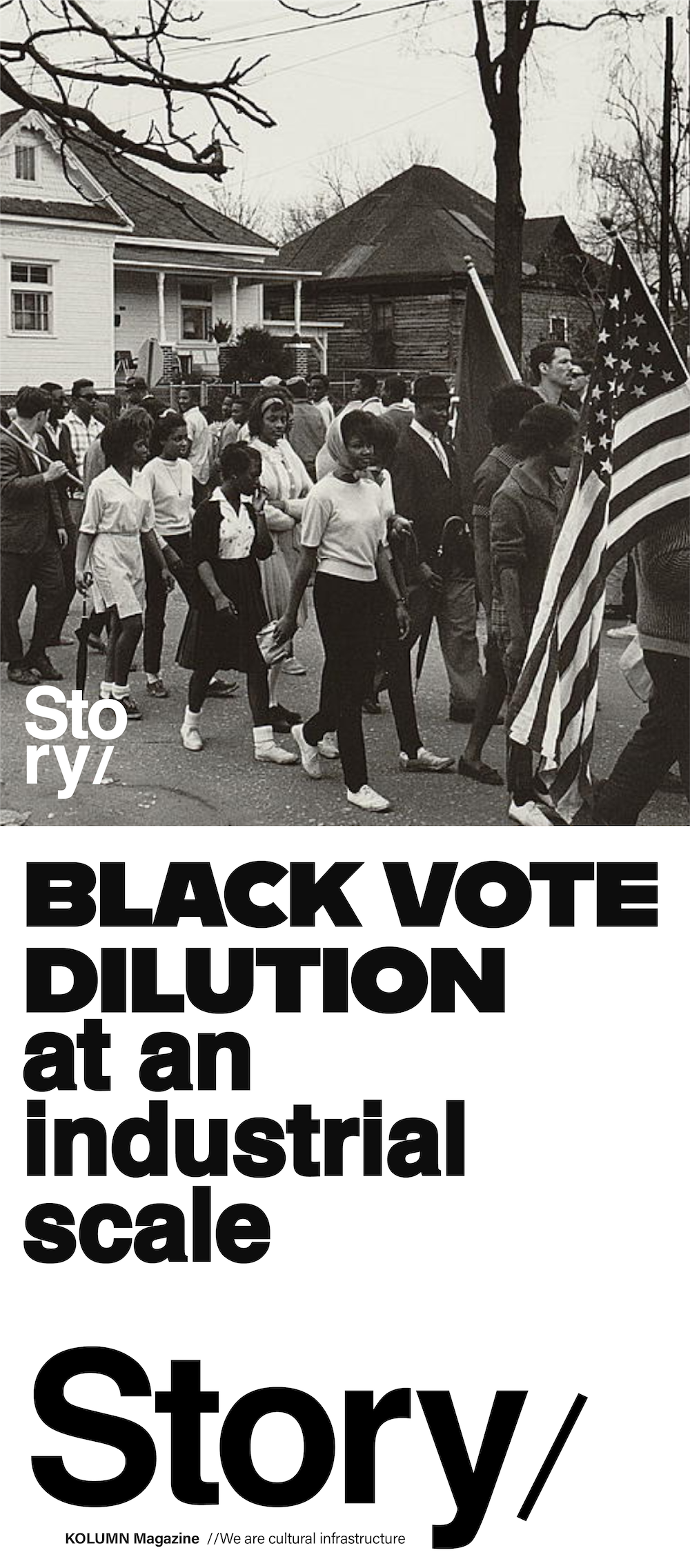
The Department of Justice’s historical overview of federal voting-rights laws notes that Congress passed the Voting Rights Act in 1965 because piecemeal litigation had repeatedly failed to stop discriminatory voting practices from simply reappearing in altered forms. President Lyndon Johnson signed the law on August 6, 1965, months after the violence inflicted upon voting-rights marchers crossing Selma’s Edmund Pettus Bridge horrified the nation.
But the Voting Rights Act was never static. Its strength evolved through amendments, litigation, and judicial interpretation.
In 1982, Congress amended Section 2 specifically to reject a narrow standard requiring plaintiffs to prove explicit racist intent. Instead, lawmakers adopted a “results test,” allowing courts to examine whether election systems produced unequal political opportunity for minority voters regardless of whether lawmakers openly admitted discriminatory motives, according to the Department of Justice. That framework became the backbone of modern vote-dilution litigation.
Four years later, the Supreme Court’s decision in Thornburg v. Gingles established the central framework for evaluating racial vote dilution claims, recognizing that racially polarized voting patterns could systematically prevent Black voters from electing their preferred candidates, even when Black citizens technically retained access to the ballot, according to the Court opinion archived by Justia.
For decades afterward, Section 2 litigation repeatedly blocked or reshaped maps courts determined unlawfully diluted Black voting strength.
Federal courts rejected Texas redistricting plans multiple times over the last twenty years, including findings that lawmakers intentionally discriminated against minority voters in congressional and legislative maps, according to reporting from the Brennan Center for Justice. North Carolina’s congressional maps were repeatedly struck down by federal courts that found lawmakers relied excessively on race in district construction while simultaneously diminishing Black electoral influence, according to coverage from the New York Times. In Alabama, the Supreme Court itself ruled in Allen v. Milligan that the state’s congressional map likely violated Section 2 because it failed to provide Black voters a fair opportunity to elect representatives of choice despite Black residents constituting more than a quarter of the state’s population, according to the Court opinion published by the Supreme Court of the United States.
For civil-rights organizations, Milligan briefly appeared to reaffirm Section 2’s continuing vitality.
Then came Callais.
Louisiana: The State That Became the Test Case
For civil rights advocates in Louisiana, the Supreme Court’s decision in Louisiana v. Callais felt less like a legal clarification and more like a public declaration that the protections Black voters spent generations securing were now negotiable. The decision transformed Louisiana from a state defending a second majority-Black congressional district into the national proving ground for how quickly legislatures might move once Section 2 protections appeared weakened.
The legal battle itself emerged after the 2020 Census revealed what advocates described as an unavoidable demographic fact: Black residents accounted for roughly one-third of Louisiana’s population, yet the state’s congressional map initially preserved only one majority-Black district out of six. Civil rights groups, including the NAACP Legal Defense Fund, argued in Robinson v. Landry that the map diluted Black voting strength in violation of Section 2 of the Voting Rights Act. Federal courts repeatedly agreed that the plaintiffs were likely to succeed under the traditional Section 2 framework, including rulings documented by the U.S. Court of Appeals for the Fifth Circuit.
But after Callais, the legal ground shifted almost immediately.
Governor Jeff Landry suspended Louisiana’s congressional primary after the Supreme Court ruling, arguing that the state needed time to draw a constitutionally valid map, according to reporting from Reuters. To supporters of the Court’s ruling, the decision restored constitutional limits on race-conscious redistricting. Conservative legal advocates argued that legislatures had increasingly relied on racial classifications to satisfy federal courts and that the Constitution requires districts to be drawn without elevating race above traditional criteria like compactness and political boundaries.
Yet opponents in Louisiana viewed the ruling through the lens of lived history rather than abstract constitutional doctrine.
Representative Troy Carter, one of Louisiana’s Black Democratic members of Congress, warned publicly that the ruling risked turning Black representation into a temporary experiment rather than an enforceable right. Civil rights attorneys similarly noted that the original congressional map had fractured Black population centers stretching from Baton Rouge to Shreveport in ways courts previously viewed as classic vote dilution under Section 2.
For many Black Louisianans, the issue was not merely partisan alignment. It was visibility.
In Baton Rouge, community organizers interviewed by regional outlets described frustration that Black communities could again become bargaining chips in negotiations controlled overwhelmingly by white lawmakers. Black pastors and local activists framed the ruling as part of a longer Southern political tradition in which Black electoral growth is tolerated only until it begins producing durable political influence.
“They tell us race can’t be considered when we ask for representation. But race always seems present when representation is taken away.”
The emotional force of the backlash came from memory as much as policy. Louisiana’s history includes literacy tests, violent voter suppression, racial intimidation, and decades of district maps designed to dilute Black voting blocs. The Department of Justice’s historical summary of federal voting-rights laws explains that Congress enacted the Voting Rights Act precisely because piecemeal litigation repeatedly failed to stop states from replacing one discriminatory voting practice with another.
Local Black voters interviewed in New Orleans and Shreveport repeatedly described a fear that Black political influence would become mathematically visible but electorally meaningless. One recurring concern was that new maps would disperse Black communities across several Republican-leaning districts, reducing the likelihood that Black-preferred candidates could prevail anywhere.
The anticipated impact extends beyond Louisiana’s borders. Reuters reported that Republican-led states viewed the ruling as an opening to revisit multiple districts nationwide that had previously survived Section 2 scrutiny. To opponents, Louisiana was not the endpoint. It was the blueprint.
Tennessee: Memphis and the Geography of Dilution
If Louisiana represented the judicial breakthrough, Tennessee represented the political acceleration.
Within weeks of the Supreme Court’s decision, Tennessee Republicans advanced proposals that would allow lawmakers to redraw the state’s congressional map again before the next census cycle. The focus quickly centered on Memphis, the majority-Black city that anchors Tennessee’s lone Democratic congressional district, according to reporting from the Associated Press.
To supporters of the remapping effort, the proposal reflected ordinary political redistricting. Republican leaders argued that districts should better reflect population growth and political realities across the state. House Speaker Cameron Sexton maintained that lawmakers were considering political data and regional continuity rather than race, as reported by the Associated Press.
But in Memphis, many Black residents heard something different.
For generations, Memphis has functioned as one of the South’s most significant Black political and cultural capitals. It is the city where sanitation workers marched beneath signs declaring “I Am A Man.” It is where Martin Luther King Jr. spent his final days before his assassination in 1968. To many Black Tennesseans, proposals to fracture Memphis politically carried symbolic and historical weight far beyond congressional arithmetic.
Representative Steve Cohen, whose district includes Memphis, argued that the proposed changes would intentionally weaken Black electoral influence under the guise of neutral redistricting. Civil rights groups warned that dividing Memphis among multiple predominantly white and Republican districts would reduce Black voters’ collective ability to elect candidates responsive to their communities.
Martin Luther King III publicly criticized the effort, connecting it directly to the unfinished legacy of the Voting Rights Act in comments reported by the Associated Press. His intervention underscored how the debate had evolved into something larger than state legislative procedure. The fight became a referendum on whether the post-civil-rights framework for Black political representation still possessed enforceable meaning.
Black voters interviewed by Tennessee media outlets and advocacy organizations described deep skepticism toward claims that race was not driving the proposal. Many pointed to the state’s earlier dismantling of Nashville’s congressional district after the 2020 Census, when Republican lawmakers split Democratic voters across several districts in a move critics called overt partisan dilution.
Sekou Franklin, a political scientist affiliated with the Tennessee NAACP, described the proposal as “Black vote dilution at an industrial scale” in comments published by the Associated Press. The phrase resonated because it captured what opponents believed was changing nationally after Callais: the scale and confidence with which states could pursue remapping efforts that once carried far greater legal risk.
“The question in Tennessee is no longer whether Black voting power can be diluted. The question is whether anyone in power still fears the consequences of doing it.”
Community leaders in Memphis also raised concerns about policy consequences. Black voters noted that congressional representation affects federal investment, transportation funding, healthcare access, environmental policy, and education priorities. Dilution, in this sense, was not merely electoral. It threatened to weaken institutional advocacy for predominantly Black communities already facing disparities in wealth, health outcomes, and infrastructure investment.
Opponents repeatedly emphasized that racial polarization in Tennessee voting patterns remains significant. Under the older Section 2 framework established by Thornburg v. Gingles, those patterns mattered because they helped demonstrate how Black voters could be systematically outvoted when dispersed across majority-white districts. Critics of the Supreme Court’s ruling argued that Callais weakened the ability of courts to account for those realities.
Florida: The Post-Section 2 Experiment
Florida entered the post-Callais landscape with an advantage many other Republican-led states lacked: an existing political infrastructure already built around aggressive redistricting fights.
Governor Ron DeSantis had previously pushed through congressional maps that critics argued dismantled a historically Black district in North Florida, triggering years of litigation under the state constitution’s Fair Districts Amendment, according to reporting from The Guardian. But after the Supreme Court’s Louisiana ruling, Florida Republicans appeared increasingly confident that federal racial-gerrymandering challenges would face steeper obstacles.
The new 2026 congressional maps intensified that confidence. Opponents argued the maps strategically weakened Black voting influence in multiple regions, including South Florida and the Tampa Bay corridor, according to the Miami Herald.
To supporters, the maps represented legitimate partisan redistricting and reflected Florida’s Republican electoral dominance. DeSantis allies argued that courts had improperly forced states into race-conscious districting for years and that the Supreme Court’s ruling restored constitutional neutrality.
But Black lawmakers and voting-rights advocates in Florida rejected the premise that race had somehow disappeared from the process.
Representative Maxwell Frost warned that the new maps threatened to reduce the political influence of diverse urban coalitions, particularly Black and Latino voters. Civil rights groups argued that removing Black neighborhoods from historically Black districts weakened community cohesion and diminished electoral accountability.
In Miami-Dade County, Black Caribbean residents voiced concerns that redistricting would fracture communities with shared political interests and distinct cultural identities. Local organizers argued that the impact would extend beyond congressional races into broader questions of policy responsiveness and resource allocation.
Black Floridians opposing the maps frequently referenced the state’s long and contested history with voting rights. Before the Supreme Court’s 2013 decision in Shelby County v. Holder, several Florida counties were covered by the Voting Rights Act’s preclearance provisions because of histories of racial discrimination in voting, according to the Department of Justice. Critics argued that the erosion of federal oversight since Shelby — followed now by the narrowing of Section 2 protections after Callais — created a political environment where aggressive remapping faced fewer meaningful restraints.
“In Florida, opponents see a future where racial vote dilution no longer needs to hide behind coded language. It only needs legal cover.”
For many Black voters, the frustration came from what they viewed as a contradiction embedded in the Court’s modern doctrine. Legislatures could insist they were drawing districts for partisan reasons rather than racial ones, even when race and party overlap heavily because of longstanding political polarization. Critics argued that this distinction allowed states to accomplish racially predictable outcomes while avoiding the constitutional consequences historically attached to racial discrimination.
That concern has become central to the national debate after Callais. Voting-rights advocates increasingly argue that the Supreme Court’s evolving jurisprudence treats racial discrimination as identifiable only when lawmakers explicitly acknowledge it, despite decades of evidence showing that modern vote dilution often operates through formally race-neutral mechanisms.
The Long Retreat From Federal Oversight
To understand why Callais alarmed civil-rights advocates so profoundly, it must be viewed not as an isolated decision but as part of a broader judicial retreat from federal voting-rights enforcement.
The Supreme Court’s 2013 ruling in Shelby County v. Holder invalidated the formula used to determine which jurisdictions required federal preclearance before changing voting laws, effectively disabling one of the Voting Rights Act’s most powerful enforcement mechanisms, according to the Brennan Center for Justice. In the years that followed, states previously subject to preclearance moved aggressively to adopt voter-ID laws, polling-place closures, district changes, and election procedures critics argued disproportionately burdened Black voters.
Section 2 remained one of the few major federal tools left.
That is why opponents of Callais increasingly describe the ruling as potentially transformative. They argue that if Section 2 becomes harder to invoke successfully in redistricting cases, then the federal judiciary may no longer serve as a meaningful barrier against racial vote dilution.
For KOLUMN Magazine, the moment carries echoes of earlier eras chronicled throughout Black political history: Reconstruction governments dismantled through violence and legal retrenchment, Black political gains erased through Jim Crow constitutional conventions, and voting systems redesigned whenever Black enfranchisement threatened entrenched power structures.
The question now is whether America has entered another version of that cycle — one in which Black voting rights remain formally protected in language, while becoming increasingly fragile in practice.
More great stories
Afro Sheen, Wall Street, and the Architecture of Black Possibility
July 6, 2026
No Comments
The Fire Inside the Fourth
July 5, 2026
No Comments