



Rhoden’s career was not hidden because it was minor. It was neglected because the canon was too narrow to hold the world he had seen.
Rhoden’s career was not hidden because it was minor. It was neglected because the canon was too narrow to hold the world he had seen.
By KOLUMN Magazine
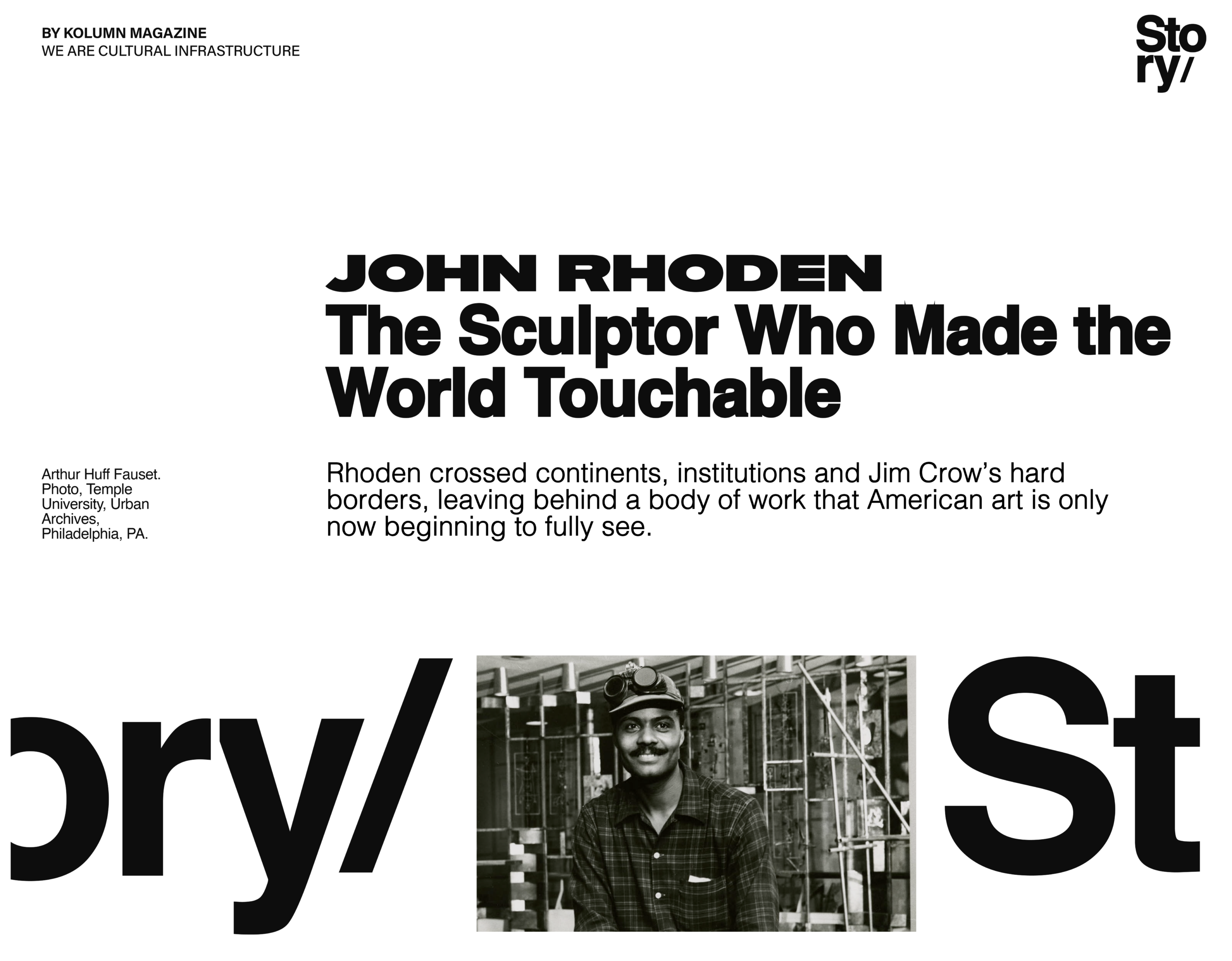
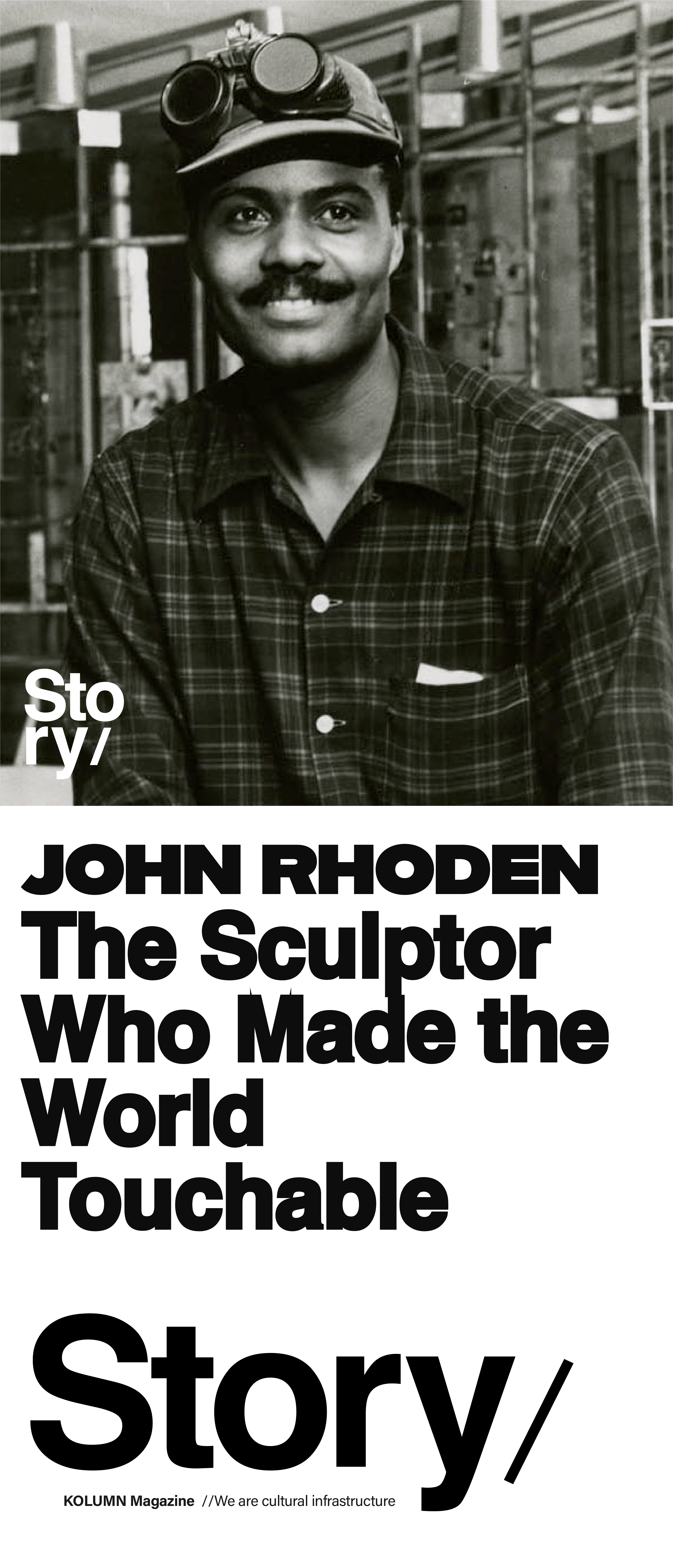
John Walter Rhoden understood early that sculpture was not stillness. It was pressure. It was muscle. It was memory pressed into material. Born in Birmingham, Alabama, in 1916, Rhoden came of age in a city structured by Jim Crow’s brutal grammar, yet he developed an artistic language that refused confinement. His work would eventually travel from Alabama to New York, from Rome to Indonesia, from public hospitals to museum galleries, from the margins of art history to the center of a long-overdue institutional recovery.
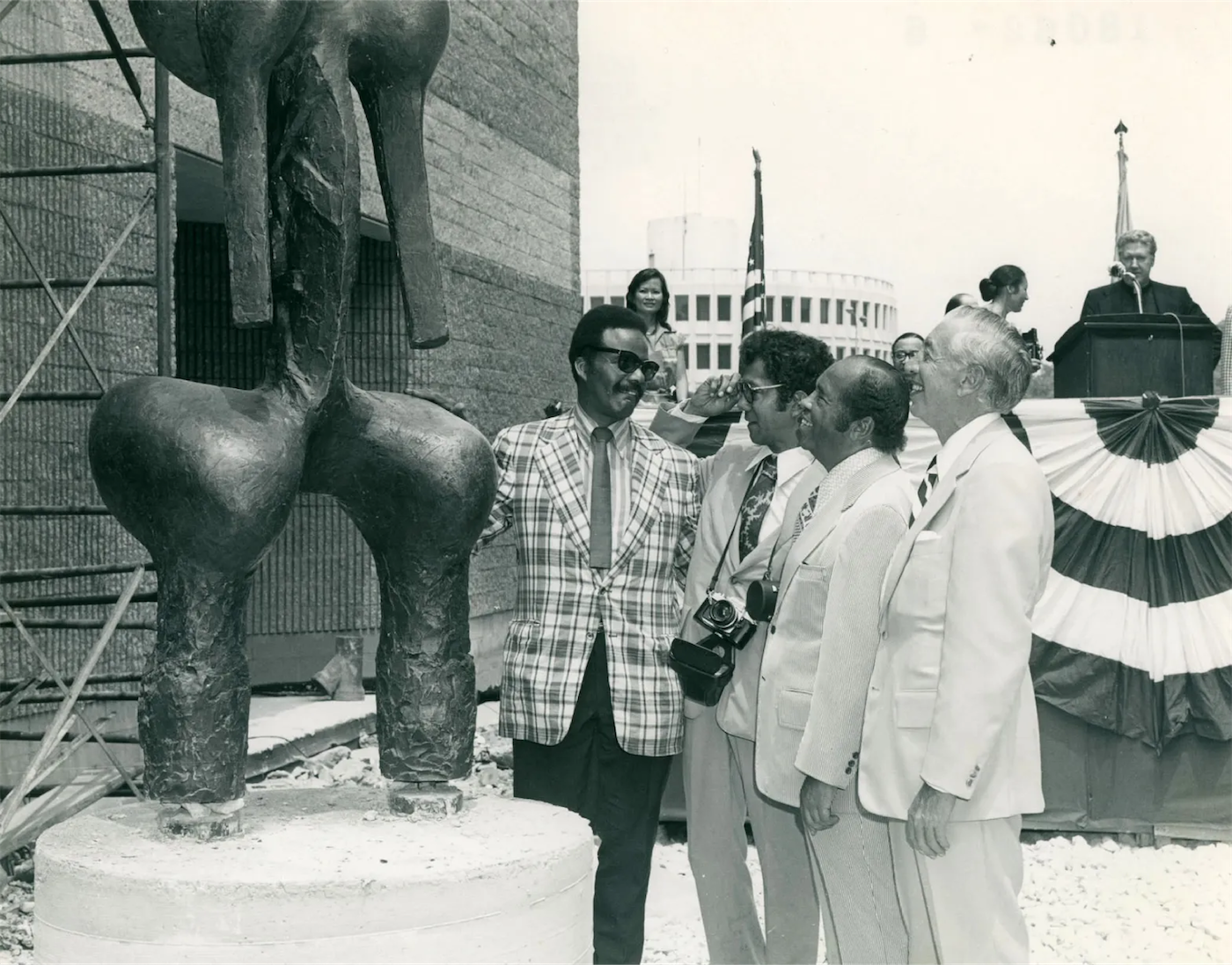
For much of the twentieth century, Rhoden was known, respected and collected, but not canonized. He exhibited at major institutions, won coveted awards, accepted public commissions, and became, according to the Pennsylvania Academy of the Fine Arts, one of the most prolific sculptors of the twentieth century. Still, his name did not circulate with the frequency of peers whose careers were granted the full machinery of criticism, scholarship and market attention. That imbalance is now being corrected, not by sentiment, but by evidence: hundreds of sculptures, thousands of archival objects, and a retrospective that makes plain what the record had obscured.
The recent reappraisal of Rhoden’s work has been anchored by PAFA’s stewardship of his estate. In 2017, the John Rhoden Estate selected PAFA to preserve and promote the artist’s legacy; the resulting collection includes more than 300 works of art and 22 linear feet of archival material, with a National Endowment for the Humanities-supported digitization project making 5,000 digital objects publicly accessible through the John Rhoden Digital Archives. That archive has become a portal into a life shaped by migration, war, study, love, public art, Black modernism and global exchange.
Rhoden’s story belongs in the same KOLUMN continuum as recent features on artists like Stephanie Pogue and Jefferson Pinder, figures whose work insists that Black art history is not a sidebar to American art but one of its structural foundations. Like Pogue, Rhoden worked through material and form as a mode of intellectual pressure. Like Pinder, he understood the body as a site of motion, resistance and meaning. But Rhoden’s particular achievement was sculptural: he made the human figure feel ancient and modern at once, rooted and traveling, intimate and monumental.
Birmingham Beginnings
Rhoden was born on March 13, 1916, in Birmingham, a steel city whose industrial landscape and racial order would shape both the conditions of his youth and the hardness of the world he had to outwork. His father, John Walter Rhoden Sr., and mother, Maime Shorter Rhoden, raised him in a segregated South where Black ambition was often treated as a social threat. Yet Rhoden’s talent emerged early. According to the Georgia Museum of Art, he created a bust of his high school principal when he was only 16, an act that reads now like both a technical beginning and a declaration: he could see form where others saw ordinary authority.
Birmingham’s Black educational networks mattered. Rhoden attended Industrial High School, later enrolling at Talladega College, one of the historically Black institutions that served as both refuge and launchpad for generations of artists and intellectuals. At Talladega, Rhoden entered a world where Black aspiration was not merely tolerated but cultivated. The college’s artistic environment, including the influence of figures such as Hale Woodruff, helped situate him inside a wider conversation about Black art, modernism and cultural self-definition.
In 1938, Rhoden moved to New York, where he studied with Richmond Barthé, one of the most important Black sculptors of the Harlem Renaissance era. Barthé’s graceful figurative work offered Rhoden a model of Black sculptural seriousness at a time when the art world frequently restricted Black artists to ethnographic, social or decorative categories. Rhoden absorbed the lesson but did not imitate it. His mature work would become more global, more architectonic, more willing to move between abstraction and figuration without asking permission from either camp.
New York, War and the Discipline of Form
Rhoden’s arrival in New York placed him near the afterglow of the Harlem Renaissance and amid a dense community of African American artists, writers and musicians negotiating the promises and betrayals of modernity. The city offered him access to teachers, museums and patrons, but it did not erase racial barriers. Black artists in mid-century America often faced a double demand: to master the dominant languages of modern art while also carrying the burden of racial representation. Rhoden’s answer was not to choose between formal experimentation and Black experience. He made work that held both.
World War II interrupted and redirected his trajectory. Rhoden served in the U.S. Army, then returned to his education through the GI Bill, studying at Columbia University. PAFA notes that he also attended the New School for Social Research and won opportunities at the Skowhegan School of Painting and Sculpture, the Fulbright program, and the American Academy in Rome, where he became the first Black visual artist fellow associated with the Rome Prize tradition, according to the American Academy in Rome.
That achievement deserves emphasis. In the 1950s, Rome was not merely a destination; it was an art-historical credential. For an African American sculptor from Birmingham to enter that lineage was to puncture a set of assumptions about who inherited antiquity, who could study monumentality, who could claim the classical world without apology. Rhoden did not become an artist by escaping Blackness into Europe. He became more fully himself by moving through the world and refusing the provincial limits America placed on him.
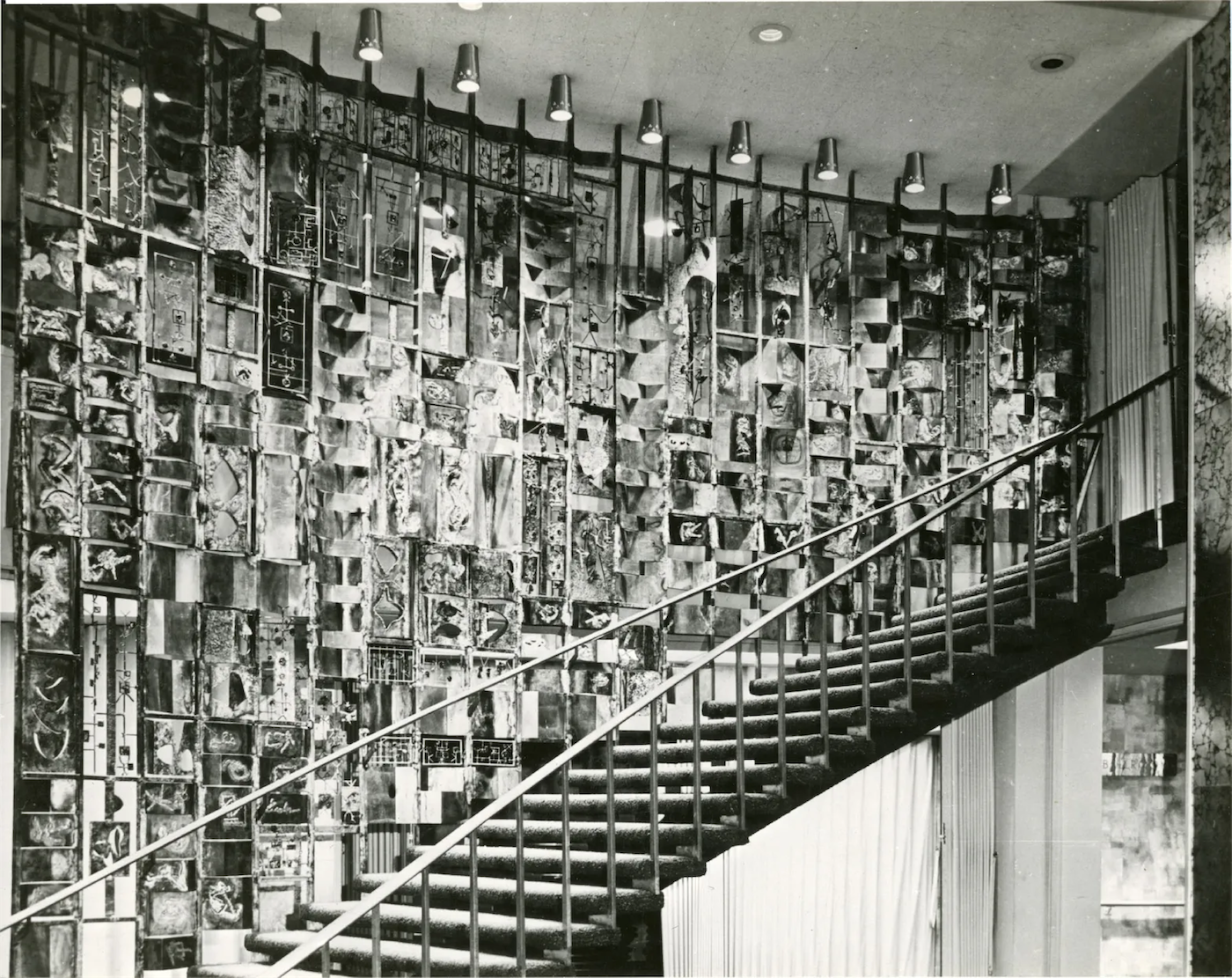
At the American Academy, Rhoden’s work began to synthesize the figurative and the abstract with increasing confidence. A 1954 bronze shown at the end of his fellowship was later described by Lindsay Harris as having a “lithe organicism” that anticipated the style Rhoden would continue developing, according to the American Academy in Rome. That phrase matters because it points to one of Rhoden’s enduring signatures: his sculptures rarely feel inert. Even when solid, they seem to bend, reach, twist or breathe.
A Black Modernist Abroad
The Cold War made culture a diplomatic weapon, and Rhoden became part of that geopolitical stage. In 1956, he joined an artists’ delegation that traveled to the Soviet Union, Poland and Yugoslavia with Rockefeller Foundation support, and the U.S. State Department later selected him as an art specialist under the International Cultural Exchange and Fair Participation Act of 1956, sending him to more than 20 countries, according to the Georgia Museum of Art. The contradiction is sharp: a Black artist whose own country denied full equality was asked to represent American cultural vitality abroad.
Rhoden used the opportunity on his own terms. He traveled with his wife, Richanda Phillips Rhoden, an artist in her own right whose presence shaped the emotional and intellectual texture of his life. Together they studied Indigenous and global art forms, absorbing visual languages from Asia, Africa, Europe and the Americas. Rhoden’s later work carries that breadth. It does not flatten cultural difference into exoticism; at its best, it suggests an artist alert to the fact that modernism was never only European. It was always planetary.
His time in Indonesia was especially important. From 1961 to 1963, Rhoden worked in Bandung, helping establish a bronze foundry at the Institut Teknologi Bandung. That episode reveals the practical dimension of his global practice. He was not only collecting impressions; he was building infrastructure, teaching technique, and participating in artistic exchange beyond the usual American-European axis. For a sculptor, foundry work is not incidental. It is the material heart of production. Rhoden’s willingness to engage that process abroad speaks to his seriousness about craft as shared knowledge.
Historiographically, this is where Rhoden becomes especially significant. Traditional narratives of American modernism have often centered New York abstraction, heroic individualism, and the market ascent of white male artists. Rhoden’s life disrupts that structure. His modernism was public, migratory, Black, interracial, institutional and global. He was not outside the twentieth-century art story. He exposes how incomplete that story has been.
Love, Studio, Partnership
Any serious account of Rhoden must include Richanda. Their marriage was not merely a domestic fact but part of the ecology that sustained his art. The Rhodens lived in Brooklyn Heights, in a four-story building at 23 Cranberry Street that became home, studio and informal gallery. Presente Media described the house as an 8,000-square-foot space where Rhoden kept nearly 300 sculptures, making it not simply a residence but a private museum of one artist’s persistence, as reported by Presente Media.
Their neighborhood presence mattered too. According to the Philadelphia Inquirer, John and Richanda were vital members of Brooklyn Heights, teaching children and helping start community festivals, including the Cranberry Street Festival. That detail complicates any narrow portrait of Rhoden as a solitary modernist. He was ambitious, yes. But he was also civic. His studio life spilled outward into neighborhood life.
Richanda’s own legacy also shaped the fate of John’s archive. PAFA’s exhibition credits lead support and artwork from the estate of Richanda Rhoden, and the institution’s stewardship of the John Walter Rhoden and Richanda Phillips Rhoden Collection makes clear that this recovery is also a story of preservation, partnership and posthumous care. The fact that Rhoden’s work survived in such depth is not accidental. It was held, guarded and eventually transferred into public trust.
The Public Sculptor
Rhoden’s public commissions are central to his significance. He did not make art only for galleries or collectors. He made work for hospitals, museums, universities and civic spaces — places where sculpture entered daily life rather than remaining sealed behind elite access. His commissions included works for Harlem Hospital, Metropolitan Hospital, Bellevue Hospital, the Afro-American Museum in Philadelphia, and Lincoln University, as detailed by PAFA’s account of Rhoden’s public works.
At Harlem Hospital, his sculptural work engaged one of Black New York’s most important public institutions. Hospitals carry intense symbolic weight: birth, illness, care, mortality, family, public responsibility. Rhoden’s “A Happy Family Is the Core of a Healthy Community,” also referred to in some records as “Untitled (Family),” placed Black familial form into the architecture of care. It was not decorative in the shallow sense. It was civic iconography.
At Bellevue, “Mitochondria” suggested the biological and abstract at once, translating cellular energy into sculptural language. At Metropolitan Hospital, “Monumental Abstraction” extended his engagement with public modernism. These works positioned Rhoden in a tradition of artists who believed sculpture could shape civic imagination. But unlike many public monuments built around conquest, military glory or state power, Rhoden’s public art often leaned toward vitality, relation and human force.
His Frederick Douglass sculpture at Lincoln University further linked him to the long Black freedom struggle. Douglass, the nineteenth-century abolitionist, writer and statesman, became through Rhoden’s hand not merely a historical subject but a sculptural ancestor. The commission placed Rhoden in conversation with Black institutional memory, education and the politics of representation.
The Material Intelligence of Rhoden’s Work
Rhoden worked in bronze, wood and stone, materials that demand different temperaments. Bronze allows durability, casting, repetition and public scale. Wood insists on grain, warmth and resistance. Stone offers weight, permanence and the risk of irreversibility. Rhoden’s command of all three is one reason the recent retrospective matters. It lets viewers see not a single signature trick but an artist thinking materially across decades.
PAFA’s “Determined To Be” exhibition brought together approximately 70 sculptures and archival materials, emphasizing Rhoden’s technical mastery and breadth of vision through works such as “Invictus,” “Eve,” “Safari,” “The Offering” and “Dancer,” according to PAFA. The title “Invictus” is especially telling. Meaning unconquered, it has often been associated with the language of endurance. In Rhoden’s hands, endurance was not passive survival. It was form.
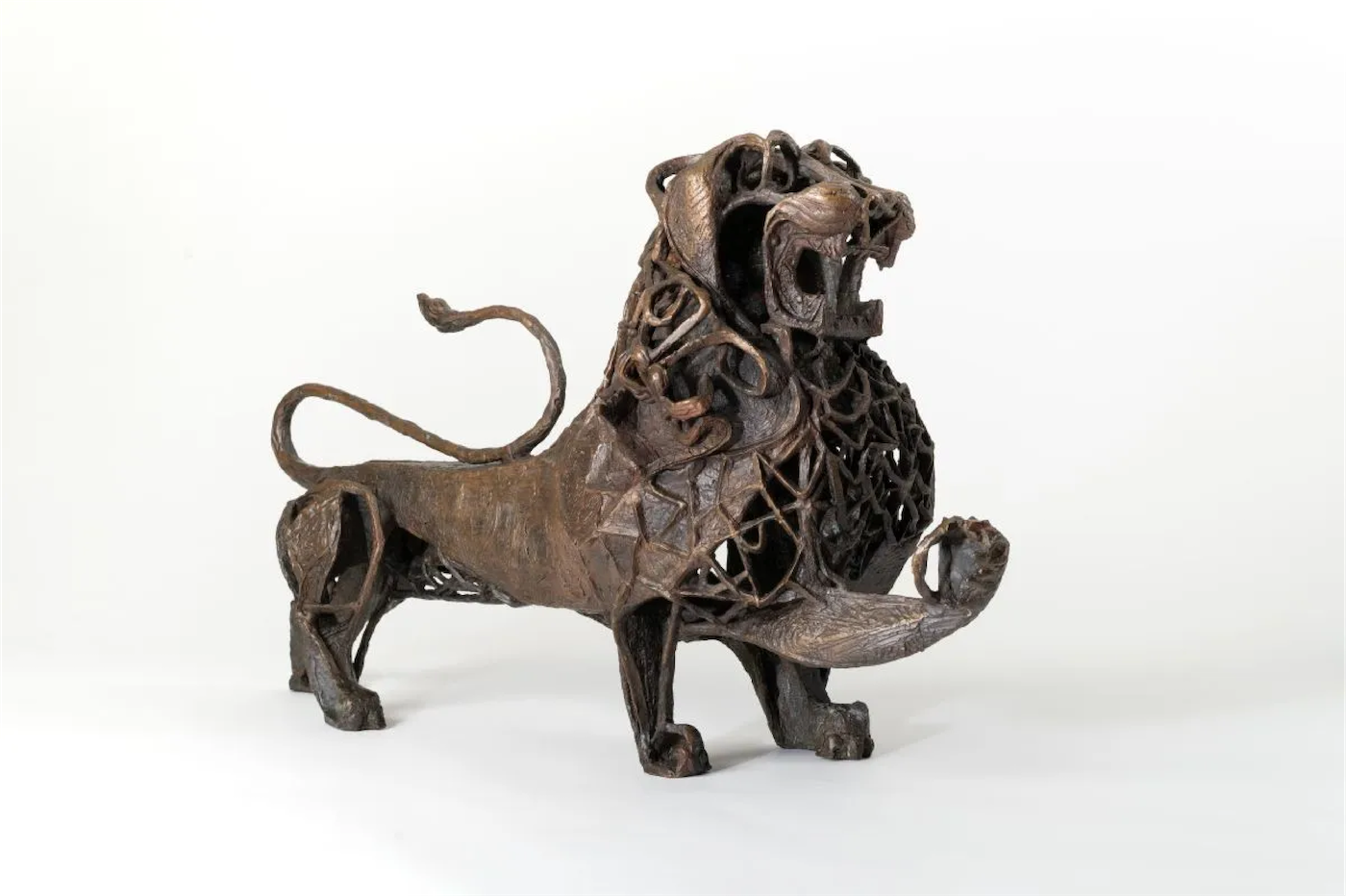
His figures frequently appear elongated, compressed, curved or fused. Faces emerge from wood as if excavated from memory. Bodies lean into each other, not as sentimental couples but as structures of relation. Animals and human figures carry symbolic density without becoming simplistic allegory. In works like “Kiss,” intimacy becomes architecture; in “The Offering,” verticality becomes ceremony; in “Eve,” the body becomes both origin and abstraction.
Rhoden’s sensualism has been noted by curators, but sensualism here should not be mistaken for softness. His surfaces invite touch, but his forms are disciplined. They are alive with restraint. He could make wood feel liquid and bronze feel breathing. That ability places him in conversation with modernist sculptors such as Henry Moore, Barbara Hepworth and William Zorach, while also extending the Black figurative tradition associated with Barthé, Augusta Savage and Elizabeth Catlett.
The Problem of Recognition
Why was Rhoden not more widely known? The answer is not simple, and it should not be reduced to institutional racism alone, though racism is indispensable to the analysis. Rhoden’s career unfolded across several art-world fault lines. He was a Black artist working during the rise of abstract expressionism, minimalism and conceptual art. He remained invested in the figure when many critics treated figuration as retrograde. He pursued public commissions, which the market often undervalued relative to gallery objects. He traveled widely and worked across cultural contexts, making him harder to place inside a tidy national style.
The canon often rewards artists who fit a clean story. Rhoden’s life resists that. He was Southern and New York-based, Black and global, figurative and abstract, public and private, formally ambitious and community-rooted. He was successful enough to be visible but not simplified enough to become easily branded.
That is where historiography becomes urgent. Art history is not merely the study of objects; it is the study of how objects are noticed, classified, funded, exhibited, ignored, rediscovered and narrated. Rhoden’s recovery shows how the archive can revise the museum wall. The 2023 PAFA retrospective, curated by Dr. Brittany Webb, was the first comprehensive retrospective of his work, according to PAFA. That fact is astonishing. An artist born in 1916, dead since 2001, with major commissions and institutional exhibitions, had to wait until the twenty-first century for a full retrospective.
PAFA President and CEO Eric Pryor framed the exhibition as part of the institution’s effort to expand American art history, telling PAFA that the show brought new stories to visitors while highlighting a less well-known African American artist. Webb was even more direct about scale, saying Rhoden’s story was “as big as his over-life sized sculptures,” according to the same PAFA announcement. These expert voices help explain the current moment: Rhoden is not being inflated by contemporary interest. He is being restored to proportion.
The Archive Opens
The John Rhoden Digital Archives represent one of the most consequential parts of this restoration. The archive makes available images, documents and biographical materials that allow scholars, journalists, curators and the public to study Rhoden beyond a few isolated works. PAFA’s NEH-supported project organized and digitized the collection, turning a private estate into a public resource, as the institution explains through the John Rhoden Digital Archives.
The importance of this cannot be overstated. Black artists have often been harmed not only by exclusion from museums but by the fragility of documentation. Letters disappear. Studios are emptied. Photographs remain unidentified. Exhibition histories become difficult to reconstruct. Once the paper trail breaks, the art historical narrative narrows. Rhoden’s archive interrupts that pattern. It gives future historians the raw material to write differently.
The Archives of American Art also holds John W. Rhoden papers dating from 1940 to 1968, including correspondence, exhibition catalogs, biographical material, clippings, a scrapbook, personal photographs and photographs of his work, according to the Smithsonian’s Archives of American Art. Together, these records place Rhoden inside a documentary field that extends across institutions and decades.
This is the kind of recovery KOLUMN’s archive-centered editorial approach treats as essential. The work is not only to celebrate rediscovered figures after the fact, but to examine the mechanisms by which they were displaced from public memory in the first place. Rhoden’s archive allows us to ask sharper questions: Who reviewed him? Who collected him? Which institutions commissioned him but failed to sustain scholarship? Which public works remain visible, and which have been neglected, relocated or lost?
A Lost Sculpture and the Fragility of Public Memory
One of the more haunting episodes in Rhoden’s story concerns “Nesaika,” a public sculpture commissioned for what became the African American Museum in Philadelphia. In 2024, the Philadelphia Inquirer reported that one of Rhoden’s Philadelphia sculptures was lost, opening a larger conversation about how public art — especially work by Black artists — can vanish through institutional turnover, redevelopment, poor documentation or simple neglect.
A lost sculpture is never only a missing object. It is a failure of custody. Public art depends on public memory, but memory requires maintenance. Rhoden’s career demonstrates both the promise and vulnerability of civic sculpture. His works were meant to live in shared spaces, but shared spaces are governed by bureaucracies, budgets and shifting priorities. When a work disappears, the loss is aesthetic, historical and communal.
That is why the current distribution of Rhoden’s works to museum collections matters. The Georgia Museum of Art recently received nine sculptures from the John Walter Rhoden and Richanda Phillips Rhoden Collection at PAFA, integrating his work into its galleries and expanding public access, according to the Georgia Museum of Art. Curator Shawnya Harris called the acquisition a milestone, saying she was thrilled to bring Rhoden’s voice into the museum’s galleries. Her comment captures the stakes: Rhoden’s work is not merely being stored. It is being reintroduced to audiences.
“Sculpting Is My Life”
Rhoden was articulate about the totality of his commitment. In a 1966 interview, quoted by PAFA, he said he put every feeling and passion into sculpting, adding simply that sculpture was his life. The statement is not romantic excess. It is accurate biography.
He worked across decades, through changing styles, countries, commissions and institutions. He did not appear to treat sculpture as a career path so much as a way of being in the world. A 1990 interview excerpt cited by PAFA shows an older Rhoden reflecting that he had enjoyed his life and had “just about everything” he really wanted. There is gratitude in that remark, but also a hard-won calm. He had not received everything an artist of his caliber deserved. But he had built the life he needed to make the work.
That tension — fulfillment without full recognition — runs through many Black artistic lives. It is tempting, in retrospective writing, to turn under-recognized artists into tragedies. Rhoden resists that. His career was not a tragedy. It was a triumph with unfinished public accounting. He traveled the world, made major work, loved deeply, taught, built, received honors and left a vast archive. The failure was not his. The failure belonged to the systems that took too long to see him whole.
The Retrospective as Correction
“Determined To Be: The Sculpture of John Rhoden” opened at PAFA in October 2023 and ran through April 2024, later traveling to other venues including the Birmingham Museum of Art and the Memorial Art Gallery in Rochester. The Birmingham Museum of Art framed the exhibition as the first comprehensive retrospective of a Birmingham-born artist whose life and work had national and international reach. The Memorial Art Gallery announced its 2026 presentation as an opportunity to engage deeply with a significant American artist and his contributions to twentieth-century sculpture.
That travel schedule is symbolically powerful. Rhoden’s retrospective began in Philadelphia, where PAFA now holds the archive and collection; moved through Birmingham, the city of his birth; and continued into other institutional contexts. The artist who spent his life moving through the world is now moving again, this time through the museum system that once lacked a full framework for him.
The exhibition’s title, “Determined To Be,” carries a double meaning. It suggests Rhoden’s determination to become an artist despite racial and professional obstacles. But it also suggests a deeper ontological claim: determination to exist, to be seen, to occupy form. Sculpture is the art of presence. Rhoden’s life was a long insistence on presence.
Rhoden and the Larger Black Sculptural Tradition
Rhoden’s significance also lies in how he expands the story of Black sculpture. Too often, Black art history has been narrated through painting, photography, literature and music, while sculpture receives less public attention. Yet sculpture has been central to Black modern and contemporary art, from Meta Warrick Fuller’s symbolic figures to Augusta Savage’s Harlem Renaissance pedagogy, from Richmond Barthé’s elegant bodies to Elizabeth Catlett’s politically charged forms, from Martin Puryear’s abstracted craftsmanship to Simone Leigh’s monumental Black female architectures.
Rhoden belongs in that lineage, but he also complicates it. His work is less overtly programmatic than Catlett’s and less market-canonized than Puryear’s. He did not build a practice around a single recognizable motif. Instead, he pursued a restless sculptural intelligence. He made portraits, public monuments, abstracted bodies, animals, mythic forms and relational figures. His art resists easy reduction to protest, even though his career unfolded in protest’s shadow. It resists easy reduction to formalism, even though form is its great language.
This complexity is precisely why he matters. Rhoden helps us understand Black modernism not as a narrow political style but as a field of experiments, migrations and material choices. His work insists that Black artists were not simply responding to oppression; they were also inventing beauty, studying global cultures, mastering techniques, building institutions and imagining public life.
The Human Figure After the World
One of the most compelling aspects of Rhoden’s sculpture is its treatment of the human figure. His bodies often feel compressed by history yet animated by inner force. They do not merely stand; they bear. They bend without breaking. They touch without dissolving. They carry the memory of ancient sculpture, African and Asian forms, European modernism and Black American social life.
In this sense, Rhoden’s figures are historical bodies. They seem to know migration, labor, intimacy and ceremony. They are modern because they have survived rupture. They are timeless because they refuse to be reduced to a single moment.
His global travels sharpened that vocabulary. Exposure to Indigenous art and international sculptural traditions did not lead him into imitation. Rather, it expanded his sense of what form could hold. In a century when Western museums often extracted and misread non-European objects, Rhoden’s work suggests a different mode of encounter: looking, learning, translating through material intelligence, and returning to the studio with a widened sense of human form.
Why John Rhoden Matters Now
Rhoden matters now because the American art canon is undergoing a necessary stress test. Museums are being asked not only to diversify their walls but to rethink the narratives those walls have upheld. Token inclusion is no longer enough. The question is structural: How do we tell American art history when artists like Rhoden are not treated as exceptions but as central evidence?
His life brings together several major twentieth-century themes: the Black South, the Great Migration, HBCU education, Harlem Renaissance afterlives, World War II service, GI Bill access, Cold War cultural diplomacy, public art, interracial and intercultural exchange, museum neglect, archival recovery and contemporary reappraisal. Few artists offer such a complete map of the century’s contradictions.
He also matters because his art is good — powerfully, materially, formally good. The recovery of Black artists should never depend only on biography or injustice. Rhoden’s biography is compelling, and the injustice of his under-recognition is real, but the sculptures carry the argument. They reward sustained looking. They change as the viewer moves around them. They hold space.
In an era of digital saturation, Rhoden’s sculptures remind us of the force of made things. Bronze, wood and stone do not scroll past. They wait. They demand encounter. They insist that history has weight.
The Long Return
John Rhoden died on January 4, 2001, in Queens, New York. By then, he had lived several artistic lives: Birmingham prodigy, Talladega student, New York apprentice, soldier, Columbia-trained sculptor, Rome Prize fellow, global traveler, public artist, Brooklyn neighbor, husband, teacher, elder. He left behind a body of work that was too large to disappear, though it came closer to neglect than it ever should have.
Now, through PAFA’s archive, traveling exhibitions, museum acquisitions and renewed scholarship, Rhoden is making a long return. But the phrase is not quite right. Rhoden is not returning to art history. He was always there. The better claim is that art history is returning to him.
For KOLUMN, the significance of Rhoden’s life is not simply that another Black artist deserves recognition, though he does. It is that his career reveals how Black cultural memory survives in material form — in houses turned studios, in archives rescued from obscurity, in public sculptures embedded in hospitals, in works that wait decades for the critical language equal to their ambition.
John Rhoden made sculpture as if life itself could be carved into presence. He shaped figures that seemed to have traveled farther than the material that held them. He built a career across borders that were never designed for him to cross. He insisted on being an artist when the world offered fewer permissions than obstacles.
And now, finally, the work stands where it always belonged: not at the edge of American art, but in its living center.
More great stories
Afro Sheen, Wall Street, and the Architecture of Black Possibility
July 6, 2026
No Comments
The Fire Inside the Fourth
July 5, 2026
No Comments