


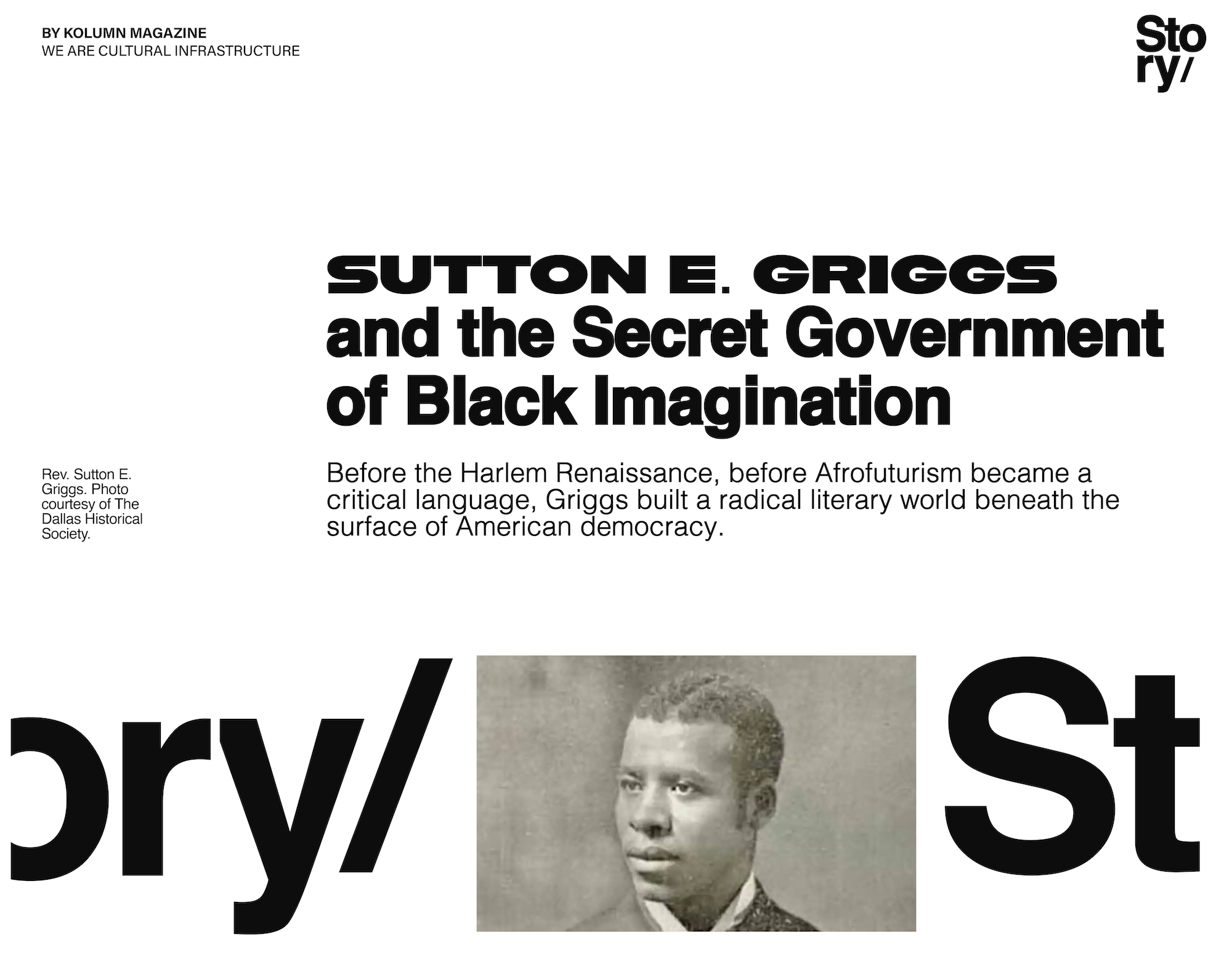
Griggs wrote as though Black citizenship was not a theory to be debated, but a life-or-death problem already inside the room.
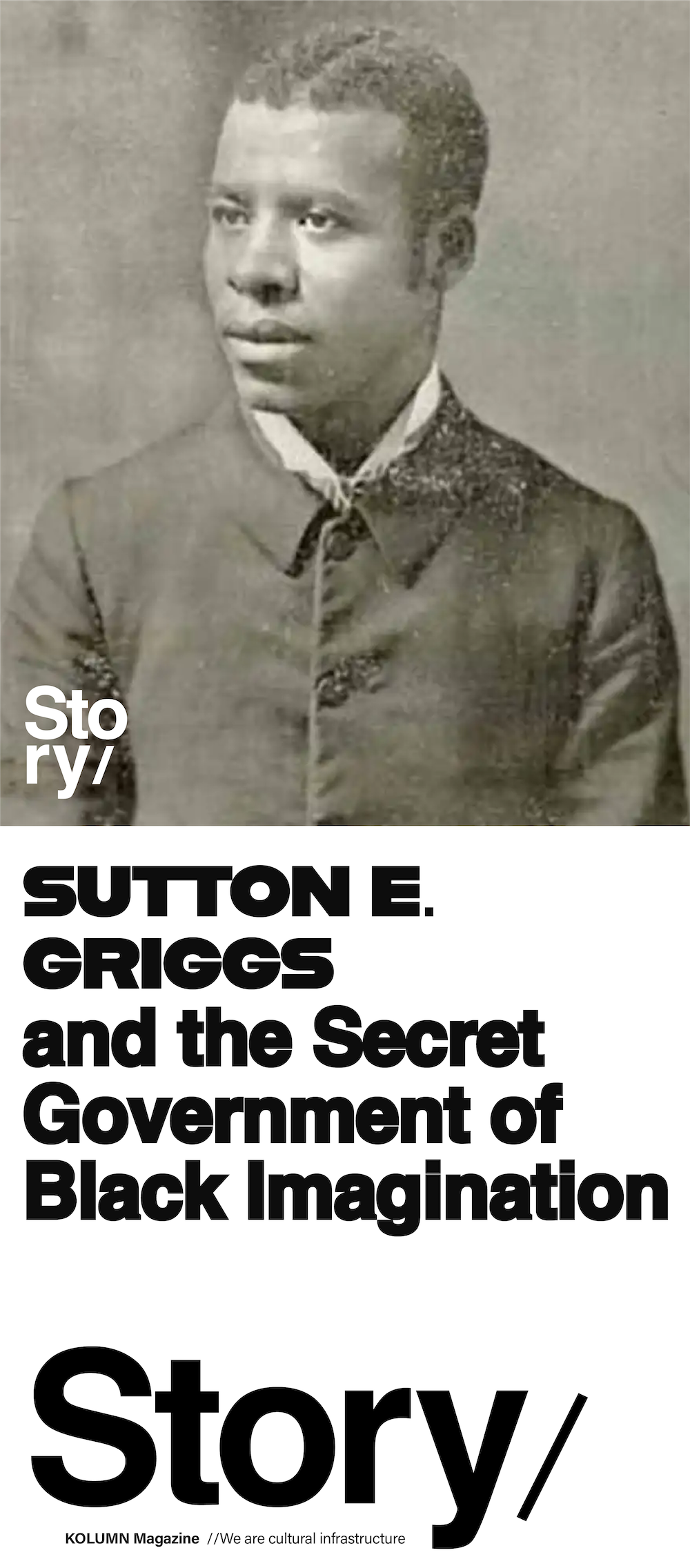
Griggs wrote as though Black citizenship was not a theory to be debated, but a life-or-death problem already inside the room.
By KOLUMN Magazine
Sutton E. Griggs wrote as though America were already on trial. Not in the abstract, not in the safe chamber of literary symbolism, but in the charged, dangerous, post-Reconstruction years when Black citizenship had been promised, betrayed, narrowed, legislated against, terrorized, and then blamed for its own dispossession. His fiction did not ask politely whether the nation might one day become just. It staged a more severe question: what should Black people do when the nation knows the law, knows the Gospel, knows the Constitution, knows the suffering, and still refuses to change?
Born in Chatfield, Texas, in 1872, the son of the Rev. Allen R. Griggs, a formerly enslaved Georgia-born Baptist minister who became a prominent religious leader in Texas, Sutton Elbert Griggs came of age in the historical aftershock of emancipation and the violent consolidation of Jim Crow, as the Texas State Historical Association records. That origin matters. Griggs was not writing from the polite distance of a later canon. He was writing from the South while the South was remaking itself against Black political life.
His best-known novel, Imperium in Imperio, appeared in 1899, and its premise still feels electrically unstable: a secret Black political organization, operating out of Waco, Texas, debates whether to remain inside the United States or break violently from it. The Rutgers University Press / University of Delaware Press edition describes the novel as a searing response to disfranchisement, Jim Crow segregation, U.S. imperial policy, revolutionary movements, and racial protest at the dawn of the twentieth century. That is the key to Griggs’s significance. He did not merely write a “race novel.” He built a fictional laboratory for the arguments Black America was already having in churches, conventions, newspapers, barbershops, schools, and private rooms where fear and strategy often sat at the same table.
A Life Formed by Church, School, and Struggle
Griggs’s path began inside the infrastructure Black communities built after slavery: the church, the school, the press, the convention, the self-help society, the mutual-aid network. He graduated from Dallas public schools and Bishop College in Marshall, Texas, in 1890, then studied at Richmond Theological Seminary in Virginia between 1890 and 1893, according to the Texas State Historical Association. This was not simply a ministerial education. It was a training in public argument. Black ministers of Griggs’s generation were often theologians, organizers, political interpreters, institutional builders, fundraisers, educators, and race spokesmen all at once.
After seminary, Griggs took a pastorate in Berkley, Virginia, and in 1897 married Emma J. Williams of Portsmouth, Virginia, as the Texas State Historical Association notes. There, in Virginia, he wrote Imperium in Imperio. The setting is worth lingering over. Virginia was not merely a place on the map. It was one of the symbolic centers of American slavery, Confederate memory, and postwar racial reaction. For a young Black minister to imagine, from that vantage point, a hidden Black state-within-a-state was not escapism. It was diagnosis.
Griggs wrote more than a dozen books over his career, including five novels, social tracts, an autobiography, a biography of John L. Webb, and religious manuals; he published and distributed much of this work at his own expense, often writing for what the Texas State Historical Association calls “the aspiring classes of the Black south.” That phrase opens an entire world. Griggs’s audience was not imagined as white literary tastemakers. He wrote toward Black readers who were studying, organizing, debating, preaching, teaching, migrating, saving, buying land, building institutions, and trying to survive a society intent on turning freedom into a technicality.
This places him inside a KOLUMN Magazine lineage of Black literary recovery. Recent KOLUMN work on Sarah Farro framed forgotten Black authors as part of a broader archive where disappearance is never neutral. KOLUMN’s profile of Ronald L. Fair likewise treated under-recognition as a political fact, not just a literary accident. Griggs belongs in that same field of recovery, but with a sharper edge: he was not merely forgotten by literary culture; he wrote in a form and tone that made forgetting convenient.
The Novel as Emergency Room
Imperium in Imperio: A Study of the Negro Race Problem. A Novel does not enter quietly. Its very subtitle announces that fiction will serve as a diagnostic instrument. The Project Gutenberg edition identifies the novel as a historical fiction work published in 1899, following Belton Piedmont, an educated Black man navigating Jim Crow Virginia, and Bernard Belgrave, whose life intersects with Belton’s before both are drawn toward a secret Black government in Waco, Texas. That summary only begins to suggest the pressure inside the book.
Belton and Bernard are not simply characters. They are political temperaments. Belton is disciplined, morally serious, integrationist in the deepest sense: he believes that justice must be pursued without surrendering the claim to American belonging. Bernard is brilliant, wounded, charismatic, and drawn toward separatist militancy. Through them, Griggs dramatizes a central crisis of Black modernity: how long can oppressed people be expected to believe in a nation that repeatedly converts their loyalty into vulnerability?
The novel’s secret organization, the Imperium, becomes a chamber of suppressed political imagination. It is not merely a conspiracy device. It is a fictional answer to a real exclusion. If Black citizens were locked out of the formal democratic order by disfranchisement, segregation, lynching, and fraud, Griggs imagined a parallel structure where Black people could debate sovereignty on their own terms. The Tennessee Encyclopedia of History and Culture notes that the novel’s central conflict involves competing nationalist and accommodationist strategies within the Black community, with characters debating violence as a possible route to liberation.
The audacity of that structure cannot be overstated. Published in 1899, the novel arrived near the end of a decade marked by the hardening of segregation and the rollback of Black voting power. The Supreme Court’s 1896 decision in Plessy v. Ferguson had given constitutional shelter to “separate but equal,” and southern states were aggressively constructing legal mechanisms to suppress Black political participation. Griggs understood that “the race problem” was not Black existence. It was white power’s refusal to accept Black freedom.
A Writer Before the “New Negro” Had a Brand
Griggs is often read as a precursor to later Black nationalist and New Negro traditions, and for good reason. The Tennessee Encyclopedia describes his five novels, published between 1899 and 1908, as often considered precursors to the Black nationalist literary tradition of the New Negro. But “precursor” can be a shrinking word. It can make a writer sound important mainly because others arrived later. Griggs deserves to be read not only as a forerunner, but as a thinker of his own moment.
His novels appeared before the Harlem Renaissance made Black literary production more visible to white publishers, patrons, and critics. He worked in a period when Black print culture depended heavily on self-publication, church networks, newspapers, conventions, and direct sales. That practical reality shaped the work. Griggs’s fiction often carries the tone of a sermon, a debate, a pamphlet, and a political meeting. It can feel stiff to modern readers expecting psychological subtlety, but that stiffness is part of its historical form. He was not writing for the workshop. He was writing for the emergency.
The University of Georgia Press volume Jim Crow, Literature, and the Legacy of Sutton E. Griggs argues that Griggs’s work opens a new historical perspective on African American literature and the political thought of the turn of the twentieth century, emphasizing his fiction, nonfiction, publishing, and religious careers as part of one broad intellectual project (University of Georgia Press). That is the most productive way to read him. The novels cannot be separated from the pulpit. The pulpit cannot be separated from race leadership. Race leadership cannot be separated from print. Print cannot be separated from the fragile, improvised, brilliant systems Black communities built to argue themselves into the future.
The Book That Made Militancy Legible
The radical force of Imperium in Imperio lies not in a simple endorsement of violence, but in its willingness to make Black militancy intelligible. Griggs does not caricature rage. He historicizes it. Bernard Belgrave’s extremity is not treated as madness floating in the air. It grows out of betrayal. It emerges from a country where Black virtue does not guarantee protection, Black education does not guarantee opportunity, Black patriotism does not guarantee citizenship, and Black patience does not guarantee mercy.
The Texas State Historical Association summarizes the novel as a chronicle of social and political injustice, centered on a secret Black organization in Waco whose leader argues for the violent takeover of Texas. But the book’s deeper drama is moral. Belton opposes the militaristic plan, even at great personal cost. The conflict between Belton and Bernard is therefore not simply “moderate versus radical.” It is a conflict over what justice demands when law has been captured by injustice.
Griggs’s refusal to flatten that argument is what makes the novel remain alive. Later readers can disagree with its politics, critique its gender assumptions, or find its plotting melodramatic. But they cannot honestly call it timid. In 1899, a Black Baptist minister imagined organized Black sovereignty, armed strategy, revolutionary debate, and the possibility that the United States might not deserve Black allegiance without writing a fantasy of easy reconciliation. That alone makes him indispensable.
The Shadow of Booker T. Washington and W. E. B. Du Bois
Griggs wrote during one of the central ideological contests in Black American history: the debate over accommodation, protest, education, economics, civil rights, and political agitation often associated with Booker T. Washington and W. E. B. Du Bois. Griggs cannot be reduced to either camp. His work moved across positions, and his career reveals the difficulty of sustaining militancy, institution-building, pastoral care, and public respectability under white surveillance.
The Texas State Historical Association notes that Griggs was one of the few Southern members of the Niagara Movement, the civil-rights organization with an outspoken platform on racial and social justice that eventually helped lead toward the NAACP. That connection matters. It places Griggs not only in literary history, but in the organized protest tradition that challenged the accommodationist politics often associated with Washington’s public program.
At the same time, Griggs’s later work and ministry became more complicated. The Tennessee Encyclopedia notes that while living in Nashville he participated in the Niagara Movement and helped organize a streetcar boycott against segregation, yet in Memphis he later distanced himself from the Black nationalist philosophy expressed in earlier writings and emphasized racial uplift, cooperation with white southerners, and the social mission of churches. That evolution has troubled some readers. Was it compromise? Strategy? Exhaustion? Growth? Contradiction? The honest answer is that it may have been all of these.
It is easy, from a later century, to demand ideological purity from the dead. It is harder to imagine the daily burden of leading Black institutions in cities where white money, white law, white violence, white press power, and white political authority could determine whether a church survived, whether a school functioned, whether a boycott was crushed, or whether a leader was marked as dangerous. Griggs’s shifts do not erase his radicalism. They show the pressure under which Black leadership had to operate.
Five Novels and a Larger Program
Griggs published five novels in less than a decade: Imperium in Imperio in 1899, Overshadowed in 1901, Unfettered in 1902, The Hindered Hand in 1905, and Pointing the Way in 1908, as listed by the Texas State Historical Association. That pace alone is remarkable. It becomes more so when one remembers that Griggs was also a minister, organizer, public speaker, and self-publisher.
His later novels did not achieve broad circulation. The Texas State Historical Association notes that neither Imperium in Imperio nor his subsequent novels received widespread distribution, and that some scholars considered the later works less militant. But circulation and significance are not the same. Black literary history is filled with works whose influence was obstructed by the very conditions they were trying to expose. A book may fail commercially because it is weak. It may also fail commercially because the market is segregated, distribution channels are fragile, white critics are indifferent, Black readers have limited purchasing power, and the subject matter makes patrons nervous.
Project Gutenberg’s current digital availability of Griggs’s novels, including Imperium in Imperio, The Hindered Hand, Unfettered, and Overshadowed, demonstrates the strange afterlife of public-domain recovery: works that struggled for circulation in their own time can become globally accessible more than a century later through digitization (Project Gutenberg). This is where KOLUMN’s larger archival project becomes relevant. As KOLUMN’s profile of Arna Bontemps argued, Black literary permanence has always depended on people who preserve, recover, teach, republish, and refuse erasure. Griggs’s survival as a subject of renewed scholarship proves that the archive is not fixed. It can still be reopened.
The Minister as Institution Builder
Griggs’s work in the church was not separate from his writing; it was one of the sources of his literary authority. Black churches in the post-Reconstruction South were among the few institutions where Black people could gather, debate, educate children, raise money, shelter political organizing, publish notices, host conventions, and produce leadership. Griggs understood the church as a social engine.
His longest pastorate was at Tabernacle Baptist Church in Memphis, where his ministry reflected his belief in the church’s social mission. A widely circulated biographical account notes that during his nineteen years at Tabernacle, Griggs helped provide facilities including a swimming pool and gymnasium then available to African Americans in the city; the Tennessee Encyclopedia likewise emphasizes his Memphis-era focus on uplift and institutional cooperation. Whatever one makes of the politics of uplift, the practical work mattered. In a segregated city, a pool was not merely recreation. A gymnasium was not merely exercise. These were claims to bodily dignity, collective investment, and civic presence.
Griggs also founded the National Public Welfare League in 1914, according to the Tennessee Encyclopedia, as part of a program to improve race relations and reshape public perceptions of African Americans. This later work exposes the tension in his legacy. His book Guide to Racial Greatness; or The Science of Collective Efficiency argued for internal reform and collective discipline, and the Tennessee Encyclopedia notes that while white Memphians praised aspects of this work, some Black critics derided him as a “White Man’s Negro.” That charge cannot be ignored. It reflects a real critique of uplift politics when such politics appeared to place the burden of white prejudice on Black behavior.
Yet the critique should not become the whole story. Griggs lived in a period when Black communities were forced to argue simultaneously against white supremacy and against white supremacy’s stereotypes. Respectability politics can become constricting, punitive, and class-bound. But for many Black leaders of Griggs’s generation, public discipline was also a survival tactic in a society eager to convert any Black error into racial indictment. Griggs’s later moralism can feel narrow. It can also be read as a desperate attempt to protect a people under constant accusation.
Why His Style Still Matters
Modern readers sometimes approach Griggs with the wrong expectations. They look for the polished realism of later canonical fiction and find instead speeches, moral instruction, melodrama, debate, allegory, and exposition. But Griggs’s form was not accidental. His novels are closer to political sermons with fictional bodies. They are built to persuade, awaken, warn, and argue. They belong to a Black print tradition where the line between literature and pamphlet was often porous because the stakes were immediate.
Eric M. Curry’s dissertation on Griggs and the African American literary tradition of pamphleteering argues that pamphlets have been neglected as an antecedent to the African American novel, with Griggs serving as a central figure in that relationship (University of Maryland DRUM). That framework helps explain why Griggs can feel both novelistic and extra-novelistic. His books want to tell stories, but they also want to function as instruments of race education.
That does not excuse every artistic limitation. It clarifies the field in which he worked. Griggs wrote before the institutional categories had settled. He wrote as novelist, minister, tract writer, publisher, organizer, and political educator. The modern separation between “art” and “advocacy” often tells us more about later literary taste than about Black writing under Jim Crow.
The Underground as Political Imagination
The underground chamber in Imperium in Imperio remains one of the most potent images in early Black fiction. Beneath the visible nation lies another nation. Beneath the official democracy lies a democracy of the excluded. Beneath the public story of American progress lies the suppressed argument of Black sovereignty.
That image resonates far beyond Griggs. It anticipates later traditions of Black speculative writing, political fiction, and alternative history. It also speaks to the long reality of Black institutional life: the need to build parallel structures when formal institutions deny entry. Black schools, churches, newspapers, mutual-aid societies, fraternal organizations, women’s clubs, reading circles, freedom schools, independent presses—these were not merely substitutes for exclusion. They were laboratories of self-definition.
KOLUMN’s recent profile of Milton Davis described Black speculative-fiction infrastructure as something built outside mainstream permission. Griggs belongs to an earlier version of that same story. He imagined Black political futurity before “Black speculative fiction” had a shelf label. He staged an argument about state power, race destiny, separatism, integration, and imperial ambition at a time when the United States was expanding abroad while betraying democracy at home.
That imperial context matters. The Rutgers/Delaware edition explicitly situates Imperium in Imperio amid U.S. imperial policies and racial protests. Griggs saw the contradiction: a nation claiming civilization abroad while tolerating racial terror at home. Black writers noticed that contradiction with special clarity. If America could debate the governance of peoples overseas, why could it not confront the disenfranchisement of Black citizens within its own borders? If sovereignty mattered in Cuba, the Philippines, or Puerto Rico, why did it vanish when Black southerners claimed the rights of citizenship?
The Women in the Frame
Any serious reading of Griggs must also confront the gender politics of his work. Like many male race leaders of his era, Griggs often imagined racial progress through male leadership, male debate, male discipline, and male institutional authority. Women appear in his fiction and life, but the central political drama of Imperium in Imperio is overwhelmingly masculinized. That limitation matters, especially when read alongside Black women writers and activists who were doing their own theorizing of race, citizenship, education, violence, and freedom.
The KOLUMN archive has repeatedly returned to Black women whose intellectual and literary labor complicates male-centered histories, including Frances Ellen Watkins Harper in the Sarah Farro piece and figures such as Pauli Murray in related literary recovery work. Griggs’s importance should not require silence about his limits. Rather, his limits help map the gendered architecture of early Black political fiction. The question is not whether Griggs was perfect. He was not. The question is what his work reveals about the era’s anxieties, ambitions, exclusions, and imaginative power.
The Canon That Arrived Late
For much of the twentieth century, Griggs remained peripheral to mainstream accounts of American literature. That neglect had several causes: the racial segregation of literary institutions, limited circulation of his books, stylistic preferences that favored other kinds of realism or modernism, and the discomfort his politics created. But scholarship has increasingly returned to him because the questions he raised never disappeared.
The University of Georgia Press notes that contemporary scholars now engage not only his five novels, but also his nonfiction, publishing, and religious career. The recent Rutgers/Delaware critical edition, edited and introduced by Tess Chakkalakal and Kenneth W. Warren, further signals that Griggs has moved from obscurity toward renewed academic attention. This matters because literary recovery is not nostalgia. It changes the story of what Black writers were thinking before the movements we more easily name.
To recover Griggs is to revise the timeline. Black political fiction did not begin with the Harlem Renaissance. Black speculative sovereignty did not begin with late twentieth-century Afrofuturism. Black debates over separatism, integration, armed resistance, moral suasion, institution-building, and state power were alive in fiction at the turn of the twentieth century. Griggs gives those debates a dramatic architecture.
A Man on the Firing Line
The phrase “the firing line” has followed Griggs in recent scholarship, and it is apt. He wrote from the line where literature met danger. He ministered from the line where pastoral care met political pressure. He organized from the line where Black advancement met white resistance. He published from the line where Black readers needed books that white-controlled literary markets had little incentive to support.
His life ended in 1933, after decades of writing, ministry, and institutional work. The Texas State Historical Association places him in a long career as novelist, minister, and civil-rights advocate; the Tennessee Encyclopedia emphasizes his continued commitment to ending racial prejudice despite criticism and ideological shifts. By then, the world he had entered in 1872 had changed dramatically and not nearly enough. Reconstruction was gone. Jim Crow remained. The Harlem Renaissance had risen. The Great Depression had begun. Black modernity had new voices, but many of Griggs’s questions were still unresolved.
They remain unresolved now. What does citizenship mean when the state protects some people from violence and exposes others to it? What does loyalty mean when the nation treats loyalty as submission? What forms of institution-building are necessary when official institutions fail? When does moderation become moral courage, and when does it become surrender? When does militancy become necessary, and when does it become destructive? How should a people imagine freedom when every available strategy carries risk?
Why Sutton E. Griggs Still Matters
Sutton E. Griggs should be read today because he understood that Black literature could be more than representation. It could be strategy. It could be warning. It could be rehearsal. It could be a parliament for arguments forbidden elsewhere. In Imperium in Imperio, he did not simply imagine a secret Black government. He revealed the hidden government that already existed in Black collective life: the networks of thought, debate, faith, grievance, discipline, imagination, and survival that white America could neither fully see nor fully destroy.
His legacy is not clean, and that is part of its value. He was a radical novelist who later embraced more accommodationist uplift strategies. He was a minister who wrote political fiction with revolutionary implications. He was a self-publisher whose work suffered poor circulation but now attracts serious scholarly recovery. He was a Black nationalist in one register, a moral reformer in another, and a builder of institutions throughout. He cannot be reduced to a slogan without losing the very complexity that makes him useful.
KOLUMN Magazine’s ongoing work of Black literary recovery insists that the archive is not a mausoleum. It is a living field of argument. Griggs belongs there not as a curiosity, but as a foundational voice in the literature of Black political imagination. He wrote before many of the names we now use for his concerns existed. He wrote before the canon knew where to put him. He wrote before the country had admitted the full depth of the crisis he described.
That may be why Imperium in Imperio still unsettles. It is not only a nineteenth-century novel about a secret organization. It is a book about the terror of being told to trust a democracy that has already betrayed you. It is a book about the moral danger of despair and the moral danger of patience. It is a book about Black leadership under pressure, Black anger under surveillance, and Black futurity under siege.
Sutton E. Griggs did not solve the race problem. No novelist could. But he did something literature at its most necessary can do: he forced the problem to speak in its full political voice. He gave Black readers a chamber in which the unsayable could be debated. He gave American literature one of its earliest and most provocative visions of Black sovereignty. And he left behind a body of work that still asks whether a nation can call itself democratic while treating Black freedom as an internal threat.
That question has not aged. It has only changed rooms.
More great stories
Afro Sheen, Wall Street, and the Architecture of Black Possibility
July 6, 2026
No Comments
The Fire Inside the Fourth
July 5, 2026
No Comments