


She was not just a barrier-breaker. She was an institution-builder.
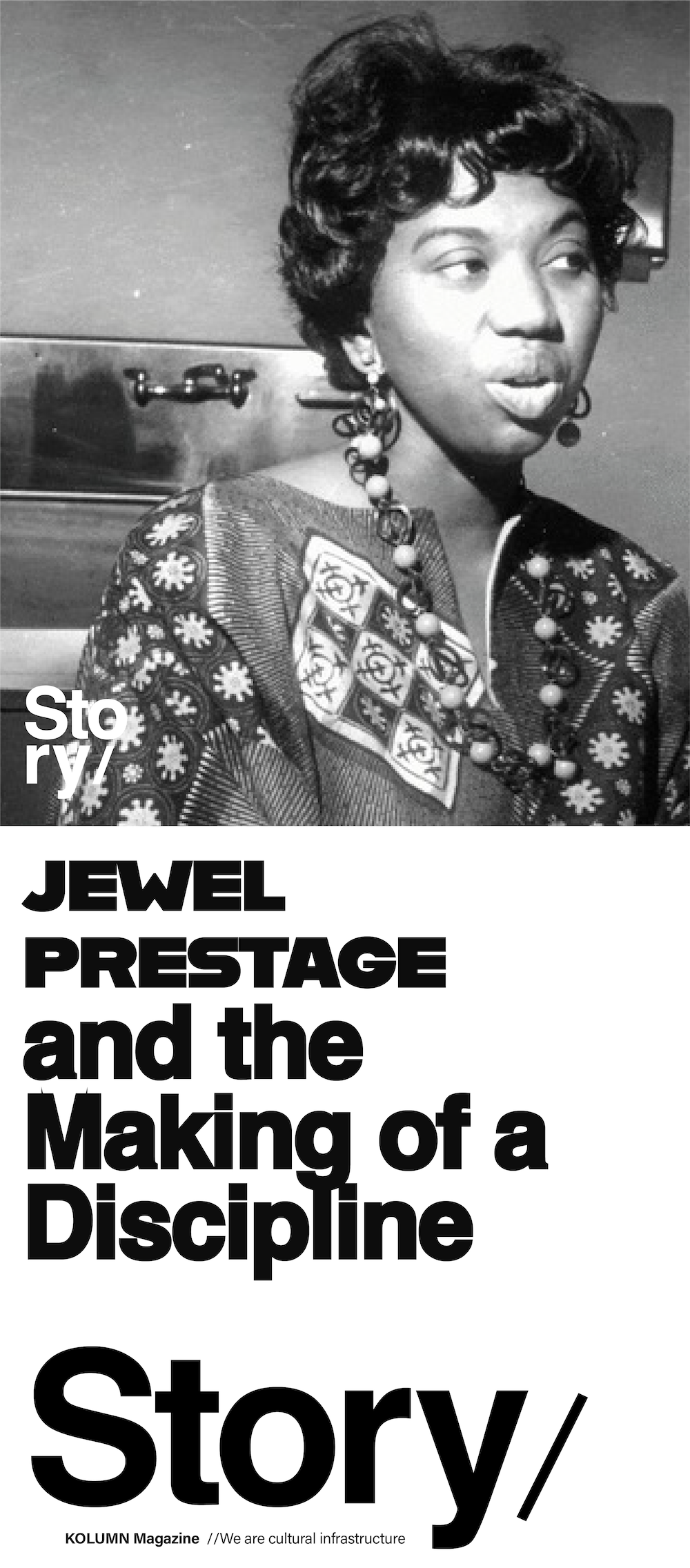
She was not just a barrier-breaker. She was an institution-builder.
By KOLUMN Magazine
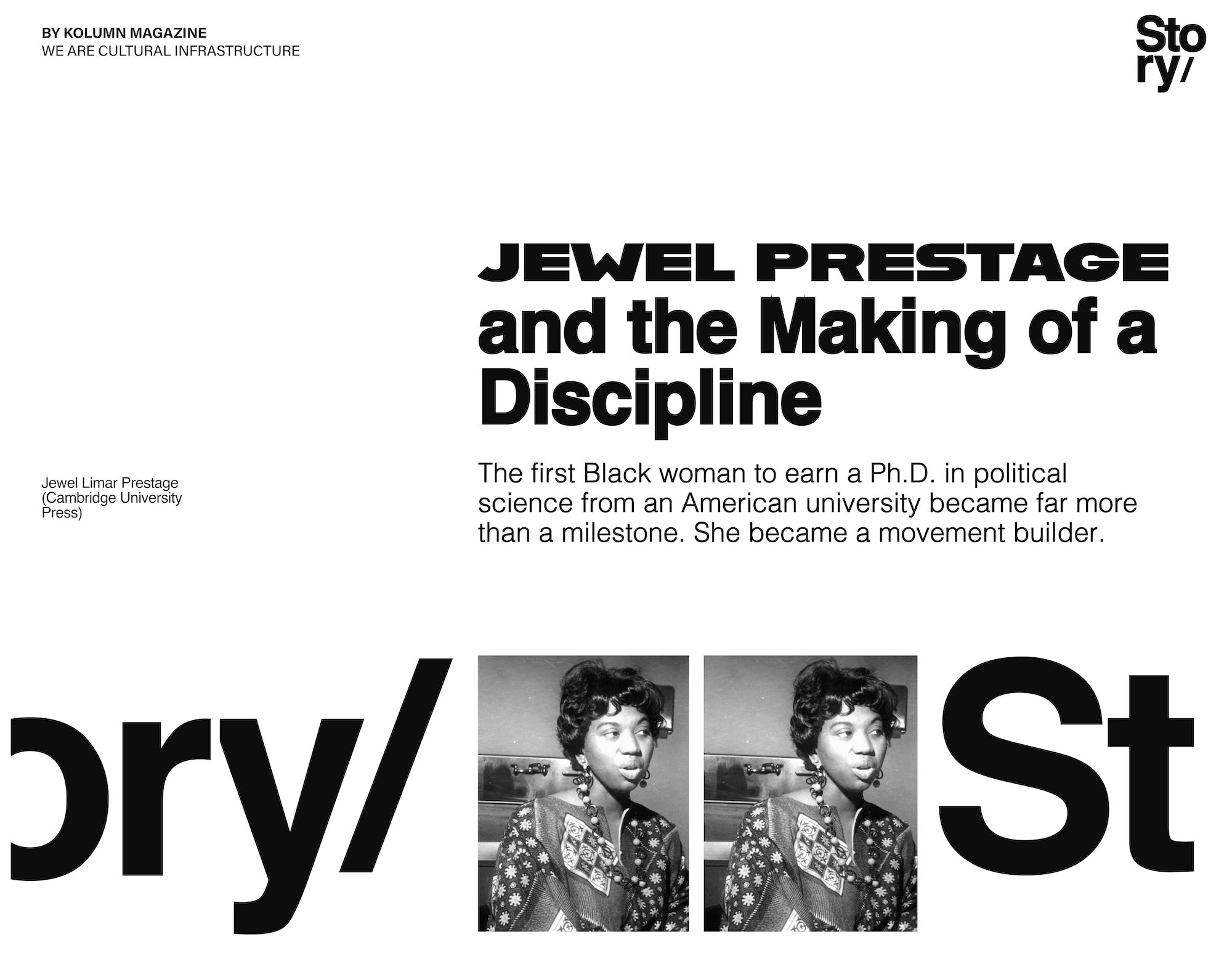
Jewel Prestage is not nearly as famous in the broader public imagination as many of the politicians, activists, or movement icons whose names fill Black history calendars and college lecture halls. But in political science, especially in Black political science, her footprint is enormous. Prestage was the first Black woman to earn a Ph.D. in political science from an American university, completing the degree at the University of Iowa in 1954 when she was just 22 years old. Over the decades that followed, she became a professor, department chair, dean, scholar of Black women’s politics, founder and builder of professional institutions, voting-rights activist, mentor to scores of students, and a living bridge between civil-rights struggle and academic transformation. She was called, with good reason, “the Mother of Black Political Science.”
That title can sound ceremonial until you sit with the scale of what she actually did. Prestage did not simply arrive first. Plenty of “firsts” are reduced to trivia, flattened into commemorative plaque language. Her career mattered because she converted singular achievement into durable infrastructure. She used the access she wrested from a segregated system to expand opportunity for other Black scholars, especially Black women, and to legitimize lines of inquiry that mainstream political science had either neglected or dismissed. Her work helped make the study of Black political behavior, Black women’s political participation, and race-and-gender power dynamics harder to ignore in a discipline that had long preferred to universalize white experience.
Prestage’s life also complicates the way people tend to separate “activist” from “academic,” as if scholarship exists in one room and struggle in another. In her case, the rooms were connected. She studied political participation, but she also registered Black voters. She wrote about Black women in politics, but she also trained and assisted Black elected officials. She served in major academic organizations, but she also helped found the National Conference of Black Political Scientists after it became clear that the existing discipline was not doing enough to support Black scholars or seriously engage Black political life. That combination of rigor and grounded public purpose is what makes her story feel so urgent now.
That distinction matters because too much of American memory is built around exceptional individuals who are celebrated for surviving systems rather than transforming them. Prestage transformed them. Or, where transformation failed, she built alternatives. Her legacy lives not only in citations and awards, but in departments, conferences, mentorship networks, graduate pipelines, and the careers of people who were able to imagine themselves in the field because she had already made room.
A Louisiana beginning in a segregated America
Jewel Limar was born on August 12, 1931, in Hutton, Louisiana, to Sallie Bell Johnson and Brudis Leroy Limar. She was raised in a large family and later moved to Alexandria, where she attended Peabody High School and graduated as valedictorian at 16. The biographical details can sound straightforward on paper, but the context was anything but. She came of age in the Jim Crow South, in a region where race determined not only where one could live, vote, study, and work, but also what kinds of ambition were treated as imaginable. For a Black girl in that setting to become a political scientist was already unusual. To become one of the most consequential people in the history of the discipline was something else entirely.
She enrolled at Southern University in 1948 and graduated summa cum laude in political science in 1951. Southern was not merely the place where she earned a degree; it was one of the central institutions that shaped her intellectual and political formation. Historically Black colleges and universities have long served as places where Black talent, otherwise constrained by segregation and discrimination, could be cultivated at a level often overlooked by mainstream histories. Prestage’s career is one more reminder that HBCUs were not peripheral to American democracy. They were among its most important training grounds.
Her next step exposed the ugly mechanics of segregation in higher education. Louisiana State University, the state’s flagship public institution with a doctoral program in political science, did not admit Black students. Rather than integrate LSU, Louisiana paid for Black students like Prestage to attend out-of-state institutions. In Prestage’s case, that meant the University of Iowa, where the state reportedly covered her tuition to preserve segregation at home. She earned her master’s degree there in 1952 and her doctorate in 1954. It is one of the enduring ironies of Jim Crow that the same machinery designed to exclude her also helped create the conditions under which she would become impossible to erase.
There is a temptation to tell that chapter as a triumphal story and stop there: young genius defeats discrimination, history made. But that would miss the deeper point. Prestage herself understood that being first in a white institution was not the same as being fully welcomed into a profession. The issue was not just access to a credential; it was access to mentorship, networks, validation, and a field of study prepared to see Black lives as central rather than marginal. She would spend much of her career answering those deficits directly.
The significance of being first, and why she refused to stay singular
In 1954, when Prestage completed her Ph.D., the accomplishment was historic: she became the first Black woman in the United States to receive a doctorate in political science from an American university. The age matters too. She was 22. Universities and scholarly associations still cite that milestone today, from the University of Iowa to Southern University to Prairie View A&M and APSA. But Prestage’s importance lies less in the symbolic value of the first than in what she did after it. She did not turn herself into a monument. She turned herself into a pathway.
“Her greatest legacy abides in the generations of students she mentored.”
She began teaching at Prairie View in 1954 and soon moved to Southern University, where she spent the core of her career and served in multiple leadership roles, including chair of the political science department and later dean of the School of Public Policy and Urban Affairs. Southern University’s own memorial account says that during her tenure, the department became the nation’s leading catalyst for the development of African American Ph.D.s in political science. That is not a minor administrative accomplishment. It suggests that Prestage understood departmental leadership as a political project: who is recruited, who is trained, who is encouraged to continue, and whose scholarship is treated as legitimate all shape the future of a discipline.
This is where the phrase “Mother of Black Political Science” starts to make analytical sense rather than just sentimental sense. She mentored widely and deliberately. A tribute in National Political Science Review credits her with influencing the development of 45 Ph.D.s and more than 200 lawyers, judges, elected officials, administrators, military officers, engineers, and business executives. Students and protégés became known as “Jewel’s Jewels,” which could sound cute if the underlying substance were not so serious. In a profession where Black scholars were often isolated, underfunded, or treated as niche figures, Prestage created a culture of expectation and belonging.
The most effective mentors do more than give advice. They change the horizon of what seems attainable. Prestage seems to have done exactly that. She had known firsthand what it meant to move through academic spaces without Black women ahead of her in the room. Later commentary on her career has emphasized that she stepped into that absence and filled it for others. She was a model for later scholars not only because she had credentials, but because she combined intellectual seriousness with practical commitment to students’ lives and institutions’ futures.
She did not just study Black politics. She widened the discipline
One of the clearest measures of Prestage’s importance is how often later scholars describe her as someone who moved a whole area of inquiry into view. The Center for American Women and Politics at Rutgers noted in 2024 that Prestage was the first political scientist to center Black women’s politics as a standalone inquiry in American politics. That phrasing is crucial. It means not just that she included Black women somewhere in the margins of her work, but that she treated their political behavior, political representation, and political participation as worthy of direct, sustained analysis on their own terms.
That was a genuinely field-shifting move. For a long time, political science often treated white men as the unmarked norm, white women as the gendered exception, and Black people as a racial category too often studied through pathology, deviance, or crisis. Black women, positioned at the intersection of race and gender, were frequently rendered invisible even within subfields that claimed to be about participation and representation. Prestage pushed against that erasure. Her work on African American women legislators and on Black women’s role in the political process challenged a profession that had not yet developed the conceptual habits to take those subjects seriously.
Her 1977 co-edited volume A Portrait of Marginality became a standard work on women in politics, according to the Texas State Historical Association. The title alone is revealing. Prestage was interested in how structural exclusion shapes political behavior, not because marginalized people are somehow deficient, but because political systems distribute visibility, access, and power unevenly. She was among the first to bring the theory of marginality into political science in a way that illuminated Black women’s political lives. Later work, including her 1994 essay “The Case of African American Women and Politics,” reinforced that Black women could not remain an afterthought in the discipline’s account of American democracy.
What now seems obvious was not obvious then. Today, Black women’s politics is a recognized and expanding field, especially in a period when Black women voters, candidates, organizers, and officeholders are central to national political analysis. But the newer visibility of that scholarship can obscure how much intellectual groundwork had to be laid for the field to exist. Rutgers’ 2024 spotlight makes that lineage explicit, connecting contemporary scholarship on Black women in politics back to Prestage’s earlier insistence that Black women were not incidental to American politics. They were one of its key interpretive centers.
Scholar and organizer, not scholar or organizer
Prestage’s activism was not ornamental to her academic life. It was part of how she understood citizenship. Accounts of her career consistently note that she and her husband, James J. Prestage, were active in the community surrounding Southern University, including work to register Black citizens to vote through the Second Ward Voters League. She later established and directed the Louisiana Center to Assist Black Elected Officials, where she helped register voters and train Black officeholders. If that sounds like a practical extension of her scholarship, that is because it was. Prestage studied political participation while also helping build it.
That pattern makes her especially interesting as a historical figure. American institutions often reward academics for appearing detached from the populations they study. Prestage moved in the opposite direction. She believed that research on Black politics should clarify how power works, but also assist Black communities in navigating and reshaping that power. In that sense, she belonged to a long Black intellectual tradition in which scholarship is not merely interpretive. It is also civic, strategic, and accountable.
Her activism showed up inside the university too. Southern University’s account of her death recalls that during student demonstrations in the 1960s, she was a “firm but quiet supporter” of student protest, and that administrators sometimes viewed her as too involved. She reportedly kept the letter signed by faculty and administrators supporting the demonstrations. That detail says a lot. Prestage was not a loud public performer of radicalism, at least not in the way history often celebrates. But she was willing to place herself at risk inside the institution in defense of student demands and Black democratic expression.
There is a lesson there for the present. Universities today love to celebrate diversity in retrospective language while disciplining the people who make equity claims in real time. Prestage lived that contradiction decades earlier. Her life reminds us that Black advancement within institutions has often depended on people who were polished enough to survive professionally and stubborn enough to resist quietly being absorbed.
Building Black political science when the profession lagged behind
If Prestage had only published and taught, her place in history would still be secure. But she also helped build the professional world Black political scientists needed in order to thrive. She was among the founders of the National Conference of Black Political Scientists, the organization known as NCOBPS. A historical record on the organization’s founders notes that in 1970 Prestage and Mae C. King helped organize the pivotal Baton Rouge conference that gave birth to NCOBPS, at a time when APSA had long neglected the engagement of Black political scientists.
This is a vital part of her legacy because disciplines do not change through argument alone. They change through organizations, conferences, journals, committees, mentoring structures, funding streams, and gatekeeping fights over legitimacy. If Black scholars are absent from those spaces, or if their work is treated as secondary, entire research agendas can be delayed by decades. Prestage seems to have understood that point clearly. When existing professional structures were insufficient, she helped create better ones.
Her leadership inside the broader profession was also substantial. The Texas State Historical Association notes that in 1973 she became the first woman and the first African American to serve as president of the Southwestern Social Science Association. The University of Iowa’s profile highlights that she later served as vice president of the American Political Science Association, president of the Southern Political Science Association, and president of the National Conference of Black Political Scientists. These roles show that she was not operating at the margins of professional life. She was helping direct it.
That institutional labor is often undervalued because it does not always read as glamorous in a résumé line. But for scholars who came after her, it mattered immensely. Professional associations are where younger academics find mentors, present work, meet collaborators, and get a sense of whether the field has room for them. By leading and shaping those spaces, Prestage helped ensure that Black political science was not merely an insurgent conversation happening off to the side. It had a home, a network, and increasingly, a future.
The pipeline was part of the politics
Prestage’s role in the Ralph Bunche Summer Institute is another example of how seriously she took the long view. APSA states that the program was created in 1986 through a partnership involving APSA, the Committee on the Status of Blacks in the Profession, and faculty members Jewel L. Prestage and Peter Zwick. The program’s goal was to increase diversity in political science by introducing African American students to graduate study and senior scholars in the field. APSA’s Prestage-Fenno Fund, which supports expanded opportunities for students considering advanced training in political science, explicitly honors her role as the institute’s first director.
The pipeline metaphor is overused in higher education, but in Prestage’s hands it meant something concrete. She did not simply argue that the discipline needed more Black scholars; she helped build a mechanism to find them early, train them seriously, and keep them connected to the profession. An APSA working-group report found that 19 alumni from the institute’s early phase, when Prestage was involved, earned Ph.D.s. For a discipline historically short on Black representation, that kind of intervention is transformative.
And again, the numbers only tell part of the story. Programs like the Ralph Bunche Summer Institute matter not just because they improve graduate-school application rates, but because they change the social psychology of belonging. Students who might have been the only Black person in their department, or the only person interested in race and politics, get to experience an intellectual community in which their questions are normal, rigorous, and worth pursuing. Prestage knew from lived experience how valuable that kind of environment could be.
Her public life extended beyond campus walls
Prestage also moved in policy and public-service circles. Prairie View A&M notes that she was appointed by President Jimmy Carter and confirmed by the U.S. Senate to serve on the National Advisory Council on Women’s Educational Programs in the U.S. Department of Education. That service aligned with her long-standing interest in education, women’s access, and civic preparation. It also reinforced the point that her expertise was not confined to classrooms or journals. She was part of broader national conversations about equity and educational opportunity.
Even so, what feels most striking about her public life is how local and national work fed each other. She could serve in major professional organizations and still stay deeply tied to the work of helping Black voters and Black officeholders in Louisiana. She could produce scholarship on marginality and political participation while also supporting students navigating concrete institutional barriers. That scale-shifting capacity is one reason her career feels so modern. She understood that structural change requires action at multiple levels at once.
Why her legacy still lands so hard now
In 2026, it is easier than it once was to find commentary on Black women’s political power. It is routine to hear analysts discuss Black women as a decisive constituency in Democratic politics, a crucial organizing force, or an expanding group of elected leaders and public intellectuals. But that visibility has a prehistory, and Prestage belongs near its center. Rutgers’ Center for American Women and Politics was explicit about that in 2024, naming her as the first political scientist to make Black women’s politics a standalone area of inquiry. That matters because the public conversation often treats Black women’s political sophistication as newly discovered, when in fact scholars like Prestage were documenting and theorizing it decades earlier.
Her story also lands differently in an era when universities and public institutions are again wrestling, or pretending to wrestle, with attacks on diversity, equity, and inclusion. Prestage’s career is a reminder that inclusion was never a natural byproduct of institutional progress. It had to be demanded, organized, researched, defended, and taught into being. Black scholars did not simply enter an open profession. They built footholds inside a reluctant one.
There is another reason she matters now: mentorship has become an increasingly fragile ideal in higher education, often celebrated rhetorically while faculty workloads, budget cuts, and institutional precarity make sustained guidance harder to deliver. Prestage represented a model of mentorship as vocation and discipline-building practice. NCOBPS still gives an annual mentorship award in the Prestages’ name to recognize professors who demonstrate that same spirit of commitment to students. Awards do not preserve a legacy by themselves, but they do signal what a field chooses to honor. In this case, the field is still honoring the thing she did best: multiply possibility.
“A discipline is not only what it publishes. It is who it trains, who it notices, and who it makes room for.”
That might be the most useful way to understand Prestage. She changed all three. She produced scholarship that widened the frame. She trained people who would transform classrooms, courtrooms, offices, and public life. And she helped make room where little had existed before. Her achievements were elite, but her legacy was collective.
The quiet enormity of Jewel Prestage
Jewel Prestage died on August 1, 2014, at age 82. By then she had spent nearly half a century in higher education, including decades at Southern University and a later chapter at Prairie View A&M, where she served as professor and dean of the Benjamin Banneker Honors College before retiring in 2002. Institutions mourned her as a trailblazer, and they were right to do so. But that language, though accurate, can still undersell the depth of what she left behind. Trailblazers make it through. Prestage made it possible for others to follow, stay, and lead.
That is why any serious account of her life has to hold several truths at once. She was a first, yes. She was a brilliant scholar, yes. She was an educator, yes. But she was also a citizen activist, an architect of Black professional life, and an early theorist of Black women’s politics in a field that badly needed correction. Her life offers a counternarrative to the idea that academic work is somehow removed from democratic struggle. In Prestage’s career, scholarship and democratic expansion were intertwined.
It is also worth noting that her story exposes the unevenness of public memory. Someone of her influence should arguably be far better known outside academic and HBCU circles than she is. The relative scarcity of mainstream treatment compared with the magnitude of her contributions says something about whose forms of leadership get canonized widely and whose remain under-acknowledged. Prestage’s life does not need embellishment. It needs fuller circulation. That, too, is part of the work of fair historical reporting.
In the end, Jewel Prestage’s significance is not reducible to a single milestone, title, or office held. It is the sum of a way of moving through American life: brilliant without being remote, ambitious without being detached from community, institutionally accomplished without forgetting the people institutions leave out. She studied power, but she also redistributed some of it. She was denied equal access by segregation, then spent a lifetime widening access for others. She saw Black women where the discipline barely looked. She saw Black students where the profession saw scarcity. She saw future scholars where other people saw exceptions. And then she did the practical, patient, unglamorous work of helping bring that future into being.
That is not just a good academic legacy. It is a democratic one.
More great stories

Afro Sheen, Wall Street, and the Architecture of Black Possibility
July 6, 2026
No Comments
The Fire Inside the Fourth
July 5, 2026
No Comments