

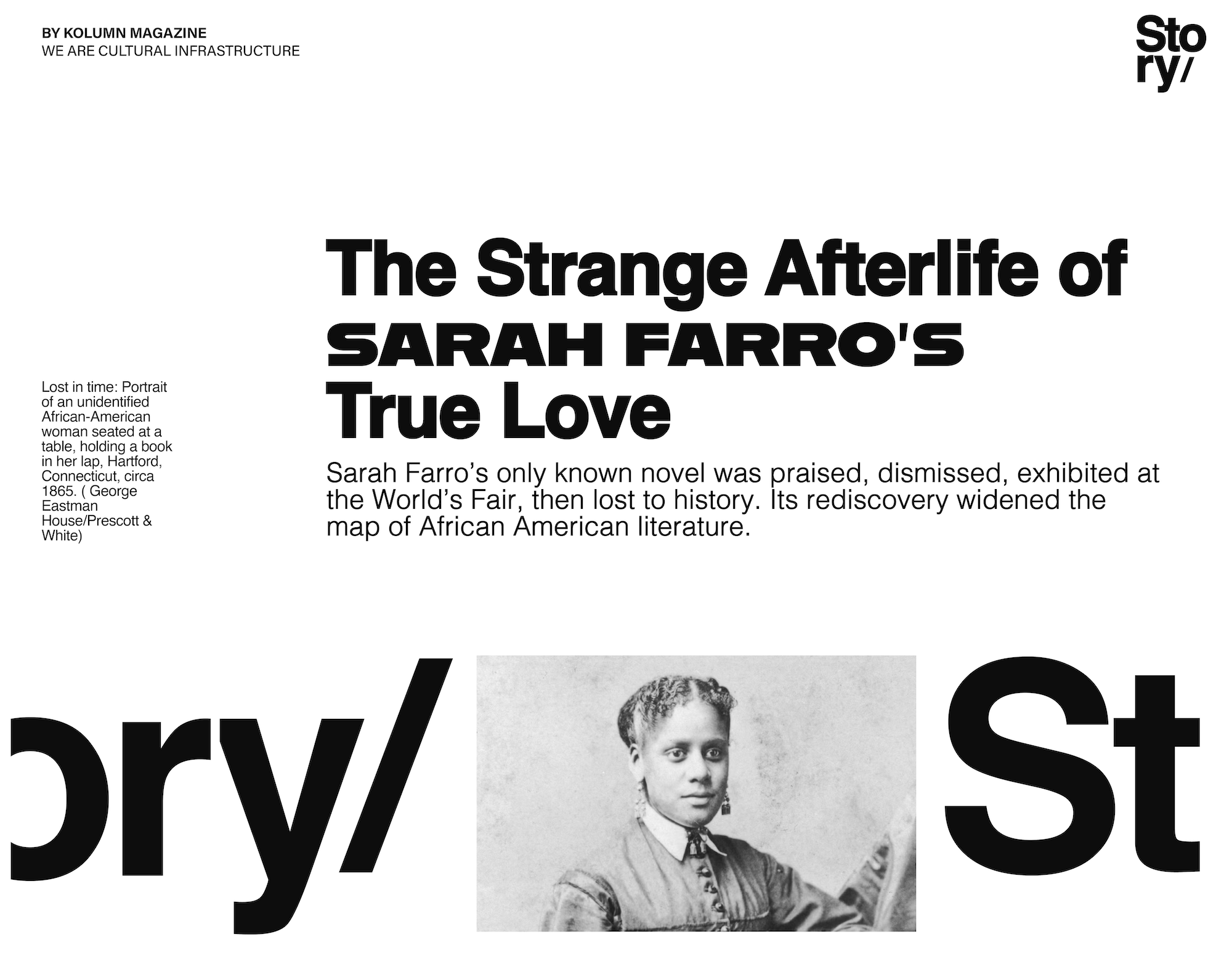
Sarah Farro did not vanish because she wrote nothing. She vanished because literary history did not know what to do with what she wrote.
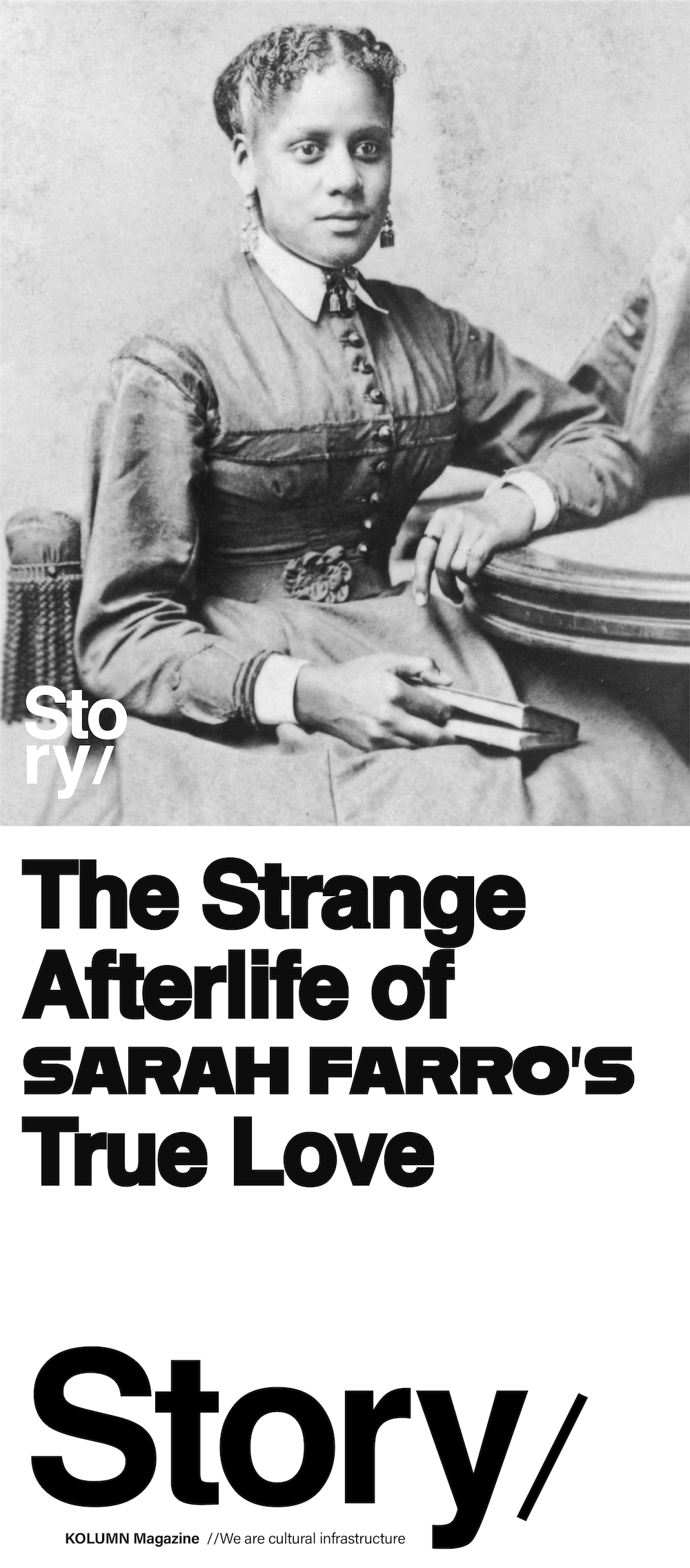
Sarah Farro did not vanish because she wrote nothing. She vanished because literary history did not know what to do with what she wrote.
By KOLUMN Magazine
Sarah E. Farro enters literary history like a figure seen through a half-open door. There is a name. There is a book. There are newspaper notices, census traces, a few tantalizing biographical clues, and then a long silence. Her only known novel, True Love: A Story of English Domestic Life, was published in Chicago in 1891 by Donohue & Henneberry, and the surviving copy now digitized by the Internet Archive identifies the book as a 121-page work of English-set fiction. Project Gutenberg, which made the novel widely available online in 2020, describes it as a late-19th-century domestic story centered on the Brewster family and the emotional complications surrounding two sisters, Mary Ann and Janey, in an English social world of courtship, obligation, grief and propriety available through its public-domain edition.
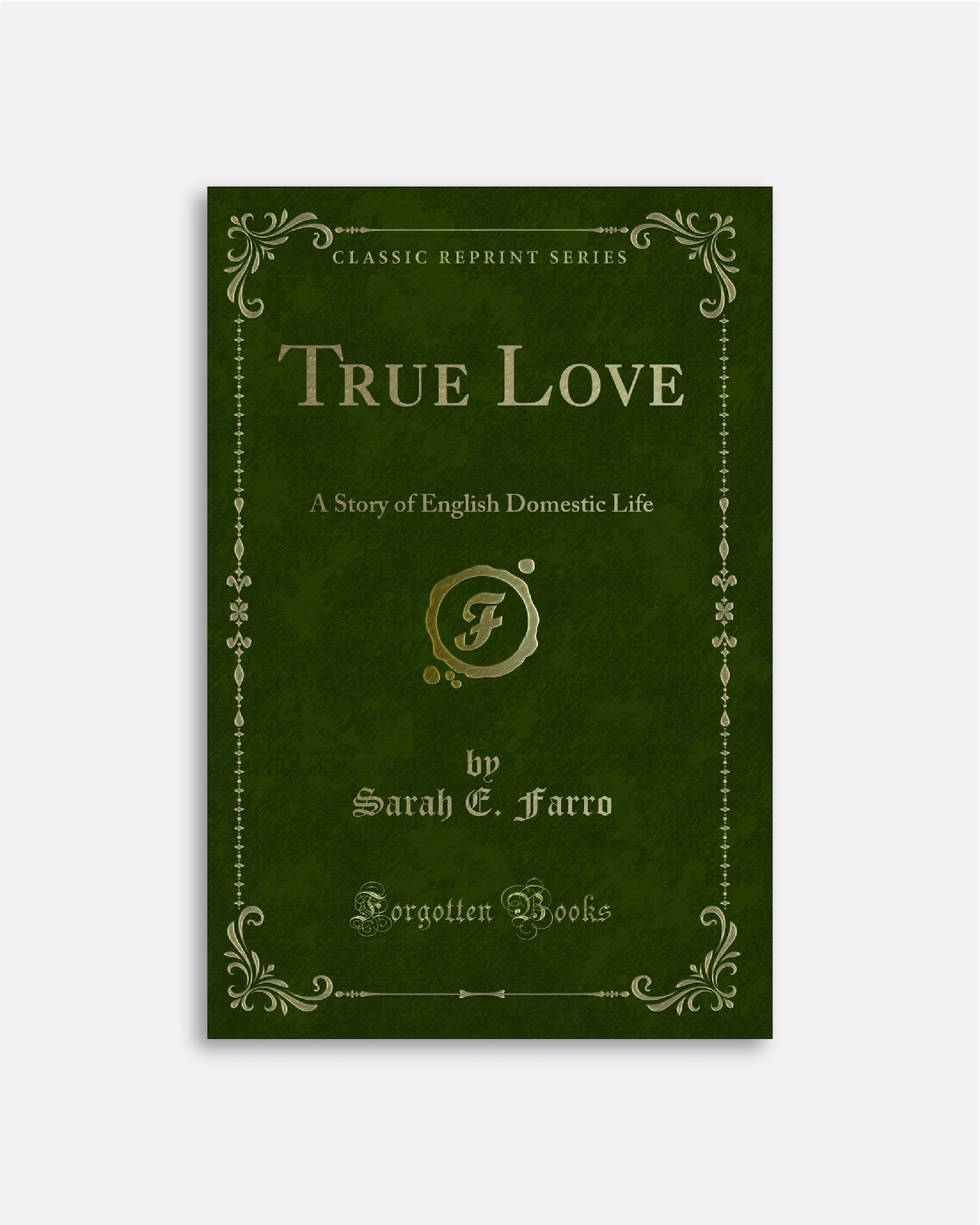
That bare description does not sound revolutionary. It sounds almost aggressively conventional: a Victorian-inflected romance, full of domestic feeling, family interference and moral consequence. But Farro was a young Black woman writer in Chicago at a moment when American publishing was not built to receive her imagination on equal terms. Newspapers of the period called her “the first negro novelist,” a claim scholars now know was inaccurate, but one that tells us how startling her appearance seemed to contemporary editors. As Gretchen Holbrook Gerzina later wrote, she discovered an 1893 notice in London’s Daily Telegraph that announced Farro in those terms while she was researching Black Victorians and Black people in 18th- and 19th-century Britain in an essay republished by Salon from The Conversation.
Her rediscovery matters not because True Love is an undisputed masterpiece, but because the book scrambles assumptions. It is one of the earliest known novels published by an African American woman in the United States, yet it contains no Black characters. It is a Black-authored book that looks toward England, not plantation memory, abolitionist testimony or Reconstruction politics. It sits awkwardly beside the works through which Black women’s 19th-century writing has most often been recovered: Harriet E. Wilson’s Our Nig, Frances Ellen Watkins Harper’s Iola Leroy, Hannah Crafts’s The Bondwoman’s Narrative. Farro’s book asks a less comfortable question: What happens when a Black woman writer claims the right to literary imitation, romance, melodrama, Anglophilia and commercial ambition?
That question places Farro directly inside KOLUMN Magazine’s broader archive of Black literary recovery. Recent KOLUMN profiles have returned to writers such as Frances Ellen Watkins Harper, whose career fused literature, abolition, feminism and democratic critique, and Bebe Moore Campbell, whose fiction and advocacy challenged the silencing of Black interior life. Farro belongs to that lineage, but strangely. Harper wrote into the furnace of racial justice. Campbell wrote into the pressure chambers of race, family, mental health and public silence. Farro wrote a story of white English domestic life. Her significance lies partly in that refusal to behave as the archive expected.
A Young Black Woman in Chicago
What can be said with confidence about Sarah Farro is modest. She was born in Illinois around 1859, likely in Jefferson County, to parents who had migrated from the South. Gerzina’s reconstruction of Farro’s life, summarized in later reporting, places her in Chicago and notes that census records identify her family as Black, with Farro living among relatives in a city that was becoming one of the crucial Black urban centers of the post-Civil War North. The Independent, drawing from Gerzina’s work, reported that Farro’s parents had moved north and that Sarah grew up in Chicago before publishing True Love in 1891 as part of its coverage of her rediscovery.
The tragedy of Sarah Farro is not simply that she was forgotten. It is that the archive hints she may have tried to continue.
Chicago matters here. In the late 19th century, the city was not yet the Great Migration capital it would become in the 20th century, but it was already a site of Black institution-building, aspiration and tension. It offered newspapers, churches, clubs, publishing houses, schools, reform networks and forms of public visibility that could make a figure like Farro briefly legible. Donohue & Henneberry, the Chicago firm that published True Love, was not a Black press. That fact is important. Farro’s entry into print appears to have occurred through a mainstream commercial publisher, suggesting either unusual access, unusual confidence, or both.
Newspaper notices from the period repeatedly emphasized her education and youth. The Indianapolis Journal printed a short item on April 30, 1892, calling Farro “a woman of good education” and placing her age at about 26, while noting that the first edition of True Love was nearly exhausted and that she was reportedly writing another story in a digitized newspaper page preserved by Hoosier State Chronicles. A Georgia paper, The Carnesville Tribune, reprinted a similar notice later that year, again describing her as a young educated woman from Chicago and stating that the book’s first edition was nearly exhausted in its December 14, 1892 issue.
Those notices give us two facts and one ghost. The facts: Farro was noticed, and her book circulated enough to be discussed beyond Chicago. The ghost: a second novel was said to be in progress. No such book has surfaced.
The Book That Did Not “Fit”
True Love opens with a preface that sounds both modest and ambitious. Farro writes that she is entering “a field which has been diligently cultivated by the best minds in Europe and America,” and that her design is to give the public a sketch of her ideas on the effect of “true love” in the digitized text hosted by Project Gutenberg. She wanted, she said, to make the plot exciting without becoming sensational or common, and to create characters whose thoughts, passions, language and conduct readers could judge according to circumstance.
That preface deserves attention. Farro was not presenting herself as a racial witness or political lecturer. She was presenting herself as a novelist entering a cultivated field. She named the field as transatlantic: Europe and America. She was not asking permission to write only what white America expected a Black woman to write. She was claiming access to literary convention itself.
The novel’s subtitle — A Story of English Domestic Life — announces its imaginative geography. It is a book of drawing rooms, family pressure, emotional misunderstanding, moral testing and class-coded aspiration. Its plot involves white English characters and the thwarted relationship between Charles Taylor and Janey Brewster. In a 2018 reading of the novel, the literary blog Reading Avidly noted that Farro’s characters move within “the confines of social convention in true Victorian fashion,” and that race has no explicit place in the story in a review that also engages Gerzina’s interpretation.
For decades, that absence may have worked against Farro. When Black women’s 19th-century literature was rediscovered in the 20th and early 21st centuries, the works most readily canonized were those that spoke directly to slavery, race, gender and citizenship. Wilson’s Our Nig exposed Northern racism and indentured servitude. Harper’s Iola Leroy addressed slavery, Reconstruction, education, racial uplift and Black womanhood. Crafts’s The Bondwoman’s Narrative, acquired and edited into public view by Henry Louis Gates Jr., was interpreted as a major fugitive-slave novel. Farro’s True Love did not enter that conversation easily because it did not seem to be making the expected claim.
But expectation is not the same as meaning.
Gerzina argued that Farro’s apparent refusal of racial subject matter may explain why her book disappeared from literary memory. In her 2016 essay, she wrote that other recovered works by African American women were noticed partly because they wrote about race, while Farro’s novel “doesn’t fit the mold” because it is a domestic romance tending toward melodrama and featuring white characters as republished by Salon. That is a crucial historiographical point. The archive did not merely lose Farro; later recovery habits may have overlooked her because she complicated the recovery story.
Historiography and the Problem of “Firsts”
Farro’s life sits inside a long scholarly argument over literary firsts. In the 1890s, newspapers could call her “the first negro novelist” because they did not have the evidence or inclination to recognize earlier Black novelists. Today, scholars identify William Wells Brown, Frank J. Webb, Harriet E. Wilson, Hannah Crafts and Frances Ellen Watkins Harper as part of the 19th-century Black novel tradition. Kelsey McKinney’s essay on Farro, published in Defector’s predecessor newsletter archive and later available on Substack, makes the point bluntly: American literary culture has repeatedly misidentified the “first” Black woman novelist because the archive keeps changing as lost texts are found in her essay on Farro and literary rediscovery.
Farro widens the question from “Who was first?” to “What kinds of Black imagination did the canon fail to recognize?”
That does not diminish Farro. It clarifies her. Her importance is not that she was first in an absolute sense. Her importance is that she expands the known range of what Black women were publishing, imagining and attempting in the 19th century. George Mason University’s digital project page for The Portable Nineteenth-Century African American Women Writers notes that the anthology includes a selection from Farro’s True Love, describing it as a Dickensian novel unusual because an African American writer imagines white characters’ lives without engaging race in its entry on the anthology. That inclusion is itself a historiographical correction. Farro becomes evidence against a narrow canon.
The recovery of Farro also shows how much Black literary history depends on accidents of preservation. Gerzina found Farro while reading old British newspapers. A single notice opened a trail. That trail led to a book few had read, to scattered newspaper clippings, to census records, to the realization that one of the few Black women to publish a novel in the 19th century had been sitting outside the standard story. The lesson is not only that Farro was forgotten. The lesson is that forgetting is often organized by genre, race, market and scholarly habit.
Expert Voices and a New Argument
The most important expert voice in Farro’s modern recovery is Gretchen Holbrook Gerzina, a scholar of Black British history and biography whose work has long challenged assumptions about Black presence in Britain and the Atlantic world. Gerzina’s own biography notes that she “rediscovered a forgotten early novel by an African American woman, Sarah E. Farro, of Chicago,” and that publicizing the discovery brought wide attention to Farro on her author website. UMass Amherst later reported that Gerzina’s discovery of Farro and True Love received major attention after she discussed it at the American Literature Association and published on it in 2016, with the essay reaching tens of thousands of readers and being picked up by other outlets in a university news item.
But scholarship has not stopped with recovery. In 2022, Carme Manuel Cuenca published a major article in Revista de Estudios Norteamericanos arguing that True Love is not merely a derivative Victorian-style novel but an unacknowledged and meticulous reworking of Ellen Wood’s 1863 sensation novel The Shadow of Ashlydyat. The article’s abstract calls Farro’s text a “plagiarist reconfiguration” and argues that her raceless plot and borrowing from Wood should be understood not simply as failure, but as an act of self-affirmation and literary ambition that may have contributed to her ostracism in the journal’s article page.
That argument complicates the romance of rediscovery. It asks readers not to sentimentalize Farro into a pure lost genius. It asks us to read her as a writer in the marketplace, working through imitation, adaptation, appropriation and ambition — practices hardly unknown in 19th-century literary culture. Victorian fiction itself was full of borrowing, serialization, influence and formula. The question is why Farro’s borrowing should be treated as uniquely disqualifying, especially when white writers were often permitted the full range of influence and imitation without being erased from literary history.
Cuenca’s reading is valuable because it shifts the discussion from representation to technique. Farro was not simply a Black woman who wrote white characters. She may have been a Black woman strategically rewriting a popular English novel in order to enter a literary field from which she had been structurally excluded. That does not erase the ethical issue of unacknowledged borrowing. It deepens it. Farro’s work becomes a case study in authorship under unequal conditions: What counts as originality when the gate is already guarded? What counts as theft when the literary marketplace itself has stolen possibility from entire classes of writers?
The World’s Fair and the Edge of Recognition
Farro’s book did not disappear immediately. It was visible enough to be included among 58 books by Illinois women writers exhibited at the 1893 World’s Columbian Exposition in Chicago, according to Swann Galleries’ description of a rare copy of True Love in its auction listing. The World’s Fair was a massive stage of American self-display: empire, industry, racial hierarchy, women’s achievement, technological spectacle and cultural ambition all arranged for public consumption. Farro’s presence there matters. She was not merely a private curiosity. Her book was placed within a public exhibit of women’s literary production.
Farro’s great audacity was not that she wrote about England. It was that she wrote as if the whole literary world was available to her.
And yet the recognition was fragile. Newspaper commentary on Farro often filtered her through racist novelty. Her Blackness made her publishable as a story; it did not necessarily make her readable as an artist. McKinney notes that newspapers around the country recycled the “first negro novelist” framing, and that some reviews evaluated her work through racist assumptions rather than literary fairness in her essay. This is the trap Farro faced: her race generated publicity, but the book she wrote did not satisfy racial expectation.
That trap remains familiar. Black writers are often praised when they provide usable testimony and treated as puzzling or evasive when they claim other terrains. Farro’s English domestic setting may have seemed to some critics like imitation rather than imagination. But imitation can also be a form of trespass. By writing into a white English genre, Farro entered a room not built for her and behaved as though she belonged there.
The Silence After True Love
The silence after True Love is one of the most haunting parts of Farro’s story. Newspaper notices suggested she was writing another book. No second novel has been found. The first book became rare. Her name dropped from literary histories. Even after the recovery of Wilson, Harper and Crafts, Farro remained outside the conversation until Gerzina’s discovery brought her back into view.
The known end of her life is also uncertain. The Independent reported that Farro was honored in 1937 at a Chicago event celebrating “outstanding race pioneers,” but that she apparently never published another novel in its account of her rediscovery. That recognition is poignant. It suggests that Farro remained known in some Black Chicago circles even as national literary memory forgot her. The community may have remembered what the canon did not.
This gap between community memory and institutional memory is central to Black cultural history. Archives are not neutral containers. They preserve what institutions value, what families can keep, what libraries acquire, what scholars know to search for, what markets reprint and what teachers assign. Farro’s disappearance was not inevitable. It was produced by a chain of exclusions: race, gender, genre, scarcity, critical expectation and the fragility of cheap 19th-century print.
Swann Galleries’ listing for a rare copy of True Love describes the book as printed on pulpy paper, brittle with age, bound in brick red cloth and rare in libraries in its auction description. That material description is almost symbolic. The book survived, but barely. So did the author.
Why Sarah Farro Still Matters
Farro matters because she forces a fuller account of Black women’s literary ambition. She was not writing from the center of a movement. She did not leave behind a large body of work. She did not become a public intellectual like Harper or a recovered canonical landmark like Wilson. Her importance is more elusive and, in some ways, more modern. She exposes how literary history sorts Black women into acceptable categories: protest writer, race woman, witness, activist, moral instructor, folk voice, trauma bearer. Farro was none of these in any simple way. She was a novelist of domestic melodrama who wanted to enter a transatlantic literary field.
That does not make her apolitical. The politics are in the claim. In 1891, for a Black woman to publish a novel about white English life was to assert that imagination did not have to be segregated. Her book may be conventional, imitative, melodramatic and uneven. It may also be brave. Those things can coexist.
Farro’s recovery also matters for readers now because it resists the flattening of Black literary history into a single heroic line. The tradition is not only speeches, slave narratives, protest novels and uplift fiction. It is also romance, experiment, imitation, failure, ambition, marketplace calculation, private fantasy and strange detours. A living canon must be able to hold all of that.
KOLUMN’s broader work of recovering Black cultural figures rests on this principle: significance is not always the same as fame. A figure may matter because she altered a field, because she revealed a contradiction, because she left behind a document that changes the map. Sarah Farro changes the map. She shows that Black women were not merely writing back to America. They were also writing across oceans, into borrowed forms, toward imagined rooms of literary belonging.
The Door She Left Open
There is no neat ending to Sarah Farro’s story. We do not know enough. We do not know why she stopped publishing. We do not know whether the rumored second book was completed, rejected, lost or abandoned. We do not know how she understood the reviews that greeted True Love, or whether she saw the World’s Fair exhibit as vindication. We do not know whether she considered herself a pioneer, a professional, a hobbyist, a romantic, a strategist, or simply a writer who had a story to tell.
But the surviving record is enough to demand attention. A young Black woman in 1890s Chicago published a novel with a mainstream press. Newspapers noticed. The first edition appears to have sold. The book was exhibited at the World’s Fair. Then the author vanished from the literary record until a scholar, searching old British newspapers more than a century later, found the clue that brought her back.
That is not a minor story. It is a warning about how much remains misplaced.
Sarah Farro’s legacy is not only True Love. It is the challenge her book poses to every archive that confused absence with nonexistence. She reminds us that Black literary history is still being written, still being corrected, still being pulled from brittle paper and stray clippings and misfiled notices. She reminds us that the canon is not a monument. It is a search.
And somewhere in that search, Farro stands again: not as the first, not as a perfect symbol, not as a writer easily made useful, but as something more difficult and more interesting — a Black woman who wrote beyond the role assigned to her, entered the cultivated field, and left behind a book that refused to stay buried.
More great stories
Afro Sheen, Wall Street, and the Architecture of Black Possibility
July 6, 2026
No Comments
The Fire Inside the Fourth
July 5, 2026
No Comments