





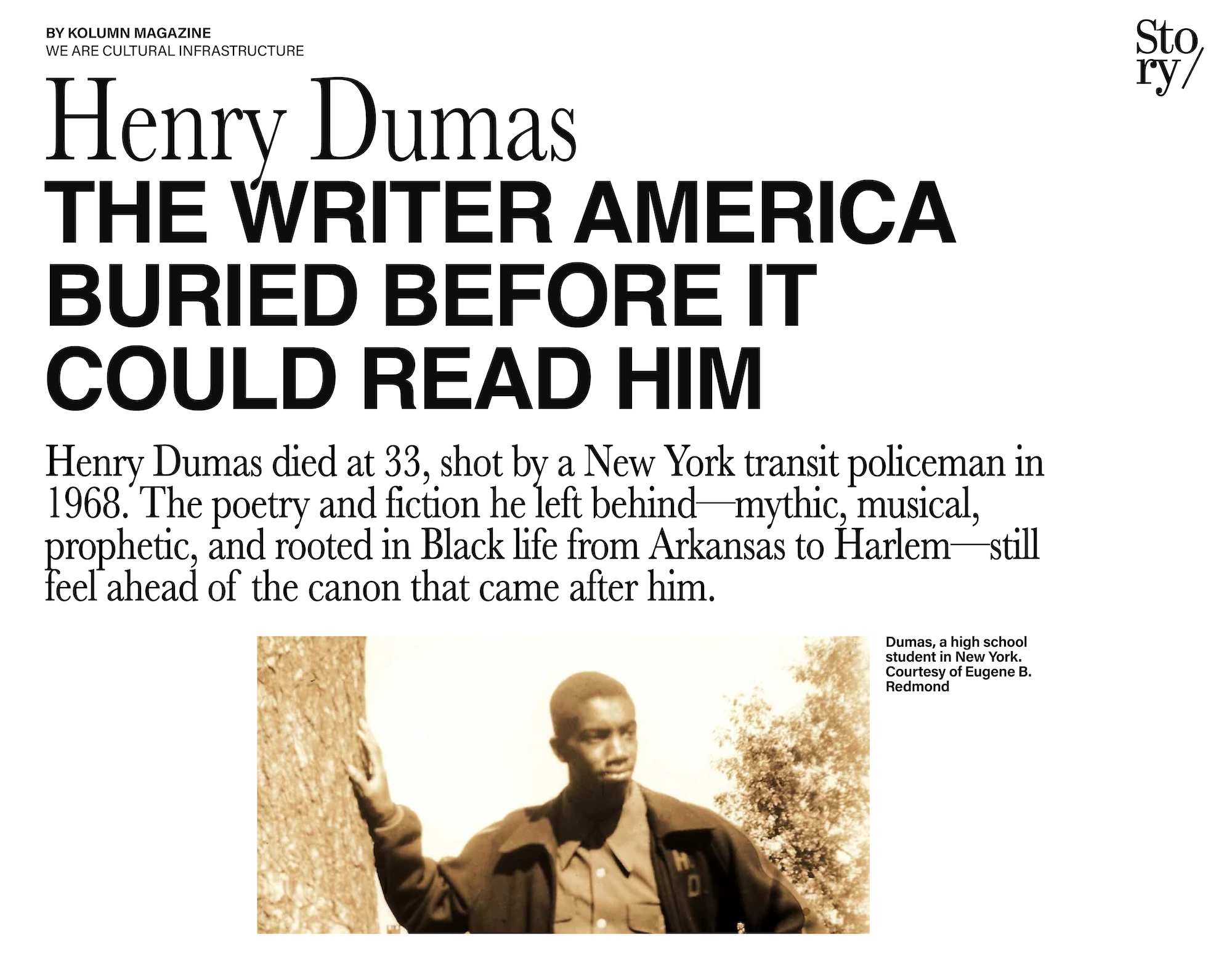
Henry Dumas was not simply a promising writer cut down too soon. He was a fully formed literary intelligence whose work still makes the canon look smaller than it should.
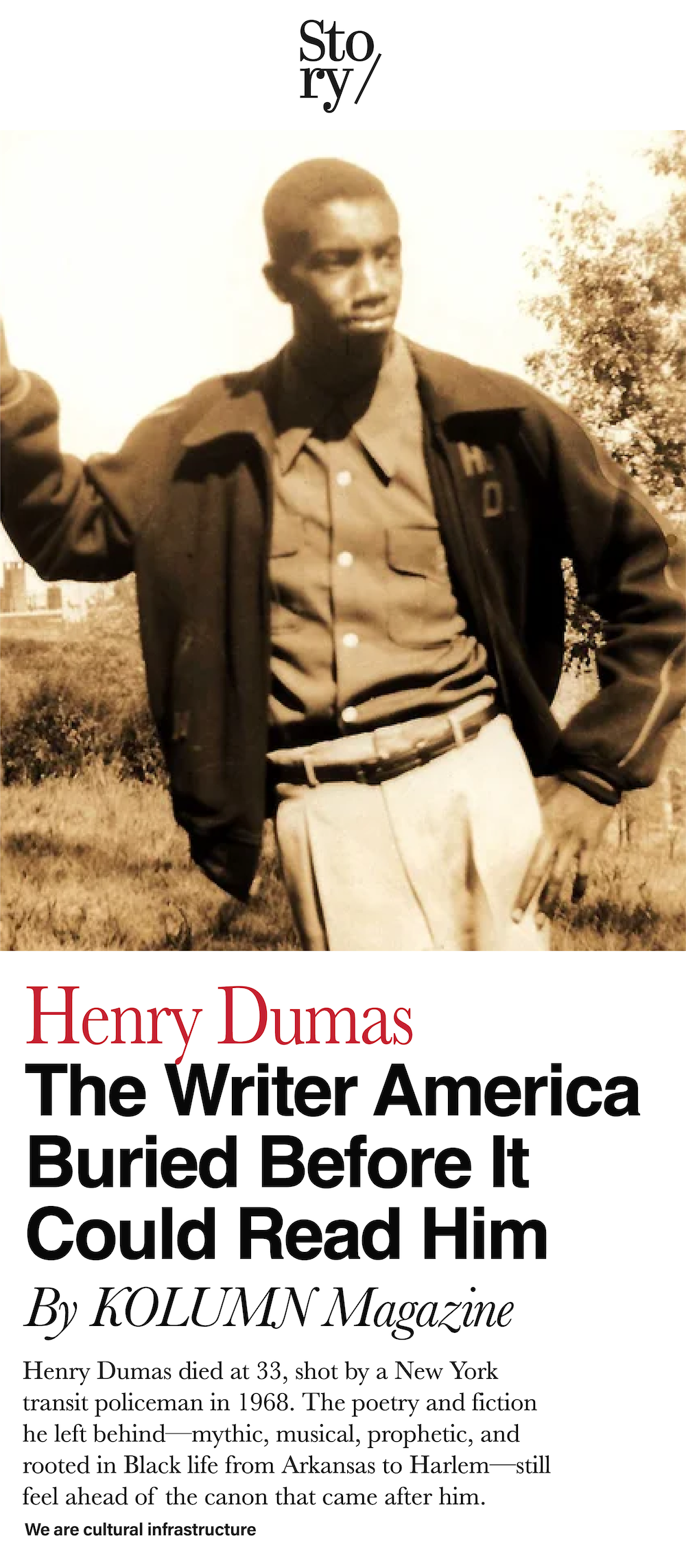
Henry Dumas was not simply a promising writer cut down too soon. He was a fully formed literary intelligence whose work still makes the canon look smaller than it should.
By KOLUMN Magazine
There are writers whose reputations arrive on time, landing neatly inside the institutions built to greet them. Then there are writers whose significance becomes clearer only after those institutions have failed—failed to publish them adequately, failed to protect them, failed to place them where they belong in the national story. Henry Dumas belongs to the second category, and perhaps to it more painfully than most. He died in 1968 at the age of 33, shot by a New York Transit policeman at the 125th Street station in Harlem. The circumstances remain contested and incomplete in the historical record. What is not contested is the magnitude of the loss. By the time he was killed, Dumas had already produced a body of poetry and fiction strong enough that Toni Morrison would later call him “an absolute genius,” and strong enough that Eugene Redmond would spend decades making sure the work did not disappear with the man.
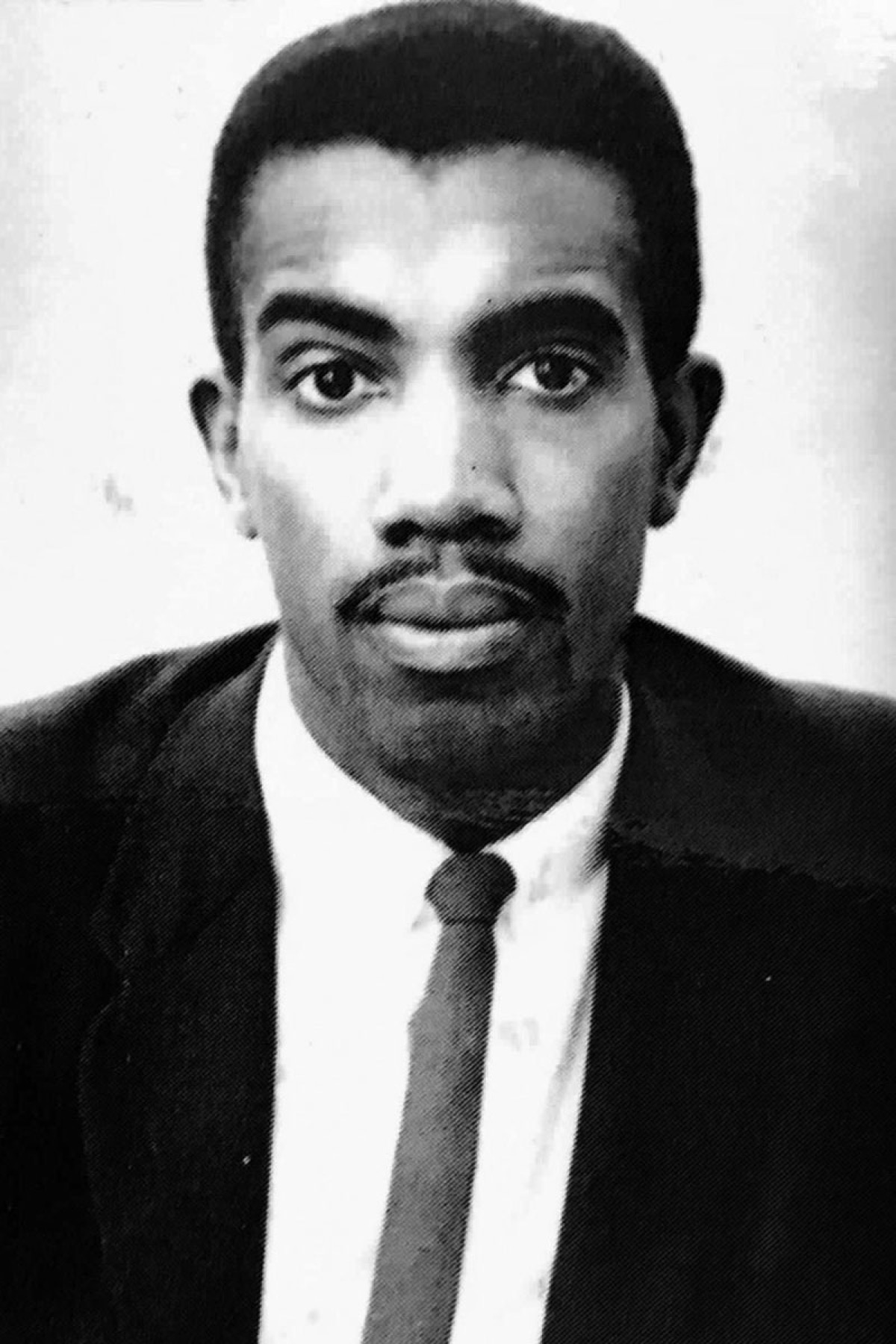
To write about Dumas now is to write against several kinds of erasure at once. One is the oldest American habit: reducing Black brilliance to posthumous regret. Another is the more literary habit of keeping certain writers as whispered legends—praised by poets, scholars, and insiders, but never fully placed before the broader reading public in proportion to their achievement. Henry Dumas has lived for decades in that unstable space between reverence and underrecognition. He has been a writer’s writer, an editor’s cause, a scholar’s recurring revelation, a name that keeps resurfacing whenever the conversation turns to Black Arts, Black mysticism, Black experimental prose, or the long prehistory of what the marketplace now likes to package as speculative Black literature.
Beyond Category: The Shape of a Singular Voice
What makes Dumas especially important is that he does not fit cleanly into a single frame. He was a poet, but not only that. He was a fiction writer, but not only that. He wrote out of the Black South and out of Harlem, out of church tonalities and jazz intelligence, out of folklore and political struggle, out of vernacular speech and visionary imagination. He belongs to the Black Arts Movement, but he also exceeds the shorthand often used to describe it. If some accounts of the movement emphasize manifesto, confrontation, public rhetoric, and nationalist clarity, Dumas reminds us that Black Arts also made room for dream states, supernatural crossings, diasporic myth, sonic experimentation, and formal risk. His work is not merely political in the declarative sense. It is cosmological.
For KOLUMN readers, that matters immediately. This magazine has already been making a larger argument across its recent cultural essays: that Black intellectual and artistic history is not only the story of the most famous names, but of foundational figures whose influence has often been deeper than their name recognition. KOLUMN’s recent pieces on Toni Morrison, Sterling A. Brown, and Alice Childress all work from that premise, showing how Black literary culture has been shaped not only by celebrity but by infrastructure, pedagogy, vernacular authority, and the refusal of easy categories. Dumas belongs naturally in that company. Like Brown, he trusted Black speech as a bearer of artistry and philosophy. Like Morrison, he treated Black life as a world-making force rather than a sociological exhibit. Like Childress, he stood outside the tidy timelines by which American institutions prefer to certify genius.
From Sweet Home to Harlem: Geography as Inheritance
Dumas was born Henry Lee Dumas on July 20, 1934, in Sweet Home, Arkansas, sometimes rendered in his imaginative universe as Sweetwater. He lived there until age ten, when his family moved to Harlem. That geography—the passage from Black southern rural life to Black northern urban life—became one of the central crossings in his work. The Arkansas of Dumas is not sentimental plantation scenery, nor is it merely a backdrop for terror. It is a place of beauty, deprivation, memory, ancestral residue, ecological presence, and hard racial truth. The Harlem of Dumas is not simply modern contrast. It is another node in the same Black world, charged differently but linked by migration, improvisation, and survival. That ability to join southern and northern Black life without flattening either into stereotype is one of the deepest sources of his originality.
The known facts of his biography help explain the range of his sensibility. He graduated from Commerce High School in Harlem in 1953, attended City College briefly, then joined the U.S. Air Force. He was stationed in San Antonio and on the Arabian Peninsula, experiences that widened his cultural field beyond the familiar national script. He married Loretta Ponton in 1955, later studied at Rutgers without completing a degree, worked at IBM, worked as a social worker, and remained active in civil-rights work, including transporting food and clothing to protesters in Mississippi and Tennessee. By 1967 he had taken positions at Hiram College and then Southern Illinois University’s Experiment in Higher Education program in East St. Louis, where he met Eugene Redmond. That meeting would become one of the decisive preservation stories in modern Black letters.

The Ecosystem of Black Literary Survival
The usual way of summarizing such a life is to call it varied. That is true, but insufficient. What mattered is how those experiences entered the work. Dumas was never a writer cut off from institutions, labor, or ordinary Black pressures. He knew military discipline, academic aspiration, wage work, community struggle, and the improvisational networks of little magazines. The Academy of American Poets notes that he edited and published a number of small magazines, including Anthologist, Untitled, Camel, Hiram Poetry Review, and Collection. That detail is easy to skim past, but it matters enormously. Dumas was not only producing literature; he was already part of the ecosystem that helps literature move. He understood, instinctively or explicitly, that Black writing survives through networks of circulation as much as through individual talent.
This is one of the reasons his posthumous life in print feels so fitting, even in its sadness. He was exactly the kind of writer who required a community of caretakers after his death because he had already been living inside such a community while alive. Redmond, who met him in East St. Louis in 1967, recognized both the quality of the work and the scale of the loss. In a recollection published by The Yale Review, Treasure Shields Redmond describes the intellectual and artistic kinship between the two men, their shared Arkansas roots, and the ways they imagined the emerging field of Black Studies together. Dumas was not an isolated genius wandering in from nowhere. He was already in conversation with peers, already participating in a collective reimagining of Black art and Black knowledge.
The Sound of Vision: Language as Force
The work itself bears that collective charge, but never at the cost of singularity. Dumas’s poems and stories do something rare: they feel orally alive without becoming casual, and visionary without becoming abstract. Toni Morrison, speaking to The Washington Post in 1988, put the matter with unusual precision. Dumas, she said, had “the ability to combine the esthetic characteristics of black art” with “the demands of literature.” She went further, stressing the “oral origins” of Black art and Dumas’s extraordinary capacity to translate the sensuality and glamour of spoken language into print. That is not generic praise. It is a technical assessment from one of the greatest stylists and editors of the twentieth century, and it captures what lesser descriptions often miss. Dumas did not decorate literature with Blackness. He allowed Black expressive culture to shape the literature from the inside out.
His stories make this plain almost immediately. They move with parable-like force while remaining lodged in ordinary lives. Children, laborers, migrants, seekers, fathers, lovers, poor Black southerners, Harlem figures, musicians, elders, and dreamers populate his work. Yet realism in Dumas is always unstable, always porous. The visible world is never all there is. Rivers think. Bones remember. Trees hold knowledge. Music becomes transmission. The dead remain proximate. Violence is both social fact and metaphysical disturbance. His fiction repeatedly stands at the threshold between the recognizable and the uncanny, but it does so in a specifically Black idiom, drawing on African American spirituality, folklore, music, and the afterlives of enslavement and migration. That is why later critics have so often treated him as a precursor to Afrosurrealism and Afrofuturism, even though those labels became culturally common long after his death.
The Threshold Between Worlds
John Keene, writing in The Baffler in 2021, called Dumas a “genre-breaking forerunner of Afrofuturism,” a phrase that matters because it is not merely retrospective branding. Keene’s broader point is that Dumas was already fashioning new aesthetic forms adequate to Black political and spiritual transformation. He drew from realism, gothic strain, supernatural fiction, Black oral traditions, and diasporic cosmology while remaining rooted in the urgencies of his era. Put differently, Dumas was not “ahead of his time” in the empty way that phrase is often used. He was rigorously of his time and yet writing beyond the boundaries by which his time tried to define literary seriousness.
The timing of that work is crucial. Dumas came of age during civil-rights struggle, decolonization, Black Power, and the rise of Black Arts. The Academy of American Poets notes his direct involvement in civil-rights support work, and the Redmond family account in The Yale Review places him squarely inside the transition from civil rights to Black Power and the cultural front of the Black Arts Movement. But unlike many simplified textbook summaries of the era, Dumas did not write as though political commitment required aesthetic narrowness. He could be militant without being schematic. He could be spiritual without becoming vague. He could be fierce without sacrificing tenderness. He could be experimental without severing himself from ordinary Black language. Those combinations are part of why he has continued to feel so modern.
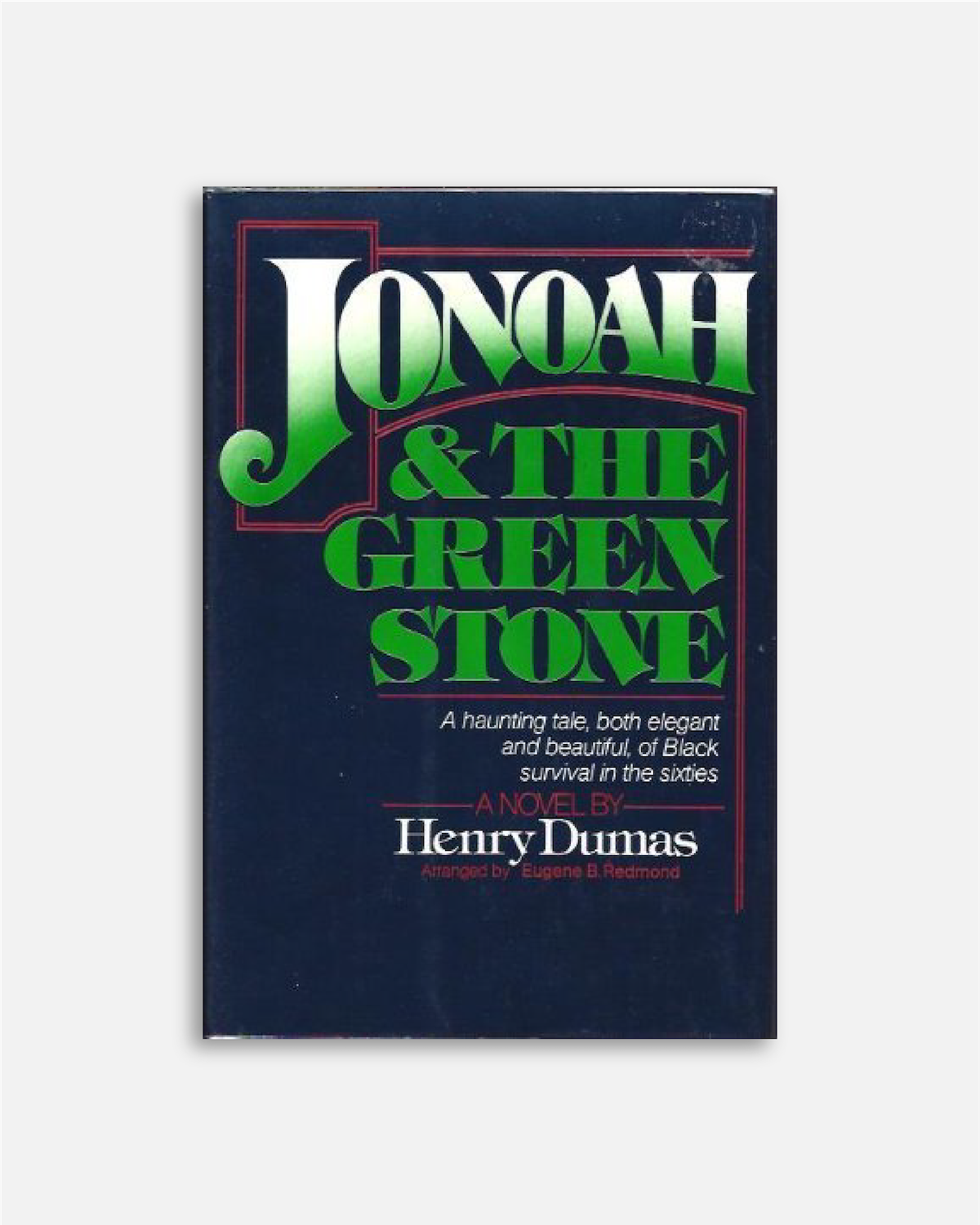
His publication history tells the story of a career interrupted and then painstakingly reassembled. During his lifetime, only a small amount of his work appeared in journals and little magazines. After his death, Poetry for My People and Ark of Bones and Other Stories first appeared in 1970. Then Toni Morrison, working at Random House, helped bring out Play Ebony, Play Ivory in 1974 and Ark of Bones in a wider trade context the same year. An unfinished novel, Jonoah and the Green Stone, followed in 1976. Later collections included Rope of Wind and Other Stories, Goodbye, Sweetwater, Knees of a Natural Man, and eventually Echo Tree: The Collected Short Fiction of Henry Dumas, which gave newer readers the fullest sense yet of the breadth of his fiction. This sequence matters not only bibliographically, but interpretively: Dumas’s reputation has always depended on editorial labor, literary devotion, and the refusal to let an estate become an archive of almost.
The early critical response, where it existed, was strikingly strong. The Academy of American Poets notes Julius Lester’s judgment in The New York Times Book Review that Dumas was “the most original Afro-American poet of the sixties.” The Washington Post later repeated that assessment while emphasizing Morrison’s sense of Dumas’s technical achievement. Critics writing about later reissues continued to stress both the power of the work and the oddity of its partial neglect. A Kirkus review of Echo Tree described Dumas as a late, lamented, and influential icon of the Black Arts Movement whose reappearance in print could connect to a new Black Lives Matter generation of readers. That sort of phrasing risks marketing shorthand, but in this case it points toward a real phenomenon: every couple of decades, literary culture seems to rediscover Henry Dumas and realize again that he should never have required rediscovery in the first place.
Violence, Memory, and the Problem of Recognition
His death remains one of the unavoidable facts of his story, but it should not be the only one. On May 23, 1968, Dumas was shot by a New York Transit policeman at the 125th Street station. The Encyclopedia of Arkansas describes the details as “sketchy and controversial,” noting that some evidence suggested mistaken identity while other evidence suggested the officer believed Dumas was reaching for a weapon. Keene, writing in The Baffler, calls the killing mysterious and stresses how few could have known, at that moment, the artistic loss it represented. Ta-Nehisi Coates, in The Atlantic, reproduced Morrison’s stark summary: a young Black man went through a turnstile, a transit cop shot him in the chest, and the circumstances remained unclear. The opacity of the record is part of the wound. So is the familiarity of the pattern.
That familiarity is what made Dumas newly legible to so many readers in the 2010s and 2020s. Ebony’s 2015 essay “Why This Author Murdered by the Police in 1968 Matters Right Now” argued that the justice system had effectively lost Dumas’s case, and framed him as a symbol of the unnamed Black people maimed, murdered, or mistreated by police power and institutional indifference. The phrase “right now” was doing important work there. Ebony was not modernizing Dumas artificially. It was recognizing that the country had not solved the conditions that made his death both plausible and forgettable. In that sense, Dumas became contemporary again not because the present discovered him, but because the present repeated him.
The Unfinished Center of the Canon
Still, to reduce him to a precursor of Black Lives Matter would be another kind of diminishment. Dumas’s relevance is larger than the fact that his death resembles later police killings. His work had already been imagining Black vulnerability, Black transcendence, and Black forms of knowledge in ways that outran the narrow political vocabulary often imposed on Black literature. His stories do not merely document racist violence. They ask what kinds of consciousness survive it, what ancestral or musical resources stand against it, what spiritual technologies Black people have developed to endure a world that repeatedly places them in proximity to erasure. Salim Washington’s scholarship on Dumas and Samuel Delany, for example, traces the role of Black music and Afro-technological imagination in Dumas’s speculative writing. That is a very different claim from saying Dumas is merely “timely.” It suggests he was building a Black epistemology on the page.
There is also the matter of sound. So much writing about Dumas circles back to it because the prose and poetry insist on it. Morrison heard it. Redmond heard it. Later critics heard it. KOLUMN’s own Sterling A. Brown essay makes a useful comparison here, arguing that Brown’s greatness lay in taking Black vernacular as art rather than garnish. Dumas belongs to that lineage, though with a different pitch. Brown’s ear was often documentary, blues-based, anti-caricatural. Dumas’s ear is more incantatory, more visionary, more willing to let speech tip into ritual and revelation. Yet both writers refuse the old literary hierarchy in which Black speech is raw material awaiting refinement. In both, the language comes preloaded with wit, philosophy, rhythm, and memory.
That may be why Dumas continues to attract writers who are themselves interested in the porous line between realism and the fabulous. Coates has spoken of the impact of Dumas’s “Rootsong,” a poem he encountered through poet Joel Dias-Porter and linked Dumas’s mythic handling of African belonging to his own work on Black Panther. Guardian coverage of Afro-surrealism places Dumas within a lineage of Black artists who fused the bizarre, the dreamlike, and the political. Keene emphasizes the range of traditions Dumas fused. Even the trade descriptions for Echo Tree have highlighted the way his stories interweave religion, culture, folklore, race history, and mythic quest. This is the throughline: Dumas’s Blackness is never narrow. It is historical, sonic, spiritual, ecological, erotic, rural, urban, diasporic, and improvisational all at once.
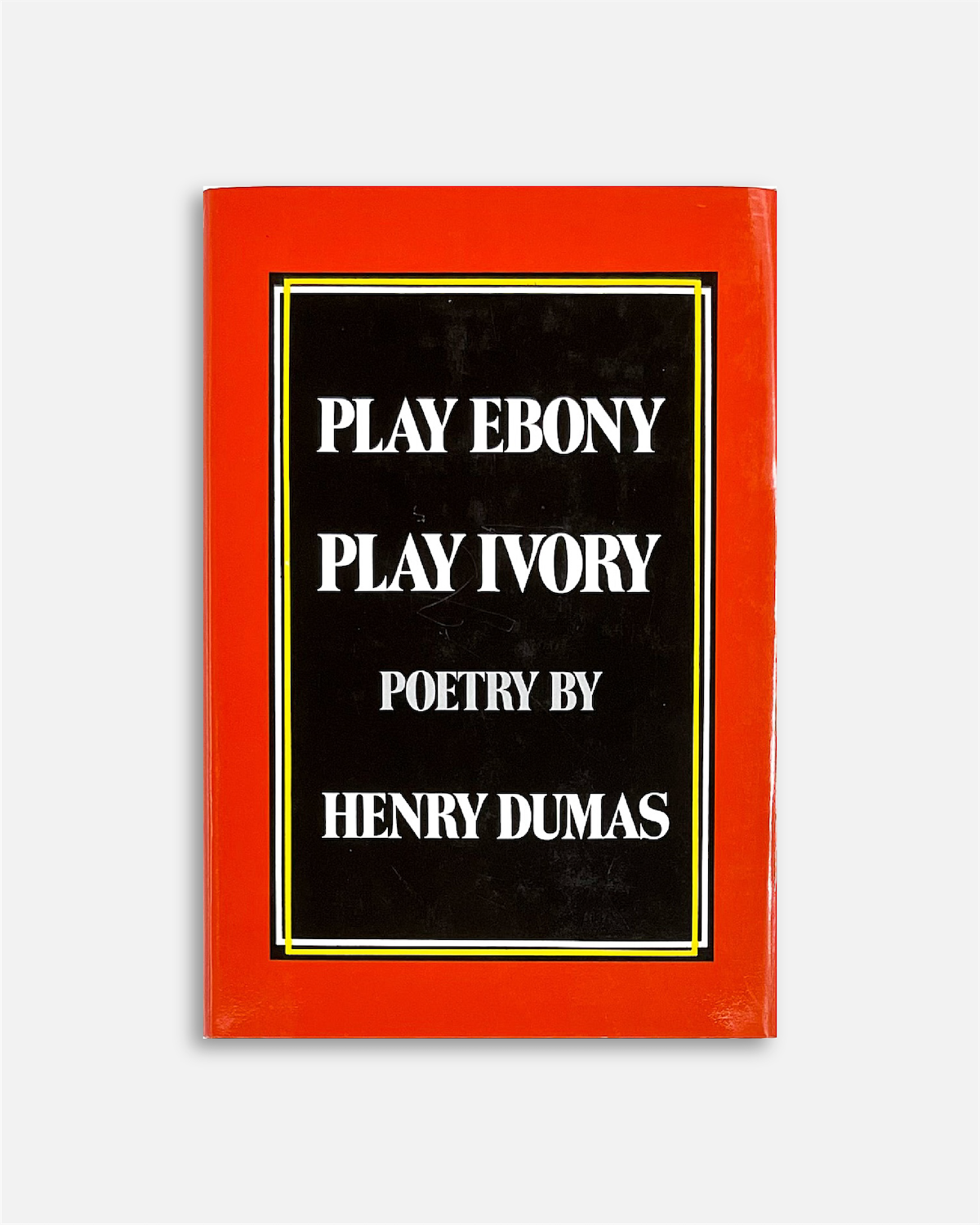
The role of Toni Morrison in Dumas’s afterlife deserves special emphasis, not only because of her stature, but because of what her advocacy reveals about literary history. Morrison did not merely admire Dumas; she used her editorial position to move his work into print. Guardian coverage published today on Morrison’s dual life as writer and editor underscores her role in championing Black authors whose importance was not yet fully recognized by mainstream publishing. The Atlantic, reflecting on Morrison after her death, similarly noted that during her tenure at Random House she acquired and promoted work by Henry Dumas along with other major Black writers. In Dumas’s case, her advocacy was also an act of preservation against historical amnesia. She recognized that what had been left in manuscript was not a side note but a major contribution.
Yet even Morrison could not instantly secure the reception she thought he deserved. In that 1988 Washington Post interview, she noted how poorly the books sold in the 1970s and suggested that Black books had too often been pushed into a “back-of-the-bus” section of bookstores, segregated physically and conceptually from the larger literary marketplace. That observation lands hard now because it names a structural problem still recognizable in subtler forms: Black literature gets celebrated rhetorically while still being siloed institutionally. Dumas’s career, or rather his aftercareer, makes that contradiction impossible to ignore. It was not enough for a great editor to know the work was great. The larger apparatus still had to decide whether Black literature that was poetic, strange, difficult, and posthumous deserved broad attention. Often, it decided no.
This is where KOLUMN’s own editorial line becomes more than decorative comparison. The magazine’s recent essays have repeatedly insisted that Black artists and writers should not have to shrink themselves into easy public archetypes to be considered central. Alice Childress was not “early”; America was late. Sterling A. Brown was not peripheral; the canon was too small. Toni Morrison was not just a laureled novelist; she was also a shaper of literary infrastructure. Henry Dumas fits this grammar exactly. He was never marginal in the imaginative sense. He was made marginal by the lag of institutions, by the violence of his death, and by the difficulty mainstream culture has always had with Black work that insists on being both formally adventurous and communally rooted.
His legacy, then, is not a matter of sentimental what-if alone, though the what-if is unavoidable. Keene writes beautifully of mourning “the lost art that is never to be realized,” and no honest reader of Dumas can avoid imagining what another twenty or thirty years of writing might have produced. But perhaps the better question is not what unwritten masterpieces died with him. It is what, exactly, survived. What survived was a literature already distinct enough to shift the map. What survived was a set of poems and stories capable of influencing writers who came decades later. What survived was a method: Black life rendered as sound, myth, pressure, ritual, history, and improvisation without apology to the conventions of white realism.
And what survived was an example of Black literary stewardship. Eugene Redmond’s role here cannot be overstated. Without him, without Loretta Dumas, without Morrison, without later editors and scholars, Henry Dumas might have remained a rumor. Instead, the work stayed available enough to keep generating new recognition. Treasure Shields Redmond’s essay is especially moving on this point because it frames preservation not as neutral archive work but as familial, historical, and political labor. Dumas’s afterlife was built by people who understood that Black literature is often preserved because someone refuses to let disappearance become official fact.
So what is Henry Dumas’s significance now? It lies partly in what he wrote: poetry and fiction of startling beauty, pressure, and metaphysical range. It lies partly in where he sits historically: at the intersection of Black Arts, civil-rights transition, vernacular experiment, and early Black speculative method. It lies partly in the manner of his death, which makes visible the American habit of cutting Black futures short while leaving the archive of explanation incomplete. And it lies partly in the way his work keeps returning, as if each generation has to discover for itself that the old canon told the story too narrowly.
Maybe that is the clearest way to place him. Henry Dumas was not merely a lost writer of the 1960s. He was, and remains, one of the writers who reveals how much Black American literature was already doing before institutions learned the language to describe it. He wrote a world in which the rural South and Harlem speak to one another, where folklore and terror live in the same house, where music is technology, where the dead continue addressing the living, and where Black language refuses confinement to documentary realism. Read him now and the category of “underread” starts to feel absurdly small. A writer this alive on the page is not simply waiting to be rediscovered. He is waiting to be placed where he should have been all along: near the center of the story.
The canon did not know what to do with Henry Dumas when he was alive. America, in the most brutal sense, did not know what to do with him either. But the page remains. The stories remain. The poems remain. And if there is any justice available now, it is not only in mourning what was taken. It is in reading the work with enough seriousness to understand that Henry Dumas was never a sidebar to Black literature, or to American literature. He was one of its unfinished revelations.
More great stories
Afro Sheen, Wall Street, and the Architecture of Black Possibility
July 6, 2026
No Comments
The Fire Inside the Fourth
July 5, 2026
No Comments