


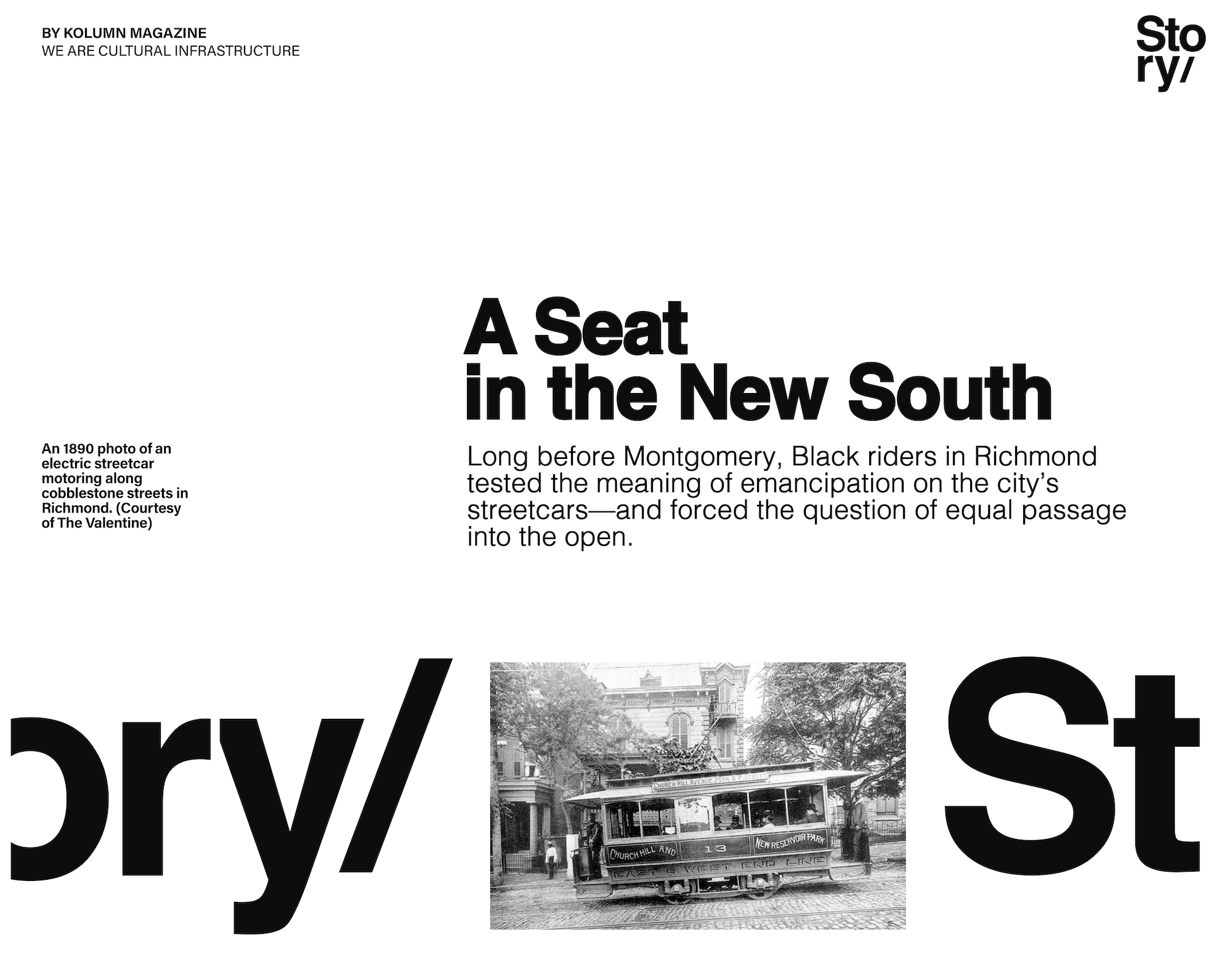
The Richmond Streetcar Protest was not just about where Black riders sat. It was about whether freedom had any standing once it entered public life.
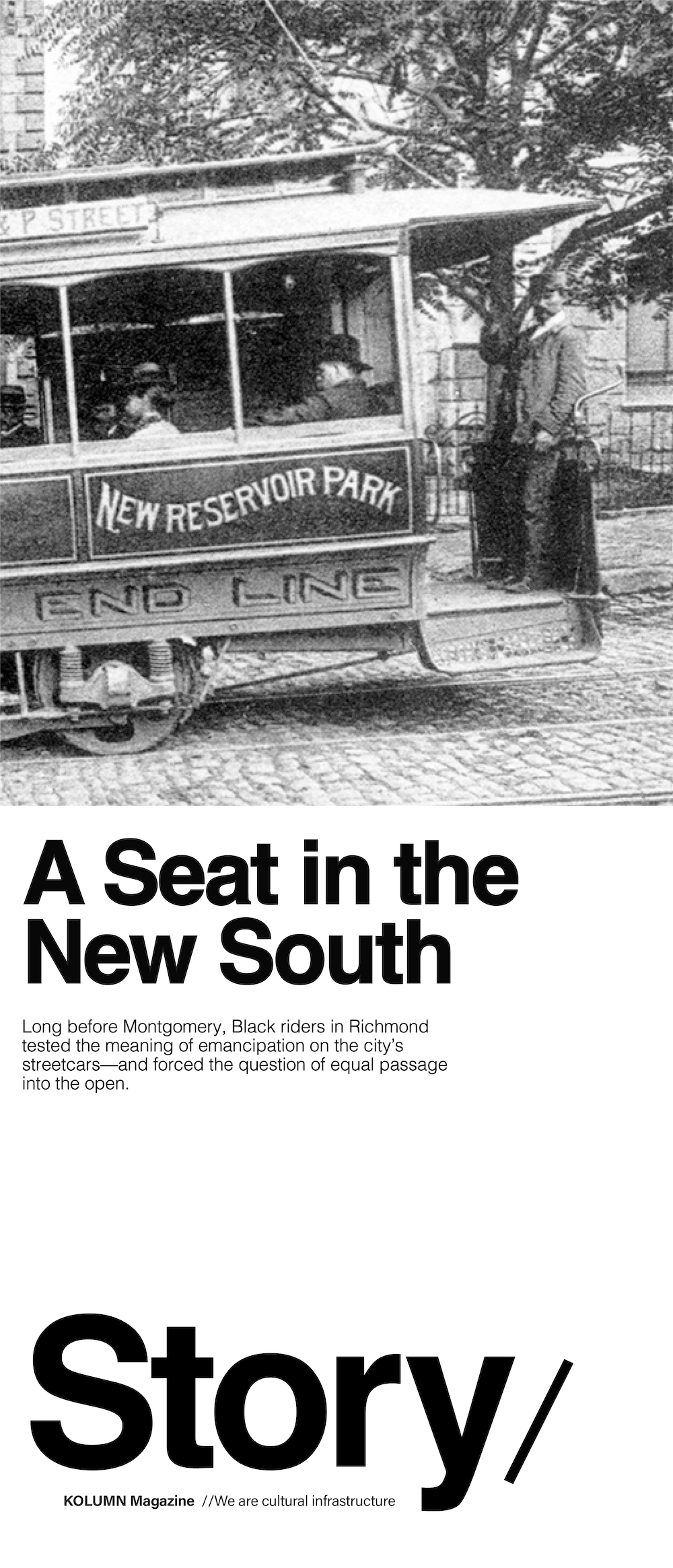
The Richmond Streetcar Protest was not just about where Black riders sat. It was about whether freedom had any standing once it entered public life.
By KOLUMN Magazine
There is a tendency in American memory to flatten the freedom struggle into a neat mid-century timeline: Montgomery, Greensboro, Birmingham, Selma. The story becomes easier to teach that way. It becomes cleaner, more portable, and, not incidentally, more flattering to a country that prefers its radical traditions delayed until television cameras arrive. But the truth is messier and much older. The fight over public transportation did not begin in 1955. It did not begin with the diesel bus, or the language of “modern civil rights,” or the now-canonical iconography of neatly dressed protesters walking to work. In Richmond, Virginia, in April 1867, Black people were already pushing the country toward an answer it did not want to give: if slavery was over, then by what logic could freedom still be ordered to the rear?
That is the power of the Richmond Streetcar Protest. It was not merely an argument about seating. It was a confrontation over the terms of Reconstruction itself. Four Black Richmonders excluded from streetcars staged what a major National Historic Landmarks theme study describes as a sit-in in April 1867, and federal military authorities ultimately overruled local officials who had claimed the private railway could write its own racial rules for paying passengers. Yet the same authorities still permitted segregated cars, a reminder that even Reconstruction’s victories often arrived clipped, compromised, and vulnerable to reversal.
That tension matters because Richmond was not any southern city. It was the former capital of the Confederacy, a place where the symbolism of Black mobility carried unusual force. To board a streetcar there was to do more than commute. It was to test whether emancipation had altered the grammar of everyday life. Could a Black person buy a ticket and expect the rights implied by payment? Could public space actually become public? Or would whiteness remain the invisible fare that mattered more than money, law, or citizenship? The protest forced those questions into the street. It also left behind a template—direct action, community solidarity, legal pressure, moral clarity—that later transportation struggles would echo, whether or not schoolbooks ever connected the dots.
In that sense, the Richmond protest belongs to the longer archive KOLUMN has been tracing in pieces on Black Student Unions and the post-affirmative-action HBCU surge: the recurring American spectacle in which Black people must organize simply to make public institutions live up to their own stated terms. The venue changes. The principle does not. A classroom, a campus, a ballot, a railcar, a streetcar, a bank lobby, a schoolhouse door—again and again, the struggle is over who gets to move through the nation as a full civic presence rather than a tolerated exception.
The city they were trying to enter
To understand why the protest mattered, it helps to remember what Richmond was in 1867: a city living amid the wreckage of war and the unfinished business of emancipation. The Confederacy had fallen, but its social logic had not evaporated with surrender. Richmond remained a place where old elites, old assumptions, and old humiliations still competed with the new demands of Black citizenship. Congress had required former Confederate states to write new constitutions, and in Virginia that process opened a political space in which Black men could vote for delegates to the Constitutional Convention of 1867–1868. The period that followed saw substantial African American political participation: almost 100 Black Virginians would serve in the General Assembly or the convention between 1867 and 1895.
That political opening did not come from benevolence. It came from pressure, federal intervention, and Black insistence. Encyclopedia Virginia notes that before 1865 only adult white men were legally able to vote in Virginia, and that the first election in which Black men voted and those votes counted was the election for delegates to the 1867–1868 convention. In other words, the spring of 1867 was not only a constitutional transition. It was a moment when Black Virginians were actively testing what new citizenship might mean on the ground.
Richmond’s Black institutions had prepared people for exactly this kind of confrontation. In the years before and during the Civil War, Black worshippers at places including Richmond’s First African Baptist Church used religious life not merely for consolation but as a language of collective hope, endurance, and imminent political freedom. Encyclopedia Virginia describes Black churches and preaching in Virginia as spaces where enslaved and newly freed people fused spiritual promise with the expectation of worldly liberation. That matters because protests do not emerge from nowhere. They are organized by people already practiced in reading power, building trust, and moving together.
So when Black Richmonders challenged the city’s streetcars in April 1867, they were doing more than reacting to insult. They were acting from within a newly assertive political culture. They had churches, meeting spaces, networks, and an expanding sense that emancipation was not just the absence of bondage but the presence of rights. The streetcar became one site—one very visible, everyday site—where that expanding claim had to be tested.
A ticket, a refusal, a crowd
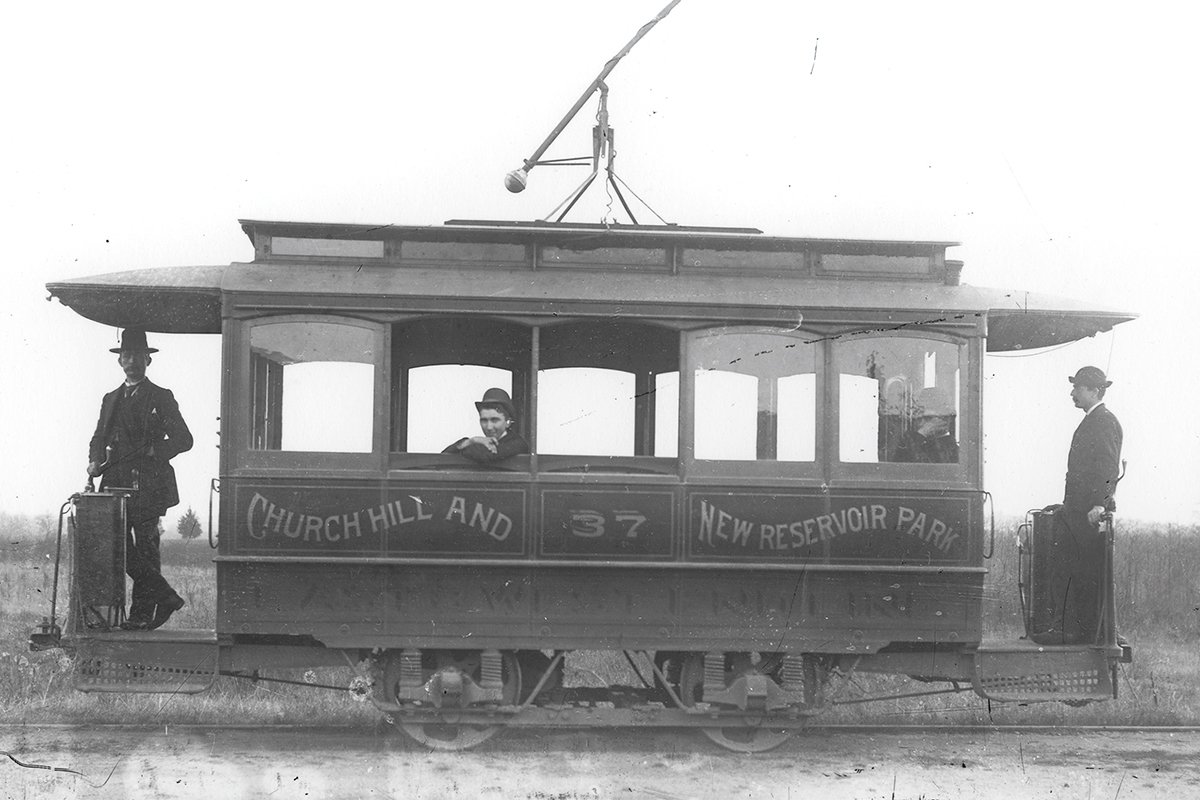
The clearest surviving account centers on Christopher Jones. The Library of Virginia’s exhibition on emancipation and Reconstruction records that in April 1867 African Americans in Richmond organized protests against the privately operated company that refused to let them ride its horse-drawn streetcars. Jones attempted to board a streetcar; after a crowd gathered to support his insistence that a paying customer had the right to ride, he was arrested for disturbing the peace.
What frightened white Richmond was not simply a Black rider on a car. It was the sight of Black Richmond acting like a public.
Those details are deceptively simple, but they reveal the structure of the conflict. First, Jones’s claim was contractual and civic at once. He had bought a ticket. He was not appealing to charity. He was asserting the ordinary rights of a customer in a public-facing enterprise. Second, the immediate support he drew tells us the protest was collective, not accidental. This was not a lone individual wandering into a confrontation by chance. It was a flashpoint in a city where Black residents were already prepared to read such incidents as political. Third, the state’s response was revealingly extreme. According to the Library of Virginia, Jones was indicted for allegedly conspiring to incite insurrection by acts of violence and war against the white population, though on May 18 the court entered a nolle prosequi and declined to prosecute.
That escalation tells us what white authority believed was really at stake. A Black man insisting on a purchased right to ride was translated, through the panic of the old order, into a threat of insurrection. The language is unmistakable. The charge did not merely criminalize disorder. It reached for the deepest white fear in the post-Confederate South: that Black collective action was not politics but rebellion, not citizenship but war by another name. The fact that bystanders reportedly shouted, “Let us have our rights,” according to the Library of Virginia’s summary, makes the moral center of the protest hard to miss. The crowd was naming the issue with more clarity than the authorities ever did.
Civil-rights teaching materials and later historical summaries preserve the same broad frame. The Zinn Education Project and Civil Rights Teaching both identify April 24, 1867, as the date associated with the Richmond Streetcar Protest, describing organized Black resistance to exclusion from the city’s horse-drawn streetcars and emphasizing that Jones’s arrest followed a larger community confrontation. These are not substitutes for the archival record, but they are useful for showing how the episode has been preserved in public memory as an early Reconstruction direct action against transportation segregation.
Reconstruction’s great question: what counts as public?
One reason the Richmond protest deserves more attention is that it threw a foundational contradiction into relief. The streetcar company was privately operated. Local officials therefore argued, according to the National Historic Landmarks theme study, that the company could set its own rules. Federal military authorities rejected that position and said all paying passengers had the right to ride.
There, in miniature, is a debate that still feels contemporary. When does a nominally private enterprise become public in obligation because it serves public movement, public need, or public commerce? Reconstruction-era Black activists understood the problem immediately. If railways, streetcars, hotels, and theaters could hide behind private ownership while extracting public custom, then emancipation would remain fenced off from everyday life. Freedom would exist on paper and fail in practice.
That is why the Richmond fight cannot be reduced to manners or custom. It was about the legal and moral status of common life. Transportation sits at the center of modern citizenship because it determines who can circulate, who can work, who can access markets, schools, churches, and political meetings, and who is forced to experience the city as a sequence of gates. The right to ride is never just the right to ride. It is the right not to have one’s movement constantly converted into a racial test.
The federal intervention in Richmond signaled that even military Reconstruction recognized something broader than the company’s claim of private discretion. But the ruling was partial. The same authorities who overruled total exclusion still permitted segregated cars. That compromise should not be read as a technical footnote. It was the shape of the era. Reconstruction repeatedly conceded that Black people possessed rights while allowing local white power to dictate the humiliating terms on which those rights would be exercised. The result was a social order in which principle advanced, but dignity remained negotiable.
And yet partial victories matter. They create language, precedent, and memory. Later historians of desegregation have singled out the Richmond action precisely because it showed how early Black protest could force government to define transportation as an arena of rights rather than mere custom. Even where the ruling fell short, the claim had been lodged: public conveyance was a civic question.
Not a prelude, but a chapter in its own right
Too often, nineteenth-century Black protest is described only as a prelude to “the real movement” that comes later. That framing is lazy. It treats Reconstruction as rehearsal instead of history. The people in Richmond were not practicing for Rosa Parks. They were making demands in their own political time, under conditions of danger far more immediate than the comfortable backward glance of modern commemoration sometimes admits.
Reconstruction did not fail because Black people lacked vision. It failed because white America kept negotiating freedom downward.
Consider the date. April 1867 was less than two years after the Civil War. Federal troops still mattered. Former Confederates still imagined Black assertion as illegitimate by definition. White violence remained an ordinary political instrument across the South. In that environment, to challenge a streetcar line was to challenge a racial order still raw from military defeat and not remotely resigned to democratic equality.
The National Historic Landmarks theme study places Richmond among the southern cities where African Americans contested exclusion and segregation on streetcars during Reconstruction, alongside places such as Charleston, Mobile, Nashville, and New Orleans. That geographic pattern matters because it shows Richmond was part of a broader Black southern argument over what emancipation would mean in public accommodations. It was not an isolated tantrum. It was one front in a regional struggle over whether the postwar South would be organized by equal access or by a redesigned caste system.
And the broader scholarship backs that up. A study on African American women and desegregated streetcars argues that the spring 1867 streetcar protests helped lay a legal foundation for broader equality in public accommodations in Louisiana, demonstrating that these transportation battles were understood at the time as more than transit disputes. They were laboratories in which Black people pushed states to define public space itself. Richmond’s protest belongs in that same genealogy.
So no, Richmond was not just an opening act for the twentieth century. It was a chapter in the long freedom struggle with its own stakes, its own vocabulary, and its own risks. The temptation to call it an early version of Montgomery can be useful for recognition, but it can also diminish the protest’s own historical sovereignty. Richmond deserves to be understood not merely by what it anticipated, but by what it already was: a Black-led confrontation over mobility, law, and public status in the first great experiment of interracial democracy after slavery.
Why transportation mattered so much
Public transportation has always been one of the clearest theaters in which a society reveals what it thinks race is for. Housing can be hidden in deeds. Employment discrimination can be disguised in hiring language. School inequity can be bureaucratized. But transportation places the hierarchy in motion, in view, in the unglamorous intimacy of daily life.
A streetcar takes strangers and decides, in real time, who counts as a full fare-paying presence and who counts as a problem. That is why transportation protests recur across Black history. They make the contradiction impossible to ignore. If a Black rider can be barred, displaced, insulted, or criminalized despite payment, then citizenship is exposed as conditional.
In Richmond, that contradiction was especially sharp because the claim being made was so modest and so radical at once. Jones and the others were not demanding private intimacy. They were demanding ordinary use. They were insisting that the city’s mechanisms of circulation recognize them as persons rather than pollutants. White resistance to that idea was intense precisely because it threatened the everyday rituals through which social dominance is maintained. Segregation is never only about distance. It is about pedagogy. It teaches everyone, repeatedly, who has the right to comfort, deference, and presumption.
The protest also illuminated another truth: transportation discrimination is economic discrimination by another route. Streetcars connect labor to wages, families to markets, churchgoers to sanctuaries, children to schools, organizers to meetings, and communities to one another. To deny or humiliate Black travel is to tax Black life. It turns routine movement into delay, expense, exposure, and vulnerability. That logic would reappear in the Richmond streetcar boycott of 1904, when Black residents again confronted segregation in the city’s transit system. The Library of Virginia describes that later boycott as a response to enforced segregation on electric streetcars, while Encyclopedia Virginia notes that Maggie Lena Walker helped organize it and that John Mitchell Jr. played a major role in the campaign.
That later boycott is one of the clearest proofs of 1867’s unfinished business. Richmond had already fought over the right to ride during Reconstruction. Decades later, the city was still fighting. The continuity is devastating and clarifying at once. It tells us that white supremacy does not surrender because it loses an argument. It regroups institutionally, legally, commercially. It tests where resistance is weak. And Black communities, in turn, build longer memories of protest than the nation usually acknowledges.
The compromise that revealed the whole problem
There is something almost unbearably American about the outcome in 1867. Federal authorities overruled total exclusion. But they still permitted segregation. The system moved, but not enough. Principle was acknowledged, but hierarchy was retained. Black people were granted access, though not equality of standing.
This is the part of the story that should unsettle any easy celebration of Reconstruction. The era produced sweeping constitutional transformation—the Thirteenth, Fourteenth, and Fifteenth Amendments, Black political participation, new institutions, new officeholders, new claims on the state. But in the realm of daily life, the country often treated equality as a negotiable abstraction. Richmond’s streetcars became one more place where America attempted to split the difference between democratic ideals and white comfort.
What the compromise really did was make Black people responsible for carrying freedom through humiliation. Yes, you may ride—but perhaps on a separate car. Yes, you are a paying passenger—but not on the same terms. Yes, the law sees you—but not fully enough to spare you degradation. This is not an incidental failure of implementation. It is the core mechanism by which rights are emptied of substance while preserved in rhetoric.
The protest therefore exposes a deeper lesson about American reform. Winning recognition is not the same as winning equal conditions. A state can acknowledge a right in theory while authorizing its violation in style, procedure, architecture, enforcement, and custom. Richmond’s partial victory belongs in that lineage. It should be remembered as significant not because it solved the problem, but because it showed the problem in high resolution.
And still, Black Richmonders forced the issue. They made authorities answer. They created a record. They turned private humiliation into public dispute. The court’s eventual refusal to prosecute Jones after the extraordinary indictment against him underscores that the state could be pressured, embarrassed, even forced to retreat when its own overreach became too obvious.
The afterlife of the protest
The Richmond Streetcar Protest did not produce the kind of tidy commemorative ending that textbook culture prefers. There was no final cinematic decree that permanently settled the matter. Instead, there was a contested partial win, a city still structured by racial domination, and a political future in which Black gains would be rolled back again and again.
Richmond teaches a hard lesson: the nation can hear Black demands clearly, answer them partially, and still take generations to do what justice required in the first place.
That is precisely why its afterlife matters. The protest helps explain why Black Virginians remained so invested in politics, institutions, and local leadership in the decades that followed. During Reconstruction and after, African Americans in Virginia fought not only for the vote but also for public schools, officeholding, and civic infrastructure, with nearly 100 Black Virginians serving in the General Assembly or constitutional convention between 1867 and 1895. Those political struggles were not separate from the fight over streetcars. They were part of the same argument: Black citizenship had to be built into the operating rules of the state and the city, or else every individual gain would remain precarious.
Richmond itself would become a crucial site of that longer struggle. Maggie Lena Walker, born in Richmond in 1867, emerged as one of the city’s most consequential civic leaders, eventually becoming the first Black woman to establish and preside over a bank in the United States. Encyclopedia Virginia notes that she later helped organize the 1904 Richmond streetcar boycott. John Mitchell Jr., the “Fighting Editor” of the Richmond Planet, also played a central role in that boycott, according to both Encyclopedia Virginia and the National Park Service.
Seen together, these facts reveal something larger than coincidence. Richmond’s Black freedom struggle did not move in disconnected bursts. It developed across generations, through churches, newspapers, fraternal organizations, political conventions, and campaigns over transportation, schooling, and economic power. The 1867 protest is not merely “early.” It is foundational to understanding how Black Richmond built a civic tradition capable of resisting Jim Crow in multiple registers.
The 1904 boycott makes the lineage unmistakable. The Library of Virginia explains that after Virginia allowed cities to segregate streetcars in 1904, Richmond’s Black residents mounted a boycott that lasted more than a year; despite pressure on the company, state law in 1906 then required segregation in public transportation, extending Jim Crow until the Civil Rights Act of 1964. That is the long arc Richmond forces us to confront: 1867’s challenge, 1904’s boycott, 1906’s codification, and 1964’s federal dismantling of legalized segregation.
Why the story still feels current
The Richmond Streetcar Protest matters now because the argument beneath it never disappeared. The forms have changed. The language has been modernized. The justifications have become less naked. But the governing question remains familiar: who gets to inhabit public life without having their presence interpreted as trespass?
That question surfaces wherever Black people enter institutions that were never designed with their equality in mind and are then told to be grateful for conditional inclusion. It surfaces in education policy, in cultural funding, in policing, in voter access, in the geography of infrastructure, in the politics of public memory. It surfaces whenever the nation offers principle in ceremony and hierarchy in practice.
Richmond also matters because it disrupts the fantasy that Black protest was reactive rather than visionary. The people who challenged those streetcars understood something essential: freedom that cannot move is not freedom. Freedom that can vote but not ride, work but not sit, pay but not belong, is a freedom constantly being revised downward by those invested in keeping democracy ornamental.
This is one reason the protest deserves a more central place in the national narrative. It expands civil-rights history backward into Reconstruction, where it belongs. It complicates the chronology of transportation protest. And it reminds us that Black people were articulating sophisticated theories of public rights long before courts and mainstream media were prepared to dignify those theories as such.
There is also an ethical reason to remember Richmond properly. When histories like this are neglected, the effect is not neutral. It narrows our understanding of Black political imagination and inflates the myth that meaningful protest waited for the twentieth century to become legible. The archive says otherwise. Black Richmonders were legible to each other. They were legible to the authorities who arrested them. They were legible to the courts that tried to turn civic insistence into insurrection. The only audience that has been consistently slow to recognize them is the nation telling the story afterward.
The meaning of a seat
In the end, the Richmond Streetcar Protest of 1867 asks us to think seriously about what a seat means. A seat is small, ordinary, replaceable. That is precisely why it becomes such a powerful object in a caste society. It condenses the larger order into something tactile. Who sits where. Who is moved. Who decides. Who is presumed out of place.
Black Richmonders understood that contest with extraordinary clarity. They recognized that the streetcar was not peripheral to freedom but one of its daily proving grounds. When Christopher Jones insisted on the right to ride after purchasing his ticket, and when a crowd gathered in support, they were not asking for symbolism. They were demanding the material habits of citizenship. The state’s furious overreaction exposed how subversive that demand still seemed in the former capital of the Confederacy.
The partial federal ruling that followed exposed something else: emancipation had changed the country, but not enough to make equality self-executing. Black rights would have to be fought for in streetcars, in courthouses, in churches, in newspapers, in conventions, and later in boycotts, lawsuits, and mass movements. Richmond’s protest is therefore not a relic. It is an x-ray of the American condition in Reconstruction and, in some respects, beyond it.
What makes the episode enduring is not merely that it came early. It is that it was precise. Black Richmonders saw, with devastating accuracy, that modern freedom lives or dies in the management of ordinary things. A ticket. A seat. A public street. A paying passenger. A company claiming private discretion. A government wavering between principle and appeasement. A crowd insisting, in language as clear now as it was then, that rights are not abstract if they cannot be exercised in daylight.
The nation eventually built a more famous mythology around buses in Montgomery. It should. But if we are serious about telling the fuller story of Black struggle in America, we must start earlier and listen harder. We must return to Richmond in 1867, to a city trying to decide whether Black freedom would remain a military fact or become a civic one. We must remember the riders, the crowd, the arrest, the indictment, the compromise, and the stubborn insistence that paying passengers had rights no company should be allowed to erase.
And we should say it plainly: before the bus boycotts that entered the nation’s civic scripture, there was Richmond. Before the textbook heroes were canonized, there were Black citizens in a former Confederate capital testing whether the republic meant what it claimed. Before the phrase “civil rights movement” hardened into a period label, there were freedpeople already moving like they understood that citizenship had to be enacted, not merely announced.
That is why the Richmond Streetcar Protest belongs not in the margins, but near the center of the American story. It reveals that the battle over public space began at the moment freedom itself entered public life. It shows that Black political modernity did not arrive late; the country did. And it leaves us with a hauntingly contemporary measure of democracy: not what a nation promises in principle, but whom it permits to ride in peace.
More great stories
Afro Sheen, Wall Street, and the Architecture of Black Possibility
July 6, 2026
No Comments
The Fire Inside the Fourth
July 5, 2026
No Comments