




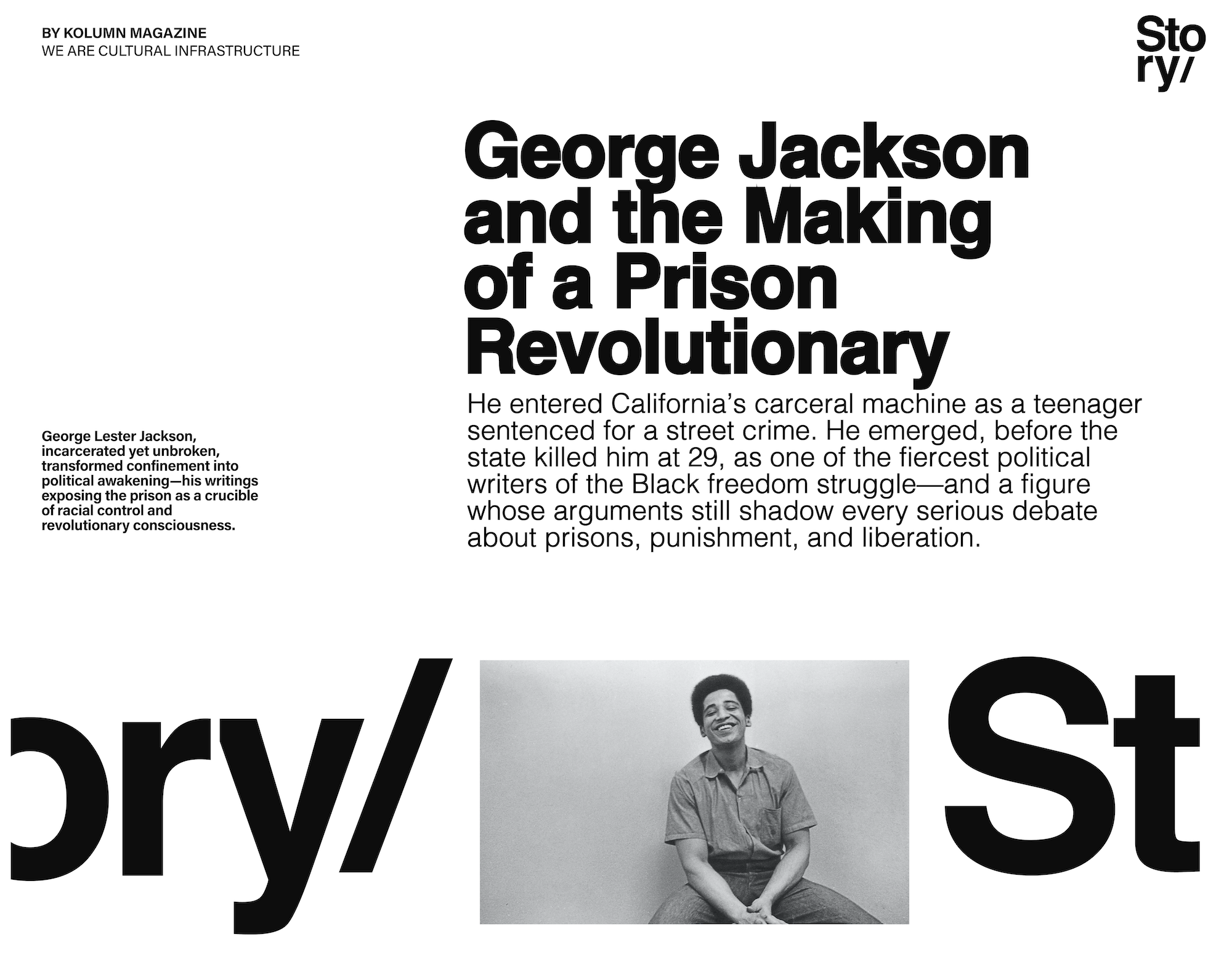
George Jackson did not become important because he died violently. He became important because he learned, inside a cage, how to describe the cage as a political system.
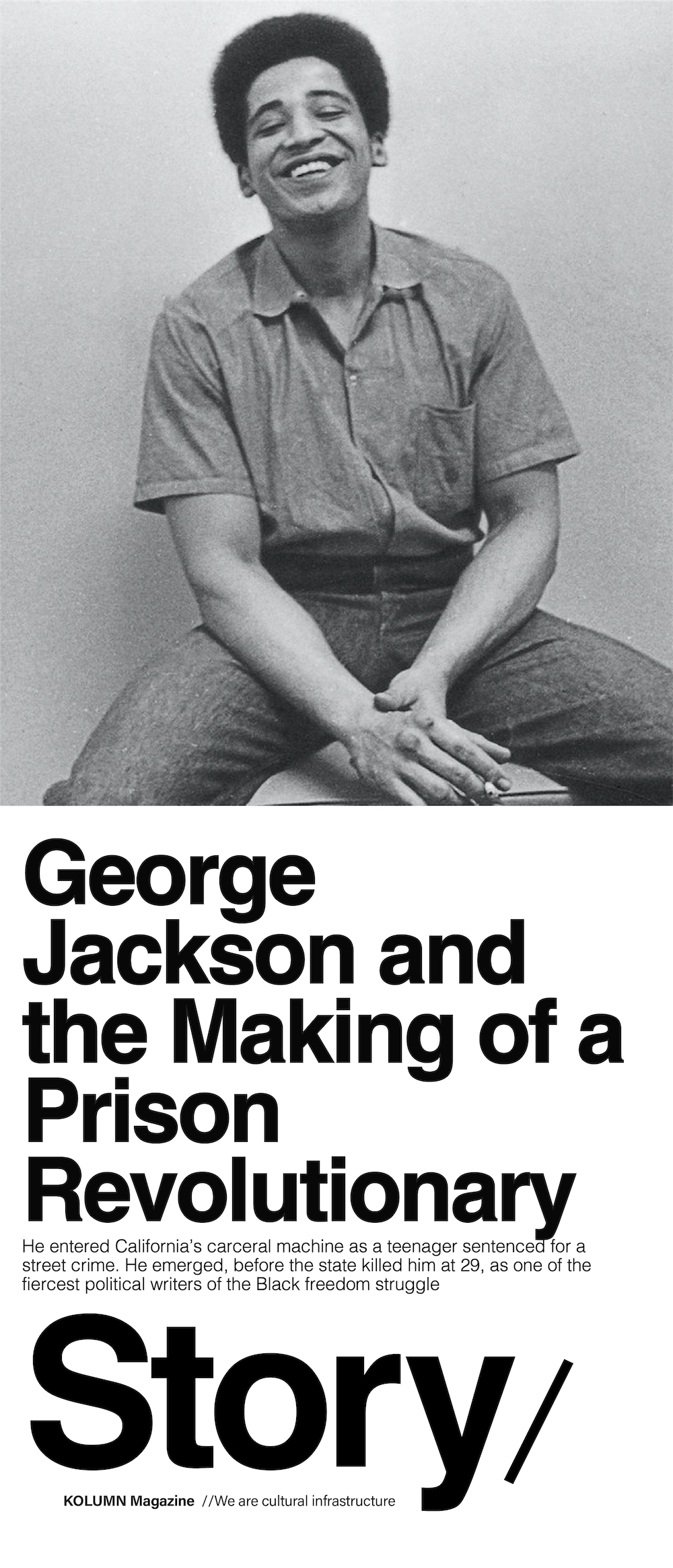
George Jackson did not become important because he died violently. He became important because he learned, inside a cage, how to describe the cage as a political system.
By KOLUMN Magazine
George Lester Jackson remains one of the most contested and consequential figures to emerge from the Black freedom struggle of the late 20th century. He was an incarcerated writer, a prison organizer, a revolutionary theorist, a public symbol of the Soledad Brothers case, and, by the end of his short life, one of the most internationally recognized Black radicals in the United States. His first book, Soledad Brother, made him famous far beyond prison walls. His second, Blood in My Eye, published after his death, fixed him in the political memory of Black radicalism as something more dangerous than a celebrity dissident: a thinker who treated the prison not as a marginal institution, but as one of the clearest mirrors of the American order itself.
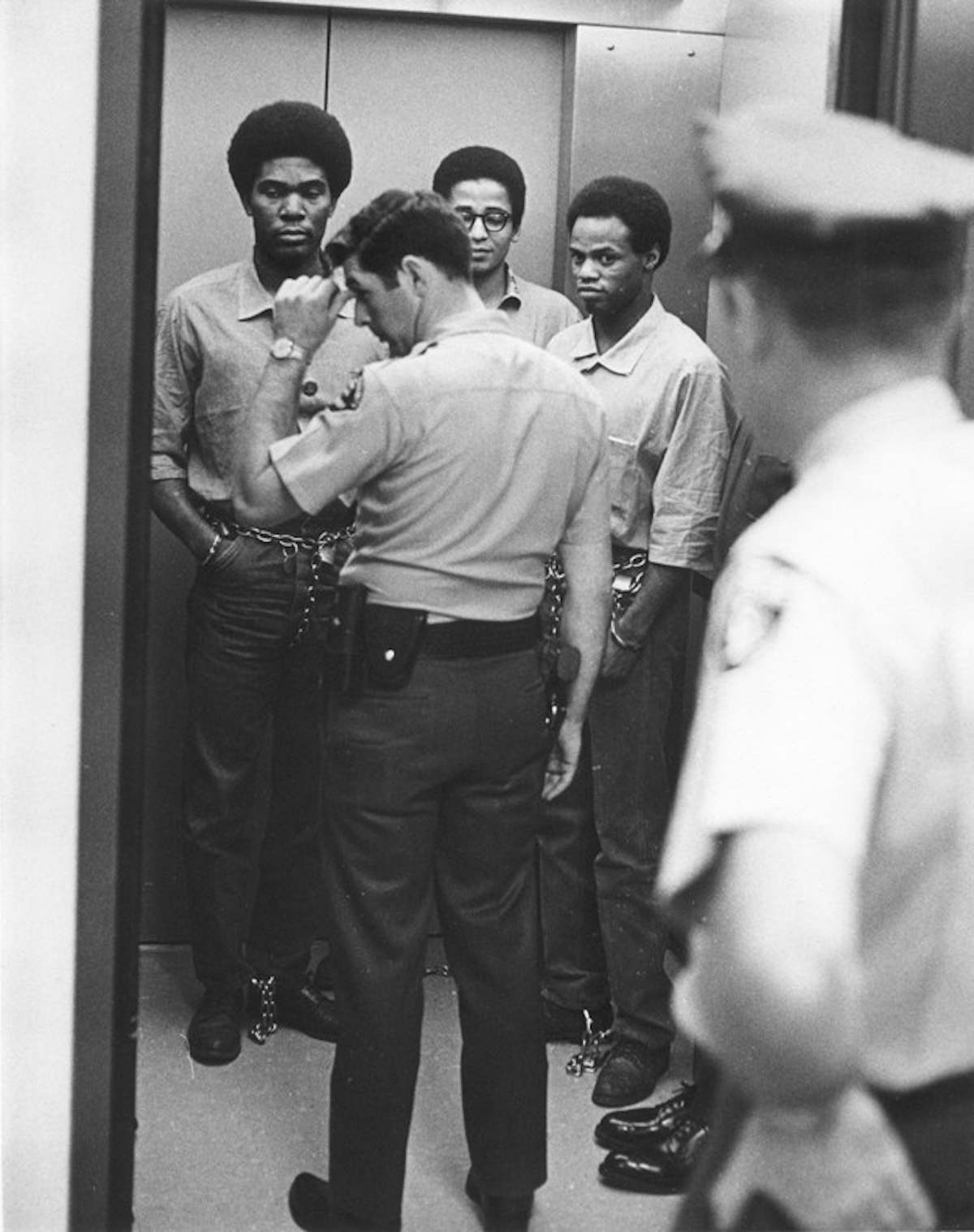
That distinction matters. George Jackson is often remembered through the drama that gathered around his name: the Soledad Brothers prosecution, the Marin County courthouse action led by his younger brother Jonathan, the public campaign around Angela Davis, and the bloody events at San Quentin in August 1971. But to leave him there is to flatten him into a symbol of crisis. Jackson was not only a man around whom events spiraled. He was a writer whose work helped shape how generations of activists, scholars, and imprisoned organizers understood race, capitalism, state violence, and the political meaning of captivity. His importance lies not just in the fact that he died in prison, but in the fact that he diagnosed prison as one of the state’s central technologies of racial rule.
For KOLUMN, his story sits naturally beside earlier work on Angela Davis, on power and punishment, and on the long afterlives of Black radical thought. KOLUMN’s 2023 feature on Davis framed crime and punishment as inseparable from capitalism and racial domination; more recent KOLUMN work on figures like Bobby E. Wright and Soffiyah Elijah has likewise insisted that the institutions marking Black people as disposable are not accidental failures but structured outcomes. Jackson belongs in that lineage, not as an accessory to it but as one of its fiercest early theorists.
The boy before the legend
Jackson was born in Chicago on September 23, 1941, and came of age in a country that had perfected the art of treating Black youth as both socially abandoned and permanently suspect. By the time he was a teenager, his family had moved west, eventually landing in Los Angeles. The world available to him was defined by segregation’s afterlives, aggressive policing, economic exclusion, and the ordinary brutalities of urban containment. He would later describe himself not as an innocent man seized by history, but as someone formed amid violence, precarity, and conflict long before the state locked him away.
In 1960, still very young, Jackson was convicted for the armed robbery of a gas station involving $71. The sentence that followed has become central to the meaning of his life because it reveals so much about California’s penal structure at the time. Under the state’s indeterminate sentencing regime, a crime that might have produced a short sentence became an open-ended captivity. Jackson entered prison at 18 and, rather than quickly cycling out, found himself consumed by a system that could extend confinement through disciplinary judgments, administrative decisions, and the broad discretionary power of prison authorities. That open-endedness would become one of the conditions that radicalized him.
The popular shorthand is that prison “made” George Jackson. That is too simple. Prison did not create his intelligence or his rebelliousness. What it did was force a collision between an already resistant temperament and an institution specifically designed to break resistance down into submission. Jackson’s answer was not penitence in the language the prison preferred. It was study. He became an autodidact under conditions meant to deny depth, attention, and intellectual self-possession. In his own later formulation, he encountered Marx, Lenin, Trotsky, Engels, and Mao in prison and claimed they “redeemed” him. However one reads that line—as autobiography, performance, or revolutionary self-making—it marks the pivot on which his life turned.
He spent years in harsh confinement, including long stretches in solitary. Those years mattered not just because they were punishing, but because they clarified for Jackson what prison really was. He came to see incarceration not as society’s unfortunate holding pen for the criminally deviant, but as a concentrated expression of class war, anti-Black control, and bureaucratically managed violence. He learned the prison from the inside out: its racial hierarchies, its economies of humiliation, its informal codes, its routine sadism, its capacity to transform wounded young men into disciplined instruments of the state or disciplined enemies of it.
Study as rebellion, writing as escape
The writing is what made him legible to the wider world. Jackson’s letters—addressed to family, friends, comrades, and supporters—became the raw material for Soledad Brother: The Prison Letters of George Jackson, first published in 1970 with an introduction by Jean Genet. The book was not merely an archive of prison life. It was a political education in epistolary form. Jackson used the intimacy of the letter to move between autobiography and analysis, between grief and strategy, between confession and indictment. The effect was electric. Soledad Brother became a bestseller and made Jackson an international figure.
That success is worth pausing over. There is always something unsettling to the American mainstream about prison writing that is too polished to be dismissed and too angry to be domesticated. Jackson’s letters refused the sentimental script of rehabilitation. He did not write to prove his fitness for reentry into the moral order that had caged him. He wrote to expose that order as murderous. Readers encountered in him not the grateful subject of reformist pity but a Black prisoner who had turned literacy into counterpower. That was part of why his work resonated so deeply across the Black left, anti-carceral movements, and international revolutionary circles.
His prose could be lyrical, cutting, tender, doctrinaire, volatile, analytical, and occasionally misogynistic in ways readers today cannot responsibly ignore. To take Jackson seriously means resisting hagiography. He was not a flawless vessel for liberation politics. He could be rhetorically absolutist and ideologically rigid. He could also be startlingly perceptive about how domination operates through institutions that present themselves as neutral. The force of his writing comes from that tension: he was at once a product of masculinist revolutionary culture and one of the sharpest interpreters of racial capitalism behind bars.
What Jackson offered, above all, was a theory of prison as political. Not political in the thin sense that policy debates surround it, but political in the thick sense that prison organizes life, labor, race, visibility, and death. Decades before “mass incarceration” became a mainstream analytic, Jackson was already writing as if the prison were not an exception to democracy but one of its hidden foundations. That insight helps explain why his work still surfaces in abolitionist thought, Black August commemorations, prison education projects, and histories of radical study.
Soledad and the manufacturing of a national cause
The event that transformed Jackson from important prison writer to global political cause came through Soledad Prison. In January 1970, after a yard confrontation involving Black prisoners and white prisoners, correctional officer Opie G. Miller shot and killed three Black inmates—W. L. Nolen, Cleveland Edwards, and Alvin Miller—from a tower. Soon after, a white guard, John V. Mills, was found beaten and thrown from a tier. Jackson, Fleeta Drumgo, and John Clutchette were charged with Mills’s murder and became known worldwide as the Soledad Brothers.
The sequence mattered politically because it seemed to confirm what many Black radicals already believed: when the state killed Black prisoners, impunity followed; when prison personnel were killed, the machinery of exemplary punishment moved at once. The Soledad Brothers case became a rallying point because it distilled the asymmetry. Legal defense committees formed. Organizers, artists, and intellectuals rallied to Jackson’s cause. His name circulated not just as that of a defendant, but as that of a political prisoner whose persecution exposed the structure around him.
The label “political prisoner” remains contentious in American discourse because it threatens one of the republic’s favorite illusions: that its prisons are populated by people outside politics, people whose caging reflects conduct rather than power. Jackson shattered that illusion. Whether one accepted every claim made in his defense or not, the conditions around the case made it impossible to separate law from racial order. The killings at Soledad, the prosecutorial response, the publicity around the defendants, and the larger climate of repression against Black radicals all made the prosecution legible as part of a broader counterinsurgency.
This was the late 1960s and early 1970s, when the United States was responding to Black radicalism not simply with argument but with surveillance, infiltration, prosecution, imprisonment, and lethal force. Jackson’s case unfolded in the same national atmosphere that entrapped, harassed, or eliminated Black Panthers and other militants across the country. He was not peripheral to that story. He represented one of its prison-centered fronts.
The brother, the courthouse, the nation watching
On August 7, 1970, the crisis surrounding George Jackson widened catastrophically when his 17-year-old brother, Jonathan Jackson, entered a Marin County courtroom armed, freed several prisoners, and took hostages in an attempt linked to the liberation of the Soledad Brothers. The episode ended in gunfire. Jonathan Jackson, James McClain, and William Christmas were killed, along with Judge Harold Haley. Others were wounded. The event became instant national news and further intensified the already combustible politics around George Jackson, Angela Davis, and revolutionary self-defense.
The tragedy hardened the lines of interpretation around George Jackson. To the establishment, the courthouse assault seemed to confirm the extremism and danger surrounding the movement that had formed around him. To supporters, it dramatized the desperation created by a system in which Black defendants, especially politicized Black defendants, could not reasonably expect justice from the institutions trying them. Jonathan’s death also enlarged George Jackson’s symbolic role. He was no longer merely a radical prisoner with a bestselling book. He was now at the center of an emotional and political vortex in which family sacrifice, state violence, and revolutionary desperation collapsed into one another.
Angela Davis’s prosecution, because the weapons used in the courthouse incident were linked to her, only intensified that vortex. The state’s attempt to make Davis answer for the event helped internationalize the politics around the Soledad Brothers still further. Jackson’s name traveled through that network of solidarity and repression, becoming shorthand for a wider battle over whether the American state could criminalize Black rebellion and then call the result neutral justice.
What is striking, looking back, is how clearly prison and courtroom merged as theaters of political struggle. Jackson’s life makes little sense if one imagines prison as merely punitive and the courtroom as purely adjudicative. Both were arenas in which the state attempted to narrate Black radicalism as criminal pathology, while Jackson and his defenders insisted on reading it as politics produced by domination. That struggle over narrative is one reason his legacy persists. We are still arguing about whose violence counts as structural, whose violence counts as criminal, and whose mourning the nation recognizes as legitimate.
San Quentin, death, and the making of martyrdom
Jackson never stood trial for the Mills murder. On August 21, 1971, at San Quentin, he was killed during a violent eruption that remains one of the most disputed and mythologized episodes in modern prison history. Authorities said Jackson had obtained a gun, initiated an escape attempt, and participated in a hostage-taking that ended with the deaths of three guards and two incarcerated men. Jackson was shot dead by prison guards. The exact details have been argued over for decades, including the question of how the gun entered the prison and whether Jackson’s death should be understood as the suppression of an escape or, as many supporters insisted, an assassination.
What can be said with confidence is that by the time he died, Jackson had become too politically significant to be read as an ordinary inmate. His death reverberated nationally and internationally. Ten thousand people reportedly attended his funeral, and his name became inseparable from what later generations would remember through Black August: a season of study, discipline, fasting, memory, and revolutionary mourning rooted in the deaths of Jackson and other freedom fighters.
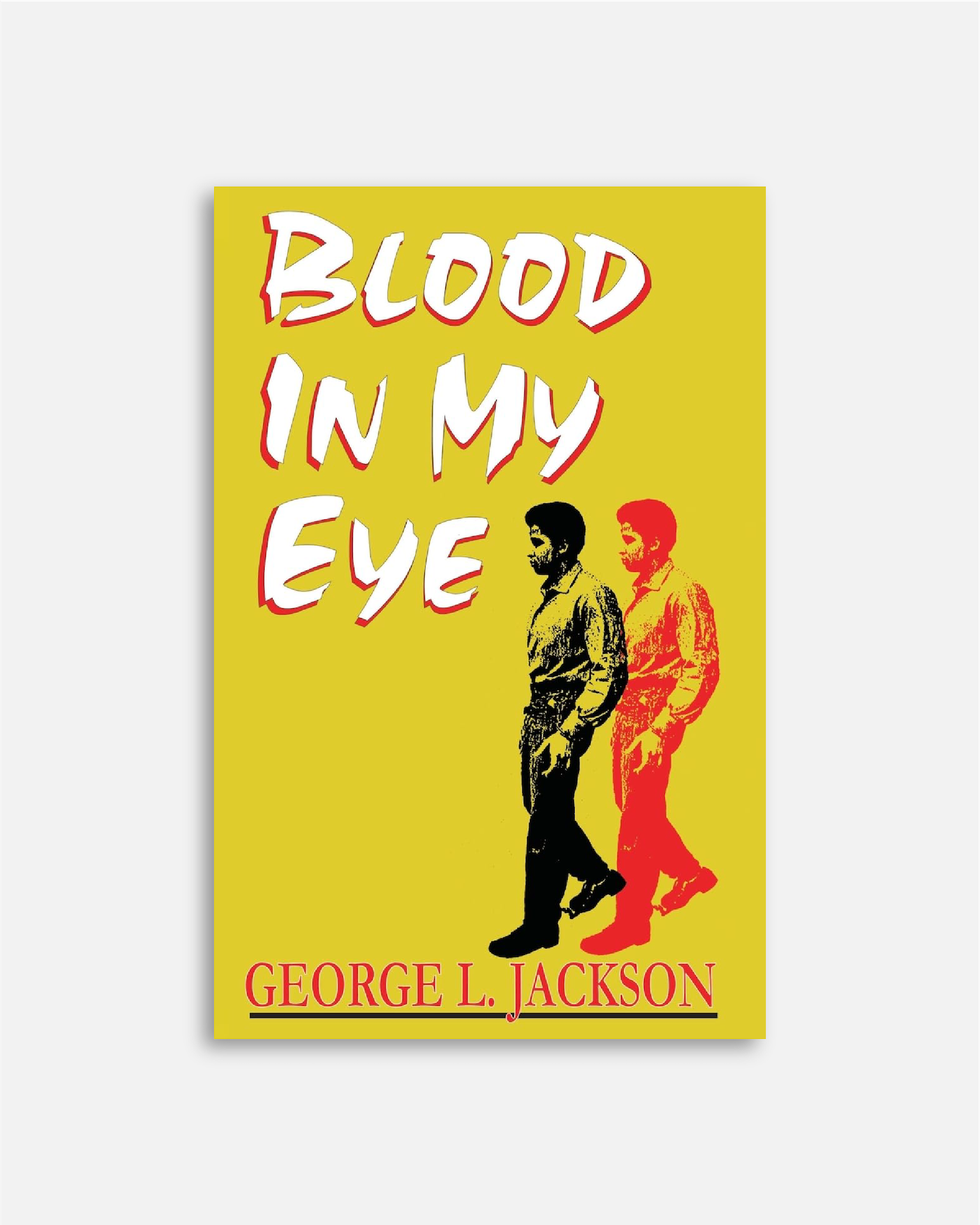
His posthumous book, Blood in My Eye, only intensified the sense that Jackson’s political thought had been interrupted rather than completed. The book was finished just before his death and published afterward. If Soledad Brother made him accessible to a broad readership through the familiar intimacy of letters, Blood in My Eye made plain the harder edge of his revolutionary commitments. It is more programmatic, more militant, less interested in winning over the skeptical liberal reader. In it, Jackson appears not as an eloquent prisoner begging to be understood, but as a committed revolutionary trying to describe the stakes of struggle in a world he considered already organized by war.
There is a danger, of course, in martyrdom. It can turn a difficult thinker into a memorial object. It can convert political complexity into iconography. Jackson has often suffered that fate. He appears on posters, in commemorations, in radical curricula, in shorthand references to “the prison movement,” and in retrospective tributes that smooth over contradiction. But the real Jackson is harder and more useful than the icon. He was angry, brilliant, strategically evolving, rhetorically severe, and formed by brutal institutions he never romanticized. He should be remembered not only because he died for a cause, but because he left arguments behind that remain disturbingly current.
Why George Jackson still matters
To understand Jackson’s continuing relevance, it helps to notice how contemporary the terrain still feels. The United States has spent the decades since his death expanding and refining carceral power on an astonishing scale. The vocabulary has shifted—supermax, mass incarceration, prison-industrial complex, carceral state—but the core problem Jackson identified remains recognizable: Black life treated as administratively manageable through surveillance, confinement, isolation, and force. He wrote before today’s terminology consolidated, but he saw with uncommon clarity what prison was becoming.
This is one reason scholars and organizers keep returning to him. Recent scholarship and public history projects continue to frame Jackson as central to the genealogy of prison abolition, Black study traditions, and global radicalism. The point is not that every present-day abolitionist position is already fully contained in Jackson’s work. It is that he helped force a line of thought in which prison had to be understood as a social relation rather than a building, as an instrument of racial order rather than a neutral response to wrongdoing.
His influence also persists culturally. Black August commemorations, prison reading circles, and radical archives keep Jackson in circulation not as a relic but as a provocation. He speaks most sharply in moments when the language of reform feels too thin—when commissions, trainings, and procedural fixes do not account for what prison does to the body, the mind, and the social field around them. His work continues to attract readers because it does not flatter the liberal imagination. It does not assume institutions can be gently persuaded out of their founding purpose.
That does not mean reading Jackson requires agreement with all of Jackson. It requires seriousness. It requires sitting with a Black radical tradition that was forged under conditions of extreme violence and that often speaks in tones the respectable center finds intolerable. KOLUMN has repeatedly argued, in pieces on Davis, Wright, and others, that Black political thought is frequently sanitized when it enters mainstream remembrance. Jackson resists sanitization. He remains difficult because the world that made him has not gone away.
The limits of respectability, the permanence of the question
One of the most revealing aspects of Jackson’s legacy is how often the culture tries to separate the writer from the revolutionary, as though one were the admirable part and the other an embarrassment. The move is familiar. America is willing, eventually, to honor Black eloquence, but much less willing to confront the political conclusions that eloquence produced. In Jackson’s case, that split does not hold. The writing is revolutionary because the analysis is revolutionary. The literary force comes from the clarity with which he understood imprisonment as social design.
That is why his life continues to press on contemporary debates about reform and abolition alike. Reform asks how prisons might be made less brutal, less racist, more humane. Jackson’s writing keeps asking a more destabilizing question: what if brutality is not a defect in the prison but one of its governing logics? What if the institution is working, in crucial respects, exactly as systems of racial capitalism require it to work? You need not adopt every element of Jackson’s revolutionary framework to feel the force of that question. You only need to look honestly at how often American punishment produces degradation and calls it order.
He also matters because he unsettles easy chronologies of the Black freedom movement. The standard civic narrative prefers a march from civil rights to legal equality to unfinished but manageable reform. Jackson forces another map into view, one in which the prison becomes a central post-civil-rights battleground and Black rebellion does not end with legislation but migrates into cells, courts, visiting rooms, defense campaigns, and theoretical texts. In that map, the story of Black liberation is inseparable from the story of punishment.
The unfinished life
George Jackson died at 29. That fact still lands with a special cruelty because his work reads with the velocity of someone writing against a closing door. He understood that his future was narrow, perhaps nearly closed. Yet the writing pulses with expansion—with reading, synthesis, argument, memory, fury, and an almost unbearable refusal to surrender his mind to the institution built to contain it. He lived long enough to become famous, dangerous, loved, polarizing, and historically consequential. He did not live long enough to become settled. That unfinished quality is part of what gives his work its charge.
For a KOLUMN audience, his life belongs in the magazine’s broader insistence that Black history cannot be told responsibly through safe icons alone. It must also be told through those who confronted the architecture of American power at its most naked. Jackson did that from a prison cell. He wrote in a register that refused consolation. He insisted that the cage was not a side story but a national story. Half a century later, the country still has not answered him.
The simplest version of George Jackson’s story is that he was a prisoner who became a revolutionary writer and died violently at the hands of the state. The truer version is harder. He was a product of America’s racial order who learned, inside its penal machinery, how that order reproduced itself. He named the relationship between Black disposability and state power with a sharpness that remains unsettling. He left behind books that still read like warnings from inside the future. And he forced into public view a question the nation has never managed to bury: what does freedom mean in a country that builds so much of its order on the cage?
More great stories
Afro Sheen, Wall Street, and the Architecture of Black Possibility
July 6, 2026
No Comments
The Fire Inside the Fourth
July 5, 2026
No Comments