





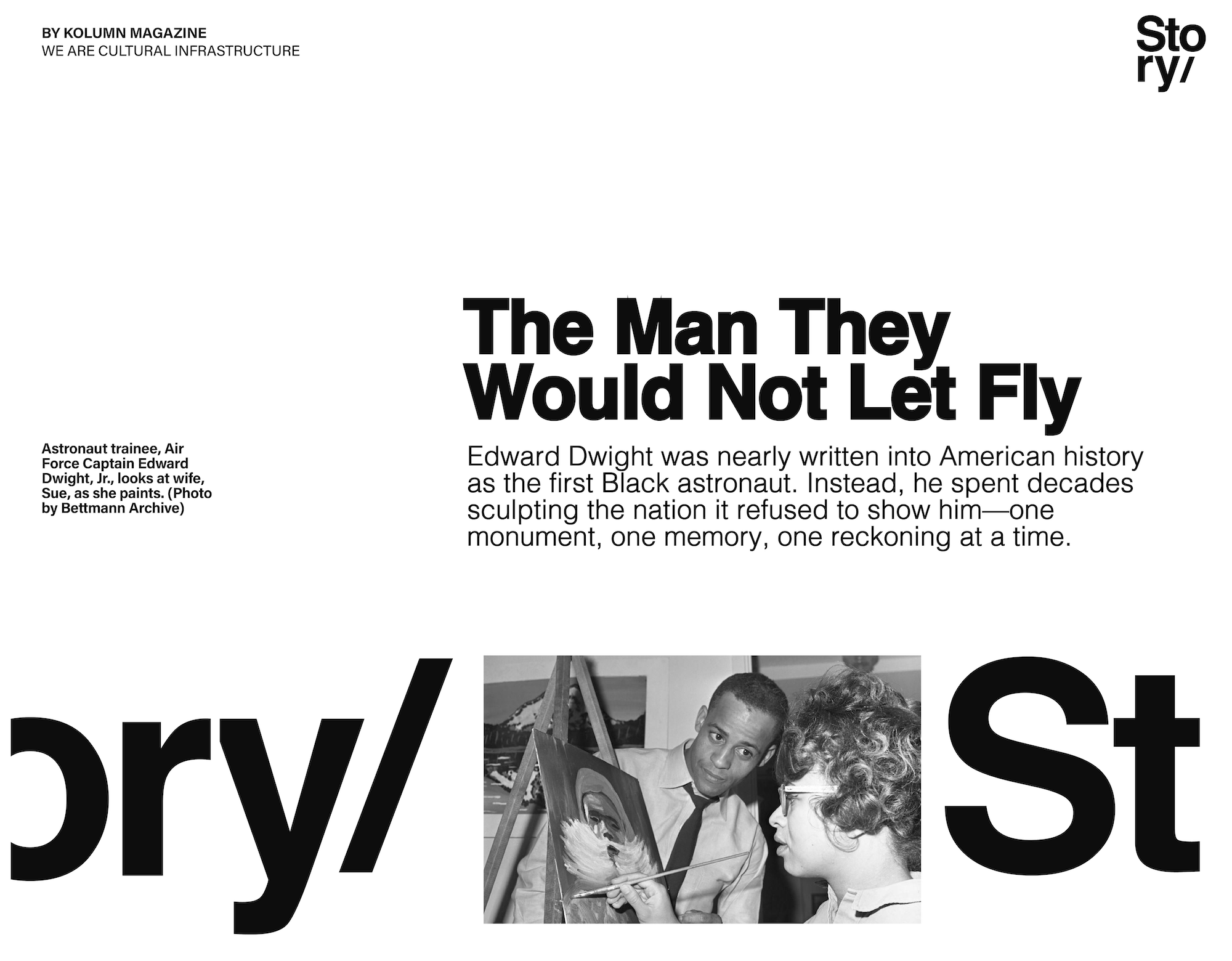
Edward Dwight’s real subject was never only space. It was access—who gets recorded, who gets honored, who gets cast into permanence.
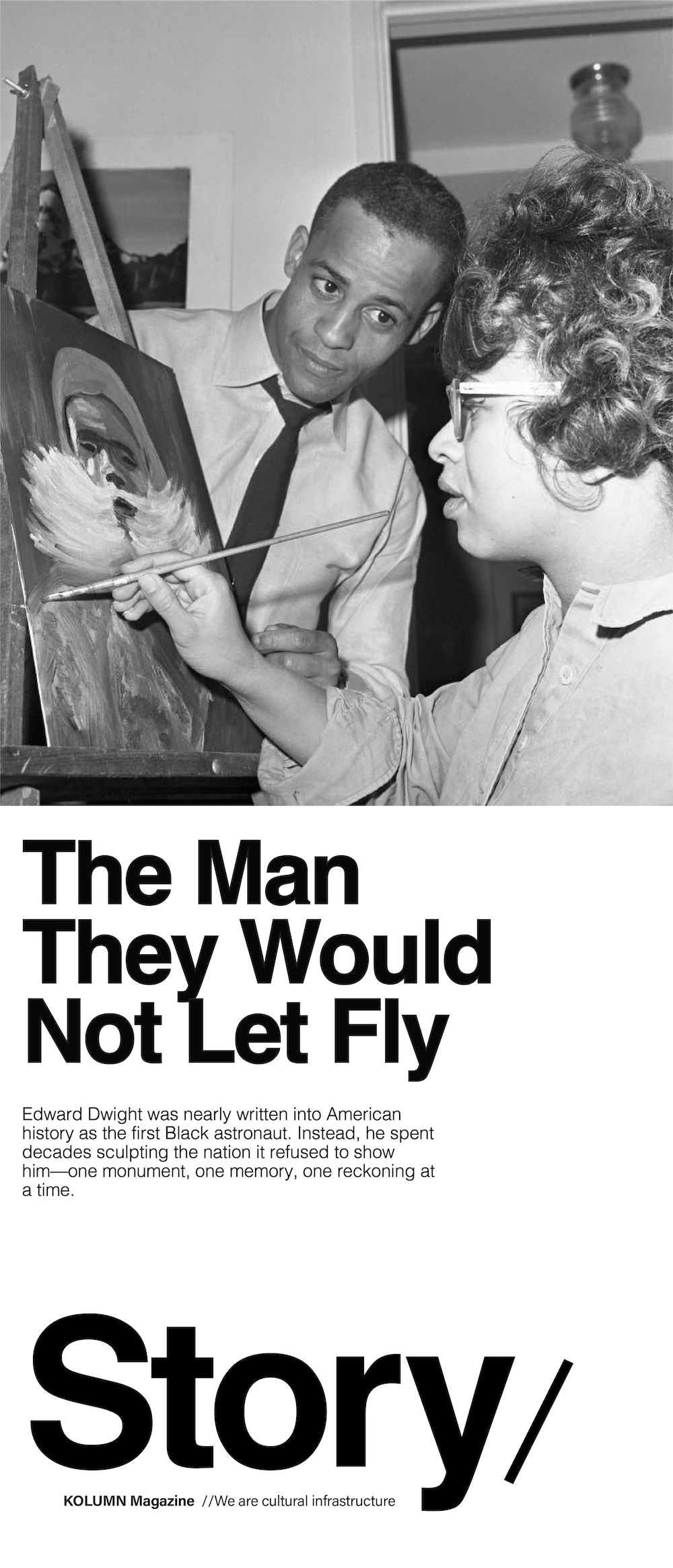
Edward Dwight’s real subject was never only space. It was access—who gets recorded, who gets honored, who gets cast into permanence.
By KOLUMN Magazine
There are certain Black American lives that reveal, with painful efficiency, how the country prefers its myths. It loves the image of progress. It loves the language of firsts. It loves to place a single Black figure near the gate of some institution and call the arrangement justice. But Edward Dwight’s life has never fit neatly into that national script. He is too complicated for the simple redemption story, too accomplished for the footnote, too stubbornly multivalent to be reduced to “the one who almost went to space.” He was that, yes. He was the first African American selected for the Air Force training pipeline from which NASA drew astronauts in the early 1960s, a public symbol of Kennedy-era possibility, and a man whose exclusion from NASA became one of the clearest illustrations of how racial power survives inside institutions that claim to represent the future. But he is also one of the most prolific sculptors of Black public memory in the United States: a maker of monuments, a builder of counterarchives, a visual historian who turned bronze into civic argument. Smithsonian Magazine, The Washington Post, and the Associated Press have all emphasized that arc—airman, almost-astronaut, sculptor—because it is the arc that makes Dwight impossible to ignore.
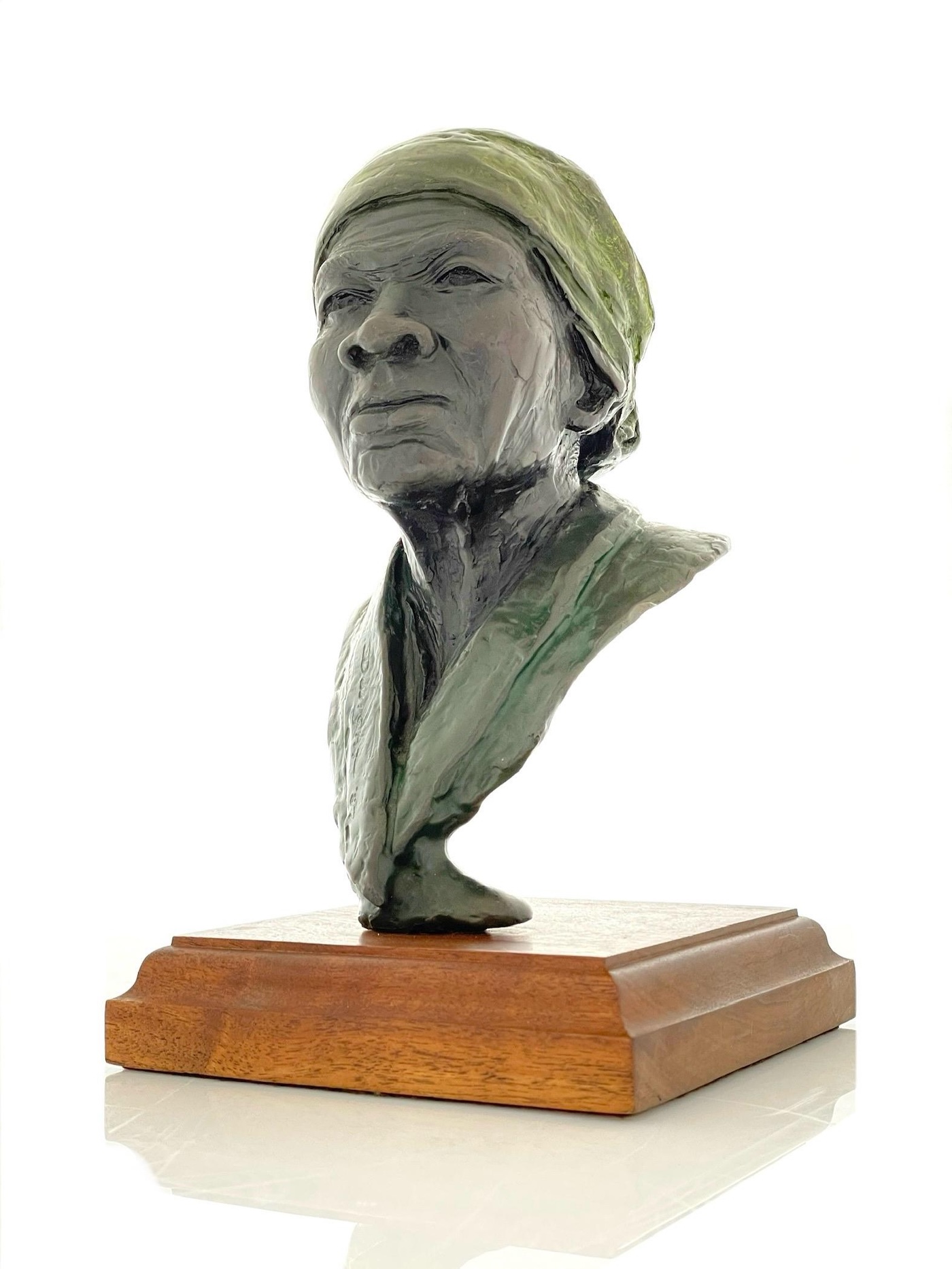
To write about Dwight seriously, though, is to resist the gravitational pull of the space-race anecdote. The near-astronaut story is real, consequential, and inseparable from his significance. But if we stop there, we let the country define him by the opportunity it withheld rather than by the civilization-scale memory work he went on to perform. Dwight’s larger contribution is not merely that he survived exclusion. It is that he spent the next phase of his life asking a harder question: if a nation refuses to fully honor Black presence in its official histories, what does it mean to build those histories in public anyway? The answer, in Dwight’s case, was sculpture on a monumental scale—works about enslavement, migration, music, abolition, civic achievement, Western expansion, and Black survival in places that the mainstream story long insisted were white by default. His career became less a second act than a corrective republic of its own. Smithsonian Magazine places that shift at the center of his artistic life, noting that after the Air Force he returned to what had always been his true love and began using sculpture to tell African American history.
For KOLUMN, Dwight belongs in the lineage this magazine has recently traced through artist-centered considerations of figures like John E. Dowell Jr., Gordon Parks, Arthur P. Bedou, and John Johnson: Black makers whose work is not only aesthetically significant, but structurally important to how Black life is seen, remembered, and argued into the public sphere. KOLUMN’s recent criticism has insisted that Black art is not merely decorative, nor even merely expressive; it is civic, evidentiary, infrastructural. Dwight fits that framework with unusual precision. He did not simply make objects. He made sites where history could no longer pretend it had forgotten. KOLUMN’s own recent essays on Dowell, Parks, Bedou, and Johnson have framed Black visual practice as a mode of memory, citizenship, and institutional challenge, and Dwight’s life extends that argument
A boy in segregated Kansas looking up
Edward Joseph Dwight Jr. was born on September 9, 1933, in Kansas City, Kansas, and came of age inside the intimate humiliations of segregation. Multiple biographical accounts describe a childhood marked by fascination with aircraft, mechanics, and making things by hand. The Bowers Museum notes that he was drawn to planes and building early, while the Associated Press has reported that as a boy he loitered around local airfields, cleaning airplanes for pocket change and dreaming of flight in a world where aviation was clearly marked as white terrain. That detail matters because it prefigures the deeper pattern of his life: Dwight’s imagination consistently outran the permissions of the society around him. He wanted to build before he was told he could build. He wanted to fly before the country had decided a Black boy belonged in the cockpit.
His path into the military and engineering was, in one sense, practical. Dwight Studios’ official biography states that he joined the U.S. Air Force in 1953, completed pilot training, and earned a degree in aeronautical engineering from Arizona State University. Britannica likewise notes his engineering background, while the University of Denver emphasizes the long route from youthful artistic impulse to the professional disciplines that would occupy his early adulthood. That mix of rigor and aspiration is crucial to understanding the sculptor he later became. Dwight was not formed only by aesthetics. He was formed by systems, measurement, design, aviation, metallurgy, and technical discipline. In him, artistic ambition and engineering logic were never enemies. They were parallel languages.
The temptation, when recounting a life like this, is to narrate childhood as destiny fulfilled. But Dwight’s early years are more instructive than inspirational in the cheap sense. They expose the psychic cost of Black ambition under segregation. One sees a recurring pattern in Black twentieth-century biographies: children encounter excellence or possibility almost accidentally, at the edge of institutions meant for someone else, then carry that glimpse like contraband. In Dwight’s case, aviation was the contraband future. The country could celebrate military heroism and technological modernity in the abstract while keeping Black people at a distance from both. Dwight’s eventual entry into Air Force flight training did not eliminate that contradiction. It merely brought him into direct contact with it. The Associated Press and Bowers both situate his young obsession with flight against that segregated backdrop, which is part of why his later exclusion from NASA cannot be dismissed as ordinary competition. It was a collision between talent and a racial order that had already spent decades defining where talent was allowed to be visible.
The first Black astronaut candidate America wanted to advertise but not reward
In 1961, at the direction of President John F. Kennedy, Dwight entered the Air Force training program that fed potential astronauts into the national space effort. Blue Origin’s official account of his 2024 mission still identified him that way—as the nation’s first Black astronaut candidate chosen in 1961 but denied the chance to fly. Smithsonian Magazine’s account is blunter about the historical symbolism: Dwight became the face of an America eager to demonstrate democratic inclusiveness during the Cold War, even as its institutions remained deeply resistant to Black advancement on genuinely equal terms. The Bowers Museum similarly notes that his image circulated nationally, that he advanced into the Aerospace Research Pilot School pipeline, and that he became a sensation who received extraordinary amounts of fan mail.
That publicity was not accidental. Dwight’s candidacy served a political function. The United States was competing not only with the Soviet Union technologically, but ideologically. Segregation was an international embarrassment. A Black astronaut candidate provided a useful image of modernity, tolerance, and national mobility. Yet the same institution that welcomed the image resisted the person. The Washington Post reported in 2024 that Dwight remained in the program only while protected by the political shelter of the Kennedy White House; once Kennedy was assassinated, Dwight recalled the atmosphere changing immediately. The Associated Press, in its reporting around the documentary The Space Race, likewise described the discrimination and institutional obstruction that shadowed his candidacy. The lesson is not that America failed to recognize his promise. It recognized it well enough to market it. What it would not do was surrender power along with symbolism.
This is why Dwight matters beyond biography. His story reveals a familiar American mechanism: inclusion as performance rather than redistribution. Institutions often permit the Black figure who can stand for progress while quietly preserving the hierarchy that prevents actual transfer of status, access, or authority. Dwight’s case is particularly stark because the space program was so saturated with futurist rhetoric. If even the machinery of tomorrow could not disentangle itself from the racial reflexes of the present, then the fantasy that technology alone ushers in justice collapses. Smithsonian Magazine’s reconstruction of Dwight’s path makes clear that he was not simply a dreamer on the sidelines; he was qualified, trained, and genuinely positioned within the system, only to find that being symbolically indispensable was not the same as being institutionally wanted.
The importance of this distinction has only grown over time. In an era fond of celebrating representation, Dwight’s experience warns against confusing visibility with power. He was photographed, profiled, and made legible to the national imagination. But he was still removable. He was still expendable once the administration that had helped propel him lost its hold. To understand Dwight’s later art is to understand that he never forgot this lesson. If the country could place Black people at the center of a photo-op while withholding permanence, then permanence itself had to become a site of struggle. Sculpture, in that sense, was not an unrelated second career. It was an answer.
After the Air Force: business, reinvention, and the return of the artist
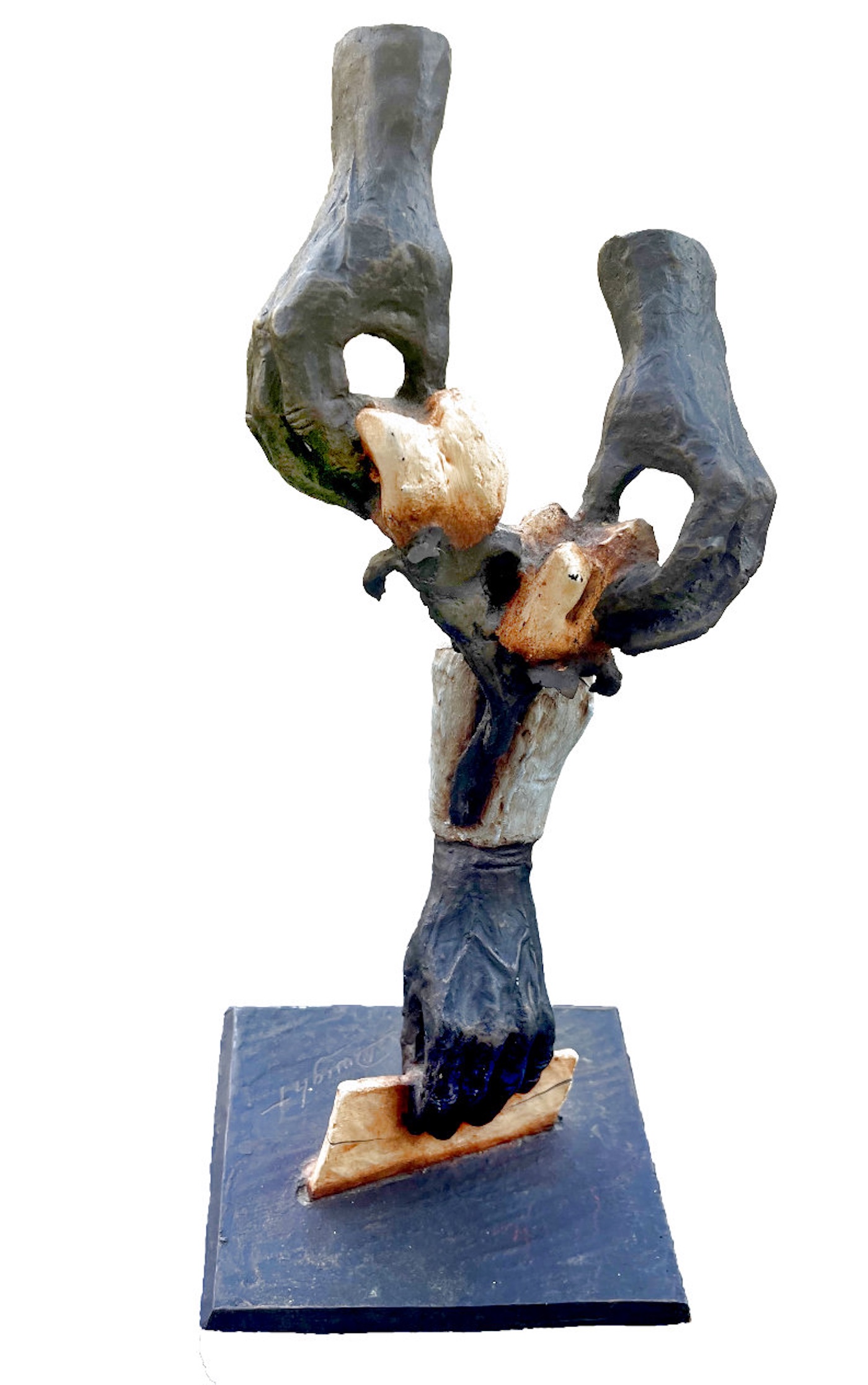
Dwight left the military in 1966, and his post-Air Force years were anything but linear. Dwight Studios’ biography and the University of Denver profile both describe a dizzying sequence of professional incarnations: IBM systems engineer, aviation consultant, restaurateur, real-estate developer, construction entrepreneur. To some readers, that stretch can look like detour or drift, evidence of a gifted man searching for a stable identity after the violence of institutional exclusion. But there is another way to read it. Reinvention was not a symptom of failure. It was practice in self-authorship. Dwight built businesses, handled systems, managed risk, and learned how capital, logistics, and infrastructure work in the real world. He became, in the phrase his own studio uses, a kind of renaissance man—though the phrase understates the historical pressure that produced such versatility in Black life. Sometimes multiplicity is not flourish. It is survival.
What changed the scale of his life was not merely that he returned to art. It was that he returned to art with a mandate. Smithsonian Magazine reports that a chance meeting in 1974 with George Brown, the Colorado politician and former Tuskegee Airman, pushed Dwight toward using sculpture to tell African American history. Dwight himself told Smithsonian that at 42, he did not know the details of slavery until Brown convinced him to tell the story of Black people through his work. The University of Denver similarly identifies Brown’s commission for a sculpture of his likeness as the catalytic event. This is one of the most revealing moments in Dwight’s biography because it turns the romantic idea of artistic calling into something more collective and political. He did not simply discover his medium. He was given a charge: learn the history, make it visible, and make it public.
Dwight then earned a Master of Fine Arts in sculpture from the University of Denver in 1977, a fact confirmed by Smithsonian, the University of Denver, the Smithsonian’s National Museum of American History object record, and Dwight’s own studio. That formal training matters, especially because Black artists of a certain generation are often mythologized either as raw visionaries or as social chroniclers, with insufficient attention paid to skill, study, and technique. Dwight was disciplined. He learned foundry work. He developed a technical command of bronze and large-scale production. He was not simply compelled by history; he mastered form well enough to make history durable.
There is also something quietly radical in the age at which his sculptural career consolidated. The University of Denver notes that his decades-long sculpting career truly took shape after 45. In a culture obsessed with prodigy and early arrival, Dwight’s timeline is a rebuke. Black artistic life is frequently forced into nonlinear development by labor, exclusion, family obligation, and institutional denial. Dwight did not emerge as the idealized young art-world discovery. He emerged as a mature maker with technical discipline, entrepreneurial knowledge, and a sharpened sense of historical purpose. In another country, that might be described simply as depth.
Sculpting what the archive refused to hold
The earliest major phase of Dwight’s mature artistic career centered on a series called “Black Frontier in the American West.” Dwight Studios states that the Colorado Centennial Commission commissioned the series, that it depicted the contributions of African Americans to the opening of the West, and that with National Park Service support it traveled and earned wide acclaim. The Bowers Museum and Smithsonian Magazine both underscore the historical importance of this intervention. At a time when the iconography of the American West remained overwhelmingly white in mainstream memory—cowboys, settlers, scouts, lawmen—Dwight insisted on Black pioneers, soldiers, laborers, explorers, and settlers as constitutive rather than incidental.
This was not only a matter of inclusion. It was a revision of national geography. The Black freedom struggle is often narrated through the South, the urban North, and the major battlegrounds of civil rights. Dwight widened the map. He made visible a Black West too often buried beneath frontier mythology. That move resonates strongly with KOLUMN’s recent essay on photographer John Johnson, which argued that Black cultural history has too often been constrained to a few mythologized locations. Dwight’s western series performed a comparable act in sculpture decades earlier. He was saying, in effect, that Black American history does not merely arrive in the West later as migration. It is already there, embedded in the making of the place itself.
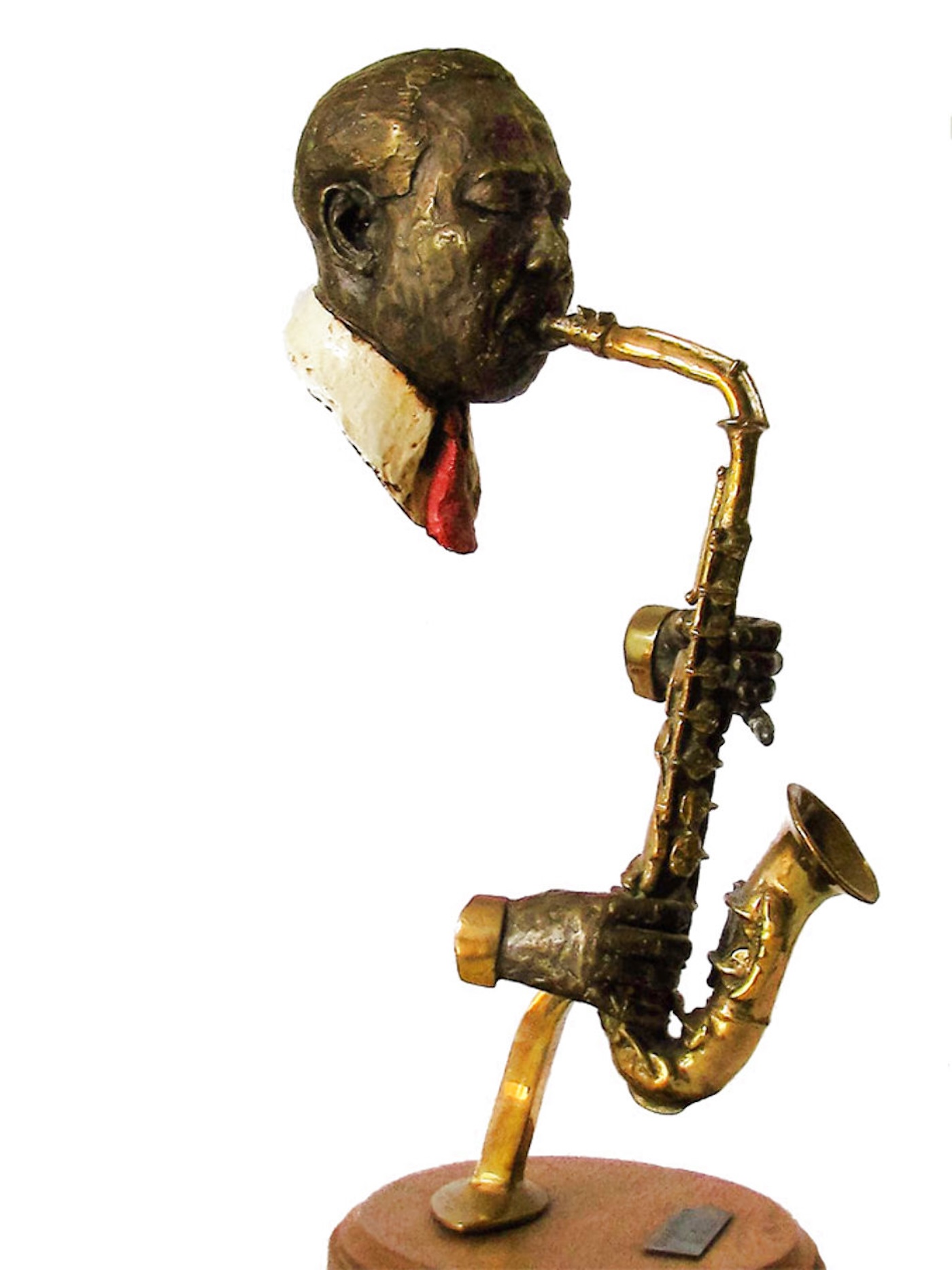
From there came “Jazz: An American Art Form,” and if the frontier series challenged a spatial myth, the jazz series challenged a cultural one. Dwight Studios and Britannica both note that the National Park Service commissioned Dwight to create an expansive sculptural series on jazz, ultimately comprising more than 70 bronzes and including figures such as Duke Ellington, Louis Armstrong, Miles Davis, Charlie Parker, Ella Fitzgerald, and Benny Goodman. Dwight’s own account emphasizes his study of African culture and the music’s roots, insisting on jazz not as pleasant ornament to American life but as one of the nation’s most significant Black cultural contributions. The point is not trivial. Jazz has long been praised as American genius while the Blackness of its origins gets softened, abstracted, or consumed as atmosphere. Dwight, working in bronze, reattached the music to its makers and its lineage.
The Smithsonian’s National Museum of American History holds Dwight’s bronze bust of Duke Ellington, made in 1988, a small but telling confirmation of his institutional reach. The object record notes both the piece itself and Dwight’s unusual path from Air Force test pilot and astronaut trainee to MFA-trained sculptor of large memorials and public art. That record matters not just as validation but as evidence of Dwight’s material intelligence. He understood how to convert movement, musicality, and charisma into mass. His Ellington bust is not simply commemorative. It is kinetic, poised, conductive. One sees in it the sculptor’s broader project: to render Black cultural magnitude with the formal seriousness white institutions have historically reserved for other subjects.
Monument as argument, monument as repair
By the late twentieth and early twenty-first centuries, Dwight had become a major maker of public memory. His studio says he has completed more than 128 public art and large-scale memorial installations and over 18,000 gallery sculptures; the University of Denver, in 2022, cited 129 monuments and more than 18,000 gallery pieces, while Britannica describes him as the sculptor of major monuments across the country. Even allowing for the usual minor variation among institutional counts, the point is unmistakable: Dwight’s output is enormous, and its scale is inseparable from its politics. He did not confine Black history to the gallery, where interpretation is optional and audience selective. He placed it in civic space.
Consider the African American History Monument on the grounds of the South Carolina State House. Historic Columbia records that it was installed on March 29, 2001, designed by Ed Dwight, funded through private donations, and built to tell the story of Black South Carolinians from 1619 to the present. The organization’s description of the monument is especially instructive: a semi-circular plaza recalling a drum, an obelisk, imagery of the slave ship Brookes, and 12 chronologically arranged panels moving from enslavement through emancipation, civil-rights struggle, and contemporary achievement. Historic Columbia also notes that controversial elements from Dwight’s original design, including more explicit depictions of terror, were muted or translated into text. The monument therefore embodies a recurring struggle in Black memorialization: how to tell the truth in public while navigating the limits of what public institutions can bear to see.
Then there is the Texas African American History Memorial on the Capitol grounds in Austin. The Texas State Preservation Board states that the memorial was erected in 2016, sculpted by Dwight, and traces African American history in Texas from the 1500s to the present, including figures such as Hendrick Arnold and Barbara Jordan and a central depiction of Juneteenth. Dwight Studios adds further detail, describing the monument as a large bronze-and-granite work linking early Black exploration in Texas to later Black achievement, even reaching symbolically toward astronaut Bernard Harris. The conceptual ambition here is unmistakable: Dwight understands Black history not as a chapter in state history, but as a civilizational through-line. Texas is not imaginable without Black labor, Black struggle, Black political leadership, Black creativity, and Black futurity. The memorial says so in the language of permanence.
His commissions extend across abolition, civil rights, religion, education, and national memory. Britannica notes that the National Park Service commissioned a life-size Frederick Douglass statue in 1978. Dwight Studios lists memorials to Denmark Vesey, Medgar Evers, Rosa Parks, Martin Luther King Jr. and Coretta Scott King, and a massive Tulsa memorial reckoning with the 1921 massacre. These are not random assignments. They constitute an alternate map of Black American history, one built through public sculpture rather than textbook narrative. Dwight’s oeuvre suggests that the monument, despite all the justified suspicion around monumental culture in the United States, can still be reclaimed when it serves truth rather than domination.
There is a philosophical seriousness to this project that deserves more attention than Dwight usually receives from mainstream art discourse. Public monuments are often discussed either aesthetically or politically, but Dwight’s work demands both lenses at once. His sculptures are representational enough to be legible, dramatic enough to command public space, and historically deliberate enough to function as civic pedagogy. They do not aspire to neutrality. They teach. They correct. They insist. In a country whose landscape remains saturated with monuments to conquest, whiteness, and sanitized power, Dwight’s memorial practice amounts to a contest over what and whom public permanence is for.
Barack Obama, historical time, and the artist as witness
One of Dwight’s most notable later works is his sculptural rendering of Barack Obama’s first inauguration. Britannica notes that he completed a life-size bronze of Obama and his family, along with others present at the inauguration, in 2010, and that it was featured as a touring museum exhibit. The University of Denver recounts that the idea came from collector Doug Morton just after Obama’s election, while Dwight Studios describes the work as a historical life-size presentation of the inaugural scene, including Michelle Obama, the Obama daughters, and Chief Justice John Roberts administering the oath.
This commission reveals another dimension of Dwight’s historical vision. He is often understood as a sculptor of trauma, exclusion, and long Black struggle—and rightly so. But he is equally attentive to rupture in the opposite direction: moments when Black presence in official state ritual transforms the symbolic order. The Obama inauguration was one such moment. Dwight, the man once mobilized as a symbol of American possibility but denied the institutional fulfillment of that symbol, now found himself sculpting a Black family at the center of the republic’s most visible ceremony of power. The resonance is obvious. Yet Dwight’s career cautions against easy triumphalism. The same nation that could inaugurate Obama had also spent decades resisting the histories Dwight put into bronze. To sculpt that inauguration, then, was not simply to celebrate. It was to locate one charged moment inside a much longer struggle over who gets imagined as the state.
Finally touching space, after the country had already been remade by his hands
In May 2024, Edward Dwight finally went to space. Blue Origin’s official mission update states that NS-25 launched on May 19, 2024, carrying six passengers, including “former Air Force Captain Ed Dwight,” identified as the first Black astronaut candidate chosen by Kennedy in 1961 but denied the chance to fly. Reuters, AP, The Guardian, and The Washington Post all covered the flight, noting both its symbolic force and the fact that Dwight, at 90, became the oldest person to reach space at the time. The Guardian emphasized the 61-year gap between his original selection and his actual ascent; AP and Reuters similarly framed the event as a late historical correction, though not a full erasure of the injustice that made such lateness necessary.
The obvious reading is sentimental: history, at last, came around. And there is some truth in that. The image of Dwight emerging from the capsule is undeniably moving, a reminder that deferred recognition can still carry emotional force. But the deeper significance lies elsewhere. By the time he touched space, Dwight had already constructed an American afterlife larger than the one originally promised to him. He did not spend six decades waiting. He built. He studied. He cast. He memorialized. He made the country look at histories it preferred to minimize. In that sense, the Blue Origin flight does not complete his story so much as throw its proportions into relief. America finally let him have the view. But he had already spent half a century giving the country ways to see itself.
There is also a harder irony at work. Dwight reached space not through NASA but through the privatized spectacle economy of billionaire-era suborbital flight. Reuters and AP both situated the trip within the contemporary world of Blue Origin and commercial space tourism. That context should not cancel the emotional magnitude of the moment, but it does complicate it. The nation that once treated spaceflight as an arena of public purpose and democratic prestige did not find a way to restore Dwight through its own central institutions. The correction came through a private company, a nonprofit sponsor, and a media environment eager for historical closure. Dwight’s life once again exposes the gap between symbolic recognition and structural reckoning.
Why Edward Dwight matters now
Edward Dwight matters now because he collapses several false oppositions that still distort American thinking. He dismantles the idea that science and art belong to different moral universes. He disproves the habit of treating Black historical work as either archival or imaginative, when in fact it must often be both. He exposes the distance between institutional inclusion and institutional transformation. And he offers a model of artistic practice grounded not in abstraction from history but in an almost relentless encounter with it. Smithsonian Magazine’s account of his life frames his sculptural work as preserving the history of African Americans. That is true, but the verb may be too soft. Dwight does more than preserve. He compels encounter.
His life also sharpens a question that artists, journalists, curators, and educators continue to face: what does it mean to build public memory in a society invested in amnesia? KOLUMN has recently argued, in its work on Gordon Parks and John E. Dowell Jr., that Black visual culture is one of the places where America’s evasions are hardest to maintain. Dwight belongs squarely in that tradition. His sculptures do not ask to be admired from a safe historical distance. They implicate the viewer in the politics of memory. To stand before one of his monuments is to confront a choice: either Black history is central enough to deserve public permanence, or the country’s proclaimed commitments to truth and democracy are performative. Dwight’s work does not let the viewer escape that tension.
There is a reason his art keeps returning to enslavement, emancipation, migration, music, religion, civil rights, and state power. These are not separate topics. They are the architecture of Black American modernity. Dwight’s project has been to monumentalize that architecture against a landscape that often monumentalized the forces arrayed against it. In doing so, he has made a distinct contribution to American art: he has shown that Black history can be rendered at full civic scale without surrendering nuance, pain, or complexity. The best of his memorials are not inert tributes. They are arguments in material form.
And perhaps that is the final point. Edward Dwight’s significance is not reducible to the first he almost became or even to the oldest-person-in-space record he eventually claimed. Those facts are dramatic, but they are not the deepest measure of the man. His deeper significance lies in the way he transformed exclusion into an artistic method for public truth-telling. He took the lesson of his near-astronaut years—that symbolic visibility without real permanence is a trap—and built a career dedicated to permanence. Bronze. Granite. Plaza. Pedestal. Panel. Relief. Figure. Sequence. Statehouse. Capitol grounds. Museum. He answered erasure with mass.
That is why Edward Dwight belongs not only in the history of Black flight, or Black firsts, or even Black public art, but in the larger history of how Black Americans have refused the terms on which the nation tried to contain them. He was supposed to prove that the future could make room for a Black man. Instead, he spent his life proving that Black people had always been present in the making of the nation—and that if the country would not carry that truth honestly in its institutions, he would cast it there himself.
More great stories
Afro Sheen, Wall Street, and the Architecture of Black Possibility
July 6, 2026
No Comments
The Fire Inside the Fourth
July 5, 2026
No Comments