


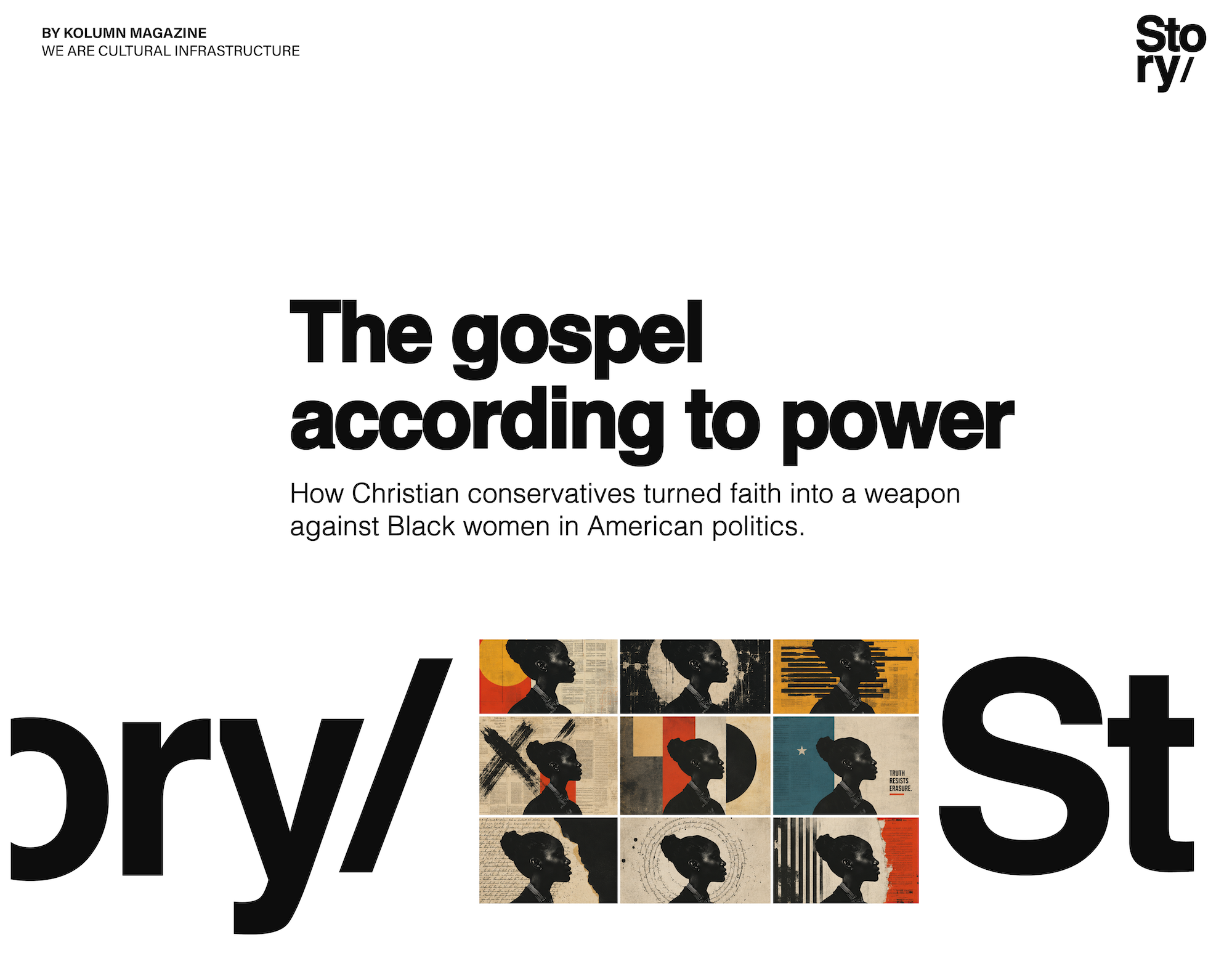
The problem is not faith in public life. The problem is faith used as a permission structure for domination.
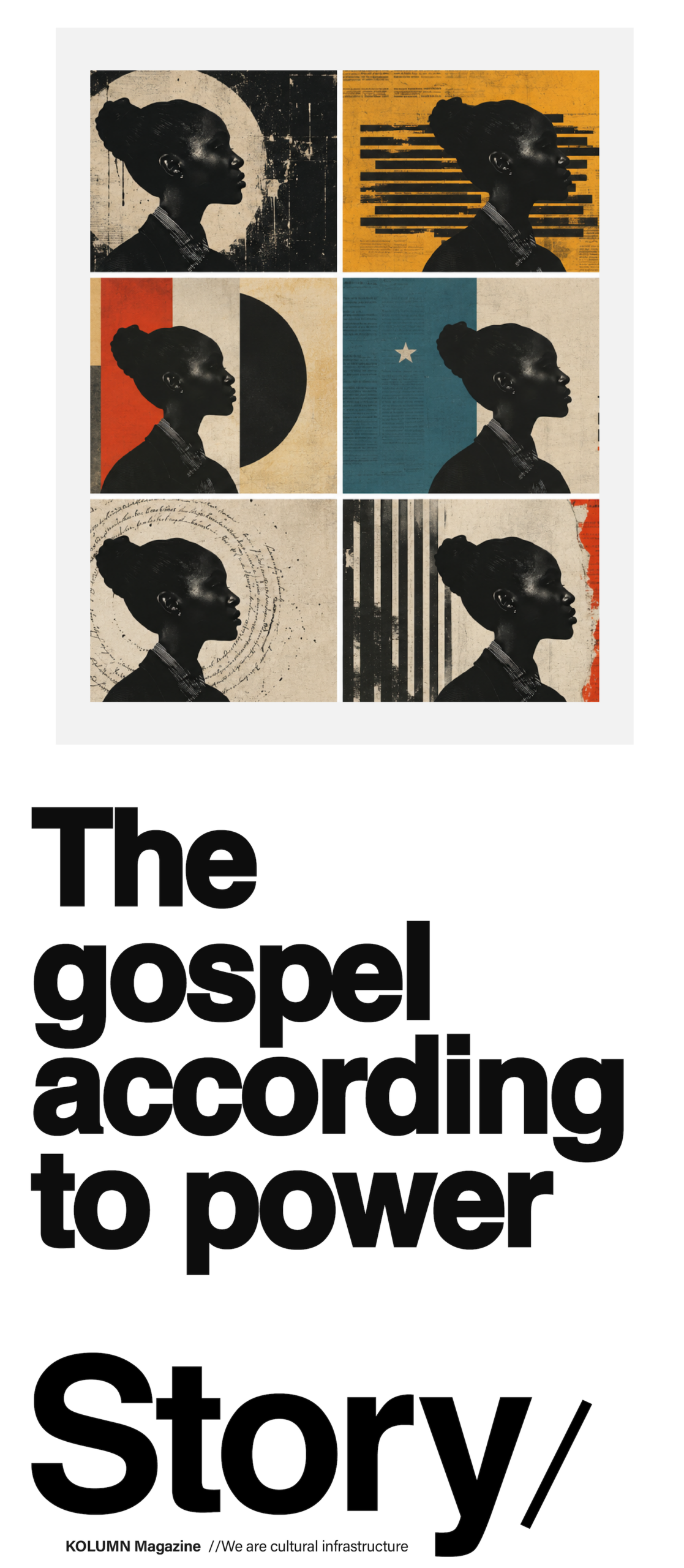
The problem is not faith in public life. The problem is faith used as a permission structure for domination.
By KOLUMN Magazine
There is a particular American political figure who must be named carefully because the name is so often disguised as virtue. He may call himself a patriot, a believer, a defender of family, a guardian of “Judeo-Christian values,” a protector of children, a champion of law and order, a man of faith standing against chaos. She may call herself a prayer warrior, a mother of the movement, a citizen trying to save the country from moral collapse. Together they form not simply a voting bloc but a political class: the Christian conservative class that weaponizes faith to justify exclusion, cruelty and contempt, while extending astonishing grace to leaders who deliver judicial power, cultural dominance and partisan victory.
This is not a critique of Christianity. It is a critique of power wearing Christianity’s clothes. It is not an indictment of every evangelical, every conservative believer, every churchgoer or every person who holds traditional theological views. Black America has always known the church as both sanctuary and battleground. The Black freedom struggle was carried by pastors, deacons, mothers of the church, Muslim organizers, secular radicals, students, domestic workers and theologians whose faith did not ask them to look away from injustice but to walk toward it. The problem is not faith in public life. The problem is faith used as a permission structure for domination.
Public Religion Research Institute has measured the scale of this political theology with unusual precision. In its 2025 American Values Atlas, PRRI found that white evangelical Protestants were the religious group most likely to hold Christian nationalist beliefs, with 67 percent qualifying as Christian nationalism adherents or sympathizers. Pew Research Center has similarly found that white evangelical Protestants remain among Donald Trump’s strongest supporters, even as many Americans view Trump as not especially religious. That contradiction is not incidental. It is the bargain.
The Christian conservative class is defined less by doctrine than by transaction. It can forgive vulgarity, corruption, racial cruelty, misogyny, threats of violence, immigrant-bashing and authoritarian appetite if the offender promises the correct enemies. It can discover moral outrage in a Black woman’s tone and lose all hearing when a favored man mocks, degrades or endangers her. It can call itself pro-family while delighting in attacks on women’s bodies, marriages, children, national origins and faith traditions. It can preach grace in the sanctuary and practice humiliation in the public square.
That is why the war against Black women in politics is not merely a series of ugly episodes. It is a system of discipline. Michelle Obama was not attacked only because she was a Democratic first lady. She was attacked because she embodied Black excellence without apology, Black womanhood without deference, Black family life without pathology and Black visibility inside the most symbolically powerful house in America. Ilhan Omar is not attacked only because she is a progressive congresswoman. She is attacked because she is Black, Muslim, immigrant, female, elected and unwilling to perform gratitude for conditional belonging. Stacey Abrams is not attacked only because she organizes voters. She is attacked because she names voter suppression as policy, not accident, and because she turned the political imagination of Georgia into a national threat to conservative control. Alexandria Ocasio-Cortez, Rashida Tlaib, Ayanna Pressley, Cori Bush, Jasmine Crockett, Summer Lee and other women of color have been cast in the same drama: too loud, too angry, too foreign, too radical, too ungrateful, too ambitious, too much.
The accusation changes. The function remains.
The Old Theology of the New Backlash
The Christian conservative war against Black women did not begin with Trump, though Trump made its cruelty more explicit and its performance more profitable. Its roots reach into the long entanglement of white Christianity, racial hierarchy and gender control. Historian Kristin Kobes Du Mez has argued in Jesus and John Wayne that modern white evangelical politics cultivated an ideal of militant masculinity, not merely piety. Robert P. Jones, founder of PRRI and author of White Too Long, has documented how white Christian institutions helped sustain racial hierarchy long after slavery formally ended. Jemar Tisby, author of The Color of Compromise, has traced the historical pattern by which white Christian institutions too often accommodated racism when moral courage threatened social power.
This history matters because the attacks on Black women in politics are often misread as personality conflicts or partisan excess. They are better understood as inheritance. The same moral imagination that once cast Black freedom as disorder now casts Black women’s authority as menace. The same theology that defended patriarchy as divine order now portrays women who govern, argue and lead as unnatural. The same racial mythology that depicted Black women as hypersexual, masculine, angry, fraudulent or dangerous has been updated for cable television, social media and campaign fundraising emails.
The term “misogynoir,” coined by scholar Moya Bailey, is essential here. Bailey developed the term to name the specific anti-Black misogyny directed at Black women and femmes, a form of contempt that cannot be reduced to racism plus sexism as separate ingredients. Northwestern Magazine describes Bailey’s work as giving language to the distinct prejudice Black women experience in society. In politics, misogynoir becomes a technology of disqualification. It says Black women are too emotional to lead, too aggressive to persuade, too corrupt to trust, too alien to represent the nation and too successful to have earned their place.
Christian conservatism did not invent misogynoir. But in its most reactionary form, it baptizes it.
Michelle Obama and the Punishment of Black Grace
Michelle Obama’s public life exposed the lie that respectability can protect Black women from racist imagination. She was Princeton-educated, Harvard-trained, married, disciplined, elegant, careful and patriotic in the language America claims to reward. She spoke about children’s health, military families, education and civic responsibility. She raised two daughters under surveillance. She offered the country the now-famous moral formulation, “When they go low, we go high,” a phrase that became both civic aspiration and burden.
None of it spared her.
The attacks began early and never really ended. She was caricatured as angry, unpatriotic, emasculating, militant, unfeminine and alien. Her arms became a controversy. Her body became a battlefield. Her face became a target. The Washington Post cataloged the rude, racist and sexist attacks Michelle Obama endured during her time as first lady, including the infamous West Virginia Facebook post that called her an “ape in heels.” Time reported that a West Virginia official was placed on leave after the racist “ape in heels” remark, while another Time report described an Arkansas teacher accused of calling her “the first chimpanzee”. These were not simply insults. They were old racial scripts in digital form.
Michelle Obama later spoke plainly about the cost. At a Women’s Foundation of Colorado event, she said the cuts that hurt most were the ones meant to make people believe she was not who she knew herself to be; Time covered her reflection on the racism she faced as first lady. Her testimony was important because Black women in public life are often asked to absorb abuse without visible injury. They are expected to be strong enough to survive it and gracious enough not to name it.
The ugliness continued beyond the Obama presidency. In February 2026, the Associated Press reported that Trump deleted a social media post after backlash over a racist video depicting Barack and Michelle Obama as primates. PBS NewsHour placed the imagery in its historical context, noting that associating Black people with apes has long been a racist dehumanizing practice. ABC News reported that even some Black Trump allies called the video “indefensible”. The episode demonstrated the larger pattern: what would once have been considered disqualifying became just another test of partisan loyalty.
For Christian conservatives who spent years policing decency, the silence was revealing. The same class that could turn school library books into moral emergencies often treated racist imagery against Michelle Obama as a passing controversy. That is the bargain again. Sin is negotiable when power is on the table.
Ilhan Omar and the Politics of Conditional Belonging
If Michelle Obama was punished for Black grace, Ilhan Omar has been punished for Black refusal. She refuses to disappear inside gratitude. She refuses to treat citizenship as something native-born conservatives may revoke by chant. She refuses to accept that Muslim identity makes her less American than a Christian nationalist who confuses democracy with possession.
Omar’s biography unsettles the myth. She arrived in the United States as a refugee from Somalia, became a citizen, won office in Minnesota and became one of the first Muslim women elected to Congress. Her presence should have been legible as an American story. Instead, Christian conservative politics often rendered it as invasion.
In 2019, Trump attacked Omar and other congresswomen of color by telling them to “go back” to the countries they came from, despite the fact that most were born in the United States and all were American citizens. The Washington Post reported that the House voted to condemn Trump’s racist remarks about the congresswomen. At a North Carolina rally, Trump’s supporters chanted “send her back” about Omar, an episode Time described as rooted in racially charged attacks on four congresswomen of color. Vanity Fair called the chant racist and openly targeted at Omar.
The chant was not incidental theater. It was a ritual of expulsion. It told Omar that citizenship could be overridden by race, religion and dissent. It told every Black Muslim girl watching that the price of visibility might be public banishment. It told Christian conservative audiences that cruelty could feel like worship if performed in the right political key.
KOLUMN has previously examined Omar’s vulnerability to hearsay and manufactured suspicion in “Ilhan Omar: The Politics of ‘I Was Told’”, noting that Omar sits at the intersection of identities long treated as suspect in American political mythology: immigrant, Muslim, Black, outspoken and unwilling to flatter the bigotry directed at her. That formulation remains central. The attacks on Omar work because they do not need evidence; they rely on atmosphere. Muslim becomes suspect. Somali becomes suspect. Black becomes suspect. Woman becomes suspect. Progressive becomes suspect. The accusation arrives already believed.
In 2025, The Guardian reported Omar’s warning that Trump’s repeated attacks fuel a climate of political violence, with Omar citing threats to her life and concern for people who resemble her. Reuters reported in 2026 that Trump suggested Omar and Rashida Tlaib should be removed from the United States after a speech clash, remarks widely condemned as racist and xenophobic. The escalation is important: “send her back” was not a one-time eruption. It was a governing language.
Stacey Abrams and the Fear of Black Political Competence
Stacey Abrams represents a different kind of threat: not symbolic occupation, but infrastructure. She is dangerous to the Christian conservative class not because she performs radical theater but because she understands systems. She understands registration, turnout, ballot access, litigation, messaging, coalition-building and the mundane architecture through which democracy either expands or contracts.
Abrams came to national prominence after the 2018 Georgia gubernatorial race, where she refused to concede in the conventional language of closure while documenting the voter suppression that shaped the contest. PBS NewsHour reported that Georgia’s election fight showed how Black voter suppression remained a Southern tradition, while Abrams used her platform to argue that democracy cannot be measured only by ballots cast but by barriers placed before voters long before Election Day. ABC News later covered Abrams calling out voter suppression during the 2020 election cycle.
The backlash against Abrams has been relentless because she disrupted a comfortable conservative fiction: that low Black turnout is apathy rather than policy, that long lines are accidents rather than warnings, that purges are administrative rather than ideological, that voter ID laws are neutral rather than targeted. She turned technical suppression into moral language. That made her especially vulnerable to the politics of punishment.
Abrams has been caricatured as power-hungry, illegitimate, delusional and corrupt. Her body has been mocked. Her ambition has been treated as evidence of disorder. Her refusal to quietly accept a compromised system has been reframed as entitlement. The gendered script is familiar: when white men contest elections, they are fighters; when Black women contest structures, they are sore losers. The racial script is older still: when Black people demand equal access to power, they are accused of stealing what was never offered freely.
This is why the religious language matters. Christian conservative politics often speaks of order, but the order being defended is not merely moral. It is racial, gendered and electoral. It is the order in which Black women may organize church drives, staff campaigns, save democracy in emergencies and then be told to wait their turn when power is distributed. Abrams refused the assignment.
AOC, the Squad and the Brown Woman as Apocalypse
Alexandria Ocasio-Cortez is not Black, but the attacks on her belong to the same racialized and gendered machinery that targets Black and brown women who refuse deference. Alongside Ilhan Omar, Rashida Tlaib and Ayanna Pressley, Ocasio-Cortez became part of “the Squad,” a label the right transformed into shorthand for everything it wanted its base to fear: socialism, immigration, Islam, Blackness, Latinidad, feminism, youth, urban politics and unapologetic dissent.
Trump’s “go back” attack targeted the Squad as a collective. The fact that Ocasio-Cortez was born in New York did not matter. The point was not accuracy. The point was to mark her as foreign to legitimate power. That is how racial politics works even when the target is a citizen, even when the biography is public, even when the facts are plain. The accusation does not need to be true. It needs only to activate an audience trained to hear brown women’s authority as trespass.
Ocasio-Cortez has been sexualized, mocked as stupid, portrayed as dangerous and treated as a symbol of national collapse. Her policy arguments are often displaced by arguments about her clothes, her voice, her former work as a bartender, her age, her body and her supposed ingratitude. The pattern is not identical to the misogynoir directed at Black women, but it is allied to it: a politics that treats women of color as threats to patriarchal national identity.
Ayanna Pressley, the first Black woman elected to Congress from Massachusetts, has faced similar contempt, often disciplined through stereotypes about anger and radicalism. Rashida Tlaib, a Palestinian American Muslim congresswoman, has been targeted through Islamophobia, anti-Palestinian racism and gendered accusations of disloyalty. Cori Bush, a Black woman, nurse, pastor and Ferguson activist turned congresswoman, has been punished for bringing movement language into legislative space. Jasmine Crockett has been attacked for the sharpness that makes her effective, her rhetorical skill recast by critics as attitude rather than intellect.
The Christian conservative class often presents these women as civilization-ending figures. That hysteria is strategic. It converts policy disagreement into existential fear. It makes a Green New Deal sound like apocalypse, voting rights sound like theft, police accountability sound like anarchy and reproductive autonomy sound like demonic rebellion. Once the woman is coded as a threat to God’s order, nearly any attack becomes permissible.
The Machinery of Harassment
The war against Black women in politics is not only rhetorical. It is operational. It moves through rallies, memes, talk radio, congressional hearings, campaign ads, fundraising emails, edited video clips, harassment campaigns and threats. The Center for Democracy & Technology has warned that disinformation and online abuse hinder women of color political candidates, noting that such attacks are designed to suppress participation and voice. The Brennan Center has similarly found that women and officeholders of color face disproportionate threats and harassment, creating a chilling effect on democratic representation.
This is not accidental. Harassment is a form of political cost. It tells Black women that leadership will require not only campaigning, fundraising and governing but also security planning, family protection, emotional endurance and public exposure to dehumanization. It asks them to pay a tax others do not pay at the same rate.
The machinery is particularly effective because it can deny coordination while benefiting from repetition. A politician makes an insinuation. A media personality amplifies it. An influencer turns it into a meme. A pastor frames it as spiritual warfare. A donor list monetizes outrage. A crowd chants. A lone actor sends a threat. Then the original speaker claims innocence. This diffusion allows the Christian conservative class to enjoy the fruits of extremism while denying responsibility for the tree.
The result is a democratic contradiction. Black women are among the most reliable defenders of democratic participation, yet they are among the most aggressively punished for exercising democratic power. They are praised when they save elections and vilified when they seek office. They are thanked as voters and threatened as leaders. They are asked to rescue institutions that still struggle to protect them.
The Moral Alibi
The Christian conservative class survives by maintaining a moral alibi. It insists that its politics are about life, family, religious liberty, parental rights and national virtue. Yet its practical record often tells another story. It has made peace with cruelty at the border, indifference to police violence, attacks on voting rights, book bans, anti-LGBTQ campaigns, reproductive coercion and a style of political rhetoric that places targets on the backs of vulnerable people.
This is why KOLUMN’s prior essay “The Gospel of Power & Race” remains relevant. That piece argued that Christian nationalism recasts the cross as a flagpole, asking believers to forgive what they once condemned so long as it delivers political victory. The war against Black women in politics is one of the clearest examples of that exchange. The moral vocabulary remains Christian. The operating logic is domination.
To be fair, there are Christians across the political spectrum who reject this bargain. Senator Raphael Warnock, pastor of Ebenezer Baptist Church, has argued that Democrats and progressives should not cede religious language to the right; The Washington Post reported his view that the country faces a spiritual crisis and that faith should be connected to care for the vulnerable and welcome for the stranger. Black church traditions have long insisted that faith without justice is not holiness but performance. Many white Christians, too, oppose Christian nationalism and recognize it as a distortion of their faith. The question is not whether Christianity belongs in moral debate. The question is whether Christianity will be used to humble power or sanctify it.
The Christian conservative class, as a political formation, has chosen sanctification.
From Jezebel to “Angry Black Woman” to Enemy of the State
The attacks on Michelle Obama, Ilhan Omar and Stacey Abrams are modern, but their grammar is old. Historians of race and gender have long shown how Black women were forced into controlling images that justified exploitation and exclusion. The Jezebel stereotype rationalized sexual violence. The Mammy stereotype demanded service without authority. The Sapphire stereotype cast Black women as loud, angry and emasculating. The welfare queen stereotype turned poverty into moral failure and Black motherhood into public threat. Each figure performed political work. Each made inequality appear natural.
In the post-civil-rights era, these controlling images adapted to new terrain. The Black woman candidate became “divisive.” The Black woman professor became “indoctrinating.” The Black woman journalist became “biased.” The Black woman prosecutor became “corrupt” if she pursued conservative power and “soft” if she pursued reform. The Black woman activist became “dangerous.” The Black woman first lady became “angry” before she had spoken.
Michelle Obama’s treatment is impossible to understand outside this lineage. So is Abrams’s. So is Omar’s, though Omar’s case also involves Islamophobia and anti-immigrant nationalism. The Christian conservative class did not have to invent new stereotypes. It inherited them, digitized them and placed them inside a politics of religious grievance.
There is also a historiography of white women’s participation in this order. Too often, public discussion frames Christian conservative politics as the work of angry men alone. But white conservative women have been central to school board fights, anti-feminist campaigns, anti-ERA activism, anti-abortion organizing and racial backlash politics. They have often claimed maternal innocence while advancing punitive policy. This matters because attacks on Black women frequently arrive through the language of protection: protecting children, protecting women’s sports, protecting neighborhoods, protecting elections, protecting faith. Protection becomes the soft face of exclusion.
What the War Reveals
The war against Black women in politics reveals what the Christian conservative class fears most: not moral decline, but plural democracy. It fears a country in which Christianity is not a weapon of state power. It fears elections in which Black voters cannot be easily suppressed. It fears women who do not ask permission to lead. It fears immigrants who become lawmakers. It fears Muslims who quote the Constitution. It fears Black wives who cannot be reduced to pathology. It fears brown women who speak in accents of the Bronx, Detroit, Minneapolis, Atlanta and Ferguson and still claim the nation as their own.
This fear is often described as cultural anxiety, but that phrase can be too gentle. What we are witnessing is a struggle over ownership. Who owns America? Who gets to define its moral center? Who gets to be angry? Who gets forgiven? Who gets believed? Who gets to make mistakes without becoming a stereotype? Who gets to speak for God?
Black women in politics disrupt the old answers. They force the country to confront the difference between faith and domination, patriotism and possession, criticism and hatred, morality and control. They expose the hollowness of a movement that can rage against drag queens and library books while shrugging at racist dehumanization. They reveal that much of what passes for Christian conservative outrage is not moral conviction but status panic.
And still, the women remain. Michelle Obama remains one of the most admired public figures in the country. Ilhan Omar remains in Congress, still speaking after years of threats. Stacey Abrams remains a central architect of voting rights politics. Ocasio-Cortez remains one of the most influential communicators in American public life. Pressley, Tlaib, Crockett, Bush, Lee and others continue to expand the visual and ideological vocabulary of power.
Their endurance should not be romanticized. Survival is not protection. Representation is not safety. Visibility is not justice. But endurance is evidence. It tells us that the old machinery, while dangerous, is not all-powerful. It can wound. It can distort. It can threaten. It can delay. But it cannot fully erase the women who have learned to read its script and still refuse the role assigned to them.
The Christian conservative class wants to make this a story about unruly women. It is really a story about unruly democracy. Black women in politics are not attacking America by demanding to shape it. They are exposing the people who mistook America for their private inheritance.
The question now is not whether the attacks will continue. They will. The question is whether the rest of the country will keep treating them as isolated ugliness or finally understand them as a governing strategy. Because once faith becomes a shield for cruelty, democracy itself becomes the heresy. And in that theology, Black women are not merely opponents. They are proof that the old gods are losing their grip.
More great stories
Afro Sheen, Wall Street, and the Architecture of Black Possibility
July 6, 2026
No Comments
The Fire Inside the Fourth
July 5, 2026
No Comments