


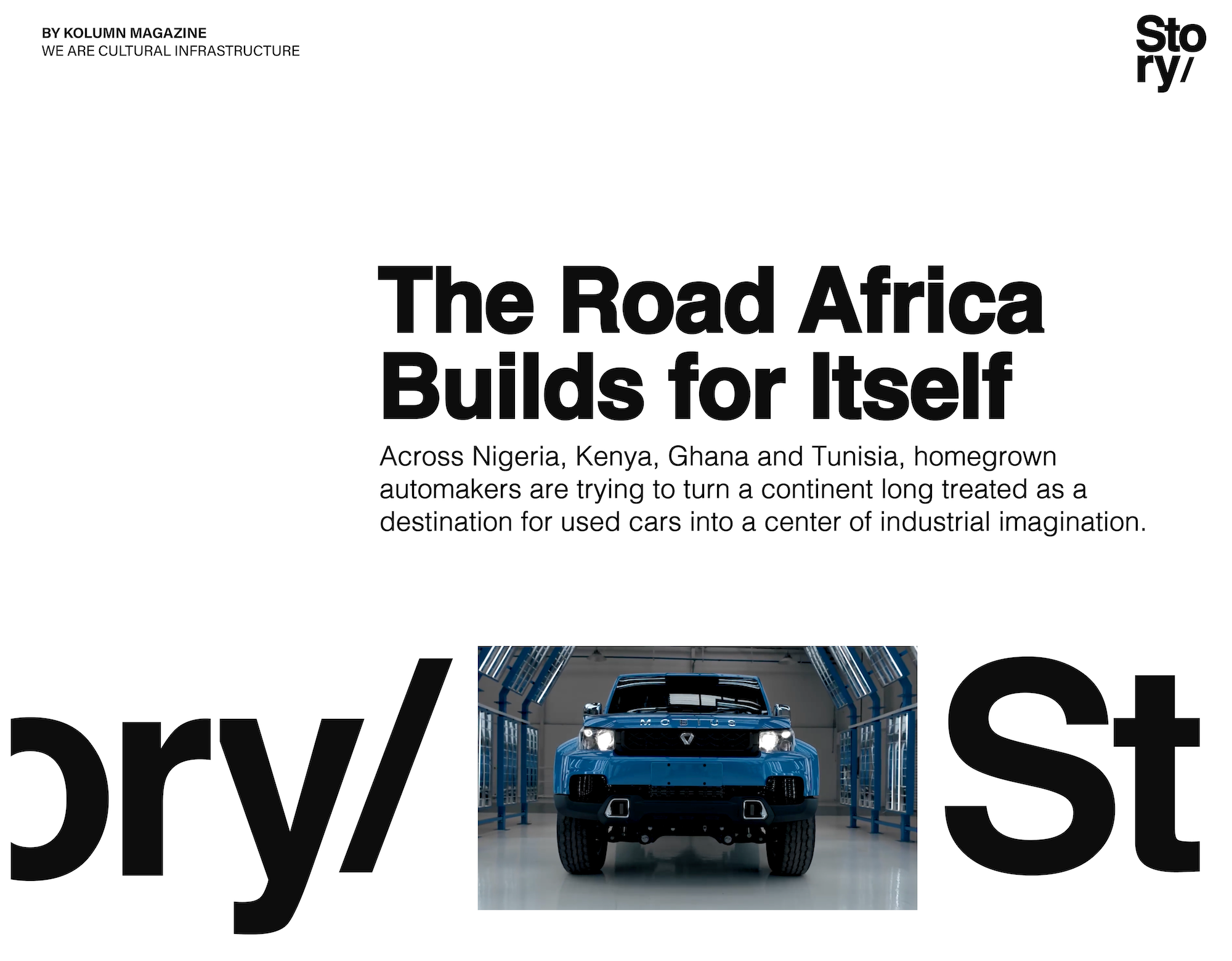
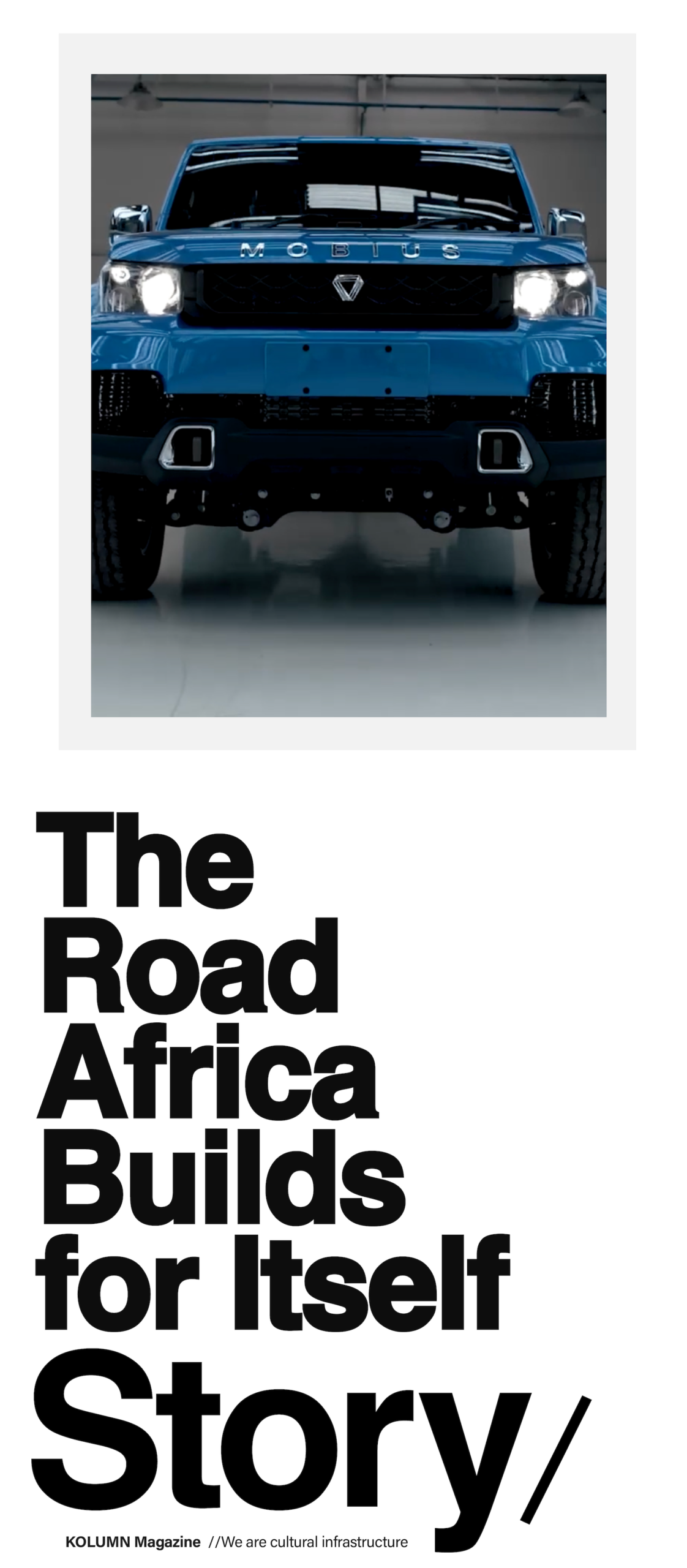
Africa’s automotive future is not simply about replacing imported vehicles with local ones; it is about whether the continent can convert mobility demand into industrial power.
Africa’s automotive future is not simply about replacing imported vehicles with local ones; it is about whether the continent can convert mobility demand into industrial power.
By KOLUMN Magazine
There is a familiar sound in the African city: the cough of a secondhand engine at dawn, the compression of traffic around a roundabout, the small negotiation between fuel price, road condition, family need and state neglect. For decades, the automobile in much of Africa has been less an emblem of industrial destiny than a moving archive of someone else’s economy. Vehicles arrive after another life in Europe, Japan, Korea, the United States or the Gulf, and then begin their African afterlife in markets where mechanics become engineers, spare parts become improvisational systems, and mobility becomes a daily referendum on infrastructure.
That history is not merely about cars. It is about the colonial road, the extractive railway, the port city, the post-independence factory, the debt crisis, the import regime, the informal workshop, the customs yard and the unsteady promise of industrial policy. Africa’s automotive market is now valued in the tens of billions of dollars, with one industry analysis estimating the market at $22.63 billion in 2026 and projecting growth to $28.93 billion by 2031, but the deeper story is not a spreadsheet. It is the struggle to move from consumption to production.

In that struggle, four names have become shorthand for different versions of the African automotive wager: Innoson Vehicle Manufacturing in Nigeria, Mobius Motors in Kenya, Kantanka Automobile in Ghana and Wallyscar in Tunisia. None of these firms is large enough to rival Toyota, Volkswagen, Stellantis, Hyundai, Renault or China’s rapidly expanding automakers. Each, however, has done something symbolically and industrially important. They have tried to build for African buyers from African locations, under African constraints, in markets where the economics of local production are often punishing.
Their stories unfold alongside the wider continental contradiction. Africa is urbanizing, motorizing and integrating its markets, yet much of its mobility demand is still met by imported used vehicles. The United Nations Environment Programme has warned that the global used-vehicle trade requires stronger quality standards, especially in importing countries, and its 2024 update tracks the flow of used light-duty vehicles from major exporters into the Global South, including Africa’s large recipient markets, through its report on used vehicles and the environment. The issue is not that every used vehicle is bad. It is that a continent’s mobility future cannot be built indefinitely on another region’s castoffs.
The Long Road Before the Factory
The historiography of Africa’s auto industry often begins with post-independence assembly plants, but the deeper archive begins earlier. Colonial transport systems were not designed to democratize mobility. Roads and rail lines were engineered to move commodities, troops and administrative authority. In British, French, Belgian and Portuguese colonial territories, the vehicle was part of an extractive geography: trucks moved cash crops, minerals and labor; roads connected mines and ports more reliably than villages and clinics. The African motorist, mechanic and passenger entered a system designed without them at its center.
After independence, many governments viewed vehicle assembly as a marker of sovereignty. Nigeria, Ghana, Kenya, Egypt, Morocco and South Africa all experimented, in different ways, with import substitution and industrial policy. South Africa became the continent’s dominant automotive manufacturing hub, with major global manufacturers and a sophisticated supplier base. Morocco later emerged as a powerhouse tied to European value chains. Elsewhere, assembly plants rose and fell with tariff policy, foreign exchange shortages, political instability and the limits of domestic purchasing power.
The African Development Bank’s working paper on Africa’s automotive industry frames the central challenge plainly: the market for cars and commercial vehicles has grown, but much of that demand has been supplied by used imports rather than locally manufactured vehicles. That reality has shaped the politics of the sector. Policymakers want factories, jobs and component industries. Consumers want affordable mobility. Dealers want inventory. Mechanics want repairable machines. Governments want customs revenue. Environmental advocates want safer, cleaner fleets. These interests do not always align.
This is why the automobile is such a revealing object. It sits at the intersection of household aspiration, industrial planning, climate policy, trade law and public infrastructure. A locally built vehicle can symbolize sovereignty, but symbolism alone cannot overcome high borrowing costs, thin supplier networks, unreliable power, weak consumer financing and the hard arithmetic of scale. To build cars competitively, a manufacturer needs not only a factory but a market deep enough to absorb volume, suppliers close enough to reduce costs, policy stable enough to justify investment and consumers confident enough to buy new rather than imported used.
Innoson and the Nigerian Industrial Imagination
Innoson Vehicle Manufacturing is perhaps the most famous indigenous automaker in sub-Saharan Africa. Based in Nnewi, Anambra State, the company presents itself as a builder of durable, affordable vehicles for African conditions, saying on its own site that its mission is to manufacture brand-new automobiles for Africans at prices close to tokunbo equivalents, using the Nigerian term for imported used vehicles. That framing is important because Innoson’s real competitor is not only Toyota, Hyundai or Ford. It is the used import itself.
Founded by Innocent Chukwuma, Innoson emerged from the commercial culture of southeastern Nigeria, where trading networks, spare-parts markets and entrepreneurial manufacturing have long blurred the line between commerce and industry. Nnewi has often been described as an industrial cluster built from apprenticeship systems, family capital and practical engineering. Innoson’s rise is inseparable from that ecosystem. It is not a Silicon Valley story. It is a market-town industrial story, built from trade knowledge, parts distribution and a practical understanding of what African buyers need from a vehicle.
The company’s history also forces a useful correction. Viral claims have sometimes exaggerated Innoson’s place in global Black automotive history, and AFP has fact-checked false online assertions that Innoson was the world’s first Black-owned automaker, noting that Nigeria’s earlier Peugeot Automobile Nigeria began production decades before Innoson’s founding in its article on false claims about the Nigerian automaker. That correction does not diminish Innoson’s significance. It makes the significance more precise. Innoson matters because it represents an African-owned manufacturing effort operating in one of the continent’s largest consumer markets, not because it needs myth to validate its importance.
Nigeria should be a natural automotive giant. It has population, urban density, entrepreneurial energy and a vast transport economy. Yet it has also struggled with power reliability, currency volatility, policy inconsistency and a flood of used imports. In that environment, Innoson’s existence is a statement of industrial persistence. It has supplied buses, SUVs, pickups and passenger vehicles, and it has benefited at times from government patronage and public-sector procurement. Those contracts matter because African automakers often cannot survive on retail sales alone; they need institutional buyers willing to create demand at scale.
The company’s challenge is the same challenge facing nearly every indigenous automaker on the continent. Local pride can open a conversation, but it cannot close a sale if price, financing, service networks and resale confidence do not follow. For many African households, a used Japanese or European vehicle still feels safer than a new local brand because the repair ecosystem is familiar and the resale market is deeper. Innoson’s long-term success depends on converting patriotic curiosity into ordinary consumer trust.
Mobius and the Brutality of the Middle Market
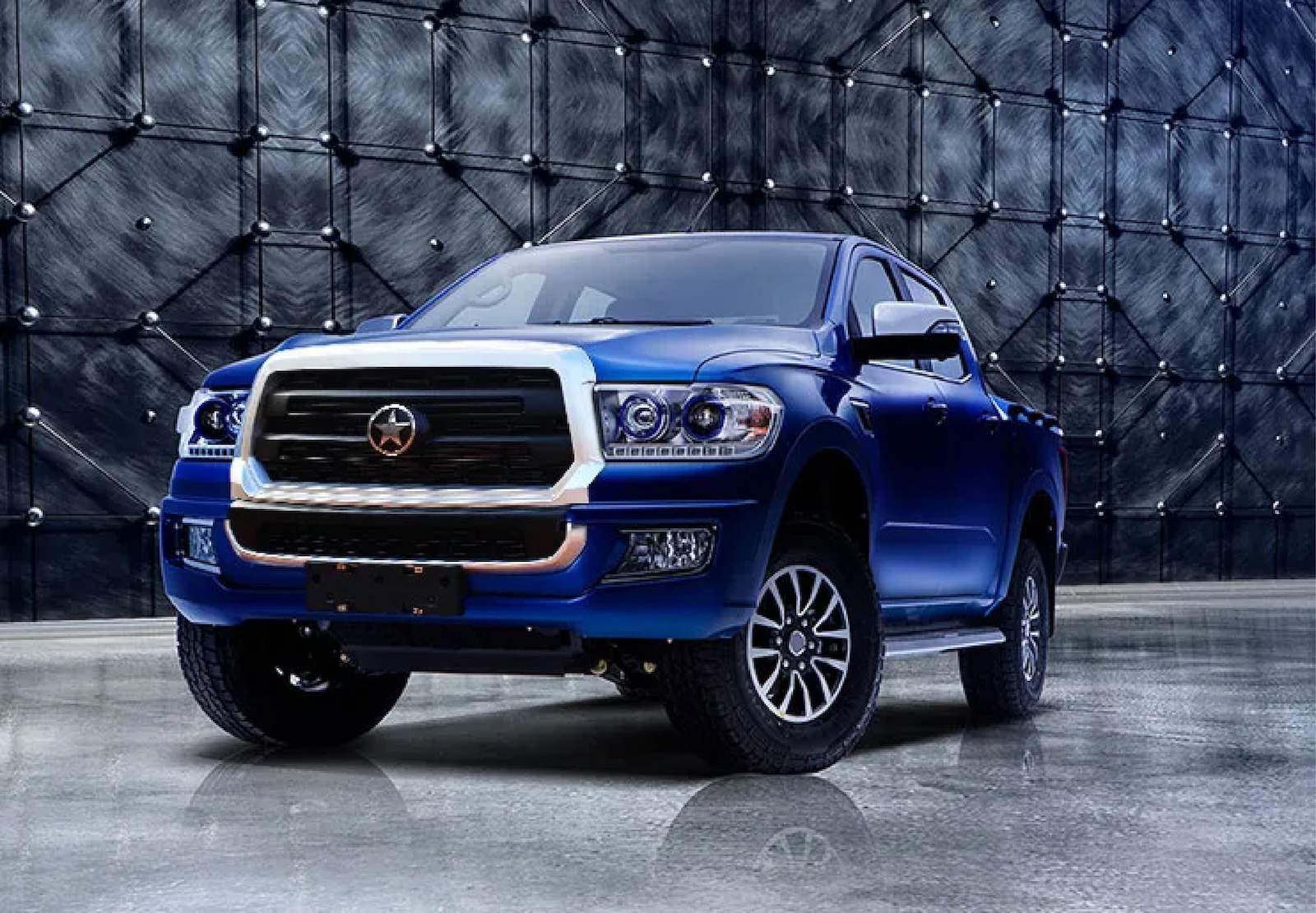
If Innoson represents the Nigerian industrial imagination, Mobius Motors represents both the brilliance and brutality of designing specifically for African roads. Founded in 2011 by Joel Jackson, Mobius described its purpose as building a vehicle in Africa, for Africa, with early models designed around ruggedness, utility and affordability. The concept was elegant: strip away unnecessary luxury, strengthen the vehicle for poor road conditions, and sell an SUV that could serve farmers, small businesses, NGOs and rural professionals.
Mobius understood a truth that global automakers often treated as a secondary concern. African roads are not simply roads with potholes. They are economic environments. A vehicle that fails on a rural route can interrupt schooling, market access, health care and income. A rugged utility vehicle is not only a lifestyle product; it can be infrastructure on wheels. In that sense, Mobius was not trying to sell aspiration alone. It was trying to sell function.
But function met finance. In August 2024, Reuters reported that Mobius would cease operations after financial difficulties, citing pressures including debt, taxes and competition from secondhand imports. Days later, Reuters reported that Mobius had accepted a takeover bid from an undisclosed buyer, avoiding the finality of liquidation. In 2025, Kenyan outlet Citizen Digital reported that Mobius was resuming operations after acquisition by a Middle Eastern buyer.
The Mobius saga is a case study in the African automotive middle market. Too expensive to compete with old used imports, too small to command global supply chains, too capital-intensive to scale like a software company, and too dependent on policy to avoid the shocks of taxes and credit conditions, Mobius occupied a narrow bridge between vision and viability. It built a product that made conceptual sense, yet the market did not reward concept alone.
Kenya’s broader auto environment is dynamic but difficult. The country has assembly capacity, a growing middle class, and a policy interest in local manufacturing, but the used import market remains powerful. Consumers are rational. If a secondhand vehicle offers lower upfront cost, familiar parts and known resale value, the moral argument for local manufacturing may not be enough. Mobius asked buyers to believe in a new African vehicle category. Belief is expensive when interest rates are high.
Kantanka and the Ghanaian Dream of Indigenous Technology
Kantanka Automobile occupies a different symbolic space. Founded by Apostle Dr. Kwadwo Safo Kantanka, the Ghanaian company is tied not only to auto manufacturing but also to a broader national mythology of invention, technological self-reliance and African genius. Its company profile states that Kantanka was established in 1994 and incorporated in 2004, with early work focused on automotive components and complete built units. The company says its first complete built unit was manufactured in 1998 using more than 75 percent local components, including the engine block, and that its first SUV, the Onantefo, was manufactured by 2006.
Kantanka’s public story is inseparable from Ghana’s postcolonial imagination. Ghana, the first sub-Saharan African country to gain independence from colonial rule, has always carried a disproportionate symbolic burden in pan-African politics. Kwame Nkrumah’s industrial dream was not simply to build a national economy but to prove that African modernity could be self-authored. Kantanka’s vehicles sit in that lineage, even when the company’s production scale and supply-chain realities are far more modest than the symbolism surrounding it.
The company’s trajectory page notes that its plant was officially commissioned in November 2015, marking a formal step from prototype culture toward commercial manufacturing. Its lineup has included SUVs, pickups and sedans, with names that often carry local linguistic and cultural resonance. That naming matters. In a market saturated with imported badges, Kantanka asserts that a Ghanaian vehicle can carry Ghanaian meaning.
Yet Kantanka has also faced skepticism. Some critics have questioned the depth of local content, the reliance on imported kits, the company’s pricing and the theatricality surrounding some of its technology exhibitions. Those critiques should not be dismissed, because industrial seriousness requires scrutiny. But neither should they obscure the deeper point: African technological ambition has often been mocked before it has been properly financed, studied or supported. Kantanka’s story sits between inspiration and accountability. It deserves both.
The Ghanaian government has tried to attract global automakers and develop assembly capacity, but the question remains whether indigenous firms can grow alongside multinational assemblers rather than be crowded out by them. Local champions need quality discipline, supplier development, financing tools and procurement support. They also need a public culture that can distinguish between patriotic hype and strategic patience.

Wallyscar and the North African Niche
Wallyscar, based in Tunisia, tells yet another version of the African automotive story. Founded in 2006, the company became known for compact, customizable vehicles such as the Wallys Izis and later the Iris. A company brochure for the Wallys Iris describes Wallyscar as created in 2006 in a spirit of adventure, and a 2023 profile describes Wallys Car as the first Tunisian car manufacturer.
Tunisia’s automotive context differs from Nigeria’s, Kenya’s and Ghana’s. It sits closer to European supply chains, has a developed components sector and benefits from proximity to Mediterranean markets. Wallyscar leaned into niche production rather than mass-market conquest. Its vehicles have often been described as leisure-oriented, youthful and customizable, a North African cousin to the beach car and compact utility vehicle rather than a direct answer to the used Toyota problem.
This makes Wallyscar significant in a different register. It shows that African automotive manufacturing need not follow only one template. Not every company must become a national mass-market producer. Some may survive by occupying specialized segments, exporting small volumes, meeting particular design tastes and using regional supplier relationships. In a continent too often described in aggregate, Wallyscar reminds us that Africa’s automotive future will be plural. A Tunisian niche manufacturer, a Nigerian bus and SUV producer, a Kenyan utility-vehicle startup and a Ghanaian indigenous technology brand are not variations of the same company. They are responses to different markets.
Wallyscar’s challenge is scale, but its advantage is identity. In automotive culture, identity matters. Buyers do not purchase only horsepower and warranty terms. They purchase belonging, style and story. Wallyscar’s story is Mediterranean, North African and export-facing. It complicates the simplistic notion that African cars must be rugged above all else. Some African cars can be playful, urban, coastal and design-led.
The Used-Car Question No One Can Avoid
Every serious conversation about African vehicle manufacturing eventually returns to imported used cars. They are the continent’s mobility safety valve and its industrial trap. They make vehicle ownership possible for millions of households and small businesses that could not afford new cars. They support repair economies and parts markets. They also undermine new-vehicle demand, delay fleet modernization, worsen emissions in poorly regulated markets and make it harder for local manufacturers to reach scale.
UNEP’s 2020 landmark report on the global trade in used vehicles examined 146 importing countries and called for harmonized minimum quality standards, arguing that cleaner and safer used vehicles require stronger regulation. The 2024 update builds on that work, making clear that the issue is no longer obscure. Used vehicles are a central climate, safety and industrial-policy question.
African governments face a difficult balance. Ban used imports too aggressively, and mobility becomes unaffordable. Allow them without age limits, emissions rules or inspection standards, and the continent becomes a dumping ground for unsafe and polluting vehicles. Protect local assembly without improving quality and affordability, and consumers pay more for less. The policy sweet spot is narrow: gradually tighten used-import standards while building financing systems, local assembly capacity and public procurement programs that make new vehicles viable.
The African Continental Free Trade Area adds another layer. The ODI has argued in its paper on AfCFTA and the automotive value chain that Africa plays a limited role in the global automotive industry but has opportunities if regional integration can overcome fragmented national markets. This is crucial. A Nigerian automaker selling only to Nigeria, a Ghanaian automaker selling only to Ghana, or a Kenyan automaker selling only to Kenya will struggle to achieve scale. The factory needs the continent.
Expert Voices and the New Industrial Moment
Experts in the sector increasingly emphasize that Africa’s auto future depends less on isolated national champions than on regional value chains. The African Association of Automotive Manufacturers, whose members include global firms and regional industry actors, positions itself around developing and driving the automotive industry in Africa. Its basic premise is that the continent needs policy coordination, predictable regulation and market scale. That is not glamorous language, but it is the language factories understand.
Japan International Cooperation Agency research on promoting the African automotive industry similarly underscores the structural constraints: small new-vehicle markets, affordability problems, weak financing and the dominance of used imports. These are not defects of entrepreneurial imagination. They are system conditions. They explain why a company like Mobius can have a compelling product and still nearly disappear, why Innoson needs government procurement, why Kantanka’s local-content claims matter, and why Wallyscar’s niche strategy may be more realistic than mass-market ambition.
The new EV transition brings both opportunity and danger. Africa has critical minerals, fast-growing cities and a need for cleaner transport, but it also risks being positioned once again as raw-material supplier and end-market rather than manufacturing center. Recent reporting by the Associated Press described how Nigeria and Kenya are assembling electric vans from Chinese EV kits, showing how the electric transition may begin through commercial fleets, public transport and kit assembly rather than private luxury EV ownership. Reuters has also reported that South Africa is proposing to extend automotive incentives to battery materials as part of a broader EV manufacturing strategy, a sign that the continent’s most advanced automotive economy is trying to adapt to the next industrial cycle.
This is where the stakes sharpen. If African countries miss the internal-combustion manufacturing wave and then miss the EV manufacturing wave, they may find themselves locked into a new dependency: importing used gasoline vehicles while the rest of the world transitions, then importing used EVs without having built battery, charging, software or component ecosystems. The lesson of Innoson, Mobius, Kantanka and Wallyscar is not that every country needs its own car brand. It is that Africa needs the capacity to decide what mobility industrialization looks like on African terms.
The KOLUMN Throughline
KOLUMN Magazine has previously explored the legacy and current landscape of Black-owned car dealerships, a story rooted in access, capital, representation and the long struggle to participate in an industry that has often profited from Black consumers while excluding Black ownership. Africa’s automotive manufacturers extend that conversation across the Atlantic. Here, the question is not only who sells the vehicle. It is who designs it, assembles it, finances it, regulates it, repairs it and benefits from the supply chain.
That distinction matters. A dealership can create wealth and representation within an existing industrial order. A manufacturer challenges the order itself. Innoson, Mobius, Kantanka and Wallyscar are not merely selling cars; they are testing whether African capital, engineering, branding and policy can converge around production. Their successes are partial. Their failures are instructive. Their ambitions are historically necessary.
The diaspora should pay attention because the auto industry has always been more than an industry. In the United States, the automobile shaped Black migration, labor organizing, suburban exclusion, policing, music, style and dealership ownership. In Africa, the automobile is shaping urbanization, trade, climate exposure, youth aspiration and industrial policy. The road is a political space. Who builds the vehicles that travel it is a political question.
What These Four Companies Teach Us
Innoson teaches that local manufacturing must speak directly to affordability. Its invocation of tokunbo pricing is not marketing fluff; it is a recognition that the used import is the benchmark. To win, African automakers must compete not with fantasy buyers but with real households weighing school fees, rent, fuel, repairs and currency instability.
Mobius teaches that product-market fit is not enough without financial architecture. A rugged African SUV makes sense, but sense does not pay suppliers or service debt. Local automakers need patient capital, fleet buyers, reasonable tax policy and credit systems that help consumers buy new vehicles.
Kantanka teaches that symbolism can mobilize attention but must be disciplined by quality, transparency and scale. African invention should be celebrated, but celebration should not exempt companies from scrutiny. The goal is not applause. The goal is durable industrial capacity.
Wallyscar teaches that African automaking can be niche, stylish and export-minded. The continent’s manufacturing future does not have to be defined only by utility vehicles and buses, even though those segments are vital. There is room for design identity, regional specialization and small-batch ambition.
Together, these companies reveal a continent in transition. Africa is no longer content to be described only as a future market. It is increasingly asking what kind of producer it can become. That question will not be answered by slogans. It will be answered by procurement rules, component suppliers, port efficiency, consumer finance, engineering education, electricity reliability, regional trade and the willingness to protect public interest without protecting mediocrity.
The Road Ahead
The future of Africa’s automotive market will likely be uneven. South Africa and Morocco will remain major manufacturing anchors. Egypt, Kenya, Ghana, Nigeria, Tunisia, Rwanda, Ethiopia and Angola will pursue different forms of assembly, EV adoption, bus production and component development. Chinese automakers will expand. European firms will defend legacy positions. Used imports will remain powerful. Indigenous brands will survive only where vision meets policy, quality and capital.
The most honest assessment is neither boosterism nor cynicism. Innoson, Mobius, Kantanka and Wallyscar are not proof that Africa has already arrived as an automotive power. They are proof that the desire to arrive is real, technically grounded and historically overdue. Their vehicles carry more than passengers. They carry the unfinished argument over whether Africa will merely consume the machines of modern life or build them.
A century from now, historians may look back on this period as an awkward, uneven beginning: factories too small, policies too inconsistent, claims too grand, markets too fragmented. But beginnings often look that way. The first roads were not highways. The first workshops were not industrial parks. The first locally branded vehicles were not global competitors. They were declarations.
Africa’s automotive market is significant because it gathers the continent’s central development questions into one moving object. Can regional integration create scale? Can industrial policy outlast election cycles? Can climate transition produce factories rather than only import bills? Can consumers be protected without being priced out of mobility? Can African brands earn trust not by asking for patriotic charity but by building vehicles people want, can afford and can repair?
The answer is still being assembled. In Nnewi, Nairobi, Accra and Tunis, it is being welded, financed, criticized, relaunched and tested on roads that were never neutral. The road Africa builds for itself will not be smooth. But it may yet be the road that changes who holds the wheel.
More great stories

Afro Sheen, Wall Street, and the Architecture of Black Possibility
July 6, 2026
No Comments
The Fire Inside the Fourth
July 5, 2026
No Comments