




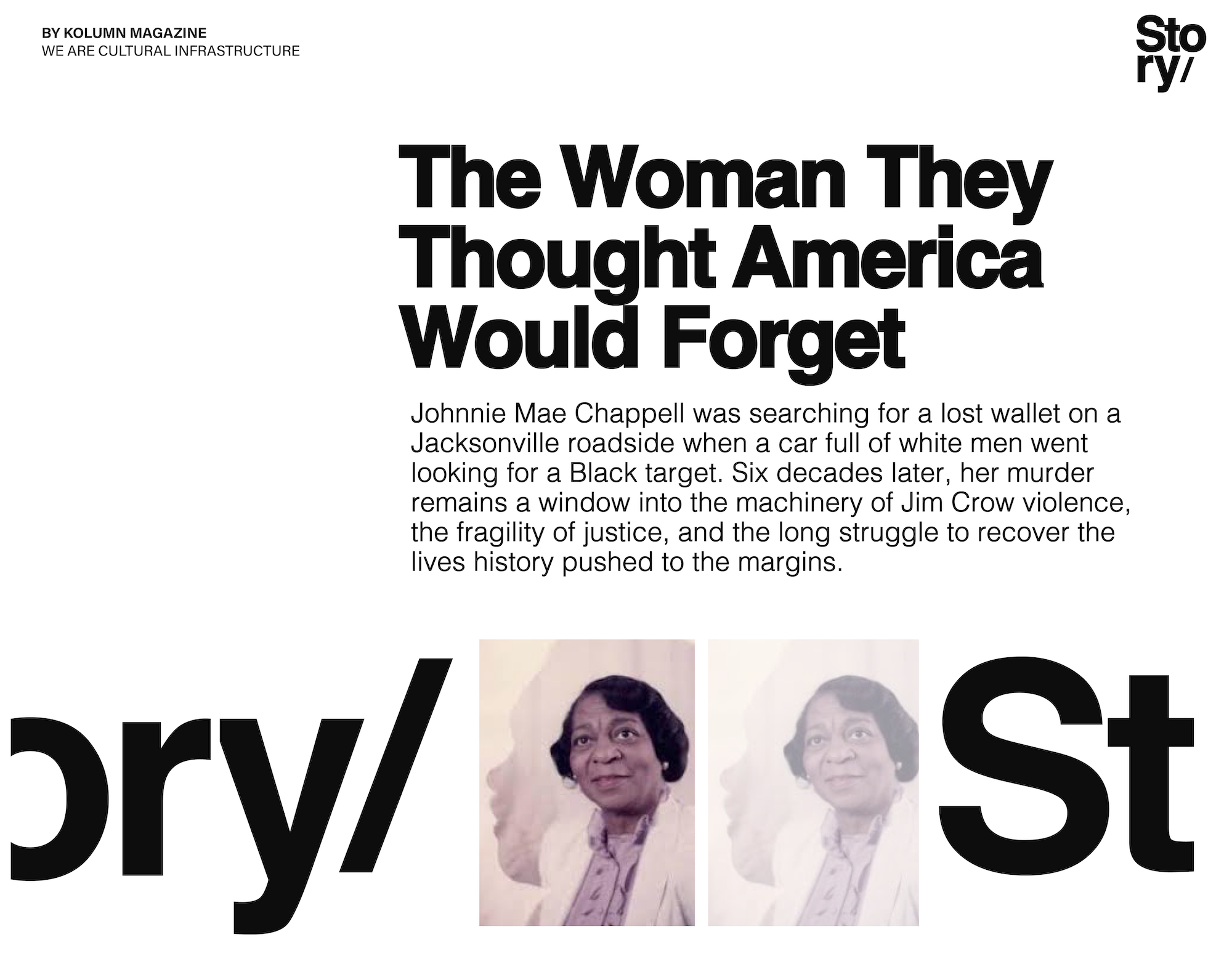
The tragedy of Johnnie Mae Chappell's murder is not only that she was killed. It is that America spent decades deciding whether her life was worth remembering.
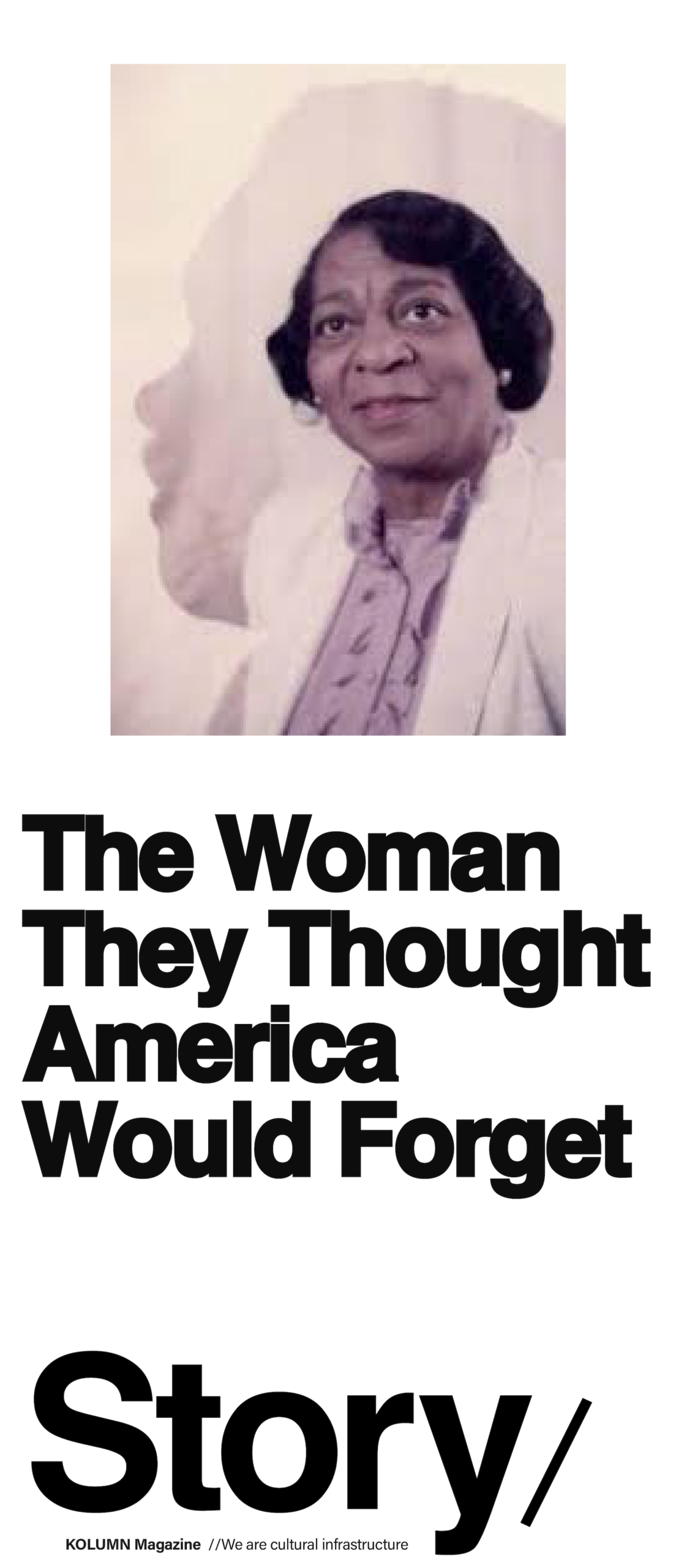
The tragedy of Johnnie Mae Chappell's murder is not only that she was killed. It is that America spent decades deciding whether her life was worth remembering.
By KOLUMN Magazine
By the time darkness settled over Jacksonville, Florida, on March 23, 1964, the city was already tense with the pressures of a changing South. Demonstrations challenging segregation had intensified. Racial confrontations had drawn police into Black neighborhoods and commercial districts. Newspapers focused on unrest in the streets. Public officials worried about order. White segregationists worried about power. Black residents worried about survival.
Johnnie Mae Chappell was worried about a wallet.
That distinction matters because history often remembers the extraordinary while overlooking the ordinary. Chappell was not leading a protest. She was not speaking from a church pulpit. She was not appearing before television cameras or organizing voter-registration drives. She was a 35-year-old wife, mother of ten children, domestic worker, and community caregiver whose life reflected the labor that sustained countless Black families throughout the Jim Crow South. According to records preserved by the Jacksonville Public Library’s collection dedicated to Mrs. Johnnie Mae Chappell, she spent her days balancing work, family responsibilities, and the countless obligations that accompanied raising a large household in a segregated city.
Yet on that March evening, while retracing her steps near the Pickettville community after realizing she had lost her wallet, Chappell encountered a form of racial violence that was both random and systematic. A car carrying four white men approached. One of the men fired a .22-caliber pistol. The bullet struck Chappell in the abdomen. Before reaching the hospital, she died.
The facts of the murder are not particularly complicated. The significance of the case lies in what happened afterward.
Over the following decades, investigators would uncover evidence suggesting that the men in the vehicle had been actively searching for a Black target. Detectives would allege that evidence disappeared. Witness testimony would point toward racial intent. Federal investigators would later reopen the case under civil-rights cold-case initiatives. Family members would spend decades demanding answers. Historians would eventually place Chappell’s murder within a broader landscape of racial terror that stretched from the lynching era into the modern civil-rights movement.
What emerged was not simply the story of a murder. It was the story of how institutions decide whose deaths matter, whose suffering receives official attention, and whose memory survives long enough to challenge the nation that failed them.
A City Built on Segregation
To understand the significance of Johnnie Mae Chappell’s murder, it is necessary to understand Jacksonville itself. During the first half of the twentieth century, Jacksonville occupied a distinctive place in Southern racial history. The city possessed a substantial Black population, a vibrant network of Black churches and businesses, and a long tradition of African American civic activism. At the same time, it remained deeply committed to segregation, both through formal law and informal custom.
The Jacksonville of 1964 was still living in the shadow of events such as Ax Handle Saturday, the notorious 1960 attack in which white mobs armed with baseball bats and ax handles assaulted Black demonstrators challenging segregated lunch counters. Historians have frequently pointed to that event as evidence that Jacksonville’s reputation as a comparatively moderate Southern city often obscured the intensity of local resistance to racial equality. As scholars examining Florida’s civil-rights movement have noted, segregation in Jacksonville was maintained not only through legislation but through violence, intimidation, and a political culture that often prioritized white stability over Black citizenship.
By March 1964, civil-rights activism had intensified throughout Florida and across the South. Congress was debating what would become the Civil Rights Act of 1964. National media coverage increasingly highlighted confrontations between demonstrators and segregationists. White resistance movements, meanwhile, responded with a mixture of political opposition and outright violence.
Against this backdrop, Jacksonville experienced a series of racial disturbances that attracted local and national attention. According to PBS FRONTLINE’s examination of the case in its Un(re)solved project, the city had become a site of escalating racial tension as Black residents challenged discriminatory practices and police responded with heavy enforcement measures. Hundreds of people were arrested, and confrontations between demonstrators and authorities became a defining feature of local news coverage during the period.
Yet Johnnie Mae Chappell was nowhere near those confrontations when she was killed.
The distinction is important because it undermines one of the most common misconceptions surrounding racial violence during the civil-rights era. Public memory often imagines such violence occurring at the site of protests, marches, or political campaigns. Chappell’s murder demonstrates something different. White supremacy did not require organized activism to justify itself. It could emerge in ordinary spaces, on ordinary roads, directed at ordinary people who happened to be Black.
The roadside where Chappell searched for her wallet was not a battlefield. The men who encountered her transformed it into one.
The Search for a Target
One of the most disturbing aspects of the Chappell case emerged months after her death, when investigators began assembling testimony from individuals connected to the shooting.
According to a later Department of Justice review of the case, investigators learned that the men in the vehicle had spent part of the evening drinking beer and driving around Jacksonville. During subsequent interviews, witnesses described a conversation in which one of the occupants suggested they find a Black person to shoot. The Justice Department’s review, which revisited the case decades later under federal civil-rights cold-case initiatives, cited evidence indicating that the group intentionally entered a predominantly Black area before the fatal encounter.
The significance of those allegations extends beyond the question of individual guilt. Historians who study racial violence frequently distinguish between crimes motivated by personal conflict and crimes intended to reinforce racial hierarchy. The latter category occupies a central place within the history of Jim Crow because such violence functioned as a social warning. Its purpose was not simply to injure a victim but to remind an entire community of its vulnerability.
Johnnie Mae Chappell appears to have been selected precisely because she was available. The randomness was part of the terror. She did not need to know her attackers. She did not need to challenge them. She did not need to threaten them. Her race alone made her a potential target.
That reality places the murder within a broader historical tradition of racial violence that scholars have increasingly connected to both lynching and modern hate crimes. Organizations such as the Equal Justice Initiative have argued that racial terror often operated through public unpredictability, creating an atmosphere in which Black Americans understood that danger could emerge without warning. Whether the violence occurred at a courthouse, a roadside, a school, or a storefront, the message remained consistent: Black life existed under conditions of conditional protection.
The murder of Johnnie Mae Chappell reflected precisely that logic.
The randomness was not evidence that the crime lacked meaning. The randomness was the meaning.
A Mother's Life Beyond the Crime
One of the enduring challenges facing historians of racial violence is the tendency for victims to become known only through the circumstances of their deaths. The crime overwhelms the biography. The violence eclipses the life. Over time, a person becomes remembered primarily as a victim rather than as an individual whose existence extended far beyond the moment of tragedy.
That danger is particularly acute in the case of Johnnie Mae Chappell.
Much of what survives in public memory focuses on the shooting itself, yet contemporary accounts and family recollections paint a fuller portrait. Chappell was a wife to Willie Chappell and the mother of ten children. She worked as a domestic laborer and was known in her community for assisting with childbirth and caregiving responsibilities. Like countless Black women throughout the South, she occupied a position that was simultaneously essential and undervalued. Her labor sustained families and neighborhoods while rarely attracting public recognition.
Historians of Black women’s history have increasingly argued that understanding the civil-rights era requires examining precisely these kinds of lives. Scholars such as Danielle McGuire, Barbara Ransby, and others have challenged older narratives that centered almost exclusively on ministers, politicians, and nationally visible activists. Their work demonstrates that Black women often formed the social infrastructure of freedom struggles, even when their names failed to appear in newspaper headlines.
Johnnie Mae Chappell was not a movement celebrity. She did not become a symbol during her lifetime. Yet her murder reveals how ordinary Black women occupied the front lines of segregation simply by moving through public space. The dangers they faced were not separate from the civil-rights movement. They were part of the conditions that made the movement necessary.
That understanding represents one of the most important historiographical shifts in recent decades. Earlier generations of civil-rights scholarship often asked whether an individual was directly involved in activism. Contemporary historians increasingly ask a different question: what did segregation do to ordinary Black lives?
The answer, in Chappell’s case, is devastatingly clear.
The Investigation That Threatened to Go Nowhere
In the immediate aftermath of the shooting, there was little reason for Black residents of Jacksonville to believe justice would arrive swiftly. Throughout the Jim Crow South, racial murders frequently followed a familiar trajectory. Initial public outrage would be followed by investigative delays, incomplete evidence collection, witness intimidation, prosecutorial hesitation, or acquittals delivered by all-white juries. Even when arrests occurred, convictions were far from guaranteed. The legal system often operated less as a mechanism of accountability than as a reflection of the racial power structures it was supposedly tasked with regulating.
The Chappell case initially appeared destined to follow that pattern. Law enforcement officers investigated the shooting, but critical opportunities were lost almost immediately. Over the decades, these early failures would become central to understanding why the case remained controversial long after the fatal shot was fired. The issue was never merely whether investigators identified a suspect. The issue was whether authorities preserved enough evidence to ensure that the truth could survive the passage of time.
The later federal review conducted under the Justice Department’s Civil Rights Division would reveal a series of troubling irregularities. According to the Department of Justice’s final memorandum reviewing the case, investigators discovered that the vehicle allegedly involved in the shooting was not subjected to the level of forensic examination that would be expected in a homicide investigation. The firearm believed to have fired the fatal shot eventually disappeared. The bullet recovered from Chappell’s body was never subjected to testing capable of definitively linking it to a particular weapon. Decades later, these gaps would become more than procedural concerns. They would become barriers that prevented prosecutors from reconstructing events with complete certainty.
What makes those omissions especially significant is that they occurred when memories were still fresh and physical evidence still existed. Historians examining civil-rights-era violence have repeatedly emphasized that many cold cases became unsolvable not because time naturally erased the record but because institutions failed to preserve the record when preservation was still possible. In that sense, the disappearance of evidence is not simply a technical failure. It is a historical event in its own right. Every lost document, misplaced weapon, or incomplete report narrows the future’s ability to understand the past.
For the Chappell family, these shortcomings would become a recurring source of frustration. The question was no longer confined to who fired the gun. It expanded to include why critical evidence vanished, why certain investigative leads were not pursued more aggressively, and why a Black woman’s murder appeared to receive a level of attention that many believed would have been unacceptable had the victim been white.
Detectives Against the Current
The story might have ended there were it not for the efforts of two Jacksonville detectives whose names would become inseparable from the case: C. Lee Cody and Donald Coleman. Their investigation ultimately produced arrests and indictments, but it also revealed the obstacles confronting law enforcement officers who attempted to pursue racial violence aggressively during the civil-rights era.
As later accounts reconstructed the investigation, Cody and Coleman followed witness statements that led them toward a group of young white men connected to the shooting. Their work culminated in the arrest of four suspects and the presentation of evidence to a grand jury. The resulting indictments represented a significant development in a region where racial murders often failed to generate meaningful legal consequences.
Yet the detectives themselves would later express concerns about the handling of the case. Over the years, public statements and interviews suggested that both men believed important evidence had been lost or mishandled. Their concerns became part of the broader narrative surrounding Chappell’s death because they originated not from outside critics but from investigators directly involved in the original case.
The detectives’ allegations contributed to a growing perception that the murder had never been fully resolved. Although legal proceedings moved forward, questions lingered regarding whether authorities had pursued every available avenue of accountability. Those questions would become increasingly important as journalists, historians, and civil-rights organizations revisited the case decades later.
Their experience also reflected a larger reality of civil-rights-era law enforcement. The South was not divided neatly between racist officials and heroic reformers. Institutions contained individuals operating under conflicting pressures. Some investigators sought justice while working inside systems resistant to change. Others accommodated prevailing racial norms. The resulting tensions often shaped the trajectory of high-profile cases.
The Chappell investigation illustrates precisely that complexity. The arrests suggested determination. The missing evidence suggested failure. Together, they produced a case that was simultaneously prosecuted and compromised.
The Trial of J.W. Rich
The legal proceedings that followed revealed how difficult it remained to secure meaningful convictions in racially charged cases during the civil-rights era.
Among the men implicated in the shooting, J.W. Rich emerged as the primary defendant. According to findings summarized in the Justice Department’s later review, Rich acknowledged firing the weapon that killed Chappell. His defense, however, argued that the shooting lacked the deliberate intent necessary for a murder conviction. Alternative explanations were presented regarding the trajectory of the bullet and the circumstances surrounding the discharge of the firearm.
The distinction between murder and manslaughter proved critical. A murder conviction would have required jurors to conclude that Rich intentionally killed Chappell. Manslaughter, by contrast, implied a lower threshold of criminal intent. The difference carried enormous implications not only for sentencing but for public understanding of the crime itself.
In December 1964, Rich was convicted of manslaughter rather than murder and received a ten-year prison sentence. According to the Justice Department’s review, he ultimately served approximately three years before being released. Charges against the other men were dismissed.
For many observers, the outcome reflected a familiar pattern. The legal system acknowledged wrongdoing while stopping short of recognizing the full scope of the offense. A Black woman had been killed. A conviction had been obtained. Yet the broader context of racial terror appeared largely absent from the final result.
Historians frequently note that civil-rights-era courts often struggled—or refused—to address racial motivation directly. Prosecutors might secure convictions on lesser charges while avoiding broader discussions about white supremacy and organized racial violence. This approach allowed institutions to claim success while leaving underlying systems largely unexamined.
The Chappell case exemplifies that dynamic. The verdict produced accountability in the narrowest sense. It did not produce closure.
The distinction would matter enormously in the decades that followed.
Historiography and the Recovery of Forgotten Victims
For many years, Johnnie Mae Chappell occupied a relatively minor place within mainstream civil-rights histories. Her name appeared occasionally in discussions of racial violence, but she rarely received the sustained scholarly attention afforded to figures such as Medgar Evers, Emmett Till, James Chaney, Andrew Goodman, Michael Schwerner, or the four girls killed in the Birmingham church bombing.
This disparity reflected broader patterns within historical scholarship. Earlier generations of civil-rights historiography often emphasized major campaigns, landmark court decisions, and nationally recognized martyrs. Such approaches produced invaluable scholarship, but they also left many victims on the margins of public memory.
Beginning in the late twentieth century, historians increasingly challenged these limitations. Scholars examined local movements, community organizing, gender dynamics, and forms of violence that occurred outside nationally televised confrontations. This shift transformed the way researchers understood cases like Chappell’s.
Rather than asking whether her death altered federal policy or generated national headlines, historians began examining what her experience revealed about everyday Black life under segregation. This approach broadened the scope of civil-rights history, allowing scholars to recover stories that had previously remained obscured.
The result was a more expansive understanding of racial violence. Researchers recognized that segregation functioned not only through spectacular acts of terror but through constant reminders of vulnerability. Black citizens navigated a world in which danger could emerge during ordinary activities—walking home, shopping, traveling, working, or, in Chappell’s case, searching for a lost wallet.
That historiographical shift helps explain why interest in the Chappell case increased during the early twenty-first century. As scholars turned their attention toward overlooked victims, her story emerged as a powerful example of how racial violence permeated everyday life.
The question was no longer why she had not become famous.
The question became why America had failed to remember her.
A Family Refuses Silence
No discussion of Johnnie Mae Chappell’s legacy can be separated from the persistence of her family, particularly her son Shelton Chappell. Born only months before his mother’s death, Shelton grew up knowing her primarily through stories, photographs, and the memories of relatives. Yet over time, he became one of the most visible advocates for preserving her place in American history.
His efforts reflected a burden shared by many descendants of civil-rights-era victims. Families frequently become the custodians of memory when public institutions fail to fulfill that role. They collect documents, preserve photographs, grant interviews, speak at commemorative events, and challenge narratives that minimize what occurred.
The responsibility is often emotionally exhausting because it requires survivors to revisit trauma repeatedly. Yet without those efforts, many stories would disappear entirely.
Shelton Chappell’s advocacy helped bring renewed attention to the case during the era of civil-rights cold-case investigations. Journalists, historians, and civil-rights organizations increasingly sought his perspective, recognizing that family members often preserve details overlooked by official records. Through public appearances and interviews, he consistently emphasized that the case was not merely about a historical crime. It was about a mother whose absence shaped generations of family life.
That perspective altered the way many observers understood the murder. Rather than viewing Chappell solely as a civil-rights victim, audiences encountered her as a parent, spouse, worker, and community member whose loss reverberated across decades.
The human consequences became impossible to ignore.
Every discussion of evidence, trials, and investigations ultimately led back to a simpler reality: ten children lost their mother.
That fact remained unchanged regardless of legal outcomes.
Memory as a Form of Justice
One of the recurring themes in KOLUMN’s coverage of civil-rights history has been the distinction between legal justice and historical justice. Courts determine guilt according to evidentiary standards and procedural rules. Historians, by contrast, seek broader truths about context, causation, and consequence. The two forms of inquiry overlap, but they are not identical.
The Chappell case demonstrates why that distinction matters.
Legally, the case reached a conclusion decades ago. A conviction occurred. Appeals ended. Investigative avenues narrowed. Federal authorities eventually closed their review. Yet historically, the case continues to generate questions because it illuminates larger patterns of racial violence, institutional failure, and selective memory.
In this sense, remembrance itself becomes a form of accountability. Memorials, historical markers, museum exhibits, scholarly research, and journalistic investigations cannot substitute for prosecution. They can, however, challenge the silence that often follows injustice.
That process has become increasingly visible in Jacksonville. Public commemorations, educational initiatives, and historical projects have helped integrate Chappell’s story into the city’s broader understanding of its civil-rights past. Such efforts do not erase earlier failures, but they represent an acknowledgment that the community bears responsibility for remembering what occurred.
Memory, after all, is never passive.
Societies choose what to preserve.
They choose which names appear in textbooks.
They choose which stories become public history.
They choose whether victims remain invisible.
The continuing effort to remember Johnnie Mae Chappell reflects a growing recognition that her life and death belong not only to her family but to the broader American story.
The Federal Government Looks Back
When Congress passed the Emmett Till Unsolved Civil Rights Crime Act in 2007, lawmakers sought to address one of the most painful realities of the civil-rights era: hundreds of racially motivated crimes had never been fully investigated, and many of those that had received attention were handled so inadequately that justice remained elusive. The legislation directed federal authorities to review unsolved or unresolved civil-rights-era murders, creating an opportunity to revisit cases that had lingered in the shadows of American history.
Johnnie Mae Chappell’s murder became one of those cases.
For Chappell’s family and for advocates who had spent decades demanding accountability, the federal review represented a measure of hope. The passage of time had not diminished the significance of the crime. If anything, it had highlighted the importance of confronting unresolved violence before witnesses disappeared and historical memory faded further. The reopening of the case also reflected a broader shift in American public culture. Historians, journalists, museums, and civil-rights organizations were increasingly emphasizing that racial violence was not confined to a handful of iconic cases. Rather, it constituted a vast landscape of injustice that extended across the South and beyond.
Federal investigators reviewed surviving evidence, examined historical records, and conducted interviews with available witnesses. Yet the passage of nearly half a century imposed severe limitations. According to the Department of Justice’s final notice closing the investigation, authorities concluded that no viable federal prosecution remained possible. Witnesses had died. Evidence had disappeared. Legal barriers prevented certain avenues of prosecution. Some individuals connected to the case had already received immunity in exchange for testimony, further narrowing potential options.
The memorandum is a sobering document because it illustrates the difference between knowing that an injustice occurred and possessing the legal tools necessary to prosecute it. Federal investigators did not suggest that Chappell’s death lacked significance. On the contrary, the review acknowledged the seriousness of the crime and the troubling circumstances surrounding the original investigation. What investigators ultimately concluded was that the evidentiary and procedural obstacles had become insurmountable.
For many observers, that conclusion underscored a painful lesson. Justice delayed is not merely justice postponed. In many cases, justice delayed becomes justice diminished because the very passage of time erodes the mechanisms required to establish accountability. Evidence disappears. Witnesses die. Memories fade. Institutional failures that occur in the immediate aftermath of a crime acquire greater significance with each passing year.
The Chappell case illustrates that reality with unusual clarity. By the time federal authorities revisited the murder, many of the decisions that shaped the outcome had already been made decades earlier. The possibility of a different result had been compromised long before the case was reopened.
Historians, Scholars, and the Meaning of the Case
As legal avenues narrowed, historical inquiry assumed greater importance. Scholars examining racial violence increasingly recognized that cases like Chappell’s reveal dimensions of American history that traditional civil-rights narratives often overlook.
Earlier generations of scholarship frequently emphasized transformative victories: Brown v. Board of Education, the Montgomery Bus Boycott, the March on Washington, the Civil Rights Act, and the Voting Rights Act. Those milestones remain indispensable, but historians have increasingly argued that a focus on triumph can obscure the human costs that accompanied the struggle. Every legislative victory was achieved in a landscape marked by intimidation, economic retaliation, bombings, assaults, and murders that extended far beyond the handful of cases remembered nationally.
The murder of Johnnie Mae Chappell occupies a significant place within this expanded understanding of civil-rights history because it demonstrates how racial terror operated beyond the boundaries of organized activism. Chappell was not killed while registering voters. She was not killed while leading a demonstration. She was not killed while challenging segregation in court.
She was killed while trying to recover a lost wallet.
That fact forces historians to confront the breadth of racial vulnerability during the Jim Crow era. Segregation did not merely punish activism. It endangered ordinary life. The threat of violence accompanied Black Americans into neighborhoods, workplaces, schools, and public roads. Understanding that reality requires moving beyond heroic narratives and examining the daily conditions under which millions of Black citizens lived.
Scholars of racial violence frequently emphasize that terror functions most effectively when it appears unpredictable. The victim need not be a political leader. The victim need not be known to the perpetrator. What matters is that the broader community understands the implications. Violence directed at one individual becomes a warning to many.
In that sense, Chappell’s murder fits within a long historical tradition that stretches from Reconstruction-era racial violence through twentieth-century lynching and into the civil-rights movement. The methods changed over time, but the underlying purpose remained remarkably consistent: maintaining racial hierarchy through fear.
Expert Voices and Contemporary Relevance
The continuing relevance of the Chappell case helps explain why it remains a subject of attention among civil-rights organizations. Tafeni English-Relf, director of the Civil Rights Memorial Center at the Southern Poverty Law Center, has argued that remembering victims like Chappell is essential because their experiences illuminate the historical roots of contemporary struggles. In discussing the case with the Southern Poverty Law Center, English-Relf emphasized that unresolved racial violence remains connected to broader conversations about equality, accountability, and public memory.
Her observation reflects a larger trend in scholarship and public discourse. Over the last decade, historians have increasingly drawn connections between civil-rights-era violence and contemporary debates about policing, criminal justice, and racial inequality. Such comparisons do not suggest that historical and modern cases are identical. Rather, they highlight recurring questions regarding whose lives receive protection, whose deaths prompt institutional action, and how communities respond when accountability appears incomplete.
The names associated with these discussions have changed across generations. The underlying concerns often have not.
When Americans debate the killings of Ahmaud Arbery, Breonna Taylor, George Floyd, or other victims of racialized violence, they are also confronting historical legacies that shaped earlier cases. Those legacies include unequal access to justice, disparities in media attention, and the persistent struggle to ensure that Black victims are remembered as fully human rather than reduced to statistics, symbols, or political talking points.
Johnnie Mae Chappell’s story therefore resonates not because it offers easy parallels but because it illustrates the long historical roots of those conversations. Her murder reminds us that racial violence did not emerge suddenly in the modern era. It developed within systems that normalized unequal protection and frequently minimized Black suffering.
Understanding those systems requires remembering the people who lived—and died—within them.
The Politics of Memory
The effort to preserve Johnnie Mae Chappell’s story also raises important questions about public memory itself. Why do some victims become household names while others remain known primarily within families, communities, or specialized historical circles? Why are certain murders incorporated into national narratives while others require decades of advocacy before receiving meaningful recognition?
The answers often reveal as much about the present as they do about the past.
Public memory is not a neutral process. It reflects decisions made by journalists, educators, politicians, historians, cultural institutions, and communities. Those decisions influence which stories appear in textbooks, documentaries, museum exhibits, and public commemorations. They determine whether a victim becomes a symbol or disappears from public consciousness altogether.
For many years, Johnnie Mae Chappell occupied the margins of national memory despite the shocking nature of her murder. That marginalization reflected broader patterns within American historical culture. Black women, particularly working-class Black women, have frequently received less attention than their male counterparts. Their experiences were often documented inadequately, discussed briefly, or omitted altogether.
Recent efforts to recover Chappell’s story therefore represent more than an attempt to solve a historical mystery. They are part of a larger project aimed at broadening the scope of American memory. By recovering overlooked lives, historians and journalists challenge narratives that privilege only the most visible actors while neglecting the communities that sustained them.
This approach aligns with KOLUMN’s ongoing examination of how Black history is preserved, contested, and transmitted across generations. Whether exploring the fate of the Ebony and Jet photo archives, the preservation of local civil-rights histories, or the stories of activists whose contributions have been minimized, the underlying question remains consistent: who gets remembered, and why?
The story of Johnnie Mae Chappell offers a powerful answer.
She is remembered because people refused to let her disappear.
The Life That Was Taken
For all the attention devoted to investigations, trials, and historical interpretation, the most important fact remains the simplest one.
Johnnie Mae Chappell should have lived.
She should have returned home that night. She should have watched her children grow older. She should have had the opportunity to experience the transformations that reshaped the South during the decades after her death. She should have witnessed the passage of civil-rights legislation, the emergence of Black elected officials, the expansion of educational opportunities, and the many changes that altered American life during the second half of the twentieth century.
Instead, her future ended on a roadside.
The consequences extended far beyond the immediate tragedy. Ten children grew up without their mother. Family milestones occurred in her absence. Generations inherited stories rather than memories. The emotional costs of racial violence reverberated through decades, shaping lives in ways that no court record could fully capture.
Historians often speak about structural inequality, political systems, and institutional power. Those concepts are important because they help explain how injustice operates. Yet every structure ultimately affects individual lives. Every policy, every act of discrimination, and every instance of violence reaches human beings whose experiences cannot be reduced to historical abstraction.
Johnnie Mae Chappell’s story reminds us of that reality. She was not merely a victim within a civil-rights narrative. She was a person whose life contained ambitions, relationships, responsibilities, and possibilities that were never allowed to unfold.
Remembering her requires acknowledging all of those dimensions.
The Long Shadow of New Kings Road
More than sixty years after the murder, the road where Johnnie Mae Chappell died remains part of Jacksonville’s physical landscape. Yet the meaning attached to that landscape has changed. What was once the site of an overlooked crime has become a place of historical reflection, civic reckoning, and collective memory.
The transformation did not occur automatically. It resulted from decades of advocacy by family members, journalists, historians, community leaders, and civil-rights organizations. Their efforts ensured that Chappell’s story would survive despite institutional failures, despite lost evidence, and despite the passage of time.
The significance of that achievement extends beyond a single case. It demonstrates that memory can function as a form of resistance. When official systems fail to deliver complete justice, communities often assume responsibility for preserving truth. They gather records, share stories, erect memorials, and insist that victims remain visible within the historical record.
Johnnie Mae Chappell’s legacy endures because of that work.
Her story remains a reminder that the civil-rights movement was fought not only in courtrooms and legislative chambers but also in neighborhoods, homes, and ordinary public spaces. It reminds us that racial violence frequently targeted individuals whose only offense was existing within a society structured by inequality. Most importantly, it reminds us that history’s most revealing stories are not always the most famous ones.
Sometimes they begin with a mother carrying groceries home.
Sometimes they begin with a lost wallet.
And sometimes they reveal more about a nation than the nation wishes to know.
More great stories
Afro Sheen, Wall Street, and the Architecture of Black Possibility
July 6, 2026
No Comments
The Fire Inside the Fourth
July 5, 2026
No Comments