



The fight was never simply about food stamps. It was about whether hunger relief could be made conditional on ideological obedience.
The fight was never simply about food stamps. It was about whether hunger relief could be made conditional on ideological obedience.
By KOLUMN Magazine
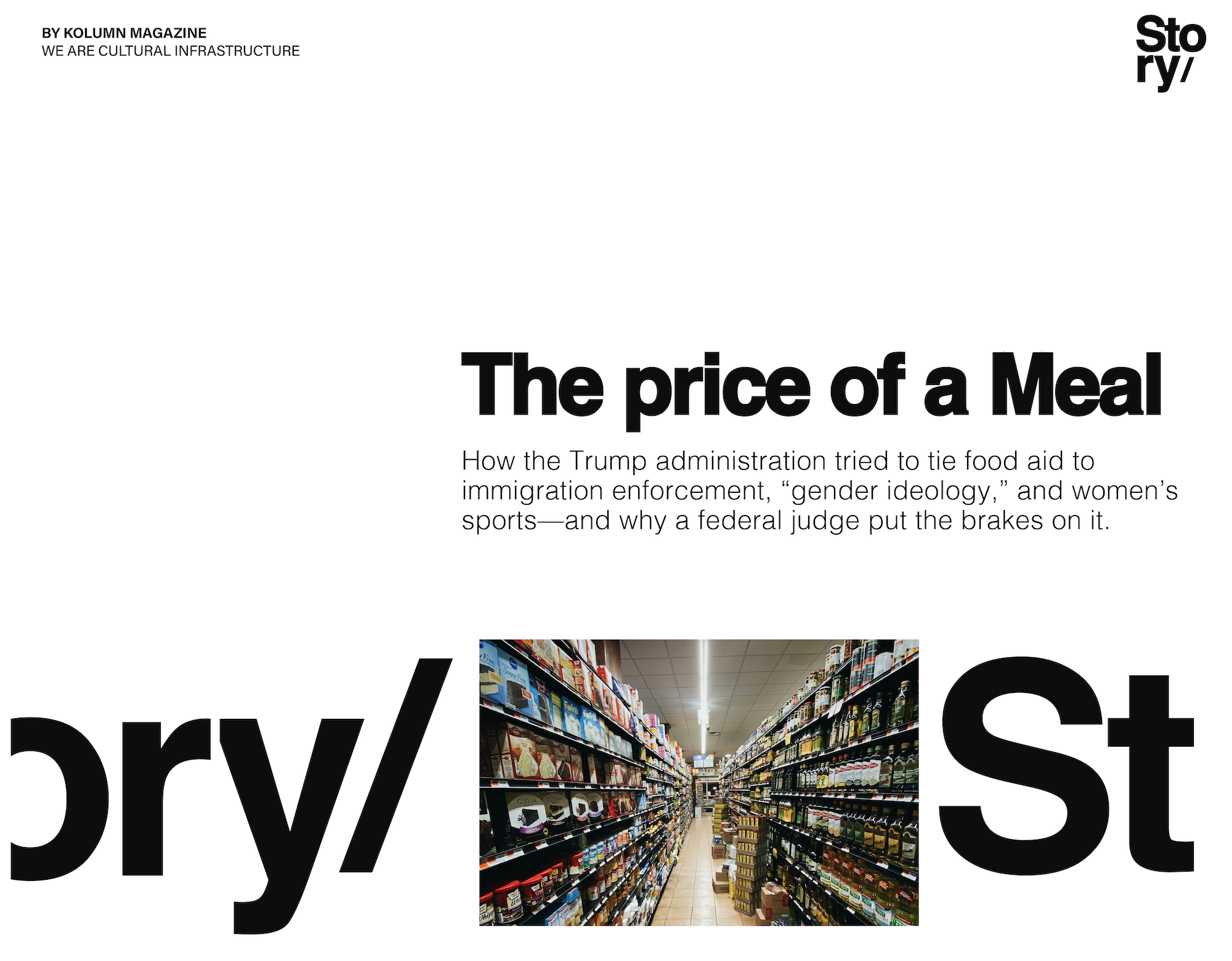
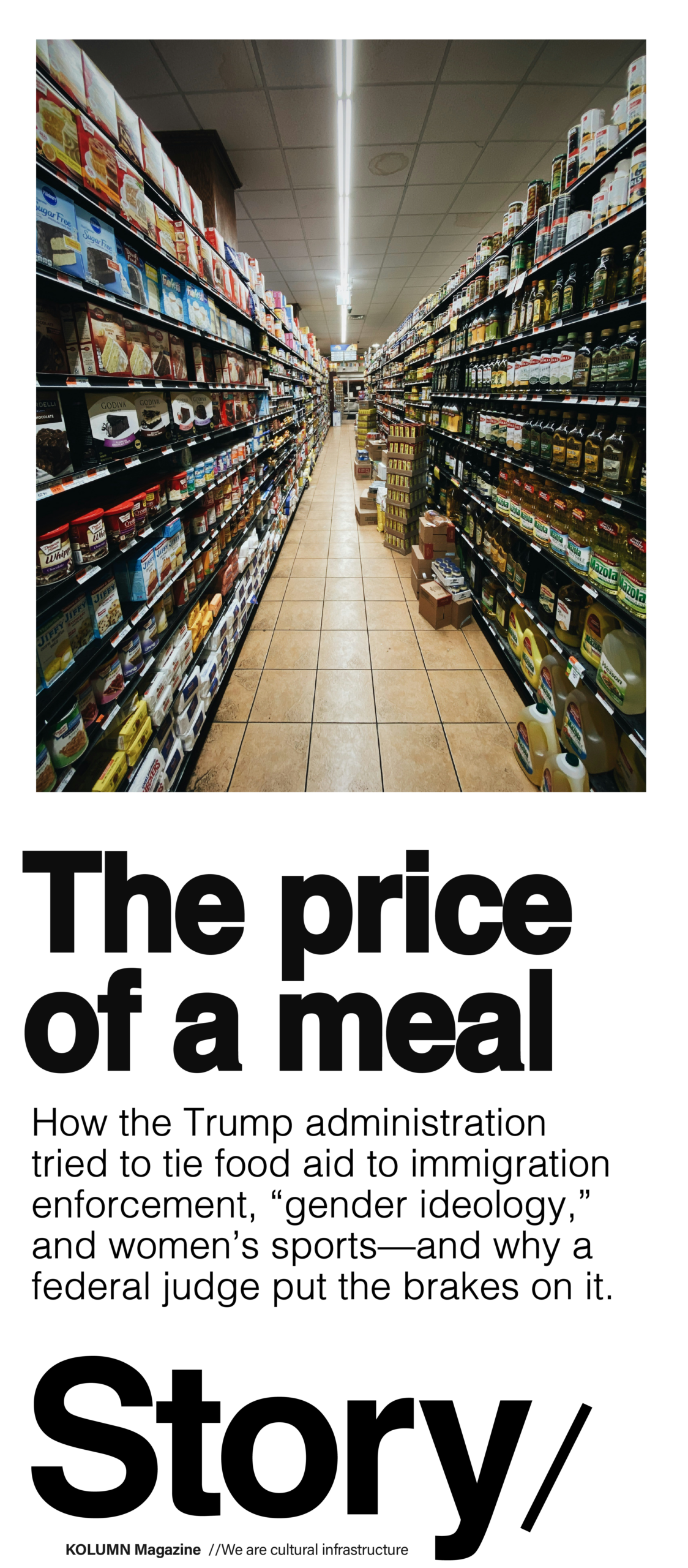
The legal fight arrived in the language of grants, certifications and federal conditions, but its most immediate meaning could be found in a grocery aisle. A mother choosing between meat and cereal. A grandmother stretching an EBT card through the last week of the month. A school district trying to keep breakfast and lunch moving without getting pulled into Washington’s latest culture-war machinery.
On June 5, U.S. District Judge Myong Joun granted a preliminary injunction in Boston blocking the Trump administration from imposing new conditions on U.S. Department of Agriculture funding, including programs tied to SNAP, school meals and WIC, after a coalition of 20 states and the District of Columbia argued that USDA had no lawful authority to make food and agriculture funding contingent on compliance with broad federal policies involving immigration enforcement, “gender ideology,” diversity initiatives and “fair athletic opportunities” for women and girls, according to Reuters and the Associated Press.
The judge said a fuller memorandum would follow, but the injunction itself landed with force because the dispute was never merely administrative. USDA had told states that, to receive federal funding, they would have to certify compliance with a set of “policies” rooted in Trump administration executive orders and agency directives. The plaintiff states said those conditions were vague, unrelated to nutrition and agriculture programs, procedurally defective and constitutionally suspect. The administration argued that federal funds have always carried compliance obligations and that its new terms were an extension of federal oversight.
The question before the court, then, was not whether Washington may attach conditions to money. It often can. The question was whether a federal agency could take programs designed to feed low-income families, support school cafeterias, stabilize WIC services and assist agricultural systems, then use that money as leverage over state policies on immigration, transgender people and athletics.
SNAP, still often called food stamps, is the nation’s largest anti-hunger program. USDA’s own materials describe it as a program that helps low-income families supplement their grocery budgets so they can buy food essential to health and well-being. USDA’s Economic Research Service notes that SNAP is federally administered through the Food and Nutrition Service while states handle day-to-day operations, eligibility determinations and benefit issuance, a structure that makes the program both national in design and deeply local in execution through state agencies.
That federal-state partnership is exactly why the new conditions were so combustible. States are not passive pass-throughs. They operate the systems. They maintain databases. They staff call centers. They run eligibility offices. They interact with families, retailers, schools and local agencies. When Washington threatens funding, it is not an abstraction. It can ripple through benefit cards, school lunch lines, state budgets and county offices where the distance between law and hunger is measured in days.
The injunction in Boston
The case, Commonwealth of Massachusetts et al. v. U.S. Department of Agriculture, was filed in the U.S. District Court for the District of Massachusetts after USDA announced that states would have to certify compliance with new conditions to receive federal financial assistance. The complaint argued that the department had created an unlawful choice: accept sweeping and unclear mandates or risk billions in federal support for food, agriculture, forestry and nutrition programs. In the states’ telling, the amount at stake was enormous: more than $74 billion annually in USDA funding to the plaintiff states, according to the complaint filed by the attorneys general.
The challenged language included restrictions on using funds to “promote gender ideology,” directing funds toward programs that “deprive women and girls of fair athletic opportunities,” and allowing “illegal aliens” to obtain taxpayer-funded benefits, language that the states said was undefined and untethered from the statutes Congress passed for food and agriculture programs. The New York attorney general’s office described the lawsuit as a challenge to “sweeping new funding conditions” that could jeopardize billions for critical programs in its March announcement.
In ordinary political speech, these phrases are familiar because they travel through rallies, campaign ads and cable-news segments. In federal grants law, vagueness can be fatal. States need to know what they are agreeing to before they accept money. They need to know whether a school nutrition program serving immigrant children could be penalized, whether nondiscrimination guidance for LGBTQ students could be treated as “gender ideology,” whether a statewide athletic policy could threaten food assistance funding, or whether a diversity program in an agricultural extension office might become a basis for withholding funds.
The states argued that USDA had not simply clarified existing law. It had attempted to insert new, politically charged conditions into programs Congress had designed for other purposes. Their legal theory drew on a familiar constitutional architecture: under the Spending Clause, funding conditions must be clear, related to the program at issue and not coercive. A Congressional Research Service report on federal funding conditions explains that the Supreme Court has recognized four general limits: clear notice, relatedness, anti-coercion and consistency with other constitutional protections, as summarized in CRS’s overview of Spending Clause limits.
Judge Joun’s preliminary injunction did not end the case. It froze the contested conditions while litigation proceeds. But preliminary injunctions matter because they reflect a court’s early judgment that the challengers have made a serious showing and that harm may occur without immediate judicial intervention. In this case, the harm identified by the states was not hypothetical: they said USDA’s conditions could disrupt programs serving low-income households, children, pregnant women, infants, farmers and communities dependent on federal food systems.
Food as federalism
American food assistance has always been political, but it has not always been partisan in the same way. The modern food stamp program grew from New Deal-era experiments, wartime surplus policy and the moral shock of hunger in a wealthy nation. The permanent Food Stamp Act was signed in 1964, during the same legislative season that produced the Civil Rights Act and deepened the federal government’s role in poverty policy. That history matters because food assistance emerged from a broad recognition that hunger was not merely a private failure. It was a public condition.
Historians of anti-poverty policy have long noted that food stamps sat at the intersection of agricultural economics and human need. The program helped farmers by expanding food purchasing power and helped families by turning federal dollars into groceries. It was never only welfare. It was also a market stabilizer, a rural policy, a public health intervention and a moral statement that citizenship in a rich country should not include routine hunger.
That history also contains racial conflict. Black communities, especially in the rural South and urban North, have often experienced hunger not as a temporary lack but as a structural inheritance. Land theft, wage suppression, school segregation, employment discrimination, redlining and uneven health care access produced the conditions that made food assistance essential. The grocery line, in that sense, has always been connected to the courthouse, the labor market and the ballot box.
KOLUMN Magazine has returned to this terrain often, including in its recent treatment of Black agricultural memory in “The Garden Is a Ledger”, which framed food, land and survival as a long ledger of coercion and resilience, and in “All Power, No Myth”, which revisited the Black Panther Party’s free food programs as part of a broader architecture of community survival. Those histories complicate the way official Washington talks about “benefits.” In Black America, food support has rarely been experienced as charity alone. It has often been a form of partial repair inside an economy that has extracted more than it returned.
That is why the USDA fight carries racial weight even when the pleadings are written in the language of federal procedure. SNAP households are racially diverse, and most are not Black. But Black families are overrepresented because Black poverty and food insecurity are overrepresented. The Center on Budget and Policy Priorities reported that 25 percent of SNAP households are headed by a non-Latinx Black person, compared with Black Americans’ smaller share of the general population, in its SNAP overview. CBPP’s chart book similarly notes that Black and Hispanic households make up a disproportionate share of SNAP households in its analysis of how SNAP helps struggling families put food on the table.
Food insecurity data makes the disparity even starker. The Food Research & Action Center, citing USDA food security findings, reported that food insecurity remained high for Black households at 24.4 percent and Latinx households at 20.2 percent, compared with 10.1 percent for white non-Latinx households, in its summary of the USDA food security report. USDA’s Economic Research Service also reported that very low food security increased for Black non-Hispanic households from 2023 to 2024 in its food security statistics.
In that context, any disruption to SNAP is not race-neutral in effect, even when written in universal terms. The policy may be administered through state agencies and federal forms, but the pain follows the shape of inequality.
The culture war enters the pantry
The Trump administration’s disputed USDA conditions drew from a broader governing style: use federal funds as pressure points to force alignment with executive priorities. Similar disputes have appeared across education, immigration enforcement, crime-victim funding, transportation and civil-rights programs. In August 2025, for example, 20 states and the District of Columbia sued the Justice Department over immigration enforcement conditions attached to crime-victim grants, arguing that victim services were being used to force state cooperation with federal immigration policy, as reported by the Associated Press.
The USDA case extends that pattern into food. The administration’s defenders frame the conditions as accountability. They argue that federal money should not support policies that conflict with federal priorities, that public benefits should not reach people unlawfully present in the United States, and that federal agencies have a responsibility to prevent discrimination and protect women’s opportunities in athletics. In court, government attorneys argued that if states must comply with federal antidiscrimination laws and regulations to receive funds, they can also be required to comply with broader federal policies, according to Reuters.
The states’ answer was that “policy” is not the same as law, and executive preference is not the same as congressional authorization. A president may set priorities for the executive branch, but Congress writes spending statutes. Agencies implement them. When agencies add conditions, they must point to legal authority. They must follow required procedures. They must tell recipients clearly what is expected. And they must connect conditions to the purpose of the funds.
That is where the words “gender ideology” become legally unstable. The phrase is not a neutral administrative term. It is a political slogan used to describe a wide range of policies involving transgender people, gender identity, school rules, health care, pronouns, bathrooms and athletics. If a school district accepts USDA school meal funds, does a library display about LGBTQ history become relevant? If a state health agency receives WIC administrative support, does guidance for transgender parents count as promotion? If a university agricultural extension program has diversity training, does that implicate USDA funding? The complaint argued that the conditions did not answer such questions.
The same uncertainty attaches to immigration. Unauthorized immigrants are already ineligible for SNAP under federal law, though many mixed-status households include U.S.-citizen children who are eligible. A condition framed as preventing “illegal aliens” from obtaining taxpayer-funded benefits may sound straightforward in political speech, but in administration it can become a dragnet of verification, data-sharing, chilling effects and fear. Eligible families may avoid benefits because a parent fears contact with government systems. Children may go hungry because paperwork becomes a proxy for suspicion.
The athletics condition is even more remote from SNAP’s core purpose. “Fair athletic opportunities” may be a live political dispute in schools and civil-rights law, but the connection to nutrition assistance is attenuated. A state’s compliance posture on athletics does not determine whether a low-income household can afford milk, rice, produce or baby formula. That gap between subject matter and funding purpose is central to the states’ claim.
The legal grammar of coercion
The Supreme Court has allowed Congress to place conditions on federal funds, but it has also warned that the spending power is not a blank check. In South Dakota v. Dole, the Court upheld a federal law withholding a small percentage of highway funds from states that refused to raise the drinking age to 21, but the decision emphasized limits, including that conditions should be related to the federal interest in the program, as summarized by Justia’s case overview. Later, in NFIB v. Sebelius, the Court held that threatening states with the loss of existing Medicaid funding if they refused to expand Medicaid was unconstitutionally coercive, a principle Cornell’s Legal Information Institute describes in its discussion of the anti-coercion requirement.
The USDA case differs from those precedents in important ways because the disputed conditions came from an agency, not directly from Congress. That may make the administration’s position more vulnerable. Congress has broad spending power. Agencies have delegated power. They can only do what statutes permit. If an agency uses grant documents or certification forms to add conditions Congress did not authorize, the issue is not only federalism. It is separation of powers.
That is why the states also invoked the Administrative Procedure Act. They argued USDA acted without proper rulemaking, imposed vague requirements and exceeded statutory authority. In plain terms, they said the department tried to rewrite the terms of food and agriculture programs without going through Congress or the ordinary administrative process.
For states, the coercion argument is practical. USDA funding is not a marginal bonus. It is embedded in state budgets and public systems. When a state receives billions for SNAP administration, school meals, WIC and agriculture-related programs, the threat of losing funding can become less like a negotiation and more like a demand. A governor or state agency cannot easily walk away from food assistance without harming residents. That is the coercive pressure the Supreme Court has recognized in other contexts: a state’s theoretical freedom to refuse money may become illusory when the fiscal stakes are overwhelming.
The SNAP backdrop: cuts, confusion and decline
The injunction also arrives after a turbulent year for SNAP. Participation declined sharply from January 2025 to January 2026. The Associated Press reported that roughly 4.3 million fewer people were receiving food stamps over that period and that experts attributed much of the drop to new requirements in the 2025 Republican tax and spending law, including stricter work requirements and narrowed exemptions, in its fact-focused review. CBPP’s SNAP tracker similarly found participation down by more than 3.5 million people in USDA data and more than 4 million over the past year in its May 2026 analysis.
This matters because funding conditions do not operate in isolation. They arrive in an environment where families are already navigating benefit reductions, eligibility churn, administrative burdens and food prices that remain punishing for low-income households. Even when formal eligibility remains, complexity can function as a cut. Missed paperwork, confusing notices, unstable work hours, transportation barriers and digital access problems can separate eligible people from benefits.
For Black families, the cumulative effect can be especially severe. Food insecurity is not merely about calories. It shapes chronic disease, school performance, maternal health, stress, household stability and neighborhood economies. When SNAP benefits arrive, they are spent quickly at local retailers. When they disappear, the loss is felt not only at kitchen tables but at corner stores, supermarkets and food banks asked to absorb public-policy failure.
The administration has framed SNAP changes as fraud control and fiscal stewardship. Fraud prevention is a legitimate government interest. But experts have repeatedly warned that overstating fraud can create a false public narrative about a program whose primary problem is not abuse but inadequacy. FRAC has emphasized that SNAP remains a first line of defense against hunger and that benefits average only a modest daily amount per person in its anti-hunger advocacy materials. CBPP has argued that SNAP reduces hardship and supports families while reaching a broad cross-section of workers, children, older adults and disabled people in its program overview.
The Boston injunction does not reverse those broader SNAP changes. It does not resolve the national debate over work requirements. It does not settle eligibility for immigrants. It does not decide the future of transgender rights or school athletics. What it does is prevent USDA, for now, from using food and agriculture funding as a lever to compel state compliance with unrelated political directives.
Expert voices and the architecture of public benefits
Legal scholars who study federal grants often describe conditional spending as a constitutional bargain. The federal government offers money. States accept conditions. But the legitimacy of the bargain depends on notice, consent and statutory authority. Eloise Pasachoff, a scholar of federal grants and administrative law, has written extensively about how federal agencies enforce Spending Clause statutes and how grant conditions can shape state behavior, including in her Yale Law Journal article on agency enforcement of Spending Clause statutes. The central insight is that federal grants are not just checks. They are governance instruments.
Anti-hunger experts look at the same machinery from the ground level. They see what happens when administrative systems become punitive or confusing. A delayed benefit is not merely a delayed payment. It may mean skipped meals. A vague rule is not merely a legal defect. It may mean a caseworker cannot answer a family’s question. A chilling effect is not merely a theory. It may mean eligible children disappear from the rolls because their parents fear surveillance.
Civil-rights experts see another layer. The conditions at issue borrow the language of antidiscrimination while targeting contested areas of identity and migration. The administration says it is protecting women, taxpayers and federal priorities. The states say it is weaponizing essential funding. Both claims invoke the public good, but only one side is attaching those claims to the grocery budget of low-income families.
That tension has deep roots. American welfare politics has often used moral categories to decide who deserves help. The “worthy poor” and “undeserving poor” have changed names across eras, but the structure persists. Immigrants, Black mothers, unemployed men, disabled people, queer and transgender people, and poor children have all been placed inside narratives of suspicion. Public benefits become the stage on which the nation argues about belonging.
Historiography helps clarify what is new and what is not. The use of food policy as leverage is old. The federal government has long used agricultural subsidies, school meals and nutrition programs to pursue broader goals. But the specific fusion of SNAP funding with immigration enforcement, anti-trans policy and athletics disputes represents a more explicit culture-war turn. It does not merely regulate program integrity. It asks food agencies to police ideological alignment.
What the ruling means now
For the plaintiff states and the District of Columbia, Judge Joun’s order preserves the status quo while the case proceeds. For SNAP recipients, the impact may be indirect but meaningful: the injunction reduces the immediate risk that nutrition funding will be disrupted by disputes over state compliance with contested federal policies. For schools and state agencies, it offers temporary breathing room in a system already strained by eligibility changes, staffing burdens and political volatility.
For the Trump administration, the ruling is another entry in a broader litigation record over executive power and federal funding. Courts have repeatedly been asked to decide whether agencies can redirect, freeze, condition or terminate funds in service of presidential priorities. Some challenges fail. Others succeed. But the pattern itself is significant: federal money has become one of the central battlefields of the second Trump presidency.
The case also signals the strategic role of state attorneys general. In an era of national polarization, Democratic-led states have become repeat plaintiffs against Republican administrations, just as Republican-led states sued Democratic administrations over immigration, health care, climate and education policy. Federalism is no longer only a constitutional theory. It is a litigation posture, an organizing strategy and a substitute legislature when Congress is locked.
Still, the moral center of this case is not the attorney general’s podium. It is the household budget. SNAP is often discussed in aggregate numbers: millions served, billions spent, percentages reduced. But its civic meaning is intimate. It is the difference between dinner and sleep. Between a child concentrating in school and a child managing hunger. Between a diabetic elder buying appropriate food and stretching starch because it is cheaper. Between a working parent’s paycheck collapsing under rent, utilities and groceries, and a public program absorbing just enough pressure to keep the household upright.
That intimacy is why the conditions felt so aggressive to critics. The administration did not choose an obscure grant. It chose money connected to food. In American politics, food assistance is both vulnerable and resilient: vulnerable because poor people are easily stigmatized, resilient because hunger remains one of the few public facts that can still puncture abstraction.
The unresolved question
The preliminary injunction is not the final word. The court’s forthcoming memorandum will explain Judge Joun’s reasoning in greater detail, and the administration may appeal. The legal questions will continue: whether USDA had statutory authority, whether the conditions were sufficiently clear, whether they were related to the programs, whether they were coercive and whether the agency complied with administrative law.
But the public question is already visible. Should a family’s access to food be exposed to political fights over immigration enforcement, transgender identity and school athletics? Should a state’s nutrition infrastructure be threatened because its policies diverge from presidential priorities outside the food program itself? Should agencies be able to use the machinery of public benefits to force ideological compliance without Congress clearly saying so?
The injunction suggests that, at least for now, the answer cannot be assumed.
There is a line in American public life that is crossed so often we sometimes stop seeing it. It is the line between governing and punishing. Governing uses public systems to solve public problems. Punishing uses public systems to make examples. SNAP was built to reduce hunger. If Washington wants to debate immigration, gender identity or athletics, it has forums for that. Congress can legislate. Agencies can regulate within their authority. Courts can interpret. Voters can judge.
But when the grocery line becomes the enforcement mechanism, the country is no longer simply debating policy. It is asking the hungry to carry the weight of the nation’s unresolved conflicts.
That is what Judge Joun’s injunction interrupted. Not the debate. The leverage.
More great stories

Afro Sheen, Wall Street, and the Architecture of Black Possibility
July 6, 2026
No Comments
The Fire Inside the Fourth
July 5, 2026
No Comments