




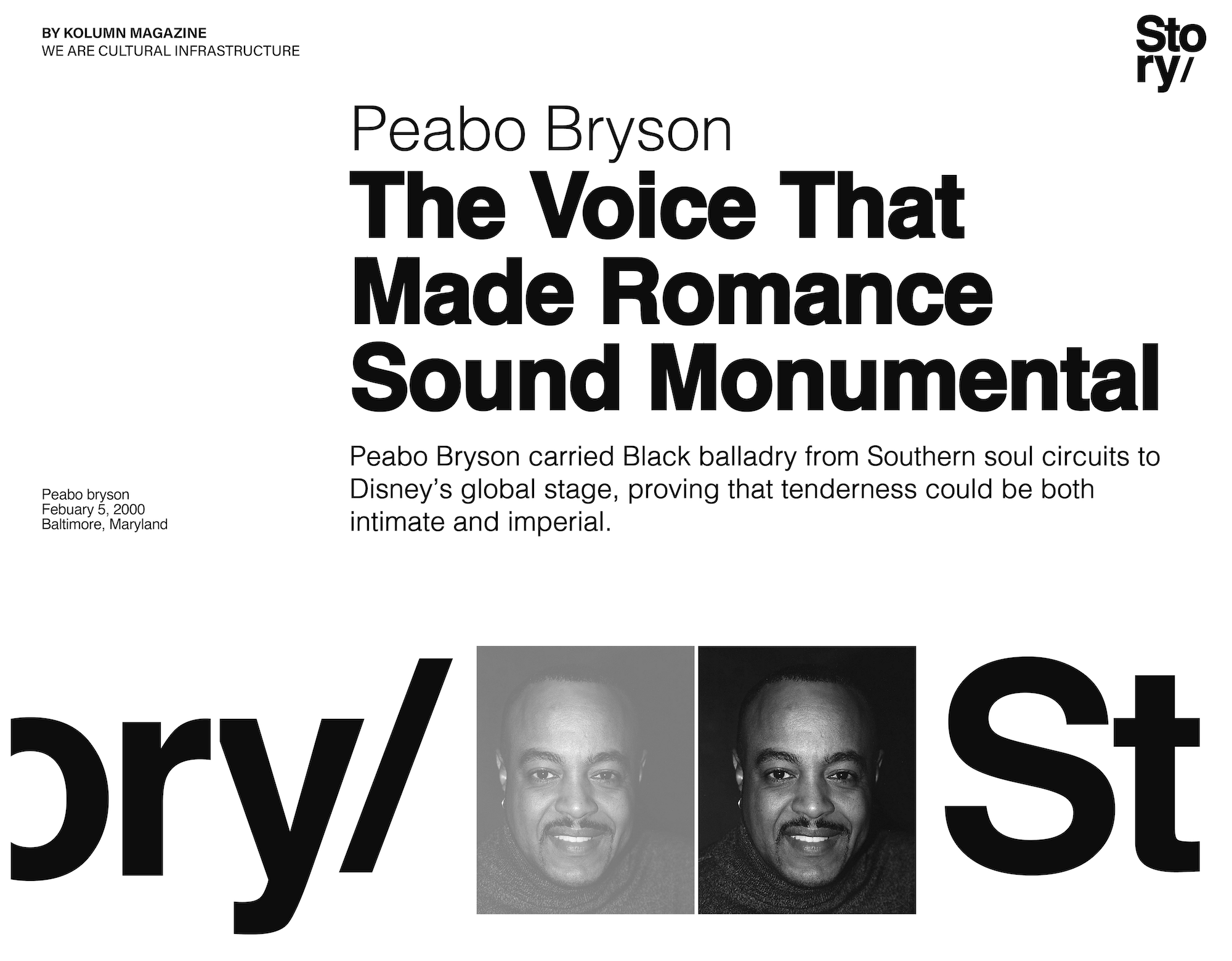
Peabo Bryson made romance sound less like escape than testimony.
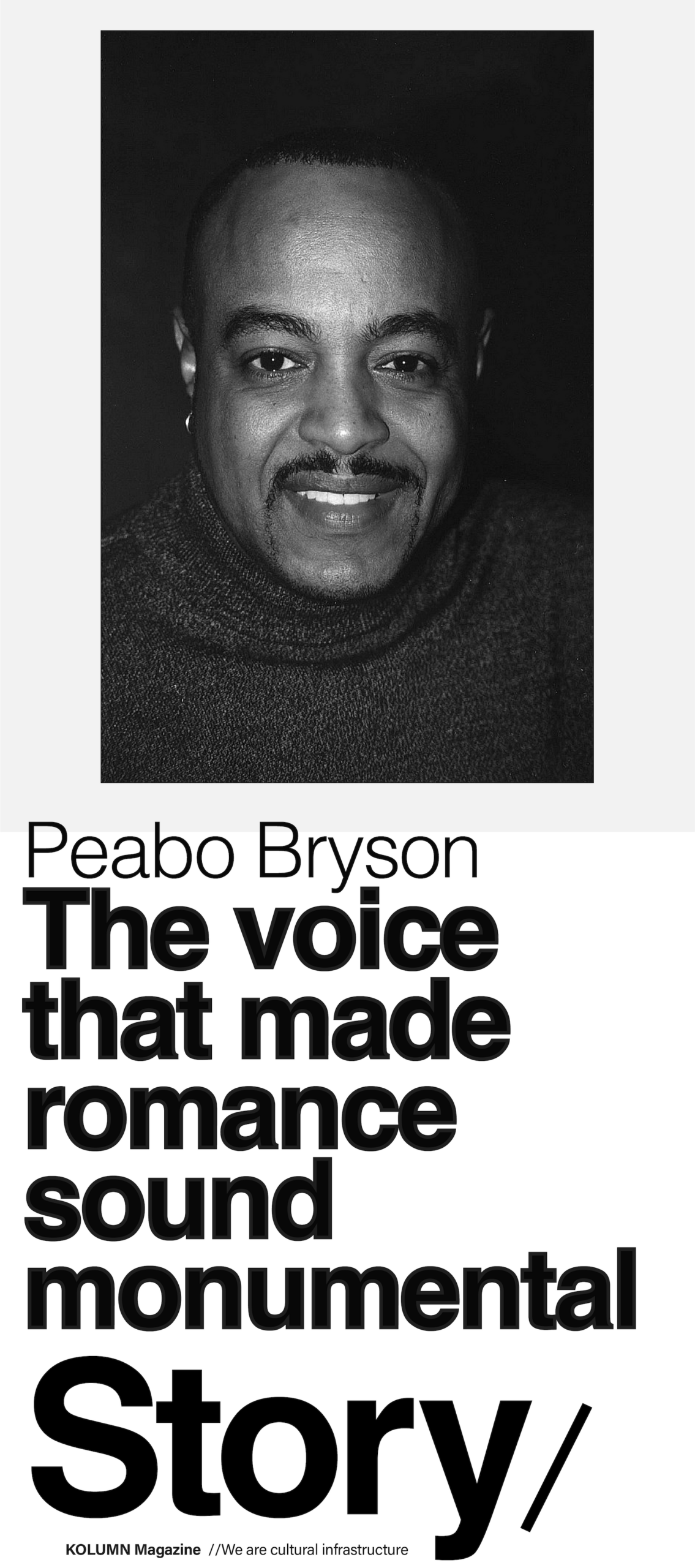
Peabo Bryson made romance sound less like escape than testimony.
By KOLUMN Magazine
Peabo Bryson’s voice did not arrive like a whisper. It opened like architecture.
There was lift in it, but also polish. There was gospel pressure without gospel excess, operatic reach without operatic distance, a romantic clarity that could turn a lyric into ceremony. His voice carried the satin finish of adult R&B, but underneath the gloss was a harder discipline: breath control, phrasing, placement, emotional timing. Bryson understood that a ballad is not a slow song. A ballad is a room. It needs walls, light, temperature, tension, release.
That is why, across five decades, Bryson became one of American popular music’s great interpreters of devotion. He sang love not as decoration, but as structure. He made romance sound durable.
Born Robert Peapo Bryson in Greenville, South Carolina, in 1951, the singer who would become known worldwide as Peabo Bryson began in a Southern Black musical world where artistry was rarely separated from labor. The HistoryMakers biography places him in the lineage of Black performers who learned craft before celebrity, moving from local stages to professional circuits before the mainstream fully knew their names. Bryson’s early years included teenage performance, regional bands and the kind of apprenticeship that formed so many twentieth-century Black musicians: practical, demanding, under-documented, indispensable.
By the time he reached a national audience in the 1970s, Bryson was already something more than a promising singer. He was an arranger, songwriter, producer and stylist. His 1977 Capitol breakthrough, Reaching for the Sky, announced a vocalist who could carry both soul intensity and pop refinement. Songs such as “Feel the Fire” and “Reaching for the Sky” made clear that Bryson’s gift was not merely volume. It was command. He could ascend without losing the lyric’s center.
The easy version of Bryson’s story begins with Disney. The better version begins earlier, in the Black radio ecosystem that made him legible before Hollywood made him unavoidable. Bryson belonged to the age of the adult R&B balladeer, a period when Black radio treated intimacy as serious culture. Quiet storm was not background music. It was emotional infrastructure. KOLUMN Magazine’s earlier essay, “Where Black Love Lived on the Dial”, traced how the format made tenderness central to Black modern life, giving artists such as Roberta Flack, Phyllis Hyman, Angela Bofill, Barry White, Marvin Gaye and the Isley Brothers room to transform desire into language.
Bryson was essential to that world. He did not simply sing love songs. He helped define how adult Black romance sounded after the civil rights era, after soul’s public thunder, after disco’s communal release. His music occupied a different register: private, elegant, often nocturnal, but never small.
The Southern Apprenticeship
Greenville mattered. The South mattered. Bryson’s formation cannot be understood apart from the Black Southern performance tradition that trained artists to be versatile before the industry gave them categories. The local circuit was a school of survival. A singer had to please church people, nightclub people, dancers, lovers, skeptics and elders who could hear imitation from the back wall.
According to Encyclopedia.com’s biographical entry, Bryson’s mother exposed him to concerts by major Black artists, giving him an early education in performance as aspiration. That detail is not incidental. In Black communities, live music often functioned as a portal: proof that technical mastery could become mobility, that beauty could be disciplined into a life.
Bryson’s professional career began early. He sang backup as a teenager and moved through bands before recording under his own name. The story of how “Peapo” became “Peabo” has often been told as a matter of pronunciation, but it also reads like a small emblem of performance life: the artist reshaped by the stage, the name adjusted by use, the self becoming public through repetition.
His early recordings built a reputation around fluency. Bryson could sing with force, but his signature was not rawness. It was controlled radiance. That made him distinct in a field where Black male vocal genius was often marketed through either church fire or erotic grit. Bryson offered another model: elegance as power.
The Ballad as Black Craft
American criticism has not always known what to do with the balladeer. Rock criticism historically rewarded rupture, rebellion and noise. Soul criticism often privileged anguish, sweat and testimony. Bryson’s art asked for another vocabulary. He was not uninterested in feeling; he was interested in shaping it.
Jon Pareles of The New York Times famously called Bryson the “Pavarotti of soul singers,” a description preserved in Encyclopedia.com’s profile. The phrase works because it recognizes scale. Bryson had a tenor that could bloom at the top without thinning, a voice that made climaxes feel inevitable rather than forced. But the comparison also risks missing the Blackness of his technique. Bryson was not a soul singer borrowing grandeur from opera. He was a Black balladeer whose own tradition already contained grandeur: gospel melisma, nightclub poise, jazz phrasing, soul directness, pop architecture.
His best performances understood that restraint creates drama. On “Feel the Fire,” he does not simply pour emotion over the song. He lets it gather. On “If Ever You’re in My Arms Again,” his first major Top 10 pop hit, Bryson sings with the polished ache of a man trying to make regret sound honorable. On “Can You Stop the Rain,” he turns weather into confession, making longing feel atmospheric.
This was his artistry: emotional control that did not become emotional distance.
Duets, Dialogue and the Roberta Flack Standard
Bryson’s duet work is central to his legacy because it revealed his ethics as a singer. A duet is not a contest unless the singers make it one. Bryson rarely did. He listened on record. He made space. He understood that chemistry is partly restraint.
His collaborations with Roberta Flack remain some of the most important recordings of his career. Their 1983 album Born to Love produced “Tonight, I Celebrate My Love,” a song that became one of the era’s definitive adult romantic ballads. People’s career overview noted that Bryson and Flack’s partnership included “Tonight, I Celebrate My Love,” “You’re Looking Like Love to Me” and other recordings that established him as one of R&B’s great duet partners.
Flack was not just another collaborator. She was a standard. She brought classical discipline, jazz patience and interpretive intelligence to popular song. To sing beside her required humility and precision. Bryson matched her not by overpowering her, but by meeting her interiority. Their voices did not fuse so much as converse.
That matters historically. Black duet singing has long carried meanings beyond romance. It stages mutual recognition. It dramatizes call and response in intimate form. From Marvin Gaye and Tammi Terrell to Donny Hathaway and Roberta Flack, the duet became a site where Black popular music imagined tenderness as exchange rather than possession. Bryson extended that tradition with unusual grace.
The Disney Transformation
For many listeners, Peabo Bryson entered permanent memory through two songs: “Beauty and the Beast” with Céline Dion and “A Whole New World” with Regina Belle. Both came from Disney’s early-1990s animation renaissance, when the studio turned Broadway-influenced songwriting into mass culture and used pop-radio versions to carry film music beyond the theater.
The Grammy Awards’ official artist page records Bryson’s two Grammy wins: one for “Beauty and the Beast” and one for “A Whole New World.” Those recordings did more than decorate animated films. They helped move Black vocal authority into a global family-entertainment marketplace that had not always centered Black singers as voices of wonder, romance and innocence.
“A Whole New World,” performed with Regina Belle, became especially historic. The song topped the Billboard Hot 100, and Billboard’s recent Bryson coverage revisited the scale of his pop-chart presence. The song also became part of a larger shift in American popular culture: the adult contemporary ballad as cinematic afterlife. A child could watch Aladdin and hear one version in the story; an adult could hear Bryson and Belle transform it into a radio ritual.
This is where Bryson’s significance deepens. He did not leave R&B behind when Disney called. He brought R&B’s phrasing, polish and emotional authority into Disney’s world. In doing so, he helped make Black adult vocal style part of the soundtrack of childhood for millions.
The Politics of Smoothness
To call Peabo Bryson “smooth” is accurate but insufficient. Smoothness in Black music has often been misread as softness, as though polish means a lack of struggle. But smoothness can be labor made invisible. It can be the result of pressure refined into elegance.
Bryson came of age in an industry that often narrowed Black male singers into marketable types: the preacher, the seducer, the revolutionary, the crossover gentleman. Bryson inhabited the last category but complicated it. His music was romantic, but it was not trivial. His presentation was refined, but it was not empty. He made a claim for Black sophistication at a time when radio formats, record labels and award institutions often separated Black artistry into commercial lanes that limited how artists could be heard.
The adult R&B marketplace gave Bryson room, but it also imposed constraints. Balladeers could be beloved and underestimated at the same time. They sold records, filled theaters, soundtracked weddings, anniversaries and private griefs, yet critics often treated their work as less urgent than protest music or less innovative than funk, hip-hop or jazz. Bryson’s career exposes that hierarchy. Why should the music that helps people love, apologize, remember, marry, mourn and continue be considered minor?
Historiographically, Bryson belongs in any serious account of Black popular music after the 1970s because he helps explain what happened when soul matured into adult contemporary forms. He is part of the bridge between the album-era soul singer and the modern soundtrack vocalist, between quiet storm radio and Disney globalism, between Black romantic tradition and mainstream pop ceremony.
Later Work and the Refusal of Disappearance
Bryson’s later career was marked by endurance. He continued recording and touring, even as the industry’s center shifted toward youth, hip-hop, streaming and spectacle. His 2018 album Stand for Love, produced with Jimmy Jam and Terry Lewis, was a late-career statement of continuity. In an interview with Rated R&B, Jimmy Jam described Bryson as a “quality artist,” comparing his voice to fine fabric in a discussion of the album’s custom-fit production approach; the project was framed as a return that honored Bryson’s classic sound without reducing him to nostalgia.
That collaboration mattered. Jam and Lewis were architects of modern R&B, producers who helped shape the sound of Janet Jackson, the S.O.S. Band, Alexander O’Neal and generations of Black pop sophistication. Their work with Bryson placed him in conversation with another chapter of Black musical modernity: Minneapolis polish meeting Southern ballad tradition.
Bryson’s health challenges also became part of his public later life. In 2019, he suffered a heart attack, and in 2026, representatives confirmed that he had suffered a stroke. CBS News Atlanta reported that the two-time Grammy winner was under medical care, and People later reported that Bryson died on June 2, 2026, at age 75. For an artist whose voice had long signified lift, the news landed with particular force. Generations had placed his songs inside their most intimate ceremonies. His passing was not simply celebrity news. It was a disturbance in the emotional archive.
What He Leaves Behind
Peabo Bryson’s legacy is larger than the two Disney songs that made him globally famous, though those recordings are central to it. He leaves behind a map of Black romantic expression across the late twentieth century: Southern apprenticeship, Capitol Records polish, quiet storm intimacy, duet mastery, adult contemporary crossover, soundtrack immortality, late-career renewal.
He also leaves behind a question worth asking more seriously: What do we lose when we treat love songs as light culture?
Bryson’s work insists that love songs carry history. They preserve ideals of care. They encode gender expectations, emotional vocabularies, class aspiration, spiritual longing and the politics of tenderness. In Black life especially, romance has never existed outside history. It has had to survive labor, migration, segregation, economic pressure, public vulnerability and private fatigue. A voice like Bryson’s did not erase those pressures. It offered listeners a way to imagine beauty anyway.
That is why his music endured. Not because every lyric was complex. Not because every production choice aged perfectly. Not because the ballad itself escaped sentimentality. It endured because Bryson sang as though tenderness deserved the full force of technique.
KOLUMN’s broader cultural work has often returned to the importance of Black memory: the artists, institutions and intimate practices that keep a people audible across generations. Bryson belongs in that frame. Like the quiet storm tradition explored in “Where Black Love Lived on the Dial”, his music treated feeling as infrastructure. Like KOLUMN’s recent profiles of Black cultural architects, his story reminds us that significance is not always measured by rupture. Sometimes it is measured by repetition: the song played at the wedding, the cassette worn thin, the radio dedication, the movie-credit duet that becomes a family memory.
Peabo Bryson sang at the intersection of skill and sincerity. He gave romance height. He gave softness force. He gave popular music a voice that could make love sound not fragile, but built to last.
And for millions of listeners, when he sang of fire, rain, beauty or a whole new world, he was not merely performing a song. He was opening the room.
More great stories
Afro Sheen, Wall Street, and the Architecture of Black Possibility
July 6, 2026
No Comments
The Fire Inside the Fourth
July 5, 2026
No Comments