

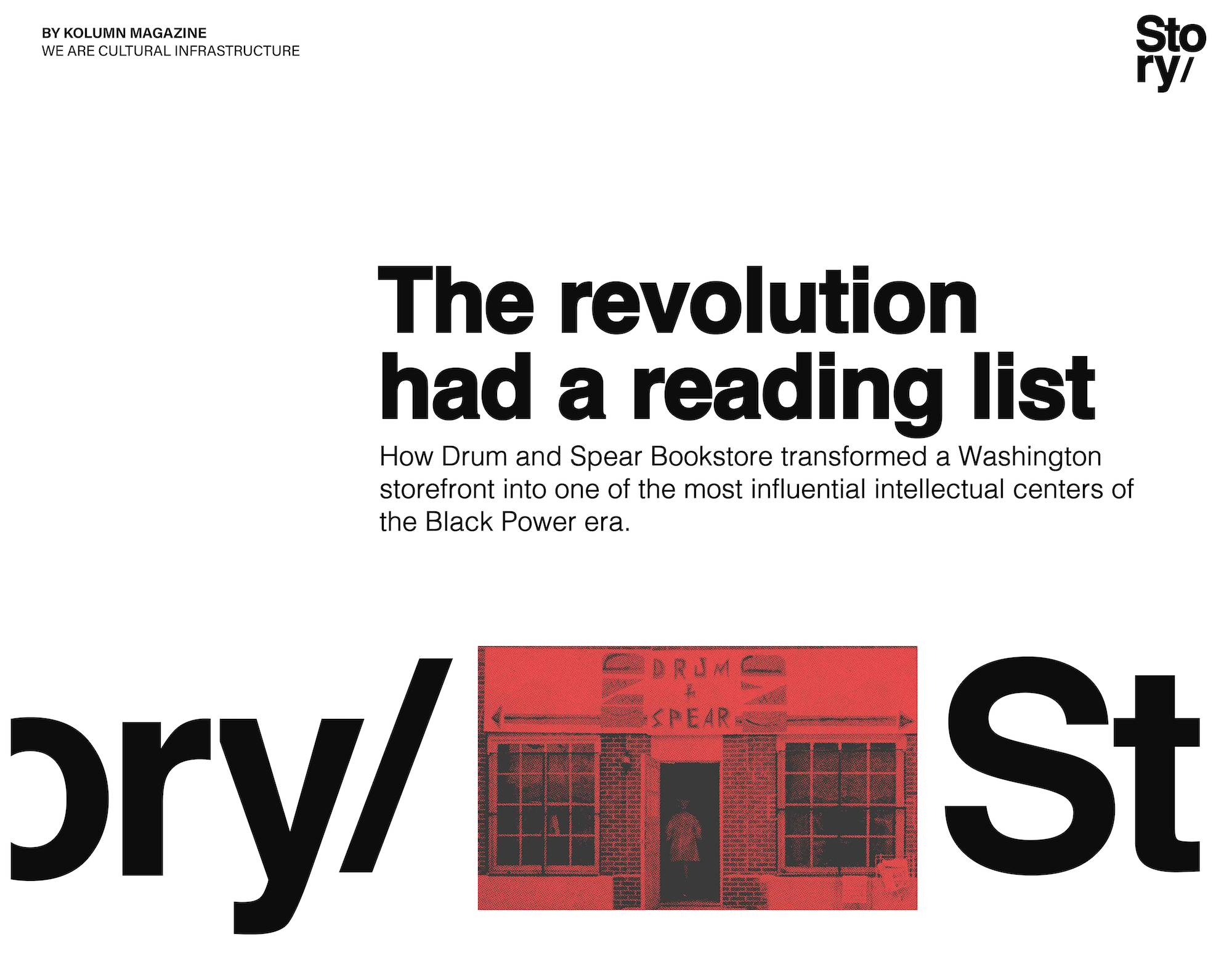
Drum and Spear was not simply selling books. It was selling the premise that Black people had the right to read themselves into history.
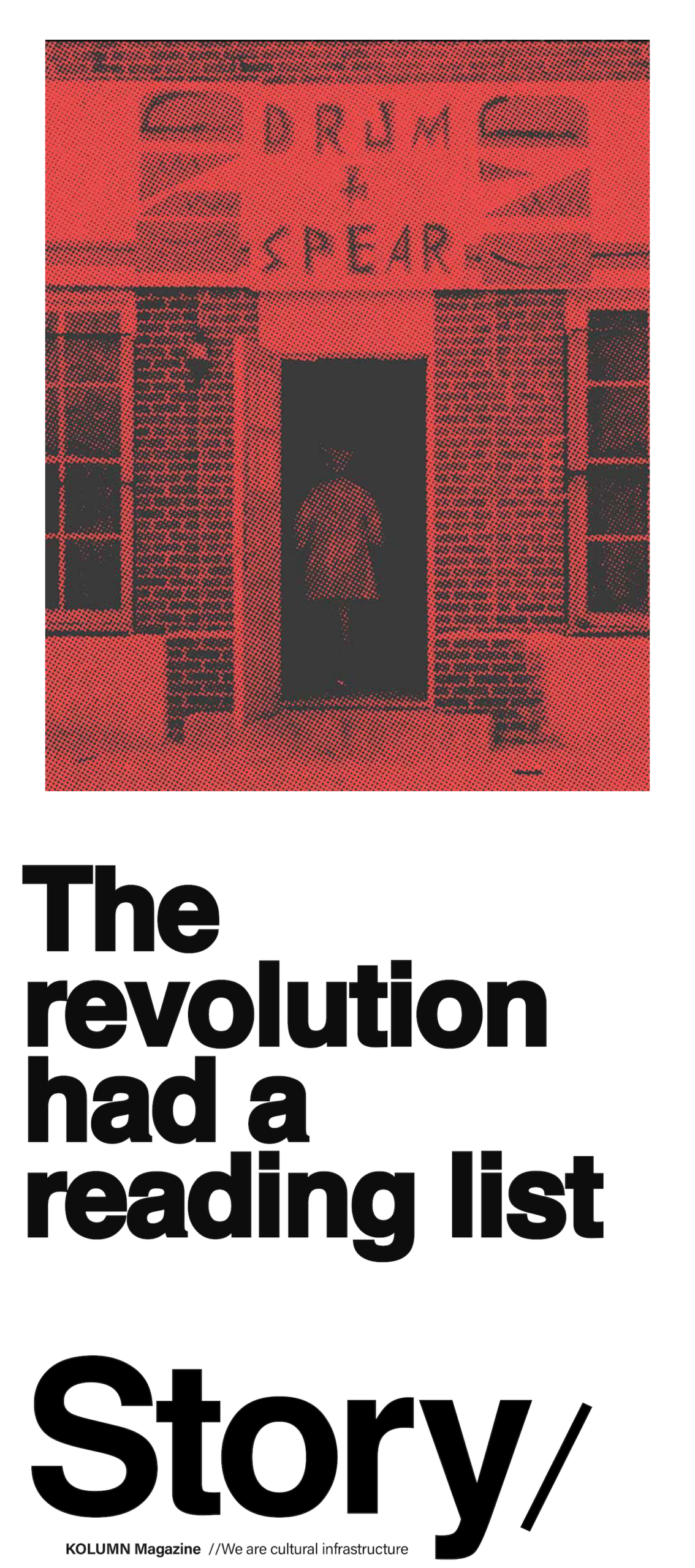
Drum and Spear was not simply selling books. It was selling the premise that Black people had the right to read themselves into history.
By KOLUMN Magazine
Washington was still breathing smoke when Drum and Spear opened its doors.
The city had erupted after the assassination of Martin Luther King Jr. in April 1968. Blocks along 14th Street NW were scarred by fire, police occupation and the raw public evidence of a nation that could mourn a prophet while refusing the conditions of justice he had demanded. Judy Richardson, one of the bookstore’s founders, later remembered the air itself as evidence: there was “still tear gas in the air,” she told the SNCC Digital Gateway. “You felt it in your nose.”
On June 1, 1968, at 14th and Fairmont Streets NW, a group of veterans of the Student Nonviolent Coordinating Committee opened Drum and Spear Bookstore. Its founders included Charlie Cobb, Judy Richardson, Courtland Cox and Curtis Hayes, later known as Curtis Muhammed, according to the SNCC Digital Gateway. Tony Gittens, Daphne Muse, Jennifer Lawson, Marvin Holloway and others would help build the enterprise into something far larger than a retail shop. It became a political instrument, a distribution network, a press, a meeting ground, a children’s education project and a living archive of Black internationalism.
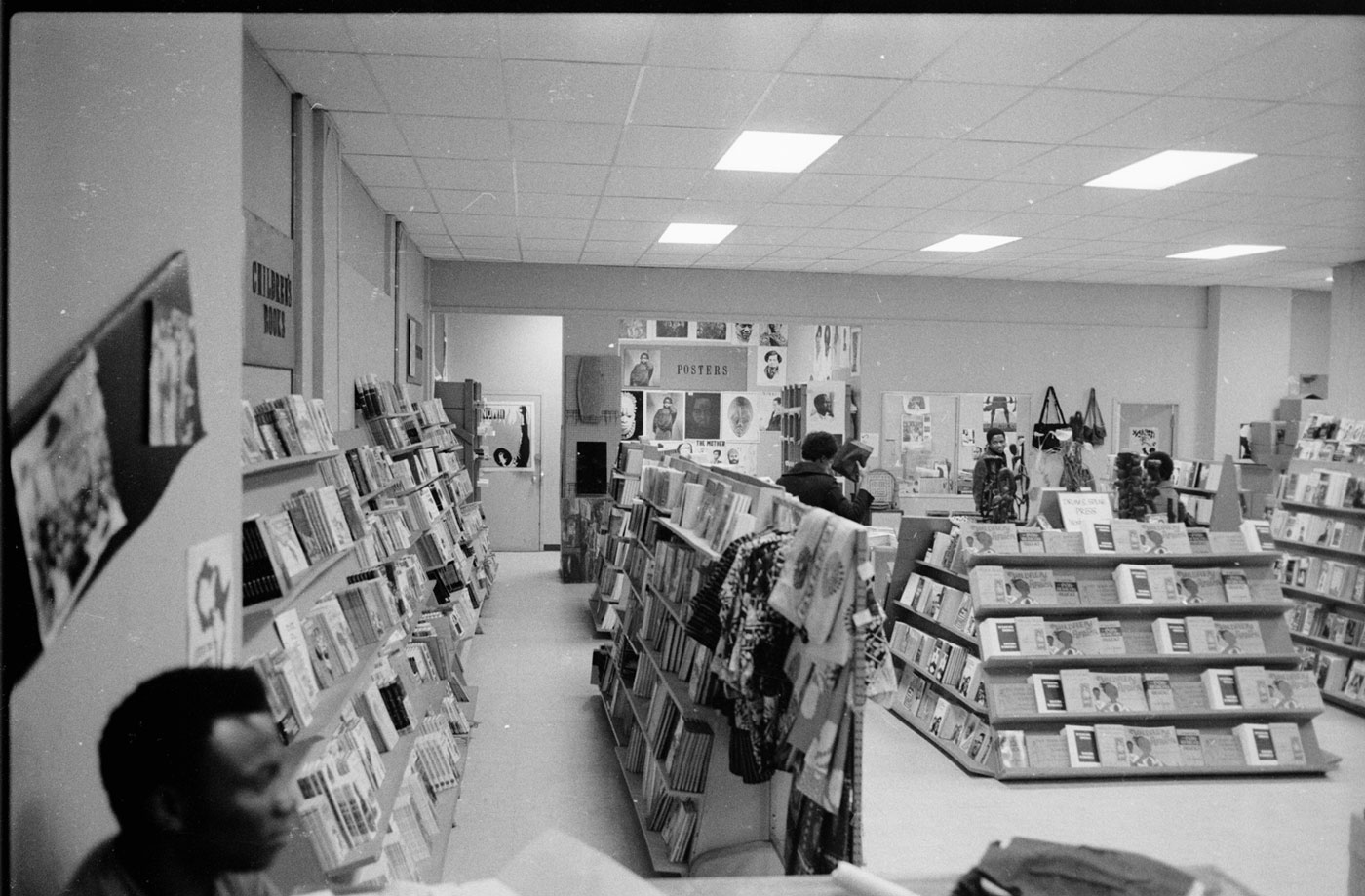
The name carried its own philosophy. Richardson explained that the drum symbolized communication across the African diaspora, while the spear signaled “whatever else might be necessary for the liberation of the people,” as preserved in the SNCC account of the bookstore’s founding. The phrase refused the timid language of uplift. It belonged to the language of self-determination. The drum called the scattered into relation; the spear warned that literacy without power was not enough.
In a city where Howard University students were protesting, Stokely Carmichael was organizing and Black Washington was remaking its political vocabulary, Drum and Spear became one of the signal institutions of the Black Power era. The Library of Congress later described it as a cultural organization that emerged from the social transformations of 1968, and the Kojo Nnamdi Show remembered it as an educational and political center for Black Power activists through the mid-1970s.
It was a bookstore, yes. But that word is too small.
The Movement Enters the Marketplace
To understand Drum and Spear, it helps to understand what a Black bookstore meant in 1968. It was not only a place to buy a book. It was a counter-institution built against the exclusions of commercial publishing, public education, white-owned bookstores and Cold War American nationalism.
Historian Joshua Clark Davis has argued that Black-owned bookstores became anchors of the Black Power movement. In his essay for the African American Intellectual History Society, Davis notes that as late as 1966, many major American cities with large Black populations still had no Black-oriented bookstore. By the late 1970s, the number had expanded dramatically, from roughly a dozen to somewhere between seventy-five and one hundred. These stores were often run by activists, not traditional retailers. They were sites of study, argument, organizing and economic experimentation.
Drum and Spear fit that pattern, but it also exceeded it. Its founders were not dabbling in cultural nationalism from the sidelines. They had been forged in SNCC’s campaigns in Mississippi, Alabama, Georgia and Washington. Cobb had been a field secretary in Mississippi and helped articulate the Freedom School idea; Cox had helped organize during Freedom Summer and in Lowndes County; Richardson had worked in SNCC campaigns and would later help shape the memory of the movement through documentary film. The Library of Congress notes Cox’s role in the March on Washington, Freedom Summer and the Lowndes County Freedom Party, and Richardson’s later work on “Eyes on the Prize” and other civil rights documentaries.
They brought to bookselling the habits of organizers: build infrastructure, distribute information, train people to read power, make the institution useful to the community.
Drum and Spear’s shelves carried the predictable classics of the age: “The Autobiography of Malcolm X,” Black Power texts, Pan-African histories, poetry, fiction, political pamphlets and children’s books. But Cobb rejected narrow policing of what counted as sufficiently Black. “What’s the point of having a black bookstore,” he asked in the SNCC Digital Gateway’s account, “if you’re going to now start to decide who’s too black or not too black enough to be in the shop?”
That openness mattered. A Black bookstore could have become doctrinaire, a temple to one faction’s line. Drum and Spear instead became capacious. It carried revolutionary theory and detective fiction, Malcolm X and Chester Himes, poetry and children’s literature, books on Africa and books on everyday Black life. It understood Black reading as a broad, democratic act.
A Storefront as Public Square
The history of Drum and Spear is also a history of Black urban space. It opened in Columbia Heights, near the corridor damaged after King’s assassination, and close to Howard University, Federal City College and the Center for Black Education. Jennifer Lawson later recalled that the bookstore, the press and the surrounding institutions formed an ecosystem of easy collaboration, with the bookstore in Columbia Heights and the press in Adams Morgan, as she wrote for Black Power Chronicles.
This geography was not incidental. Drum and Spear stood in the middle of a Black Washington that was asserting itself politically and culturally. It became a meeting place for residents, students, activists, writers and artists. The SNCC Digital Gateway records visits and events involving figures such as Gwendolyn Brooks, Lerone Bennett, Shirley Graham Du Bois, Haki Madhubuti and Sonia Sanchez.
A bookstore reading in this context was not a genteel literary event. It was public pedagogy. It was an evening school for people denied truthful curricula. It was a stage on which Black writers could speak to Black audiences without translation. It was also a rebuttal to the idea that Black communities lacked intellectual institutions unless sanctioned by universities.
This is where Drum and Spear connects to a broader KOLUMN throughline. KOLUMN’s recent longform work on figures such as Gwendolyn Brooks, Ralph Ellison and other architects of Black letters has returned again and again to the same question: what institutions allowed Black genius to survive? The answer is rarely only the university or the mainstream publishing house. It is the bookstore, the church basement, the small press, the Black newspaper, the local archive, the reading circle, the classroom built from necessity.
Drum and Spear belonged to that infrastructure. It was not merely adjacent to Black thought. It helped circulate it.
Publishing for the Pan-African World
The bookstore soon became a press. That transition is essential to the story because Drum and Spear did not only distribute Black books; it made them.
Drum and Spear Press published its first book in 1969: C.L.R. James’s “A History of Pan-African Revolt,” an updated paperback edition of a classic anti-colonial text, according to Jennifer Lawson’s history for Black Power Chronicles. The choice was revealing. James was a Trinidadian intellectual whose work linked slavery, colonialism, revolution, labor and global Black struggle. To begin with James was to announce that Drum and Spear’s intellectual map extended beyond the United States.
The press followed with “The Book of African Names,” “Speaking Swahili: Kusema Kiswahili,” “Enemy of the Sun: Poems of Palestinian Resistance,” “Children of Africa,” “The Struggle for Black Education 1968–1971” and Eloise Greenfield’s “Bubbles,” as documented by Black Power Chronicles and displayed in WAMU’s Drum and Spear retrospective. Its catalog was not random. It moved across Pan-African history, language, children’s education, Palestinian liberation, Black schooling and poetry.
The press also reached across the Atlantic. “Watoto wa Afrika,” the Kiswahili edition of “Children of Africa,” was published in both Dar es Salaam and Washington in 1971 with assistance from Walter Bgoya, founder of the Tanzanian publishing firm Mkuki na Nyota, according to Black Power Chronicles. That Tanzania connection placed Drum and Spear inside the wider history of Black American engagement with African liberation and Julius Nyerere’s ujamaa socialism. Scholar Seth Markle has examined this relationship in “Drum and Spear Press and Tanzania’s ‘Ujamaa’ Ideology,” published in The Black Scholar.
The annual calendars published by Drum and Spear Press made even time political. Lawson notes that the 1970 calendar carried the theme “We Are an African People,” the 1971 calendar declared “Africa for the Africans at Home and Abroad,” and the 1972 calendar centered land, minds, goods, services and defense. The 1971 calendar’s introduction observed that while a timepiece tells the time of day, a calendar tells “what time it is in history,” according to Black Power Chronicles.
That line captures the press’s deeper mission. Drum and Spear was trying to alter historical consciousness. It wanted Black readers to know not only what had happened, but what moment they were living in.
Children as Political Readers
One of Drum and Spear’s most important interventions was its attention to children. This was not sentimental. It was strategic.
The civil rights and Black Power movements understood that curriculum was a battleground. Mississippi Freedom Schools had already shown that education could become a form of insurgency. Children needed books in which Africa was not a footnote, slavery was not a beginning without ancestry and Blackness was not rendered as pathology. They needed material that did not ask them to disappear into whiteness before they could be considered educated.
“Children of Africa,” designed as a coloring book with layered text for children and adults, emerged from that pedagogy. Lawson wrote that she and Courtland Cox developed it through a collaborative process informed by earlier educational materials used in Lowndes County, Alabama, where SNCC organizers helped support the Lowndes County Freedom Organization, whose black panther symbol would become historically famous. She explained the book’s dual structure and its participatory coloring-book format in Black Power Chronicles.
The point was not simply representation, although representation mattered. The point was formation. Drum and Spear’s children’s books were tools for building memory, pride and political literacy. “Bubbles,” the first book by Eloise Greenfield, later an acclaimed children’s author, was also published by Drum and Spear Press, according to Black Power Chronicles.
In this sense, Drum and Spear anticipated debates that would define American education decades later: whose history belongs in the classroom, who has the authority to tell it, and why children’s books become targets when a society grows afraid of its own truths.
The Historiography of a Radical Bookstore
For years, Drum and Spear survived most powerfully in the memory of activists, former staff, Washington residents and Black book people. Its historiography has widened as scholars have revisited the Black Power era not merely as a period of rhetoric and confrontation, but as a period of institution-building.
Earlier civil rights narratives often framed the 1960s through marches, legislation and charismatic male leadership. Black Power was too frequently reduced to anger, separatism or spectacle. The history of Drum and Spear complicates that framing. It shows Black Power as practical labor: lease a storefront, stock inventory, keep accounts, design a logo, host a reading, publish a book, ship orders, teach children, connect Washington to Dar es Salaam.
Davis’s work on “activist entrepreneurs” is especially useful here. In AAIHS, he argues that Black bookstores promoted political reeducation, served as Black public spaces and rejected profit as the only measure of business success. In Time, he described ventures like Drum and Spear as part of a broader history of mission-driven businesses born from social movements.
That phrase, “mission-driven,” has since been absorbed by corporate branding. But Drum and Spear’s mission was not a slogan for ethical consumption. It was liberation work. Its nonprofit structure through Afro-American Resources Inc., noted in accounts from the DC 1968 Project, reflected a different understanding of enterprise. Cobb famously said, as quoted in Davis’s scholarship, that profit was not defined only in money.
The store’s afterlife has also been shaped by public humanities work. In 2018, the Library of Congress hosted “Since 1968: The Drum & Spear Bookstore,” a symposium that placed the store beside other cultural organizations born from the upheavals of that year. WAMU’s Kojo Nnamdi Show gathered founders and historians to revisit its legacy. The SNCC Legacy Project has preserved images, newsletters and reflections, including Daphne Muse’s description of the bookstore as a “combination bookstore, library, community center, and iconic cultural heartbeat.”
That phrase is not nostalgia. It is an archival claim.
A Black International Bookshop
Drum and Spear’s politics were never confined to Washington. Its shelves and publications insisted that Black America belonged to a global freedom struggle.
The store sold books from and about Africa and the diaspora. It helped normalize Pan-African reading for local audiences. Its press published Kiswahili language materials, Palestinian resistance poetry and work tied to Tanzania. It made clear that Black liberation in the United States could not be severed from anti-colonial struggles in Africa, the Caribbean and the Middle East.
This internationalism was consistent with SNCC’s evolution. By the late 1960s, many SNCC veterans were linking the Black freedom struggle to Vietnam, African liberation movements and Third World solidarity. Drum and Spear translated that worldview into the ordinary act of browsing a shelf.
A customer could walk in looking for a novel and leave with C.L.R. James. A parent could buy a children’s coloring book and encounter African history. A student could find language materials that made Swahili not exotic but proximate. A local reader could see Palestine, Tanzania, Mississippi and Washington arranged in the same intellectual universe.
This was one reason Drum and Spear mattered so deeply. It challenged the provincialism imposed on Black Americans by white curricula. It refused to let Black history be trapped between slavery and civil rights. It located Black Washington inside a world system of colonialism, resistance, language, land and culture.
The Business of Liberation
The romantic story of Drum and Spear must also contend with the difficulty of keeping such an institution alive. Radical bookstores often operated on thin margins, under political pressure, with limited capital and enormous community expectations. Davis notes in AAIHS that many Black booksellers were activists, teachers, writers or bibliophiles rather than experienced businesspeople, and that independent bookstores generally survived on slim profits.
Drum and Spear was ambitious. It had a storefront, a press, mail-order distribution and international relationships. It hosted events and functioned as a community hub. It also existed in a turbulent marketplace and political climate. The DC Preservation League’s historic-site entry records that the bookstore operated from 1968 to 1974. Its life was brief by conventional business standards. By cultural standards, it was seismic.
The short lifespan should not be mistaken for failure. Many of the most consequential Black institutions have been temporary in form but durable in influence. They arise to meet an emergency, alter the field and leave behind practices others adapt. Drum and Spear helped define what a Black bookstore could be. It demonstrated that the shop could double as a school, the press as an organizing arm, the catalog as a curriculum and the counter as a political threshold.
Its closure also reminds us that cultural infrastructure requires material support. The people who praise Black bookstores often forget that praise does not pay rent. The history of Drum and Spear is therefore not only inspirational. It is a warning. Institutions that carry a people’s memory cannot survive on symbolism alone.
What Remains on the Shelf
The legacy of Drum and Spear is visible in contemporary Black bookstores, community libraries, independent presses, pop-up reading rooms, abolitionist book clubs, Black studies programs and digital archives. It is visible wherever books are treated not as decorative objects but as instruments of collective formation.
It is also visible in the current struggles over public education. The campaigns to ban books by Black authors, restrict African American studies and sanitize slavery are not new. They are late chapters in an old conflict over knowledge. Drum and Spear existed because mainstream institutions had failed Black readers. Its founders understood that the absence of books is never neutral. A missing shelf can be a political act. So can a stocked one.
The store’s history clarifies why Black literary institutions matter. They are not ancillary to movements. They are where movements think. They are where people encounter the long argument before they join the public one. They are where children discover that history did not begin with their oppression. They are where adults repair the damage of schooling that trained them to distrust their own inheritance.
Drum and Spear offered that repair in the form of a place. A person could enter from the street, still marked by rebellion and tear gas, and find another atmosphere: shelves, conversation, books by people who understood the world from below.
The Drum Still Carries
The most accurate way to remember Drum and Spear is not as a lost bookstore, but as a working model.
It modeled Black control of cultural distribution. It modeled publishing as political education. It modeled children’s literature as freedom work. It modeled Pan-Africanism not as abstraction but as inventory, translation and exchange. It modeled a business that refused to measure value only by profit. It modeled a public square in which Black people could gather around books without asking permission from universities, foundations or white-owned cultural institutions.
The founders had come out of a movement that knew the stakes of literacy. In Mississippi, literacy tests had been weapons of disenfranchisement. In Freedom Schools, literacy became a weapon of liberation. Drum and Spear carried that lesson into Washington. It understood that to read was not merely to consume information. To read was to enter history with tools.
That is why the store still matters. It was a brief institution with a long echo. It belonged to a moment when Black organizers, artists and intellectuals were not waiting for inclusion. They were building the structures they needed. In the wreckage after King’s assassination, Drum and Spear did not offer consolation. It offered study. It offered memory. It offered a shelf from which a different future could be imagined.
And in that future, the drum was still sounding.
More great stories
Afro Sheen, Wall Street, and the Architecture of Black Possibility
July 6, 2026
No Comments
The Fire Inside the Fourth
July 5, 2026
No Comments