




Brooks did not write about Black life as metaphor. She wrote it as civilization.
Brooks did not write about Black life as metaphor. She wrote it as civilization.
By KOLUMN Magazine
There are certain writers who describe America, and then there are writers who expose the machinery underneath it. Gwendolyn Brooks belonged to the second category.
She did not merely write poems. She mapped migration. She recorded hunger. She documented cramped apartments, deferred dreams, exhausted mothers, corner-store philosophers, church women, soldiers, gamblers, lovers, children, and Black people who carried entire civilizations inside bodies America frequently ignored. If Walt Whitman mythologized democratic possibility and Robert Frost distilled pastoral loneliness, Brooks transformed Black urban life into an American epic.
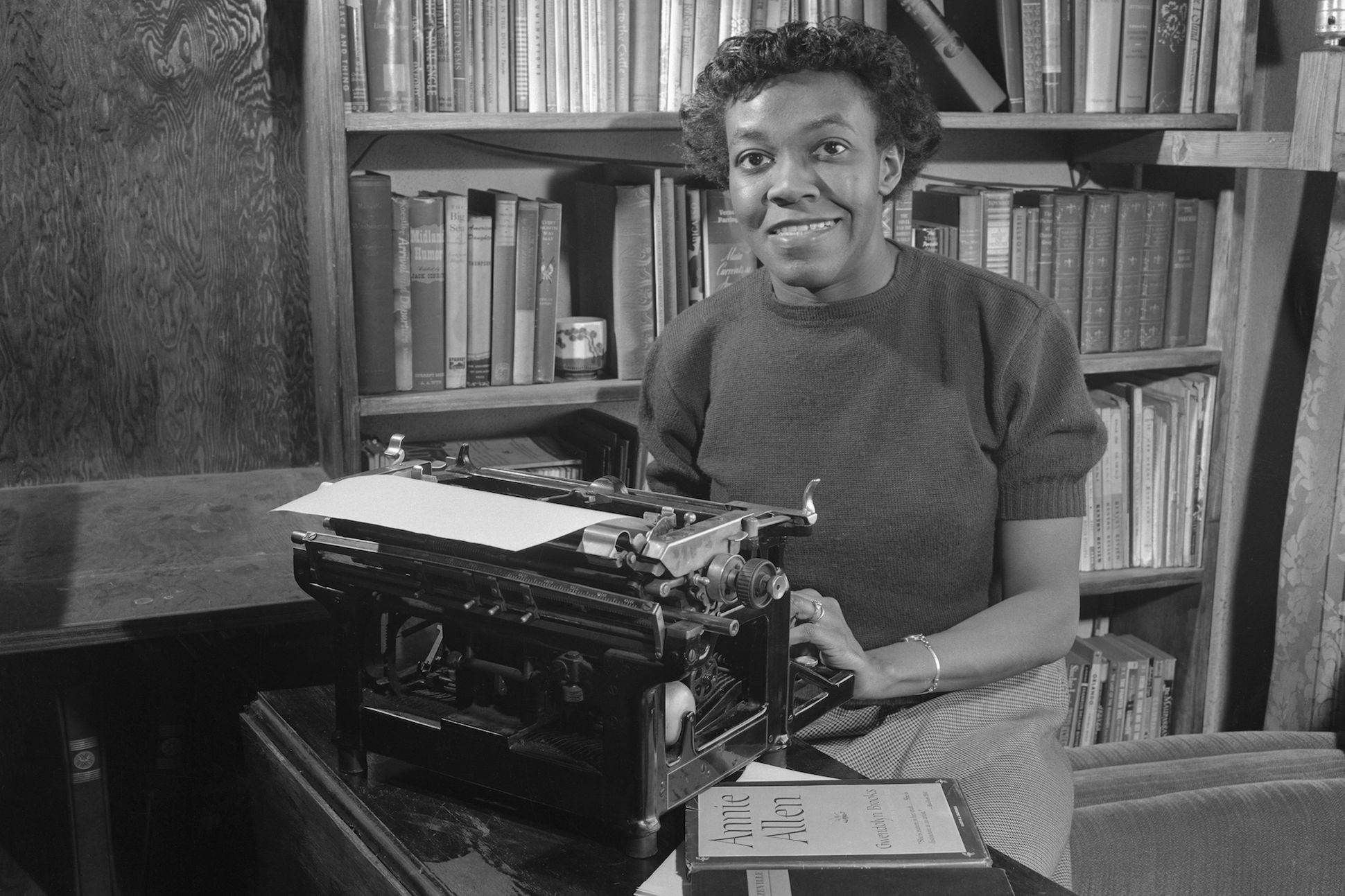
For decades, American literary institutions treated Black existence as sociological material rather than intellectual territory. Brooks changed that permanently.
Born in Kansas in 1917 and raised in Chicago during the height of the Great Migration, Brooks became one of the defining literary architects of the twentieth century. In 1950, she became the first Black person to win the Pulitzer Prize in poetry for Annie Allen, a formally daring meditation on Black girlhood, war, intimacy, race, and survival. Yet Brooks’ importance extends far beyond institutional milestones. Her real achievement was building a language capacious enough to contain Black life without flattening it for white audiences.
She understood rhythm before critics understood her politics. She understood politics before publishers understood her radicalism.
And she understood something many historians now acknowledge openly: Black Chicago was not merely a location. It was one of the intellectual capitals of modern America.
The historian Davarian Baldwin has argued in multiple studies of Bronzeville and Black Chicago that the neighborhood functioned as a center of Black artistic and political modernity, reshaping journalism, literature, labor politics, and cultural production across the nation. Brooks did not observe that world from a distance. She lived inside it. She rendered it with extraordinary precision.
Her poems remain startling because they resist sentimentality. Brooks rarely offered easy redemption. Even her famous work “We Real Cool” — perhaps one of the most widely anthologized poems in American education — pulses with tension, mortality, and unfinished futures.
The pool players “lurk late.” They “strike straight.” They “sing sin.” Then comes the devastating final line: “We / Die soon.”
Few American poets have ever accomplished so much with so little language.
According to Poetry Foundation, Brooks began writing at an early age and published her first poem as a teenager. By her twenties, she had already become immersed in Chicago’s literary circles, many of which existed outside elite white publishing infrastructure. Her mother reportedly believed her daughter would become “the lady Paul Laurence Dunbar,” invoking the legendary Black poet whose work also balanced lyricism with racial critique.
But Brooks would become something else entirely.
She would become singular.
Bronzeville as an Intellectual Geography
To understand Brooks, one must first understand Bronzeville.
During the Great Migration, hundreds of thousands of Black Southerners moved into Chicago seeking industrial jobs, political autonomy, and escape from racial terror. Segregation confined many Black residents into overcrowded South Side neighborhoods, but those same neighborhoods produced dense ecosystems of Black business, music, scholarship, journalism, and political organizing.
Bronzeville became both refuge and pressure cooker.
The journalist and historian Isabel Wilkerson, writing in The Warmth of Other Suns, describes Chicago as a northern destination carrying both promise and brutal limitations. Black migrants encountered economic opportunity alongside housing discrimination, police violence, exploitative landlords, and racial segregation. Brooks absorbed all of it.
Her work consistently rejected simplistic narratives of uplift. She understood aspiration and entrapment as simultaneous conditions.
In poems like “kitchenette building,” Brooks captured the psychic compression of poverty:
“We are things of dry hours and the involuntary plan…”
The poem examines residents crowded into subdivided apartments where survival consumes the imagination itself. Dreams become difficult under conditions of structural deprivation.
Yet Brooks never reduced her subjects to victims.
The literary scholar Houston A. Baker Jr., writing extensively on Black modernist traditions, argued that Brooks transformed everyday Black vernacular experience into high literary art without stripping it of authenticity. That distinction matters enormously. Many twentieth-century Black writers faced pressure to either sanitize Blackness for white respectability politics or exaggerate trauma for voyeuristic consumption. Brooks rejected both.
She wrote Black people as complete human beings.
In “The Sundays of Satin-Legs Smith,” Brooks constructed one of the most stylistically ambitious portraits in modern poetry: a Black man moving through urban nightlife, desire, loneliness, and performance. The poem fused jazz rhythms, modernist experimentation, and social observation into something wholly original.
Critics initially struggled to categorize her.
Was she a formalist? A racial realist? A modernist? A political poet?
The answer was yes.
According to The New York Times, Brooks possessed an extraordinary ability to move between tightly controlled forms and emotionally expansive social commentary. She could write sonnets with classical discipline while documenting the fragmentation of Black urban life.
That duality became central to her legacy.
The Pulitzer Prize and the Limits of American Recognition
When Brooks won the Pulitzer Prize in 1950 for Annie Allen, the moment was historic. It was also deeply revealing.
American literary institutions celebrated Brooks partly because her brilliance had become impossible to deny. But recognition came with conditions. Mid-century publishing frequently rewarded Black artists when their work appeared legible, restrained, or culturally manageable to white audiences.
Brooks understood this dynamic acutely.
Annie Allen follows the emotional and psychological life of a young Black woman navigating war, romance, gender expectations, and racial identity. The collection is formally complex and politically subtle, often disguising devastating social commentary beneath lyrical elegance.
The literary historian Joanne Gabbin has argued that Brooks’ early work strategically operated inside traditional poetic forms while quietly destabilizing white assumptions about race, beauty, morality, and citizenship.
Brooks was never merely descriptive. She was structural.
Even after the Pulitzer, however, Brooks remained underrecognized compared to white literary contemporaries routinely canonized by universities and publishers. The issue was not quality. It was power.
American literary canon formation has long reflected institutional gatekeeping. Historians of Black literature frequently note that Black writers were expected to perform educational labor alongside artistic labor — explaining racism while simultaneously transcending it.
Brooks refused easy translation.
As scholar Henry Louis Gates Jr. later observed in discussions about Black literary traditions, Brooks’ work operated through layered cultural fluencies that rewarded attentive readers while resisting reduction into racial symbolism alone.
She wrote Black interiority with extraordinary complexity.
And she did so at a time when many American institutions still struggled to acknowledge Black people as fully modern subjects.
The Black Arts Movement Changed Her — and She Changed With It
One of the most fascinating dimensions of Brooks’ life was her evolution.
Unlike many celebrated artists who calcify after institutional validation, Brooks remained intellectually restless. The 1960s transformed her politics profoundly.
After attending the 1967 Black Writers Conference at Fisk University — where she encountered younger Black radicals and artists associated with the emerging Black Arts Movement — Brooks underwent a visible political shift. Her writing became more overtly nationalist, more directly engaged with Black liberation struggles, and more suspicious of white-controlled publishing ecosystems.
This transition unsettled some mainstream critics.
But Brooks viewed the shift as necessary.
In her autobiography Report From Part One, Brooks described her growing awareness that literary recognition alone could not resolve the structural realities facing Black communities. The assassinations of Malcolm X, Martin Luther King Jr., Medgar Evers, and the intensification of urban unrest across American cities reshaped the moral terrain for many Black intellectuals.
Brooks adapted accordingly.
According to Encyclopaedia Britannica, Brooks increasingly worked with small Black presses, mentored younger Black writers, and devoted significant energy to community-centered literary development rather than elite institutional approval.
That choice mattered historically.
Many major Black writers of the twentieth century confronted tensions between mainstream success and community accountability. Brooks attempted to bridge both worlds. She continued engaging universities and literary institutions while deliberately investing in Black cultural infrastructure.
The poet Sonia Sanchez later described Brooks as both mentor and movement figure — someone who legitimized younger Black writers simply by taking them seriously.
Amiri Baraka, Nikki Giovanni, Haki Madhubuti, and numerous Black Arts Movement figures viewed Brooks as an elder whose literary rigor matched her political commitments.
Importantly, Brooks never abandoned craft for ideology.
This is where some historical readings oversimplify her transformation. Certain critics have attempted to divide Brooks into “early formalist” versus “later radical” phases. But many contemporary scholars reject that binary. The throughline across her career was always Black human complexity.
Her politics became more explicit because American violence became more explicit.
“We Real Cool” and the Burden of Misreading
No Brooks poem is more famous — or more misunderstood — than “We Real Cool.”
First published in 1960, the poem depicts seven pool players who have dropped out of school and linger in a pool hall called the Golden Shovel. The poem is only a few lines long, yet it remains one of the most analyzed works in American literature.
Part of its brilliance lies in musical compression.
The repeated “We” creates rhythm while simultaneously destabilizing identity. The boys speak collectively but precariously. Their bravado carries vulnerability beneath it.
Brooks herself often noted during public readings that audiences incorrectly emphasized “We” too forcefully, missing the fragility embedded in the line breaks.
The poem was never celebration alone.
Nor was it condemnation.
Instead, Brooks captured the seductive performance of rebellion among young people whose futures were structurally narrowed. The final line lands like prophecy:
“We / Die soon.”
According to recordings archived by the Academy of American Poets, Brooks read the poem with extraordinary care, emphasizing the near-whispered “We.” The effect transformed the poem from swagger into haunting.
That nuance explains why the poem continues resonating across generations.
It speaks to masculinity, risk, systemic abandonment, performance, mortality, and youth culture simultaneously.
And remarkably, Brooks accomplished all of it in fewer than thirty words.
Brooks and the Politics of Black Womanhood
Brooks’ work also remains foundational to Black feminist literary traditions.
Long before “intersectionality” entered academic vocabulary, Brooks examined the overlapping pressures facing Black women navigating race, labor, beauty standards, motherhood, sexuality, and economic instability.
Her women were never abstract symbols.
They were exhausted mothers, dreaming girls, frustrated wives, politically alert neighbors, lonely tenants, and intellectually alive individuals negotiating systems designed to compress them.
In “the mother,” Brooks delivered one of the most emotionally devastating meditations on abortion in American poetry. The poem refuses moral simplification. Instead, Brooks inhabits grief, memory, tenderness, and social pressure simultaneously.
The poem remains controversial partly because it resists ideological neatness.
Black feminist scholars such as bell hooks and Patricia Hill Collins later helped articulate frameworks Brooks had already dramatized artistically: Black women often experience social systems through overlapping forms of vulnerability and resilience that cannot be separated neatly into single political categories.
Brooks understood this intuitively.
The scholar Hortense Spillers has argued that Black women writers fundamentally reshaped American literary language by challenging assumptions about gendered voice, embodiment, and authority. Brooks belongs centrally within that lineage.
She wrote beauty without sentimentality.
She wrote motherhood without myth.
She wrote Black womanhood without apology.
Chicago Never Left Her
Many writers spend careers attempting universality by distancing themselves from place. Brooks achieved universality by going deeper into place.
Chicago was not backdrop. It was grammar.
Her work chronicled street corners, kitchenette apartments, churches, beauty shops, schoolyards, storefronts, and alleyways with ethnographic precision and poetic elasticity. She understood that Black urban life contained immense philosophical depth even when American institutions dismissed it as pathology.
This commitment distinguished her from many mid-century literary trends.
While some writers pursued abstraction, Brooks remained attentive to ordinary Black existence. Her poems often function like social documentaries rendered through lyric form.
Contemporary historians increasingly view her work as archival.
The sociologist St. Clair Drake, whose landmark text Black Metropolis documented Chicago’s Black communities, described the South Side as a dynamic ecosystem shaped by migration, labor, segregation, and creativity. Brooks’ poetry frequently overlaps with that sociological terrain while adding emotional texture impossible to capture statistically.
She documented atmosphere.
The smell of overcrowded hallways.
The silence after arguments.
The fatigue behind ambition.
The elegance Black people cultivated under structural hostility.
Brooks made these realities literary without romanticizing deprivation.
That achievement remains extraordinarily rare.
Historiography and the Brooks Canon
The academic interpretation of Brooks has evolved significantly over time.
Early criticism often emphasized her technical brilliance while softening the political implications of her work. Mid-century reviewers frequently framed Brooks as exceptional partly because she appeared accessible to white literary standards.
Later Black scholars challenged that framing.
By the 1970s and 1980s, critics associated with Black Studies and feminist literary scholarship began reinterpreting Brooks through political, sociological, and cultural lenses. Scholars argued that earlier criticism often underestimated the radical dimensions of her attention to Black communal life.
Today, Brooks occupies multiple literary traditions simultaneously:
American modernism.
Black feminist literature.
Urban literature.
Political poetry.
Mid-century lyricism.
Black Arts Movement history.
Few writers sustain relevance across so many intellectual frameworks.
According to archival analysis from the Library of Congress, Brooks also maintained enormous correspondence networks with younger writers, educators, and students, reinforcing her role not merely as poet but as institution-builder.
That role may ultimately prove as important as her published work.
Brooks mentored emerging Black writers relentlessly. She visited schools, community centers, prisons, libraries, and colleges throughout Illinois and beyond. She believed literature belonged to ordinary people, not simply elite audiences.
This democratizing impulse distinguished her profoundly.
Legacy Beyond Canonization
Gwendolyn Brooks died in 2000 at the age of 83, according to reporting from The Washington Post. By then, she had become one of the most decorated writers in American history.
Yet her influence continues expanding because the conditions she documented persist.
Housing inequality.
Educational stratification.
Racialized poverty.
Urban abandonment.
Black cultural invention.
Intergenerational survival.
Brooks remains contemporary because America remains unresolved.
You can see her fingerprints across generations of Black writers — from Toni Morrison’s attention to Black interiority to Claudia Rankine’s social lyricism to Jesmyn Ward’s renderings of community vulnerability and endurance.
Even hip-hop bears traces of Brooks’ compression, rhythm, and urban realism.
Her insistence that Black everyday life deserved epic seriousness permanently altered American literature.
And perhaps most importantly, Brooks preserved emotional histories that official archives often neglect.
Government documents record migration statistics.
Newspapers document riots and elections.
Housing reports measure overcrowding.
But Brooks recorded what it felt like to live inside those systems.
That is a different kind of history.
A necessary kind.
Why Brooks Matters Now
The modern American debate over race, education, censorship, and historical memory makes Brooks newly urgent.
At a moment when educators and lawmakers continue fighting over how Black history should be taught, Brooks offers a model of historical witness grounded in artistic rigor rather than ideological simplification.
She refused caricature.
She refused propaganda.
She refused erasure.
Her poems insist that ordinary Black life contains intellectual, emotional, and historical complexity worthy of permanent preservation.
That insistence remains radical.
In many ways, Brooks anticipated contemporary conversations about representation decades before universities and corporations adopted diversity language. But unlike institutional branding campaigns, Brooks’ work emerged from lived intimacy with Black communities.
She did not aestheticize Black struggle from afar.
She lived among the people she wrote about.
And because of that, her work retains moral credibility.
KOLUMN Magazine has repeatedly examined how Black cultural memory survives through journalism, archival recovery, oral history, and artistic documentation. Brooks belongs centrally within that tradition. Her poetry functioned as a living archive long before institutions fully valued Black preservation work.
She transformed neighborhoods into literature.
She transformed overlooked people into historical subjects.
She transformed poetry into civic testimony.
American literature is unimaginable without her.
Not because she was “the first” Black Pulitzer winner — though that matters.
Not because schools anthologized her — though they did.
Not because institutions eventually honored her — though they have.
She matters because she saw Black America clearly and wrote it with precision, dignity, complexity, and love.
And because she did, the country can no longer pretend it was invisible.
More great stories
Afro Sheen, Wall Street, and the Architecture of Black Possibility
July 6, 2026
No Comments
The Fire Inside the Fourth
July 5, 2026
No Comments