




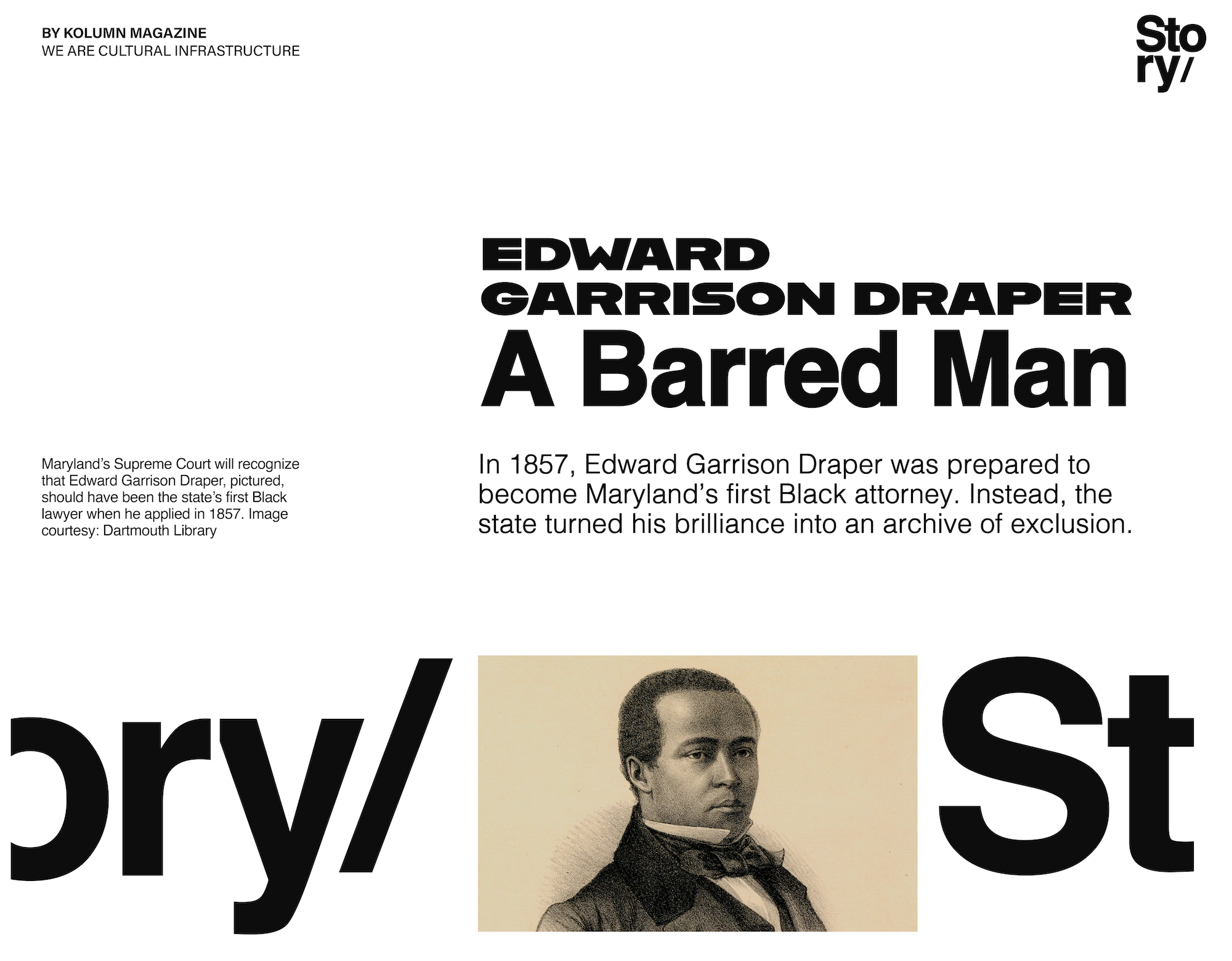
Qualified in all respects” became one of the cruelest phrases in nineteenth-century American law.
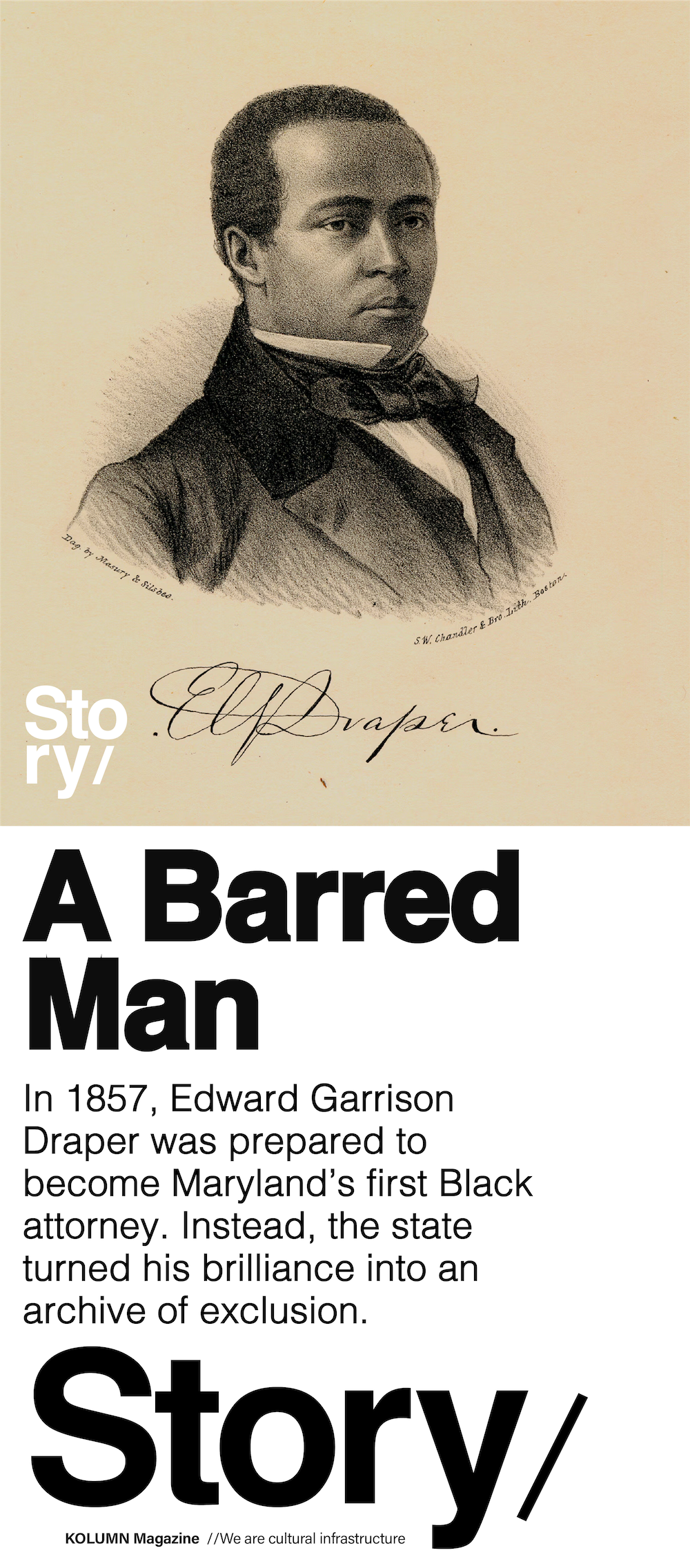
Qualified in all respects” became one of the cruelest phrases in nineteenth-century American law.
By KOLUMN Magazine
In October 2023, the Supreme Court of Maryland convened to correct a crime that had outlived the man it targeted. Edward Garrison Draper, dead for 166 years, was finally admitted to the Maryland Bar after a nineteenth-century judge once acknowledged that Draper was “qualified in all respects” to practice law—except for the fact that he was Black. The ceremony was historic not simply because it was symbolic, but because it exposed the deliberate machinery of exclusion that shaped American legal history for generations. According to the Supreme Court of Maryland, Draper was the earliest known Black man deemed fully qualified to practice law in Maryland, only to be denied because state law restricted admission to “free white citizens.”
The delayed admission was not merely a bureaucratic correction. It was an indictment of the American legal system itself.
For decades, the mythology surrounding the rise of Black lawyers in America has often begun with figures like Thurgood Marshall or Charles Hamilton Houston. Yet Draper’s life forces historians to reconsider the chronology of Black legal resistance. He existed before Reconstruction. Before emancipation. Before the constitutional amendments that theoretically redefined citizenship. He represented a generation of Black intellectuals whose ambitions emerged inside a nation structurally committed to denying them legitimacy.
His story is not simply about racism. It is about the institutional engineering of racial hierarchy.
And perhaps most importantly, it is about what America loses when talent is buried under white supremacy.
Born Free in an Unfree Nation
Edward Garrison Draper was born in Baltimore in 1834 to free Black parents during a period when freedom itself remained conditional for Black Americans. According to research published through the History of African American Alumni of Dartmouth College, Draper’s father operated a successful tobacco and cigar-making business, allowing the family to pursue educational opportunities unavailable to most Black children in Maryland.
Baltimore in the 1830s occupied a strange and volatile position in American racial life. Maryland was technically a slave state, but it also contained one of the nation’s largest populations of free Black residents. This duality created a dangerous paradox: free Black people could own businesses, pursue education, and develop professional aspirations, but they existed inside a legal framework designed to remind them that their freedom remained subordinate to whiteness.
The state’s Black Codes restricted mobility, property rights, and professional advancement. White legislators feared educated Black citizens because literacy and legal knowledge threatened the ideological foundations of slavery itself.
Historians frequently describe antebellum Baltimore as a “border city”—one suspended between slavery and freedom, North and South, democracy and racial terror. Draper’s life embodied those contradictions.
Unable to obtain robust educational opportunities locally, Draper attended school in Philadelphia, a city with a comparatively larger free Black intellectual community. Philadelphia was home to abolitionist activism, Black churches, literary societies, and educational institutions that nurtured ambitious young Black scholars despite the omnipresence of racism.
Education for Black Americans during this period was itself an act of resistance.
White America understood education as power. To educate a Black child beyond menial labor threatened the social order. This is why anti-literacy laws spread across the South after slave revolts and abolitionist organizing intensified during the early nineteenth century. Black intellectual advancement terrified white supremacist lawmakers because it destabilized the lie of racial inferiority.
Draper’s pursuit of scholarship therefore represented something larger than personal ambition. It was political.
Dartmouth and the Burden of Being “The Only One”
Draper eventually enrolled at Dartmouth College, graduating in 1855 as the only Black student in his class. According to a feature published by Dartmouth Alumni Magazine, Draper studied among a campus climate fractured by competing ideological forces. Some students and faculty embraced abolitionist ideals, while Dartmouth president Nathan Lord notoriously defended pro-slavery positions.
The emotional isolation of being “the first” or “the only” is often sanitized in retrospective histories. Institutions celebrate diversity milestones while minimizing the psychological violence endured by the individuals themselves. Draper’s presence at Dartmouth almost certainly subjected him to scrutiny, exclusion, and racial hostility that historical archives rarely fully capture.
Yet he persisted.
Dr. Forrester “Woody” Lee, a Dartmouth historian cited by the alumni publication, described Draper as existing within a small but significant network of anti-slavery allies who helped cultivate intellectual support systems for Black students in New England colleges. Such support mattered because nineteenth-century higher education was deeply entangled with white elite power structures.
Even among abolitionists, Black equality was not universally accepted.
Many white anti-slavery advocates opposed slavery while still rejecting Black citizenship, Black voting rights, interracial education, or professional equality. Draper therefore occupied a precarious position: celebrated by some reformers as evidence of Black capability while simultaneously viewed by others as an unsettling challenge to racial hierarchy.
His academic success destroyed prevailing racist assumptions.
And that destruction carried consequences.
Studying Law in a Country Built Against Him
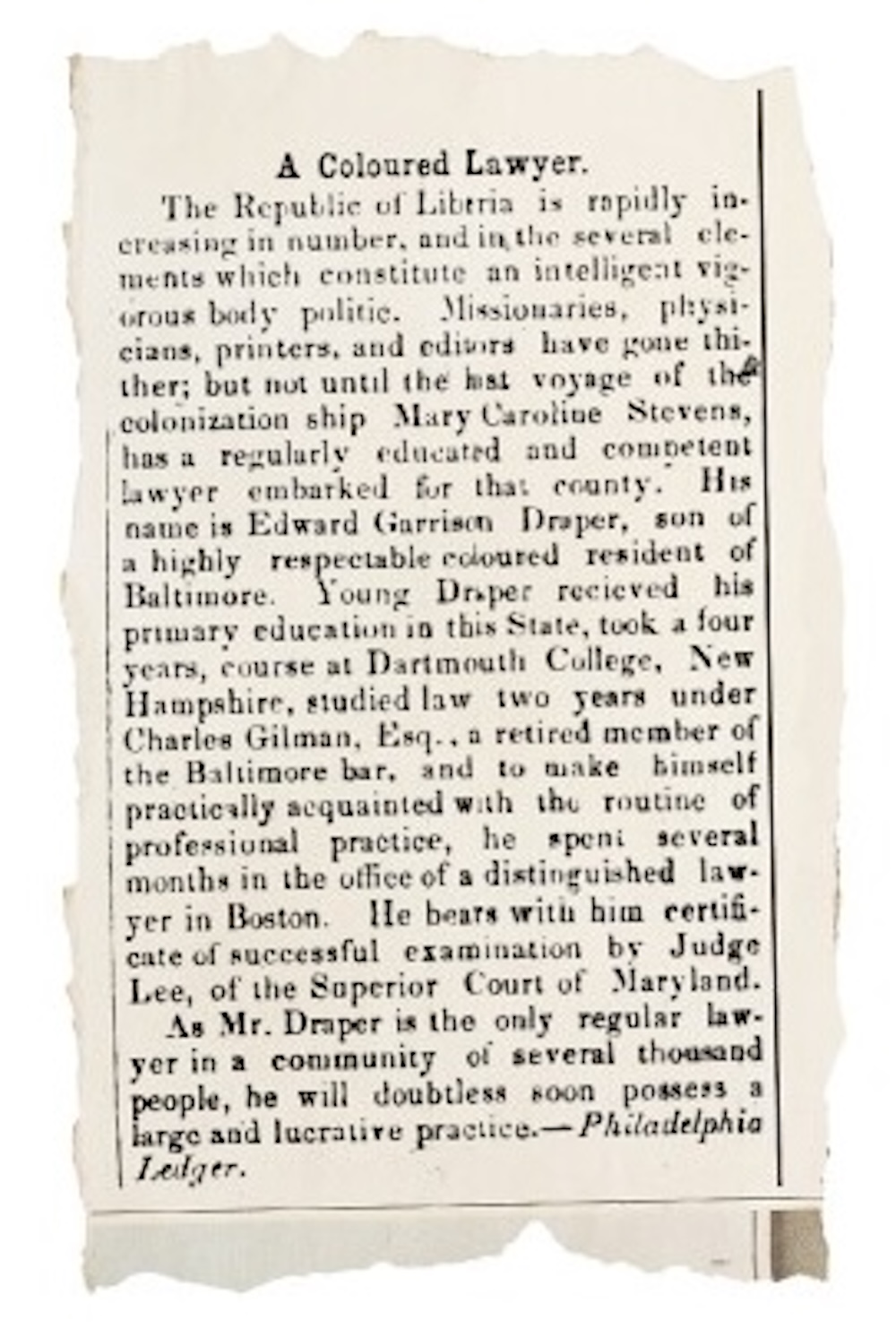
After graduating from Dartmouth, Draper returned to Maryland and studied law under attorney Charles Gilman for more than two years. By 1857, he had completed the traditional pathway toward bar admission.
Then came the hearing that would define his legacy.
On October 29, 1857, Draper appeared before Baltimore Superior Court Judge Zachaeus Collins Lee seeking admission to the Maryland Bar. According to the Maryland judiciary’s official release, Judge Lee concluded that Draper was “qualified in all respects” to practice law. The barrier was not competence. It was race.
Maryland law restricted bar admission to white citizens.
The phrasing matters because it reveals how American racism operated institutionally rather than merely socially. Draper was not denied because of academic deficiency, lack of preparation, or moral failure. He was denied because the law itself had been constructed to preserve whiteness as professional property.
Critical race scholars often describe whiteness as a protected legal asset throughout American history. Legal systems distributed opportunity according to racial identity while presenting those exclusions as neutral governance. Draper’s rejection stands as a pristine example of that process.
The law admitted his brilliance while rejecting his humanity.
This distinction is crucial.
America often prefers narratives where racial discrimination appears accidental or inconsistent. Draper’s story obliterates that comforting mythology. The state deliberately blocked Black legal participation because Black lawyers threatened the legal justification for racial domination.
Black attorneys could challenge property seizures, slavery statutes, labor exploitation, voting restrictions, and discriminatory criminal prosecutions. Excluding Black lawyers was not incidental to white supremacy. It was essential to maintaining it.
Legal historian John G. Browning argued in his article, “To Fight the Battle, First You Need Warriors,” that Maryland lagged behind other states in admitting Black attorneys and maintained especially rigid racial barriers long after the Civil War.
That history matters because Maryland often escapes the scrutiny directed toward Deep South states.
Yet border states perfected subtler systems of racial containment.
Liberia and the Exile of Black Ambition
After Maryland denied him admission, Draper obtained certification allowing him to practice law in Liberia, the West African nation established through colonization efforts backed by the American Colonization Society.
The Liberia episode reveals another painful contradiction within nineteenth-century America.
White leaders frequently promoted colonization as a “solution” to racial tensions, arguing that free Black Americans should emigrate rather than claim equality within the United States. Colonization movements framed Black citizenship as fundamentally incompatible with American democracy.
For ambitious Black intellectuals, Liberia became both refuge and forced compromise.
Draper’s relocation was not merely professional relocation. It was exile.
America effectively told him that his talents could exist anywhere except within the nation of his birth.
According to Governor Wes Moore’s office, Draper practiced law in Liberia before dying of tuberculosis in 1858 at only 24 years old.
Twenty-four.
The brevity of his life intensifies the tragedy surrounding it. Draper never received the decades necessary to fully develop his legal scholarship, political influence, or public advocacy. America extinguished possibility before it matured.
The nation lost not merely a lawyer, but an entire trajectory of Black legal thought.
Historiography surrounding Black intellectual history increasingly emphasizes these “interrupted lives”—individuals whose contributions were minimized or erased because racism constrained their opportunities before their influence could fully emerge. Draper belongs squarely within that lineage.
He was not forgotten accidentally.
He was forgotten structurally.
The Historians Who Resurrected Him
One of the most revealing aspects of Draper’s story is how close America came to losing it entirely.
For generations, his name barely appeared in mainstream legal histories. Histories of the American bar often celebrated white legal milestones while reducing Black attorneys to footnotes that emerged only after Reconstruction.
That erasure reflects a broader pattern in American historiography.
Black achievement is often remembered only once institutions can safely celebrate it without confronting the violence that originally suppressed it.
The revival of Draper’s story came largely through the work of legal historians and attorneys committed to documenting the hidden architecture of racial exclusion within American law. John G. Browning, Domonique Flowers, and Professor José Anderson played central roles in petitioning for Draper’s posthumous admission.
Their efforts were not symbolic nostalgia. They were historiographical intervention.
By restoring Draper to legal history, scholars challenged dominant narratives that portray Black legal advancement as beginning only after white institutions gradually became more enlightened. In reality, Black Americans pursued legal excellence long before white institutions allowed them access.
The exclusion came first.
Recognition came centuries later.
Bloomberg Law reporting republished by The Habari Network noted that Draper’s rediscovery reshaped understandings of Maryland’s legal history. Browning argued that “the story of Black lawyers in Maryland began with Edward Garrison Draper.”
That statement carries profound implications.
It reframes Draper not as an obscure anomaly, but as the opening chapter in a broader struggle for Black legal participation.
Maryland’s Reckoning With Its Own History
The 2023 ceremony admitting Draper to the Maryland Bar arrived during a broader national reexamination of institutional racism. Universities, courts, museums, and state governments have increasingly confronted histories of exclusion once treated as peripheral.
Yet symbolic gestures remain complicated.
What does it mean to apologize to the dead?
Can institutions meaningfully repair harms generations after the victims themselves are gone?
These questions hovered over Draper’s posthumous admission ceremony.
Governor Wes Moore framed the event as an effort to “right an historic wrong,” according to the governor’s official statement. Chief Justice Matthew Fader similarly emphasized the importance of highlighting the legacy of those wrongly denied the opportunity to practice law.
But ceremonies alone cannot erase structural legacies.
The American legal profession remains disproportionately white. Black attorneys continue to face barriers in hiring, partnership advancement, judicial appointments, and professional retention. Studies consistently demonstrate that racial disparities persist throughout elite law firms and judicial systems.
Draper’s story therefore resonates beyond historical curiosity.
It speaks directly to contemporary struggles over access, legitimacy, and institutional gatekeeping.
The same profession that once explicitly excluded Black lawyers now often relies on subtler forms of exclusion: networking disparities, educational inequality, credential bias, and financial barriers to legal education.
The architecture evolves.
The hierarchy adapts.
Black Legal Resistance Before Reconstruction
One of the greatest misconceptions in American history is the idea that Black political consciousness emerged only after emancipation. Draper’s life reveals a much older tradition of Black legal and intellectual resistance.
Before the Civil War, free Black communities across northern and border states built schools, newspapers, churches, mutual aid societies, literary circles, and political organizations. Black abolitionists did not merely protest slavery; they developed sophisticated critiques of American constitutional hypocrisy.
Figures like David Walker, Frederick Douglass, and Martin Delany articulated expansive visions of Black citizenship long before the Civil War transformed federal law.
Draper belonged to that intellectual ecosystem.
His pursuit of legal training represented a profound act of political imagination. To become a lawyer in antebellum America required believing that Black citizenship deserved institutional recognition despite overwhelming evidence to the contrary.
That aspiration itself was radical.
Historians increasingly argue that Black professionals before the Civil War laid critical groundwork for Reconstruction-era activism. Their educational achievements, organizational networks, and political arguments helped shape later civil rights struggles.
Draper’s exclusion therefore illuminates what Reconstruction inherited: not a vacuum, but a suppressed tradition of Black legal ambition.
The Long Shadow of Professional Exclusion
Professional exclusion has always functioned as one of America’s most effective tools of racial control.
Restricting Black access to law, medicine, finance, academia, and journalism ensured that white institutions retained authority over public knowledge and power. Exclusion from professions meant exclusion from policymaking, wealth accumulation, and cultural legitimacy.
Draper’s rejection embodied this broader system.
Law mattered especially because attorneys shape citizenship itself. Lawyers influence legislation, constitutional interpretation, property rights, criminal justice, and voting systems. Preventing Black lawyers from entering the profession protected white control over the legal meaning of America.
This pattern extended beyond Maryland.
Throughout the nineteenth and early twentieth centuries, Black professionals frequently encountered licensing barriers, segregated educational systems, discriminatory examinations, and outright statutory bans. Even after formal restrictions ended, informal discrimination persisted through professional associations and hiring practices.
Draper’s story therefore belongs to a much larger American tradition of racialized gatekeeping.
And that history still reverberates.
Why Edward Garrison Draper Matters Now
Edward Garrison Draper matters because he disrupts national memory.
He complicates simplistic narratives about progress. He exposes how deeply racism shaped American institutions. He reminds audiences that Black excellence has always existed—even when archives, courts, and textbooks attempted to erase it.
But perhaps most importantly, Draper matters because his story forces a confrontation with the cost of exclusion.
What jurisprudence never emerged because he died at 24? What cases might he have argued? What students might he have mentored? What political movements might he have shaped?
American racism did not merely harm individuals.
It diminished the nation itself.
The loss of Draper represents a measurable intellectual theft carried out by white supremacy. Every blocked opportunity reverberated outward into lost scholarship, lost advocacy, lost institutional transformation, and lost futures.
This is why recovering suppressed histories matters.
Not as symbolic multiculturalism.
Not as institutional branding.
But because historical erasure distorts public understanding of how power actually functioned in America.
KOLUMN Magazine has repeatedly examined the hidden figures erased from dominant historical narratives—whether documenting overlooked abolitionists, civil rights organizers, Black intellectuals, or early legal pioneers. Draper’s story belongs within that continuum of recovery. He stands among the many Black Americans whose contributions were obscured because acknowledging them would have forced America to confront the deliberate nature of racial exclusion.
His life also serves as a warning.
Democracy does not naturally expand inclusion. Institutions rarely surrender exclusion voluntarily. Progress emerges because individuals challenge systems designed to deny them recognition.
Draper did exactly that.
And even though the state rejected him in life, history ultimately recorded the truth the law tried to suppress:
Edward Garrison Draper was a lawyer long before Maryland finally admitted it.
More great stories
Afro Sheen, Wall Street, and the Architecture of Black Possibility
July 6, 2026
No Comments
The Fire Inside the Fourth
July 5, 2026
No Comments