



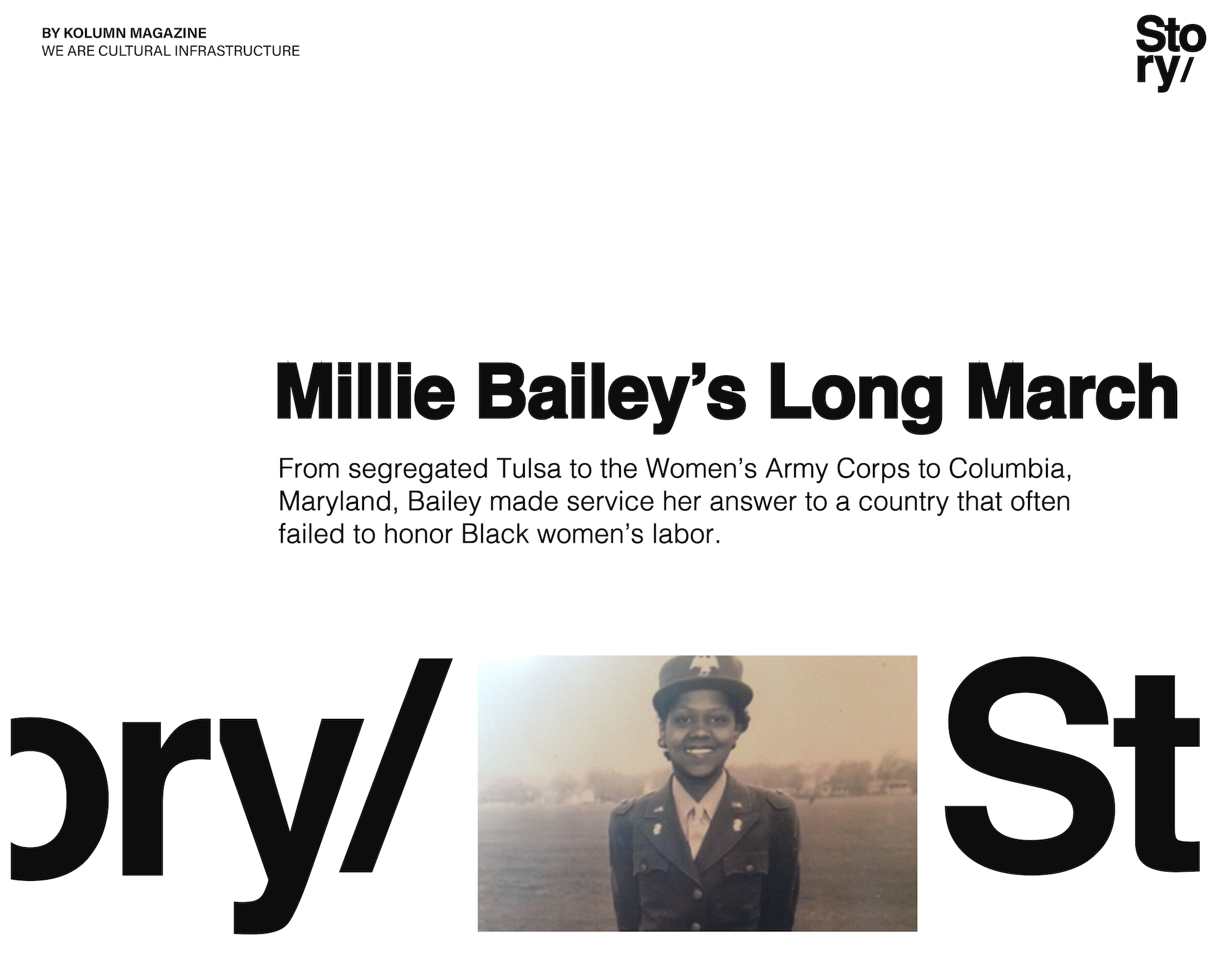
Bailey’s life was not a footnote to military history. It was an argument about citizenship.
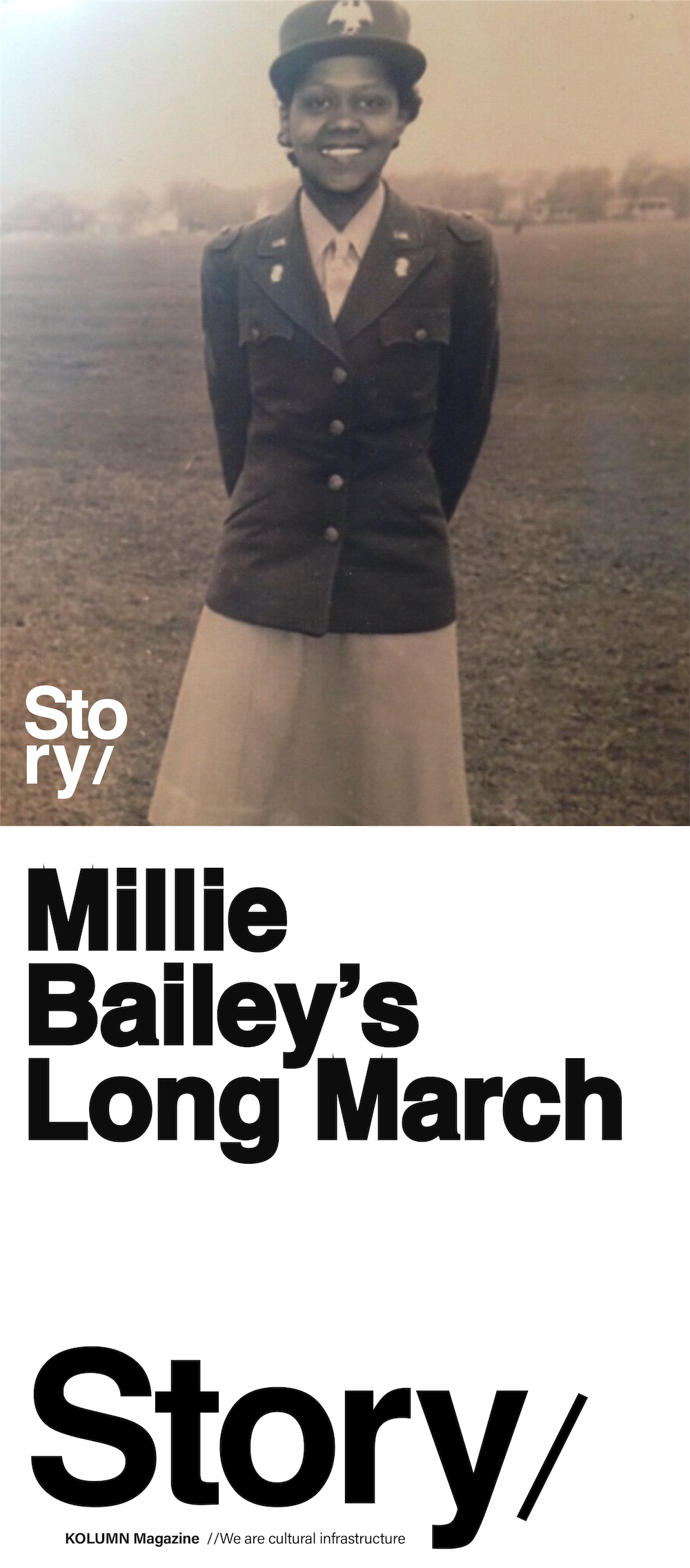
Bailey’s life was not a footnote to military history. It was an argument about citizenship.
By KOLUMN Magazine
Vivian Mildred Corbett Bailey lived long enough to witness nearly every defining contradiction of modern American democracy. Born on February 3, 1918, in Washington, D.C., and raised in Tulsa, Oklahoma, Bailey entered the world before women had fully secured the right to vote nationwide and decades before the United States military would desegregate. By the time she died at 104 years old on May 1, 2022, she had watched America move through world war, Jim Crow, civil rights upheaval, Cold War politics, Black political ascension, and the digital age. Yet what made Bailey remarkable was not simply the length of her life. It was the continuity of her service.
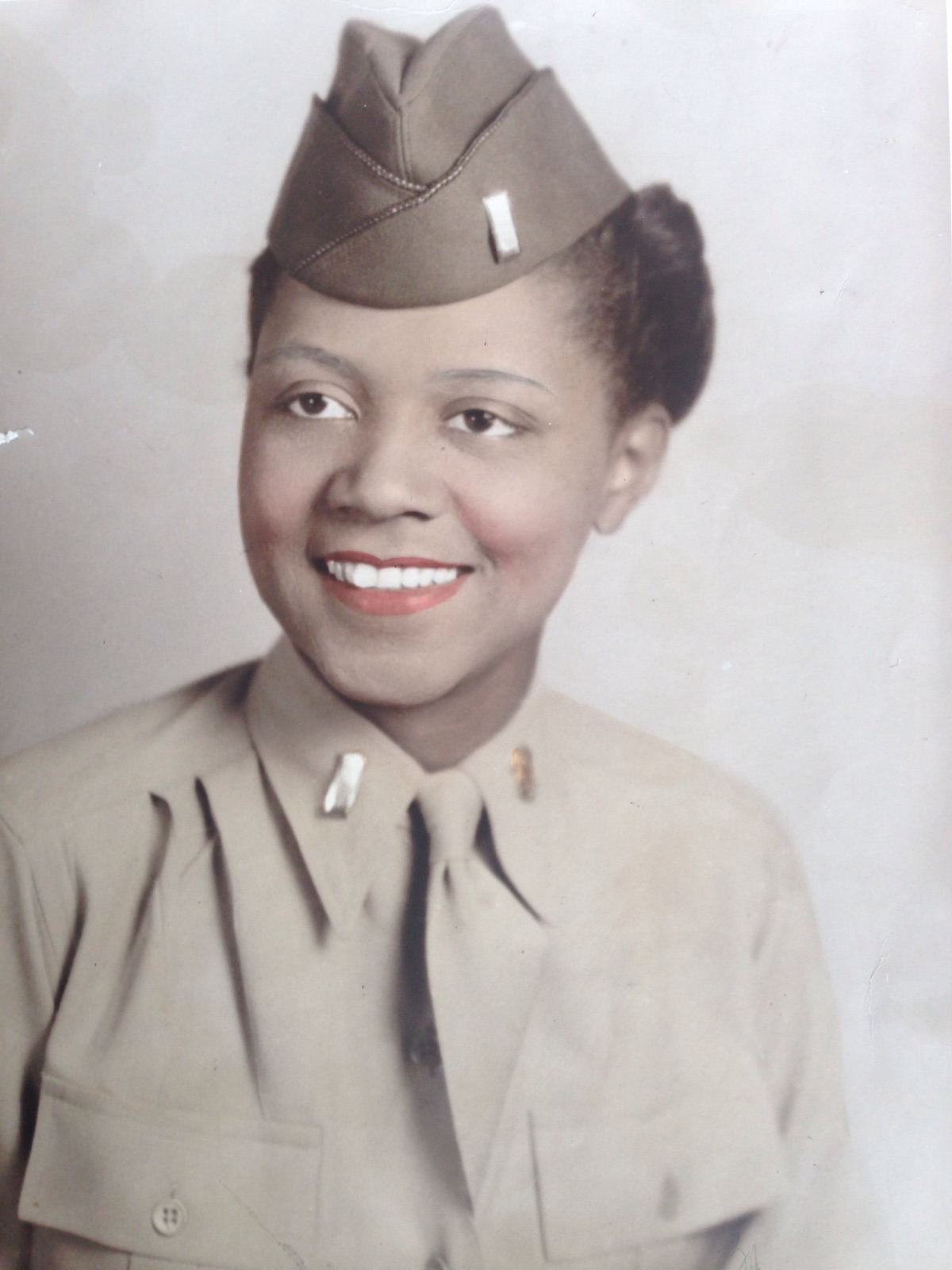
Her obituary published by Harry H. Witzke’s Family Funeral Home described her as a “dedicated public servant and philanthropist,” but the phrase only scratches at the scale of her influence. Bailey belonged to a generation of Black women who carried American institutions on their backs while simultaneously being excluded from full participation within them. She served her country in the Women’s Army Corps during World War II, worked in federal government leadership through the Social Security Administration, became a major civic force in Howard County, Maryland, and spent decades supporting schools, hospitals, and veterans.
Her life was not merely inspirational. It was political.
Bailey’s story reveals how Black women often functioned as the hidden infrastructure of American democracy. They organized communities, stabilized institutions, raised money, educated children, sustained churches, and defended the nation while simultaneously being denied equal recognition for that labor. Historians have increasingly corrected the public record to account for these women, but for decades their work was treated as supplementary rather than foundational.
Historian Darlene Clark Hine explained this marginalization in an interview archived by the National Endowment for the Humanities, noting that Black women’s history was long excluded from dominant historical narratives because Black women were viewed as neither proper “subjects” nor “objects” of scholarly inquiry. Bailey’s life demonstrates precisely why that exclusion distorted the American story.
Bailey never became a household name nationally. She did something rarer. She became indispensable locally.
Growing Up in Tulsa’s Shadow
Although Bailey was born in Washington, D.C., much of her upbringing occurred in Tulsa, Oklahoma, a city permanently marked by racial violence and Black resilience. She graduated as valedictorian from Booker T. Washington High School, according to her obituary at Harry H. Witzke’s Family Funeral Home, and worked as a stenographer and medical records clerk before entering military service.
Her adolescence unfolded in the aftermath of the 1921 Tulsa Race Massacre, during which white mobs destroyed the prosperous Black Greenwood District, murdering residents and devastating Black economic life. Although Bailey was only a small child during the massacre, the event shaped the racial climate surrounding her upbringing. Tulsa’s Black community rebuilt itself despite the violence, creating a culture deeply invested in education, discipline, self-determination, and collective survival.
That environment mattered.
Black educational institutions in segregated America often functioned as political training grounds disguised as schools. Students were taught not merely academic excellence but racial responsibility. Booker T. Washington High School produced generations of Black professionals who understood achievement as communal obligation rather than individual escape.
Bailey’s trajectory reflected that tradition. Her rise to valedictorian status was not simply a personal triumph. It represented entry into a class of Black women expected to carry institutions forward under hostile conditions.
The historian Evelyn Brooks Higginbotham famously described the “politics of respectability” that shaped many Black communities in the twentieth century, where discipline, education, service, and professionalism became both survival strategies and forms of racial advocacy. Bailey embodied many of those values. Yet reducing her life to respectability politics alone would miss the sharper truth: she used institutional excellence as a form of quiet insurgency.
Joining a Segregated Army
When Bailey entered the Women’s Army Auxiliary Corps in December 1942, she joined an institution still deeply shaped by segregation. The United States needed manpower—or, more accurately, personnel—for World War II, but American military leadership remained reluctant to fully integrate Black soldiers and Black women into the wartime structure.
The WAAC, later renamed the Women’s Army Corps, represented a major expansion of women’s military participation. According to the Army Heritage Center Foundation, the first officer candidates arrived at Fort Des Moines in July 1942, including 40 African American women among 440 trainees.
Fort Des Moines already carried historical significance. During World War I, it had trained Black officers, and during World War II it became the first WAAC training center and the only training center for WAC officers, according to the National Park Service.
Yet Black women entering military service confronted a brutal contradiction. The federal government needed their labor while still doubting their belonging.
The National Archives has documented how Black women in the WAC faced segregated housing, limited occupational opportunities, racial discrimination, and institutional hostility. Even within the wartime emergency, military leadership feared white backlash over Black women wearing uniforms and occupying positions of authority.
Bailey nonetheless rose to become a first lieutenant commanding an all-female detachment during World War II, according to profiles by the Department of War and Howard Community College.
That achievement cannot be separated from race.
Black women officers occupied an especially fraught position inside segregated military structures because they disrupted multiple assumptions simultaneously: racial hierarchy, gender hierarchy, and authority itself. Historian Martha S. Putney’s landmark study When the Nation Was in Need: Blacks in the Women’s Army Corps During World War II, cataloged in WorldCat, documented the persistent discrimination Black WACs endured despite their service.
Many white military leaders viewed Black women as suitable only for domestic or custodial work regardless of qualifications. A ProQuest educational archive on African American women in the WAC notes that Black women were frequently restricted to segregated assignments and denied opportunities available to white servicewomen.
Bailey’s leadership therefore represented institutional resistance. Every promotion challenged assumptions about who was qualified to command.
Black Women and the Wartime State
The public memory of World War II still tends to center white male soldiers, Rosie the Riveter iconography, and battlefield heroism. But Black women like Bailey occupied an essential and underexamined layer of wartime America.
They staffed offices, organized logistics, maintained military records, operated communications systems, and helped sustain the enormous administrative machinery necessary for global war. The National WWII Museum notes that women in the WAC eventually filled more than 200 occupational specialties.
This labor transformed the meaning of military participation.
For Black women especially, wartime service became part of the broader “Double V” campaign: victory against fascism abroad and racism at home. Black newspapers such as the Pittsburgh Courier championed the idea that Black military service should produce expanded citizenship rights after the war.
Yet Black women veterans often returned home to familiar exclusions.
Bailey’s generation understood this betrayal intimately. They had worn uniforms, obeyed military command, and served federal objectives while still confronting segregated housing, discriminatory employment, and restricted political rights.
The historian Adriane Lentz-Smith has argued that Black military participation repeatedly forced the nation into moments of democratic reckoning because military service destabilized arguments for racial inferiority. Bailey’s life fits within that larger historical pattern. Her competence made segregation harder to justify.
Federal Service and the Bureaucracy of Care
After leaving military service in January 1946, Bailey transitioned into federal government work and eventually became a division director within the Social Security Administration, according to biographical information from the Department of War and Howard Community College.
This phase of her life deserves more attention than it often receives.
The postwar federal bureaucracy became one of the largest pathways into the Black middle class during the twentieth century. Government employment frequently offered Black workers more stability and advancement opportunities than the private sector, where discriminatory hiring remained rampant.
But Bailey’s work also reflected something deeper: an investment in the infrastructure of public welfare.
The Social Security Administration occupies a central place in American civic life. It manages retirement benefits, disability systems, survivor benefits, and income support structures touching millions of lives. Bailey’s role inside that bureaucracy positioned her within the machinery through which the federal government materially interacted with ordinary citizens.
This was activism in administrative form.
Scholar Keeanga-Yamahtta Taylor has written extensively about how Black Americans have historically fought not simply for symbolic equality but for equitable access to public goods and institutional resources. Bailey’s career reflected that struggle. She worked inside the state itself.
Her leadership mattered because Black women in federal authority positions remained relatively rare during the mid-twentieth century. Every advancement challenged both workplace segregation and assumptions about managerial competence.
Columbia, Maryland and the Politics of Community
By the time Bailey moved to the Baltimore area in 1970, she had already completed military service and built a significant federal career. Yet her most visible public impact may have emerged during her later decades in Howard County, Maryland.
She became deeply involved in civic life across Columbia, a planned community often promoted as a racially integrated suburban experiment. Columbia’s founding mythology centered on inclusion and community-building, but maintaining those ideals required constant civic engagement.
Bailey provided exactly that.
She supported Howard Community College, contributed to Howard County General Hospital, volunteered extensively, and helped organize support efforts for deployed military personnel. According to Johns Hopkins Giving, she became the longest-serving trustee of Howard County General Hospital and played a major role in supporting the institution financially and organizationally.
Howard Community College described her contributions as “tremendous” in its donor profile published on HowardCC.edu.
Bailey’s civic model reflected a generation that viewed public institutions as collective responsibilities rather than abstract systems managed by others. Schools, hospitals, veterans’ organizations, and community associations required labor, fundraising, visibility, and trust.
She supplied all four.
Importantly, Bailey’s activism did not depend on celebrity politics. She was not a nationally televised activist. She was something more durable: a civic steward.
The Politics of Care Packages
One of the most revealing details about Bailey’s later life involved her decades-long effort supporting active-duty service members through care packages. According to the Department of War profile on Bailey, she helped collect and ship care packages to troops beginning in 1966 and continuing for decades afterward.
At first glance, the act may appear quaint or symbolic. It was neither.
Care work has historically been feminized and therefore politically underestimated, particularly when performed by Black women. But Bailey’s sustained commitment to service members represented an extension of her understanding of citizenship.
She knew military life personally. She understood isolation, bureaucracy, discipline, and sacrifice. Sending care packages was not charity. It was solidarity.
Black feminist scholars including Patricia Hill Collins have argued that caregiving within Black communities often functions as political labor because it sustains populations navigating structural inequality. Bailey’s veteran support work fits squarely within that tradition.
Her generation often expressed activism through institution-building and mutual aid rather than solely through public confrontation. That distinction matters historically. Not all political labor appears as protest.
Becoming a Public Symbol
In 2020, Howard County officially dedicated the Vivian C. “Millie” Bailey Neighborhood Square at Lake Kittamaqundi in Downtown Columbia, according to the Howard County Government.
Public naming is political memory.
Who receives monuments, parks, schools, statues, and squares determines whose stories become normalized within civic identity. Black women veterans have historically been excluded from these landscapes of remembrance.
Bailey’s inclusion signaled an important shift.
The naming acknowledged not only her military service but also her decades of civic contribution. It transformed her from respected local figure into part of the physical geography of public memory.
At the same time, Bailey’s public visibility expanded nationally through lighter cultural moments. News coverage highlighted her White House visits, birthday celebrations, and even her skydive at age 102, documented by the Department of War.
These stories made her widely admired. But they also risked flattening her into an inspirational figure detached from historical struggle.
The deeper significance of Bailey’s longevity was not novelty. It was witness.
She had seen the United States before military desegregation, before Brown v. Board of Education, before the Voting Rights Act, before the Civil Rights Act, before women gained broad workplace protections.
Her life became a living archive.
Historiography and the Recovery of Black Women’s Memory
For much of the twentieth century, women like Bailey existed at the edges of mainstream historical storytelling. Black women veterans were especially neglected within both military history and women’s history.
That omission has gradually changed through decades of scholarship.
Historians including Darlene Clark Hine, Deborah Gray White, Brenda Stevenson, and Martha S. Putney expanded the academic field surrounding Black women’s experiences, forcing institutions to recognize that Black women were not marginal historical actors.
The shift has also appeared in museums and archives. The National Archives has increasingly highlighted Black women’s military contributions, while the National WWII Museum has broadened its interpretation of wartime labor.
Bailey’s life illustrates why this historiographical correction matters.
Without these efforts, women like her risk becoming isolated anecdotes instead of recognized historical forces. Their lives become inspirational side stories rather than central evidence about how American democracy functioned.
But Bailey was not peripheral to history.
She stood inside multiple major historical transitions simultaneously: Black migration, wartime mobilization, federal workforce expansion, civil rights transformation, women’s advancement in public leadership, and suburban civic development.
Her life connected these histories together.
Service as Democratic Practice
There is a temptation in American political culture to separate activism from administration, protest from governance, or civic work from political transformation. Bailey’s life rejects those distinctions.
She practiced democracy administratively.
She believed institutions mattered because ordinary people depended on them. Schools mattered. Hospitals mattered. Veterans mattered. Public space mattered. Community memory mattered.
This ethic sharply contrasts with modern political cynicism, where institutions are often treated as distant, corrupt, or disposable.
Bailey represented an older civic tradition rooted in participation rather than performance.
That tradition remains especially important within Black political history. African American communities frequently built parallel civic infrastructures precisely because exclusion from white institutions required it. Churches, schools, civic associations, aid societies, and advocacy groups became survival mechanisms.
Bailey carried that institutional ethic across her entire life.
The Legacy of Vivian Mildred Bailey
When Vivian Mildred Bailey died in 2022 at age 104, the country lost more than a veteran or philanthropist. It lost a living bridge between eras of American struggle.
Her life challenges simplistic narratives about patriotism. Bailey loved her country enough to serve it while simultaneously understanding its failures intimately. She defended democratic ideals while recognizing that democracy itself remained unfinished.
That tension defined much of Black American history.
Bailey’s story also complicates contemporary understandings of activism. Not all activism appears confrontational. Some of it is infrastructural. Some of it looks like governance, fundraising, volunteerism, mentorship, care work, or institutional stewardship.
She understood that democracy survives through maintenance as much as through protest.
The United States has often celebrated Black women symbolically while depending on their labor materially. Bailey’s life exposed that contradiction while transcending it. She refused invisibility through competence, persistence, and public commitment.
In the end, Vivian Mildred Bailey spent more than a century proving that service itself could become a form of resistance.
And perhaps that is the most radical lesson she leaves behind: democracy is not sustained by rhetoric alone. It survives because people like Millie Bailey continue showing up long after applause fades.
More great stories
Afro Sheen, Wall Street, and the Architecture of Black Possibility
July 6, 2026
No Comments
The Fire Inside the Fourth
July 5, 2026
No Comments