





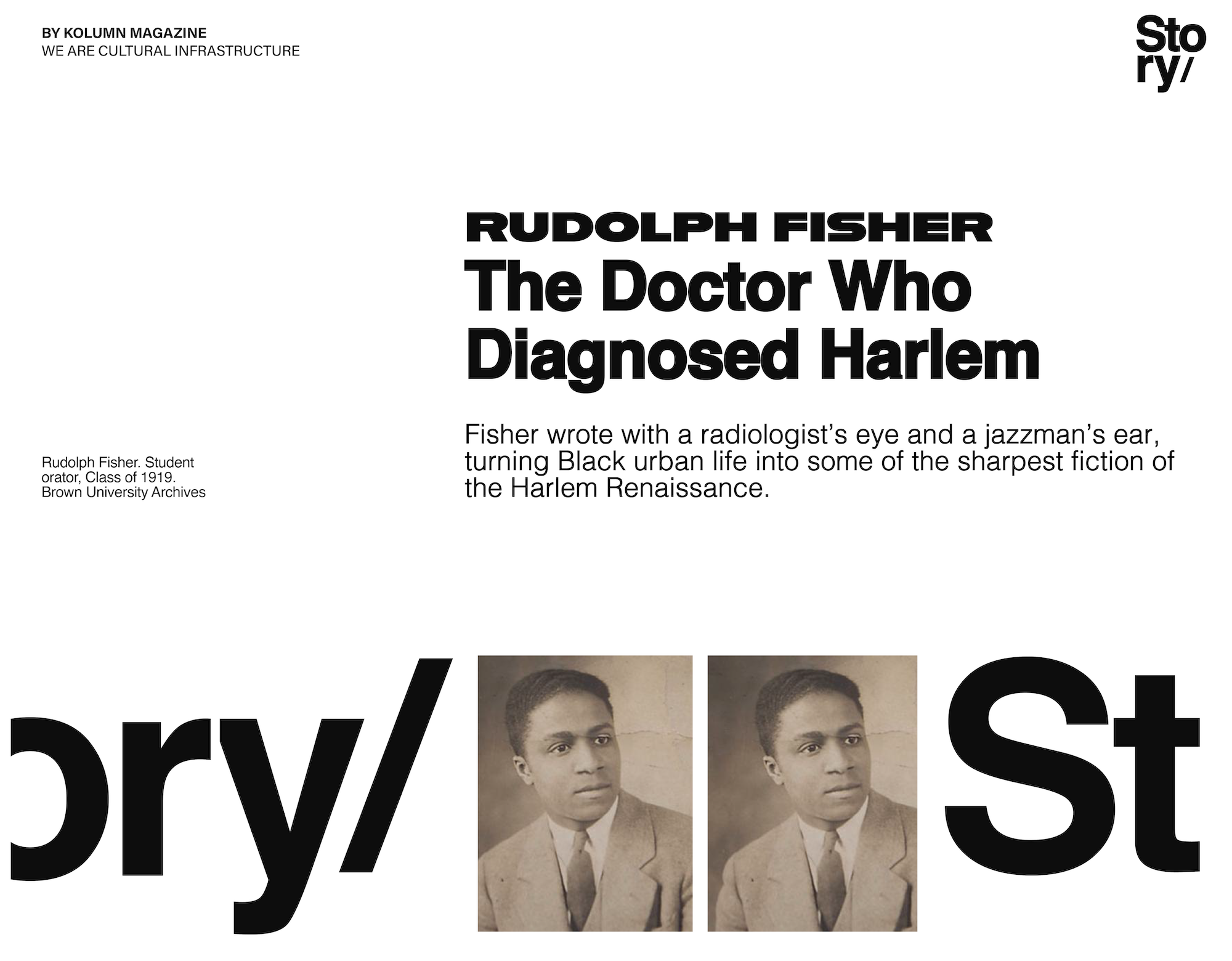
Fisher did not write Harlem as a stage set for white fascination. He wrote it as a living system — class-struck, joke-rich, wounded, brilliant and always in motion.
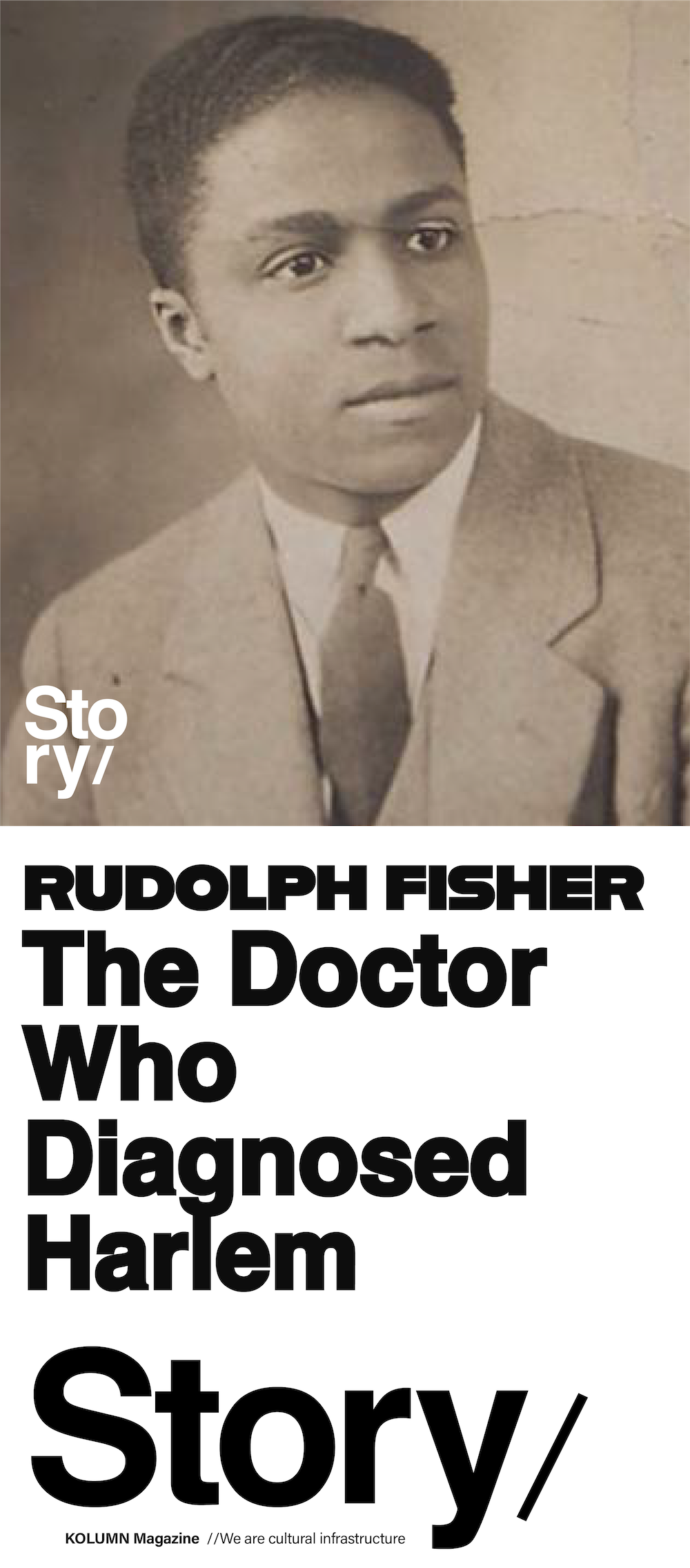
Fisher did not write Harlem as a stage set for white fascination. He wrote it as a living system — class-struck, joke-rich, wounded, brilliant and always in motion.
By KOLUMN Magazine
Rudolph Fisher arrived in Harlem with the habits of a scientist and the instincts of an artist. He could read an X-ray, score a song, charm a room, puncture a pretension, and turn a city block into fiction dense with argument, music and motion. In the crowded mythology of the Harlem Renaissance, where Langston Hughes, Zora Neale Hurston, Alain Locke, Nella Larsen, Countee Cullen and Jessie Fauset often stand near the front of the frame, Fisher is still too often found at the edge — a brilliant figure half-remembered as a curiosity, a physician who wrote novels, a writer who died young, a Renaissance man whose range may have made him harder to categorize.
That marginality is not evidence of smallness. It is evidence of how literary memory works: it rewards the durable brand, the surviving archive, the classroom anthology, the long life. Fisher had none of those advantages. He died in 1934 at 37, leaving behind two novels, a body of short stories, essays, scientific papers, musical arrangements, and a reputation among his peers for devastating wit. Brown University, where Fisher graduated in 1919, later described him as a biology-and-English double major whose career made him both “one of the pioneers in what is now radiology” and one of the wittiest writers of the Harlem Renaissance according to Brown’s archival profile. Britannica, in an entry written by scholar George Hutchinson, calls Fisher’s fiction a realistic depiction of Black urban life in the North, especially Harlem, and identifies him as one of the most gifted short-story writers of the Renaissance in its biography of Rudolph Fisher.
This is the Fisher worth recovering: not a footnote, but a diagnostician of Black modernity.
KOLUMN’s continuing attention to overlooked Black authors — from Sutton E. Griggs to Sarah Farro to Arthur Huff Fauset — makes Fisher a natural subject. Like those writers, he belongs to a buried canon of Black literary production that did not disappear because it lacked power. It disappeared because publishing, criticism, race politics and institutional memory narrowed the archive. Fisher’s work asks to be read again not merely because it was “first” in one genre or another, but because it understood something permanent about American life: the city was becoming the central stage of Black possibility, and Harlem was both refuge and trap.
A Child of Washington, Providence and the Long Black North
Rudolph John Chauncey Fisher was born in Washington, D.C., on May 9, 1897, to John Wesley Fisher, a Baptist minister, and Glendora Williamson Fisher, a schoolteacher. His early childhood moved through several Black geographies: Washington, New York and Providence, Rhode Island. That movement mattered. Fisher would later become the great fictional cartographer of Harlem, but his imagination was shaped by the broader Black North — its churches, schools, immigrant neighborhoods, racial violence, and thin promises of civic belonging.
Harriet A. Washington, writing in The American Scholar, notes that Fisher’s father moved the family to Providence, where he established Macedonia Baptist Church, and that young Rudolph became a prodigious student, pianist, debater and singer in her 2025 essay on Fisher. At Classical High School, Fisher studied German, debated, sang Schubert, and earned a reputation as a “silver-tongued orator.” His nickname, Bud, reportedly came from his sharp humor and from Bud Fisher, the cartoonist behind Mutt and Jeff as Washington recounts.
Providence was not an innocent backdrop. Its civic mythology could suggest New England restraint, but its history contained anti-Black violence, segregation and mob attacks. Washington places Fisher’s youth within that tension: the city’s Black citizens navigated opportunity and hostility at the same time. Fisher’s later fiction would carry that same double vision. He was too observant to sentimentalize the North as liberation. He was also too committed to Black modern life to reduce the North to betrayal.
At Brown University, Fisher studied biology and English — a pairing that, in retrospect, looks like the blueprint for his life. In 1919, he delivered a commencement oration titled “The Emancipation of Science,” arguing for the kinship of scientific inquiry and moral purpose. Brown’s archival profile quotes Fisher’s claim that science and religion could meet in the work of “making life worth living,” a sentence that now reads like an early manifesto for his career as preserved by Brown University. He did not see medicine and art as separate callings. He saw both as methods of interpretation.
That matters because Fisher’s fiction often feels diagnostic. His scenes move with clinical alertness: bodies, gestures, slang, rooms, crowds, social reflexes. He watches class behavior as carefully as symptoms. He listens to vernacular as data. He follows migration as both hope and pathology. His eye is affectionate, but rarely soft.
The Physician as Artist
After Brown, Fisher earned a master’s degree there and then attended Howard University College of Medicine, graduating in 1924. Britannica notes that he moved to New York City in 1925, meeting major Black writers including Langston Hughes, Nella Larsen, James Weldon Johnson, Walter White and Jessie Redmon Fauset in its Fisher biography. Brown’s account adds that he came to New York on a Columbia fellowship to study the influence of ultraviolet rays on viruses, even as Harlem’s literary and musical movement was reaching its charged middle years according to Brown.
This was no ornamental medical career. Fisher worked in radiology, then a young and hazardous field. He became superintendent of International Hospital in Harlem and later opened his own radiology practice. The Library of Congress describes him as a practicing New York physician with a thriving specialty in radiology, an honors graduate of Brown and Howard, and a jazz musician as well as a novelist and scientific writer in its publication page for The Conjure-Man Dies.
The racial context of that medical career was severe. Black physicians in the early 20th century faced exclusion from professional societies, hospital privileges and specialty training. Washington’s essay situates Fisher among Black medical professionals forced to practice under constraints imposed by segregation and professional gatekeeping, noting that the American Medical Association and local medical societies often excluded Black doctors in The American Scholar. Fisher’s work in radiology placed him at the edge of modern medicine while American medicine itself remained steeped in racial exclusion.
There is a temptation to treat Fisher’s medicine as biography and his fiction as art, but in his case the two are inseparable. His detective fiction depends on procedure, evidence, bodies and inference. His social fiction depends on observation and diagnosis. He understood Harlem not only as a neighborhood but as an organism under pressure: migration, class aspiration, white voyeurism, Black intraracial snobbery, nightlife economies, religious memory, urban danger, comic survival.
Harlem, Heard From the Inside
Fisher’s first major literary breakthrough came with “The City of Refuge,” published in The Atlantic Monthly in 1925 and later included in Alain Locke’s landmark anthology The New Negro. Britannica identifies “City of Refuge” as one of Fisher’s notable works about Southern Black migrants adjusting to Harlem in its overview. The story follows King Solomon Gillis, a Southern migrant who arrives in Harlem imagining it as a promised land because even the policemen are Black. Fisher’s genius is that he neither mocks the dream nor protects it. He lets the dream walk straight into the machinery of the city.
The title itself carries a biblical charge. Harlem is refuge, yes, but refuge from what? Southern racial terror? Economic confinement? The humiliation of Jim Crow? And what kind of refuge absorbs the vulnerable into new forms of exploitation? Fisher’s Harlem is not a postcard of Black achievement. It is a system of arrival.
That is why his fiction remains so alive. He captured not simply the glamour of the Renaissance, but the social physics beneath it. The cabaret, the church, the tenement, the professional office, the street corner, the drawing room and the rent party all become sites of negotiation. His characters code-switch before the term becomes common. They perform respectability, reject it, profit from it, parody it. His humor works like a blade because it is grounded in intimacy.
Langston Hughes understood Fisher’s singularity. Brown’s profile quotes Hughes calling him “the wittiest of these New Negroes of Harlem,” a man whose sharp tongue frightened him a little because Fisher could always think of something incisive to say as Brown recounts. Washington similarly places Fisher among the brightest figures of the Renaissance, noting that Hughes’s admiration came with awe in The American Scholar.
But wit should not be mistaken for lightness. Fisher’s humor is political because it refuses simplification. He did not write Black life as uplift propaganda. He did not write poverty as spectacle. He did not write the folk as embarrassment. In this, he shared aesthetic kinship with Zora Neale Hurston. Washington notes that both Fisher and Hurston resisted the demand that Black art confine itself to “uplift” images, and she quotes Hurston’s later judgment that Fisher was “too honest” to write race propaganda in her essay.
That honesty placed Fisher in a difficult position within Renaissance politics. The era’s artists were often asked to carry the burden of racial representation. Every Black character could become, in the eyes of critics, evidence for or against the race. Fisher refused that bargain. His Harlem contained hustlers, doctors, migrants, elites, fools, lovers, skeptics, workers, strivers and frauds. He wrote Black humanity at full temperature.
The Walls of Jericho and the Comedy of Class
Fisher’s first novel, The Walls of Jericho, appeared in 1928. Britannica describes it as a novel inspired by a friend’s challenge that he sympathetically treat both the upper and lower classes of Black Harlem in its Fisher entry. That challenge was perfectly suited to Fisher’s gifts. Class in Black Harlem was not incidental to him; it was one of the great dramatic engines of the city.
The novel stages conflicts among Black professionals, social climbers, working-class Harlemites and white neighbors. Its comedy emerges from proximity: people forced to confront one another across status boundaries that migration, segregation and urban density make unstable. Fisher understood that Black class divisions were both real and absurd — real because they shaped opportunity, marriage, speech, housing and respectability; absurd because white supremacy flattened those distinctions whenever it chose.
The title invokes the biblical walls that fall after collective sound. In Fisher’s hands, the metaphor becomes social. What walls must fall inside Harlem? Between Black elites and the working poor? Between migrants and established Northerners? Between racial pride and class contempt? Between private ambition and communal obligation?
The novel’s satire is often gentle but never toothless. Fisher’s professional classes are not villains; they are insecure, funny, aspirational, sometimes narrow, sometimes generous. His working-class characters are not romantic types; they are vivid, flawed and intelligent. What Fisher offers is not a sermon but a social composition.
That composition places him within a broader Harlem Renaissance argument over representation. W.E.B. Du Bois famously insisted in “Criteria of Negro Art” that art was propaganda in the struggle for Black freedom. Fisher’s work suggests another possibility: that truth itself, rendered without apology, could be politically radical. To write Black life as complex, internally differentiated and aesthetically sufficient was a form of resistance.
The White Gaze Comes Uptown
One of Fisher’s most important nonfiction interventions was “The Caucasian Storms Harlem,” published in The American Mercury in 1927. Washington notes that the title was imposed by editor H.L. Mencken; Fisher’s original title was “The Complexion of the Negro Night Clubs” according to The American Scholar. That editorial change matters. It sharpened the provocation, but it also reframed Fisher’s analysis through Mencken’s appetite for controversy.
The essay addressed a crucial phenomenon of the 1920s: white fascination with Harlem nightlife. Downtown visitors poured uptown for cabarets, music, illicit alcohol, erotic adventure and proximity to Black culture without accountability to Black people. Fisher saw the danger. Harlem’s artistic energy was becoming a commodity for outsiders who consumed the neighborhood at night and returned downtown with their prejudices intact.
Washington summarizes Fisher’s resentment at finding formerly Black social spaces transformed into white playgrounds, including clubs where Black patrons were increasingly unwelcome in her account. The insult was double: Black culture drew the crowd, but Black people were pushed aside.
This critique remains contemporary. Cultural extraction did not begin with social media, streaming platforms or gentrification. Fisher saw its Jazz Age form: the Black neighborhood as spectacle, the Black performer as atmosphere, the Black artist as raw material, the Black resident as inconvenience. His essay is therefore not merely a complaint about cabarets. It is an early theory of cultural consumption under racial capitalism.
Fisher’s vantage was unusual because he was not anti-modern, anti-urban or puritanical. He loved Harlem’s nightlife. He had performed music himself, including with Paul Robeson in his student years, as Washington recounts in The American Scholar. His objection was not to pleasure. It was to dispossession.
The Conjure-Man Dies and the Birth of a Black Detective Tradition
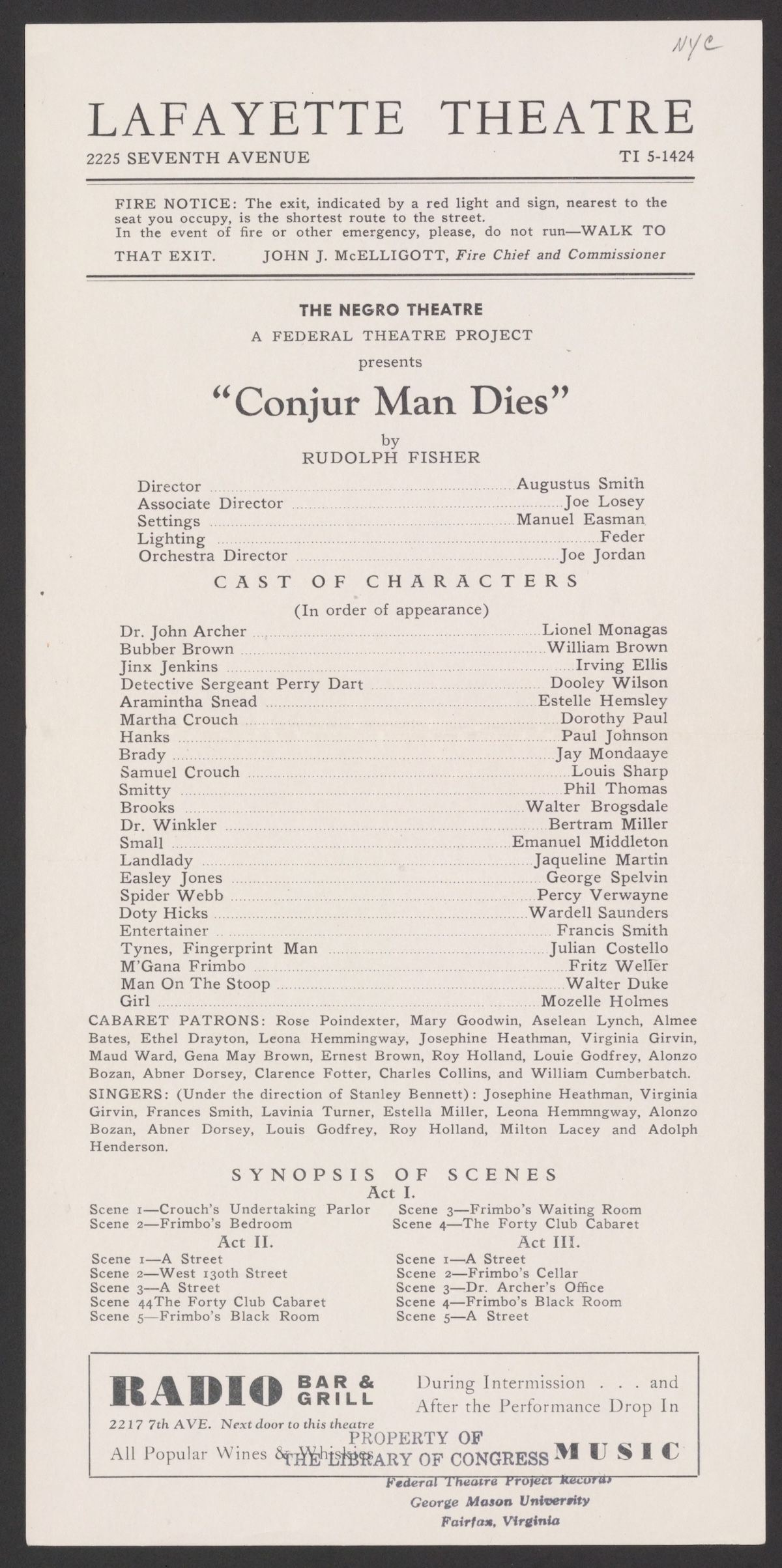
In 1932, Fisher published The Conjure-Man Dies: A Mystery Tale of Dark Harlem, the work for which he is most widely remembered today. The Library of Congress describes it as the first mystery novel by a Black writer to feature a Black detective and an all-Black cast of characters on its Crime Classics page. Britannica calls it a mystery and detective story set in Harlem, featuring an all-Black cast and blending African ritual, murder and hidden identities in its biography.
The premise is irresistible: N’Gana Frimbo, an African conjure-man, is found apparently dead in his consultation room. Police detective Perry Dart and physician Dr. John Archer investigate, aided and complicated by the comic energies of Bubber Brown and Jinx Jenkins. The Library of Congress notes that Fisher considered the book an “experiment in technique,” combining golden-age detective conventions with hard-boiled realism, police procedure, forensics, Harlem vernacular and a Holmes-and-Watson-style partnership in its description.
The book’s importance is not only that it came first. “First” can be a flattening category, useful for trivia but inadequate for art. The Conjure-Man Dies matters because Fisher made genre fiction do cultural work. He took a form associated with drawing rooms, manor houses and rational deduction and relocated it in Harlem, where science, folk belief, policing, migration and performance collide.
Dr. Archer, the physician, is Fisher’s clearest alter ego. Perry Dart, the detective, moves through Harlem with professional authority. Their partnership asserts Black competence in two fields — medicine and law enforcement — that American racism often withheld from Black citizens. At the same time, the novel refuses to become a simple celebration of rational modernity. Frimbo, the conjure-man, brings African diasporic mystery into the room. Fisher does not merely oppose superstition to science. He stages a contest over knowledge itself: who knows, who performs knowing, who profits from belief, and what modern Black people do with inherited spiritual vocabularies in an urban age.
The Library of Congress reissued The Conjure-Man Dies in 2022 as part of its Crime Classics series, a recovery that signals Fisher’s renewed importance to American crime fiction as listed by the Library. That republication places Fisher where he belongs: not on the margins of detective fiction, but inside its history.
Modern Black crime writers — from Chester Himes to Walter Mosley and beyond — would later make the Black detective a figure of social interpretation. Fisher anticipated that tradition. His detective story is not simply about solving a murder. It is about reading a city designed to be misread by outsiders.
The Historiography of a Disappearing Genius
Why did Fisher fade? The answer is partly obvious: he died young. But early death alone does not explain literary disappearance. Some artists become more mythic in death. Fisher’s problem was more complex. His work crossed categories too easily. He was a doctor in a literary movement, a short-story master in a canon built around novels and poems, a satirist in an era of racial uplift, a genre innovator before Black crime fiction had an established shelf.
His archive also suffered from the broader neglect that met much Harlem Renaissance writing after the 1930s. The Great Depression, changing literary tastes, the politics of respectability, the rise of social realism, the limited republication of Black texts and the institutional whiteness of American literary study all shaped who remained visible. Washington notes that after Fisher’s son Hugh died in 1964, much of Fisher’s work fell out of print, though later reissues helped bring him to new readers in The American Scholar.
The historiography has shifted in stages. Early accounts of the Harlem Renaissance tended to privilege a familiar cluster of figures and debates: Locke’s New Negro philosophy, Hughes’s vernacular poetics, Hurston’s folklore, Cullen’s lyricism, Larsen’s novels of passing and interiority, Du Bois’s cultural politics. Fisher appeared, when he appeared, as a talented secondary figure. Later scholars recovered him as a key short-story writer and satirist of Harlem social life. More recent attention has emphasized his importance to crime fiction, medical humanities and Black scientific history.
Brown’s archival profile quotes John McCluskey Jr., editor of The City of Refuge: The Collected Stories of Rudolph Fisher, arguing that Fisher delivered Harlem’s breadth and vitality so consistently that readers must turn to him “to get the flavor, the music and the poetry” of the 1920s Black capital as cited by Brown. That assessment remains one of the cleanest summaries of Fisher’s literary value.
Harriet Washington’s 2025 essay expands the frame further by insisting that Fisher’s significance lies not only in his art but in his embodiment of Black scientific and literary excellence. She places him beside figures such as Louis T. Wright, May Chinn and Henry Binga Dismond, reminding readers that the Harlem Renaissance was not only a movement of poets and painters but also a world of Black scientists, doctors and intellectuals fighting racist pseudoscience with expertise in The American Scholar.
That reframing is crucial. Fisher was not an exception who proves that one Black man could be brilliant in multiple fields. He was evidence of a suppressed intellectual ecology.
Death, Radiation and the Unfinished Future
Fisher’s death came on December 26, 1934, after a chronic abdominal illness and multiple operations. Britannica states that he died of a mysterious stomach ailment that some scholars suspect may have been caused by radiation exposure from his medical work in its biography. Washington gives a fuller account, noting diagnoses that included chronic gallbladder infection and liver abscess, and describing the care he received from his friend Louis T. Wright at Edgecombe Sanitarium in Harlem in The American Scholar.
His death at 37 is one of the great “what ifs” of Black literary history. What if Fisher had lived into the age of Richard Wright? What would he have made of the Depression’s transformation of Harlem? What would his detective fiction have become after Chester Himes? Would Dr. Archer and Perry Dart have developed into a long-running series? Would Fisher have written more about medicine, race and science? Would he have become a bridge between Renaissance wit and midcentury protest fiction?
We cannot know. But we can see the scale of the loss. Fisher had already mastered the short story, written two novels, helped invent a Black detective tradition, practiced medicine, contributed to scientific literature and participated in Harlem’s cultural debates. His career was not winding down. It was opening.
Washington records that Zora Neale Hurston sent Jane Fisher a telegram after his death: “The world has lost a genius. You have lost a husband and I have lost a friend” as quoted in The American Scholar. The sentence has the force of testimony. Hurston knew what had disappeared.
Why Rudolph Fisher Matters Now
To read Fisher today is to encounter a writer who understood Black urban life without needing to translate it for approval. He was cosmopolitan but not detached, satirical but not cynical, scientific but not bloodless. He saw Harlem’s beauty and its scams, its intellectual daring and its class anxieties, its music and its menace. He wrote from inside the room.
His importance also lies in the genres he disturbed. He pushed Harlem Renaissance fiction beyond pastoral folk memory and racial uplift drama into urban comedy, social satire and detective fiction. He made the Black physician a literary intelligence. He made Black Harlem a site of forensic complexity. He saw that modern Black life was not one story but many overlapping systems: migration, capitalism, medicine, policing, nightlife, religion, performance, housing, aspiration.
For KOLUMN readers, Fisher’s recovery is part of a larger cultural task. The archive of Black life is full of figures whose importance has been obscured not by lack of achievement but by the mechanics of neglect. Fisher belongs beside the authors, activists and artists whose work complicates the standard map of Black history. He reminds us that the Harlem Renaissance was not merely a flowering. It was an argument — over art, class, science, sexuality, respectability, Africa, America, commerce and the future of Black modernity.
His fiction still moves because Harlem still moves through the American imagination as symbol and neighborhood, as real estate and memory, as cultural capital and home. Fisher warned against the outsiders who consumed it without understanding it. He warned against insiders who narrowed it through class contempt. He honored its speech, jokes, danger, intelligence and improvisation.
Rudolph Fisher diagnosed Harlem with unusual precision. But he did not treat it as an illness. He treated it as life: complex, contradictory, pulsing, mortal, magnificent.
More great stories

Afro Sheen, Wall Street, and the Architecture of Black Possibility
July 6, 2026
No Comments
The Fire Inside the Fourth
July 5, 2026
No Comments