




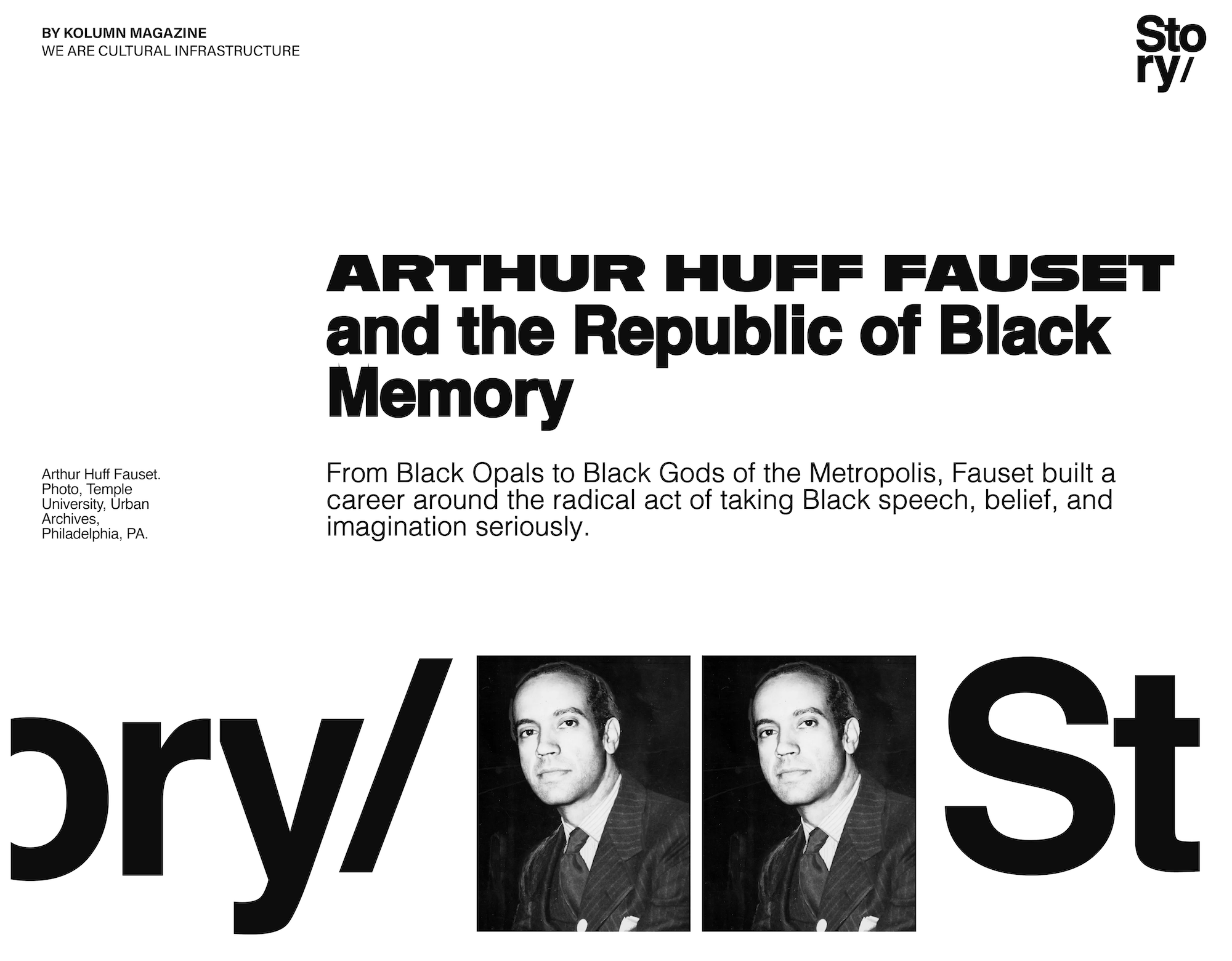
Arthur Huff Fauset treated Black life not as folklore trapped in the past, but as evidence of a people thinking, adapting, organizing, and surviving in real time.
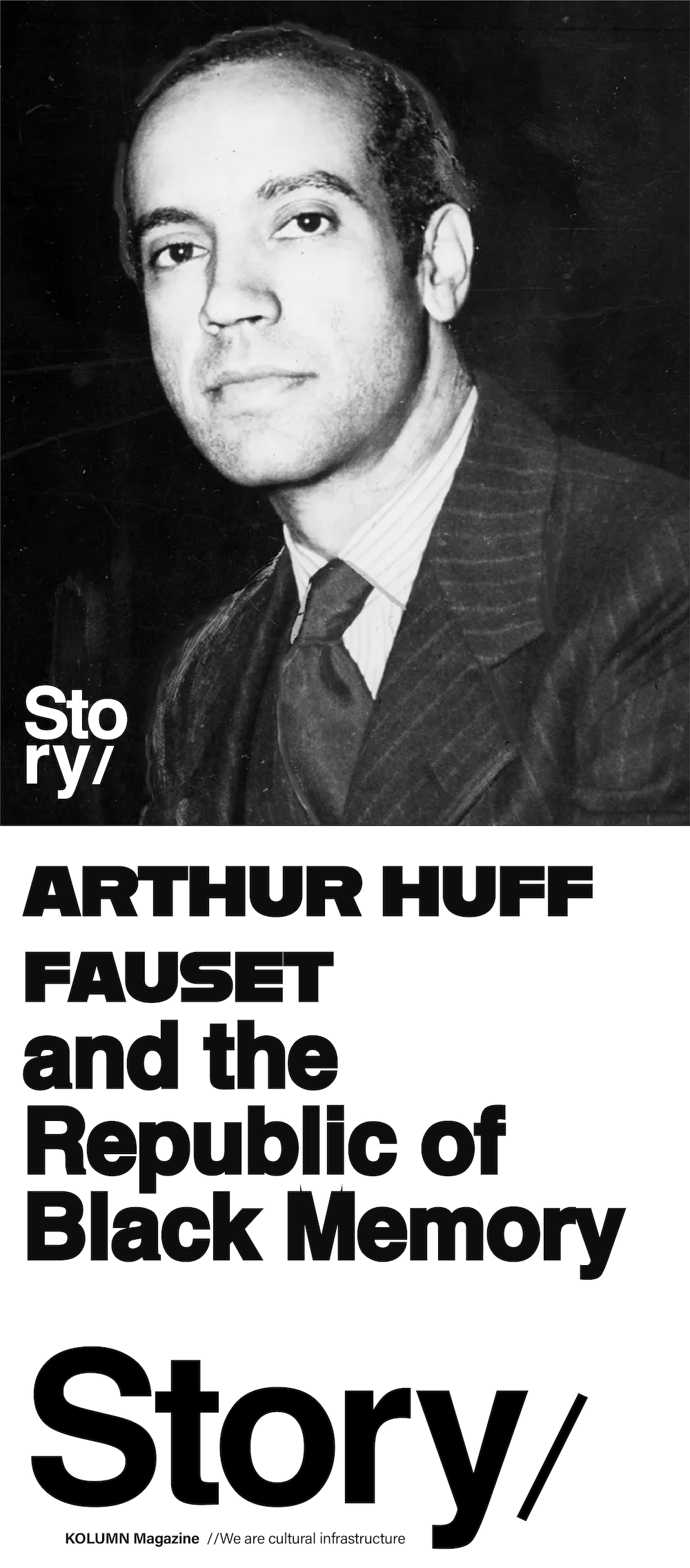
Arthur Huff Fauset treated Black life not as folklore trapped in the past, but as evidence of a people thinking, adapting, organizing, and surviving in real time.
By KOLUMN Magazine
Arthur Huff Fauset’s life belongs to a category of Black American brilliance that history often mishandles: the builder whose scaffolding remains, even when his name does not. He was a writer, educator, anthropologist, folklorist, labor organizer, civil-rights activist, editor, and interpreter of Black religious life. He moved through the Harlem Renaissance without being swallowed by Harlem, worked in Philadelphia without provincialism, and wrote across genres without the protection of a single label. Born in Flemington, New Jersey, on January 20, 1899, and raised largely in Philadelphia, Fauset came of age inside a family where literature, race, religion, and education were never abstractions; they were the architecture of daily life. The Academy of American Poets identifies him as an anthropologist, folklorist, educator, activist, and poet, but even that generous inventory feels incomplete because Fauset’s significance lies in how insistently he connected those vocations.
His older half-sister, Jessie Redmon Fauset, became one of the indispensable literary editors of the Harlem Renaissance, helping shape The Crisis and the careers of younger Black writers. Arthur’s own path was less canonized but no less revealing. Where Jessie helped curate the literary flowering of the 1920s, Arthur moved through the classrooms, unions, field sites, church sanctuaries, literary circles, and political organizations where Black modernity was being argued into form. He was not only producing texts; he was documenting systems of thought that America had trained itself to belittle.
A child of a complex interracial household, Fauset was born to Redmon Fauset, an African Methodist Episcopal minister, and Bella Huff, a white woman of Jewish descent who converted to Christianity. His father died when Arthur was young, leaving the family in conditions that made education both a refuge and a strategy. The University of Pennsylvania’s Arthur Huff Fauset Collection notes that Fauset earned an A.B. in 1921, an M.A. in anthropology in 1923, and a Ph.D. in anthropology in 1942. Those degrees matter not merely as credentials but as evidence of a Black intellectual navigating institutions that were never designed for him and extracting from them the tools to study his own people with rigor.
A Philadelphia Mind in a Harlem Renaissance World
To speak of Fauset only through Harlem is to flatten him. He belonged to the Harlem Renaissance, but he was also evidence that the Renaissance was never confined to Harlem. Philadelphia had its own Black institutions, reading circles, churches, schools, and literary insurgencies. It had Alain Locke, Nellie Rathbone Bright, Jessie Fauset, Black teachers, Black editors, Black civic organizers, and young writers who understood that culture was a public necessity. In that setting, Arthur Fauset became a bridge between the Renaissance’s aesthetic revolution and the less glamorous labor of building durable Black intellectual infrastructure.
The Penn finding aid records that in 1925 Fauset’s folklore work appeared in the Journal of American Folklore and that three examples of his work were selected for Alain Locke’s landmark anthology The New Negro. This detail is more than bibliographic housekeeping. The New Negro was one of the defining statements of Black modernism, and Fauset’s presence in it reminds us that folklore was not some quaint side chamber of the Renaissance. It was central to how Black writers and thinkers argued for a modern selfhood rooted in inherited speech, vernacular memory, and communal imagination.
Fauset’s gifts were recognized early. In 1926, he won awards from Opportunity magazine for the short story “Symphonesque” and the essay “Segregation,” and the Penn finding aid notes that “Symphonesque” was also selected for The Best Short Stories of the Year and won an O. Henry Memorial Award. The achievement placed him in the Renaissance’s competitive literary ecosystem, where Black writers were not only creating art but fighting for editorial attention, institutional legitimacy, and a reading public.
Still, Fauset’s deepest commitment was not celebrity. It was method. He was interested in how Black people narrated themselves when no white audience was present to approve or distort the story. That interest sent him to field sites across Philadelphia, the American South, Nova Scotia, and the Caribbean. Encyclopedia.com notes that in the 1920s he gathered folklore in Philadelphia, Alabama, Mississippi, Louisiana, and the Lesser Antilles. In an era when mainstream anthropology often treated Black people as specimens, Fauset approached Black communities as producers of knowledge.
The Folk as Archive
Folklore, in Fauset’s hands, was not nostalgia. It was record-keeping. Tales, riddles, songs, jokes, legends, and religious utterances contained social theory. They revealed how Black people interpreted power, danger, freedom, migration, and moral order. The folk tale was not an escape from history; it was one of history’s instruments.
Fauset’s radicalism began with a deceptively simple proposition: Black people were not raw material for someone else’s theory. They were theorists themselves.
His work in Nova Scotia is especially revealing. Fauset’s Folklore from Nova Scotia, published in 1931 by the American Folklore Society, emerged from field research among Black communities whose stories unsettled simple assumptions about African diasporic continuity. He observed difference as carefully as similarity, and that mattered. Rather than imposing a single theory of Black culture across geographies, he listened for local variation. That listening was itself an intellectual ethic.
At the time, Black cultural study was pulled between competing pressures. One pressure demanded that Black intellectuals prove Black respectability by distancing themselves from rural, vernacular, or “folk” expression. Another pressure exoticized Black folk culture as primitive raw material for white consumption. Fauset resisted both. His work assumed that Black folk expression was neither embarrassment nor ornament. It was knowledge.
That stance places him in conversation with Zora Neale Hurston, whose afterlife KOLUMN has already explored in pieces such as “Looking for Zora, Finding a Country”, where Hurston’s folklore method is treated as a refusal of reduction. Fauset and Hurston were not the same kind of writer, and Hurston’s literary genius has commanded a different scale of attention. But they shared a crucial instinct: the belief that Black vernacular life deserved to be documented from within, with texture intact.
Black Opals and the Literary Philadelphia That Refused the Margin
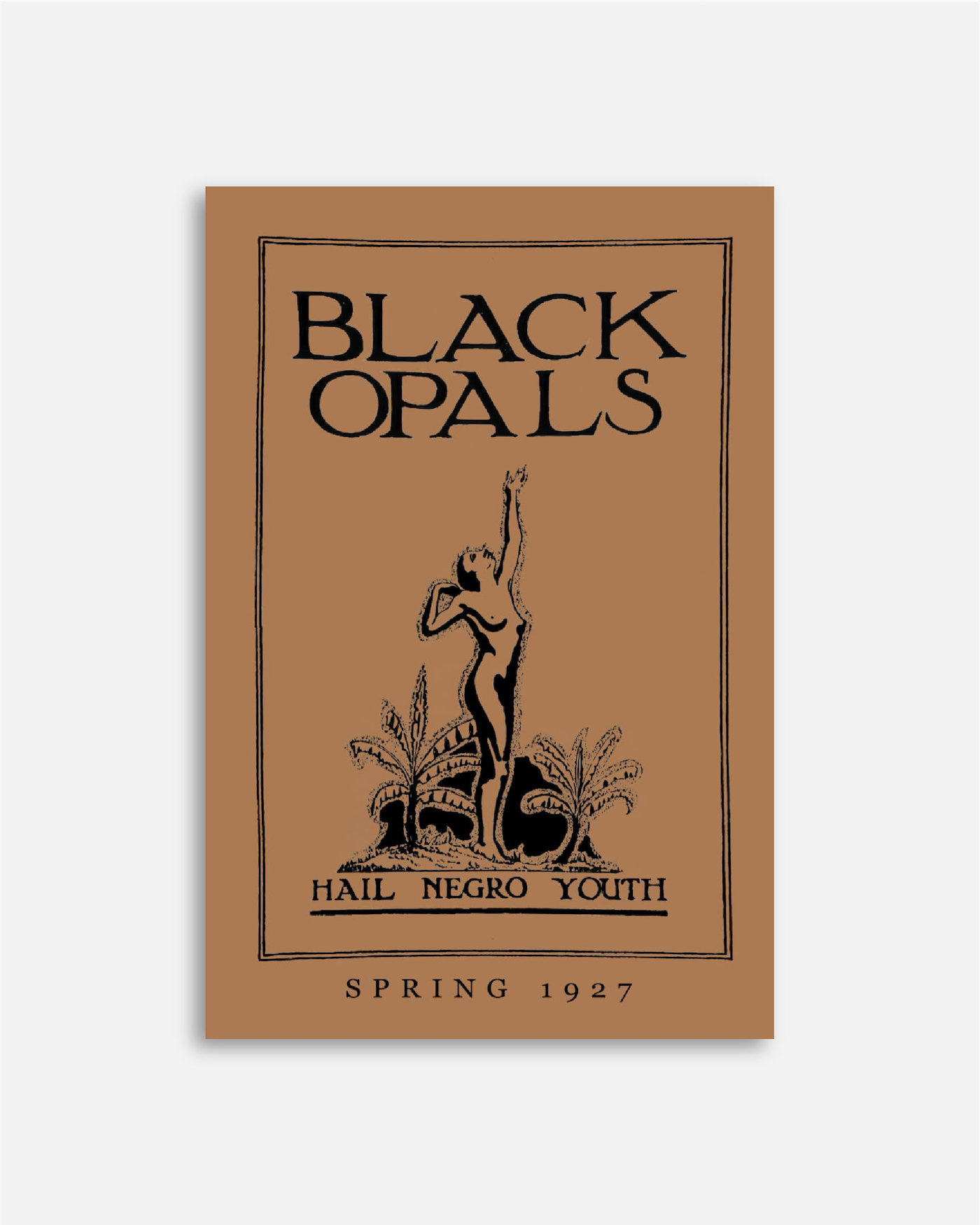
In 1927, Fauset helped launch Black Opals, a Philadelphia literary journal that deserves a much larger place in the story of Black modernism. The Penn finding aid describes Black Opals as the first Black-owned Philadelphia periodical devoted to literary work by Black and African Americans since McGirt’s Magazine. It appeared in spring 1927 and lasted until Christmas 1928—a brief run, but one with long implications.
The publication was co-founded and edited with Nellie Rathbone Bright, an educator and literary figure whose own recovery has helped scholars rethink the geography of the Harlem Renaissance. A Philadelphia Inquirer account of Black Opals notes that Fauset was a founding editor and that Jessie Redmon Fauset contributed to the journal. The same account places the magazine in a network that included Allan Randall Freelon, Mae Cowdery, Langston Hughes, Alain Locke, and other major or emerging Black figures.
The very title, Black Opals, suggests a philosophy of value: dark brilliance, layered color, beauty under pressure. The magazine arrived at a time when Black writers were pushing against the gatekeeping of white publishers and the New York-centered assumptions of literary prestige. Fauset’s participation reflected his larger commitment to Black-controlled platforms. A people who could not own the means of cultural publication would always be vulnerable to distortion.
KOLUMN’s recent profile “Arna Bontemps Kept Black Literature From Vanishing” argued that Bontemps’ work mattered not simply because he wrote within the Harlem Renaissance, but because he helped make Black literary memory durable. The same frame applies to Fauset. His labor around Black Opals was not a footnote to his “real” work as an anthropologist; it was part of the same project. He was building the institutions through which Black thought could circulate.
Writing History for Black Children
Fauset’s first book, For Freedom: A Biographical Story of the American Negro, was published in the late 1920s and later revised. The University of Pennsylvania’s Online Books Page lists a revised 1934 printing by Franklin Publishing and Supply Company, while HathiTrust records an earlier 1928 edition. Written for young readers, the book presented Black historical figures as actors in the American story rather than decorative exceptions.
This was educational work with political stakes. At a time when school curricula routinely erased or distorted Black achievement, Fauset wrote a usable history. He understood that children are not merely students of the past; they are subjects formed by the stories a nation permits them to inherit. To offer Black children a lineage of struggle, intellect, courage, and leadership was to intervene in the making of citizenship.
The Wolfsonian has noted that For Freedom was described in a 1927 New York Times review as a book presenting a “phase of American history that all young people ought to know about,” and that it included figures ranging from Crispus Attucks and Sojourner Truth to W.E.B. Du Bois and Alain Locke in its account of Black life and achievement. That range reveals Fauset’s sense of history as continuity: rebellion, witness, scholarship, activism, and cultural leadership all belonged to the same freedom tradition.
The educational purpose also linked him to his day job. Fauset worked in Philadelphia public schools for decades. The University of Pennsylvania collection overview notes that he worked in Philadelphia public schools into the 1940s and was active in civil-rights and labor organizations throughout his life. In other words, he was not writing about education from a distance. He knew the classroom as an arena where democracy either widened or narrowed.
Labor, Civil Rights, and the Politics of Public Schooling
Fauset’s activism complicates any attempt to confine him to the archive. He organized. He fought professional exclusion. He moved through labor politics. The Penn finding aid states that Fauset faced institutionalized racism in the Philadelphia school system, where promotion for Black professionals was virtually nonexistent, and that he helped found the reorganized Philadelphia branch of the American Federation of Teachers. He also served as one of its early vice presidents.
This labor history matters because it connects Fauset’s intellectual work to material struggle. He knew that Black knowledge workers were workers. He understood that the classroom was not only a moral space but a workplace structured by race, hierarchy, and power. His fight for fair treatment in education aligned with broader campaigns against discrimination in jobs, housing, and public life.
Fauset also became associated with the National Negro Congress, a major organization formed in the 1930s to address racial and economic injustice. That affiliation places him in a more radical democratic current than the genteel image of “folklorist” might suggest. He belonged to a generation of Black intellectuals who saw no contradiction between scholarship and agitation. Indeed, the scholarship sharpened the agitation because it revealed the depth of the social order being challenged.
His marriage to Crystal Dreda Bird Fauset adds another dimension to the political world he inhabited. Crystal Bird Fauset became the first Black woman elected to a state legislature in the United States, winning a seat in the Pennsylvania House of Representatives in 1938. Their marriage later ended, but the overlap in their public commitments suggests a household deeply embedded in debates over race, reform, and power.
The Anthropologist Who Entered the Storefront Church
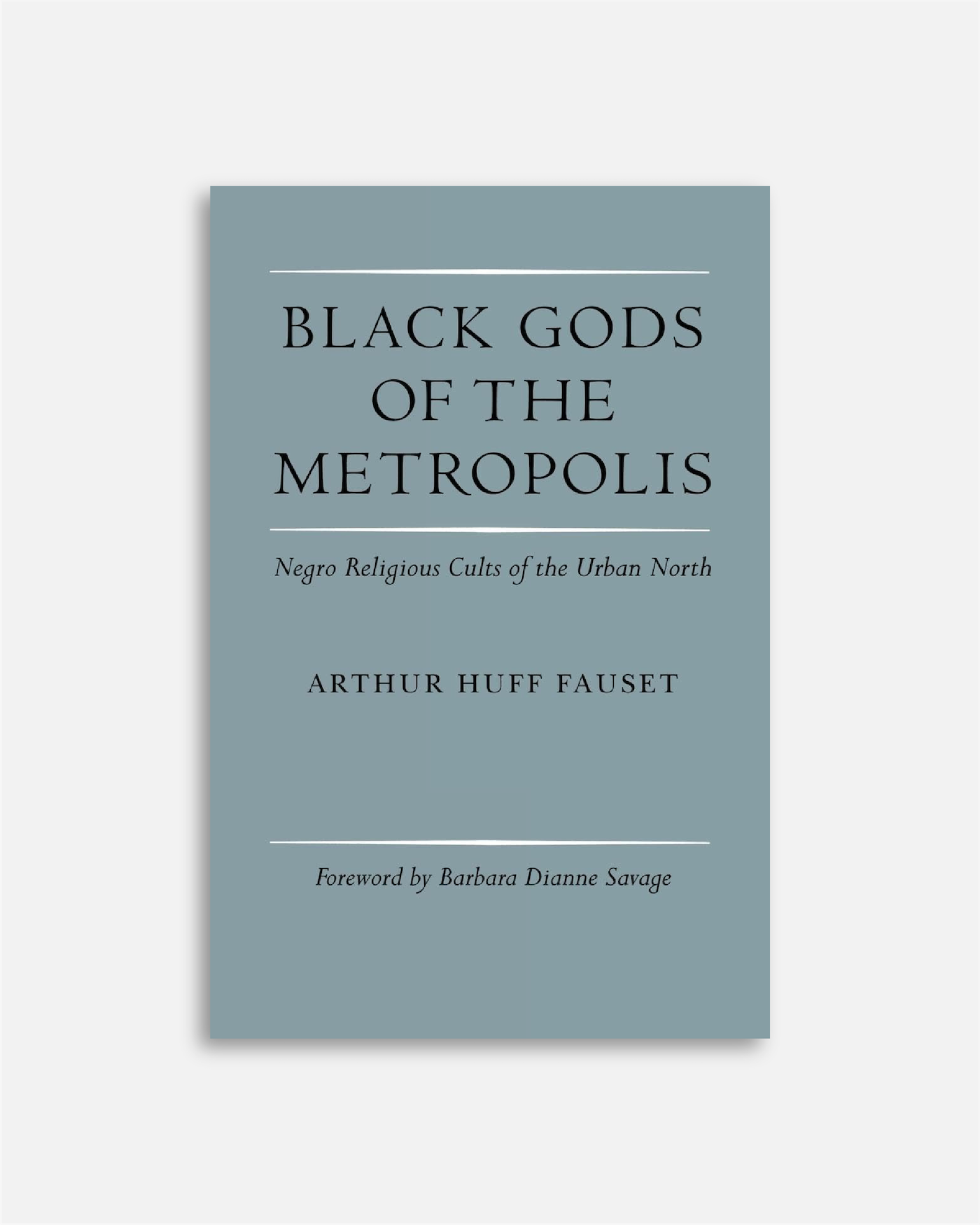
Fauset’s most influential scholarly work, Black Gods of the Metropolis: Negro Religious Cults of the Urban North, was published in 1944 by the University of Pennsylvania Press. The title reflects the language of its time, including the word “cults,” but the book’s substance was more serious and more respectful than the term may suggest to contemporary readers. Based on fieldwork among Black religious groups in Philadelphia, it examined movements often treated as marginal, strange, or embarrassing by mainstream observers.
The University of Pennsylvania Press describes Black Gods of the Metropolis as a study stemming from Fauset’s anthropological fieldwork among Black religious groups in Philadelphia in the early 1940s. The same press page notes that the book offered detailed primary accounts of early spiritual movements and their beliefs, including movements connected to the later significance of the Nation of Islam and other lesser-known Black religious communities.
The book’s importance lies partly in its subject matter and partly in its posture. Fauset did not treat Black religious experimentation as pathology. He understood it as social creativity. Storefront churches and new religious movements were spaces where Black migrants, workers, women, spiritual leaders, and urban communities experimented with authority, healing, politics, economics, and identity. Religion was not merely doctrine. It was institution-building.
Later scholars have recognized the scale of that intervention. Indiana University Press’s volume The New Black Gods: Arthur Huff Fauset and the Study of African American Religions, edited by Edward E. Curtis IV and Danielle Brune Sigler, argues that Fauset’s 1944 book “launched original methods and theories” for understanding African American religions as modern, cosmopolitan, and democratic. That description is crucial. Fauset was not merely cataloging eccentric groups. He was offering a theory of Black religious modernity.
The same scholarly collection makes clear that Fauset’s work continues to shape studies of Pentecostalism, Black Judaism, Black Islam, Father Divine’s Peace Mission Movement, and other religious expressions forged in the wake of the Great Migration. In that sense, Fauset anticipated later Black Studies, religious studies, urban studies, and diaspora studies frameworks. He saw Black religion as dynamic, adaptive, and institutionally inventive.
Historiography: Why Fauset Was Forgotten, Then Recovered
The historiography of Arthur Huff Fauset is a study in how Black intellectual labor can be hidden in plain sight. He published. He won awards. He earned a doctorate. He participated in the Renaissance. He produced a major work in African American religious studies. His papers were preserved. Yet he never entered the broad public imagination in the way Hurston, Hughes, Locke, or even Jessie Redmon Fauset eventually did.
Part of the explanation lies in genre. Fauset did too many things for a canon that prefers clean categories. He was not only a novelist, not only a poet, not only an anthropologist, not only an activist. He wrote children’s history, collected folklore, edited a literary journal, produced fiction, organized teachers, studied religion, and wrote biography. That range made him valuable to Black communities but difficult for later academic departments and literary canons to package.
Another part of the explanation lies in the politics of respectability and religion. Black Gods of the Metropolis studied religious groups that many Black elites and white scholars had reason to dismiss. Fauset’s subjects were not always the respectable institutional Black church, and they were not always legible within Protestant norms. The very communities that made his book pioneering also made it vulnerable to marginalization.
Then there is the problem of anthropology itself. Early 20th-century anthropology was entangled with racial hierarchy, colonial knowledge, and the classification of human difference. Black anthropologists working within that discipline had to fight both exclusion and the discipline’s inherited assumptions. Fauset’s work has therefore been recovered partly by scholars interested in how Black intellectuals used, revised, and challenged anthropological tools.
Barbara Dianne Savage’s foreword to later editions of Black Gods of the Metropolis is important here. Penn Press notes that Savage discusses the relationship between Black intellectuals and Black religion, especially the relationship between Black social scientists and Black religious practices during Fauset’s time. That framing helps contemporary readers understand both the power and tension of Fauset’s position. He was an insider to Black struggle, but also a trained observer. He respected the communities he studied, but he still wrote within the academic vocabulary of his period.
The 2009 scholarly collection The New Black Gods marked a major act of recovery. It did not simply praise Fauset; it used him as a starting point to rethink the field. The book’s table of contents includes essays on Pentecostal church mothers, Father Divine, Prophet Cherry’s Church of God, the Moorish Science Temple, Black Orientalism, African American religious historiography, and Fauset’s relationship to the Herskovits-Frazier debate. That breadth shows how Fauset’s work opened questions that scholars are still answering.
Expert Voices and the Reappraisal of Fauset
The expert consensus that has emerged around Fauset is not hagiographic. It is more interesting than that. Scholars value him because he complicates inherited assumptions. The editors and contributors of The New Black Gods position him as a figure whose work breaks down false divides between “mainstream” and “marginal” religion, while the press description emphasizes that he understood African American religions as modern and democratic. This is an expert intervention into the old tendency to treat nontraditional Black religious movements as fringe phenomena rather than as serious responses to modern urban life.
Lee D. Baker, whose work on anthropology and race has been central to rethinking the discipline’s history, is quoted by Penn Press describing Black Gods of the Metropolis as “a foundational text” across religion, urban studies, Black studies, and anthropology. The force of that assessment lies in its interdisciplinarity. Fauset matters because his work refuses the boundaries later scholars often impose.
Barbara Dianne Savage’s role in reframing the book is also significant. A historian of African American religion, politics, and public life, Savage helps readers see Fauset’s work not as a dated curiosity but as a document of Black social science grappling with Black religious creativity. Penn Press’s description of her foreword emphasizes the “complexities” of the relationship between Black intellectuals and Black religion. That word—complexities—is doing necessary work. Fauset’s study was sympathetic, but not simple. It belonged to a moment when Black scholars were negotiating respectability, skepticism, racial uplift, secular training, and religious vitality all at once.
The Family Shadow and the Fauset Name
It is impossible to write about Arthur Huff Fauset without mentioning Jessie Redmon Fauset, but it is also necessary not to reduce him to her orbit. Jessie’s editorial work at The Crisis helped define the Harlem Renaissance, and her novels have been recovered by scholars attentive to Black women’s literary history. Arthur’s career intersected with hers but followed a different line. Where Jessie labored at the center of literary gatekeeping, Arthur moved through the less stable terrain of folklore, anthropology, public education, and religious ethnography.
The sibling relationship is useful because it reveals the density of Black intellectual networks. The Fauset family was not an isolated story of individual achievement. It was part of a larger world of Black teachers, editors, scholars, clergy, activists, and artists who built institutions under hostile conditions. Alain Locke’s encouragement, Jessie’s editorial prominence, Arthur’s fieldwork, Bright’s co-editing, and the Philadelphia school community all formed a web of Black cultural production.
That web matters for KOLUMN because it challenges the way Black genius is often narrated as solitary. The more accurate story is collective. The Renaissance was not only a parade of famous names. It was magazines, classrooms, churches, prizes, anthologies, teachers’ unions, small presses, correspondence, manuscripts, and arguments. Fauset’s life allows us to see the machinery.
The Later Works and the Long Arc of Freedom
Fauset continued writing beyond his best-known early and mid-career work. His later publications included Sojourner Truth: God’s Faithful Pilgrim and, with Nellie Rathbone Bright, America: Red, White, Black, Yellow. These books extended his investment in making history available to younger readers and general audiences. The titles alone suggest a writer still committed to the question that animated For Freedom: how should a multiracial democracy tell its own story?
Sojourner Truth was an apt subject for him. She embodied oral power, religious conviction, political witness, and the transformation of lived experience into public speech. Fauset had spent his career listening to the spoken forms through which Black people made meaning. Writing about Truth allowed him to connect biography, faith, abolition, women’s rights, and Black memory.
His collaboration with Bright late in life also closed a circle. The co-editor of Black Opals returned as a co-author in a book for young people. That continuity suggests that for Fauset, education was never a phase. It was a lifelong discipline.
Why Arthur Huff Fauset Matters Now
Fauset matters in 2026 because the questions he confronted have not disappeared. Who gets to define Black culture? Which Black institutions are treated as legitimate? What happens when Black religious movements fall outside elite comfort zones? How should schools teach Black history? What kinds of archives matter? Who listens when Black communities speak in idioms the academy does not immediately respect?
In a moment when Black history remains politically contested, Fauset’s work offers an ethic of attention. He did not wait for permission to treat Black life as worthy of study. He did not assume that Black children should inherit a curriculum of absence. He did not concede that Black religious innovation was merely eccentric. He did not accept that Harlem was the only map of Black modernism. He saw Philadelphia. He saw the South. He saw Nova Scotia. He saw the Caribbean. He saw churches, classrooms, journals, unions, and children’s books as parts of the same freedom struggle.
That breadth is his significance. Arthur Huff Fauset was not a minor figure because he stood outside the most familiar spotlight. He was a major figure precisely because he worked in the spaces where culture becomes durable before fame arrives to rename it.
The final irony is that Fauset, the collector of voices, still requires recovery of his own. His papers sit at the University of Pennsylvania. His books remain available to scholars and determined readers. His name appears in the footnotes of Harlem Renaissance studies, anthropology, folklore, African American religion, and Philadelphia literary history. But he deserves more than footnotes. He deserves to be read as one of the early architects of what we now call Black Studies: interdisciplinary, community-rooted, historically alert, and ethically opposed to the erasure of Black interior life.
Arthur Huff Fauset listened where America refused to look. He understood that a people’s jokes, prayers, children’s lessons, political meetings, literary journals, and folk tales were not fragments. They were a civilization speaking. And he spent his life making sure someone wrote it down.
More great stories
Afro Sheen, Wall Street, and the Architecture of Black Possibility
July 6, 2026
No Comments
The Fire Inside the Fourth
July 5, 2026
No Comments