



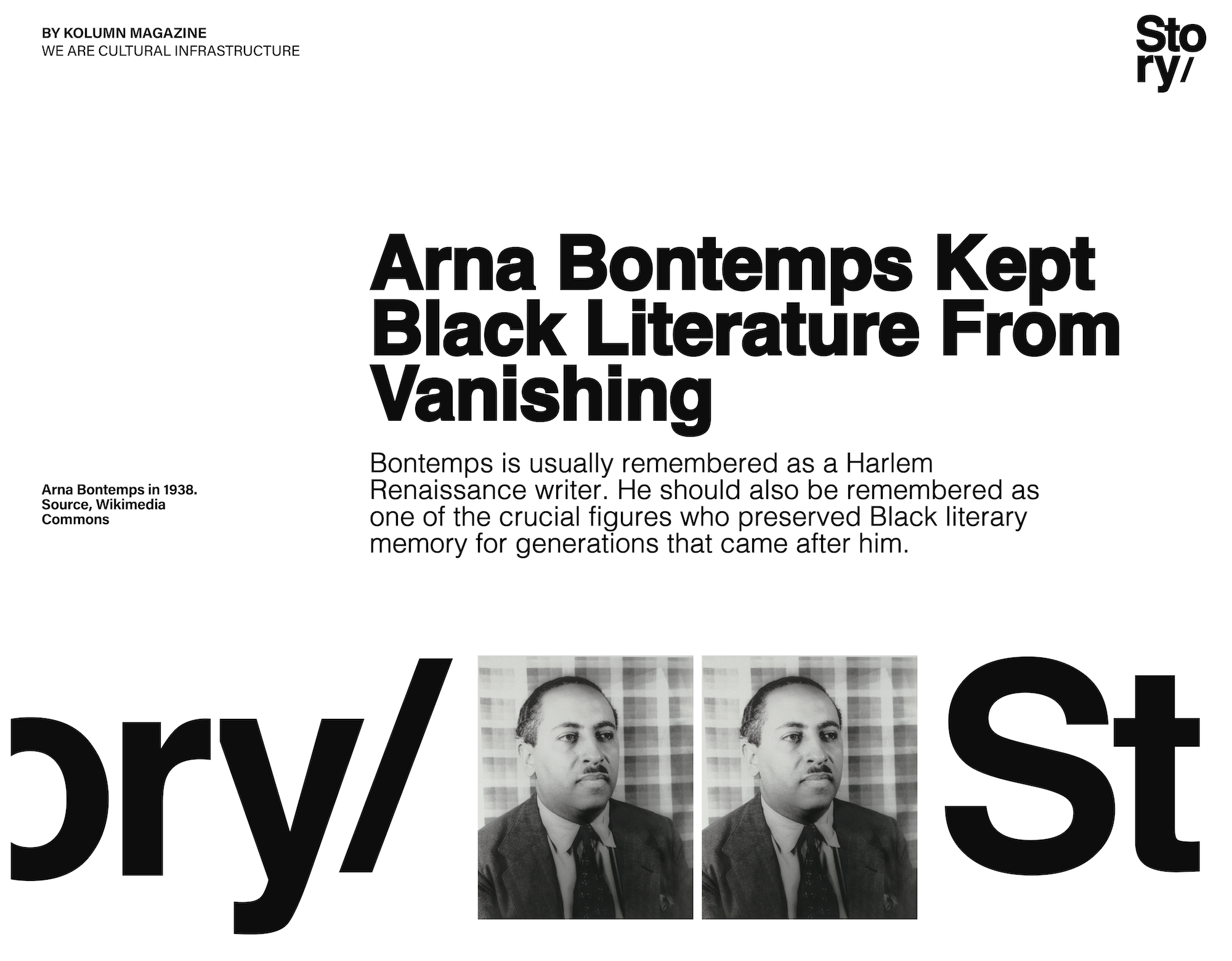
Arna Bontemps was not simply a Harlem Renaissance writer. He was one of the builders of Black literary permanence.
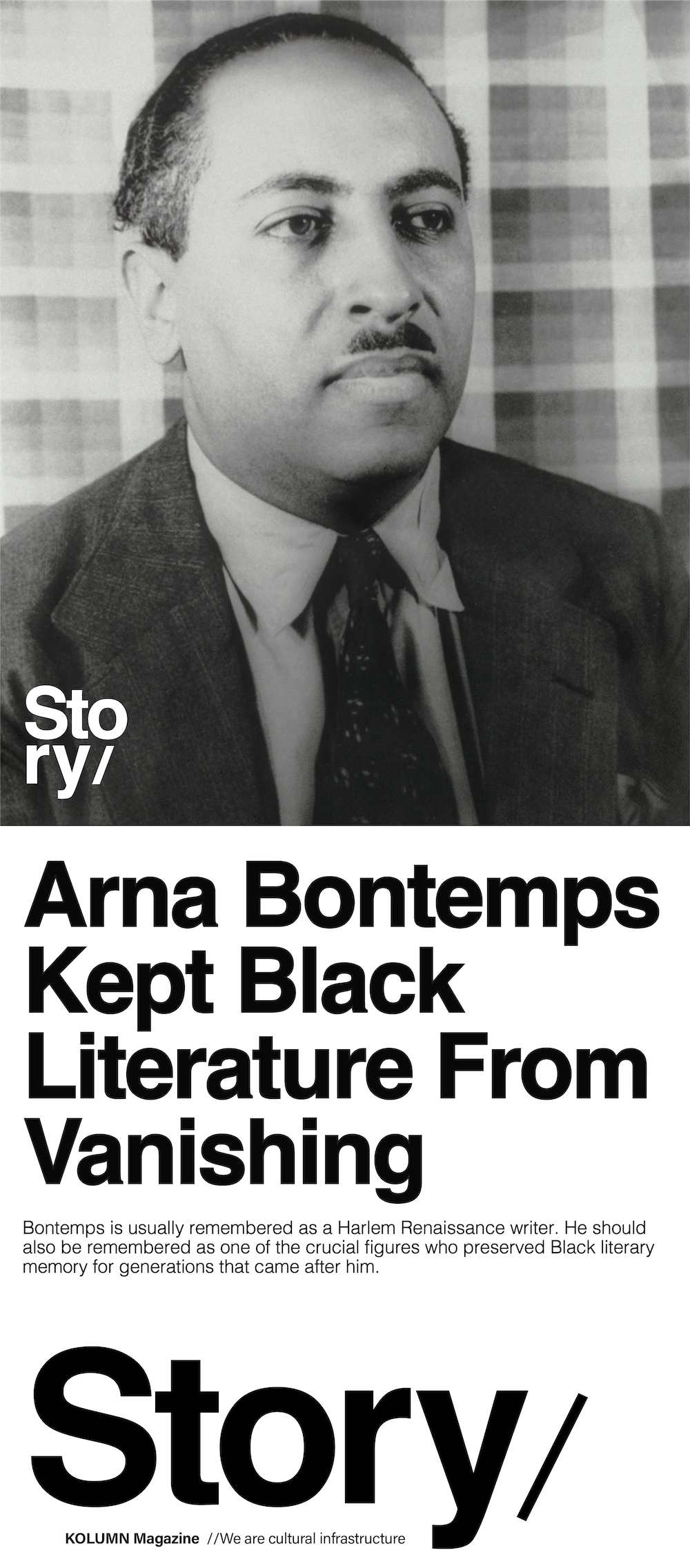
Arna Bontemps was not simply a Harlem Renaissance writer. He was one of the builders of Black literary permanence.
By KOLUMN Magazine
Arna Bontemps is often introduced as a Harlem Renaissance figure, which is true in the same way that calling a cathedral a building is true. It gives you the category and misses the scale. Yes, Bontemps belonged to that extraordinary flowering of Black art and letters in the 1920s and 1930s. Yes, he wrote poems, novels, children’s books, histories, and anthologies. Yes, he moved in the company of Langston Hughes, Countee Cullen, Zora Neale Hurston, Claude McKay, and James Weldon Johnson. But to leave him there is to misread what his life finally amounted to. Arna Bontemps was not only a writer in a movement. He was one of the people who helped make Black literary memory durable.
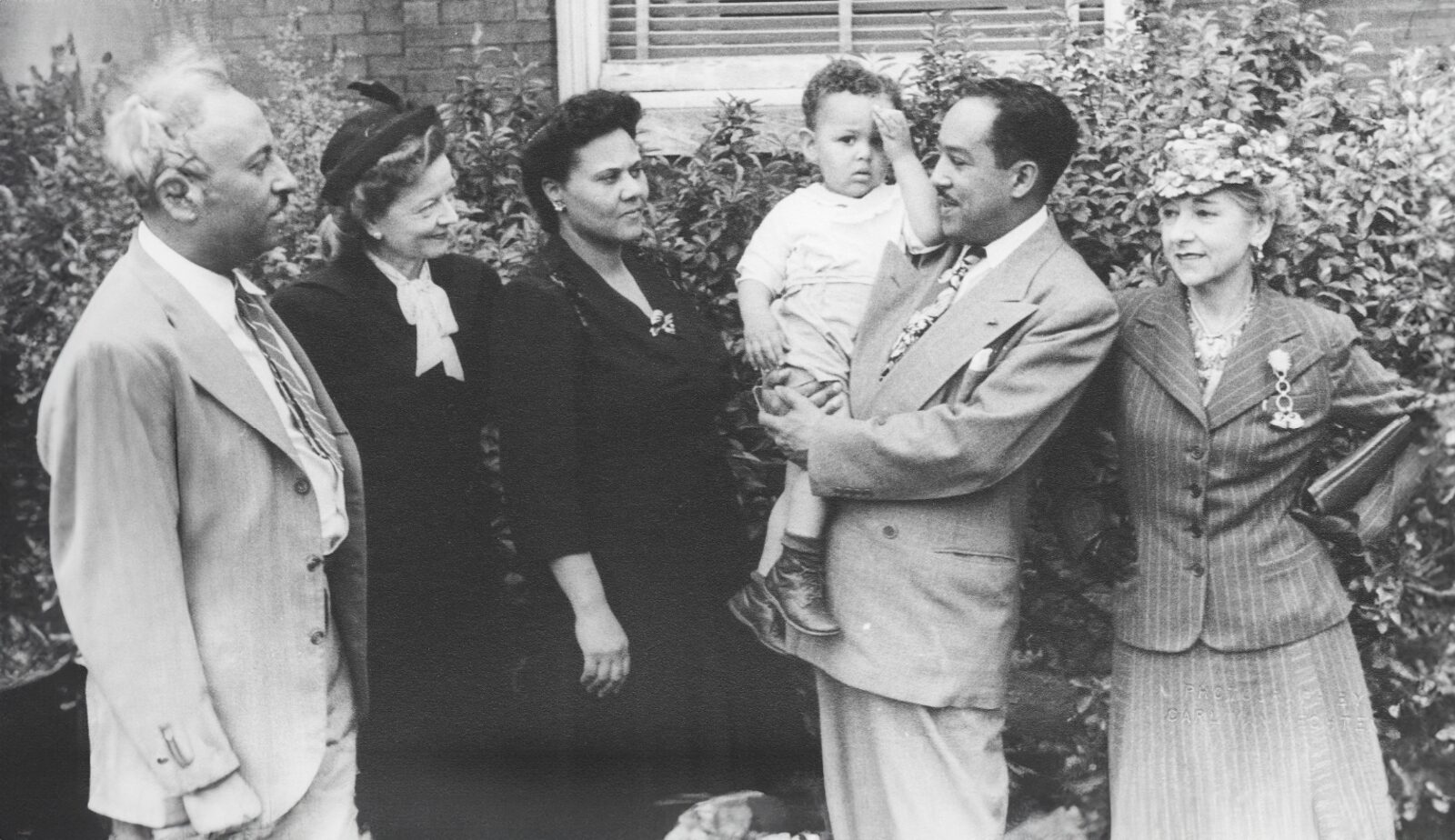
Born on October 13, 1902, in Alexandria, Louisiana, Bontemps would go on to become one of the most versatile literary workers of the twentieth century, a writer whose life stretched across poetry, fiction, children’s literature, history, editing, and librarianship, as noted by both Britannica and the Poetry Foundation. He is remembered for novels such as God Sends Sunday, Black Thunder, and Drums at Dusk; for children’s books such as Popo and Fifina; for landmark editorial projects like The Poetry of the Negro; and for the years he spent at Fisk University helping turn Black literary preservation into institutional practice, as outlined by the Academy of American Poets and the Syracuse University finding aid to his papers.
That range is precisely why Bontemps still feels under-read relative to his significance. American literary culture has a habit of over-celebrating the flamboyant and under-crediting the infrastructural. It remembers the dazzling performance and forgets the careful keeper of records. But Black culture, perhaps more than any other cultural tradition in the United States, has survived because somebody did the patient work: collecting, preserving, editing, cataloging, reissuing, teaching, and carrying memory forward when the nation had little interest in doing so. Bontemps was one of those somebodies.
A Southern birth, a Western upbringing, a Black inheritance
Bontemps’s early life already contained the tensions that would define his writing. He was born into a Creole family in Louisiana, and while still a small child he was taken west to California after racial danger made remaining in the South untenable. The Academy of American Poets notes that his father had been threatened by white men, one reason the family relocated to Los Angeles. That move placed Bontemps inside one of the great Black stories of the early twentieth century: migration not only as geography, but as psychic reordering.
If the South remained a wound and a source, California offered another education. Bontemps studied in Seventh-day Adventist schools and later attended Pacific Union College in Angwin, California, where he graduated in 1923, according to Britannica and an Adventist historical profile. He reportedly shifted from a pre-med track to English, a decision that now reads less like a pivot than a surrender to vocation. The discipline of religious schooling, the dislocation of migration, and the persistence of Black folk memory all fed into the literary personality he would develop.
That background matters because it complicates simplistic narratives about Harlem Renaissance writers being born into Harlem or spiritually made there. Bontemps arrived in New York from elsewhere, carrying the South in memory and the West in experience. BlackPast and BlackPast’s overview of the Harlem Renaissance in the American West both help place him in a broader geography of Black cultural formation. He was not provincial when he came east. He was already formed by migration, religion, regional complexity, and the developing sense that Black life in America required multiple literary languages.
His early success came quickly. He began publishing poetry in leading Black journals such as The Crisis and Opportunity, and he won literary prizes from both magazines in the 1920s, according to the Poetry Foundation, the Academy of American Poets, and the Adventist Encyclopedia entry on Bontemps. That recognition placed him firmly inside the New Negro moment. But even in those early years, what distinguished him was not only talent. It was range. He did not seem interested in being one thing.
Harlem made him visible, but it did not contain him
When Bontemps moved to New York in 1924, Harlem was becoming the symbolic capital of Black modernism. The neighborhood was alive with magazines, parties, editorial offices, arguments over art and politics, and the social electricity of a generation trying to imagine Black life beyond caricature and respectability scripts. Britannica’s account of his life and its essay on God Sends Sunday as “the last book of the Harlem Renaissance” both place him directly inside that scene.
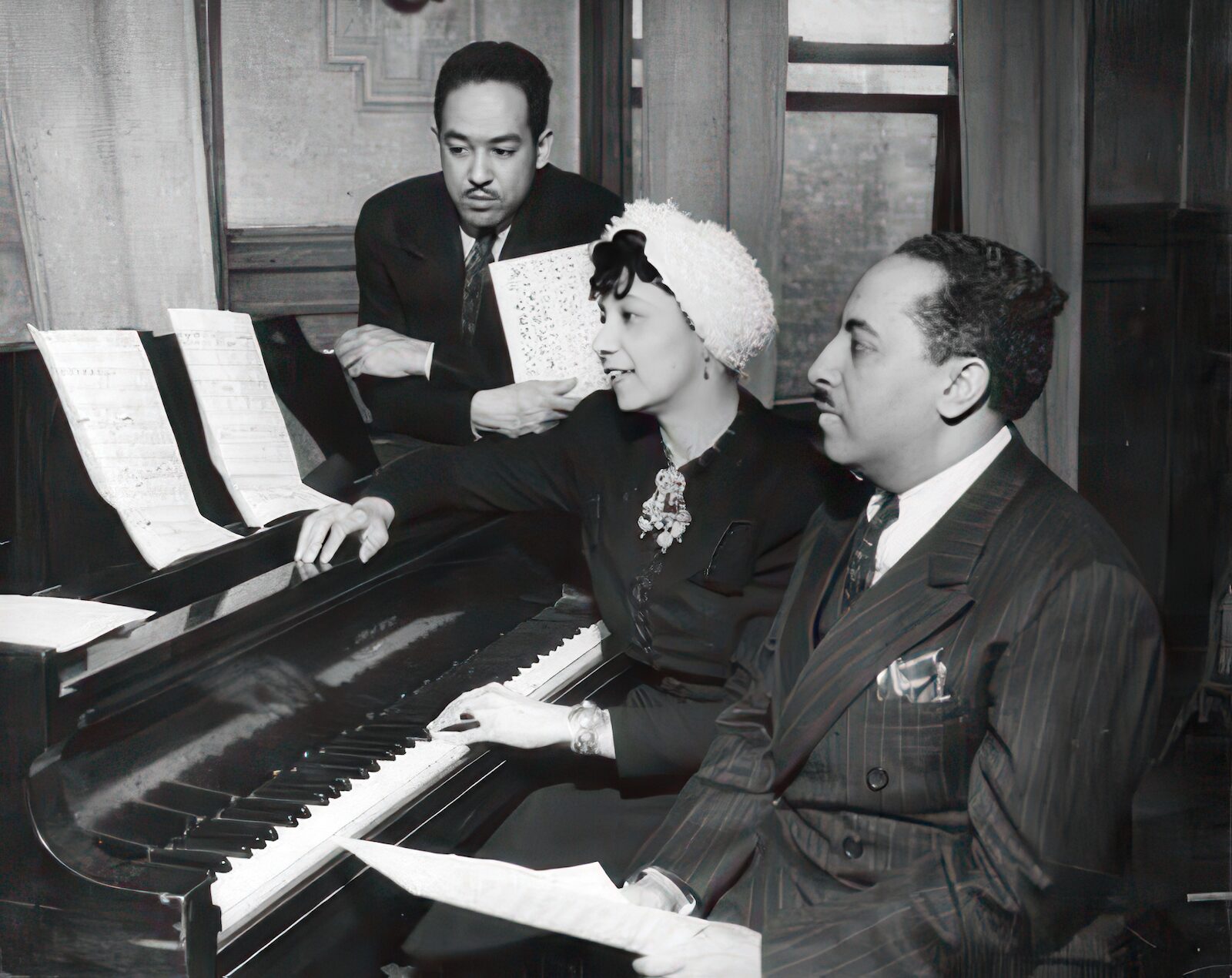
He taught at Harlem Academy while publishing poems and building relationships with fellow writers. The Adventist Encyclopedia notes his friendships with Hughes, Hurston, McKay, and Johnson, and emphasizes his especially deep bond with Langston Hughes, with whom he would maintain a correspondence running to more than 2,000 letters. That number matters not just as trivia, but as evidence of intimacy, collaboration, and shared labor across decades. Bontemps was not orbiting the movement. He was part of its internal machinery.
His first novel, God Sends Sunday, appeared in 1931. Britannica describes it as a novel about a Black jockey whose gift with horses contrasts with his difficulty managing human relationships. The book would later become the basis for the musical St. Louis Woman. But what matters most in retrospect is that Bontemps did not settle into the role of poet-who-also-publishes. He was already pushing himself toward larger narrative structures.
Harlem gave him access to a network and a stage. It also sharpened his sense that Black writing had to do more than ornament modernity. It had to narrate history, document struggle, and widen the emotional and political field of Black literature. Bontemps’s career after Harlem makes clear that he saw the renaissance not as an end in itself, but as a beginning.
The novelist of revolt and historical depth
If Bontemps’s early poetry established his place in Harlem’s literary world, his historical fiction established his seriousness on another level entirely. His 1936 novel Black Thunder, centered on the planned 1800 slave revolt led by Gabriel Prosser in Virginia, remains one of the defining works of Black historical fiction. Britannica’s entry on the novel describes it as a historical novel notable for its portrayal of slave community and dialect, while BlackPast identifies Bontemps as a pioneering African American historical novelist.
What made Black Thunder so important was not just subject matter. It was perspective. American historical memory has long been comfortable remembering Black suffering and far less comfortable remembering Black insurgency. Bontemps refused that comfort. He wrote enslaved people not as background victims to the nation’s drama but as thinkers, planners, conspirators, dreamers, and political actors in their own right. That move was artistic, but it was also historiographic. It insisted that Black resistance was central to the American story, not marginal to it.
That the novel did not receive full recognition on first publication says as much about the country as it does about the book. Britannica notes that Black Thunder was largely ignored when first published and received greater critical attention after a 1968 reissue. That delayed recognition now feels familiar. Black writers often produce the necessary work before the critical establishment develops the language or humility to receive it.
Bontemps followed with Drums at Dusk in 1939, a novel set around the Haitian Revolution, again using fiction to widen the historical imagination of Black readers and American literature more broadly, as Britannica notes. Haiti mattered symbolically and politically in Black thought, and Bontemps’s decision to take that history seriously on the novelistic level suggests a writer thinking beyond U.S. borders. He was helping map Black modernity through revolt, diaspora, and global memory.
This is one of the reasons Bontemps deserves more attention now. He understood that Black history could not be treated as a string of firsts and humiliations. It had to be narrated as strategy, rebellion, continuity, and intellectual life. He wrote the past not as museum atmosphere but as a living argument.
Writing for children was part of the mission, not a detour
Too many literary histories still treat children’s literature as secondary labor, as though writing for the young were somehow outside the central project of serious authorship. Bontemps’s career makes nonsense of that hierarchy. He wrote for children because he understood that cultural survival depends on inheritance, and inheritance depends on what the young are given to read.
One of the best examples is Popo and Fifina: Children of Haiti, written with Langston Hughes and published in 1932. The New York Public Library describes the book as an “impressionistic novel” about a brother and sister in Haiti and notes that it exemplifies the collaborative and varied creative output of the Harlem Renaissance. That description captures something essential. Bontemps and Hughes were not merely writing downward for a juvenile audience. They were expanding the imaginative geography available to Black children and other readers, centering Black Caribbean life in a literary world that usually centered whiteness.
Bontemps went on to produce children’s books, biographies, and histories that treated Black life as foundational subject matter. His Story of the Negro became especially important. BlackPast notes that the book earned major acclaim, and the Jane Addams Children’s Book Award history records Story of the Negro as a 1956 winner. The book also became the first African American-authored title to receive a Newbery Honor, a fact widely noted in educational and library histories and reflected in discussions of the book’s legacy by institutions such as the Smithsonian catalog entry for the work.
That achievement was bigger than prize recognition. Bontemps was making a sweeping Black history available to young readers in a country determined to marginalize, sanitize, or omit that history from formal education. Story of the Negro was not simply informative. It was corrective. It treated Black history as a civilizational narrative worthy of coherence and breadth.
The same spirit guided his anthology work. The Library of Congress’s archive of recorded poetry and literature notes that in a 1963 reading Bontemps read from Golden Slippers, The Book of American Negro Poetry, and The Poetry of the Negro 1746–1949. Those titles reveal the arc of his ambition. He was writing, collecting, and presenting Black literature across generations and age groups. He understood literature as inheritance, not merely production.
Fisk University and the transformation from writer to keeper
In 1943, Bontemps earned a master’s degree in library science from the University of Chicago and was appointed librarian at Fisk University, according to the Academy of American Poets. That sentence, in most short biographies, arrives like a career note. It should be read as something larger. Fisk was not merely a job. It was where Bontemps turned preservation into vocation.
He served at Fisk for roughly two decades, with Syracuse University’s guide to his papers describing his 21-year career there and emphasizing that the archive documents him not only as writer but as educator, historian, and chronicler of African American culture. Fisk itself also preserves records connected to his papers and work, underscoring his role in the university’s intellectual life. At Fisk, Bontemps helped develop collections of African American literature and culture at a time when mainstream institutions still treated Black letters as peripheral, fragile, or expendable.
That work cannot be reduced to shelving books. Building Black archives in mid-century America meant correspondence, acquisition, discernment, advocacy, and faith in the future. It meant understanding that a manuscript no major university wanted in one decade might become indispensable in the next. It meant seeing that letters, drafts, magazines, scrapbooks, and ephemera were not incidental remains but evidence of a civilization speaking in print.
Bontemps grasped that with unusual clarity. The Syracuse papers include correspondence, writings, and memorabilia that illuminate the scope of his literary and archival life. The Tennessee State University digital note on Bontemps also reflects his continuing significance to Tennessee’s Black scholarly landscape. What emerges from these institutional traces is a writer who understood the archive not as a dead storehouse, but as a living safeguard against erasure.
This is why Bontemps needs to be placed not only with artists but with builders of cultural infrastructure. To preserve Black literary history in an anti-Black nation is not neutral labor. It is political labor. It is civilizational labor. It is, in the most practical sense, freedom work.
The anthologist, the collaborator, the quiet strategist
Bontemps’s editorial and collaborative work further reveals the depth of his vision. He helped assemble anthologies that gave Black poetry and folklore wider circulation, including The Poetry of the Negro and The Book of Negro Folklore, both of which are central to how later generations encountered Black literary tradition, as summarized by Britannica and the Poetry Foundation.
Anthologies are sometimes treated as lesser achievements than original poems or novels. In Black literary history, that is a serious misunderstanding. An anthology can function as a canon, a classroom, a declaration of continuity, and a portable archive. Bontemps knew that. He had lived long enough inside the vulnerabilities of Black publication to understand how easily work could scatter or disappear. To anthologize was to gather the record before the record was lost.
His long collaboration with Langston Hughes belongs here too. The Adventist Encyclopedia notes the enormous scale of their correspondence, and the existence of books they created together demonstrates that their friendship was not only personal but productive. Bontemps’s temperament seems to have been unusually suited to collaboration. He was not driven by the myth of solitary literary genius alone. He was willing to build with others.
That quality may be part of why he is still insufficiently famous. He does not fit the easy American script of the singular genius burning across the page. He looks, instead, like something perhaps more valuable: a strategic literary citizen. He wrote. He edited. He preserved. He taught. He built collections. He made books for adults and children. He helped convert a moment into a tradition.
Why Bontemps still matters now
Arna Bontemps died in Nashville on June 4, 1973, according to Britannica. But the life that ended there continues to shape how Black literature is read, taught, and remembered. His papers survive in places like Syracuse University. His work continues to circulate through libraries, classrooms, and reprints. His role in Black literary preservation continues to matter precisely because the conditions that made such preservation necessary have not disappeared.
We are still living in a nation where Black history is contested terrain, where curricula are policed, where archives remain unevenly funded, where some stories are endlessly reproduced while others slip toward obscurity. In that environment, Bontemps appears less like a charming historical figure and more like a model. He understood that representation without preservation is unstable. He understood that publication without institutional memory is vulnerable. He understood that Black literature needed not only brilliance but custody.
That is what makes him feel especially resonant for KOLUMN readers. KOLUMN has already published deeply attentive work on Black literary and cultural figures such as Lucille Clifton, Alice Dunbar-Nelson, Joseph Seamon Cotter Sr., and Paul Laurence Dunbar. Bontemps belongs in that editorial lineage. He is another example of a Black literary life that did not merely produce text, but helped construct the conditions under which Black text could survive.
And maybe that is the cleanest way to say what Arna Bontemps means. He was a Harlem Renaissance writer, yes. He was also a historical novelist who treated Black revolt as central drama. He was a children’s author who believed Black history belonged to the young. He was an anthologist who gathered scattered voices into durable chorus. He was a librarian who understood that a culture disappears not only when it is attacked, but when it is left uncared for.
Arna Bontemps did not only write Black literature. He helped keep Black literature from being lost to the country that so often tried not to hear it. That is not a side note to his legacy. It is the legacy.
More great stories

Afro Sheen, Wall Street, and the Architecture of Black Possibility
July 6, 2026
No Comments
The Fire Inside the Fourth
July 5, 2026
No Comments