





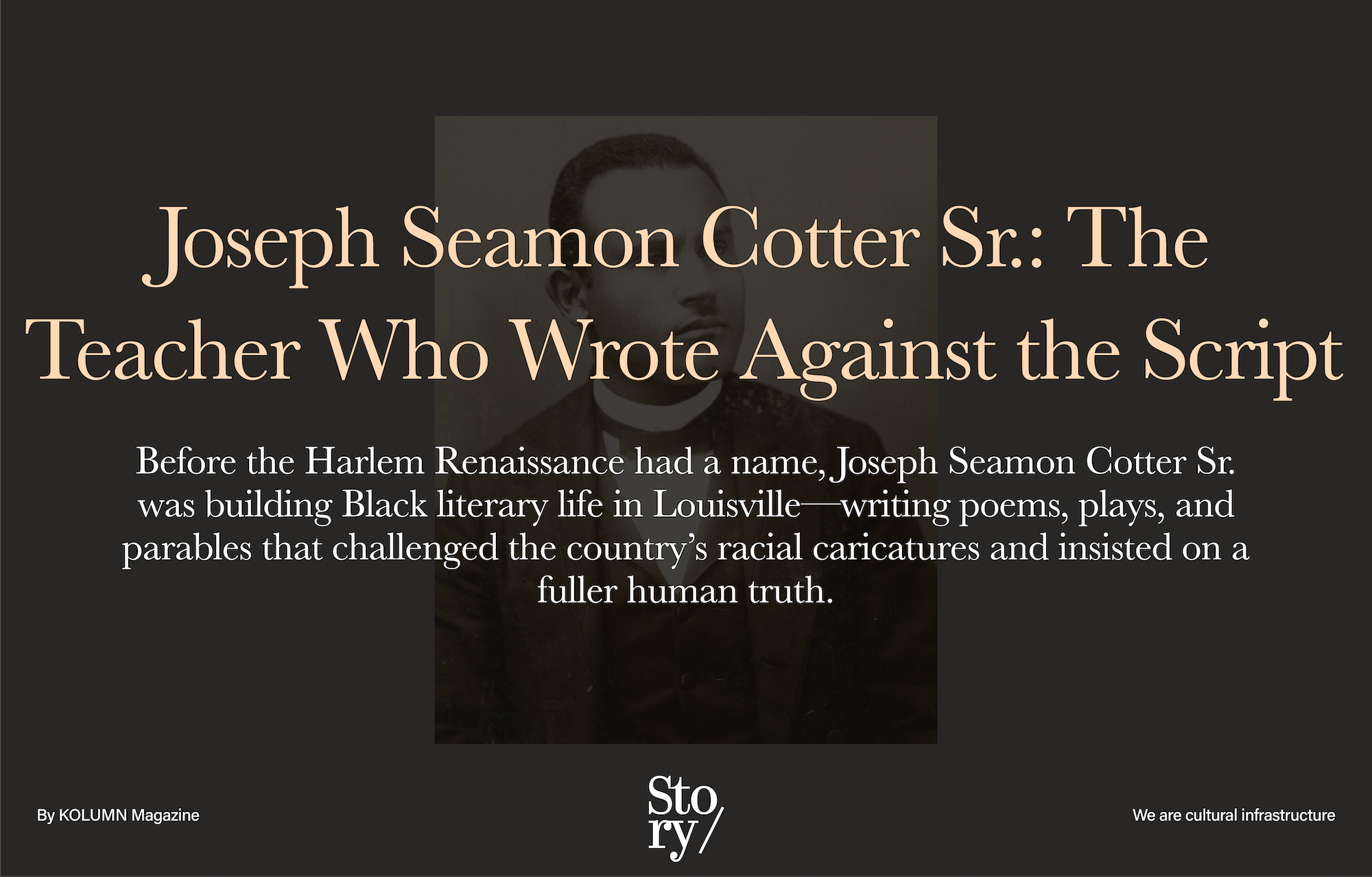
He made himself in public view, and then spent the rest of his life trying to widen that possibility for others.
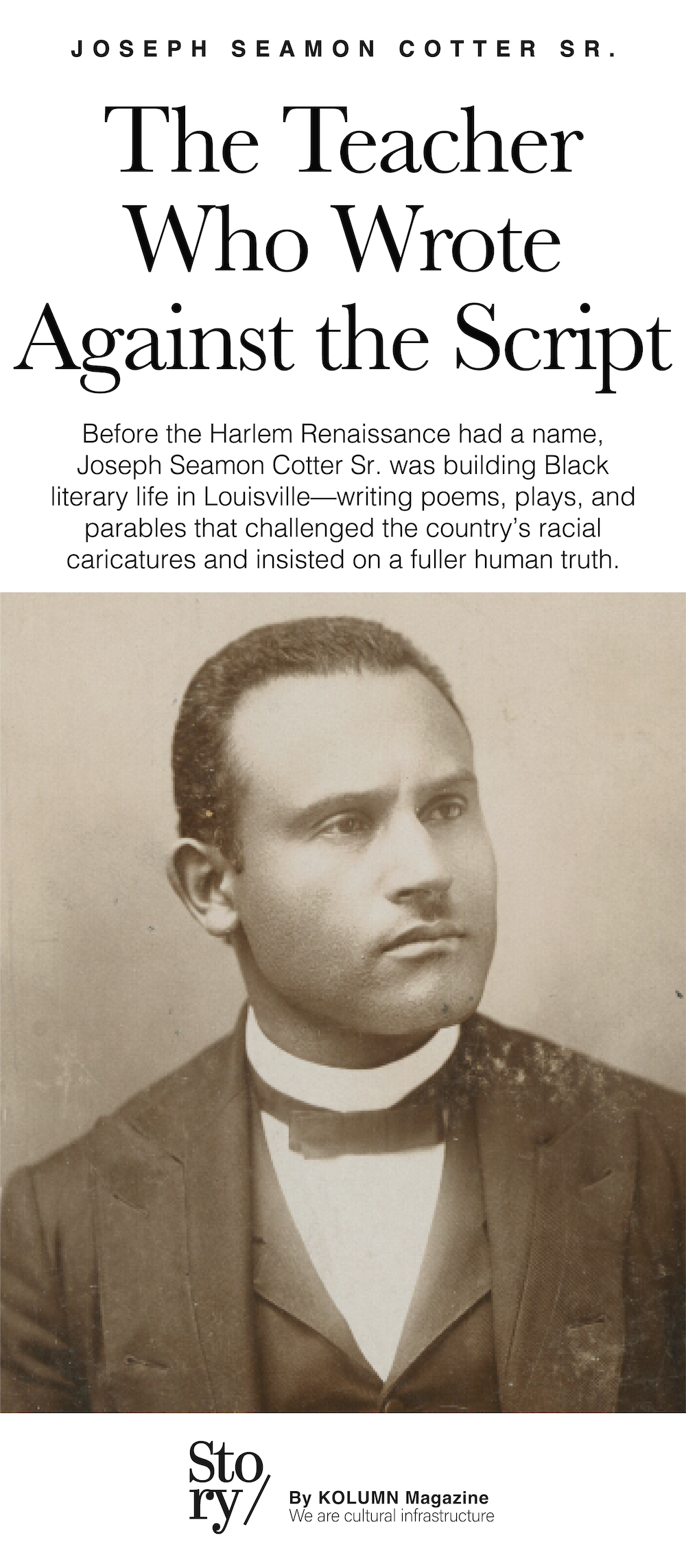
He made himself in public view, and then spent the rest of his life trying to widen that possibility for others.
By KOLUMN Magazine
Joseph Seamon Cotter Sr. belongs to that crowded but still under-read shelf of American cultural history reserved for people who were indispensable without ever becoming broadly canonical. He was a poet, playwright, fiction writer, educator, organizer, and community leader, born in Kentucky in 1861 at the opening of the Civil War and dead in Louisville in 1949, after nearly nine decades that encompassed emancipation, Reconstruction, Jim Crow, the New Negro era, two world wars, and the earliest rumblings of the modern civil rights movement. His life ran almost exactly alongside the long argument over what Black citizenship, Black education, and Black artistry might look like in the United States. That makes him significant before anyone even opens one of his books. But once you do open them, the case becomes stronger: Cotter was not just adjacent to Black literary history. He helped make it.
A Life That Refuses the “Prelude” Label
The easiest way to misread Cotter is to call him merely “early.” Early Black playwright. Early Black poet. Early Black educator. All true, and all insufficient. “Early” can flatten a person into a prelude, as if his main value were arriving before somebody more famous. Cotter deserves better than that. He was one of the earliest African American playwrights to be published, yes, but he was also a sustained practitioner across poetry, drama, fiction, and civic prose, with nine published volumes and a teaching career that stretched more than 50 years. His writing moved among social satire, philosophical reflection, racial uplift discourse, historical tribute, and everyday observation. He was the kind of cultural worker who built infrastructure: schools, readerships, habits of thought, and literary conversation. In that sense, he was less a footnote to the Harlem Renaissance than one of the figures who helped make its emergence imaginable.
Self-Made, Publicly Forged
Cotter’s biography resists the kind of smooth, prestige-friendly narrative that often governs literary remembrance. He was born near Bardstown, Kentucky, and raised in Louisville. His mother, Martha Vaughn, was literate and religious, and accounts of his childhood repeatedly emphasize that she was central to his early education. His father, Michael Cotter, was white and of Scots-Irish ancestry. Cotter learned to read young, but after finishing only the third grade he left formal schooling and worked as a laborer for years. The fact that he later became a teacher and principal is not simply an uplifting anecdote. It is a clue to the seriousness with which he treated self-formation. At 22, he enrolled in Louisville’s night school for Black students, earned credentials, and slowly constructed an intellectual life that was never handed to him by elite institutions. Whatever else one says about Cotter, he made himself in public view, and he spent the rest of his life trying to widen that possibility for others.
The Classroom as Cultural Infrastructure
That self-making became inseparable from education. Over the course of more than half a century, Cotter taught and led in Black schools in and around Louisville, including Western Colored School, Ormsby Avenue Colored School, Eighth Street School, Paul Laurence Dunbar School, and Samuel Coleridge-Taylor School. He founded the Paul Laurence Dunbar School in 1893 and served as principal there until 1911, later leading Samuel Coleridge-Taylor School until 1942. These are not minor résumé items. In segregated America, Black schools were not just educational institutions; they were civic laboratories, rehearsal rooms for leadership, and sites where racial survival became daily practice. Cotter’s classroom career therefore matters as much as his bibliography. He was shaping readers before he was shaping posterity. His literary work and school work were not separate lanes. They were twin expressions of one belief: that Black life could be cultivated against the grain of American contempt.
Writing Against the Caricature
That belief also helps explain why his work can feel so broad in moral range. Modern readers sometimes approach writers of his generation expecting a single, unified posture on “the race question,” but Cotter is more interesting than that. He could sound admonitory, hopeful, satirical, lyrical, and strategic, sometimes within the same period of writing. Historians and literary scholars have noted that his work often emphasized pride, humility, labor, education, and disciplined self-help. At points, especially in relation to industrial education and respectability, he seems legible within a Booker T. Washington-era framework. Yet reducing him to a simple Washingtonian moralist misses something important. His writing also registers the pressure of racist representation itself—especially the minstrel-era distortions that saturated public culture. A 2019 University of Louisville thesis argues that Cotter used his writing to confront minstrel tropes, fashion a modern Black subject, and uplift his community. That is a sharper formulation than the old “uplift poet” shorthand, and it gets at why he still matters. He was not merely asking Black readers to behave better inside a racist script. He was trying to alter the script.
One of the most useful ways to understand Cotter is to place him in the long struggle over representation. He wrote during a period when Blackness in mainstream American culture was constantly staged, ventriloquized, caricatured, and sentimentalized by white performers, publishers, editors, and audiences. Blackface minstrelsy was not just a theatrical form; it was a national epistemology, a way of mis-seeing Black people that leaked into law, education, journalism, politics, and entertainment. Cotter’s career unfolded in that atmosphere. So when he wrote poems, tales, and plays about Black character, aspiration, speech, and ethical life, he was doing more than producing literature. He was contesting the dominant archive of images available to the country. That helps explain both the variety of his forms and the seriousness of his didactic streak. For him, aesthetics and correction were not enemies. Style itself could be a method of refusal.
Drama as Declaration: Caleb, the Degenerate
His play Caleb, the Degenerate, published in 1903, is especially important in this regard, even if it is not the easiest work for contemporary readers to love. Critics have long observed that the play bears the imprint of its era, including an earnest investment in reform language and in debates about the “needs” of Black America. But even skeptical assessments still note its significance: it was an early published Black play; it used blank verse; and it attempted serious dramatic treatment of African American types, customs, and aspirations at a time when Black characters were routinely flattened into burlesque. That does not make the play timeless. It makes it consequential. Cotter was trying to seize dramatic form for Black seriousness, and in the early 20th century that was itself a radical act. Writers do not only matter because they perfect a genre. Sometimes they matter because they insist that their people are entitled to one.
Poetry, Precision, and Public Voice
Poetry, though, may be the most direct route into his sensibility. Cotter’s poems are notable for their formal range and their tonal agility. He could write occasional verse, reflective lyric, dialect poems, satire, and race-minded public poetry without sounding as though he believed one register alone could carry Black experience. In the short lyric “The Way-Side Well,” he arrives at metaphor with startling economy, ending on the caution that “hearts are like wells” and that one may not know “they are dry ’til you question their depths.” That is graceful, aphoristic writing, small in scale but not small in ambition. The poem’s movement from roadside scene to moral realization reveals a writer interested in compression, in letting image do the philosophical labor. It also demonstrates why Cotter should not be remembered only as a historical figure of racial significance. He could actually write.
“Cotter’s genius was not simply that he wrote in many forms. It was that he understood Black literature had to meet Black life in many forms.”
He could also be funny, which is another way of saying he could be dangerous. “The Tragedy of Pete,” one of his best-known poems, turns on comic brevity, social observation, and the discipline of timing. Its popularity in contest culture and anthologies speaks to Cotter’s command of accessible verse—work that could circulate beyond specialist literary spaces. Humor, especially for Black writers in the late 19th and early 20th centuries, was never just humor. It was often a tactical form, a way to outmaneuver insult, dramatize folly, or expose social pretension without surrendering complexity. Cotter understood that. He could write toward philosophy, but he could also write with an ear for the compact, memorable line that survives public reading and print culture alike. That flexibility mattered in an era when Black writers had to create audiences as well as address them.
Literary Networks and the Dunbar Connection
Cotter’s friendship with Paul Laurence Dunbar offers another revealing angle on his significance. Dunbar, of course, remains the far more widely recognized figure, one of the major Black literary voices of the fin de siècle. But Cotter was not merely an admirer in the crowd. Surviving correspondence shows the two men in active literary relation, and scholarship has long noted Dunbar’s visit to the Cotter family in Kentucky in the 1890s. Their exchange matters not for gossip value but because it locates Cotter inside a Black literary network that was regional, ambitious, and mutually sustaining. Long before the better-known coteries of Harlem, Black writers were building circuits of encouragement, criticism, performance, and publication across cities and institutions. Cotter’s correspondence with Dunbar shows him participating in that world as peer, host, facilitator, and fellow craftsman. Literary history often over-centers movements once they acquire a memorable label. Cotter reminds us that the work began earlier and in more places than the label suggests.
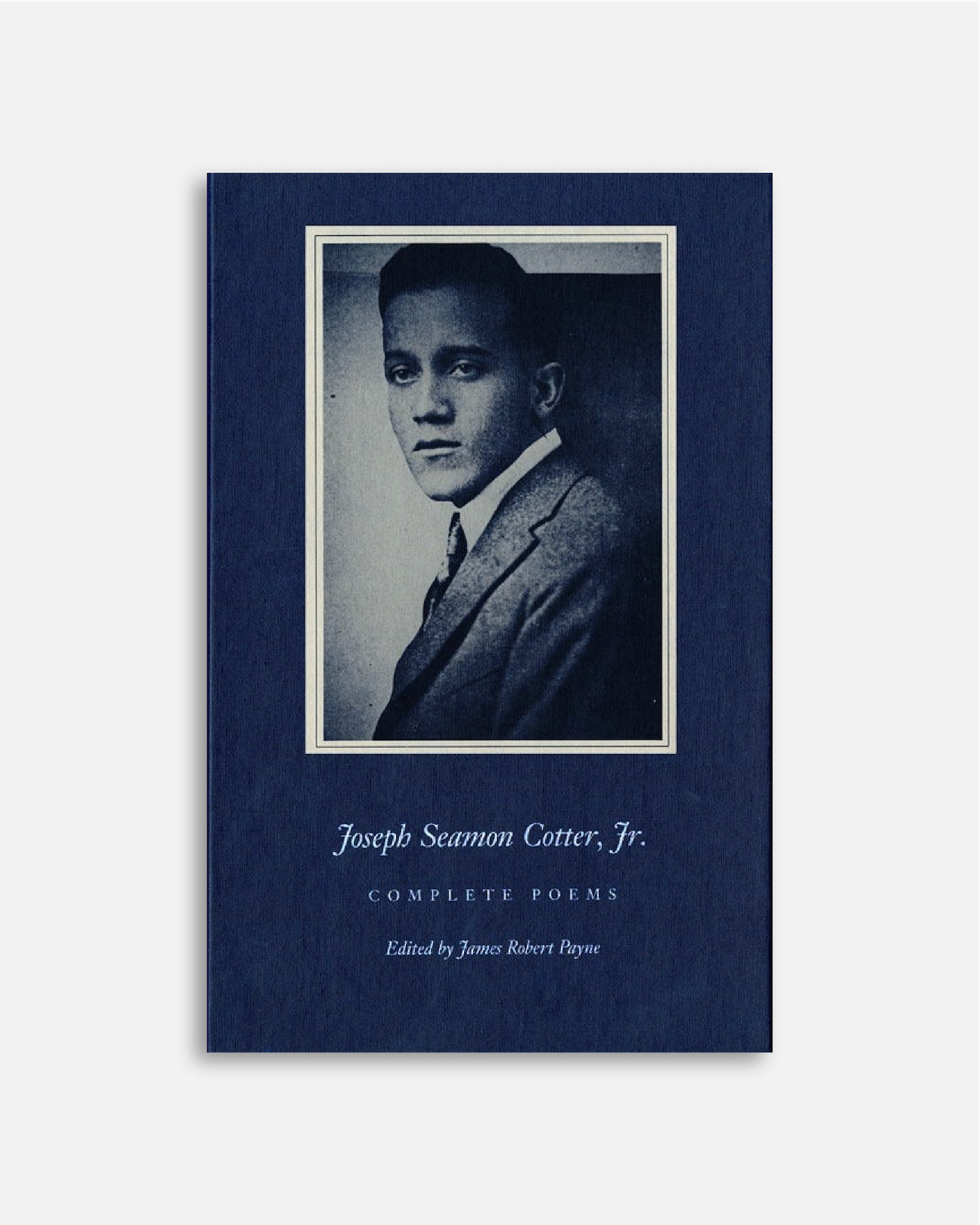
There is also the matter of family, which in Cotter’s case shades into inheritance and grief. He married fellow educator Maria F. Cox in 1891, and together they raised children including Joseph Seamon Cotter Jr., who would become a gifted poet and playwright in his own right before dying young of tuberculosis. Florence Olivia Cotter also died young. Those losses were not incidental to Cotter’s later life; they sat inside the household that was already doubling as a literary environment. The father’s legacy cannot be disentangled from the son’s brilliance and early death, especially because Joseph Seamon Cotter Jr. is now sometimes remembered more readily in poetry classrooms than his father is. But that should not produce a zero-sum reading. The Cotter home appears, instead, as a rare intergenerational Black literary site in Louisville—a place where education, discipline, performance, and art crossed daily life. That matters historically. It also deepens the emotional texture of Cotter’s story. The man who spent decades teaching and writing about Black becoming also had to endure the intimate undoings that no amount of moral poise can prevent.
A Lifetime of Work, Not a Moment of Fame
Cotter’s publication history is itself evidence of uncommon stamina. He published A Rhyming in 1895, Links of Friendship in 1898, Caleb, the Degenerate in 1903, A White Song and a Black One in 1909, Negro Tales in 1912, Collected Poems in 1938, Sequel to “The Pied Piper of Hamelin,” and Other Poems in 1939, and Negroes and Others at Work and Play in 1947, among other works. He also published in newspapers and magazines, including the Courier-Journal, National Baptist Magazine, Voice of the Negro, Southern Teacher’s Advocate, and Alexander’s Magazine. That record tells us two things. First, he was not an occasional dabbler who happened to leave behind a few notable pages. Second, he understood literature as serial labor. He wrote over decades, through changing aesthetic climates and political vocabularies, refusing the idea that Black authorship had to be brief, singular, or spectacular to count.
“To write Cotter back into view is to recover a whole social geography of Black letters.”
And yet Cotter never fully entered the American literary canon in the way some of his peers or successors did. There are reasons for that. Canon formation is never just about merit; it is about circulation, institutional endorsement, anthologizing, classroom adoption, archive survival, and the biases of critics who decide whose work feels central. Cotter’s regional location mattered. So did genre. Writers who move among poetry, fiction, aphorism, drama, and civic prose can be harder for literary institutions to package cleanly. His didacticism may have cost him favor in periods that preferred either the folk authentic or the modernist rupture. And because his life bridged so many eras, he is easy to misfile: too late for some 19th-century frameworks, too early for the Harlem Renaissance story as popularly told. But those same reasons are precisely why he deserves renewed attention. He exposes the blind spots in the usual map.
One of the more revealing descriptions of Cotter comes from later commentators who cast him as a Black bard of Kentucky and as a writer of “conscious art.” The phrase is useful. Cotter was not naïve about art’s social use. He believed writing could teach, steer, dignify, and reframe. Contemporary readers sometimes hear that as quaint, because American literary culture often prizes alienation over instruction and ambiguity over avowed purpose. But Cotter’s work emerged from circumstances in which Black representation was a life-and-death civic problem. Under those conditions, “conscious art” was not a failure of imagination. It was an ethical method. The real question is not whether Cotter was programmatic. Of course he often was. The real question is whether we are prepared to understand programmatic Black art as art, rather than as some lesser adjacent form. Cotter pushes that question directly at the present.
He also matters because he complicates the lazy divide between artist and institution-builder. American culture loves the solitary genius, preferably one who suffers beautifully and leaves behind an interpretable aura. Cotter’s life proposes a different model. He wrote books, yes, but he also administered schools, worked in Black civic organizations, and participated in the ordinary machinery of community life. Sources note his involvement with groups including the NAACP, the Association for the Study of Negro Life and History, and other educational and civic organizations. That kind of life rarely produces legend on its own. It produces something quieter and in many ways more durable: continuity. Cotter was not only making poems. He was helping construct the conditions under which Black intellectual life could continue from one generation to the next.
If that sounds grand, it is because the scale of his life warrants it. Cotter was born while slavery still existed. He came of age in the wreckage of Reconstruction and taught during the reign of segregation. He lived long enough to see Black artistic and political expression transform on a national scale, though not long enough to see the legal dismantling of Jim Crow. Through all of that, he remained in Louisville, working. There is something deeply instructive about that steadiness. American literary memory often favors the metropolitan and the dramatic. Cotter’s career suggests that regional Black modernity was being forged in classrooms, local presses, church-linked institutions, and modest book publications far from the traditional capitals of prestige. To write him back into view is not just to rescue one neglected man. It is to recover an entire social geography of Black letters.
Why Cotter Still Matters
So what, finally, is Joseph Seamon Cotter Sr.’s significance? It lies partly in chronology: he stands among the early published Black playwrights and among the important Black poets of the generation before the New Negro movement crystallized. It lies partly in output: nine published volumes across poetry, drama, and prose is not a marginal achievement. It lies partly in mentorship and network: his literary friendship with Paul Laurence Dunbar and the later emergence of Joseph Seamon Cotter Jr. place him inside a meaningful lineage. But most of all, his significance lies in synthesis. He fused literary work with educational labor and race-conscious community building. He modeled a Black authorship that was not detached from institutional life, and a Black pedagogy that was not detached from imagination. In a country that so often demanded that Black people choose between usefulness and beauty, Cotter insisted on both.
That is why he should be read now, not merely commemorated. To commemorate Cotter is easy enough: Kentucky has inducted him into the Kentucky Writers Hall of Fame, literary reference works keep his name alive, and anthologies preserve a few poems. Reading him is harder, because reading him requires us to engage a writer whose work sits at the junction of uplift politics, formal experimentation, regional history, pedagogy, and anti-caricature struggle. It requires us to grant that Black literary history was never only the story of its biggest names. It was also the story of durable workers, of people who wrote and taught and organized without the guarantee of national fame. Cotter was one of those workers. He helped draft a language of Black seriousness before the nation was prepared to hear it clearly. The fact that many readers still do not know his name is not evidence of his smallness. It is evidence of how much American literary history still leaves out.
In one sense, Cotter’s life can be told as a classic American ascent: child laborer becomes teacher, principal, author, and civic elder. But that version is too neat. The truer story is that he built a life in active resistance to the terms available to him. He was born into a nation inventing new ways to deny Black humanity after slavery; he answered by teaching Black children, writing Black complexity, and placing Black aspiration on the page again and again. He did this not with grandiose self-mythology, but with discipline. Not with one immortal masterpiece, but with a body of work. Not from the cultural center, but from Louisville. Sometimes that kind of career gets called minor because it does not conform to the mythology of genius. A better word would be foundational.
And maybe that is the cleanest way to place him. Joseph Seamon Cotter Sr. was foundational not because he solved the problems Black writers faced, and not because every page he wrote still crackles with equal force. He was foundational because he understood, early and with remarkable steadiness, that Black literary life had to be built at multiple levels at once: in schools, in family, in print, in performance, in argument, in local institutions, and in the inner discipline of language itself. He wrote as a man who knew the story being told about Black people in America was false, and who refused to leave the matter uncontested. That refusal, sustained over a lifetime, is a literary achievement. It is also a civic one.
More great stories
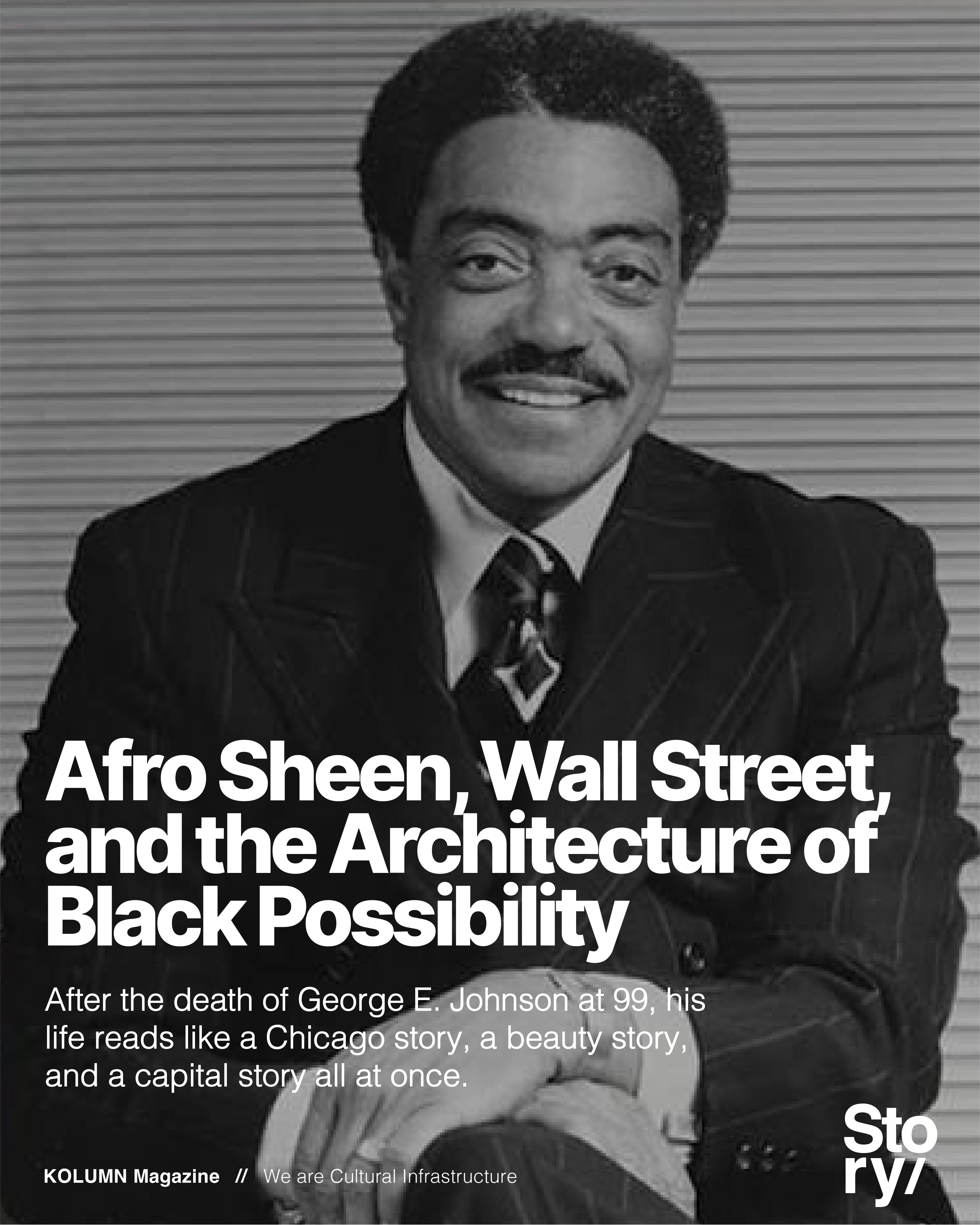
Afro Sheen, Wall Street, and the Architecture of Black Possibility
July 6, 2026
No Comments
The Fire Inside the Fourth
July 5, 2026
No Comments