



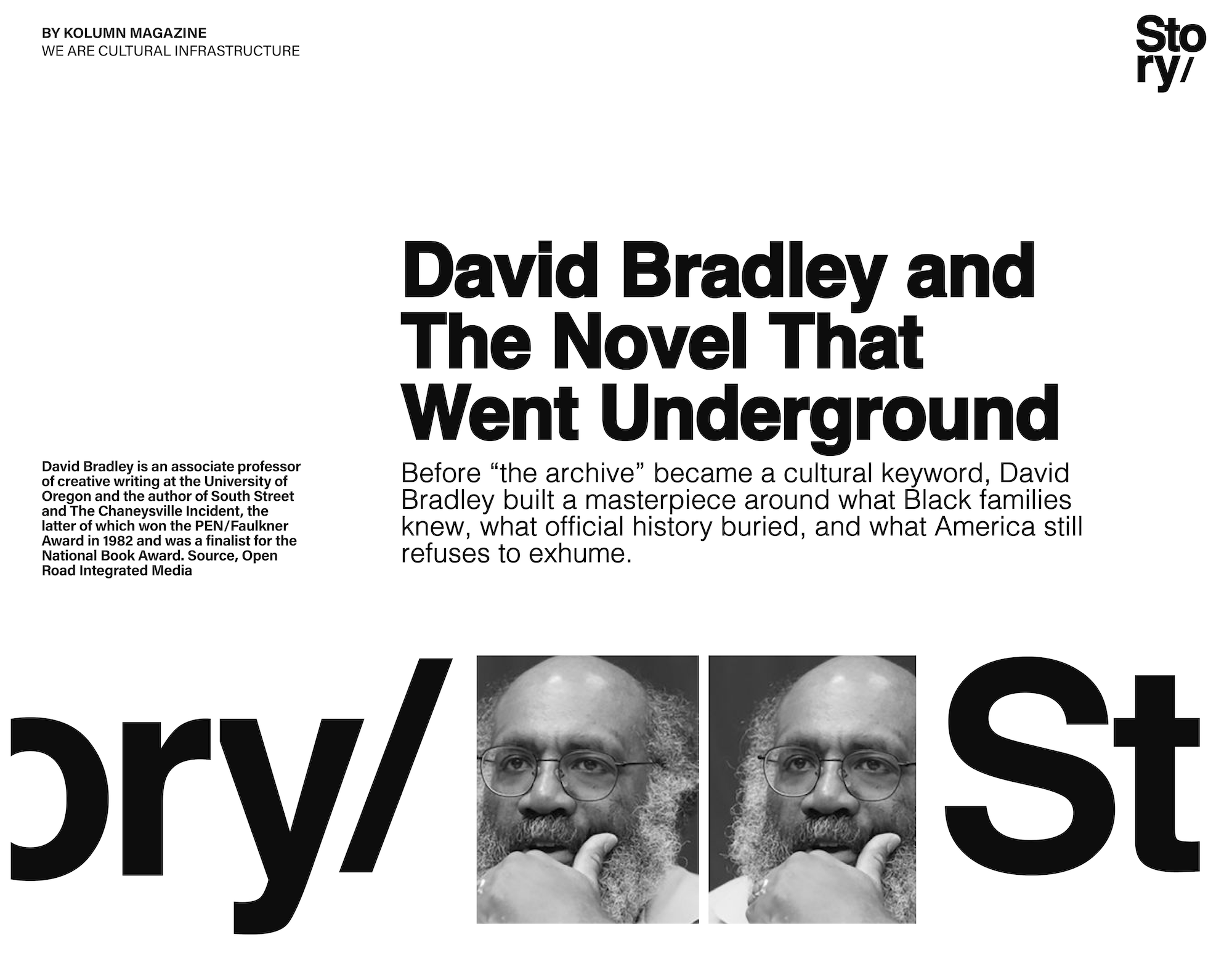
Bradley’s great subject is not the past. It is the violence required to keep the past from speaking.
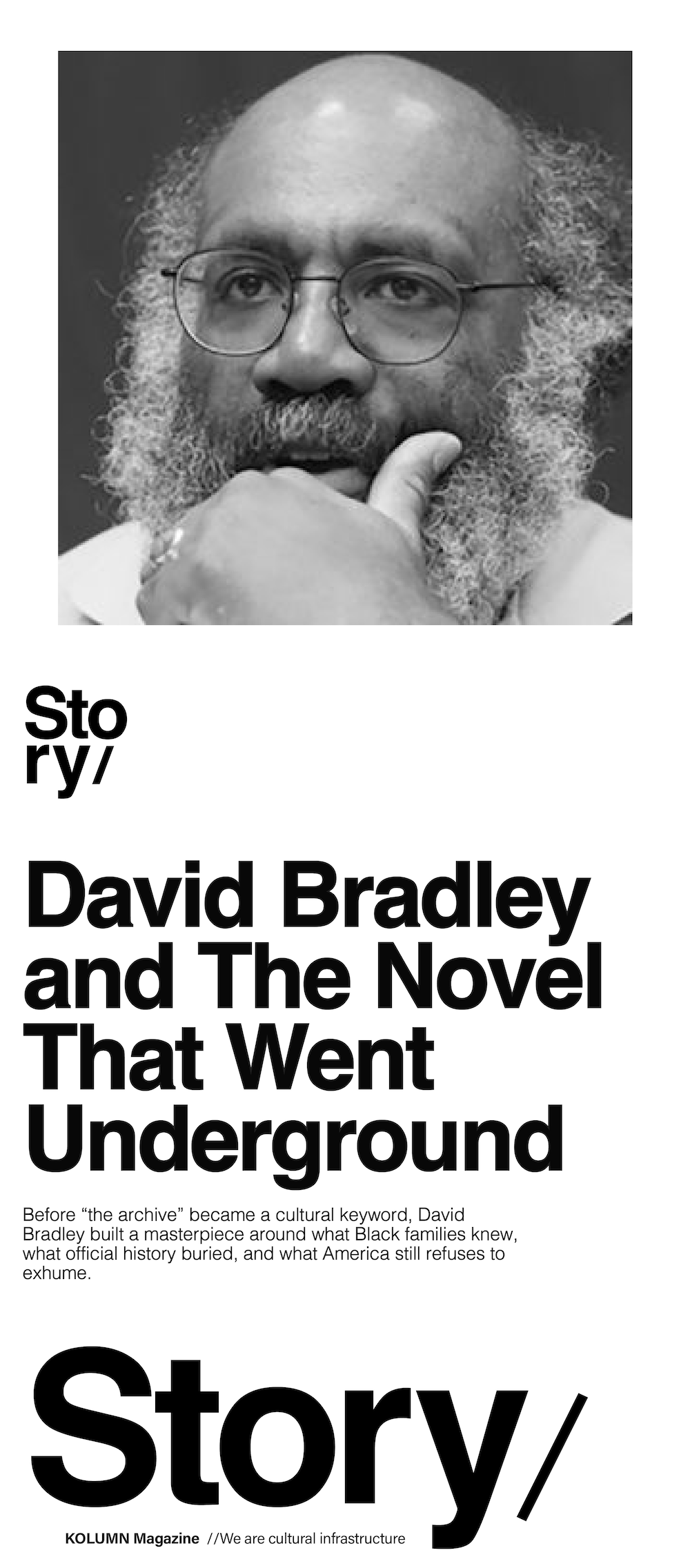
Bradley’s great subject is not the past. It is the violence required to keep the past from speaking.
By KOLUMN Magazine
David Bradley’s literary reputation rests on a strange and almost defiant fact: he did not need a long shelf of novels to become one of the essential American writers of historical memory. He published South Street in 1975 and The Chaneysville Incident in 1981, and the second book—massive, recursive, intellectually ferocious—won the 1982 PEN/Faulkner Award for Fiction and later became a National Book Award finalist in paperback fiction in 1983 That might sound like the beginning of a long public ascent. Instead, Bradley became something rarer: a writer whose scarcity sharpened his legend.
He was born David Henry Bradley Jr. in Bedford, Pennsylvania, in 1950, a small-town origin that would become more than background. It became terrain, pressure, inheritance. Biographical accounts identify him as the son of David Henry Bradley and Harriette Jackson Bradley, raised in rural Bedford before studying at the University of Pennsylvania and earning a master’s degree in United States Studies at the University of London The geography matters because Bradley’s greatest novel is not merely “set” in western Pennsylvania. It excavates the moral sediment beneath it. Bedford County becomes a place where the Underground Railroad is not a museum phrase but an unresolved system of signs: graves, roads, stories, silences, property lines, wounds.
KOLUMN has often returned to writers and cultural workers whose significance exceeds their visibility—Henry Dumas, for example, whose work KOLUMN recently framed as one of Black literature’s unfinished revelations Bradley belongs in that same larger conversation, though his case is different. Dumas was cut short by death; Bradley’s career unfolded as a deliberate argument with literary expectation. He did not disappear. He withheld. He taught, lectured, wrote essays and reviews, and continued to think in public about race, language, memory, and American literature. But he refused the marketplace’s preferred rhythm: produce, promote, repeat. In a culture that often confuses output with importance, Bradley became a rebuke.
Bedford, Philadelphia, London: The Making of a Historical Imagination
Bradley’s education was unusually suited to the novelist he became. At the University of Pennsylvania, he studied creative writing and received his bachelor’s degree in 1972; at the University of London, he pursued United States Studies and earned a master’s degree in 1974. That pairing—craft and history—would become the architecture of his fiction. He was not simply a novelist who used history for atmosphere. He wrote as though history were a contested method of knowing, and as though narrative itself could become a tool of investigation.
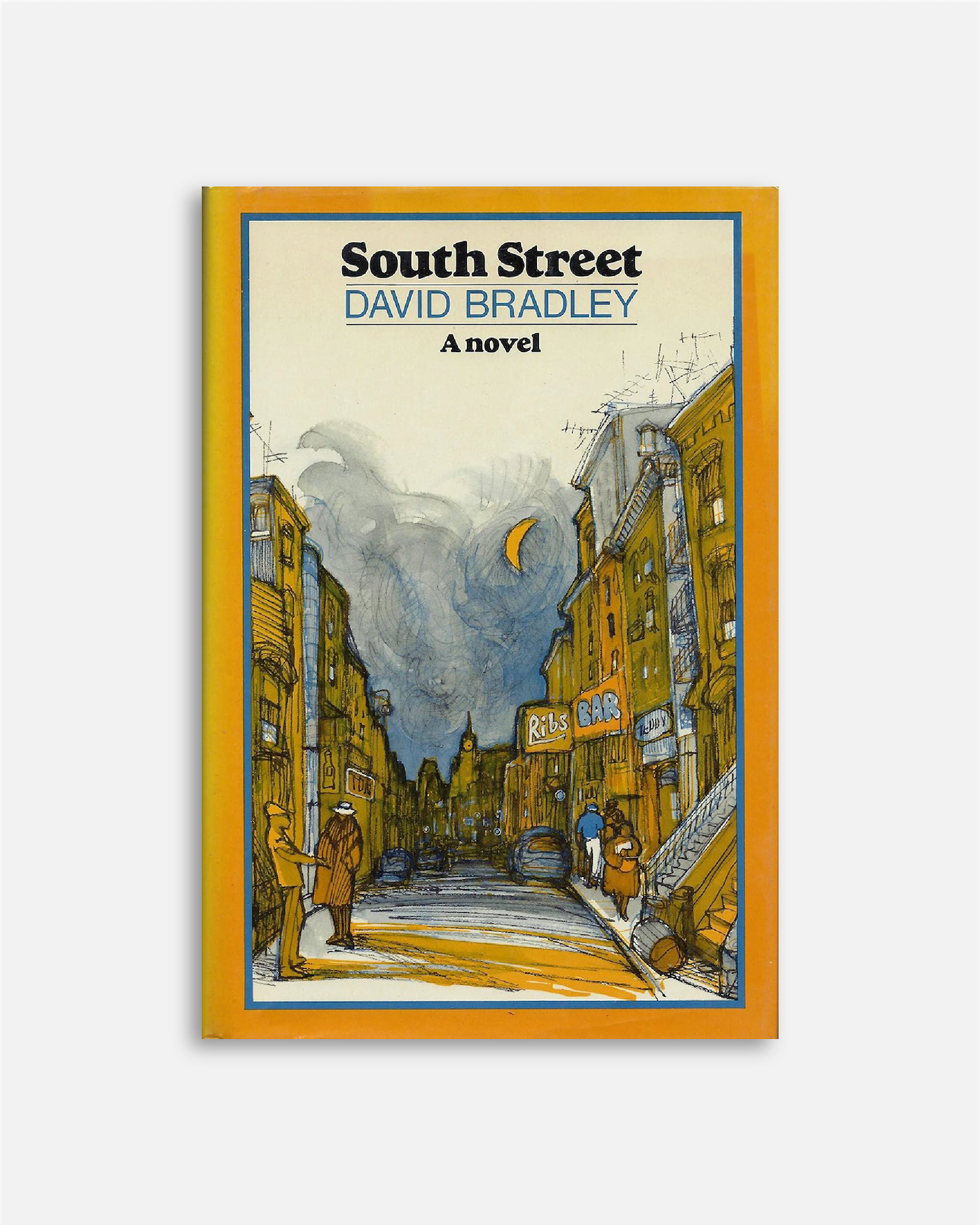
The early professional path was equally telling. After graduate study, Bradley worked in publishing and later joined Temple University’s English department in Philadelphia, according to biographical summaries of his early career. Philadelphia gave him the setting for South Street, his debut novel, published when he was still in his twenties. The book takes its name from the famous Philadelphia corridor, long associated with Black commerce, nightlife, music, migration, and urban change. Bradley’s first novel did not yet have the monumental structure of The Chaneysville Incident, but it already showed his appetite for social density: characters colliding across race, class, speech, appetite, ambition, and neighborhood mythology.
Bradley was part of a generation writing after the civil rights movement had changed the legal architecture of American life but not the deeper structures of memory. By the 1970s and early 1980s, Black literature was being read through multiple inheritances at once: the modernism of Ralph Ellison, the moral fire of James Baldwin, the folk-historical and mythic recoveries of Toni Morrison, the vernacular experiments of the Black Arts era, and the institutional emergence of Black Studies. Bradley’s work conversed with all of this, but it did not comfortably belong to any single lane. He was too historical to be merely postmodern, too formally audacious to be merely realist, too suspicious of easy recovery to be nostalgic.
His father’s influence also mattered. Narrative Magazine’s biography notes that Bradley was shaped by rural western Pennsylvania and by his father, described as a church historian and preacher. That detail helps explain the peculiar cadence of Bradley’s fiction: part sermon, part cross-examination, part field note, part ghost story. In his work, oral knowledge has authority, but not innocence. Written records matter, but they are incomplete. The archive is necessary, but it lies by omission. Family stories can preserve truth, but they also distort under the pressure of trauma. Bradley’s gift was to dramatize the work of sorting through all of it.
South Street and the City as Argument
Published in 1975, South Street introduced Bradley as a writer alert to the social theater of Black urban life. Open Road Media’s author biography identifies South Street as the first of his two novels, followed by The Chaneysville Incident six years later. The debut’s world is loud, crowded, unstable, and performative. It is also a book about who gets to narrate a neighborhood and who gets consumed by it.
“Bradley’s fiction understands place as evidence. A street, a grave, a tavern, a road—each holds testimony.”
If The Chaneysville Incident would later become Bradley’s defining work, South Street should not be treated as a mere prelude. It shows a young novelist already suspicious of simplified racial storytelling. Bradley understood that Black neighborhoods were not symbols waiting for outsiders to interpret them. They were worlds of contradiction: beauty and danger, exploitation and intimacy, laughter and exhaustion, history and hustle. He was drawn to the way public spaces collect private grief. A street, in Bradley’s fiction, is never only a street. It is a stage, a witness, a ledger.
The 1970s were a volatile period in American urban history, especially in older northern cities shaped by deindustrialization, white flight, policing, housing segregation, and political neglect. Bradley did not write policy fiction, but he wrote from inside the atmosphere produced by such forces. His characters move through cities where structural power is not abstract; it is in the rent, the bar, the job, the police encounter, the rumor, the body. This is part of his significance: he could make social history feel intimate without reducing it to sociology.
But the larger breakthrough came when Bradley turned from Philadelphia’s urban present to Bedford County’s buried past. There, he found a story large enough to hold his questions about Black history, masculinity, scholarly authority, racial memory, and the terrible intimacy between fact and legend.
The Graves Near Chaneysville
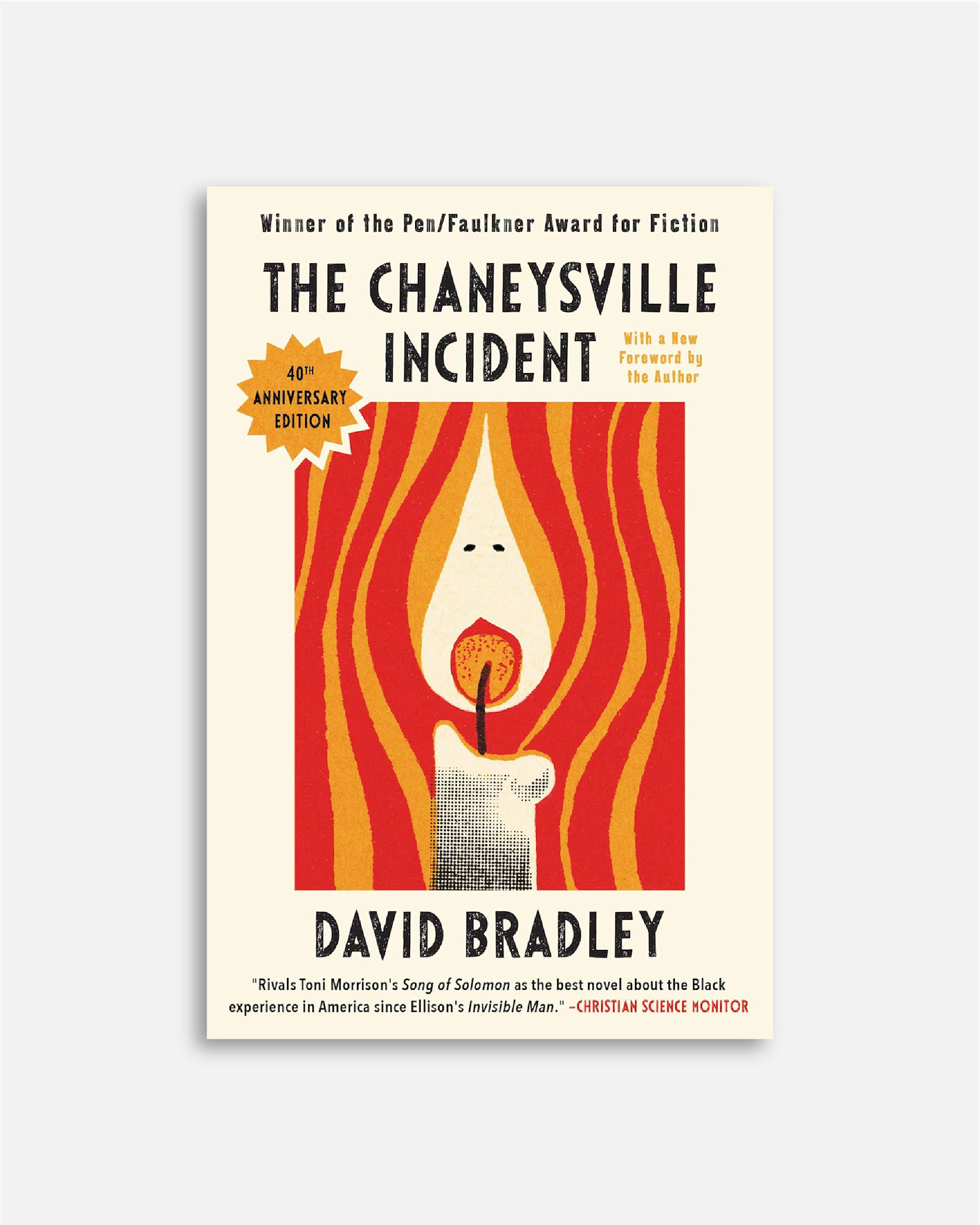
The central historical spark behind The Chaneysville Incident is now part of Bradley lore. PEN/Faulkner has described the novel as inspired by the discovery of graves of runaway slaves on a farm near Chaneysville in Bedford County, Pennsylvania, where Bradley was born. Between the Covers gives a fuller account, noting that Bradley’s mother, while doing research connected to the area’s bicentennial in 1969, discovered thirteen unmarked graves on a Bedford County property. From that seed, Bradley built a novel about the difficulty—and necessity—of recovering a history designed to vanish.
The novel’s protagonist, John Washington, is a Black historian who returns home after the death of Jack Crawley, a white man who had been close to his family and who knows pieces of the story John has spent his life trying to decode. John’s search eventually leads him toward the deaths of fugitive enslaved people and toward the unresolved death of his father, Moses Washington. The book is often summarized as a historical mystery, but that undersells it. It is also a philosophical novel, a family drama, a love story, a study of racial rage, and an argument about historiography.
Bradley understood that the Underground Railroad had often been sentimentalized into a morality play: brave fugitives, noble conductors, safe houses, freedom northward. The Chaneysville Incident refuses that smoothness. It asks what freedom meant when geography itself was dangerous, when capture meant torture or sale, when the line between survival and death could narrow to a matter of minutes. Literary Hub’s discussion of the novel identifies its legendary core as the story of fugitive enslaved people who killed themselves rather than be returned to slavery. Bradley’s achievement was not simply to dramatize that legend. It was to build a narrative machine around the question of how such a story can be known.
The word “incident” in the title is cold, almost bureaucratic. It suggests a file, a notation, an event reduced to administrative language. Bradley turns that coldness against itself. The incident becomes an abyss. Who recorded it? Who refused to? Who preserved it orally? Who profited from forgetting? Who inherited the obligation to ask? The book’s answer is never easy because Bradley did not believe in easy recovery. Some truths emerge only through fragments. Some remain ethically dangerous. Some are knowable but not redeemable.
The Historian as Wounded Detective
John Washington is one of the most demanding protagonists in American fiction because he is both brilliant and damaged, rigorous and evasive, tender and cruel. He is a historian by training, but his own life is the archive he cannot master. His relationship with Judith, a white psychiatrist, gives the novel one of its central conflicts: the limits of interracial intimacy when history is not past but active, bodily, and unresolved.
In interviews, Bradley often discussed the political and personal dynamics of John and Judith’s relationship. A Callaloo interview from 1984, later excerpted in reference sources, focused on South Street and The Chaneysville Incident, including the characters John Washington and Judith and the novel’s engagement with racial identity, history, and family legacy. That conversation matters because Bradley’s fiction is sometimes misread as historical reconstruction alone. It is equally a study of interpretation: who has the right to explain pain, who has the burden of remembering it, and what love can or cannot repair.
John’s training as a historian gives him tools, but those tools are inadequate without the older knowledge carried by Jack Crawley and by the community’s memory. Bradley places academic history in tension with oral history, not to romanticize either but to force a reckoning. Official documents can authenticate dates and names. Oral stories can preserve motive, fear, gesture, weather, warning, consequence. Neither is whole. Together they may still fail. Yet the attempt matters.
This is where Bradley’s work speaks directly to contemporary debates about archives, public memory, and Black historical recovery. Today, museums, universities, digital humanities projects, and cultural institutions routinely speak of “recovering hidden histories.” Bradley was dramatizing the difficulty of that work decades earlier. His fiction insists that recovery is not a clean act of retrieval. It is confrontation. It can implicate the seeker. It can expose family myths. It can reveal that the archive’s silence was not accidental but produced by violence.
The Breakthrough and the Burden of Acclaim
When The Chaneysville Incident appeared in 1981, it was recognized quickly as a major work. Open Road Media notes that the novel won the 1982 PEN/Faulkner Award, became a National Book Award finalist, and earned Bradley an Academy Award for literature. The National Book Foundation’s archive confirms its status as a 1983 National Book Awards finalist in paperback fiction. A later Open Road description cites the Los Angeles Times calling the novel perhaps the most significant work by a new Black male author since Baldwin’s early work.
That praise is revealing, but also constricting. To compare Bradley to Baldwin was to signal seriousness, fire, and moral authority. But Bradley was not repeating Baldwin. Baldwin’s central theater was often the soul under pressure: sexual, racial, religious, national. Bradley’s great theater was historical method under pressure. He wanted to know how the past enters the bloodstream of the present, and how a Black intellectual might survive the work of knowing too much.
The PEN/Faulkner Award placed Bradley among the most important fiction writers of his moment. Yet the public literary system has never quite known what to do with him. He is acclaimed but not as widely read as he should be. He is canonized in certain academic circles but absent from many popular accounts of late-twentieth-century American fiction. His masterpiece is admired, but not always taught with the regularity afforded to Morrison, Ellison, Baldwin, Walker, or Gaines. Part of that may be the book’s difficulty. The Chaneysville Incident is long, nonlinear, intellectually dense, and emotionally punishing. But difficulty alone cannot explain the unevenness of Bradley’s visibility. American literary culture often has trouble sustaining attention to Black writers whose work does not fit familiar narratives of uplift, trauma testimony, protest, or marketable identity.
Bradley’s work demands more. It asks readers to become investigators, to sit with contradiction, to understand that Black history in America is not merely a sequence of injustices but a struggle over evidence. The novel does not offer the comfort of simple revelation. Its final power comes from the way it makes knowledge feel costly.
After the Masterpiece: The Myth of Silence
The easiest story to tell about Bradley after The Chaneysville Incident is that he went quiet. The truer story is more complicated. Since the mid-1980s, Bradley has worked substantially in creative nonfiction, publishing in venues including Esquire, The New York Times, Philadelphia Magazine, The Nation, Dissent, and others, according to biographical summaries. Creative Nonfiction’s biography adds that his nonfiction has appeared in The New York Times, The Los Angeles Times, The New Yorker, and The Nation, and that he received fellowships from the John Simon Guggenheim Foundation and the National Endowment for the Arts.
That is not silence. It is a different form of literary citizenship.
Bradley also became known as a teacher and lecturer. Open Road Media identifies him as an associate professor of creative writing at the University of Oregon. AALBC likewise describes him as a University of Oregon creative writing professor and summarizes his career across fiction, essays, reviews, and interviews. Those institutional roles matter because Bradley influenced writers not only through the books he published but through the standards he modeled: seriousness, precision, skepticism, and a refusal to simplify the racial history of American language.
The myth of silence may persist because readers expected another novel equal in scale to The Chaneysville Incident. Bradley has acknowledged working on later fiction, including stories set in the world connected to the town of his great novel. In a 2013 interview with Southern Literary Review, he said he had returned to fiction and was working on a collection of stories set in what he called “the Town” in The Chaneysville Incident, later named Raystown. His short story “You Remember the Pin Mill,” published in Narrative, won a 2014 O. Henry Award, confirming that Bradley’s fiction did not end with 1981.
But Bradley’s career resists the standard literary biography because its center is not productivity. It is integrity of inquiry. He has seemed less interested in feeding the machine than in preserving the terms of his own attention.
The N-Word, Twain, and the Argument Over American Language
One of Bradley’s most public later interventions came through debates over Mark Twain’s Adventures of Huckleberry Finn and the attempt to publish censored editions replacing the N-word. Bradley appeared in a 2011 60 Minutes segment about the controversy, according to biographical summaries and interviews. That appearance was not a detour from his literary project. It was an extension of it.
Bradley has long been concerned with the moral life of language—especially the way American racism lives in words, institutions, habits, and evasions. The debate over censoring Twain is often framed as a conflict between sensitivity and fidelity. Bradley’s larger concern has been more exacting: what happens when Americans try to remove the evidence of racism from the texts that reveal it? What pedagogical responsibility accompanies the teaching of racial slurs? What is the difference between confronting language and reproducing harm? What does it mean to sanitize a book whose power depends partly on the ugliness of the world it records?
These questions connect directly to The Chaneysville Incident. In both cases, Bradley resists the false comfort of purification. History cannot be made safe without being made false. Language cannot be cleansed of violence by pretending the violence was not there. Yet exposure alone is not ethics. Bradley’s work requires readers, teachers, and critics to ask what kind of attention historical pain demands.
That makes him especially relevant now, in a period when fights over curriculum, public memory, book bans, race-conscious education, and historical interpretation have intensified. Bradley’s writing offers no slogan for these debates. It offers something more durable: a method. Follow the evidence. Distrust innocence. Listen to the buried story. Do not confuse discomfort with danger. Do not confuse erasure with healing.
The Black Historical Novel Beyond Costume
Bradley’s significance also lies in how he expanded the possibilities of the Black historical novel. Before and after him, Black writers have used historical fiction to recover the lives of the enslaved, the fugitive, the migrant, the rebel, the ancestor. Morrison’s Song of Solomon and Beloved, Ernest J. Gaines’s historical moral worlds, Gayl Jones’s psychic intensities, Charles Johnson’s philosophical fiction, and later works by writers such as Edward P. Jones, Colson Whitehead, and Jesmyn Ward all demonstrate the range of Black historical imagination. Bradley’s contribution is distinctive because The Chaneysville Incident makes historiography itself dramatic.
The book is not content to represent the past. It investigates the making of the past as knowledge. It asks how evidence is assembled and who is authorized to interpret it. It shows that historical narrative is never neutral, especially when slavery is involved. The archive of slavery in America was produced by people who often treated Black life as property, labor, threat, or statistic. To write against that archive requires both imagination and suspicion. Bradley knew this. His novel does not simply fill gaps. It studies the gap as a wound.
This is why The Chaneysville Incident remains urgent for institutions like KOLUMN, whose editorial project is rooted in recovering, contextualizing, and reanimating Black histories. KOLUMN’s recent work on figures such as Henry Dumas has emphasized how the canon often fails to account for Black artists whose work exceeds the categories available to them. Bradley’s case extends that concern into the domain of historical method. He shows that the problem is not only who gets remembered. It is how remembering is structured, who controls the terms, and what kinds of knowledge are dismissed as legend until a novelist forces them back into view.
Masculinity, Inheritance, and the Father’s Death
At the emotional center of The Chaneysville Incident is a son trying to understand his father. Moses Washington’s death haunts the book not merely as plot but as inheritance. John Washington’s search for historical truth is inseparable from his search for paternal meaning. In Bradley’s hands, Black masculinity is not a performance of invulnerability but a field of damage: knowledge withheld, tenderness disguised, rage inherited, silence mistaken for strength.
The novel’s men carry history in their bodies. They hunt, drink, remember, misremember, and test one another through language. They pass down skills that are also codes. They protect by withholding, but withholding becomes another form of harm. Bradley’s genius is to refuse easy judgment. The fathers and surrogate fathers in his fiction are neither saints nor simple casualties. They are men shaped by a country that made Black survival depend on secrecy, discipline, and suspicion.
John’s intellectual arrogance is part of this inheritance. He believes he can master history through analysis, but the novel teaches him that mastery is the wrong goal. History is not an animal to be conquered. It is a relation to the dead. It requires humility, and humility is precisely what John resists. The drama of the novel is therefore not only whether he will solve the mystery. It is whether he will become capable of receiving the truth without turning it into another instrument of control.
This makes Bradley’s work unusually rich for contemporary readers thinking about intergenerational trauma. The phrase can become vague in public discourse, but Bradley renders it with specificity. Trauma is not only pain passed down. It is also a damaged system of knowledge: what families can say, what they cannot say, what they encode in jokes or warnings, what they leave for children to decode after the elders are gone.
Judith and the Limits of Liberal Intimacy
Judith’s presence in the novel prevents The Chaneysville Incident from becoming a closed masculine ritual. She is not a decorative figure. She is a challenge to John’s assumptions, and also a site where Bradley examines the limits of white liberal intimacy. Judith loves John, but love does not grant automatic access to the full burden of Black memory. Her training as a psychiatrist gives her one interpretive framework; John’s historical and familial inheritance gives him another. Neither is sufficient alone.
Bradley’s handling of their relationship is unsparing because he understands that interracial intimacy in America is never merely private. It carries the pressure of history, fantasy, guilt, desire, and power. Judith may want to understand John, but understanding itself can become possessive if it refuses to recognize what it cannot own. John may need Judith, but need does not absolve him from cruelty. Their relationship is one of the novel’s most difficult spaces because Bradley refuses sentimental reconciliation.
This refusal matters. Much American storytelling wants interracial relationship plots to resolve national contradiction symbolically: two people love, therefore history bends. Bradley is far too rigorous for that. He knows that love can create a room for truth, but it cannot abolish the structures that made truth dangerous. Judith and John’s relationship becomes a test of whether intimacy can survive historical honesty. Bradley does not offer an easy answer because America has not earned one.
Awards, Fellowships, and the Career That Would Not Behave
Bradley’s institutional recognition is substantial. Beyond the PEN/Faulkner Award and National Book Award finalist status, his career includes an Academy Award in literature from the American Academy and Institute of Arts and Letters, as cited in author biographies. Creative Nonfiction notes his Guggenheim and National Endowment for the Arts fellowships. Poets & Writers records that “You Remember the Pinmill” received a 2014 O. Henry Prize and that Bradley’s later work has appeared in venues including Narrative, Brevity, and TriQuarterly.
Yet the career still feels under-discussed. That is partly because Bradley complicates the machinery of literary fame. The market prefers writers who remain legible. Bradley’s trajectory is harder to package. He is a major novelist with only two novels. A historical writer who distrusts historical simplification. A Black literary figure who resists being turned into a representative symbol. A public intellectual who often appears at the edges of national debate rather than at its center. A teacher whose influence may be strongest in rooms that leave few public records.
This is precisely why his significance requires renewed attention. Literary history should not be built only around abundance. Some writers matter because they produced a vast body of work. Others matter because one or two books changed the available terms. Bradley belongs to the latter group. The Chaneysville Incident remains one of the great American novels about slavery’s afterlife, not because it represents slavery directly in the now-familiar mode of historical immersion, but because it reveals the long afterlife of slavery as an epistemological crisis. How do we know what happened? Who tells us? What counts as evidence? What does the living owe the dead?
The Archive Before the Archive Became Fashionable
In the twenty-first century, “archive” has become a cultural keyword. Artists build archives, magazines curate archives, universities digitize archives, families preserve archives, and activists challenge state archives. The word now carries technological, institutional, and political meanings. Bradley’s work anticipated this moment by decades. But his understanding of the archive was never neutral or decorative. For him, the archive is a battlefield.
The graves near Chaneysville are an archive. Jack Crawley’s memory is an archive. John Washington’s body is an archive. His father’s death is an archive. The land itself is an archive. But each form of evidence is unstable. Graves can be unmarked. Memory can be partial. Bodies can mislead. Land can be owned by those invested in forgetting. Bradley’s fiction teaches that the archive is not merely a repository. It is a structure of power.
That is why his work feels newly relevant in the age of digital recovery. Digitization can make materials visible, but visibility is not the same as justice. A document can be scanned and still misunderstood. A photograph can circulate and still be stripped of context. A name can be indexed and still remain socially dead. Bradley’s method insists on interpretation, responsibility, and narrative ethics. The archive must be read, but it must also be argued with.
For KOLUMN’s readers, this is one of Bradley’s strongest contemporary lessons. Black history is not simply content. It is contested inheritance. It requires editorial seriousness, narrative care, and an understanding that what survives often survives against design. Bradley’s fiction models that seriousness.
Why David Bradley Matters Now
David Bradley matters now because America is once again fighting over the past as though the past were a dangerous public resource—which, of course, it is. Battles over slavery education, public monuments, school curricula, library access, and racial language all turn on the same question Bradley built into his fiction: who benefits when history is simplified?
He also matters because his work challenges the current speed of cultural consumption. The Chaneysville Incident cannot be skimmed into usefulness. It asks for duration. It asks the reader to follow buried roads. It asks for patience with anger, density, contradiction, and grief. That kind of reading is itself a political discipline in an age of summary.
He matters because he gives Black rural Pennsylvania a central place in the literary imagination. Too often, Black history is mapped through the South, Harlem, Chicago, Detroit, Philadelphia, Oakland, or Washington. Bradley turns toward Bedford County and shows that slavery’s memory and Black resistance are not confined to the expected geographies. The Underground Railroad ran through borderlands, small towns, farms, hills, and hidden routes. Bradley makes that terrain legible without making it simple.
He matters because he refused to turn Black history into consolation. There is dignity in his work, but not sentimentality. There is revelation, but not closure. There is love, but not absolution. His fiction is difficult because the history is difficult. His sentences carry weight because the dead in his work are not metaphors. They are claims.
And he matters because his career reminds us that literary significance is not always loud. Sometimes a writer publishes two novels and changes the field. Sometimes he teaches, argues, writes essays, appears in interviews, returns to stories slowly, and lets the major work continue doing its subterranean labor. Sometimes the measure of a writer is not how often he appears in the news cycle but how long his questions remain dangerous.
The Long Road Back to Chaneysville
To read David Bradley today is to enter a demanding moral landscape. The road into The Chaneysville Incident is not smooth; it is winding, overgrown, and haunted by what official maps omit. But that is the point. Bradley’s fiction does not guide readers toward an easy monument. It guides them toward the labor of historical consciousness.
The unmarked graves near Chaneysville gave Bradley a narrative beginning, but his achievement was to understand that graves alone do not tell stories. The living must decide whether to listen, whether to investigate, whether to risk what the truth will change. John Washington’s journey is fictional, but the obligation it dramatizes is real. Black history in America is full of Chaneysvilles: places where evidence survives in fragments, where families know what institutions ignored, where the land holds what the archive refused.
Bradley turned that condition into art of the highest order. With South Street, he showed that Black urban life could be rendered in its crowded, contradictory fullness. With The Chaneysville Incident, he created one of the great American novels of memory, history, and descent. With his later nonfiction, teaching, and public commentary, he continued to insist that language and history must be handled without cowardice.
A writer’s significance is sometimes easiest to see by asking what disappears without him. Without David Bradley, American literature has one less model for treating Black history as intellectual mystery rather than inherited lesson. One less map of the Underground Railroad’s psychological afterlife. One less warning against confusing archival silence with absence. One less proof that the historical novel can be not costume drama but investigation, not memorial but confrontation.
David Bradley made fiction answer the archive. He made the archive answer the dead. And he left readers with a question that remains as urgent as ever: when history has been buried on purpose, what kind of courage does it take to dig?
More great stories
Afro Sheen, Wall Street, and the Architecture of Black Possibility
July 6, 2026
No Comments
The Fire Inside the Fourth
July 5, 2026
No Comments