


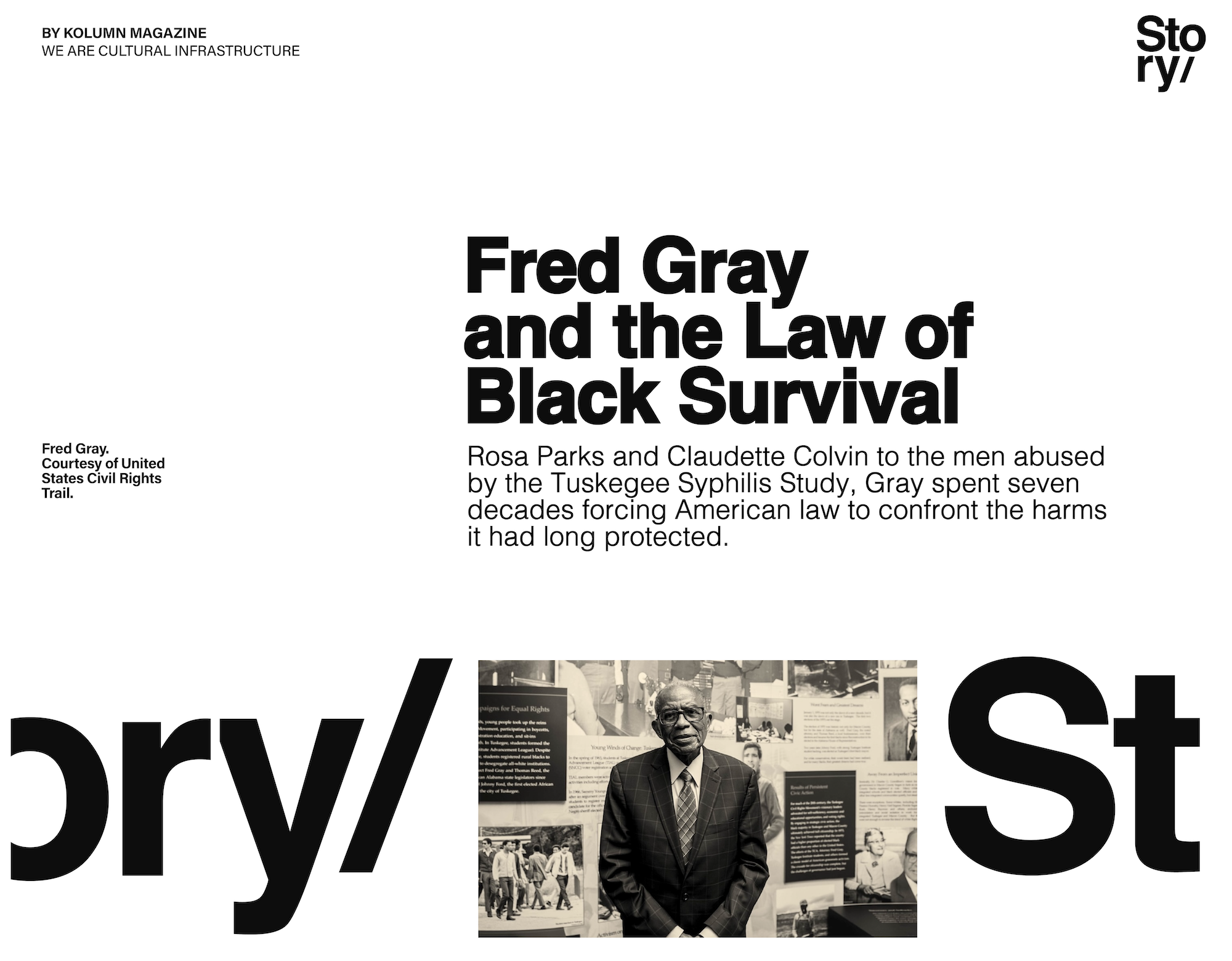
Fred Gray’s genius was not only that he believed Black people were right. It was that he knew how to make the law admit it.
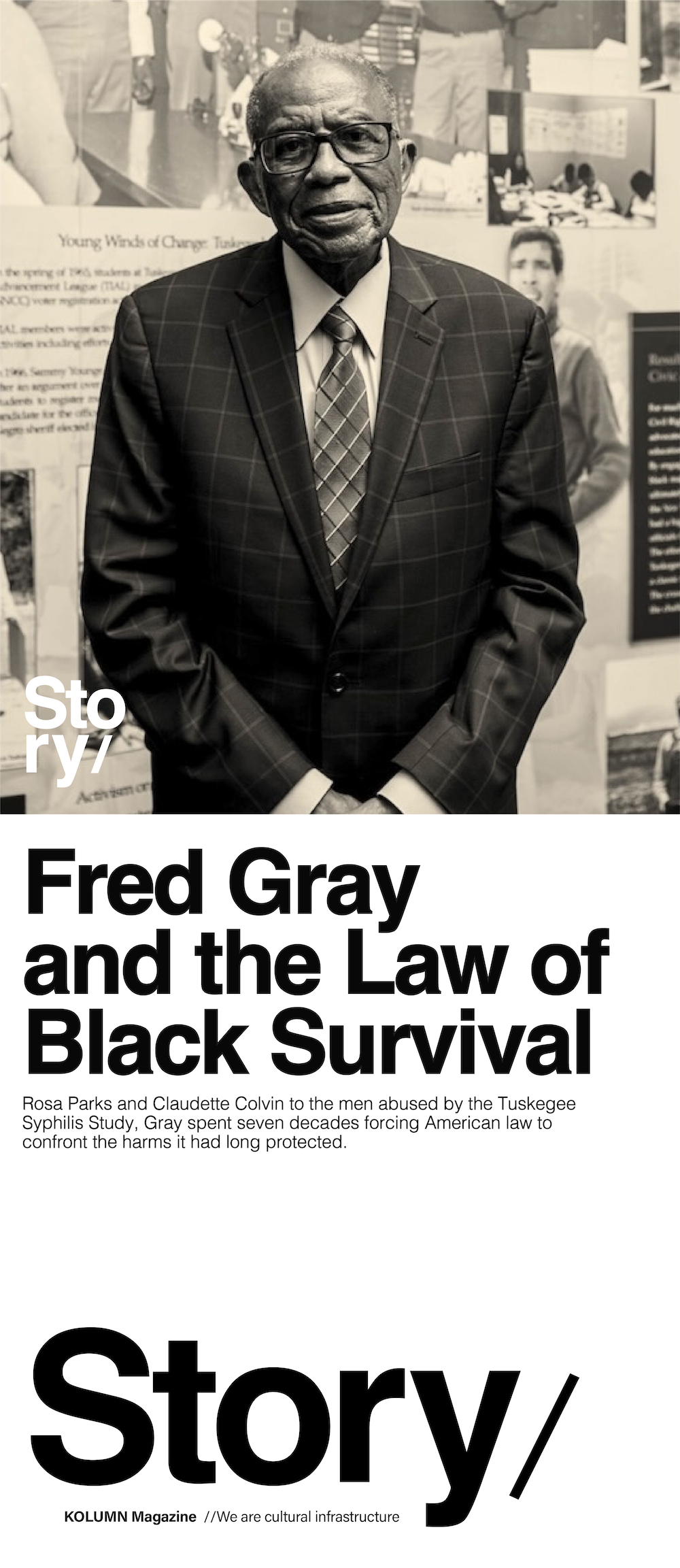
Fred Gray’s genius was not only that he believed Black people were right. It was that he knew how to make the law admit it.
By KOLUMN Magazine
There are civil-rights figures whose names arrive with immediate iconography. Martin Luther King Jr. brings the pulpit, the cadence, the march route, the jail cell. Rosa Parks brings the bus seat, the arrest, the stillness that changed the country. John Lewis brings the bridge. Fred Gray brings something less cinematic and, for that reason, often less fully understood: the legal brief, the client interview, the courthouse strategy, the patience to turn outrage into precedent. Yet without Fred Gray, much of what the public remembers as movement triumph might have remained moral theater instead of enforceable law.
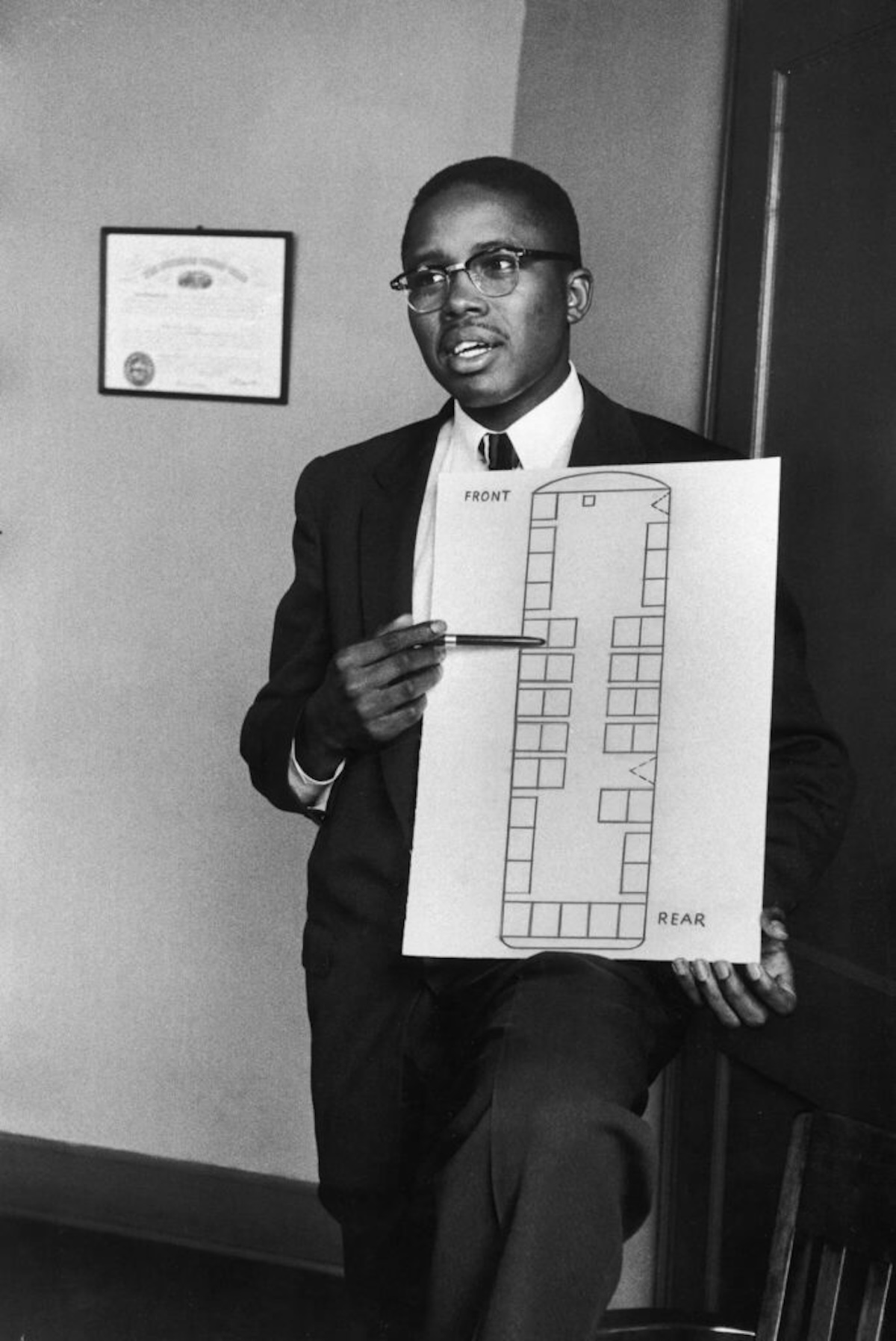
Martin Luther King Jr. once called Gray “the chief counsel for the protest movement,” as recorded by the Stanford King Institute. That description has endured because it is not ornamental. It is structurally true. Gray was not merely a lawyer who happened to represent civil-rights clients. He was one of the people who made it possible for the Black freedom struggle in Alabama to survive the transition from protest to judicial reckoning. He represented Rosa Parks, advised the Montgomery Improvement Association, represented Claudette Colvin, worked on the litigation that ended bus segregation, fought school segregation, defended the Selma marchers, challenged racist political boundaries in Tuskegee, and later represented the victims and families harmed by the Tuskegee Syphilis Study. Even into his nineties, he has remained publicly active, still speaking and still litigating, a point underscored by the U.S. Civil Rights Trail and recent reporting from the Associated Press.
That longevity matters because Fred Gray’s significance is not confined to the heroic years of the 1950s and 1960s. His career allows us to see the civil-rights movement not as a burst of moral clarity but as a long, grinding contest over institutions. He understood early that segregation did not live only in hateful custom. It lived in ordinances, school boards, jury systems, police departments, election maps, medical bureaucracy, and courthouse habits. To fight it required more than courage. It required legal imagination disciplined enough to meet the state on its own terrain and ruthless enough to expose the violence hidden beneath the language of order.
That is why Gray deserves to be read not only as a “movement lawyer” but as one of the master technicians of Black democratic survival. In recent KOLUMN pieces like “Before the Boycott Had a Name” on Claudette Colvin and “The Woman Whose Name Changed the Law” on Aurelia Browder, the magazine has already been tracing the people whose names were too often reduced to footnotes in the Montgomery story. A serious Fred Gray profile belongs in that same lineage. He was the connective tissue between those lives and the legal record. He helped make sure that Black refusal did not vanish into folklore. He placed it in the Federal Reporter.
Born into a city built for humiliation
Fred David Gray was born on December 14, 1930, in Montgomery, Alabama, a city he would later describe as both “the cradle of the Confederacy” and the eventual cradle of the modern civil-rights movement, as recounted in a 2023 appearance covered by Texas Tech University. The paradox is useful. Gray was born into a geography where white supremacy was not incidental but civic design. Montgomery was not simply a southern city with racist customs. It was a capital of racial management, a place where the state, memory, and daily life all worked to discipline Black existence.
The official oral history published by the U.S. District Court for the Middle District of Alabama notes that Gray grew up in Montgomery’s Washington Park section, entered school early, and later attended the Nashville Christian Institute, a Churches of Christ boarding school for Black students. Those details matter because they show the formation of two lifelong commitments: education and faith. Gray would become both a lawyer and an ordained minister. That dual formation helps explain the striking texture of his public language. He often speaks as someone for whom law is not merely procedural but moral, not merely adversarial but vocational. His later slogan “lawyers render service,” now part of his public legacy, was never empty branding. It condensed an ethic.
After the Nashville Christian Institute closed, Gray returned to Alabama and attended Alabama State College. He initially planned to become a history teacher and considered preaching as another path. But he also saw, firsthand, the humiliations Black riders faced on Montgomery buses, an experience highlighted in the Texas Tech University account. That everyday cruelty—so routine it could have been mistaken for the weather—became one of the conditions that pushed him toward law. He would go on to earn a law degree from Case Western Reserve University after Alabama’s segregationist regime made in-state legal education inaccessible on equal terms, a trajectory summarized by the Encyclopedia of Alabama and the Pennsylvania Academy of the Fine Arts profile page.
When Gray opened his Montgomery law office in 1954, he was entering a profession and a region organized to isolate someone like him. The Civil Rights Digital Library notes that he was one of the few Black attorneys in Alabama at the time. This is the sort of detail that can flatten into trivia if handled carelessly. It should instead sharpen our understanding of risk. To be one of the few Black lawyers in Alabama in the mid-1950s was not just to occupy a rare professional niche. It was to become legible to power immediately. Your clients would be watched. Your alliances would be watched. Your mistakes would be magnified. Your success would be treated as provocation.
Montgomery was not waiting for a savior. It was waiting for a lawyer who would stay.
The mythology of the Montgomery Bus Boycott often privileges its most visible figures, which is understandable but incomplete. Movements need charismatic voices, but they also need disciplined operators who can translate collective action into institutional pressure. Fred Gray became indispensable because he was prepared to do the work after the headlines: filing, briefing, counseling, strategizing, and protecting clients whose names the nation did not yet know.
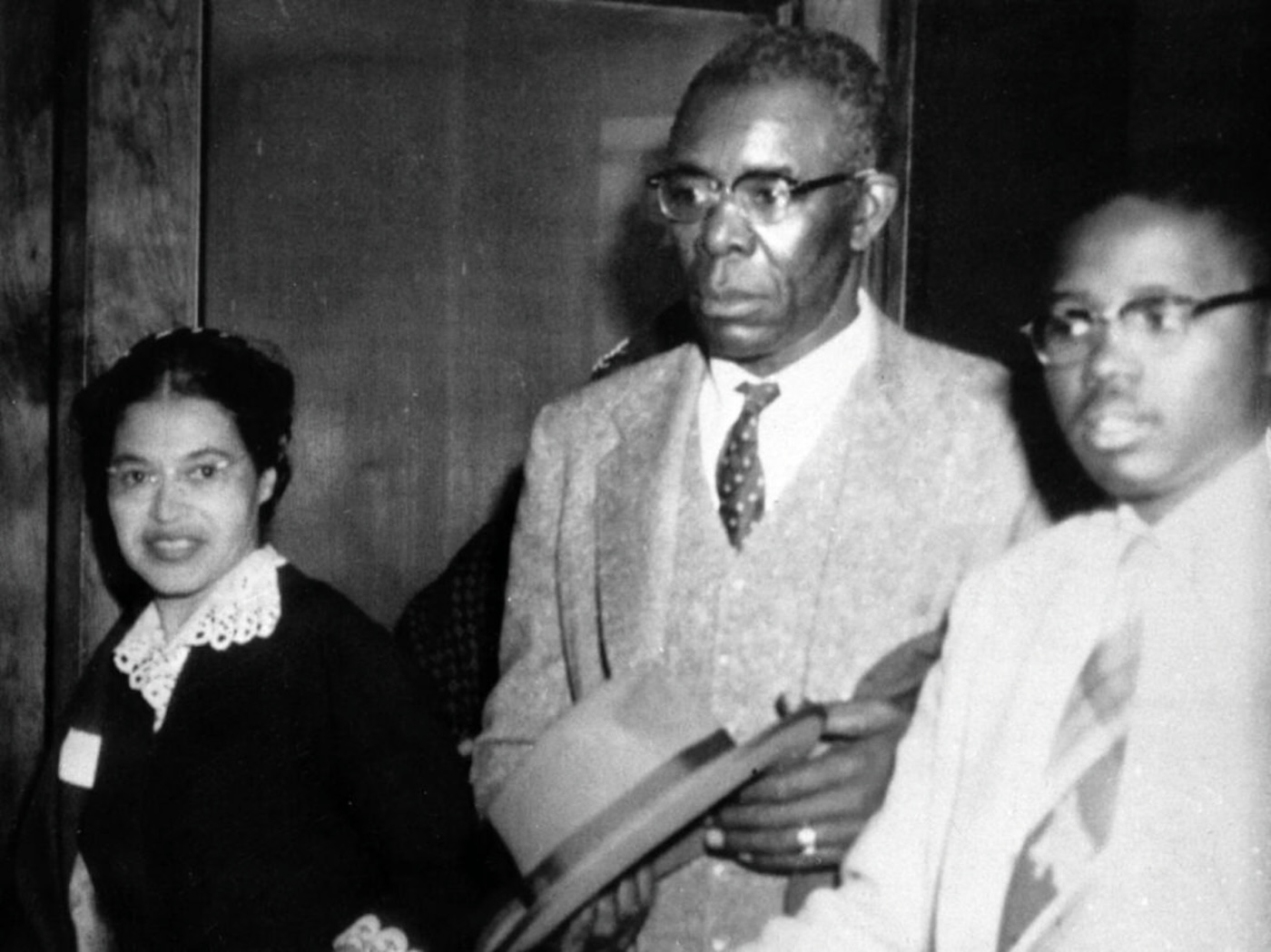
The Library of Congress notes that on December 13, 1955, in the earliest days of the boycott, Gray met with Rosa Parks, Martin Luther King Jr., and other leaders to discuss the legal path forward. Parks authorized the NAACP to process her case, and Gray—already serving as counsel to the Montgomery Improvement Association—agreed to represent her with advice from senior legal figures including Thurgood Marshall and Robert L. Carter. This is one of the hinge moments in movement history. It reveals that Montgomery’s resistance was never only spontaneous mass outrage. It was also, very early, an organized legal project.
Gray represented Rosa Parks after her arrest, but the larger strategic breakthrough came through Browder v. Gayle. As the National Park Service explains, Gray assembled Aurelia Browder, Susie McDonald, Claudette Colvin, and Mary Louise Smith to challenge Montgomery’s bus segregation laws in federal court, arguing that the scheme violated the Equal Protection Clause of the Fourteenth Amendment. The National Archives describes the case as one of the central legal landmarks associated with the boycott. The point here is crucial: the public symbol was Rosa Parks, but the federal case that broke the system required a broader plaintiff structure and a legal architecture calibrated for constitutional victory. Gray understood that distinction.
That fact alone should complicate the popular memory of movement lawyering. Gray did not merely defend against state punishment. He built offensive constitutional litigation. He knew that protest without a legal pathway could be contained, sentimentalized, or crushed. He also knew that law without movement pressure could stall indefinitely. His career, especially in Montgomery, demonstrates how Black organizers learned to make courtroom action and street action mutually reinforcing rather than sequential.
KOLUMN has already emphasized this ecosystem in pieces like “The Woman Who Set Montgomery in Motion” and “He Was There Before the Cameras”, which insist that the boycott’s endurance depended on logistics, unnamed labor, and longer strategic vision. A Fred Gray story deepens that argument. He was part of the hidden infrastructure that made the famous moments durable. He did not stand outside the movement as outside counsel. He was part of its machinery.
The clients history kept trying to shrink
One of the most important things about Fred Gray is that he repeatedly represented people whose public memory has been unevenly distributed. Rosa Parks became a global icon. Claudette Colvin did not. Yet Gray’s work linked them in the same legal and moral field.
The Equal Justice Initiative recently underscored that Gray’s storied career began in 1955 with Claudette Colvin and Rosa Parks. The Associated Press likewise noted, in its 2025 coverage of Gray’s statue unveiling, that he used the occasion to direct attention back toward lesser-known clients, including Colvin, who refused to surrender her seat months before Parks. That instinct—redirecting praise away from himself and toward clients history had relegated to the margins—is not incidental. It is part of his significance. Gray’s work did not merely produce legal wins. It preserved a wider cast of Black actors in the historical record.
This is one reason Gray matters so much to Black historical writing now. He stands at the intersection of biography and archive. Through him, one can recover the names that mass culture either simplified or discarded. In Alabama, Black women repeatedly risked arrest, job loss, and public exposure. Gray’s practice converted those acts from local episodes into federal claims. He gave those women not visibility alone but juridical consequence.
His representation of Martin Luther King Jr. is also often described too vaguely, as though Gray merely hovered nearby as the movement’s resident attorney. The Stanford King Institute is more precise: Gray provided legal advice to King, the Montgomery Improvement Association, the local and state NAACP, and the Montgomery Progressive Democratic Association. That scope matters. It shows that Gray’s work was institutional, not merely personal. He was not just King’s lawyer in the celebrity sense. He was counsel to a network of organizations that together carried a local insurgency into the realm of lasting public change.
The result is that Gray belongs in the story not only as a lawyer to heroes but as a guardian of movement plurality. His client list reminds us that no freedom struggle is composed solely of its most famous names. It is composed of a thousand people whom the state hoped to isolate one by one. Gray’s practice became a form of collective defense against that isolation.
He did not stop at buses because segregation did not stop at buses
A lesser lawyer might have been memorialized forever on the strength of Browder v. Gayle alone. Fred Gray kept going because he understood that bus segregation was only one expression of a larger system. Once you grasp that white supremacy is infrastructural, you stop confusing any single courtroom victory with final transformation.
Take Gomillion v. Lightfoot, the 1960 Supreme Court case arising from Tuskegee’s infamous racial gerrymander. The city had redrawn its boundaries into an absurd, twenty-eight-sided figure that excluded nearly all Black voters while preserving white power. The case is now canonical because it established that political district lines could violate the Fifteenth Amendment when engineered to disenfranchise Black citizens. The fact pattern is so outrageous that it can almost read like caricature. But that is exactly the point: segregationist governance was often grotesque in form because it was confident in impunity. Gray helped challenge that impunity. The Encyclopedia of Alabama identifies Gomillion as one of the landmark cases associated with his career.
Then there was school desegregation. The Encyclopedia of Alabama entry on Solomon Seay Jr. notes that Seay and Gray, working with the NAACP Legal Defense Fund, were central to Lee v. Macon County Board of Education, the 1963 litigation that became a major engine of public-school desegregation in Alabama. Again, Gray’s importance is not just that he appeared in the room. It is that he stayed in the long fight after the more photogenic flashpoints had passed. School desegregation was slower, more technical, and often more bureaucratically evasive than bus litigation. It required endurance across years of procedural resistance. Gray had that endurance.
He was also involved in litigation connected to the NAACP’s right to function in Alabama. In NAACP v. Alabama, the Supreme Court rebuked the state’s effort to suppress the organization. The Library of Congress Supreme Court report shows Fred D. Gray listed on the brief for petitioner alongside Robert L. Carter and other notable attorneys. That case is often told as a First Amendment and associational-rights landmark. It was also, more concretely, part of the state’s attempt to disable Black collective organizing by weaponizing administrative power. Gray’s presence there reflects the breadth of his work. He was not confined to transit cases or local arrests. He was helping defend the organizational capacity of the movement itself.
And when the movement moved toward Selma, Gray was there too. The Associated Press notes that he represented participants in the Selma-to-Montgomery marches of March 1965, one of the pivotal confrontations that accelerated passage of the Voting Rights Act later that year. This is where Gray’s career becomes impossible to narrate as a set of isolated achievements. He appears, again and again, at moments when Black Americans were forcing the nation to choose between democratic language and democratic practice. His role was to make evasion harder.
The Tuskegee Syphilis Study and the politics of repair
If Fred Gray had only fought legal segregation, he would already be a towering figure. But his career expanded into another field of American harm: state-sponsored medical abuse. His work on behalf of the men exploited in the Tuskegee Syphilis Study and their families marks one of the most morally devastating chapters in his life’s work.
The Encyclopedia of Alabama explains that after the study’s exposure, Gray sued on behalf of the men and their survivors, eventually securing a $10 million settlement and medical benefits. The Associated Press notes that this legal effort contributed to the chain of public accountability that culminated in President Bill Clinton’s 1997 apology. An Oxford Academic essay on the study underscores the historic importance of Gray’s role in seeking justice for the men after the federal government had knowingly allowed disease to run its course under the guise of research.
The Tuskegee litigation matters because it widens the usual frame through which Gray is viewed. He was not only a desegregation lawyer. He was a lawyer of Black bodily integrity. He confronted a federal system that had treated poor Black men not as citizens but as research material. To represent them was to insist that racism could not be quarantined to buses, schools, and voting booths. It also lived in hospitals, public-health agencies, and research design.
This part of Gray’s work feels especially urgent now because contemporary discussions of medical mistrust in Black communities are too often handled as cultural pathology rather than historical consequence. The Tuskegee case is one reason that mistrust exists. Gray’s involvement reminds us that “trust” is not a public-relations asset the state can demand. It is something institutions either earn or forfeit through conduct.
There is also something revealing in the way Gray’s legal career moved from civil-rights protest cases into medical redress. It suggests a broader theory of injustice than the one most public commemorations offer. In the tourist version of civil-rights history, racism is a problem of dramatic humiliation. In Gray’s case record, racism is a system of distributed power that can produce bus arrests, political disenfranchisement, school exclusion, and medical predation. The law had to be pushed across all those terrains because Black life was endangered across all those terrains.
A legislator, bar leader, and elder who refused ceremonial retirement
Another reason Fred Gray’s public image can feel oddly incomplete is that his post-movement achievements are substantial enough to constitute a second career. In 1970, he became one of Alabama’s first Black state legislators after Reconstruction, a milestone noted in recent AP coverage and in state and biographical summaries. Later, in 2002, he became the first Black president of the Alabama State Bar, a milestone emphasized by the Associated Press and the Alabama State Bar.
Those honors were not simply the establishment catching up to his excellence. They symbolized a deeper institutional transformation. Think about the historical arc: a Black lawyer begins practice in a state structured to degrade Black professional authority, then later becomes the first Black president of that state’s bar. That is not evidence that the profession redeemed itself fully. It is evidence that Gray forced it to confront the gap between its ideals and its practices.
The phrase most associated with his later public standing—“lawyers render service”—has become the Alabama State Bar’s motto, as noted in both AP and Alabama State Bar materials. It is a deceptively compact line. In Gray’s hands, it seems to mean at least three things. First, that law is a profession of duty rather than prestige. Second, that representation is not ethically neutral; whom you choose to serve matters. Third, that law’s legitimacy depends on whether it can be made useful to people whose humanity the social order routinely discounts.
He has also continued to receive national recognition. President Joe Biden awarded Gray the Presidential Medal of Freedom in 2022, as reported by the Associated Press and reiterated in legal-community notices such as the American Bar Foundation. In 2023, the American Bar Association gave him the ABA Medal, the organization’s highest honor. These recognitions are deserved, but they also create a danger: that Gray becomes easier to admire than to read. The elder statesman version of Fred Gray can be used to sand off the adversarial force of the younger one. It is more comfortable to celebrate the medal than to dwell on the country that made his lawsuits necessary.
Recent honors in Alabama have made that tension visible. In April 2025, a life-size bronze statue of Gray was unveiled outside the Alabama State Bar building in Montgomery, according to the Associated Press, the Alabama State Bar, and Alabama State University. Statues are flattering things. They also risk transforming movement actors into monuments that no longer trouble the present. Gray himself seemed to resist that flattening, using the moment to praise unnamed clients and to insist that the struggle for equal justice continues.
Faith, discipline, and the legal temperament
One of the less discussed dimensions of Fred Gray’s life is how explicitly his faith shapes his understanding of lawyering. The U.S. District Court oral history and the Associated Press both note that Gray is an ordained minister. That matters because it helps explain why his rhetoric so often oscillates between constitutional exactness and moral insistence. He does not appear to understand legal work as a private market skill detached from larger obligations. He understands it as service under ethical demand.
That sensibility also clarifies why Gray’s career has never sat comfortably within the narrow stereotype of the lawyer as elite technician. He is obviously technically gifted. But his work has always carried a pastoral dimension. He represented clients whose vulnerability was not abstract. They were arrested children, domestic workers, churchgoing women, movement leaders under surveillance, men deceived by the federal government, citizens cut out of democratic maps. To represent such people well requires more than intellectual competence. It requires steadiness in proximity to trauma.
This may be one reason Gray’s longevity feels so remarkable. The U.S. Civil Rights Trail reported that he was still working in his law practice in his nineties, and AP’s 2025 story makes clear that he remains publicly engaged. That sort of endurance is not just physical. It is existential. It suggests a person who never treated justice as a historical phase that ended when textbooks decided to relax.
Why Fred Gray matters now
Fred Gray matters now because the United States is once again deep in an argument over whether law protects democracy or merely administers hierarchy more elegantly. That question is not new. It is, in many ways, the central question of Gray’s career.
His life shows that American law does not naturally bend toward justice. It bends toward whatever organized pressure, moral clarity, litigation strategy, and institutional courage can force from it. Gray did not romanticize the courts. He used them. He also understood their limits. AP quoted him in 2025 acknowledging that the court system “doesn’t always deliver justice” even as he pledged to keep working. That is a harder, more adult democratic ethic than naïve faith in institutions or cynical abandonment of them. It is the ethic of someone who knows that law is both compromised and necessary.
He also matters because he offers a more sophisticated model of activism than today’s culture often rewards. Our political era privileges speed, visibility, and instant declaration. Gray’s career reminds us that transformation often requires repetition, paperwork, disciplined argument, coalition, and procedural endurance. There is nothing glamorous about drafting filings under hostile conditions, yet that labor is often where durable change begins.
For Black political thought in particular, Gray’s life is a rebuke to the false divide between radicalism and professionalism. He was impeccably professional and profoundly disruptive. He wore the suit and destabilized the order the suit was supposed to defend. He worked inside institutions without mistaking them for neutral terrain. He demonstrates that respectability and insurgency are not always opposites; sometimes one is a delivery system for the other.
KOLUMN’s recent work has been especially good at recovering this broader freedom infrastructure—the people who made change administratively, legally, pedagogically, and organizationally rather than solely through spectacle. In that sense, Fred Gray belongs beside the magazine’s treatments of Claudette Colvin, E. D. Nixon, C. K. Steele, and Amelia Boynton Robinson. He is one of the figures who allows readers to see the civil-rights era as an ecosystem rather than a pageant of icons.
The unfinished legacy
There is a temptation, when writing about men like Fred Gray, to end in reverence alone. Reverence is warranted, but it is insufficient. Gray’s real legacy is not that he can now be praised across party lines or installed in bronze. His legacy is that he leaves behind a demanding record. He asks what it means to practice law in a society whose official ideals and operational realities have so often diverged. He asks whether lawyers serve power or people. He asks whether institutions can be transformed without first being embarrassed. He asks whether the nation can ever honestly narrate its progress without naming the depth of the brutality from which that progress was extracted.
His life also complicates the way the movement is typically taught. Too often, civil-rights history is rendered as a morality tale with a narrow cast and a neat ending. Gray destroys that simplicity. His client list alone tells a different story: children, workers, ministers, organizers, survivors of medical abuse, disenfranchised voters, students denied equal schooling. His case history tells the rest: buses, elections, schools, organizational freedom, marching rights, medical accountability. This is not the record of a movement that solved one problem. It is the record of a country repeatedly forced to confront the many locations of its own anti-Black design.
And then there is the matter of place. Fred Gray is inseparable from Alabama. Montgomery and Tuskegee are not just backdrop in his story; they are laboratories of the American racial state. Gray’s greatness lies partly in the fact that he did not flee the terrain that formed him. He fought in it. He built a practice there. He represented people there. He returned, again and again, to the places where the state believed Black people could be managed most efficiently. That geographical fidelity matters. It means his career is not merely national in significance. It is local in method. He changed the country by staying in the places most invested in not changing.
That is why his story still feels so alive. Fred Gray is not simply a survivor from a noble past. He is evidence that the legal dimension of Black freedom work has never been optional. The issues change form, the jargon evolves, the constitutional theories update, the coalitions shift, but the underlying question remains familiar: who gets the full protection of law, and who must fight to be recognized by it?
Gray spent more than seventy years answering that question not with abstraction but with clients. Rosa Parks. Claudette Colvin. Aurelia Browder. Martin Luther King Jr. The Selma marchers. The men of Tuskegee and their families. Countless others whose names rarely headline commemorations. In his remarks at the 2025 statue unveiling, he stressed those “unknown heroes and clients” whose names never appear in print media or on television. That instinct may be the clearest window into his character. Fred Gray has spent a lifetime making sure the law had to look at people the culture preferred to overlook.
In the end, that may be the sharpest way to understand him. Fred Gray did not just win cases. He altered who could appear in the constitutional imagination of the United States. He helped move Black people from the status of tolerated subjects toward that of enforceable citizens. Not perfectly. Not finally. Not without backlash. But unmistakably.
And that is why Fred Gray remains one of the essential American figures of the last century and this one: because he knew that history is not changed only by those who refuse injustice in public. It is also changed by those who know how to pursue that refusal all the way into the record, all the way into precedent, all the way into the state’s own language, until the country is forced to hear what Black people had been saying all along.
He made the movement legible to the law. He made the law answer to the movement. And he is still, even now, part of the argument over whether justice in America will remain aspirational language or become something people can actually use.
More great stories
Afro Sheen, Wall Street, and the Architecture of Black Possibility
July 6, 2026
No Comments
The Fire Inside the Fourth
July 5, 2026
No Comments