




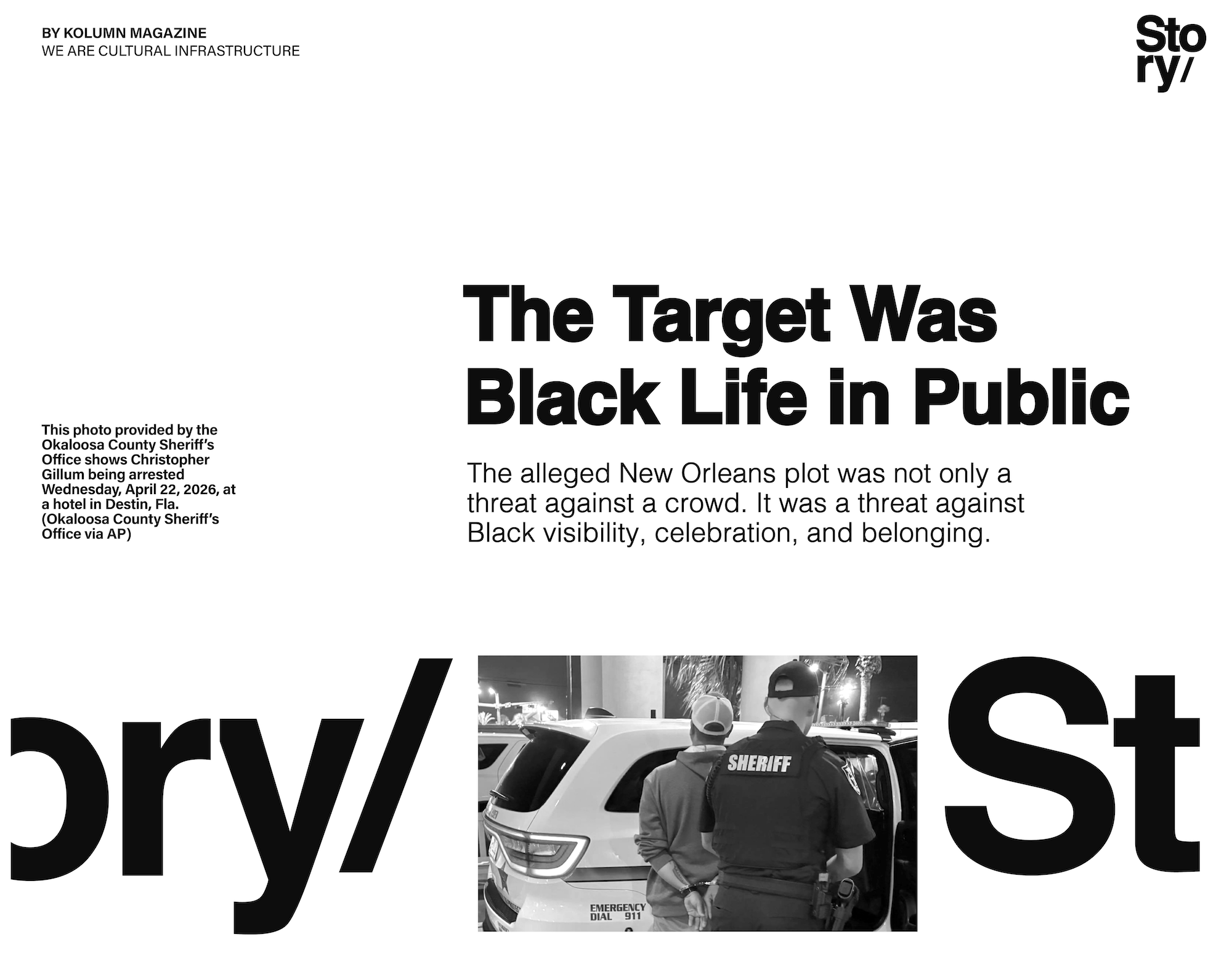
The threatened target was not only a crowd. It was Black public life — music, gathering, movement, pleasure, inheritance.
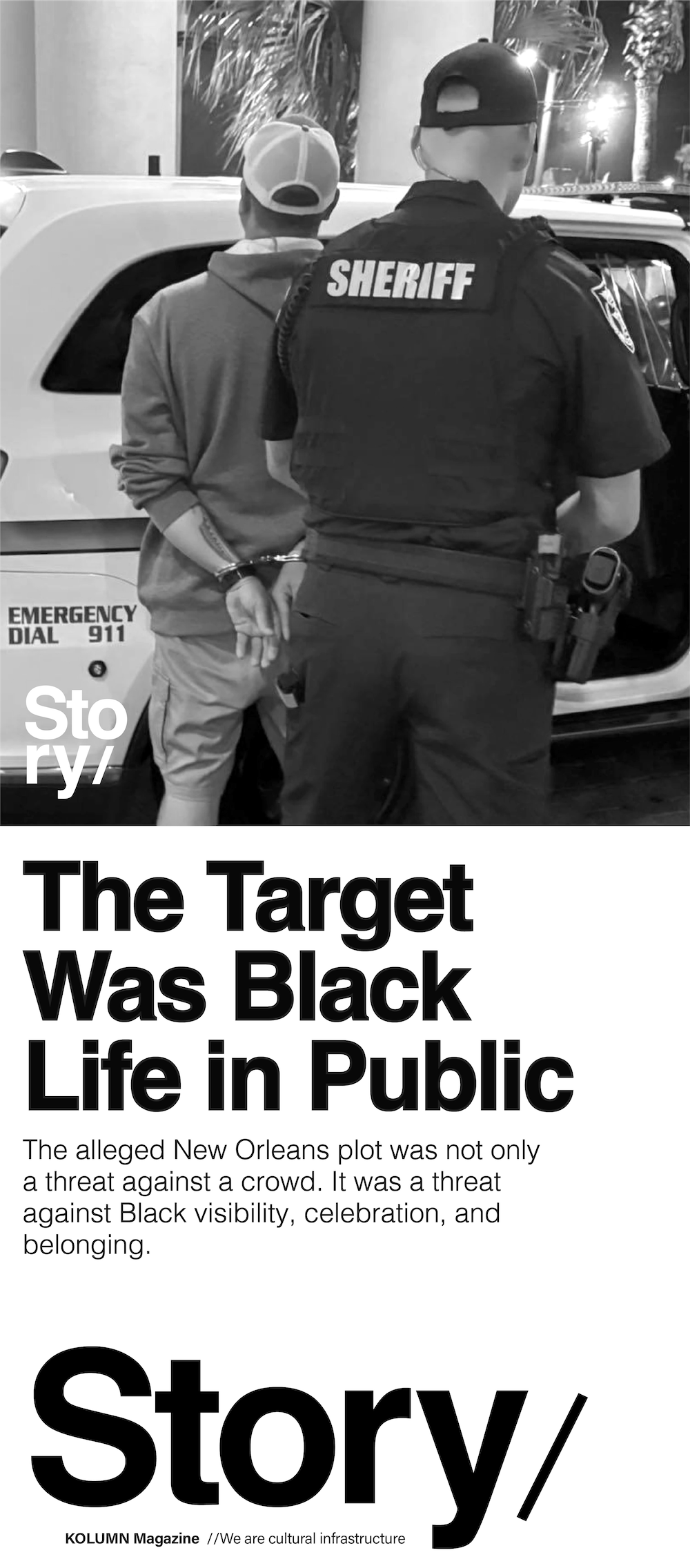
The threatened target was not only a crowd. It was Black public life — music, gathering, movement, pleasure, inheritance.
By KOLUMN Magazine
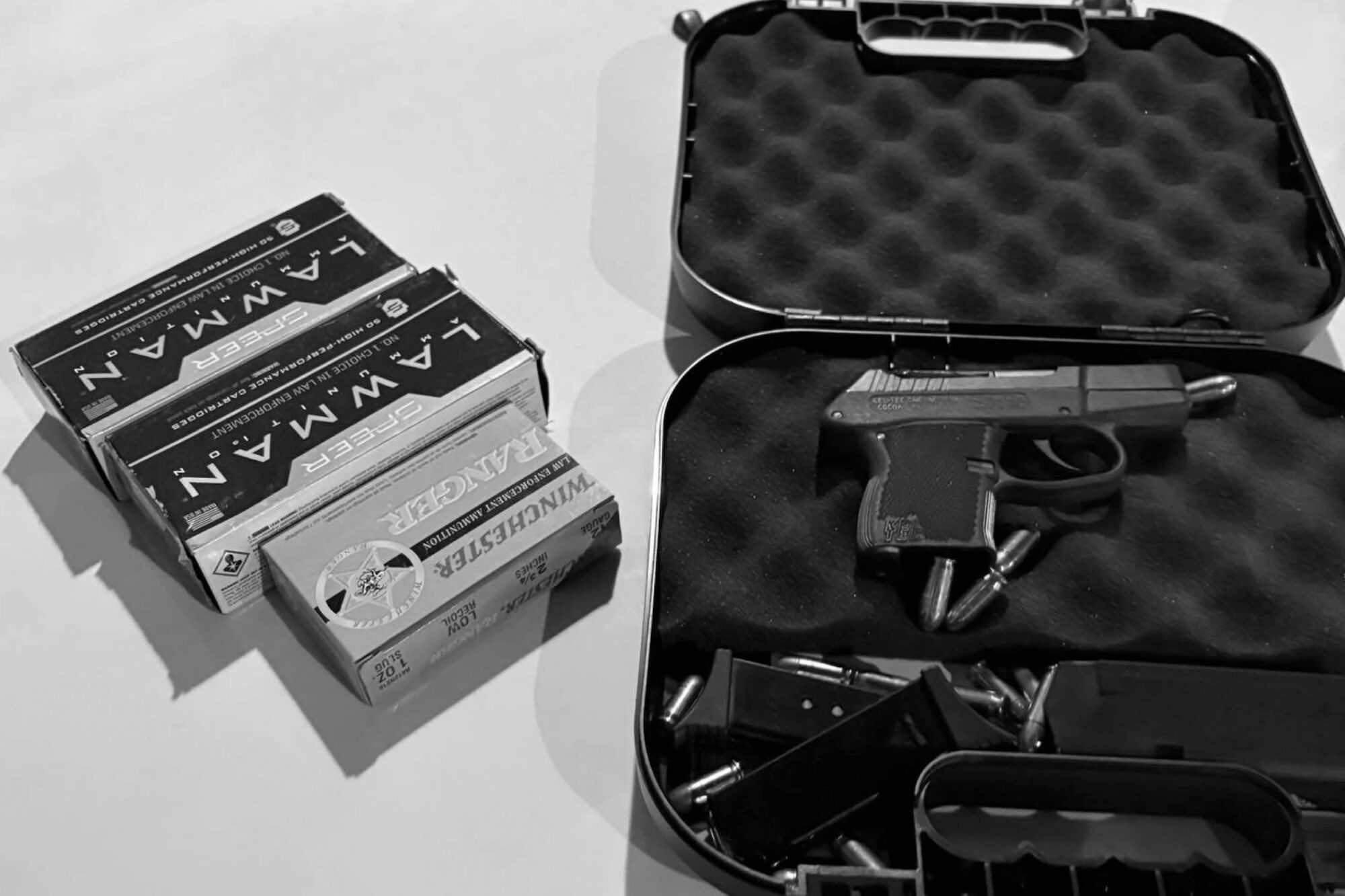
Before the brass bands, before the folding chairs, before the long lines for crawfish bread and the ritual argument over which stage deserved the afternoon, the warning moved through law enforcement channels. A North Carolina man named Christopher Gillum, a former law enforcement officer, had allegedly threatened to travel to New Orleans and carry out a mass shooting at a festival, with Black people described by authorities as the intended targets. The Associated Press reported that Gillum was arrested Wednesday evening, April 22, 2026, at a hotel in Destin, Florida, after authorities said he had been found with a handgun and roughly 200 rounds of ammunition.
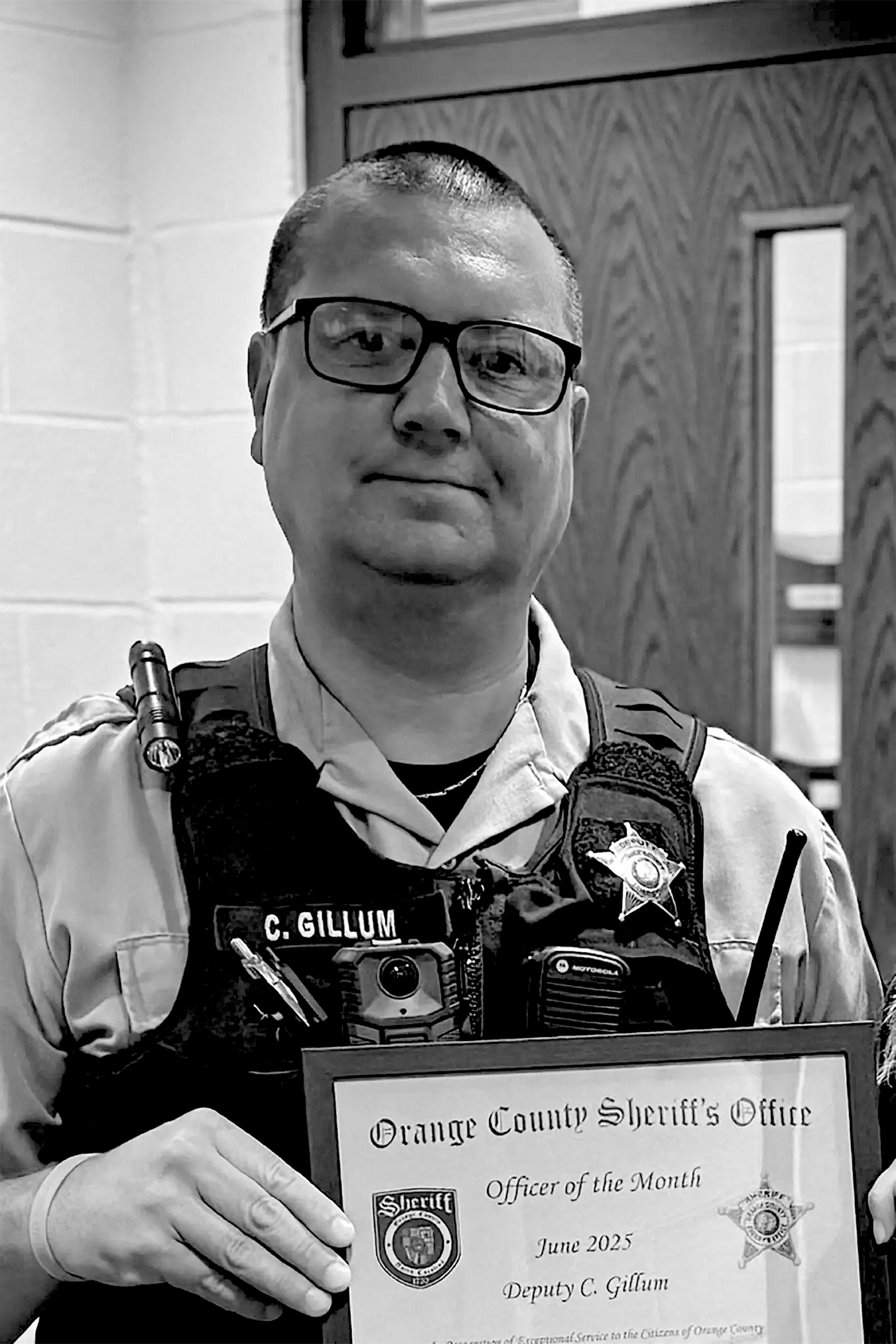
This is the kind of story America has learned to read too quickly. A name. A booking photo. A weapon. A target. A city preparing for celebration. A plot interrupted just before it could become a memorial. But the Gillum case demands slower attention, not because the accused deserves mythology, but because the threatened people do not deserve abstraction. According to authorities cited by the Associated Press, Gillum allegedly planned to kill Black people at a New Orleans festival and then die by “suicide by cop.”
The festival has not been officially named by authorities in every public statement, but the timing hung over the city. The 2026 New Orleans Jazz & Heritage Festival opened April 23 and was scheduled to run through May 3; the previous year’s Jazz Fest drew 460,000 fans, according to organizers cited by New Orleans CityBusiness. In New Orleans, a festival is never only an event. It is a public grammar of belonging. Jazz Fest, second lines, Mardi Gras Indian traditions, brass-band processions, neighborhood parades — these are not decorations around Black life in the city. They are part of how Black life has survived the city.
That is why the allegation lands with such force. A threat against a New Orleans festival is not merely a threat against entertainment. It is a threat against the civic stage on which Black culture has repeatedly transformed pain into sound, displacement into motion, and grief into communal choreography. In KOLUMN’s own recent essay on New Orleans second lines, The Second Line Is What Happens When People Won’t Disappear, the publication framed Black public celebration as a centuries-deep form of cultural continuity and civic insistence. The Gillum case, if prosecutors prove the allegations, belongs in that same moral geography: the long contest over whether Black people can gather in public without being treated as available targets.
What authorities say happened
The known facts are still developing, and the case remains an allegation. Gillum has not been convicted of the reported threat. But the available record, drawn from law enforcement statements and reporting by the Associated Press, WRAL, WXII, WVUE/Fox 8, and other outlets, sketches a multi-state intervention that began not as a terrorism case but as a missing-person concern.
According to the Associated Press, Gillum’s family reported him missing and warned authorities that he had made threats against Black people. WXII reported that the Alamance County Sheriff’s Office alerted Burlington Police Department’s Aerial Reconnaissance Tactical Intelligence Center, known as ARTIC, in connection with a missing-person case; as the inquiry progressed, Triad law enforcement officials said they developed reason to believe Gillum was a danger to himself and others.
The machinery that followed was modern, networked, and revealing. WXII reported that ARTIC investigators used FLOCK license-plate readers to determine Gillum was traveling south toward Florida, then contacted other agencies and disseminated an intelligence bulletin to law enforcement, including the New Orleans Police Department and Louisiana State Police. Gillum was later located at a Destin hotel and arrested without incident, according to the Okaloosa County Sheriff’s Office account reported by WXII and WVUE/Fox 8.
Authorities said deputies recovered a handgun and approximately 200 rounds of ammunition from his hotel room. The Louisiana charge publicly identified in reports was terroristic threats, and Gillum was being held in the Okaloosa County jail pending extradition.
The New Orleans-area anxiety was compounded by timing. Jazz Fest began the day after the arrest, and WVUE/Fox 8 reported that the FBI said there were no known threats to Louisiana festivals following Gillum’s arrest. That reassurance matters. So does the fact that reassurance is not the same as repair. For Black attendees, performers, vendors, and families, the report did not vanish simply because the accused man was in custody. The story entered the emotional weather.
The accused man in uniform
One of the most disturbing features of the case is not only what Gillum is accused of planning, but who he had been. WRAL reported that North Carolina certification records showed Christopher Gillum worked at the Chapel Hill Police Department, Orange County Sheriff’s Office, and Carolina Beach Police Department over the course of more than 20 years. Other reporting described him as a former Chapel Hill officer who served from 2004 until his resignation in 2019 and briefly returned in 2024.
That detail cannot be treated as incidental. When an accused person with a law enforcement background is alleged to have threatened racial violence, the story enters a deeper American archive. It touches the old fear that the person trained to enforce public safety may also understand its blind spots, its timing, its language, its thresholds for intervention. It also forces a question that institutions often prefer to avoid: how are warning signs identified, documented, and acted upon when the person raising concern has spent years inside the same professional culture that later must assess him?
This is not an argument for collective guilt. It is an argument for institutional seriousness. A former officer accused of planning racial mass violence is not simply a “lone wolf” story. It is a personnel story, a threat-assessment story, a weapons-access story, and a public-trust story. If the allegations are proved, the public will deserve a fuller accounting of Gillum’s career exits, any known disciplinary history, any mental-health or violence-related interventions, and whether law enforcement employers saw warning signs before his family did.
The phrase “former officer” also carries a particular weight in Black communities. KOLUMN has repeatedly returned to the way racial terror has often involved not only mobs or vigilantes but the choices of uniformed institutions. In The Bombs Before the Riot, KOLUMN wrote about Chicago’s 1917–1919 racial bombings and argued that in many stories of racial terror, the most consequential actor is not always the masked attacker but the institution that fails to act. The Gillum case, by contrast, appears at this early stage to be a story of institutions acting in time. But the shadow remains: Black safety has often depended on whether warnings are believed before bodies fall.
New Orleans as symbol and target
To understand the alleged target, one must understand New Orleans as more than geography. New Orleans is one of America’s great Black cultural capitals, a city whose public sound has carried African, Caribbean, Creole, Catholic, working-class, and Southern histories into forms the world recognizes even when it does not know their origins. A second line is not a parade in the tourist sense. A brass band is not background music. Jazz is not just a genre. These are forms of public memory.
That memory is not sentimental. It has been made under pressure. Black New Orleans has endured slavery, segregation, redlining, disinvestment, policing battles, Hurricane Katrina, displacement, tourist extraction, and the constant conversion of local culture into marketable atmosphere. Yet the city continues to move. Its genius has often been the ability to make survival visible without making it simple.
That is what gives the alleged threat its symbolic violence. Authorities said Gillum planned to attack a festival crowd and kill Black people. A festival crowd in New Orleans is not racially or culturally monolithic, but Black presence at Jazz Fest and in the city’s festival ecosystem is foundational. Black labor built the music. Black neighborhoods incubated the traditions. Black vendors, culture-bearers, musicians, families, and elders give the city much of what visitors arrive to consume.
New Orleans has also been living with public-safety trauma. WSJ reporting noted that the region still remembered the New Year’s Day 2025 vehicle attack in New Orleans, which killed 14 people. That context matters because mass threats do not fall on blank civic ground. They land on cities already trained by grief. Security officials, festival organizers, residents, and visitors now move through a ritual of vigilance that has become common in American public life: bag checks, barricades, cameras, police towers, emergency alerts, and the uneasy reassurance that no known threat exists.
The result is a public culture that is both resilient and burdened. People still come. The music still starts. But the freedom to gather is increasingly conditioned by the knowledge that someone, somewhere, may see a crowd as an opportunity for spectacle, grievance, or racial punishment.
The racial grammar of the alleged threat
The most important word in this case may be the one that often gets softened in headlines: Black. Authorities said Gillum threatened Black people. That reported specificity is not a side detail; it is the core of the alleged plot. Without it, the case becomes another generalized mass-shooting scare. With it, the case belongs to a lineage of racial terror.
The United States does not lack examples. Black churches bombed. Black students shot. Black neighborhoods burned. Black shoppers murdered. Black activists beaten in jail. Black homeowners terrorized for crossing residential lines. Black public life has often been treated as provocation: the schoolhouse, the church, the polling place, the supermarket, the parade route, the neighborhood block, the concert field.
KOLUMN’s recent piece What Happened at Colfax revisited the 1873 massacre in Louisiana, where more than 100 Black men were killed by armed white supremacists, with estimates ranging from at least 60 to as many as 150. That history is not being invoked to collapse past and present into the same event. It is being invoked because racial terror has always relied on public message. Violence against Black people has often been designed not only to kill the immediate victims but to discipline the living: stay home, stay quiet, stay afraid, stay in your place.
The alleged Gillum threat, if proven, would fit the modern grammar of that old message. A festival is visible. A crowd is symbolic. A shooting at a major cultural event would not only produce casualties; it would produce broadcast terror. That is why prosecutors, journalists, and the public must avoid framing the alleged plot solely as personal crisis. Personal crisis may be part of the case. But a threat to kill Black people is also a racialized political fact.
The FBI’s hate-crime framework defines hate crimes as criminal offenses motivated, in whole or in part, by bias against protected categories including race, religion, disability, sexual orientation, ethnicity, gender, and gender identity. The Justice Department reported that law enforcement agencies submitted 11,679 hate-crime incidents involving 14,243 victims for calendar year 2024. Those data are imperfect and widely understood to be underreported, but they help locate the Gillum allegation within a broader national landscape in which bias-motivated threats remain a persistent feature of American life.
Prevention is not luck
The Gillum case appears to have been interrupted by a combination of family warning, local law enforcement escalation, real-time intelligence tools, interstate communication, and an arrest warrant. That sequence matters. Prevention is often discussed after tragedy as a list of missed signs. Here, at least based on the public record so far, the signs were acted upon.
The Secret Service National Threat Assessment Center has repeatedly emphasized behavioral threat assessment as a prevention model focused not on demographic profiles but on observable behaviors, communications, grievances, planning, access to weapons, and leakage of intent. Its report on mass attacks in public spaces from 2016 to 2020 stated that there is no single profile of a mass attacker and that prevention depends on identifying concerning behavior and intervening before violence occurs.
The Gillum case, as reported, contains several elements threat-assessment professionals often worry about: alleged threats, reported suicidal intent, travel toward a potential target area, weapon possession, ammunition, and a specific racial animus. Authorities said he planned to conduct a mass shooting and then commit suicide by cop. If that account is accurate, the case was not merely a vague online rant. It had movement, means, and stated intent.
At the same time, the case raises civil-liberties and accountability questions that serious journalism should not ignore. License-plate readers, real-time crime centers, and interstate intelligence bulletins are powerful tools. WXII reported that investigators used FLOCK license-plate readers to determine Gillum was traveling south toward Florida. In this case, those tools appear to have helped locate a man accused of making a grave threat. But the public still deserves oversight around how such systems operate, how long data are retained, who accesses them, and how errors are corrected.
That tension is not a reason to dismiss the intervention. It is a reason to govern it. Black communities know both sides of the public-safety dilemma: the terror of being unprotected when threats are real, and the danger of being over-policed when surveillance expands without accountability. The Gillum case should not be used as a blank check for every technology law enforcement wants. Nor should skepticism about surveillance blind us to the value of rapid intervention when credible threats emerge.
Mental health, violence, and the danger of lazy explanations
Some reports have noted that Gillum had a history of mental-health concerns or self-harm. The Associated Press reported that family members described such concerns when they contacted authorities. That fact must be handled carefully. Mental illness is not a synonym for violence, and most people experiencing mental-health crises do not commit mass attacks. Reducing an alleged racial mass-shooting plot to “mental illness” does two forms of harm at once: it stigmatizes people with mental-health conditions and obscures the ideological content of the threat.
The more precise frame is layered risk. A person may be in crisis, may hold racist beliefs, may possess weapons, may communicate intent, may begin traveling toward a target, and may imagine death by police as part of the plan. None of those elements alone tells the whole story. Together, they create an urgent prevention problem.
This is where public language matters. “Troubled man” is too soft. “Monster” is too easy. “Alleged attacker” may be legally careful but morally incomplete if it strips away the racial target. The better language is disciplined: Christopher Gillum, a former North Carolina law enforcement officer, is accused of making terroristic threats connected to an alleged plan to conduct a mass shooting at a New Orleans festival and kill Black people. That sentence preserves the allegation, the office history, the racial target, and the seriousness of the conduct.
It also prevents a familiar escape route. America often individualizes racist violence after the fact. The accused was disturbed. The accused was isolated. The accused was spiraling. Those things may be true in particular cases, but they do not erase the social scripts from which racial violence draws meaning. People do not invent anti-Blackness alone in a locked room. They inherit it, absorb it, perform it, and sometimes weaponize it.
The festival as Black infrastructure
A festival can look frivolous to outsiders. It is not. In New Orleans, festival culture is an economy, an archive, a workplace, a reunion, and a ritual calendar. Jazz Fest alone drew 460,000 fans in 2025 and showcased Louisiana music, food, crafts, and cultural programming, according to New Orleans CityBusiness. The New Orleans Jazz & Heritage Festival and Foundation owns the festival, and proceeds support year-round work in education, economic development, and cultural enrichment, the outlet reported.
That means a threat against the festival ecosystem is also a threat against workers: musicians, stagehands, cooks, security staff, drivers, culture-bearers, small vendors, artists, neighborhood entrepreneurs, and families who rely on seasonal income. It is a threat against memory work. It is a threat against the fragile civic agreement that people can gather in large numbers and be more than vulnerable bodies.
KOLUMN’s recent New Orleans coverage has repeatedly treated Black culture as infrastructure rather than atmosphere. In The Houses That Held the Line, the magazine examined Black builders, free people of color, enslaved laborers, and wage workers whose skill shaped New Orleans’ built environment. In The Camera as Citizenship, it considered the work of Arthur P. Bedou and Black photography in New Orleans as a form of self-representation and institutional memory. The Gillum story belongs beside those pieces because it reminds us that culture is not merely what Black communities create. It is also what must be defended.
The arrest came before catastrophe. That fact should be honored without romanticizing danger. No one should have to feel grateful that a festival was not massacred. No city should have to convert prevention into celebration because the alternative would have been unbearable.
Why this story cannot become spectacle
There is a risk in writing about interrupted mass violence. The accused can become the gravitational center. His biography can expand; his grievances can be rehearsed; his weapons can become props in a national theater of dread. Responsible coverage must resist that pull.
The public needs to know the operational facts: who was threatened, what authorities allege, how the intervention unfolded, what charges are pending, whether the threat was racially motivated, whether any institutions missed earlier signs, and what protections are now in place. The public does not need lurid fascination. It does not need the accused man turned into an antihero of menace. It does not need Black fear used as clickable atmosphere.
That is especially true because the threatened community is not hypothetical. Black New Orleanians have names, jobs, churches, families, favorite food booths, preferred stage routes, and inherited relationships to the city’s sound. The alleged target category — Black people — contains elders who remember segregation, children learning festival traditions for the first time, musicians whose families built the repertoire, and workers whose labor makes public celebration possible.
In this sense, the best journalism about the Gillum case should widen the frame without losing the facts. It should ask what the arrest tells us about threat prevention, race, policing, guns, public gathering, and the emotional burden placed on Black communities in a country where the phrase “mass shooting threat” is no longer shocking enough.
The law, the charge, and the presumption
Gillum is entitled to the presumption of innocence. That is not a technicality; it is a democratic requirement. Reports indicate he was wanted in Orleans Parish on a terroristic-threats charge and was held in Florida pending extradition. Prosecutors will have to prove the case in court. The public record may change as charging documents, court appearances, defense arguments, and investigative findings emerge.
But presumption of innocence does not require presumption of insignificance. The allegations are serious. The reported evidence — threats, travel, weapon possession, ammunition, and alleged racial targeting — deserves public scrutiny. So does the institutional response. If the system worked, how? If it nearly failed, where? If family members sounded the alarm, what support did they receive? If involuntary commitment or protective intervention was considered, what legal thresholds shaped the response? If law enforcement agencies shared intelligence, what did they know and when?
Those questions should be answered through records, court proceedings, interviews, and careful reporting. They should not be answered by rumor.
A country trained to almost-mourn
America has developed a grim category of relief: the mass shooting that did not happen. The school threat interrupted. The synagogue plot detected. The nightclub plan stopped. The festival attack prevented. These stories are often treated as clean victories. They are victories, but they are not clean. They reveal that the conditions for mass harm were already assembled. The weapon existed. The grievance existed. The target existed. The only missing element was completion.
That is why “thwarted” can be a misleadingly tidy word. It suggests closure. But for people who were named as targets, the story does not close when the suspect is booked. It lingers in the body. It changes how people stand in a crowd. It adds another layer to the already unequal psychology of public space.
Black Americans have long had to navigate joy with contingency plans. Church with exit routes. Grocery shopping with vigilance. Protest with legal support. School with historical memory. Festivals with emergency awareness. The Gillum allegation extends that burden into one of New Orleans’ most visible rituals of cultural abundance.
KOLUMN’s After Orangeburg, Before the Reckoning argued that the Orangeburg Massacre matters because it reveals continuity between segregation-era policing and later forms of state violence. The Gillum case is different in key ways: the alleged attack was stopped, and law enforcement appears to have moved with urgency. But the continuity lies elsewhere — in the recurring vulnerability of Black gathering, and in the knowledge that racial terror adapts to the public spaces each generation holds dear.
What accountability should look like now
The immediate accountability belongs to the courts. Gillum should be prosecuted based on evidence, and the public should be informed through verified filings rather than speculation. But broader accountability extends beyond one defendant.
Law enforcement agencies should explain, when legally possible, how the warning traveled from North Carolina to Florida to Louisiana, what protocols worked, and what delays or barriers appeared. Agencies should also clarify whether any prior employment issues in Gillum’s law enforcement career raised concerns relevant to violence, bias, weapons, or psychological fitness. If there were warning signs, the public deserves to know whether they were documented and shared appropriately.
Festival organizers and public officials should continue communicating clearly with attendees without inflating fear. WVUE/Fox 8 reported that the FBI said there were no known threats to Louisiana festivals after the arrest. That message is necessary, but it should be paired with visible, competent safety planning that does not turn cultural gathering into a militarized spectacle.
Policymakers should resist the temptation to use the case as a slogan. It is not simply a gun story, though guns matter. It is not simply a mental-health story, though crisis intervention matters. It is not simply a policing story, though Gillum’s background matters. It is not simply a hate story, though anti-Black targeting appears central to the allegation. It is all of these at once, which is why single-cause politics will fail to explain it.
The city keeps playing
The cruelest thing about threats against Black cultural life is that they attempt to make ordinary joy feel reckless. They ask people to treat their own gathering as danger. They try to turn music into exposure, dance into risk, family tradition into vulnerability.
New Orleans has heard versions of that demand before. The city’s Black communities have been told, in countless ways, to shrink their sound, reroute their movement, quiet their mourning, commercialize their culture, and make their survival more convenient for outsiders. Yet the second line continues. The brass still answers. The drum still calls people into the street.
That does not mean fear is absent. It means fear does not get the final arrangement.
Christopher Gillum’s arrest, if the allegations are borne out, will stand as a narrow escape from racial mass violence. But the deeper story is not about him. It is about the people he allegedly wanted to harm and the culture he allegedly chose as a stage for terror. It is about a city where Black public life remains both celebrated and exposed. It is about the difference between security as performance and safety as a lived condition. It is about whether America can learn to treat threats against Black joy with the same seriousness it brings to the aftermath of Black death.
For now, the music continues under watch. The gates open. The crowd gathers. The city moves with the uneasy knowledge that a catastrophe may have been prevented just in time.
And somewhere inside that knowledge is the demand that this not be enough.
More great stories
Afro Sheen, Wall Street, and the Architecture of Black Possibility
July 6, 2026
No Comments
The Fire Inside the Fourth
July 5, 2026
No Comments