



...the difference of colour and complexion... does not alter the nature or quality of a man.
...the difference of colour and complexion... does not alter the nature or quality of a man.
By KOLUMN Magazine
There are some figures in political history who become famous because institutions finally decide they are safe to remember. Then there are figures like Ottobah Cugoano, who remain harder to domesticate because what they said still feels uncomfortably current. Cugoano did not merely ask Britain to feel pity. He did not simply provide the sentimental testimony that white reformers could package into moral uplift. He named the transatlantic slave trade for what he believed it was: organized theft, piracy, national sin, and a structure so violent that no civilized people could claim innocence while profiting from it. Born in what is now Ghana, kidnapped as a child, enslaved in Grenada, freed in England, and transformed into one of the most radical abolitionist writers of the 18th century, Cugoano belongs in the front rank of Black Atlantic political thought. Yet he is still too often treated as a footnote to men whose names fit more comfortably into textbook chronology.
That relative obscurity is not accidental. Cugoano’s work made demands that were more sweeping than many of his contemporaries wanted to hear. He did not argue for the slow moral improvement of slaveholders. He did not accept gradualism as wisdom. He did not flatter Parliament, the Crown, or the church. In his 1787 book, Thoughts and Sentiments on the Evil and Wicked Traffic of the Slavery and Commerce of the Human Species, he called for an immediate end to the trade, freedom for the enslaved, and moral accountability for the people and institutions that sustained the system. Modern scholars now describe him as one of the most radical abolitionist voices in Georgian Britain, and English Heritage calls his book among the earliest Black-authored anti-slavery works published in Britain, as well as the most radical of its era.
That radicalism is precisely why he matters now. If KOLUMN Magazine’s recent work on David Ruggles traced how Black abolitionists built infrastructures of escape and insurgent care before official history caught up, Cugoano belongs to that same moral and political lineage: he was part of the abolitionist tradition that refused to beg empire for gentleness and instead exposed the entire arrangement as illegitimate. He did not ask Britain to be kinder inside slavery. He asked what right Britain had to call itself Christian, lawful, or civilized while trafficking in human life.
Taken From Home, Not From History
Cugoano was born around 1757 in Ajumako, on the coast of present-day Ghana, then part of the Gold Coast. By his own later account, he came from a Fante family and was kidnapped at about age 13 while playing near his uncle’s house. That detail matters, and not only biographically. In his later writing, Cugoano used the memory of that abduction to demolish one of the central lies of proslavery argument: that Africans sold their own indiscriminately, that children were naturally detached from kinship, or that Atlantic slavery could somehow be explained away as a legitimate extension of war, debt, or punishment. His story insisted on something the trade’s defenders needed to blur: he was not captured in just war, not punished for crime, not lawfully bound by debt. He was stolen.
He was sold to Europeans in exchange, he later wrote, for “a gun, a piece of cloth, and some lead,” then forced through the Middle Passage to the Caribbean. English Heritage notes his harrowing recollection of captives so desperate aboard ship that death seemed preferable to continued transport. He was taken to Grenada and made to labor in plantation gangs for nearly two years. London Museum and other historical sources emphasize that his anti-slavery politics did not emerge in abstraction; they were forged in the sugar economy’s machinery, where African captivity was converted into imperial wealth. His book was not a philosophical exercise detached from experience. It was testimony sharpened into doctrine.
In 1772, he was brought to England by Alexander Campbell, a slaveholder who had purchased him in Grenada. The same year, Lord Mansfield issued the famous Somerset ruling, which held that James Somerset could not be forcibly removed from England and sent back into slavery. Historians remain careful here: the decision did not abolish slavery across the British Empire, and it did not magically free everyone in Britain. But it cracked the presumption that masters could move Black people through English soil as unquestioned property. Cugoano arrived in this unsettled legal atmosphere, and English Heritage notes that while the precise mechanism of his liberation remains unclear, the Somerset case may have encouraged or enabled his freedom. He was baptized at St. James’s, Piccadilly, in August 1773 under the name “John Stuart,” an alias he would later use in his political correspondence.
This uncertainty around his manumission has sometimes tempted historians into vagueness, but the more important point is the transformation that followed. In Britain, Cugoano did not simply pass from bondage into anonymity. He learned to read and write, absorbed theology and political debate, and entered a metropolitan world in which Black presence was visible but precarious. London in the late 18th century contained a sizable population of people of African descent, many of them formerly enslaved, many living under conditions of instability and racial hostility. A recent Guardian adaptation from Brooke Newman’s work notes that by the 1780s there were roughly 4,000 people of African descent in London. Cugoano would become one of the city’s most forceful Black political voices.
London Made Him Visible, and He Made London Answer
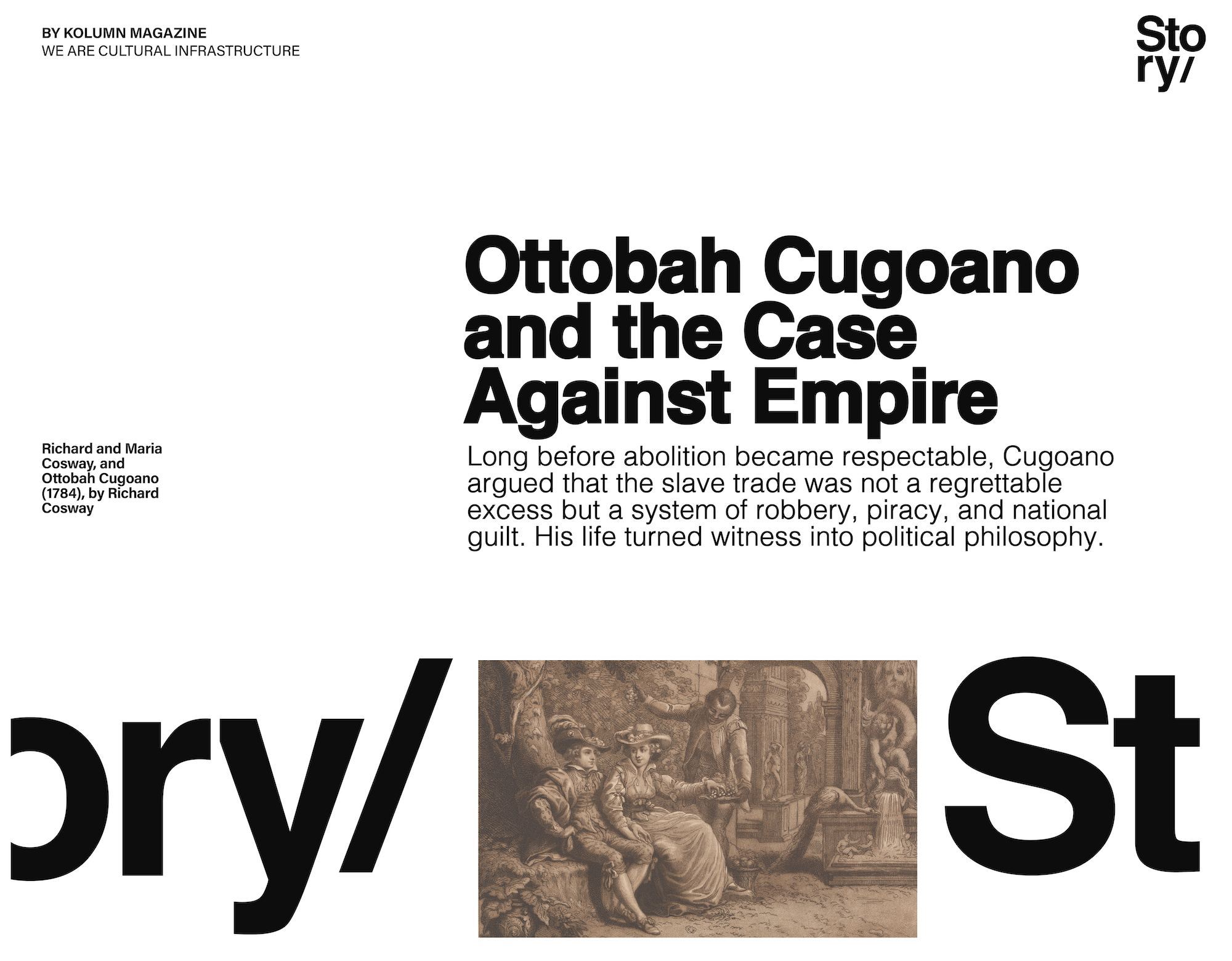
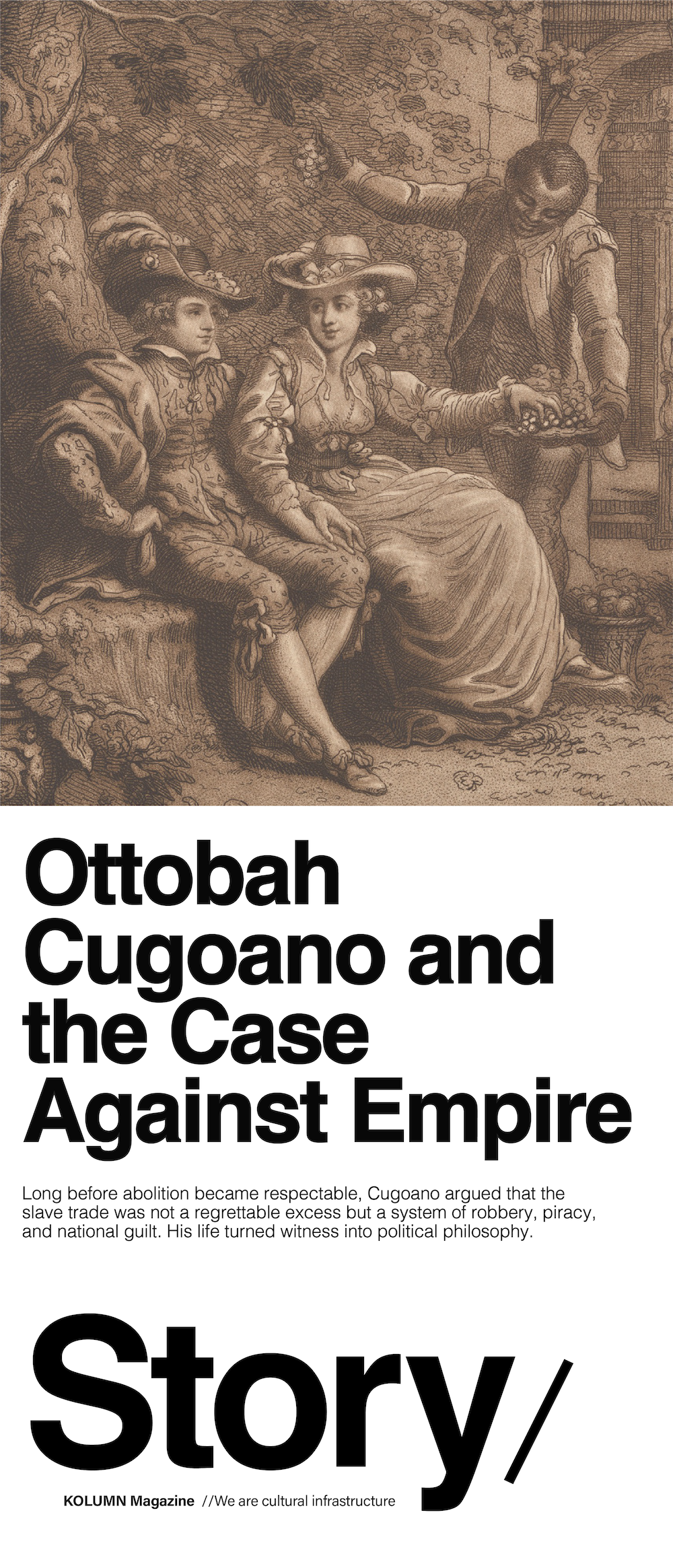
By the mid-1780s, Cugoano was working in the household of the artists Richard and Maria Cosway at Schomberg House on Pall Mall, later moving with them to Queen Street in Mayfair. This domestic position might, in another telling, be framed as a minor footnote in elite London life. In Cugoano’s story, it becomes something more revealing: a reminder that Black life in Britain was often staged within imperial intimacy. He served in a world of fashionable art, aristocratic patronage, and cultivated manners. Yet that same world was underwritten by colonial extraction, plantation profits, and the ready social acceptability of Black servitude. English Heritage and London Museum both stress that the only known image associated with him shows him in that setting, as a servant in the Cosways’ orbit. The visual record itself tells the story of empire’s preferred optics. (English Heritage)
But Cugoano did something empire never likes its servants to do: he converted proximity into critique. Through the Cosways’ circles, he came into contact with artists, politicians, and men of influence, including the Prince of Wales’s milieu. A recent Guardian excerpt on royal ties to slavery recounts that in 1786 Cugoano sent the Prince of Wales anti-slavery tracts and an appeal to consider the barbarity inflicted on Africans. He understood that polite society was not separate from power. It was one of the rooms where power reproduced itself. So he entered the room, and he sent the indictment in. (The Guardian)
His activism was not only literary. English Heritage records that in 1786 he helped campaign, alongside another Black Briton and a white abolitionist, to save Harry Demane from being forcibly shipped to the West Indies. Other historical accounts identify the intervention more specifically: Demane had been tricked or kidnapped onto a vessel, and Cugoano helped alert Granville Sharp, who secured his removal before the ship sailed. The incident is crucial because it shows Cugoano acting not merely as a commentator on injustice but as an organizer in real time against the re-enslavement of Black people in Britain. He was already practicing abolition as direct intervention. (English Heritage)
That practical politics also extended to his participation in the Sons of Africa, the group of educated Black abolitionists in London associated with Olaudah Equiano and others. Stanford’s account notes that Cugoano helped found the organization and participated in wider efforts around education and resettlement for free Black Britons, though not all those plans came to fruition. The Sons of Africa mattered because they complicate the usual white-centered narrative of British abolition. Black people in Britain were not simply witnesses used by benevolent reformers. They were intellectuals, petitioners, strategists, correspondents, and public actors in their own right. Cugoano was central to that formation.
This matters especially because popular memory still often gives abolition a reassuring cast: a handful of white moral heroes, a Parliament that slowly found its conscience, an empire capable of self-correction. Cugoano disrupts that fantasy. His life demonstrates that abolition in Britain was pressed forward not only by reform-minded insiders but by Black people who understood the system from within its wound. They forced language, testimony, and moral contradiction into public circulation until the nation had less room to pretend it did not know.
The Book That Refused Gradualism
In 1787, Cugoano published the work that secured his place in abolitionist history: Thoughts and Sentiments on the Evil and Wicked Traffic of the Slavery and Commerce of the Human Species. The title is long, but its moral architecture is simple. Slavery was evil. The trade was wicked. The commerce itself was a crime against the human species. The book drew from his autobiographical experience, Christian ethics, natural-rights reasoning, and sustained engagement with contemporary arguments for and against slavery. But what made it exceptional was not only that a formerly enslaved African published it in English Britain. It was that Cugoano’s argument went further than many white abolitionists of the day were willing to go.
London Museum states the point plainly: Cugoano called for an immediate end to the “infernal traffic,” freedom for the enslaved, and punishment for those who had kept or traded African people. Stanford’s entry goes further, noting that scholars emphasize how decisively he moved beyond earlier sources in both his proposals and his underlying framework. He criticized Parliament, the King, and the Church of England for their ongoing complicity in Atlantic slavery, and his ideas about what should happen after abolition were more sweeping than those of earlier white abolitionists. Modern philosophical scholarship has also underscored that he broke ground by opposing both the trade and slavery itself without compensation to slaveholders.
That last point is essential. Too much abolitionist history is narrated as though the radical horizon was always obvious. It was not. In the 1780s, even many critics of the trade hesitated before the prospect of immediate emancipation. They worried about property claims, colonial stability, or the pace of change. Cugoano did not grant the premise that stolen labor generated legitimate ownership rights. In his moral universe, there was no just claim to compensation for the end of robbery. The enslaver was not an injured party when slavery ended. The enslaver was the perpetrator.
He also insisted that Atlantic slavery was not merely another form of servitude found across history. Stanford’s account of his thought shows how carefully he distinguished West Indian slavery from debt bondage, war captivity, penal servitude, and the forms of bondage invoked by proslavery writers in Scripture and antiquity. For Cugoano, Atlantic slavery was categorically different because it rested on kidnapping, hereditary domination, racialized dehumanization, and commercialized violence. He rejected the lazy equivalence that because many societies had forms of servitude, therefore Britain’s plantation slavery could be normalized as just another historical institution. That refusal remains one of his sharpest intellectual achievements.
He was equally devastating on the question of race. English Heritage preserves one of his most memorable formulations: “the difference of colour and complexion” does not alter the nature or quality of a man. In an age when racial hierarchy was being hardened into pseudo-science and imperial common sense, Cugoano argued for a radical sameness of human worth without denying cultural or physical difference. He did not need to erase African identity to make a universal claim. He used universalism as a weapon against the racialization of domination.
A Christian Argument, and an Indictment of Christian Hypocrisy
One of the mistakes modern readers sometimes make is to imagine that Cugoano’s Christianity softened his politics. In fact, it often intensified them. He understood the Bible, used its language fluently, and addressed the moral claims of Christian Britain directly. But he did not do so in the deferential mode of someone asking the empire to live up to its own ideals one day. He made Christian hypocrisy part of the charge sheet. If Britain called itself Christian while running a vast machinery of abduction, torture, sale, and hereditary bondage, then Britain was not merely inconsistent. It was profaning its own profession.
Stanford’s entry shows how central this was to his method. Cugoano answered defenders of slavery who appealed to Biblical precedent by arguing that the bondage described in Mosaic law bore no moral resemblance to Atlantic chattel slavery. He likewise rejected the idea that the prevalence of slavery in ancient or non-European societies validated Britain’s practice. Historical existence was not moral justification. Precedent was not innocence. A society’s willingness to commit a barbarism did not convert barbarism into right.
His Christianity also had a political edge because it undermined one of the era’s most durable colonial fictions: that Europeans were civilizing Africans through enslavement. Cugoano’s autobiographical sections described African society as structured, relational, and politically intelligible, not the savage void imagined by proslavery propaganda. He showed that he came from a family world, a social order, and a people capable of government, affection, and moral life. In doing so, he dismantled the argument that enslavement delivered Africans from chaos into civilization. The so-called civilized nations, he suggested, were the ones organizing piracy on a global scale.
There is a reason his language still lands with force. He was not trying to win by charm. He wrote as someone who knew that decorum had already done enough damage. The pious, refined, respectable classes of Britain had built a culture in which the slave ship and the prayer book could sit too close together. Cugoano did not politely separate them. He showed how one helped shield the other.
“They should carry on a traffic of the most barbarous cruelty?”
He Wrote Abolition as Self-Defense
One of the most striking dimensions of Cugoano’s thought is that he did not imagine the enslaved as passive recipients of future benevolence. Sources summarizing his work note that he argued enslaved people were morally justified in escaping slavery and that force could be used to prevent further enslavement. Even where later scholarship parses the limits and nuances of his views, the broad point remains unmistakable: he did not treat resistance as disorder. He treated it as the rightful response to unlawful domination.
That position made him unusually dangerous to the status quo. There were abolitionists who sought to move British sentiment through compassion, and there were abolitionists who sought to move British policy through economic argument. Cugoano could use both registers, but beneath them ran a harder current: the enslaved were not waiting for history to discover their humanity. Their freedom was already theirs by right. Any law or institution claiming otherwise was fraudulent. In that sense, his work prefigures later Black radical traditions far more than it resembles the sanitized image of abolition as parliamentary reform alone.
This is part of why he feels modern. Cugoano does not only belong to the moral history of abolition. He belongs to the political history of illegitimacy: the tradition that says a system built on theft cannot be redeemed by procedural niceness. It must be named, opposed, and undone. That is not the most comfortable inheritance for liberal memory, but it is one of the most truthful.
The Nation, Not Just the Trader, Stood Accused
Cugoano’s critique was expansive enough to implicate more than merchants and planters. He understood slavery as a national structure. Stanford notes that he developed an account of collective moral responsibility, charging Britain at large with complicity in the continuation of Atlantic slavery. Recent scholarship has further explored how he linked slavery to public finance, national guilt, and political obligation. He was not content to isolate cruelty in the figure of the exceptionally wicked slave trader. He recognized that an entire social order had made itself comfortable on the proceeds.
That insight has not aged out. It is one of the reasons Cugoano speaks so sharply into the present. His argument anticipates the modern insistence that structural crimes cannot be understood only as personal prejudice or individual vice. They are systems of law, economy, culture, and habit. When people today debate whether the afterlives of slavery should be framed in terms of memory, reparatory justice, or national accountability, they are moving through terrain Cugoano already recognized. Slavery, in his telling, was not a moral failure at the margins of empire. It was one of empire’s organizing truths.
That is why recent renewed attention to him matters. The Guardian’s 2026 excerpt on the Crown’s silence places Cugoano back inside a conversation about monarchy, wealth, and imperial responsibility. He had directly appealed to the Prince of Wales. He had entered the circuits of power. And he was ignored. That silence was not incidental. It was a form of political speech in its own right. The refusal to answer Black indictment has always been one of empire’s preferred languages.
The Disappearance
And then, in one of history’s cold familiar gestures, he vanishes.
After 1791, Cugoano drops from the archival record. Stanford states plainly that he disappeared from history after that year. English Heritage marks his life as born around 1757, with no settled death date. Some secondary accounts speculate that he died in the early 1790s, but the documentary certainty is thinner than the urge to complete a life neatly. We know that a shorter 1791 edition of his work appeared, addressed to the “Sons of Africa,” and that he remained engaged with projects related to free Black Britons and Sierra Leone. We know he traveled to promote his book. Then the record closes.
That disappearance tells its own story about the archive. Black political lives in the 18th century were often documented unevenly unless they served the needs of white institutions, courts, patrons, or controversy. To survive enslavement, to write a foundational abolitionist text, to intervene in the kidnapping of another Black man, to challenge monarchy and Parliament, and still to be left with a biographical ending marked by uncertainty is not an aberration. It is one more sign of how empire recorded Black brilliance selectively while depending on Black erasure as method.
But disappearance from the archive is not the same thing as disappearance from significance. Cugoano’s book survived. His words survived. His arguments survived. And perhaps more importantly, the questions he forced into public life survived: What kind of nation calls theft commerce? What kind of church blesses racial domination? What kind of monarchy can hear the truth from a Black subject and remain silent?
Why He Still Matters to Black Intellectual History
Cugoano should be read not only as an abolitionist witness but as a theorist of freedom. That distinction matters. Witnessing tells us what happened; theory tells us what it means, how it works, and what must follow. Modern scholarship, including the new Stanford Encyclopedia entry, places him squarely inside political philosophy because his work is not reducible to memoir. He developed arguments about natural liberty, the illegitimacy of hereditary domination, the difference between Atlantic slavery and other forms of subjection, the moral duties of nations, and the political claims of the oppressed. He was not merely contributing evidence to someone else’s framework. He was constructing his own.
This is an especially important correction because Black thinkers of the 18th century are too often treated as exceptions to European intellectual history rather than producers of political thought who forced that history to confront its own fraudulence. Cugoano belongs alongside the major abolitionist minds of his century, but he also belongs in the genealogy of Black radical thought that extends forward into anti-colonialism, prison abolition, reparations discourse, and theories of structural domination. When he wrote that a nation was implicated in slavery’s evil, he was announcing a grammar of collective responsibility that remains startlingly contemporary.
His life also complicates simplistic national narratives. He was Ghanaian-born, Caribbean-enslaved, and politically forged in Britain. His story sits at the center of the Black Atlantic. It refuses the tidy compartmentalization by which British history, African history, and Caribbean history are taught as adjacent but separate. Cugoano’s life shows they were braided together by force, commerce, law, religion, and resistance. You cannot understand Britain’s self-image in the 18th century without understanding the people it tried to transform into property. And you cannot understand the making of Black modern politics without understanding how people like Cugoano transformed survival into argument.
Memory Arrives Late, but It Arrives
In recent years, public memory has begun to recover some of what older history sidelined. English Heritage unveiled a blue plaque for Cugoano at Schomberg House in 2020, identifying him as an author and anti-slavery campaigner and noting that he was among the earliest Black figures so honored in London. The Guardian reported at the time that he became the earliest Black figure to receive a London blue plaque. In 2023, St. James’s Church, Piccadilly, commemorated the 250th anniversary of his baptism with a plaque and new artwork, presenting him as a significant though long-forgotten figure in Black British history.
These acts of recognition matter. But they also risk turning a radical into a heritage object if memory is not matched by intellectual seriousness. Cugoano should not be recovered merely as an inspiring first, a pioneering Black presence in Georgian London, or a useful diversity corrective to the blue-plaque map. He should be recovered as a thinker whose indictment of British slavery reached into its political theology, its racial ideology, its economic logic, and its national self-understanding. Commemoration without confrontation would tame the very thing that made him dangerous.
For KOLUMN, that distinction matters deeply. Our best historical writing does not rescue Black figures simply to place them inside the nation’s comforting story. It restores the pressure they placed on that story. In that sense, Cugoano stands with the publication’s recent attention to abolitionists, fugitives, and unquiet archives: figures who did not ask to be remembered as mascots of moral progress, but who forced the modern world to reckon with the violence hidden inside its claims of civilization.
The Measure of the Man
What, finally, was Ottobah Cugoano’s significance?
It was not only that he survived kidnapping, slavery, and racial degradation. Many survived, though the archive rarely honored their survival with names. It was not only that he wrote, though writing mattered immensely. It was that he understood with startling clarity what the age required him to say, and he said it before consensus made it comfortable. He told Britain that slavery was not an unfortunate blemish on civilization but evidence against its civilizational claims. He told Christians that a piety reconciled to bondage was blasphemous. He told those profiting from the trade that commerce could be criminal in its very design. He told the nation that guilt did not end with the trader’s hand; it extended to the structures that authorized, protected, and normalized the trade.
He also told later generations something else, whether they have fully listened or not: Black political thought did not enter modernity as an aftereffect. It was there at the making, arguing from the hold of the ship, the plantation field, the London street, the servant’s quarters, the printed page. It named empire’s crime while empire was still calling itself enlightened. Cugoano belongs to that founding chorus.
And that is why he deserves more than recovery. He deserves placement. Not at the margins of abolitionist history, but near its center. Not as a colorful companion to better-known names, but as one of the writers who helped define what abolition could mean when stripped of delay, apology, and euphemism. Before abolition became policy, before memory turned it into virtue, Ottobah Cugoano gave it a language equal to the crime.
More great stories
Afro Sheen, Wall Street, and the Architecture of Black Possibility
July 6, 2026
No Comments
The Fire Inside the Fourth
July 5, 2026
No Comments