




These sculptures are pretty much like drawing in space.
These sculptures are pretty much like drawing in space.
By KOLUMN Magazine
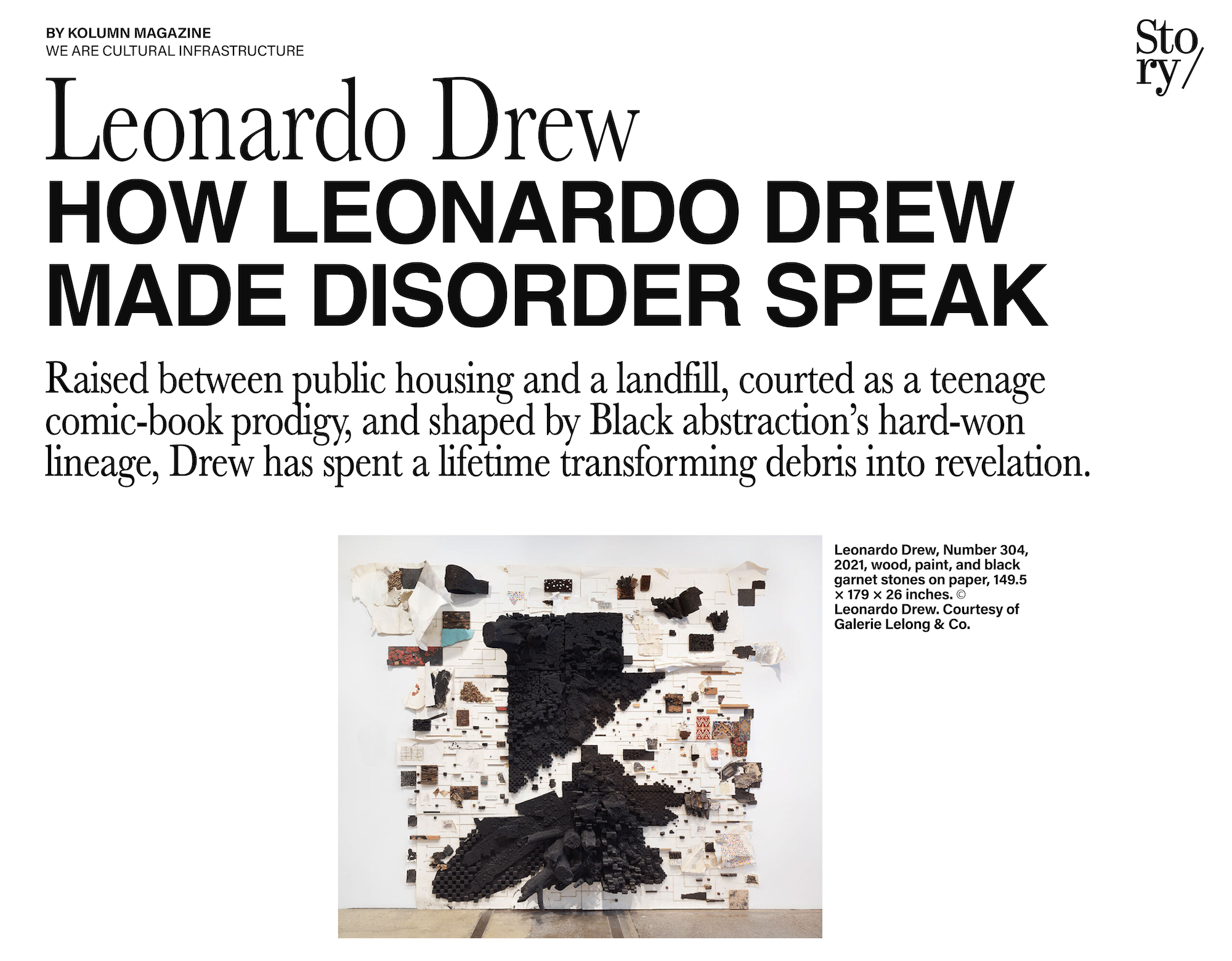
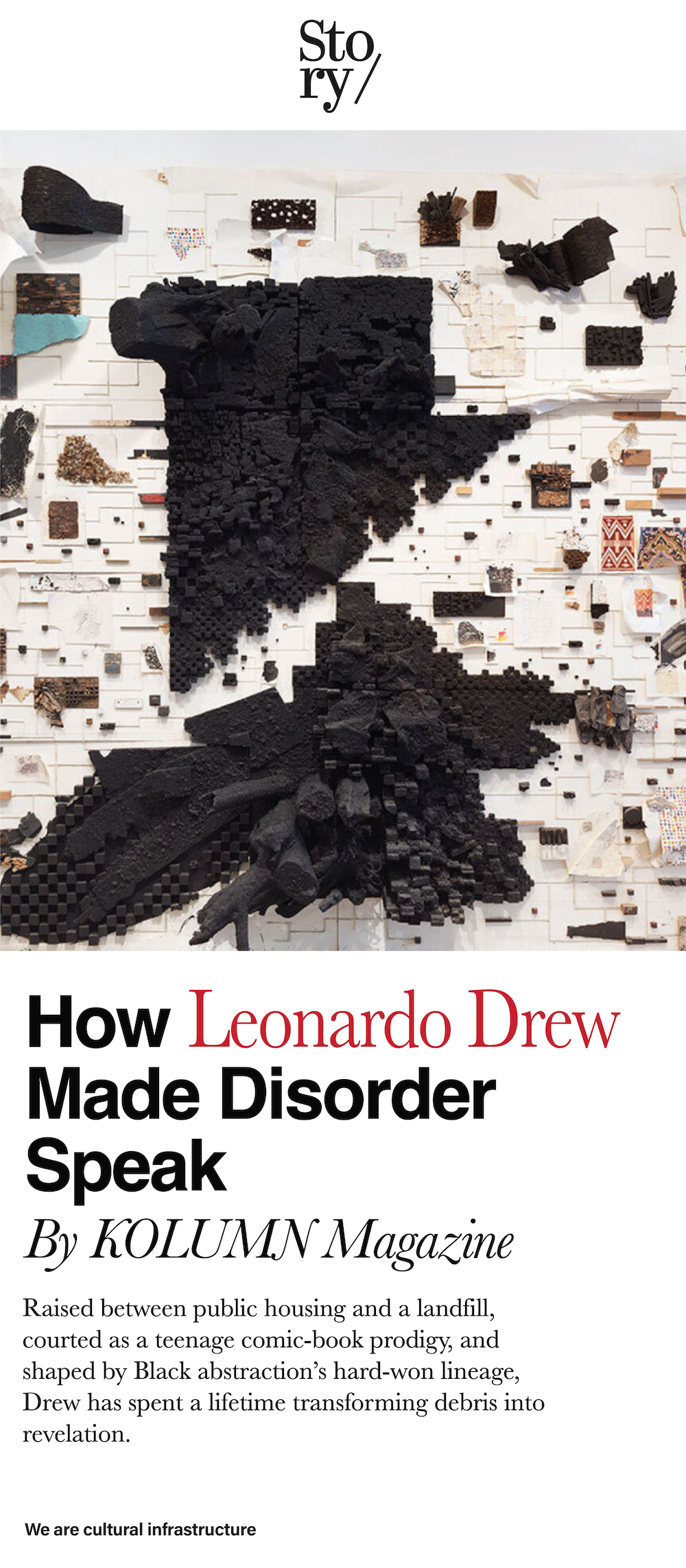
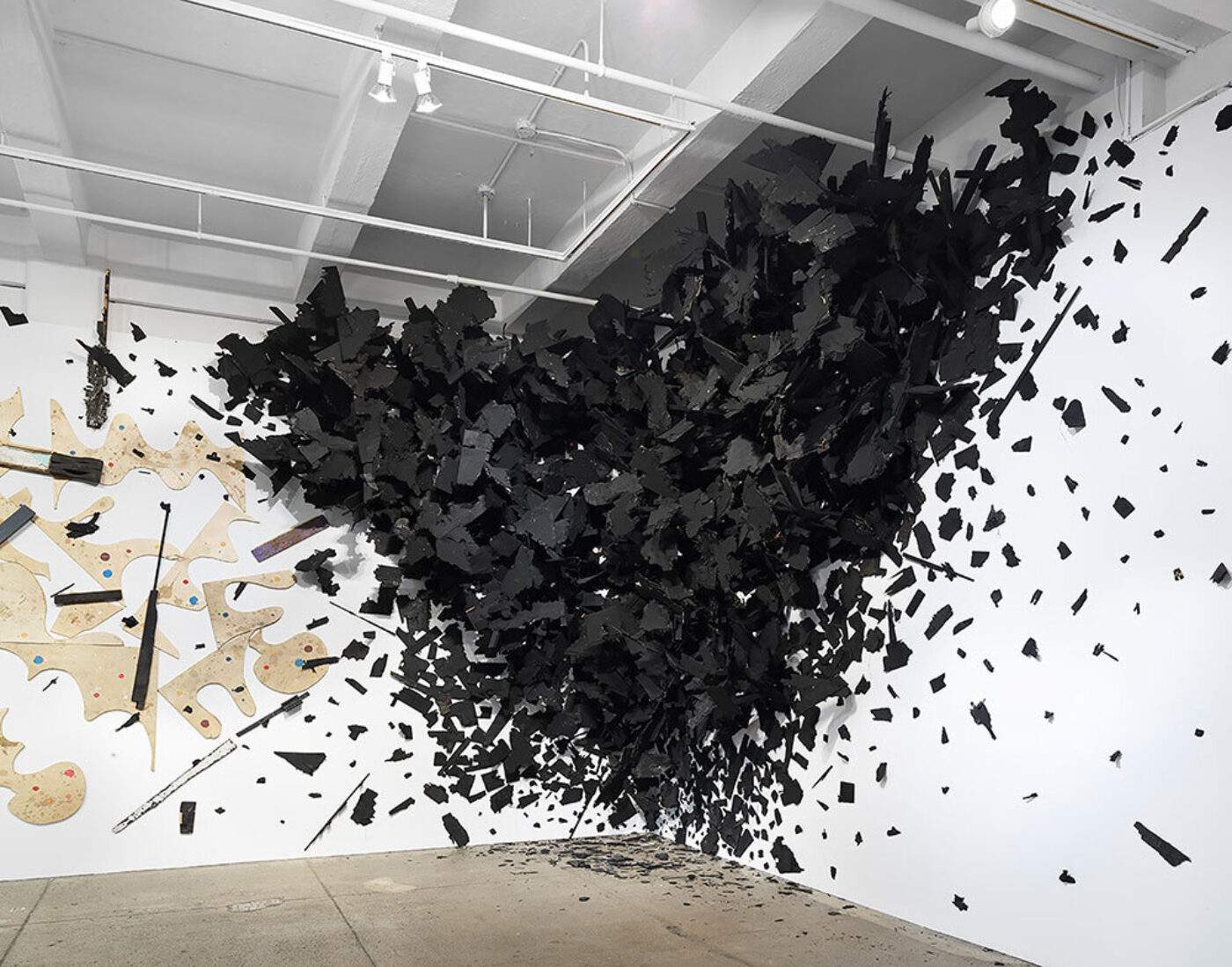
Leonardo Drew makes art that looks as if it has survived something. A fire. A flood. An industrial collapse. A private grief. A national one. His sculptures and installations arrive before the viewer with the force of aftermath: splintered wood, scorched surfaces, oxidized metal, cotton, paper, plaster, and dense accumulations of matter that seem to have been broken apart and then held in suspension at the very moment of reassembly. Yet that first impression, powerful as it is, can also mislead. Drew is not simply an artist of ruin. He is an artist of transformation. He takes materials that appear exhausted, blasted, weathered beyond repair, and reorganizes them into forms of startling rhythm and rigor. What seems destroyed is also being remade. What looks like chaos is usually the record of exacting control. In Leonardo Drew’s hands, disorder becomes syntax.
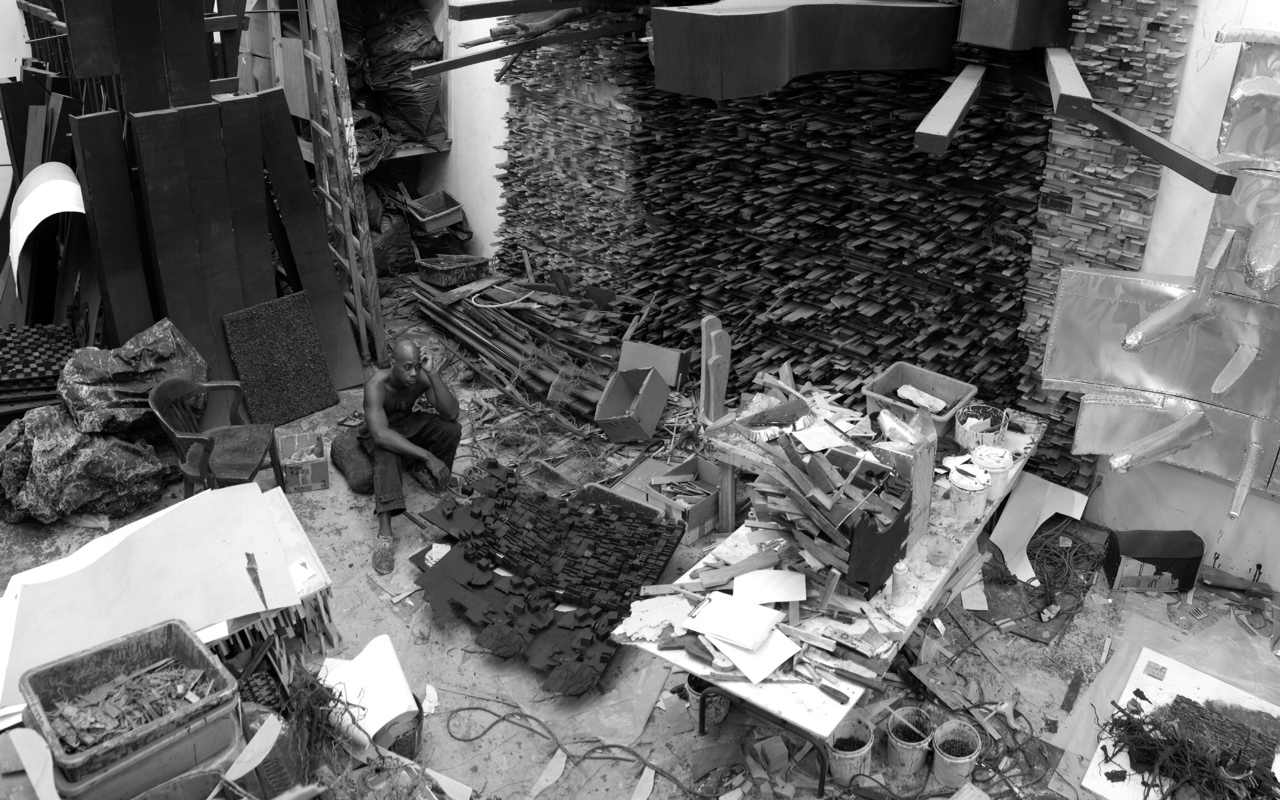
That is one reason Drew matters so much to contemporary American art, and why his career deserves to be read not as a side route through abstraction but as a central chapter in it. For more than three decades, he has built a body of work that moves between sculpture, installation, wall relief, drawing, paper, and public art without surrendering its internal logic. The materials shift, the scale expands and contracts, the commissions grow more ambitious, and the institutional embrace widens, but the governing questions remain remarkably consistent: How does matter carry time? How does form register memory without illustration? How do entropy, repair, and renewal become not just themes but structure? Museums and institutions have increasingly recognized that coherence, from the Hirshhorn’s 2000 exhibition to the Blaffer Art Museum’s survey Existed in 2009, to major later projects at Madison Square Park, the Wadsworth Atheneum, the Amon Carter Museum of American Art, Yorkshire Sculpture Park, and South London Gallery.
For KOLUMN, Leonardo Drew also belongs to a lineage this magazine has been tracing with intention: artists whose work reshapes the visual vocabulary through which Black life, Black thought, and Black material intelligence are understood. In recent KOLUMN pieces on Ernest Crichlow, Cheryl Derricotte, and John E. Dowell Jr., the question has not merely been who made important work, but who altered the frame itself. Drew belongs squarely in that conversation. He is a Black American artist who entered abstraction without apology, without translation, and without diluting complexity for legibility. His work refuses the false choice between formal innovation and historical depth. It insists on both.
Before the museums, there was Bridgeport
Leonardo Drew was born in Tallahassee, Florida, in 1961 and grew up in Bridgeport, Connecticut, where his earliest environment was not a pristine studio fantasy but a working-class urban landscape shaped by public housing, industrial residue, and proximity to a landfill. Multiple institutional biographies return to those origins because they matter. Art21 notes that memories of the housing project where he lived and the adjacent landfill resurface in the grids and configurations of his work. The Studio Museum likewise frames his practice through an engagement with the industrial past and present of the United States. Drew himself has resisted simplistic biographical decoding, but he has also acknowledged that those beginnings remain available within the work’s larger physical and spiritual journey.
This is where lazy art writing often makes its first mistake. It sees Drew’s weathered surfaces and corroded textures and rushes to turn them into autobiography, as if the artist’s childhood near refuse can wholly explain a mature practice of extraordinary formal intelligence. Drew has spent years pushing back against that kind of reductive reading. In a 2026 interview, he said that viewers are welcome to bring their own interpretations, and that reading his beginnings into the work is possible, but not exhaustive; there is, he suggested, “something much, much larger” at play. That instinct is crucial. Leonardo Drew is not interesting because he transcended his environment in some bootstrap morality tale. He is important because he metabolized it without becoming trapped inside it. He learned early that matter holds history, but he also learned that history must be transformed, not merely displayed.
He was, by every credible account, precocious. Blaffer records that he exhibited locally as a teenager, adept in figurative drawing and painting. That talent was not merely noticed by teachers or neighbors; according to later interviews and profiles, his comic-book drawings were strong enough to attract interest from Marvel and DC while he was still very young. Drew has spoken about turning away from that path after encountering reproductions of Jackson Pollock, sensing that another visual language—one driven by energy, scale, and freedom rather than narrative illustration—would be the truer route. In retrospect, it is easy to mythologize this as a heroic conversion story. But what it actually reveals is something more interesting: early on, Drew understood that virtuosity and vocation are not the same thing. Technical ability alone was not enough. He wanted a system big enough to think inside.
That search took him through Parsons School of Design and then to Cooper Union, where he earned his B.F.A. in 1985. Art21, Blaffer, and other institutional biographies agree on the educational trajectory, but what matters more than the résumé line is what he encountered there: the possibility of abstraction not as retreat from the world, but as a way of engaging it at a deeper frequency. He has described the decision to stop relying on familiar modes of drawing and painting as a necessary disruption. In his own formulation, challenging the “correct traditions” of making opened a more expansive language of art. That willingness to walk away from what came easily would become one of the defining ethics of his career.
Finding a language in matter
The breakthrough work in Drew’s story is usually Number 8 from 1988, and for good reason. Blaffer’s survey text describes it as the moment of personal and artistic breakthrough, a work made of blackened rope, dead birds, animal hides, and carcasses suspended from wooden supports. It was shown at Kenkeleba House in 1989 and announced a mature language that was at once ominous, tactile, ritualistic, and unsparing. Art Basel, looking back on that work decades later, described it as inscribing Drew into several intertwined lineages: Post-Minimalism, assemblage, and African American vernacular practice. That is a concise and useful map. Drew did not enter the field by choosing between those inheritances. He entered by making them collide.
There is always a temptation to clean up early Black avant-garde work in retrospect—to make it respectable, digestible, elegantly inevitable. Number 8 resists that treatment. It was ugly in the right way, severe in the right way, spiritually loaded without becoming pious. Blaffer writes that Drew considered it the “mother work” from which subsequent work derived. You can see why. It established not just a look but an ontology. Materials would never be inert in Drew’s art. They would arrive with weight, with abrasion, with residue. Rope was not rope; it was pressure. Hide was not hide; it was mortality. Charred matter was not simply a surface effect; it was evidence of passage. If later Drew works would become more architectonic, more modular, more luminous in their intelligence, they never abandoned this basic proposition: materials are never only themselves.
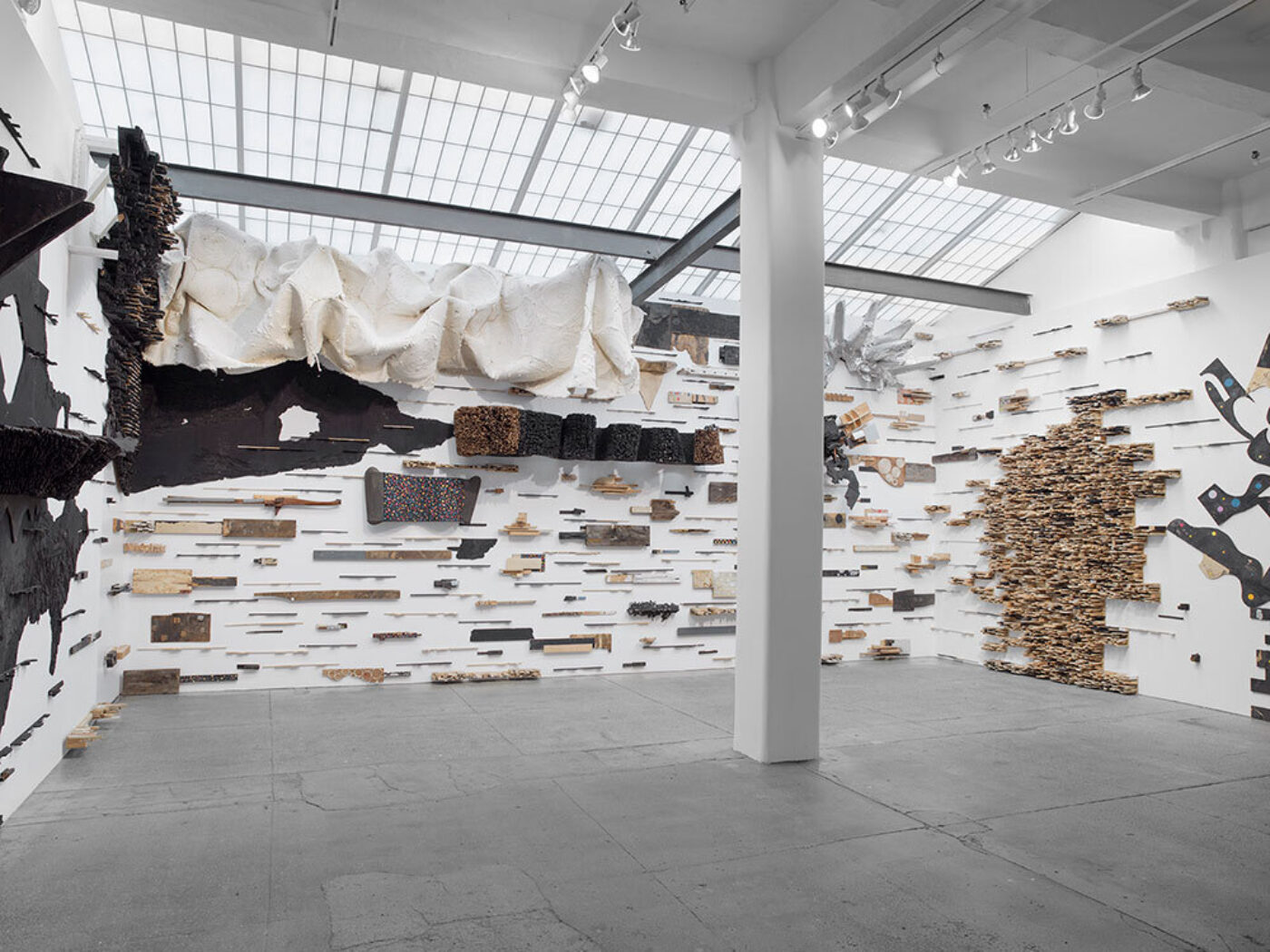
By the 1990s, Drew had begun to refine that proposition into one of the most compelling sculptural idioms of the period. The Metropolitan Museum of Art’s holdings from that decade—Number 24 from 1992, made with wood, rusted and patinated iron, and cotton waste; the 1994 Untitled with painted wood, fabric, fibers, threads, cords, and feathers; later works on paper such as Number 1A and Number 2A from 1999—show just how broad his material range already was. What holds them together is not medium but method: repetition, weathering, compression, fragmentation, and the transformation of new materials into things that seem to have lived long, difficult lives. Art21 is explicit on this point. Although the sculptures are often mistaken for found-object accumulations, they are made from “brand new stuff” that Drew intentionally subjects to burning, oxidation, decay, and stress.
That distinction matters because it clarifies what kind of artist Drew is. He is not simply a scavenger-poet of the urban castoff, though that would already be an honorable lineage. He is closer to an alchemist of fabrication. He manufactures the conditions of age. He stages deterioration. He composes entropy. The result is a body of work that appears archeological but is, in fact, rigorously contemporary. Even the patina is a decision. Even the fracture is edited. This is why the work can feel at once ancient and immediate, intimate and monumental. It is not documenting decay. It is building a visual grammar through which decay becomes legible as form.
The grid, the module, the storm
One of the persistent tensions in Drew’s work is the coexistence of explosion and order. Stand before a major installation and the first sensation is often centrifugal: things seem to burst, scatter, avalanche, swarm. But look longer and another logic emerges. Units repeat. Structures lock together. Surfaces are organized through grids, modular panels, and disciplined accumulations. The Washington Post noticed this in 2000, writing that beneath the apparent randomness of works made of technological castoffs was a meticulous modular structure based on two-foot-square wood panels. The critic saw what many viewers miss on first contact: Drew’s wreckage is almost never random. It is orchestrated.
Drew himself has explained the grid in surprisingly practical terms. In a 2026 interview, he said it began as a way to break works into controllable components, to get them out of his apartment and install them without assistance. Only secondarily did it resonate with Minimalism’s formal language. That explanation is vintage Drew: direct, unsentimental, suspicious of theory detached from labor. But it is also revealing. The grid in his work is not a cold, ideological imposition. It is a survival technology. It is how scale becomes possible. It is how the monumental can be built by hand. It is how an artist converts impossible ambition into manageable segments without losing force.
This is one reason his work belongs in any serious account of post-Minimalist and post-1960s sculpture. Drew adopts some of Minimalism’s organizational discipline but refuses its fantasies of neutrality and industrial cleanliness. His structures are not sleek; they are wounded. They do not deny touch; they insist on it. They do not pretend to be free of history; they look saturated by it. And yet he is equally distinct from a purely expressionist model. He is not simply flinging material affect onto the wall. As he told Art Basel, one of the gifts of practice is putting yourself in a position where you have to “dig yourself out” and discover the next iteration. That statement says everything about the relation between control and risk in his work. The composition is found through pressure, not preordained from above.
That phrase, short as it is, opens an important door. Drew’s sculptures are not only built; they are drawn. They move across walls and through rooms with the logic of line, rhythm, cadence, punctuation. A wall relief can read like a sentence exploded into fragments and then reassembled into a different syntax. A room-filling installation can behave like a storm cloud and a diagram at once. This is where viewers sometimes feel the work before they can name it. Drew’s compositions are not illustrations of catastrophe. They are scores for attention. They ask the eye to move, pause, double back, zoom out, then plunge in. They are sculptural, yes, but just as importantly, they are choreographic.
Black abstraction without apology
Any honest account of Leonardo Drew has to situate him within Black art history, but not in the flattened way that institutional shorthand often does. Drew’s work has frequently been discussed as a comment on the position of African Americans in U.S. society, and Blaffer’s survey text acknowledges that line of interpretation even as it argues that the work exceeds any single historical or ethnic reference. That tension is exactly right. Drew is a Black artist whose work can never be detached from Black history, Black material life, and the structural conditions under which Black abstraction has been marginalized. But his significance lies partly in refusing representational obligation. He does not illustrate Blackness. He constructs a field in which Black thought, Black memory, and Black formal invention operate at high intensity without explanatory captions.
This matters because Black abstraction has so often been forced to justify itself against the assumption that Black art should be figurative, legible, testimonial, or directly narrative. Drew belongs to a lineage of artists who refused that narrowing—artists such as Jack Whitten, whom Drew has cited as a formative mentor. In a recent interview, Drew recalled meeting Whitten while transferring from illustration into fine art and described him as a guiding force who introduced him to the overlooked history of Black abstractionists at a time when the doors were largely shut to them. That testimony is invaluable. It places Drew not in a vacuum of individual genius but in a hard-won genealogy of transmission, where one Black artist makes it possible for another to imagine a broader formal world.
The politics of Drew’s art, then, are not always at the level of content. They are also at the level of permission. He grants himself the full scale of abstraction. He claims monumentality. He claims opacity. He claims the right to address life, death, decay, spirituality, labor, and the natural world without converting them into explanatory allegories. That is not an evasion of Black history. It is one of the ways Black history enters the work: as the insistence that Black artists need not remain pinned to the representational burdens assigned to them. His art stands in that radical space where freedom is not simply declared but structurally enacted.
The Studio Museum’s long relationship with Drew underscores this point. He was part of the museum’s 1990–91 artist-in-residence cohort, later received its Joyce Alexander Wein Prize, and has appeared in exhibitions there across decades. Those details are not incidental. The Studio Museum has historically served as one of the essential institutions through which artists of African descent have been recognized, debated, and canonized on their own terms. Drew’s place there confirms both his singularity and his belonging. He is not an outlier to Black art. He is one of the figures who expanded what Black art could publicly be.
Museums caught up to what the work already knew
Institutional recognition came steadily, then emphatically. Art21 lists major exhibitions across the 1990s and 2000s, including the Carnegie International, MCA San Diego, the Hirshhorn, the Bronx Museum, and the Fabric Workshop. Blaffer’s Existed marked the first American survey dedicated to his work and traveled onward, helping consolidate Drew’s midcareer reputation. Public collections now include the Metropolitan Museum of Art, the Guggenheim, MOCA Los Angeles, the Hirshhorn, and Tate, among others. In other words, the art world eventually did what it often does with artists who were clearly central all along: it formalized the consensus late.
But the more telling story is not simply that museums collected him. It is how they learned to trust the scale of his thinking. The Hirshhorn’s 2000 exhibition presented Directions: Leonardo Drew at a moment when his wall-based accumulations could still surprise audiences with their combination of junkyard rawness and compositional refinement. The Washington Post’s review from that period captured the jolt: giant fields of discarded matter that looked like circuit boards, maps of a burned-out metropolis, or some technological apocalypse held together by astonishing discipline. What the critic recognized, perhaps without fully naming it, was that Drew had built a visual language adequate to the feel of late-century American breakdown without ever slipping into illustration.
Then came the commissions and installations that widened his public reach. In 2019, Madison Square Park Conservancy commissioned City in the Grass, Drew’s first public art project. Stretching over more than 100 feet, the work offered a topographical cityscape over a patterned panorama, a kind of torn-carpet landscape that invoked home, sanctuary, and bodily engagement. Drew explicitly wanted viewers on the work, moving through its swells and folds, locating themselves physically within it. When the piece was later adapted for the Wadsworth Atheneum’s lawn, the museum emphasized its participatory nature: a place for rest, reflection, play, and performance. This was not a minor shift. It demonstrated that Drew’s work could move from wall and gallery into civic space without losing conceptual density.
At the Wadsworth in 2021, that outdoor interactivity was paired with Number 82S, an interior “explosion” in the museum’s Main Street lobby. There is a useful duality there. One project invited occupation; the other staged eruption. Together they showed how Drew thinks spatially: not just about what an object is, but about what a body does in relation to it. A sculpture is a field of relation. A wall is not a limit but an opening. A lobby can become an event. That same large-scale intelligence animated later commissions like Number 235T at the Amon Carter Museum, where the institution described Drew’s use of larger “planets” surrounded by hundreds of smaller elements in search of interconnectedness. The phrase is almost cosmological, and appropriately so. Drew’s work often feels like debris because debris is one of the few available visual languages for total systems under pressure.
The international stage, the same hard questions
By the 2020s, Drew’s reach had become unmistakably global. Yorkshire Sculpture Park commissioned Number 360 in 2023 for its 18th-century chapel, describing the work as a reflection on collective experience, memory, and the cycles of life and death, decay and regeneration. Installed in a historic religious space, the piece sharpened something already latent in Drew’s practice: its spiritual weather. His materials may be secular, but his structures often feel lit by metaphysical questions. What survives? What transforms? What remains of an event after its force has passed through matter? Drew does not answer those questions didactically. He builds environments in which the viewer inhabits them.
Critical responses have varied, which is as it should be with serious work. The Guardian’s 2023 review of the Yorkshire exhibition praised Drew’s understanding of the chapel’s unusual vantage points and the way the installation honored cycles of life and death within that setting. A later 2025 Guardian review of his South London Gallery exhibition was more ambivalent, reading Ubiquity II through the lens of environmental and cultural decline and finding the result less emotionally potent than intended. That disagreement is worth noting because it reveals the risk built into Drew’s ambition. When an artist works at the threshold of the sublime, with forms that suggest disaster and transcendence simultaneously, not every viewer will feel the balance tilt the same way. But even criticism of Drew tends to confirm the scale of the undertaking. No one mistakes the work for something minor.
South London Gallery presented Ubiquity II in 2025 as Drew’s first solo exhibition at a London institution. Official materials described it as an immersive sculptural installation taking over the main gallery, and Art Basel’s studio profile from that same period emphasized that visitors moved around masses of painted wood chips that seemed frozen mid-cascade as they erupted from the walls. That combination—immersion, eruption, suspension—is an accurate shorthand for where Drew’s work has gone in recent years. It has become even more architectural, even more environmental, even more committed to the sensation of being inside a sculptural thought.
It is one of his best phrases because it compresses a whole philosophy. Drew does not approach material as a static thing to be arranged prettily. He approaches it as a force field. Color, he has said, is closer to weather and natural occurrence in the work. Regeneration, not mere decay, is the truer frame. Pieces that return to the studio are liable to be remade. Works are numbered rather than named partly to give viewers room for uncoerced experience and partly to keep the artist from fixing them too firmly in place. This is not indecision. It is ontology. Drew’s art is alive to the possibility that matter is always in transition, and that the artist’s job is not to arrest that truth but to shape it into visible intensity.
Why Leonardo Drew matters now
In a culture saturated with fast images, quick takes, and disposable spectacle, Leonardo Drew’s work does something increasingly rare: it slows the viewer into confrontation. Not through minimal emptiness, but through density. Not through sentiment, but through pressure. His sculptures are often beautiful, but theirs is not the beauty of ease. It is the beauty of abrasion, of labor, of things forced to coexist until they generate a new order. That is one reason the work speaks so strongly to this historical moment. We are living amid visible breakdown—ecological, civic, infrastructural, moral. Drew’s art does not journalize those crises, yet it feels native to them. It understands collapse as texture. It understands fragmentation as structure. It understands that ruin, in America, is rarely abstract.
And yet the work refuses nihilism. That refusal may be its deepest gift. Drew has repeatedly framed what others call decay as regeneration. He does not sentimentalize suffering, but he also does not fetishize damage. The works hold because he makes them hold. Their power comes not from the fantasy of destruction alone, but from the discipline of recomposition. This is where his significance exceeds style. He offers a model of art-making in which endurance is not clean, healing is not tidy, and transformation is never abstractly uplifting. It is physical. It is cumulative. It is built from the very matter that seemed used up.
That ethos also explains Drew’s continuing relevance to younger artists. He embodies a practice of restless investigation. Art21 describes him as someone never content with work that comes easily, always asking, “What if….” Recent interviews reinforce the same disposition: every work will find its place eventually; no piece is ever entirely finished; the artist must keep listening for what the work wants to become. In an era when brand identity often threatens to harden artists into repeatable signatures, Drew remains committed to risk without abandoning recognizability. You know a Leonardo Drew when you see one, but you also sense that he is still pushing the language open from inside.
There is also the matter of scale, and what scale means for a Black abstract artist in the United States. Monumentality has never been neutral here. Who is permitted to work large, to command space, to be difficult, to be public, to be collected by major museums, to be read as formally consequential rather than sociologically interesting—these are political questions even when they are disguised as aesthetic ones. Leonardo Drew’s career does not solve those inequities, but it does expose them by existing so forcefully beyond them. He has made work too rigorous to be sidelined, too materially intelligent to be dismissed as gesture, too spatially commanding to be confined to footnotes. That is not only an artistic achievement. It is a historical one.
The artist who keeps moving the edge
The simplest description of Leonardo Drew is that he is a sculptor. It is also inadequate. He is a builder of pressure systems, a draftsman of matter, a composer of weathered surfaces, a choreographer of collapse, a formal thinker whose medium is transformation itself. His works can look like cities after impact, forests after burn, altars after ritual, archives after flood, or organisms still evolving in plain sight. But they are never simply about what they resemble. They are about what they do to perception. They make you feel the instability of structure and the structure within instability. They bring you to the edge of disorder and then show you that the edge has been built, plank by plank, by a mind of almost ferocious clarity.
If there is a lesson in Drew’s career, it may be this: seriousness and freedom are not opposites. His art is disciplined, exacting, historically grounded, and physically punishing to make. It is also playful in the deepest sense—a testing, probing, improvisational mode of inquiry that refuses final answers. He has said that he sees a continuum from where he started to where he is now. That feels right. The child drawing on every blank surface, the teenager turning down comics, the young artist dragging cotton bales through Manhattan, the midcareer sculptor whose works could be dismantled and reborn, the international figure building immersive environments in London and Yorkshire and New York—these are not separate versions of Leonardo Drew. They are phases of the same relentless investigation.
And perhaps that is why the work still feels urgent. Leonardo Drew has never confused arrival with completion. Museums catch up. Markets catch up. cities and countries catch up. The work keeps asking harder questions anyway. It keeps refusing the obvious. It keeps moving through ash, rust, cotton, paper, plaster, wood, and light toward something that is not exactly resolution, but something better: a form sturdy enough to hold contradiction without reducing it. That is a rare achievement in any era. In this one, it feels indispensable.
More great stories
Afro Sheen, Wall Street, and the Architecture of Black Possibility
July 6, 2026
No Comments
The Fire Inside the Fourth
July 5, 2026
No Comments