



A phone bill is usually an extraction. Love Mobile is betting it can become a circulation.
A phone bill is usually an extraction. Love Mobile is betting it can become a circulation.
By KOLUMN Magazine
There are moments when Black entrepreneurship is treated as symbolism and moments when it is better understood as infrastructure. The difference matters. Symbolism can trend for a week. Infrastructure changes what people can reach, what they can build, and how money circulates after the headline fades. That is the deeper frame through which the 2025 launch of Love Mobile has to be read.
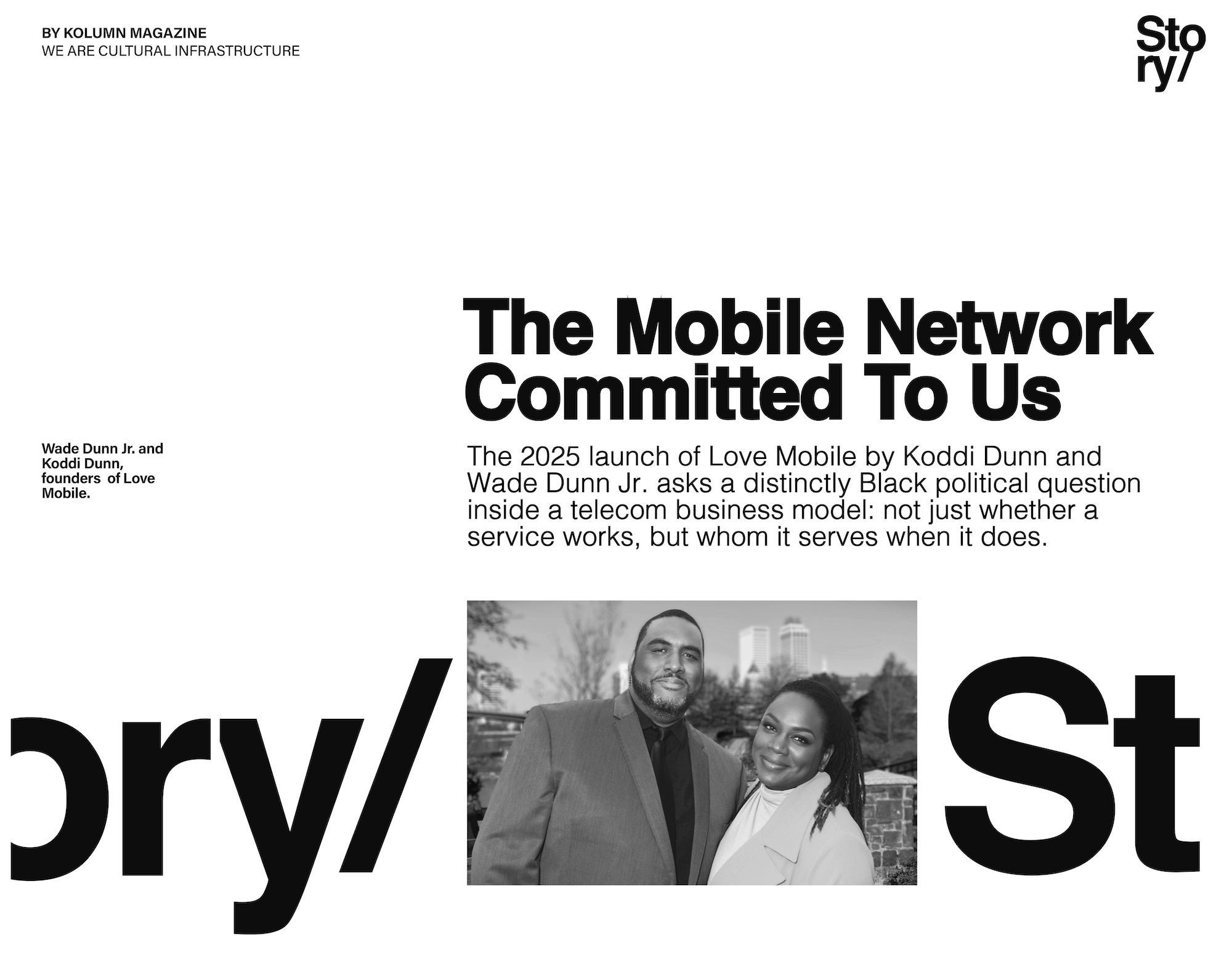
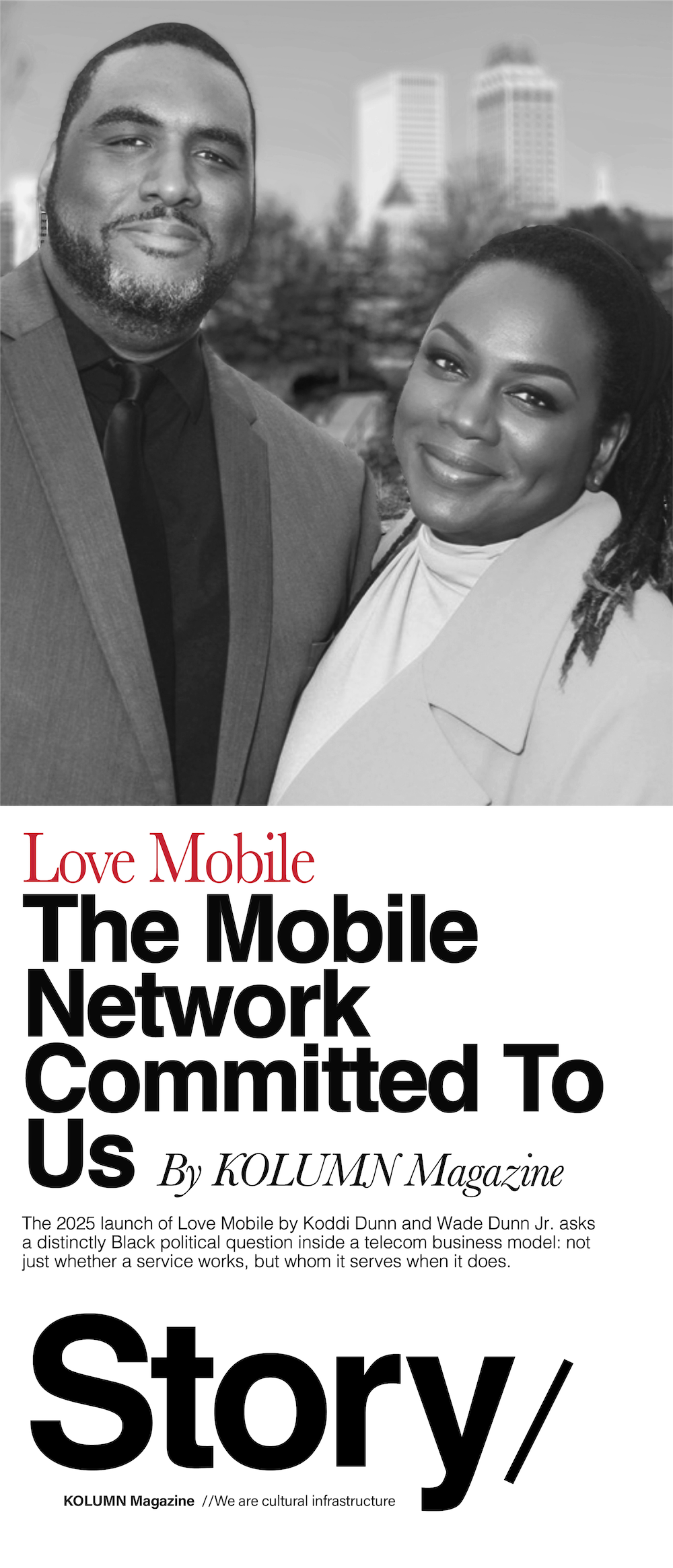
On paper, the Tulsa-based company is a mobile virtual network operator, or MVNO, the kind of wireless brand that sells service without owning the physical cellular towers itself. In practice, Love Mobile is trying to do something more politically legible than simply reselling access. Founded by Koddi Dunn and Wade Dunn Jr., the company launched publicly on June 26, 2025, as a nationwide 5G provider built around a “Give Back” model that directs a portion of subscriber revenue toward education, community outreach, environmental work, and animal welfare, with its earliest visible partnerships and initiatives tied to Tulsa, North Tulsa, workforce training, and homelessness response. According to Love Mobile’s launch materials, the Dunns framed the company as a way to move “community impact from charity jar to core business function,” not as a seasonal philanthropic add-on but as a standing operating principle built into each bill. That distinction is the whole story.
Understanding the MVNO Model
To understand why that matters, it helps to briefly explain what an MVNO is. A mobile virtual network operator does not build and maintain the full radio network that powers mobile service. Instead, it leases network capacity from established carriers and resells service under its own brand, often competing on price, customer service, niche identity, or specialized features. Reuters described MVNOs in 2025 as providers that lease network capabilities from major carriers rather than owning their own infrastructure, a model that has made brands like Mint and Tracfone familiar players in the American wireless market. Love Mobile’s own site says it runs across all three major U.S. networks, pitches no-contract plans under $30 per month, and positions itself as a modern prepaid carrier with eSIM activation and nationwide coverage. In other words, it is entering a well-established telecom lane. What makes it notable is not the existence of the lane, but the purpose to which the lane is being directed.
A Telecom Model With a Black Civic Question
That is where the Black question enters. Love Mobile is not important because it invented a new telecom structure. It is important because it is testing whether a Black-founded company can take a familiar structure and bend it toward Black civic purpose. KOLUMN has already been writing in that register. In “The Long Ledger of Black Banking”, the magazine argued that Black-owned banks emerged because mainstream finance was never neutral: exclusion was routine, risk was racialized, and Black communities had to build institutions that would take their money seriously. The same analytic habit applies here. Telecommunications is not merely a neutral utility. It is one of the systems through which opportunity is distributed. A phone is a school portal, a job application device, a telehealth terminal, a transportation tool, a classroom backup, a camera, a payment rail, a safety device, and, for many low-income Americans, the primary node through which public life is accessed. When Black founders step into that market and insist that the bill itself should recycle some value back into community institutions, they are not just selling service. They are intervening in the politics of extraction.
The Stakes of Digital Access
That wager arrives at a time when digital access still tracks inequality. The National Telecommunications and Information Administration reported in 2024 that Black Americans were less likely than white Americans to use a desktop, laptop, or tablet, and that 16 percent of Black Americans were “smartphone only” internet users in 2023, compared with 12 percent of white non-Hispanics. Pew Research Center’s national survey work has also shown how deeply internet and smartphone access are woven into modern life, with most Americans relying on these tools for everyday participation. Those broad national statistics matter because they locate the phone not as a lifestyle accessory but as a site of dependency and unequal resilience. For people who are smartphone-only users, the mobile carrier is not just a brand choice. It is often the last functioning bridge to school systems, employers, benefits portals, maps, appointments, banking, and family networks. In that context, a Black-owned wireless company that frames itself around education, community development, and economic mobility is making a political argument about where telecom dollars should land after they leave a Black household.
Grounded in Tulsa, Built for Community
Love Mobile’s public launch narrative was explicit about this aspiration. The company’s June 2025 release described the business as a “purpose-driven nationwide 5G provider” and said a portion of every bill would go to education, environmental restoration, animal welfare, and community outreach. The founders cast the company’s origins as a kitchen-table conversation that turned into a commercial structure. By itself, that would be a pleasant origin story. What gives it journalistic interest is the specificity of where the company moved first after launch. The inaugural publicly emphasized partnership was with BeHeard Movement in Tulsa, a nonprofit serving people experiencing homelessness through mobile drop-in services. TulsaKids Magazine, in profiling Koddi Dunn as one of its “Impactful Women of the 918,” wrote that Love Mobile’s first partnership would help BeHeard provide free showers, laundry, and hygiene care for unhoused individuals in the region. Love Mobile’s own July 2025 announcement said BeHeard’s services had already included more than 15,000 free showers, 5,000 loads of laundry, and 3,200 haircuts. A second cluster of activity centered on workforce development through Google career certificates, including work with Booker T. Washington High School in North Tulsa and later broader scholarship and cohort models. These are not abstract “causes.” They are material interventions around dignity, training, and access.
Defining What It Means to Serve Black Causes
There is a temptation, when writing about Black business, to demand an impossible purity test. Is the product exclusively for Black people? Does every beneficiary fit a racial category? Is every initiative perfectly trackable from the first quarter? Those questions are not useless, but they can miss how Black causes have historically functioned in actual civic life. A Black cause is not only an organization explicitly branded as Black. It is also any durable effort that expands survival, education, ownership, mobility, and institutional capacity in communities that have long been asked to endure without enough of all four. By that definition, Love Mobile’s most visible early work lands squarely within a Black civic tradition, particularly in Tulsa. North Tulsa is not an arbitrary geography. It is one of the nation’s most symbolically loaded Black urban landscapes, a place where the memory of Greenwood coexists with present-day fights over investment, access, and opportunity. So when Love Mobile publicizes no-cost digital credential access tied to Booker T. Washington High School, or underwrites the communications and operations of a homelessness-response partner in the metro, it is entering an existing Black struggle over what community repair should actually look like.
That does not mean every Love Mobile program is race-exclusive. The public materials do not support that claim, and a responsible article should not make it. The better claim is more precise: Love Mobile appears to be building a Black-founded wireless company whose early give-back programs map onto Black community needs, Black institutional spaces, and Black equity concerns, especially around workforce access, neighborhood investment, and dignified service delivery. That is different from racial branding for its own sake. It is closer to a Black political economy of usefulness.
“A Black cause does not have to be a slogan. Sometimes it is a shower, a credential, a signal bar, a bill that sends money back home.”
The workforce development piece is where the company’s argument becomes most legible. Love Mobile’s January 2026 release on its Grow with Google certification initiative said that, since launch, participants had completed 330 professional certifications and logged 2,307 total learning hours, with 166 learners still actively progressing at the time of the announcement. Those are company-reported numbers, and because independent third-party reporting on the program remains limited, they should be read as provisional public claims rather than audited social-impact proof. Still, they are significant enough to warrant attention, especially when paired with earlier reporting from Love Mobile that it had negotiated access to Google career certifications for students, families, and faculty tied to Booker T. Washington High School in North Tulsa. In that account, the company said it coordinated with school leaders to help residents access no-cost online training in fields like data analytics, cybersecurity, user experience design, project management, and IT support. Later materials connected Wade Dunn Jr. to securing 500 licenses for students and families and to announcing another 100 scholarships through a RETE conference partnership tied to NYU and equity-centered entrepreneurship conversations. Taken together, the pattern is unmistakable: Love Mobile has tried to turn telecom customers into a support base for digital-skills acquisition.
Why is that specifically resonant for Black causes? Because the digital divide is not just about whether a signal exists. It is about whether the person holding the phone can convert connectivity into leverage. NTIA’s data show that Black Americans remain more likely than white Americans to rely exclusively on smartphones for internet access. That means the very device sold by a carrier can become either a ceiling or a launchpad. When Love Mobile places technical training, AI literacy, and certification pathways near the center of its giving architecture, it is implicitly acknowledging that access alone is not enough. The next battle is convertibility: can access be converted into credentials, wages, entrepreneurship, and time reclaimed from precarity? That question belongs squarely in KOLUMN’s own existing archive. In “The Future Is Written in Code. Will Black Students Get to Write It?”, KOLUMN asked what happens when Black students are present in the digital future mostly as users rather than authors. Love Mobile’s answer, however partial and early, is that even a phone company can try to underwrite authorship.
The Tulsa dimension gives the story still more texture. According to TulsaKids, Koddi Dunn and her family relocated from Georgia to Broken Arrow several years before Love Mobile’s launch, and the company’s identity is now deeply tethered to Tulsa. That matters because Tulsa, perhaps more than any other American city, occupies a charged place in the national imagination of Black enterprise. Greenwood is both history and burden. Almost any Black business story in Tulsa risks being flattened into a ritual invocation of Black Wall Street. The stronger reporting move is to ask not whether a company can reenact Greenwood, but whether it can operate in the long shadow Greenwood left behind: chronic underinvestment, symbolic overuse, and the constant pressure to turn memory into measurable repair. Love Mobile’s hometown narrative suggests that the founders understand this tension. Their public language is less about nostalgia than about present-tense function: subscriber bills, nonprofit nominations, scholarship seats, community partners, operating support. The work is ordinary on purpose. That may be its most serious quality.
One of the most revealing lines in the TulsaKids profile is Dunn’s statement that the company is actively looking for smaller organizations, not only the highly visible nonprofits with large marketing budgets. “We’re trying to find lesser knowns that are quietly doing the work,” she said. That sentiment deserves more attention than it will probably receive in standard business coverage. Black civic life is full of under-capitalized organizations doing essential labor without national branding. The ecosystem depends on people who know how to find them, fund them, and take their usefulness seriously before a major foundation discovers them. If Love Mobile’s giving structure can in fact surface smaller groups and reliably move money toward them, then the company is doing more than cause marketing. It is functioning as a small-scale redistributor of attention and cash. That is a real civic role, especially in communities where visibility is already unevenly allocated.
“The story is not that Love Mobile has already won. The story is that it is asking telecom to answer a moral question.”
That moral question is especially sharp in a sector where consumers are accustomed to choosing among faceless giants, celebrity-endorsed budget brands, and low-friction apps. Wireless service is usually marketed as convenience: better price, better speed, better perks, better bundling. Love Mobile certainly uses some of that conventional language too. Its site advertises “Big Network Quality,” built-in discount perks, and the ease of eSIM activation. But layered underneath is a different message: your phone bill is already leaving your pocket every month, so why should none of its afterlife belong to the communities from which it came? That is a much older Black question than the telecom industry. It is the question behind cooperative economics, Black banking, mutual aid, benevolent societies, church auxiliaries, neighborhood credit circles, and community foundations: can ordinary transactions be reorganized so they do not merely exit Black life, but sustain it?
In that sense, Love Mobile belongs to a broader genealogy of Black institutional imagination. The sector is new; the instinct is not. Black communities have long built parallel structures not because separatism was fashionable, but because dependence on hostile or indifferent systems was too expensive. Sometimes those structures were schools. Sometimes insurers. Sometimes newspapers. Sometimes banks. Sometimes burial societies. Sometimes civil-rights organizations. Sometimes radio stations. In the 2020s, amid platform monopolies and digital precarity, perhaps one of those structures can also be a mobile carrier. Not because the carrier itself is revolutionary, but because control over the billing relationship offers a chance to redirect value flows. The innovation here is not technical. It is distributive. Love Mobile takes a common consumer mechanism and asks whether the margin can be ethically reassigned.
The company’s later 2025 visibility in telecom circles also matters. Love Mobile announced that its founders were selected to appear at MVNO Nation Live in Spain in November 2025, and subsequent releases positioned them at additional telecom events in 2026. Those speaking invitations do not prove market success on their own. They do, however, suggest that the company’s identity-driven and purpose-forward positioning is legible beyond Tulsa. The same December 2025 release that highlighted the NYU RETE conference described conversations about racially minoritized founders, STEM opportunity, and equitable access to AI-era entrepreneurship. Whatever one thinks of conference circuits, there is strategic value in a Black-founded carrier insisting in those spaces that subscriber growth and social mission do not have to be opposites. If the telecom industry is willing to celebrate “purpose” only when it is depoliticized, then Love Mobile’s Black-rooted civic framing is itself a kind of pressure.
It is also worth pausing over the founders themselves. Publicly available materials present Koddi Dunn as a co-founder and chief executive voice of the company’s mission, and Wade Dunn Jr. as a co-founder or managing partner whose background includes training, operations, digital-media work, and technology-access initiatives. The launch release describes the two as former digital broadcast-media professionals and business trainers. Later company materials say Wade Dunn helped more than 5,000 clients build digital media expertise through prior work and positioned him as a voice on equitable AI and workforce development. TulsaKids’ profile of Koddi Dunn places her at the center of the company’s origin story and emphasizes her desire to build not just a business but a movement. Those details matter because Love Mobile does not appear to have come out of nowhere as a pure financial arbitrage play. Its public-facing leadership story is grounded in communication, training, and community-facing problem-solving. That is exactly the kind of biography that makes a give-back telecom company more plausible than it would be coming from founders whose only stated interest was churn optimization.
Love Mobile’s early public record points toward three linked commitments. The first is dignified service for vulnerable people, as seen in the BeHeard Movement partnership around unhoused neighbors in Tulsa and Oklahoma City. The second is educational and workforce mobility, especially through no-cost Google certificate initiatives, Booker T. Washington High School outreach, and scholarship announcements tied to broader equity and STEM conversations. The third is institutional imagination: the attempt to turn a monthly bill into a small, repeatable instrument of community funding. None of those commitments is exclusive to Black communities. But all of them answer longstanding Black needs. And because the company is Black-founded, Tulsa-rooted, and publicly vocal about community uplift, the effort sits firmly within a Black tradition of building practical institutions where indifference has been normalized.
What KOLUMN has often understood, and what mainstream business writing often misses, is that Black institution-building is not always glamorous when it is most important. Sometimes it looks like a bank. Sometimes it looks like a school. Sometimes it looks like a magazine building an archive. Sometimes, in 2025, it looks like a phone company asking customers to reconsider what a bill is for. That may sound small until you remember how much of modern life runs through that device. A carrier controls more than signal. It controls a relationship of monthly trust, recurring payment, and habitual dependence. To place that relationship inside a Black-owned, community-minded framework is to say that even the most ordinary transaction can be politically rearranged.
What a Phone Bill Can Carry
Love Mobile is still early enough in its life that prophecy would be irresponsible. The company could scale meaningfully. It could remain a strong regional moral experiment with national ambitions. It could struggle under the brutal economics of telecom. All of that remains open. But the launch itself deserves serious notice because it refuses the thin idea that Black business is only about representation at the top. Love Mobile is more interesting than representation. It is about redistribution at the point of payment. It is about whether the infrastructure of daily life can be asked to remember the people most often extracted from by daily life. It is about whether Black ownership in the digital economy can be practical, durable, and answerable to more than investor appetite.
That is why the company’s slogan, stripped of marketing gloss, contains a larger political possibility. A phone company that gives back sounds soft until you think harder about the systems around it. Broadband inequity is not soft. Smartphone dependence is not soft. Homelessness is not soft. Underemployment is not soft. The lack of no-cost pathways into digital credentials is not soft. None of those problems are solved by a single carrier. But a company that places them at the center of its business model is at least refusing the lie that commerce and community belong in separate moral universes.
In a market crowded with louder names, that refusal may end up being Love Mobile’s sharpest contribution. Not simply that Koddi Dunn and Wade Dunn Jr. launched another MVNO in 2025, but that they launched one with a theory of Black usefulness. In the best reading of the company, the service is not the whole point. The service is the vehicle. The larger ambition is to prove that Black-owned infrastructure can still be built inside ordinary markets, that it can still route money back toward schools, skills, dignity, and neighborhood care, and that even something as mundane as a phone bill can be made to carry a little more history, a little more accountability, and a little more love.
More great stories
Afro Sheen, Wall Street, and the Architecture of Black Possibility
July 6, 2026
No Comments
The Fire Inside the Fourth
July 5, 2026
No Comments