




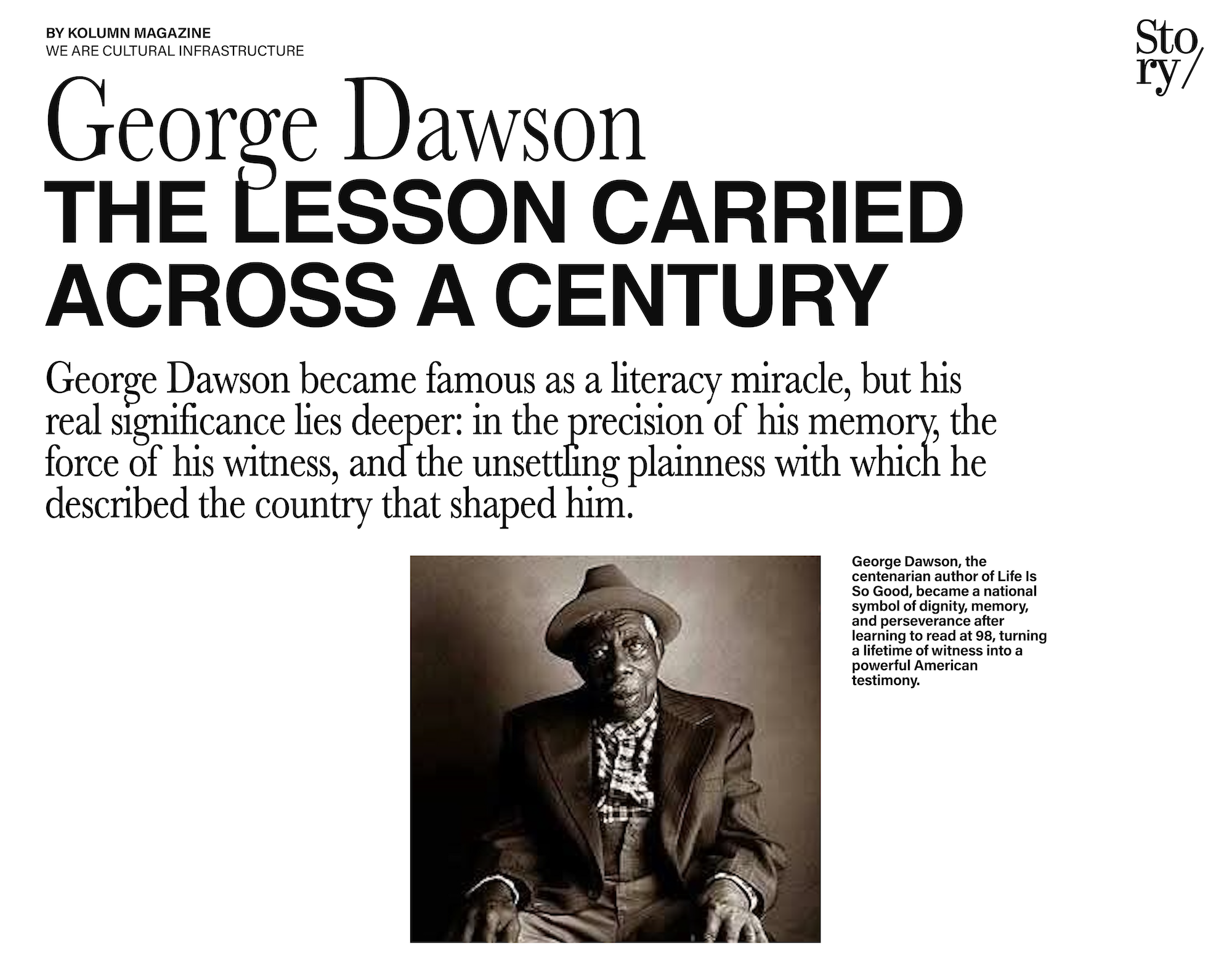
George Dawson became an author late. He became important long before that.
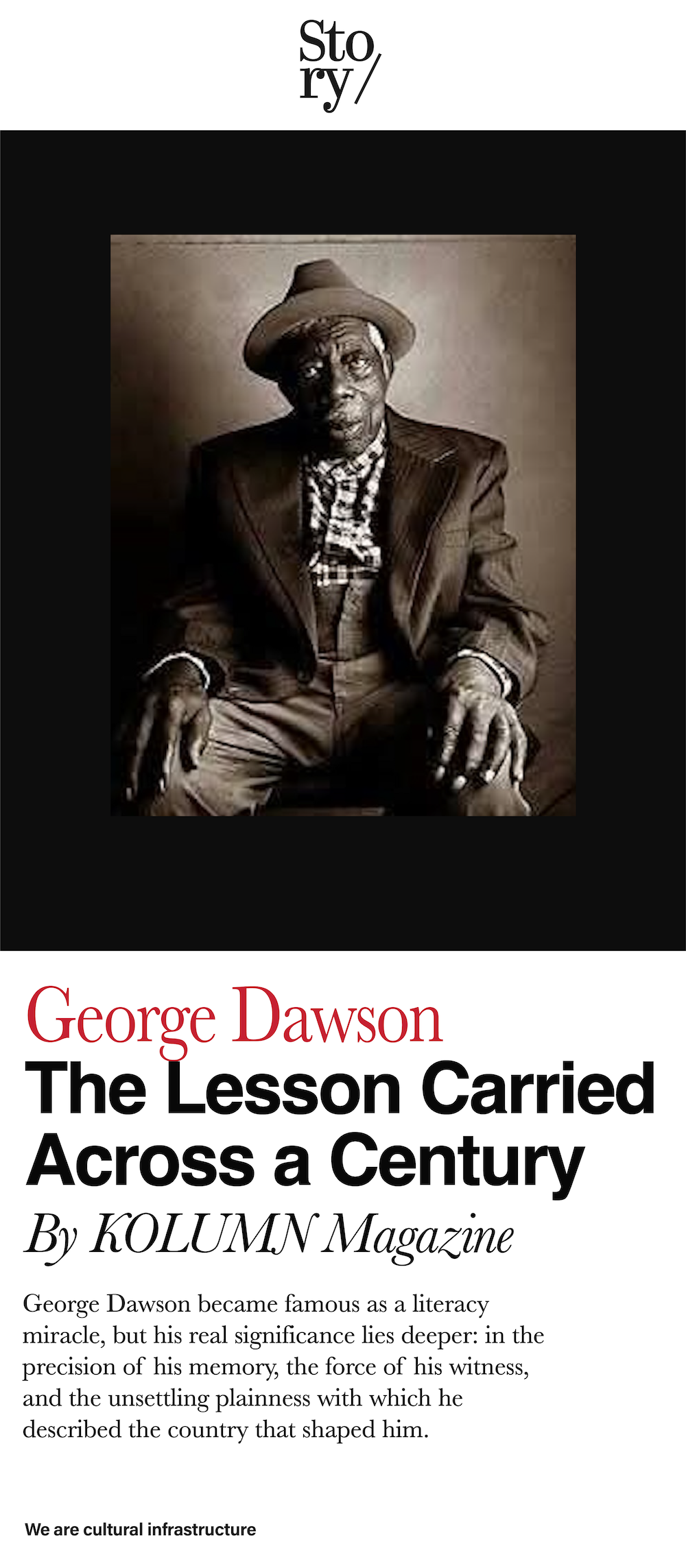
George Dawson became an author late. He became important long before that.
By KOLUMN Magazine
George Dawson is often introduced through the hook that made him legible to national media: he learned to read at 98. It is a remarkable fact, and it earned him exactly the sort of coverage America likes to give to lives that can be framed as inspirational without requiring too much structural self-examination. Newspapers marveled. Television booked him. Readers embraced Life Is So Good, the memoir he published with Richard Glaubman in 2000, when Dawson was past 100. In the simplest version of the story, George Dawson is the man who proved it is never too late. That version is true. It is also incomplete.
The more complete version is harder, richer, and more useful. Dawson was born in 1898 near Marshall, Texas, the grandson and great-grandson of enslaved people. He came of age in a Black world still living inside slavery’s afterlife, where labor was expected early, schooling could be denied without ceremony, racial violence was ambient, and dignity had to be defended in small, exact, daily ways. By the time he learned to read, he had already worked farms, hauled logs, traveled widely for labor, raised a family, and witnessed a century of American change that included Jim Crow, lynching, migration, mechanization, depression, war, and the long unfinished business of civil rights. His literacy was late, but his education in America had been brutal and continuous.
That is what makes Dawson important as an author, not merely as a literacy anecdote. Life Is So Good matters because it places extraordinary historical range inside an apparently plain voice. It gives the twentieth century back to someone who spent most of it outside the official terms of literacy and power, yet saw with startling moral exactness. In recent KOLUMN appreciations of writers such as J. California Cooper and Charles W. Chesnutt, the magazine has emphasized plain speech, witness, and the political force of literary clarity. Dawson belongs in that lineage, even if his route into print was radically different. He was not a career literary figure. He was something in some ways rarer: a man whose life itself had become an archive, and whose eventual authorship forced American readers to confront what knowledge exists outside credentialed institutions.
What his book did, when it arrived, was refuse the cheap division between “wisdom” and “literacy.” Dawson had always possessed the first. America had denied him the second. When he finally acquired literacy, he did not become wise; he became newly audible to a country that too often mistakes formal access for intelligence. That distinction is central to understanding his significance. Dawson’s life is not simply proof of personal resilience. It is evidence of systemic deprivation, and of the astonishing intellectual life that can persist in spite of it.
Before the book, there was the boy sent to work
Dawson’s own telling of his early life is unsparing in its calmness. He was the oldest of five children, born into a family for whom labor was not metaphor but organizing principle. In his account, he did not go to school because his father could not spare him. Childhood, in that arrangement, was brief. Work started early. By age 12, he had been hired out to work on a neighboring farm. Later, after extended family tragedy increased the number of mouths the household had to feed, he worked even more, including hauling logs at a sawmill. The point is not merely that he worked hard. Millions have worked hard. The point is that his labor came at the exact site where schooling might have been. In Dawson’s life, as in so many Black Southern lives of the period, the theft was double: extraction of labor and foreclosure of literacy.
His father’s lesson to him, as Dawson recounted it, was not tender in the modern therapeutic sense. It was protective, stern, and built for racial weather. Hold your head high. Remember who you are. Understand that pride can be armor, but also understand the country you are moving through. The Washington Post’s review of Life Is So Good captured how deeply this ethic structures the memoir: Dawson moved through a segregated order with both caution and self-respect, absorbing his father’s instruction that a Black man in America had to “take heed” of race, not because he was lesser, but because white power was real and often lethal.
That context matters because Dawson’s later public image could invite misreading. He smiled easily. He spoke with warmth. His title, Life Is So Good, sounds almost disarmingly serene. A casual or impatient reader might assume this means the book floats above history’s violence. It does not. The optimism in Dawson’s life was neither naïveté nor forgetfulness. It was discipline. It had been forged in circumstances that would have embittered many people, and in some cases should have. The miracle is not that Dawson found joy. The miracle is that he did so without erasing the facts.
One of those facts, perhaps the most chilling in the memoir’s early pages, is Dawson’s memory of a lynching. In the Post’s review, the book opens with 10-year-old George recalling the murder of his teenage friend Pete, falsely accused of impregnating a white woman. When the child she delivered was white, Dawson noted, the accusation simply evaporated; the killing remained. He says, in effect, that others may have forgotten, but he did not. It is a devastating entry point into the memoir because it clarifies the world that produced his philosophy. Dawson’s gratitude was not born of ignorance. It was born after knowledge.
The knowledge of an unread man
One of the sharpest insights Dawson offers, both in his memoir and in the later excerpts and profiles built around it, is what illiteracy actually feels like in a literate society. It is not just inconvenience. It is vulnerability. In his Guideposts essay, Dawson describes being cheated, misdirected, and exposed because he could not read tickets, forms, or menus. He learned compensatory strategies. He listened harder. He watched more carefully. He let others order first and then repeated the choice. He lived, in other words, by constructing a parallel intelligence system around the absence that formal schooling had left in him.
That is where Dawson becomes especially interesting as a writer. His authority on the page does not derive from polish. It derives from the depth of his observation. A man who cannot rely on text becomes a connoisseur of tone, gesture, sequence, deceit, and risk. He has to. He learns how institutions sound when they are about to use him. He learns how humiliation is staged. He learns the choreography of passing, concealment, and tactical silence. Much of Dawson’s memoir gains force from that perspective. He is not simply recounting events. He is reporting on the hidden mechanics of power from below.
This is why the phrase “he learned to read at 98” can obscure as much as it reveals. It implies a before-and-after story in which ignorance gives way to knowledge. But Dawson’s life demonstrates something else: knowledge had been present all along, though often in forms the dominant culture undervalued. What literacy gave him was access, confidence, and an expanded ability to communicate with strangers and institutions. It allowed him to sign his own name instead of marking an X, to read birthday cards, to speak on the record, to enter print. But the mind doing that work was not new. It had been under construction for a century.
There is a useful caution here for anyone tempted to consume Dawson as a tidy parable. His story flatters America only if you look at the last chapter and ignore the first hundred years. Yes, he eventually entered an adult education course near his Dallas home after a literacy volunteer handed him a flyer and awakened a longing he had carried most of his life. Yes, he excelled. Yes, by age 100 he was reading at roughly a third-grade level, according to contemporary reporting. But those facts should lead directly to the more difficult question: what kind of country allows a man of Dawson’s intelligence, discipline, and endurance to reach 98 before being offered a viable path into literacy?
America loved George Dawson as a symbol of persistence. It has been less eager to sit with him as a witness against its own arrangements. The comfort of his smile should not cancel the severity of his testimony.
Work, movement, and the map of Black survival
Before he became famous, Dawson had already lived several archetypal American lives. He traveled widely in search of work, taking jobs where he could find them, moving through cities and labor circuits that connected the South, the Midwest, the Gulf, Mexico, and even Canada in his account. He helped build levees near Memphis, unloaded cargo in St. Louis and New Orleans, rode the rails when money ran short, and worked wherever labor was available. These itinerant years matter because they place Dawson inside a broader Black history of improvisational mobility. Movement was often necessity, sometimes aspiration, occasionally adventure, and always education.
Dawson’s travels also sharpened his understanding of regional racial difference. The Post review notes his astonishment at finding integrated train cars and restaurants in Ohio after a life shaped by Southern segregation. This is a familiar feature of Black twentieth-century testimony: the shock of discovering that rules presented as natural were in fact local arrangements backed by violence and habit. Dawson’s experience illustrates how profoundly Jim Crow depended on controlling not only Black bodies but Black imagination. Once a person sees another order, even briefly, the inevitability of the old one begins to crack.
Yet Dawson never romanticized motion. Being on the move while illiterate carried its own hazards. Tickets could be switched. Wages could disappear. Written agreements could become traps. His story belongs, in that sense, not just to Black educational history but to labor history. It asks what it means to navigate modernity when the modern world is increasingly organized through documents you cannot decode. The rise of bureaucratic America made literacy more than cultural capital; it made it a condition of security. Dawson’s life lets readers feel that pressure in human scale.
When he finally returned to Marshall in 1928, tired of roaming and ready to settle, he discovered another consequence of illiteracy. His family had moved, and even if they had known where he was, they could not reliably have reached him through letters he could read. It is a small detail with large emotional force. Illiteracy narrows not only one’s public agency but one’s private continuity. It can distort kinship itself.
He married Elzenia, moved to Dallas, and raised seven children, all of whom, in his telling, completed college. That detail is one of the most striking in his story. A man denied schooling became the patriarch of an educated family. He did not pass on his deprivation as destiny. He interrupted it. The irony is sharp and moving: Dawson lived the logic of education before he was fully admitted into its tools. He believed in schooling enough to want for his children what had been withheld from him, and he protected that desire even while hiding his own inability to read.
Dignity as practice, not slogan
One reason Life Is So Good lasts beyond the initial astonishment of Dawson’s late-life literacy is that its central subject is not reading. It is dignity. Reading is one avenue through which dignity is reclaimed, but the book is crowded with earlier instances in which Dawson insists on his humanity without theatrics. The Washington Post review recounts one of the memoir’s most memorable episodes: while working part-time as a gardener after retirement, Dawson was served lunch on a porch shelf near the dogs’ food. He refused to eat it and told the woman plainly, “I don’t eat with dogs. I eat with people. I am a human being.” The exchange captures the signature Dawson mode—measured, exact, impossible to misunderstand.
That sentence deserves to live in the American archive. It is not legal argument. It is not protest rhetoric. It is a moral correction delivered at household scale. And that is much of what Black survival under segregation required: not only collective movement, though that was essential, but unrecorded daily refusals that preserved the self against diminishment. Dawson’s memoir gives those refusals narrative form. He lets readers see how a person can be disciplined by racism without being spiritually organized by it.
This is also why Dawson’s optimism should be read with more rigor than it often receives. “Life is so good” was not his way of saying life had been fair. It was his method of refusing to let injustice claim total ownership of his interior life. There is a difference. In Black intellectual history, from slave narratives forward, one finds again and again this complicated coexistence of sorrow, wit, faith, strategic restraint, and joy. Dawson’s title belongs to that tradition. It is not denial. It is counter-sovereignty.
Many contemporary readers are suspicious of uplift, often for good reason. Too much inspiration literature asks the injured to make injury meaningful for the comfort of bystanders. Dawson can be mistaken for that genre because the outlines of his public story are so heartening. But a closer reading reveals something sturdier and less sentimental. His outlook is ethical, not decorative. He repeatedly frames life as gift while remaining attentive to insult, danger, and loss. He does not convert racism into wisdom candy. He remembers it with detail and then chooses not to let it be his only register. That discipline is not softness. It is mastery.
The making of Life Is So Good
Dawson’s ascent into national attention after learning to read was swift enough to seem improbable, but the book that emerged was not accidental. According to the Washington Post review, Richard Glaubman, an elementary school teacher from Washington state, sought Dawson out after reading about him in a newspaper. Their collaboration produced Life Is So Good, published in 2000. Penguin Random House still describes the book as the reflections of a slave’s grandson who learned to read at 98 and lived to 103, offering a firsthand view of America across the twentieth century. Those two descriptions, taken together, explain both the memoir’s reach and its unusual texture: the voice is Dawson’s, the shaping hand collaborative, and the historical sweep almost unmatched.
The book succeeded because Dawson’s life satisfied several American appetites at once. It offered longevity, hardship, personal triumph, race history, common-sense philosophy, and the irresistible drama of a centenarian beginner. But it also succeeded because readers recognized authenticity in Dawson’s voice. The Post called the book “engaging,” “plain-spoken,” and a meaningful addition to literature about America’s “shameful history of racial discrimination.” The Los Angeles Times obituary later noted that the book was praised for presenting a straightforward Black man’s view of changing racial attitudes while also boosting literacy programs. This combination matters. Dawson’s appeal was not only inspirational. It was testimonial.
One might say that Dawson entered print through the side door and then rearranged the room. Unlike authors whose authority is conferred by elite education, literary circles, or institutional pedigree, Dawson arrived with lived magnitude. He had outlived presidents, systems, and fashions. He had memories that reached back to the 19th century and a manner that made readers trust him. His book did not require elaborate theory to announce its stakes. The stakes were in the life.
There is also something formally powerful about a memoir written from such temporal altitude. Dawson was not a young writer documenting the immediacy of trauma. He was an old man reordering a century from the vantage of survival. That gave the book a composure many memoirs lack. He could see pattern. He could distinguish the humiliations that merely hurt from the ones that revealed structure. He could move between anecdote and philosophy without sounding self-conscious because age itself had done much of the editing.
And yet the most moving scenes in the public reception of the book were often the simplest ones: Dawson reading cards, signing his own name, speaking to audiences, entering the symbolic house from which he had long been excluded. Literacy did not erase the old wound, but it altered its terms. He could now meet the written world without disguise. That is no small thing.
Why Dawson’s authorship matters
George Dawson is significant not only because he wrote a book, but because of what his authorship reveals about who gets counted as an author in American culture. Too often, authorship is imagined as the output of professional literary identity. Dawson disrupts that. He became an author after a century of agricultural labor, itinerant work, municipal employment, family life, and observational apprenticeship in the republic’s underside. His book reminds us that authorship can also be the act by which a historically silenced person finally converts accumulated witness into durable form.
In that sense, Dawson belongs to a deep Black tradition in which life writing functions as counter-history. The classic slave narratives did this explicitly. So did many later memoirs and oral histories by Black Southerners, workers, migrants, activists, and elders. Dawson’s memoir stands near that tradition, though born in a different media age. He is not a polished stylist in the usual literary sense. What he offers instead is something the best life writing always needs: an intact relation between voice and truth. He says what happened. He says what it meant. He does not ornament pain into abstraction.
It is also important that Dawson’s fame arrived through literacy discourse. He became, as one obituary and later summaries suggested, a kind of poster figure for adult literacy. That designation helped mobilize attention and resources, but it also risked narrowing him. Literacy campaigns understandably emphasized the triumphant lesson: you can start late, and learning changes lives. Dawson certainly believed that. But his memoir widens the frame. It asks readers to consider how illiteracy is produced, racialized, hidden, and survived. It points not only to personal redemption but to public failure.
For Black readers especially, Dawson’s importance can register on another frequency. He represents a familiar elder type: someone denied opportunity by design, underestimated by institutions, yet carrying enormous intellectual and ethical substance. American culture periodically “discovers” such figures and acts surprised by their depth. Dawson’s memoir answers that surprise with quiet rebuke. Of course he had depth. The question is why so many systems had been organized to ignore it.
The uses and abuses of inspiration
By the time of his death in 2001 at age 103, after suffering a stroke earlier that year, Dawson had become a national figure. The Los Angeles Times obituary noted appearances on Oprah Winfrey, Nightline, Good Morning America, and Sunday Morning, as well as a People magazine profile. That media arc tells its own story. America likes stories in which suffering culminates in uplift, and Dawson’s life could certainly be told that way. But one must ask what gets lost when inspiration becomes the dominant mode of reception.
The risk is twofold. First, inspiration can individualize what is structural. If Dawson is mainly “the man who never gave up,” then the systems that denied him schooling become background texture rather than central fact. Second, inspiration can flatten complexity. Dawson becomes genial emblem rather than historically situated thinker. His careful moral distinctions disappear behind a general message about positivity. That is a disservice both to him and to readers.
The better reading is more demanding. Dawson’s life shows resilience, yes, but resilience should not be used to absolve the conditions that made such resilience necessary. His narrative is full of American failures: failures of schooling, equal protection, labor fairness, and racial justice. What makes the memoir extraordinary is that Dawson narrates those failures without surrendering his own joy. That balance is what readers ought to admire, not because it lets the country off the hook, but because it demonstrates a form of Black self-possession under pressure.
There is a useful contrast here with some contemporary discourse around “representation.” Dawson was not significant because he became a symbol. He became a symbol because his life had already acquired moral density. The order matters. Too often public culture turns Black elders into mascots of perseverance and then neglects the substance of what they actually said. Dawson said plainly that racism demeaned people, that illiteracy endangered them, that pride could both protect and isolate, and that being treated as less than human required firm correction. That is not vague uplift. That is civic instruction.
George Dawson and the politics of memory
The afterlife of Dawson’s reputation has proved almost as revealing as the life itself. In 2002, a Texas middle school was named in his honor. Two decades later, his memoir became caught up in the politics of curricular review in Southlake’s Carroll ISD, where officials debated or reviewed the use of Life Is So Good because of its treatment of racism, lynching, segregation, and civil rights themes. The irony was almost too sharp to invent: a school named for a Black elder who had borne witness to American racial violence hesitated over whether students should read the testimony that made him worthy of honor in the first place.
That episode says a great deal about the present. America has become increasingly comfortable with commemorating Black figures in the abstract while growing uneasy with the specifics of what they endured and described. It will name a building after George Dawson, but it may recoil from the chapter where a Black child witnesses lynching. It will celebrate literacy in principle, but censor the text that shows what literacy must sometimes confront. The contradiction is not incidental. It is the mechanism by which public memory is sanitized.
Dawson’s memoir resists sanitization precisely because it is so plain. There is no dense theoretical scaffolding to argue with. There is no stylistic extravagance to dismiss as provocation. There is only testimony, measured and direct. That may be why it remains potent. A calm Black witness can be more threatening to national myth than an angry one, because calmness denies the country the excuse of tone. Dawson does not rant. He remembers. And memory, when it is this exact, can be subversive.
Plain speech, Black witness, durable form
KOLUMN has recently shown a marked interest in Black artists and writers whose work turns clarity into force rather than mere accessibility. Its pieces on J. California Cooper and Charles W. Chesnutt, among others, situate literary plainness not as simplicity but as strategy: a way of speaking with enough precision that institutions cannot easily hide behind evasive language. George Dawson fits that editorial lineage. He was not a fiction writer, not a career intellectual, not a literary insider. But he shared with those figures a commitment to saying what happened without surrendering complexity.
That is one reason he feels so KOLUMN-ready. Dawson’s story sits at the intersection of Black history, literacy politics, memory, labor, and the ethics of witness. He is the sort of figure a magazine devoted to Black life should treat not as feel-good ornament but as primary text. His significance is cultural and political, not just biographical. He helps us ask what counts as authorship, what literacy means under racial capitalism, how elder testimony should be handled, and why so much of Black historical intelligence is housed in voices America initially considered marginal.
More than that, Dawson clarifies something central to Black cultural production: some of the most important texts are not produced by people trained to sound “literary,” but by people whose authority derives from contact with history at close range. When those voices enter print, the task of editors, co-authors, and readers is not to improve them into respectability. It is to preserve the integrity of what they know. By most accounts, Life Is So Good succeeded because it kept Dawson’s voice intact enough for readers to feel the man inside the sentence.
The late lesson
It is worth dwelling, finally, on the emotional power of Dawson’s late literacy without letting it collapse into cliché. There is something almost unbearably moving about a man who spent decades signing with an X and then, near the end of life, learned to write his own name. The Los Angeles Times profile of 2000 described the tactile immediacy of that transformation: the old man gripping a pencil, recalling how little those crossed lines had once stood for, and then beginning again. That image matters because literacy is often discussed in policy terms—in rates, outcomes, benchmarks, interventions. Dawson returns it to the body. The hand changes. The self changes. The horizon changes.
And yet his story also argues that one should never wait for institutional recognition to acknowledge a person’s depth. Dawson was not incomplete before literacy. He was denied something essential, yes, but he was not waiting to become fully human. He was already a thinker, a father, a worker, a witness, and a keeper of memory. Learning to read expanded his tools; it did not invent his personhood. This is a crucial distinction in any humane account of education. Schooling can cultivate and unlock, but it does not create human worth. Dawson knew that before many educated people did.
His book title, taken at face value, can sound almost scandalous in an age addicted to irony. Life Is So Good? After the Jim Crow South, after humiliation, after labor exploitation, after witnessing mob murder, after nearly a century barred from reading? And Dawson’s answer, stubbornly, is yes. Not because America was good to him. Not because suffering was unreal. But because he refused to permit evil full authorship over his experience. That is not optimism as mood. It is optimism as sovereignty.
There is perhaps no better way to understand George Dawson’s significance. He stands as a rebuke to every system that confuses access with intelligence, every institution that honors Black memory while shrinking from Black truth, and every reader tempted to separate literacy from justice. He also stands as an invitation—to read more carefully, to listen more humbly to elders whose knowledge was not credentialed, and to understand that some of the clearest books in American life are written by people whom America worked hardest not to hear.
George Dawson became an author late. He became important long before that. The book simply gave the rest of the country a chance to catch up.
More great stories
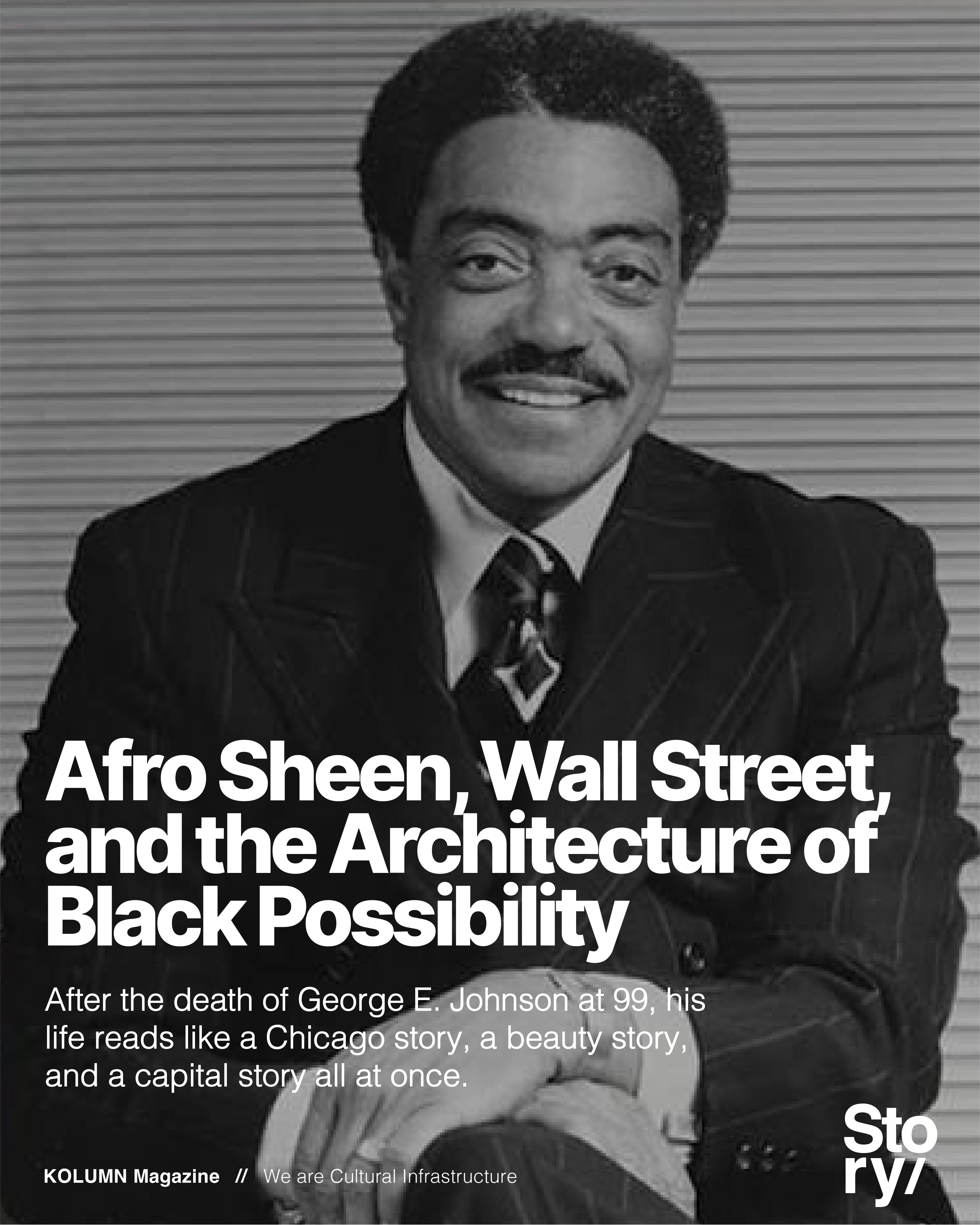
Afro Sheen, Wall Street, and the Architecture of Black Possibility
July 6, 2026
No Comments
The Fire Inside the Fourth
July 5, 2026
No Comments