




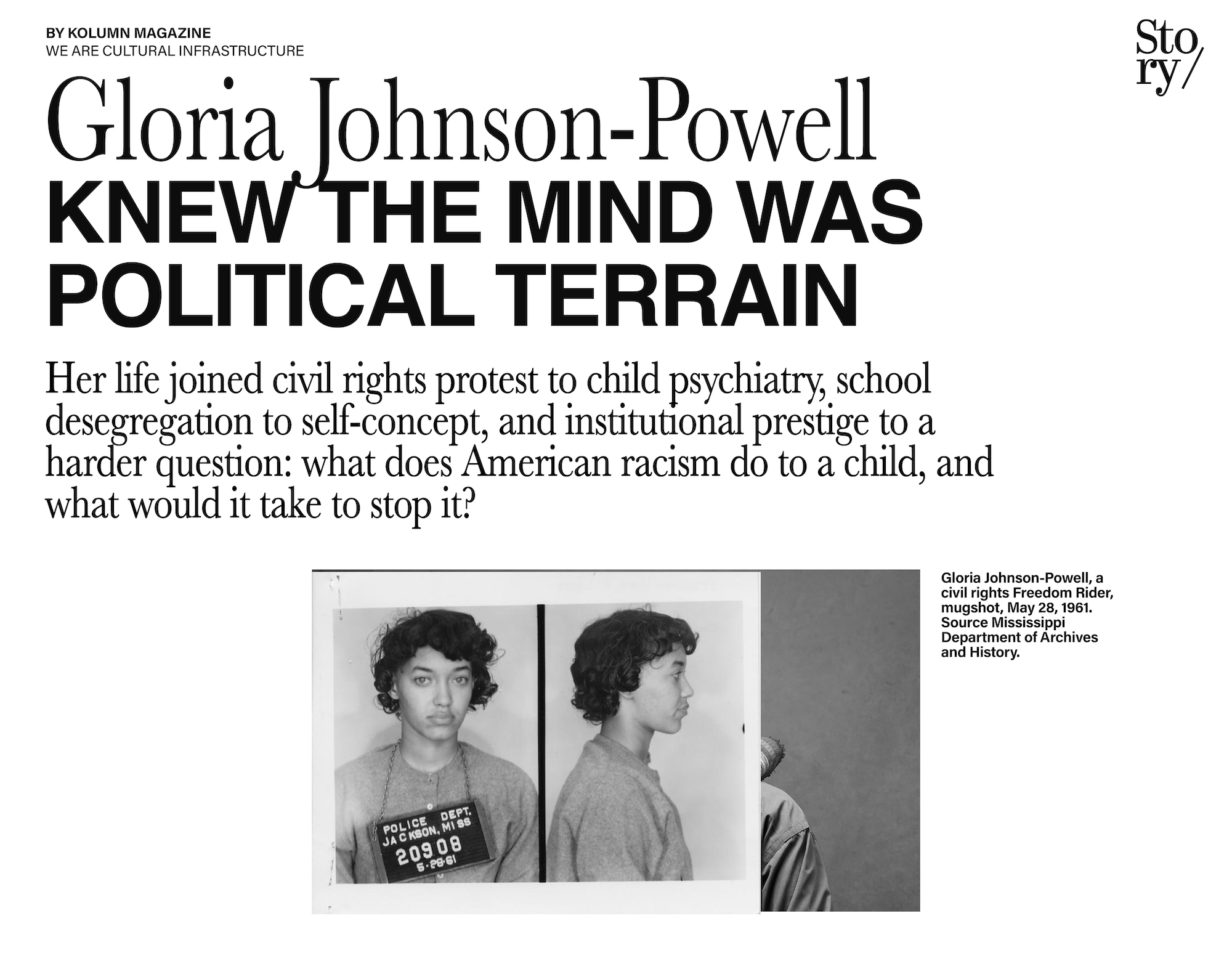
She did not go south despite the struggle. She went because of it.
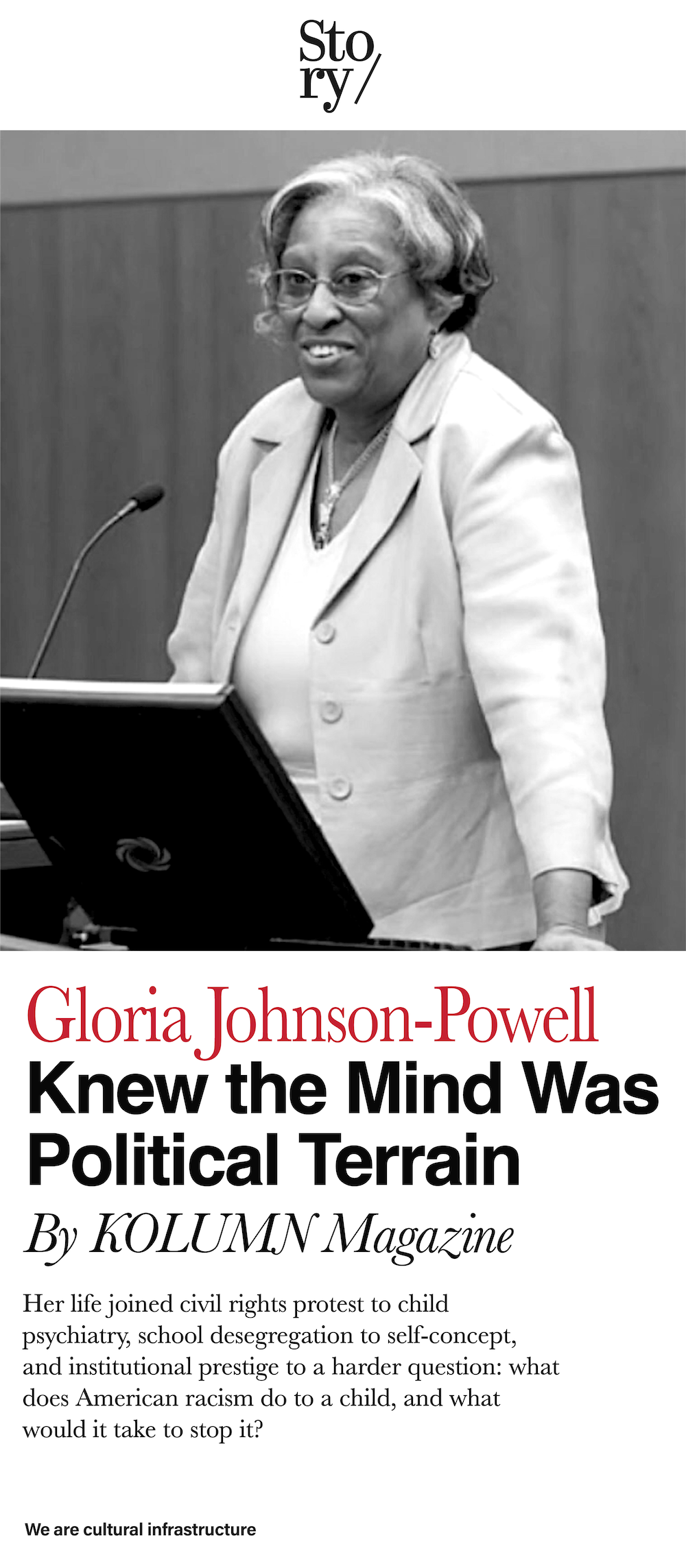
She did not go south despite the struggle. She went because of it.
By KOLUMN Magazine
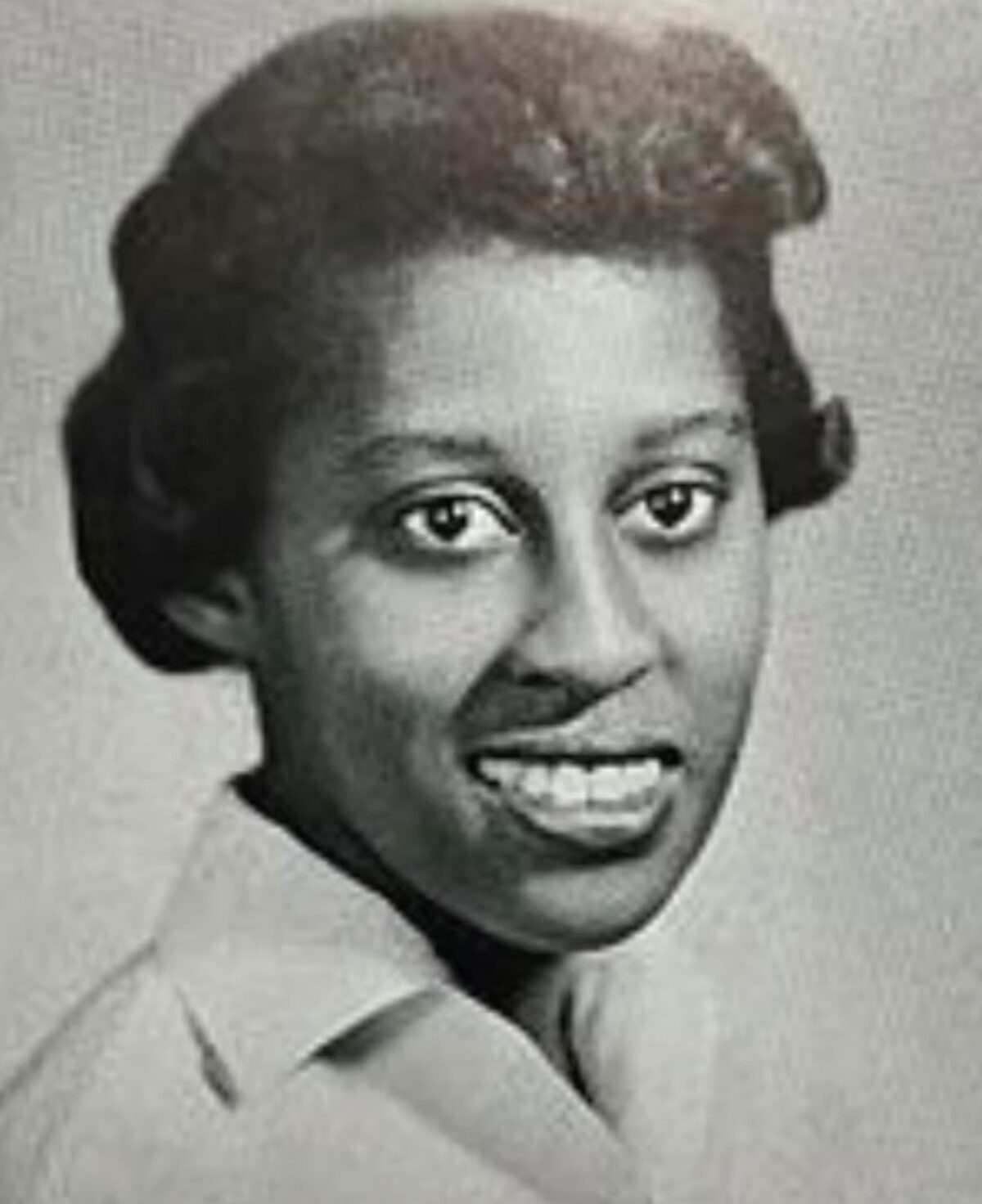
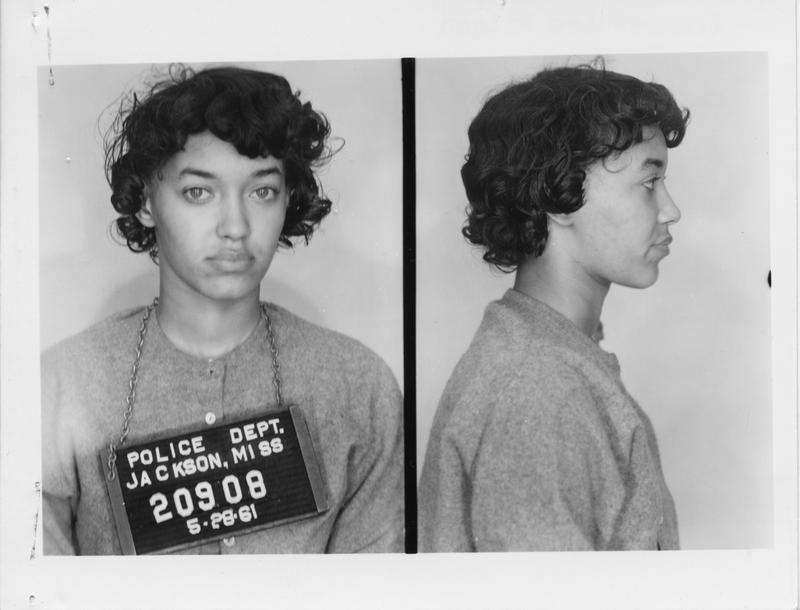
There are activists whose significance is easy to narrate because history likes a photograph. A march. A jail cell. A podium. A dog bite. A bridge. Then there are figures whose lives make that habit of memory look embarrassingly small. Gloria Johnson-Powell belongs to the second category. She was part of the Nashville movement trained in nonviolence by James Lawson. She was active in the civil rights struggle while at Meharry Medical School. She became a child psychiatrist, taught for years at UCLA, rose to Harvard Medical School as its first African American female professor and one of the first women to hold a tenured faculty post there, and later helped build cultural-diversity and minority-health initiatives at the University of Wisconsin. Across that arc, the through line was not prestige. It was a stubborn, intellectually rigorous refusal to sever medicine from power, childhood from history, or the interior life of Black children from the structures pressing on them every day.
That combination of movement history and psychiatric seriousness is precisely what makes Johnson-Powell so vital now. The civil rights movement is still often flattened into a morality tale of southern segregation overcome by heroic confrontation. Medicine, meanwhile, is too often narrated as if it advances by technical enlightenment alone. Johnson-Powell’s life demolishes both simplifications. She understood that racism was not just a legal regime or a moral stain. It was an environment. It entered the school, the clinic, the family, the self-image, the body, and the language adults used to explain children to themselves. Her career kept returning to the same basic proposition: if you disregard context, you misread the child. In one public forum, that principle was put plainly as the core of her talk: clinicians who “disregard context” do so “at your own and your patients peril.”
KOLUMN has recently shown an appetite for the kind of Black historical figure America half-remembers and badly under-explains: the parent behind a school-desegregation child, the organizer who stayed after the cameras left, the name adjacent to a headline but central to the real labor. In recent KOLUMN pieces on Ruby Bridges and Charles Sherrod, the magazine has emphasized exactly that distinction between familiar symbolism and deeper structural work. Johnson-Powell fits that editorial tradition almost uncannily well. Like Bridges, she belonged to the long afterlife of desegregation as lived experience, not just constitutional principle. Like Sherrod, she belonged to the movement’s ecosystem of builders whose importance expands when one stops confusing celebrity with consequence.
The making of a political child
Johnson-Powell did not stumble accidentally into movement life. The available record suggests something more deliberate and more revealing. A recent scholarly study of the Nashville movement notes that she grew up in Boston, participated in a local Freedom House that debated political issues, and had shown signs of intense political consciousness from childhood; by eighth grade, she had decided not to salute the flag because, as she later put it, her allegiance “belonged to the whole world.” That is not a casual biographical anecdote. It tells you something essential about the architecture of her mind. Before she was a doctor, before she was a professor, before she had institutional authority, she already possessed a skeptical and international political sensibility.
She attended Mount Holyoke, majoring in economics and sociology, at a moment when the crises of school desegregation and Black citizenship were impossible to ignore. In an interview quoted by that same Cambridge study, she explained why she chose to go south for medical school: Little Rock was in the air, social questions were pressing, and Meharry in Nashville seemed to offer a way to understand not only medicine but also the conditions under which Black people in the South had been denied care. That choice matters because it resists the comforting myth that professional success pulled her away from activism. The move into medicine was itself political. She did not go south despite the struggle. She went because of it.
At Meharry, she joined a world where student activism was not ornamental but insurgent. Vanderbilt’s account of the Nashville model places Gloria Johnson Powell among the cohort trained by James Lawson in nonviolence alongside Marion Barry, James Bevel, Bernard Lafayette, John Lewis, Diane Nash, C.T. Vivian, and others who would help transform Nashville into one of the most disciplined and consequential student movements of the era. A delegate list from the April 1960 conference that helped launch SNCC includes “Johnson, Miss Gloria L.,” placing her in the documentary stream of that movement moment. These are not merely associative facts meant to garnish her résumé with famous names. They situate her within the organizational revolution that made the student movement more militant, more decentralized, and in some respects more strategically generative than the conventional top-down story of civil rights usually allows.
There is a revealing counterfactual tucked inside the record. JBHE reports that while at Meharry she became so involved in the movement that she considered dropping out of medical school to devote herself fully to activism, and that Martin Luther King Jr. urged her to finish her studies. Whether one wants to emphasize King’s advice or her own eventual decision, the point is the same: Johnson-Powell’s medical career was not a retreat from the freedom struggle but a strategic extension of it. She would carry movement analysis into professional domains that the movement itself needed but could not always theatrically represent—schools, clinics, psychiatric theory, university policy, and the interpretive frameworks through which Black children were understood or pathologized.
Beyond the march, into the child’s mind
The dominant American habit is to treat desegregation as a court order and activism as the pressure that produces it. Johnson-Powell understood that this was only the beginning of the story. Her 1973 book Black Monday’s Children examined the effects of school desegregation on the self-concepts of Southern Black children, and later materials about her work note that she continued this line of research with children in the North. That focus was groundbreaking not because nobody knew desegregation was difficult, but because she treated the emotional and psychological consequences as central rather than incidental. Desegregation was not only about access. It was about what happened when Black children entered institutions still organized by white judgments of worth.
A 1991 Washington Post feature captured her insight in language that still lands with force. “What a person thinks about himself or herself,” Johnson-Powell said, “is largely based on what they perceive significant others think about them.” The article went on to summarize the problem starkly: when a child’s self-image is shaped by racist epithets at home, in schools, in media, and in public culture, the consequences for self-esteem are profound. This was classic Johnson-Powell territory. She was not sentimental about childhood, and she was not willing to psychologize children in isolation from the people and images around them. She grasped that the Black child in America is often forced to read herself through hostile mirrors.
What made this body of work especially important was her refusal to let formal inclusion masquerade as justice. The standard national script says that once the doors opened, progress naturally followed. Johnson-Powell’s scholarship and commentary asked a harsher question: what if admission into white institutions also meant admission into environments that transmitted inferiority, surveillance, and conditional acceptance? That line of argument feels contemporary because it is contemporary. It anticipated later conversations about belonging, stereotype threat, internalized racism, differential discipline, and the psychic tax of integration without transformation. She was writing and speaking from inside those questions long before they became fashionable vocabulary.
Her broader work on minority child development made the same intervention at a field level. A 1997 conference profile described The Psychosocial Development of Minority Group Children as the first child-psychiatry textbook to address that subject directly. That claim matters. It suggests that Johnson-Powell was not merely adding a Black chapter to an established field. She was helping redefine the field’s scope. Minority children were not niche deviations from a white normative baseline; they required frameworks attentive to culture, history, family structure, racism, and the differences between pathology and adaptation. In other words, she was asking psychiatry to stop pretending that dominant assumptions were universal science.
A Black woman at Harvard, and what that meant
It is possible to tell the Harvard chapter as triumph and leave it at that. It is also inadequate. Johnson-Powell did become Harvard Medical School’s first tenured African American woman, and multiple sources mark her as one of the first women professors tenured there. That was institutionally historic, and it deserves to be said clearly. But the more revealing part is how she herself narrated the environment. In a public forum recounting her interview with the dean, she described sensing his nervousness and wondering whether he expected confrontation over employment practices, affirmative action, and related politics. She eventually asked not a status question but a safety question—how safe Massachusetts government was—framing that concern through prior experience with coups in Africa and the Los Angeles uprisings. It is a remarkable anecdote because it condenses race, gender, prestige, and global political knowledge into one scene. She entered Harvard not as a grateful beneficiary of elite benevolence but as someone fully aware of institutions as political environments.
That consciousness matters because institutions often love to celebrate “firsts” without reckoning with the conditions under which firsts must work. The category of first Black woman, first tenured Black woman, or one of the first women in a space sounds celebratory. It is also diagnostic. It tells you how long exclusion lasted, how exceptional the admitted figure had to be, and how much representational burden she was expected to carry. Johnson-Powell knew this burden well enough to speak publicly, later, about the danger of anti-Black stereotypes being internalized even by highly educated Black professionals. In TIME in 1991, she cited a study suggesting that Black professionals in some instances held more stereotypical negative views of Black behavior than white counterparts did. Her point was devastating because it exposed racism not simply as external hostility but as a disciplinary logic capable of reproducing itself through institutions, credentials, and ambition.
This is one reason Johnson-Powell cannot be reduced to a “representation matters” story, though representation certainly mattered. She was interested in something deeper than placement. She wanted transformed interpretation. It was not enough for Black professionals to enter elite spaces if those spaces kept teaching them to read Black children through deficit, suspicion, or racial respectability politics. Her critique was pointed enough to implicate not just white systems but Black elites who had “swallow[ed] the stereotypes,” to use the line quoted in Time. That willingness to name the psychic colonization of professional life distinguishes her from easier, celebratory diversity narratives.
The clinician of context
If activism taught Johnson-Powell to read power structurally, clinical work taught her how intimate that structure could become. The summary of her 1997 public talk is among the clearest windows into her method. The central warning was that clinicians must “keep context in mind throughout their work,” and the lesson was not abstract multiculturalism of the brochure variety. It was grounded in biography, race, institutional life, and what children absorb long before they have language to defend themselves against it. She recalled suggesting to a school principal that Black history be discussed in school, only to be brushed aside. She also recounted the injury caused by a relative who praised her “genteel qualities and high aspirations” by calling her a “little white girl.” The cruelty was not merely in the phrase but in the racial equation beneath it: studiousness, aspiration, and refinement were marked as white. To be Black was to be imagined as their opposite.
That anecdote should be read as more than autobiographical pain. It illuminates the central Johnson-Powell theme that racist injury can be domestically intimate and culturally recursive. Not all violence arrives as law or slur from a stranger. Some of it arrives as a compliment twisted by hierarchy. Some of it comes disguised as aspiration. Some of it is reproduced by kin, teachers, clergy, therapists, and institutions that sincerely imagine themselves benevolent. Johnson-Powell was unusually good at tracing that kind of damage because she knew both the political and the familial registers in which Black children were formed.
The phrase “transcultural child development,” attached to one of her later works, might sound technical or even politely academic. In Johnson-Powell’s hands, it was not. It named an argument about the actual social world of children. In Wisconsin, where she later helped launch a center focused on minority women and children, she emphasized that culturally competent research and care required people to understand, value, and incorporate cultural differences while also examining their own values and beliefs. She linked that conviction partly to the period after medical school when she lived in Ethiopia and encountered a society of many distinct ethnic groups and languages, an experience that challenged her own assumptions about how to approach patients. This was not identity branding. It was epistemology. She was saying, in effect, that you do not know what you think you know about a child until you know the world from which that child arrives—and the assumptions you yourself are carrying into the room.
The long geography of her work
One of the striking things about Johnson-Powell’s career is how geographically broad it became without losing political coherence. After Meharry, she completed residency at UCLA and taught there for fifteen years. She later moved to Harvard. After Harvard came Wisconsin, where she served as associate dean for cultural diversity and professor of psychiatry and pediatrics. An obituary published through the New York Times channel also credits her with founding the Center for the Study of Cultural Diversity in Healthcare, described there as a precursor to the National Institute on Minority Health and Health Disparities. Additional institutional materials note that she taught or worked in Brazil, Ethiopia, Nigeria, South Africa, Tanzania, and Uganda. This is the kind of résumé that can look merely impressive unless one notices the pattern: throughout, she kept building intellectual and institutional language for the health consequences of racial, cultural, and social inequality.
The Wisconsin chapter is especially revealing because it makes explicit what had been implicit throughout her life. A university announcement about a new center addressing the health of minority women and children quotes Johnson-Powell saying that Wisconsin’s broad reputation as a healthy state obscured severe maternal-child disparities among disenfranchised women and their children in Milwaukee. The proposed response was broad by design: research spanning biology, environment, families, communities, behavior, and social science; training in culturally competent research; and support for younger minority scientists. This is Johnson-Powell in full view—not narrowing medicine into the clinic, not flattening disparity into behavior, and not treating race as an add-on variable after the “real” science was done.
It is also worth noting what she chose to endow and memorialize. Mount Holyoke records show that the Mary E. Johnson Fund was established by Gloria Johnson-Powell in honor of her mother to support lectures on social justice and human rights, and the college later awarded her an honorary Sc.D. in 1998. Those details are small only if one mistakes legacy for branding. In fact they say something telling about how she understood intellectual life. Honor the mother. Fund the lecture. Tie scholarship back to justice and rights. The through line from The House on Elbert Street, the biography of a welfare mother she coauthored with her daughter, to the Mount Holyoke lecture fund is not hard to see. She insisted that the moral archive of Black women’s ordinary endurance belonged inside serious intellectual culture.
Why “activist” is both right and not quite enough
Calling Gloria Johnson-Powell an activist is accurate. It is also a little too blunt. The word can imply somebody adjacent to formal expertise, somebody marching while other people theorize, research, or govern. Johnson-Powell’s life worked against that division. She was movement-trained, clinically sophisticated, academically productive, institutionally pioneering, and globally experienced. She occupied a zone where protest, interpretation, and professional authority were constantly informing one another. The better word may be “freedom worker,” though even that needs expansion to include the clinic, the classroom, the policy memo, and the textbook.
This matters for the way Black women’s intellectual labor is remembered. When Black women enter public memory through the civil rights era, they are often split into separate symbolic castes: the marcher, the mother, the teacher, the scholar, the doctor. Johnson-Powell’s life defies that partition. She was not an activist who later became a doctor in the way people say someone “moved on” from politics. Nor was she a doctor who happened to have a youthful movement chapter. Her psychiatry was political in the strongest sense: it was an inquiry into how power arranges vulnerability, self-concept, developmental risk, and the interpretation of suffering. And her activism was intellectually dense, aimed not only at protest but at changing the way institutions conceptualized Black life.
The historical tendency to shrink such a figure into a string of milestones—Freedom Rider, Harvard pioneer, scholar of minority children—does her no favors. Milestones can be a way of not thinking. Johnson-Powell’s actual significance lies in the argument her life makes when seen whole. It is the argument that the psychic life of Black children is not marginal to democracy but central to it. It is the argument that institutions cannot claim moral legitimacy while misunderstanding the communities they serve. It is the argument that culture is not decorative background but a condition of accurate knowledge. And it is the argument that integration, absent a transformation of values, can become another site of injury.
The unfinished relevance of Gloria Johnson-Powell
There is a reason Johnson-Powell feels startlingly current. The language has changed, but the terrain has not. Schools still debate whose history counts and how children learn to see themselves. Medicine still wrestles, often inadequately, with racial disparities, bias, mistrust, and the gap between nominal access and meaningful care. Universities still celebrate firsts while leaving many of the conditions that made firsts exceptional largely intact. And Black children still move through institutions that alternately sentimentalize them, criminalize them, or explain them through frameworks insufficient to the world they inhabit. Johnson-Powell’s life speaks into all of that because she refused false separations from the beginning.
Her relevance is especially sharp in an era when “diversity” is often defended in managerial language stripped of moral force. Johnson-Powell was after something more demanding than representational variety. She wanted interpretive competence, structural awareness, and accountability to the actual lives of minority children and families. That meant studying disparities, yes, but also interrogating the observers—the clinicians, teachers, researchers, and institutions who claimed authority over those disparities. In that sense, her work belongs not only to civil rights history or psychiatric history, but also to the longer Black intellectual tradition of forcing American expertise to answer for its blind spots.
And yet Johnson-Powell remains under-known beyond specialized circles. That is not because her achievements were small. It is because her kind of significance resists easy civic packaging. She did not give the nation a single scene it could endlessly replay in classrooms while ignoring the larger argument. She gave it something harder: a body of work and a public life insisting that Black freedom had to include the child’s psyche, the family’s dignity, the clinician’s self-examination, and the institution’s willingness to confront its own racial assumptions. America has always been better at praising courage than at absorbing analysis. Johnson-Powell offered both. The imbalance in memory says more about the country than about her.
The most responsible way to write about Gloria Johnson-Powell, then, is not to cast her as a side character in better-known men’s stories or a diversity landmark in elite medicine. It is to understand her as one of those Black women thinkers and builders whose lives reveal the hidden continuity between the movement and the institution, between social protest and professional knowledge, between the public crisis and the private wound. She stands in the lineage of people who knew that racism is never only an argument about laws. It is also an argument about who gets to develop whole, who gets misread, who gets called dangerous, who gets called damaged, and who gets to define the terms of care. Johnson-Powell spent her life trying to change those terms.
What her life asks of us now
The last measure of a life like this is not whether it can be admired. It is whether it can still instruct. Johnson-Powell’s instruction is uncomfortably clear. Do not confuse legal wins with psychic repair. Do not confuse presence in an institution with transformation of its values. Do not imagine that children can be treated apart from the racial and cultural worlds that shape them. Do not let expertise become a mask for inherited bias. And do not reduce Black freedom to public spectacle when the quieter work of interpretation, care, and institutional redesign may determine whether any spectacle leaves a durable trace.
For KOLUMN, her story offers exactly the kind of corrective Black historical journalism is uniquely positioned to provide. It restores texture to a life that mainstream memory has not entirely forgotten but has never adequately framed. It shows that the movement did not end when its students became professionals; in some cases, that was when they became even more dangerous to the status quo. And it reminds readers that Black women have long been producing the interpretive tools needed to understand America’s institutions—even when those institutions were slow to understand them in return.
Gloria Johnson-Powell died in Hamburg, Germany, on October 11, 2017, at 81. By then she had been, according to the record, a movement participant, a physician, a professor, an author, an award recipient, a builder of centers and curricula, a teacher across continents, and a benefactor of social-justice education. But those descriptors, while true, still feel partial. The deeper truth is that she spent a lifetime answering a question America remains reluctant to ask with sufficient honesty: what happens to children when a society teaches them, directly and indirectly, where it thinks they belong? She refused the sentimental and evasive answers. She looked where it hurt. She looked where institutions preferred not to look. And in doing so, she made both medicine and freedom struggle answer to the child.
More great stories

Afro Sheen, Wall Street, and the Architecture of Black Possibility
July 6, 2026
No Comments
The Fire Inside the Fourth
July 5, 2026
No Comments